

Spain Electric Bike Market Research Report: Forecast (2026-2032)
By Propulsion Type (Pedal Assist (Pedelec), Throttle), By Battery Type (Lithium-Ion Battery, Lead Acid Battery, Nickel-Metal Hydride Battery, Others), By Motor Power (<250W, 250W–5 ... 00W, 500W–750W, 750W), By Application (Commuter, Leisure), By Distribution Channel (Retail Offline, Specialty Bike Stores, Sporting Goods Stores, Department Stores, Others, Retail E-Commerce, Brand Websites, Third-Party Platforms), By End-User (Individual), By Motor Placement (Hub (Front/Rear), Mid-Drive), By Drive Systems (Chain Drive, Belt Drive) Read more
- Automotive
- Jul 2026
- Pages 145
- Report Format: PDF, Excel, PPT
Spain Electric Bike Market
Projected 6.81% CAGR from 2026 to 2032
Study Period
2026-2032
Market Size (2026)
USD 480.6 Million
Market Size (2032)
USD 713.0 Million
Base Year
2025
Projected CAGR
6.81%
Leading Segments
By Propulsion Type: Pedal Assist
Spain Electric Bike Market Key Takeaways
- The Spain electric bike market size in Spain was valued at USD 450.0 million in 2025 and is projected to grow from USD 480.6 million in 2026 to USD 713.0 million by 2032, expanding at a CAGR of 6.81% during 2026–2032.
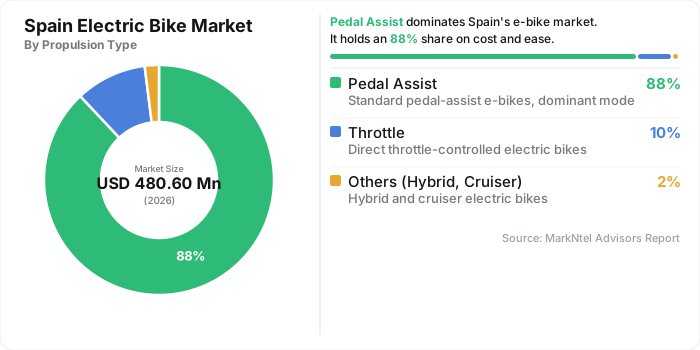
- Pedal Assist (Pedelec) is expected to dominate the market with approximately 88% share in 2026.
- Lithium-ion batteries are anticipated to account for nearly 95% of the market in 2026.
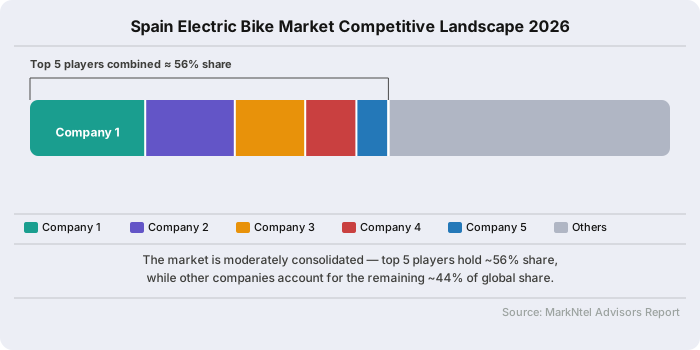
- The market remains moderately consolidated, with the top five manufacturers collectively accounting for approximately 56% market share in 2026.
Spain Electric Bike Market Size and Outlook
The electric bike market size in Spain was valued at USD 450.0 million in 2025 and is projected to grow from USD 480.6 million in 2026 to USD 713.0 million by 2032. Along with this, the market is estimated to grow at a CAGR of around 6.81% during the forecast period, i.e., 2026-32.
Spain's strongest emerging growth driver is a forthcoming national purchase subsidy. In March 2026, the Ministry of Transport and Sustainable Mobility opened a public consultation on a Royal Decree to establish direct grants for individuals and businesses buying pedal-assist electric bicycles, with comments accepted until 18 March 2026. The measure fulfils a commitment made in Royal Decree-Law 1/2025 of 28 January 2025, which had already identified purchase incentives as a lever to lower the entry barrier to e-bike ownership.
Regulatory certainty reinforces this outlook. Under Ley 5/2025, published in the Official State Gazette on 25 July 2025, pedal-assist bicycles with motor output at or below 250W and assistance cutting off before 25 km/h remain explicitly exempt from the new mandatory civil-liability insurance imposed on light personal vehicles such as e-scooters. This distinction shields conventional e-bike owners from the compliance costs now applying elsewhere in personal mobility.
Improving road-safety outcomes adds further support. The Ministry of the Interior's summer 2025 traffic balance recorded nine cyclist fatalities in July–August, seven fewer than the sixteen registered over the same period in 2024, within a vulnerable-road-user total that fell to 101 from 117. Combined with pending subsidy design and stable regulation, these trends point toward sustained, policy-anchored expansion of Spain's electric bike market through 2032.
Spain Electric Bike Market Key Indicators
- Spain's Recovery Plan has financed the construction of 1,084 km of new cycling lanes across 124 municipalities and nearly 11,000 bicycle parking spaces in 61 municipalities. Expanded cycling infrastructure improves accessibility and encourages greater adoption of electric bicycles for daily mobility.
- The Government of Spain introduced direct financial support in 2025 for local authorities operating public bicycle-sharing services under Royal Decree-Law 1/2025.
Increased investment in public bike-sharing systems expands exposure to e-bikes and supports long-term market growth. - Spain's Sustainable Mobility Law (Law 9/2025) mandates the development of a National Strategy to promote bicycle use and establish technical standards for cycling infrastructure.
A unified national framework improves cycling safety and encourages higher consumer confidence in electric bicycle adoption. - Spain allocated approximately USD 965 million under the Social Climate Plan to improve affordable and sustainable mobility, alongside USD 371 million for active mobility initiatives including cycling infrastructure. Higher public investment strengthens the ecosystem supporting electric bicycles and multimodal transportation.
- By September 2025, Spain had committed nearly USD 945 million to active mobility projects, benefiting 153 municipalities and supporting the construction of approximately 695 km of cycling infrastructure. Continuous expansion of cycling networks creates favorable conditions for sustained growth in electric bicycle ownership and usage.
- Spain classifies pedal-assist bicycles (EPACs) with a maximum continuous motor power of 250W and assistance up to 25 km/h as conventional bicycles under the General Vehicle Regulation. The absence of registration, vehicle approval, driving licence, and mandatory motor vehicle insurance requirements significantly lowers ownership barriers, encouraging higher consumer adoption of electric bicycles across commuting and recreational applications.
- Spain's expanding quick commerce and food delivery ecosystem is increasing commercial demand for electric bikes. In September 2025, Just Eat Spain operated more than 1,500 electric vehicles, including electric bicycles and electric motorcycles, while extending its partnership with Cooltra through 2026 and continuing collaborations with Zoomo and PandaGo to expand its zero-emission delivery fleet across major Spanish cities. The rapid electrification of last-mile delivery fleets is accelerating commercial purchases of electric bikes, supporting sustained demand from delivery, logistics, and shared mobility operators alongside individual consumers.
- Spain's Sustainable Mobility Law (Law 9/2025) requires the creation of digital mobility platforms and integrated Mobility-as-a-Service (MaaS) systems, while public authorities continue expanding shared mobility and public bicycle-sharing networks. In March 2025, the government also introduced direct financial support for public bicycle-sharing services to reduce user subscription costs by at least 50%. The expansion of integrated MaaS platforms and subsidized shared mobility services increases public access to electric bicycles, encourages multimodal travel behavior, and supports long-term growth in both shared and privately owned e-bike usage across Spanish cities.
Spain Electric Bike Market Scope
| Category | Segments |
|---|---|
| By Propulsion Type | Pedal Assist (Pedelec), Throttle |
| By Battery Type | Lithium-Ion Battery, Lead Acid Battery, Nickel-Metal Hydride Battery, Others |
| By Motor Power | <250W, 250W–500W, 500W–750W, 750W |
| By Application | Commuter, Leisure |
| By Distribution Channel | Retail Offline, Specialty Bike Stores, Sporting Goods Stores, Department Stores, Others, Retail E-Commerce, Brand Websites, Third-Party Platforms |
| By End-User | Individual |
| By Motor Placement | Hub (Front/Rear), Mid-Drive |
| By Drive Systems | Chain Drive, Belt Drive |
Spain Electric Bike Market Growth Drivers
Government Incentives and Cycling Infrastructure Investments Accelerate Electric Bike Adoption Across Spain
Spain's electric bike market is being primarily driven by government-backed sustainable mobility policies, financial incentives, and continuous expansion of cycling infrastructure, rather than the product innovations highlighted in recent market trends. National and regional authorities are promoting low-emission transportation through investments in dedicated cycling lanes, urban mobility projects, and purchase incentive programs under Spain's Recovery, Transformation and Resilience Plan, supported by the European Union's NextGenerationEU funding. These initiatives are improving accessibility to electric bicycles while encouraging modal shifts from private vehicles to sustainable transport. The expansion of cycling infrastructure is also increasing consumer confidence, supporting higher daily usage, and creating favorable conditions for long-term market growth.
A notable example is Spain's Ministry of Transport, Mobility and Urban Agenda (MITMA) approving funding under the Recovery, Transformation and Resilience Plan for sustainable urban mobility projects, including the development and improvement of cycling infrastructure across municipalities. Complementing these initiatives, Rivas-Vaciamadrid launched the fully electric BicinRivas bike-sharing system in June 2025, deploying 439 electric bicycles and 42 docking stations to strengthen public access to sustainable transport. These public investments continue to create a supportive ecosystem for electric bicycle adoption while stimulating demand for both privately owned and shared e-bikes across Spain.
Recent Trends
Connected E-Bikes with IoT and GPS Features Are Emerging as a Key Differentiator in Spain's Premium E-Bike Market
Spain's electric bike market is witnessing rapid adoption of IoT-enabled connectivity, GPS-based navigation, and intelligent digital ecosystems, particularly in premium commuter and electric mountain bikes. Manufacturers are increasingly integrating smartphone connectivity, remote diagnostics, ride analytics, over-the-air software updates, and anti-theft capabilities to enhance rider convenience and improve vehicle security. These digital features are becoming an important competitive differentiator as consumers seek connected mobility solutions that extend beyond conventional electric assistance. The trend is further supported by Europe's broader digital mobility transition, encouraging manufacturers to invest in software-driven innovation alongside hardware improvements.
A notable example is Orbea's launch of the new Wild LT, which features the company's RS Control System integrating ride information, electronic controls, and smart dropper functionality into a unified communication platform based on automotive-grade CAN bus architecture. The system enables seamless communication between components while simplifying battery management and improving reliability, demonstrating how Spanish manufacturers are incorporating connected technologies into next-generation electric bicycles. This development reflects the industry's transition toward intelligent, software-enabled mobility platforms.
Spain Electric Bike Market Opportunities and Challenges
Bike Theft Risk and Fragmented Registration Push Spain's Electric Bike Market Toward a Unified National Tracking System
Theft remains a persistent deterrent to daily electric bike use in Spain, a challenge compounded by the absence of a single, mandatory national registry. Municipal systems such as Terrassa's official Biciregistro, run jointly by local councils, local police, and the Directorate-General for Traffic (DGT) under the Red de Ciudades por la Bicicleta framework, remain voluntary and city-by-city, meaning ownership records and stolen-vehicle data are not consistently shared or verified across regions, leaving higher-value pedelecs particularly exposed to resale in informal secondhand channels.
This gap is driving a government-led move toward digital traceability as a market opportunity. Under the current framework, registered e-bikes receive a unique national tracking code and QR-linked identification kit, allowing local police nationwide to confirm ownership and recover stolen units regardless of where they resurface. As municipalities and the DGT work to interconnect these registries, manufacturers and retailers that proactively register and QR-tag e-bikes at point of sale stand to differentiate on security, reduce theft-related churn, and strengthen buyer confidence in Spain's higher-value pedelec segment.
Segmentation Insights
Pedal Assist (Pedelec) Captures Approximately 88% Market Share, driven by Regulatory Compliance and Expanding Urban Mobility Demand
Pedal Assist (Pedelec) is estimated to account for approximately 88% of the Spain electric bike industry in 2026, making it the dominant product type. Its leadership is primarily supported by the European Union's EN15194 framework, under which pedal-assist bicycles with a maximum continuous rated motor output of 250W and assistance up to 25 km/h are classified as conventional bicycles. This regulatory treatment eliminates registration, licensing, and insurance requirements, encouraging widespread consumer adoption. Growing investments by Spanish municipalities in cycling infrastructure, low-emission urban transport, and active mobility initiatives have further strengthened demand for pedelecs across commuter, recreational, and tourism applications, reinforcing their position as the preferred electric bicycle category.
The segment's dominance is further illustrated by Orbea's September 2025 launch of the new Wild electric mountain bike, equipped with Bosch's latest Performance Line CX pedal-assist drive system, upgraded battery integration, and enhanced off-road performance. The product launch reflects the industry's continued investment in advanced pedelec technology to meet rising consumer demand for premium electric bicycles in Spain. Increasing innovation by domestic manufacturers, combined with supportive European regulations and expanding cycling infrastructure, is expected to sustain the segment's leadership throughout the forecast period. Base d on the propulsion type, the market is further bifurcated into:
- Pedal Assist
- Throttle
- Others (Hybrid, Cruiser)
Lithium-Ion Batteries Account for Approximately 95% Market Share, Supported by Superior Performance and Rapid Technology Adoption
Lithium-ion batteries are estimated to hold approximately 95% of the Spain electric bike market in 2026, making them the leading battery technology. Their dominance is driven by superior energy density, lightweight construction, faster charging capability, longer operating life, and lower maintenance requirements compared with lead-acid and nickel-metal hydride alternatives. In addition, the implementation of the European Union Battery Regulation is accelerating the adoption of sustainable, high-performance battery technologies across the electric mobility ecosystem. As a result, manufacturers supplying the Spanish market increasingly standardize lithium-ion battery systems across commuter, trekking, urban, and electric mountain bike models to improve efficiency, range, and overall rider experience.
The market's transition toward lithium-ion technology is further supported by BH Bikes' introduction of its 2025 iLynx+ SL range, which integrates compact, high-capacity lithium-ion battery systems within lightweight carbon frames to deliver greater riding efficiency and extended travel range. Such product innovations demonstrate manufacturers' continued focus on battery optimization, weight reduction, and enhanced performance. As consumer expectations for longer range and faster charging continue to rise, lithium-ion batteries are expected to remain the preferred technology across Spain's electric bicycle market. Based on the battery type, the market is further bifurcated into:
- Lithium ion battery
- Lead acid battery
- Nickel-Metal Hydride Battery
- Others
Spain Electric Bike Market Competitive Analysis
The Spain electric bike industry is moderately consolidated, with the top five companies, Orbea, BH Bikes (Beistegui Hermanos S.A.), Specialized Spain, Giant Spain, and Trek Bicycle, collectively accounting for approximately 56% of the market in 2026. These companies maintain their competitive positions through extensive dealer and service networks, strong brand recognition, continuous product innovation, and broad portfolios spanning electric mountain, urban, trekking, and commuter bicycles.
Key Companies in the Spain Electric Bike Market
- BH Bikes (Beistegui Hermanos S.A.)
- Orbea
- Specialized Spain
- Giant Spain
- Trek Bicycle
- Cube Bikes
- Haibike (Accell Group)
- Bergamont (Scott Sports)
- Urbanbiker
- Moustache Bikes
- Other
Spain Electric Bike Industry News and Recent Developments
March 2026: Orbea Launches Carpe Urban Electric Bike Series
Spanish bicycle manufacturer Orbea unveiled the Carpe electric bike family, targeting urban commuters. The new range features a Shimano EP6 mid-drive motor, a fully integrated 420 Wh battery, optional range extender, lightweight aluminum frame, and integrated lighting. The launch expands Orbea's urban mobility portfolio and strengthens its position in Spain's premium commuter e-bike segment.
Impact Analysis: The Carpe launch reflects increasing manufacturer focus on lightweight, premium urban e-bikes as Spanish cities continue investing in sustainable mobility. The introduction is expected to strengthen competition in the commuter segment while supporting higher adoption of electric bicycles for daily transportation.
July 2026: BH Bikes Unveils Its Complete 2026 Electric Bicycle Portfolio
BH Bikes presented its 2026 electric bicycle collection to dealers through a nationwide roadshow covering Barcelona, Alicante, Málaga, Vitoria-Gasteiz, and Portugal. The portfolio includes updated electric mountain bikes, urban e-bikes, trekking models, and gravel e-bikes with improvements in motor integration, battery efficiency, and frame design.
Impact Analysis: The nationwide launch demonstrates BH Bikes' strategy to strengthen dealer engagement before commercial rollout. Early product demonstrations improve retailer preparedness, accelerate new product availability, and reinforce Spain's domestic manufacturing leadership in premium electric bicycles.
June 2025: Specialized Launches the Turbo Levo 4 Electric Mountain Bike in Spain
Specialized introduced the Turbo Levo 4 to European markets, including Spain. The new generation features the Specialized 3.1 motor, increased battery capacity, updated MasterMind display, improved frame geometry, and enhanced ride customization through the Specialized mobile application.
Impact Analysis: The launch raises competition within Spain's premium e-MTB segment by introducing higher power output and longer riding range. Advanced digital connectivity and performance upgrades are expected to accelerate innovation among premium electric bicycle manufacturers.
June 2025: Moustache Bikes Launches the 2026 J Series Urban E-Bikes
Moustache Bikes introduced its 2026 J Series electric bicycles featuring the latest Bosch Performance Line motors, improved frame integration, upgraded battery options, and enhanced urban comfort features. The range became available across European dealer networks, including Spain.
Impact Analysis: The new J Series reinforces competition within Spain's premium urban electric bicycle segment. The adoption of next-generation Bosch drive systems reflects manufacturers' increasing emphasis on rider comfort, connectivity, and extended battery range to attract urban commuters.
Frequently Asked Questions
- Market Segmentation
- Introduction
- Product Definition
- Research Process
- Assumptions
- Executive Summary
- Spain Electric Bike Market Supply Chain Analysis 2022-2032
- Spain Electric Bike Market Import & Export Data Analysis 2022-2032
- Spain Electric Bike Production (Thousand Units) Trend 2022-2032
- Spain Electric Bike Market Policies, Regulations, and Product Standards
- Spain Electric Bike Market Trends & Developments
- Spain Electric Bike Market Dynamics
- Growth Factors
- Challenges
- Spain Electric Bike Market Hotspot & Opportunities
- Spain Electric Bike Market Outlook, 2022-2032
- Market Size & Outlook
- By Revenues (USD Million)
- By Unit Sold (Thousand Units)
- Market Segmentation & Outlook
- By Propulsion Type- Market Size & Forecast 2022-2032, USD Million & Thousand Units
- Pedal Assist (Pedelec)
- Standard Pedelec
- Speed Pedelec
- Throttle
- Others (Hybrid, Cruiser, etc.)
- Pedal Assist (Pedelec)
- By Battery Type- Market Size & Forecast 2022-2032, USD Million & Thousand Units
- Lithium-Ion Battery
- Lead Acid Battery
- Nickel-Metal Hydride Battery
- Others
- By Motor Power- Market Size & Forecast 2022-2032, USD Million & Thousand Units
- <250W
- 250W–500W
- 500W–750W
- 750W
- By Application- Market Size & Forecast 2022-2032, USD Million & Thousand Units
- Commuter
- Leisure
- By Distribution Channel- Market Size & Forecast 2022-2032, USD Million & Thousand Units
- Retail Offline
- Specialty Bike Stores
- Sporting Goods Stores
- Department Stores
- Others
- Retail E-Commerce
- Brand Websites
- Third-Party Platforms
- By End-User- Market Size & Forecast 2022-2032, USD Million & Thousand Units
- Individual
- Commercial (Delivery, Rental, Sharing Fleets, etc.)
- By Motor Placement- Market Size & Forecast 2022-2032, USD Million & Thousand Units
- Hub (Front/Rear)
- Mid-Drive
- By Drive Systems- Market Size & Forecast 2022-2032, USD Million & Thousand Units
- Chain Drive
- Belt Drive
- By Company
- Competition Characteristics
- Market Share & Analysis
- By Propulsion Type- Market Size & Forecast 2022-2032, USD Million & Thousand Units
- Market Size & Outlook
- Spain Individual Electric Bike Market Outlook, 2022-2032
- Market Size & Outlook
- By Revenues (USD Million)
- By Unit Sold (Thousand Units)
- Market Segmentation & Outlook
- By Battery Type- Market Size & Forecast 2022-2032, USD Million & Thousand Units
- By Motor Power- Market Size & Forecast 2022-2032, USD Million & Thousand Units
- By Application- Market Size & Forecast 2022-2032, USD Million & Thousand Units
- By Distribution Channel- Market Size & Forecast 2022-2032, USD Million & Thousand Units
- By End-User- Market Size & Forecast 2022-2032, USD Million & Thousand Units
- By Motor Placement- Market Size & Forecast 2022-2032, USD Million & Thousand Units
- By Drive Systems- Market Size & Forecast 2022-2032, USD Million & Thousand Units
- Market Size & Outlook
- Spain Commercial Electric Bike Market Outlook, 2022-2032
- Market Size & Outlook
- By Revenues (USD Million)
- By Unit Sold (Thousand Units)
- Market Segmentation & Outlook
- By Battery Type- Market Size & Forecast 2022-2032, USD Million & Thousand Units
- By Motor Power- Market Size & Forecast 2022-2032, USD Million & Thousand Units
- By Application- Market Size & Forecast 2022-2032, USD Million & Thousand Units
- By Distribution Channel- Market Size & Forecast 2022-2032, USD Million & Thousand Units
- By End-User- Market Size & Forecast 2022-2032, USD Million & Thousand Units
- By Motor Placement- Market Size & Forecast 2022-2032, USD Million & Thousand Units
- By Drive Systems- Market Size & Forecast 2022-2032, USD Million & Thousand Units
- Market Size & Outlook
- Spain Electric Bike Market Key Strategic Imperatives for Success & Growth
- Competitive Outlook
- Company Profiles
- BH Bikes (Beistegui Hermanos S.A.)
- Business Description
- Product Portfolio
- Collaborations & Alliances
- Recent Developments
- Financial Details
- Others
- Orbea
- Business Description
- Product Portfolio
- Collaborations & Alliances
- Recent Developments
- Financial Details
- Others
- Specialized Spain
- Business Description
- Product Portfolio
- Collaborations & Alliances
- Recent Developments
- Financial Details
- Others
- Giant Spain
- Business Description
- Product Portfolio
- Collaborations & Alliances
- Recent Developments
- Financial Details
- Others
- Trek Bicycle
- Business Description
- Product Portfolio
- Collaborations & Alliances
- Recent Developments
- Financial Details
- Others
- Cube Bikes
- Business Description
- Product Portfolio
- Collaborations & Alliances
- Recent Developments
- Financial Details
- Others
- Haibike (Accell Group)
- Business Description
- Product Portfolio
- Collaborations & Alliances
- Recent Developments
- Financial Details
- Others
- Bergamont (Scott Sports)
- Business Description
- Product Portfolio
- Collaborations & Alliances
- Recent Developments
- Financial Details
- Others
- Urbanbiker
- Business Description
- Product Portfolio
- Collaborations & Alliances
- Recent Developments
- Financial Details
- Others
- Moustache Bikes
- Business Description
- Product Portfolio
- Collaborations & Alliances
- Recent Developments
- Financial Details
- Others
- Others
- BH Bikes (Beistegui Hermanos S.A.)
- Company Profiles
- Disclaimer
MarkNtel Advisors follows a robust and iterative research methodology designed to ensure maximum accuracy and minimize deviation in market estimates and forecasts. Our approach combines both bottom-up and top-down techniques to effectively segment and quantify various aspects of the market. A consistent feature across all our research reports is data triangulation, which examines the market from three distinct perspectives to validate findings. Key components of our research process include:
1. Scope & Research Design At the outset, MarkNtel Advisors define the research objectives and formulate pertinent questions. This phase involves determining the type of research—qualitative or quantitative—and designing a methodology that outlines data collection methods, target demographics, and analytical tools. They also establish timelines and budgets to ensure the research aligns with client goals.
2. Sample Selection and Data Collection In this stage, the firm identifies the target audience and determines the appropriate sample size to ensure representativeness. They employ various sampling methods, such as random or stratified sampling, based on the research objectives. Data collection is carried out using tools like surveys, interviews, and observations, ensuring the gathered data is reliable and relevant.
3. Data Analysis and Validation Once data is collected, MarkNtel Advisors undertake a rigorous analysis process. This includes cleaning the data to remove inconsistencies, employing statistical software for quantitative analysis, and thematic analysis for qualitative data. Validation steps are taken to ensure the accuracy and reliability of the findings, minimizing biases and errors.

4. Data Forecast and FinalizationThe final phase involves forecasting future market trends based on the analyzed data. MarkNtel Advisors utilize predictive modeling and time series analysis to anticipate market behaviors. The insights are then compiled into comprehensive reports, featuring visual aids like charts and graphs, and include strategic recommendations to inform client decision-making
We offer flexible licensing options to cater to varying organizational needs. Choose the pricing pack that best suits your requirements:
Buy Now Inquire Before Buying
 Request Customization
 Talk to our Consultant







