

Australia E-Bike Market Research Report: Forecast (2025-2030)
Australia E-Bike Market Size- By Product Type (Pedal Assist (Pedelec), Throttle Control (Non-Pedelec), Speed Pedelec), By Battery Type (Lithium-Ion Batteries, Nickel Hydride Ba ... ttery, Lead-acid Battery, Others), By Price Range (Below USD2,000, Between USD2,000-USD4,000, Above USD4,000), By Distribution Channel (Online Retail, Specialty Stores, Supermarkets/Hypermarkets, Others), By End-User (Personal Use, Commercial, Government Sector, Rental Service Providers, Others (Off-Road, Trekking, etc.)), By Region (Southeast, South, Northeast, North, Central-West), and others Read more
- Automotive
- Jul 2025
- Pages 122
- Report Format: PDF, Excel, PPT
Market Insights & Analysis: Australia E-Bike Market (2025-30):
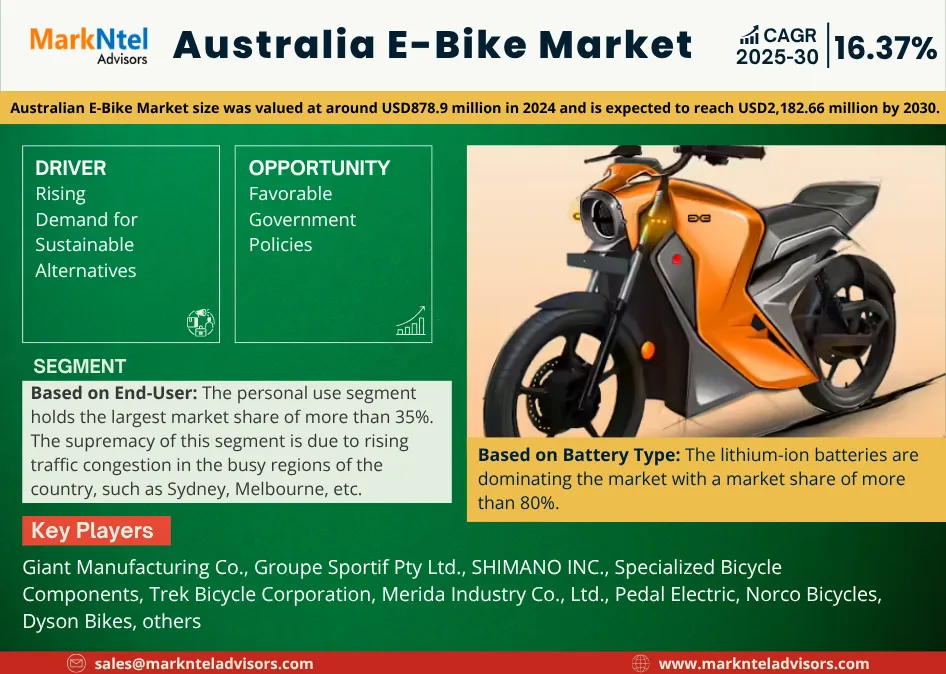
The Australian E-Bike Market size was valued at around USD878.9 million in 2024 and is expected to reach USD2,182.66 million by 2030. Along with this, the market is estimated to grow at a CAGR of around 16.37% during the forecast period, i.e., 2025-30. The market growth is driven by several factors, including rising environmental concerns, increasing demand for sustainable practices, the adoption of green transportation to reduce carbon emissions, active government support, and the incorporation of smart features. One of the major growth factors is the increasing health consciousness of Australians, who prefer e-bikes for daily commuting activities.
Additionally, the Australian government is actively promoting the adoption of cleaner transport by drafting various policies and initiatives such as the E-Micro Mobility Action Plan, the NSW Rebate Scheme, the ACT Shared E-Bike and E-Scooter Program, etc. Similarly, the government is providing subsidies and rebates to manufacturers and customers to increase the potential market growth. And, the heavy investments through the Australian government in the infrastructural development of the roads and cycle pathways are creating ample growth opportunities for the Australia E-Bike Market.
| Report Coverage | Details |
|---|---|
| Historical Years | 2020–23 |
| Forecast Years | 2025–30 |
| Market Value in 2024 | USD 878.9 million |
| Market Value by 2030 | USD 2,182.66 million |
| CAGR (2025–30) | 16.37% |
| Top Key Players | Giant Manufacturing Co., Groupe Sportif Pty Ltd., SHIMANO INC., Specialized Bicycle Components, Trek Bicycle Corporation, Merida Industry Co., Ltd., Pedal Electric, Norco Bicycles, Dyson Bikes, others |
| Segmentation | By Product Type (Pedal Assist (Pedelec), Throttle Control (Non-Pedelec), Speed Pedelec), By Battery Type (Lithium-Ion Batteries, Nickel Hydride Battery, Lead-acid Battery, Others), By Price Range (Below USD2,000, Between USD2,000-USD4,000, Above USD4,000), By Distribution Channel (Online Retail, Specialty Stores, Supermarkets/Hypermarkets, Others), By End-User (Personal Use, Commercial, Government Sector, Rental Service Providers, Others (Off-Road, Trekking, etc.)), By Region (Southeast, South, Northeast, North, Central-West), and others |
| Key Report Highlights |
|
*Boost strategic growth with in-depth market analysis - Get a free sample preview today!
Furthermore, the lithium-ion batteries are being incorporated significantly in the E-bikes, which provides high-energy density, low-maintenance, and longer lifespan as compared to other types of batteries, such as nickel-metal hydride batteries, etc. Moreover, the market is gaining popularity due to the adoption of technologically advanced features such as GPS tracker systems, mobile connectivity features, OLED touchscreens, smart locks, etc., to increase their efficiency, automation, and customer experience. These innovations are actively shaping the market’s growth. However, the high upfront costs due to additional import prices and expensive batteries are hampering the market growth. Also, the market is facing a lower presence of manufacturing units for E-bikes in Australia and a high dependence on imports for these.
Australia E-Bike Market Driver:
Rising Demand for Sustainable Alternatives – The growth is driven by the rising environmental concerns regarding environmental health due to the emissions of harmful substances directly into the environment. Transportation is the leading sector to pollute the environment by releasing significant amounts of particulate matter, carbon dioxide, sulfur, and nitrogenous wastes. This waste results in environmental pollution, including air pollution.
Around 40% of the air pollution is caused by the transportation sector in Australia, which needs to be reduced, as, consequently, the cases of respiratory disorders have increased in the country. This led to a higher demand for green transportation, including electric vehicles such as E-Bikes. Therefore, the E-Bike manufacturing and importing have increased in the country. For instance, in 2024, over 2,60,000 E-bikes were imported in Australia from countries like Japan, China, Vietnam, etc. Additionally, in Australia, unlike other electric vehicles, there is no requirement for licensing, registration, or insurance for E-Bikes below 250W motor power. Thus, customers are highly preferring E-Bikes in Australia.
Australia E-Bike Market Opportunity:
Favorable Government Policies – The Australian government is actively promoting E-Bikes in the country through significant investments by drafting various incentives and policies related to the adoption of electric vehicles, such as E-Bikes, and to promote carbon reduction alternatives. These policies are providing rebates and subsidies on electric bikes in the country. For instance, the Queensland government (2024) launched a rebate program with significant funds of over USD650,000 to encourage the adoption of eco-friendly e-bikes. Similarly, the NSW (New South Wales) (2025-26) provides a rebate of USD1,200 per E-Bike, increasing potential market growth by encouraging and attracting customers for E-Bikes in the country.
Additionally, the government is heavily investing in infrastructural development to improve connectivity. For instance, the Sydney government allocated around USD25 million to upgrade the Harbour Bridge Cycling Ramp for the expansion of the cycleways. These efforts are contributing to the potential market growth.
Australia E-Bike Market Challenge:
High Upfront Costs & Fewer Production Facilities Hindering Market Growth – The market is facing a high upfront cost challenge, which is resulting in decreasing demand for electric vehicles, including E-Bikes in Australia. The batteries used in these bikes are highly expensive, and this adds to the final cost of the vehicles. For example, a single battery replacement in an E-Bike can cost about 40% of the total value of the E-Bike. Therefore, the E-bikes are costlier than the traditional types of bikes and can exceed up to USD9,750.
Additionally, the lack of manufacturing industries is leading to high retail prices, as the country is largely dependent on imported E-bikes from neighboring countries like Taiwan, Japan, Germany, China, etc. Importing activities increases various duty taxes, thus increasing the final price of products, including E-Bikes. These factors are hampering the market’s growth.
Australia E-Bike Market Trend:
Increasing Demand for Smart Features in E-Bikes – The market is gaining traction due to the incorporation of smart features in E-Bikes, which have increased their efficiency and customer experience. These bikes are now highly automated with digital screens, advanced GPS trackers, smart locking systems, mobile connectivity options, and many more. Additionally, one of the major reasons to integrate smart locking systems is the rising E-Bike theft in the country.
Several companies, such as Tiller Rides Ltd., Van Moof, etc., are providing these advanced features in E-Bikes to increase their efficiency. For instance, in 2024, DJI Amflow launched an electric mountain bike with an advanced system called the Avinox Drive System, with a 2-inch OLED touchscreen that can connect with the Avinox mobile application for anti-theft alerts, to customize assist levels, and GPS tracking. These innovations are actively uplifting the Australian E-Bike Market.
Australia E-Bike Market (2025-30): Segmentation Analysis
The Australia E-Bike Market study of MarkNtel Advisors evaluates & highlights the major trends and influencing factors in each segment. It includes predictions for the period 2025–2030 at the national level. Based on the analysis, the market has been further classified as:
Based on End-User:
- Personal Use
- Commercial
- Government Sector
- Rental Service Providers
- Others (Off-Road, Trekking, etc.)
Out of these, the personal use segment holds the largest market share of more than 35%. The supremacy of this segment is due to rising traffic congestion in the busy regions of the country, such as Sydney, Melbourne, etc. It has increased the demand for easier, faster, and sustainable alternatives for travelling, thus Australian citizens are highly preferring the E-Bikes for their daily commuting. As per the Infrastructure Department of Australia, congestion costs exceed USD13 billion annually, which is expected to rise continuously in the country. This leads to high encouragement for increasing commuter E-bikers in the country for their personal use to save time and costs. This shows that the E-bikes are mainly being utilized for personal use in Australia. Also, many Australians are more health-conscious and prefer commuting in ways that allow some physical activity, contributing to the dominance of the personal use segment in this market.
Based on Battery Type:
- Lithium-Ion Battery
- Nickel-Hydride Battery
- Lead-Acid Battery
- Others
Among these, the lithium-ion batteries are dominating the market with a market share of more than 80%. The dominance is due to the production of high-energy density, low-maintenance, and longer lifespan as compared to other types of batteries, such as nickel-metal hydride batteries etc. Companies are actively integrating lithium-ion batteries in E-bikes due to their benefits. However, the manufacturing industries for lithium-ion batteries are fewer in the country, yet the assemblers and local distributors such as BYD, Tesla, MANLY Battery, etc. for lithium-ion batteries are rapidly increasing in the country.
Also, the government is supporting the lithium-ion battery production in the country by significant investments in the expansion of local manufacturing facilities under some initiatives called the National Battery Strategy, Battery Breakthrough Program, etc. These factors are contributing to the dominance of this segment in the Australia E-Bike Market.
Australia E-Bike Industry Recent Development:
- 2025: Giant Manufacturing Co. continues to focus on product innovation, particularly in lightweight frame materials and smart technology integration. Their latest E-Bike models feature advanced battery systems and app-based connectivity, enhancing both range and rider experience.
- 2025: Trek Bicycle Corporation introduced the latest e-bikes, emphasizing ultra-lightweight design and modular battery systems, making them easier to carry and maintain. Trek has also expanded its local dealer network in Australia.
Gain a Competitive Edge with Our Market Report
- Australia E-Bike Market Report by MarkNtel Advisors provides a detailed & thorough analysis of market size & share, growth rate, competitive landscape, and key players. This comprehensive analysis helps businesses gain a holistic understanding of the market dynamics & make informed decisions.
- This report also highlights current market trends & future projections, allowing businesses to identify emerging opportunities & potential challenges. By understanding market forecasts, companies can align their strategies & stay ahead of the competition.
- Australia E-Bike Market Report aids in assessing & mitigating risks associated with entering or operating in the market. By understanding market dynamics, regulatory frameworks, and potential challenges, businesses can develop strategies to minimize risks & optimize their operations.
*Reports Delivery Format - Market research studies from MarkNtel Advisors are offered in PDF, Excel and PowerPoint formats. Within 24 hours of the payment being successfully received, the report will be sent to your email address.
Frequently Asked Questions
- Market Segmentation
- Introduction
- Product Definition
- Research Process
- Assumptions
- Executive Summary
- Australia E-Bike Market Policies, Regulations, and Product Standards
- Australia E-Bike Market Supply Chain Analysis
- Australia E-Bike Market Trends & Developments
- Australia E-Bike Market Dynamics
- Growth Drivers
- Challenges
- Australia E-Bike Market Hotspot & Opportunities
- Australia E-Bike Market Outlook, 2025-2030
- Market Size & Outlook
- By Revenues (USD Million)
- By Volume (Million Units)
- Market Share & Outlook
- By Product Type
- Pedal Assist (Pedelec) – Market Size & Forecast 2025–2030, USD Million
- Throttle Control (Non-Pedelec)– Market Size & Forecast 2025–2030, USD Million
- Speed Pedelec – Market Size & Forecast 2025–2030, USD Million
- By Battery Type
- Lithium-Ion Batteries– Market Size & Forecast 2025–2030, USD Million
- Removable Lithium-Ion Battery– Market Size & Forecast 2025–2030, USD Million
- Integrated Lithium-Ion Battery– Market Size & Forecast 2025–2030, USD Million
- Dual Lithium-Ion Battery– Market Size & Forecast 2025–2030, USD Million
- Nickel Hydride Battery- Market Size & Forecast 2025–2030, USD Million
- Lead-acid Battery- Market Size & Forecast 2025–2030, USD Million
- Others- Market Size & Forecast 2025–2030, USD Million
- Lithium-Ion Batteries– Market Size & Forecast 2025–2030, USD Million
- By Price Range
- Below USD2,000– Market Size & Forecast 2025–2030, USD Million
- Between USD2,000-USD4,000– Market Size & Forecast 2025–2030, USD Million
- Above USD4,000– Market Size & Forecast 2025–2030, USD Million
- By Distribution Channel
- Online Retail – Market Size & Forecast 2025–2030, USD Million
- Specialty Stores – Market Size & Forecast 2025–2030, USD Million
- Supermarkets/Hypermarkets – Market Size & Forecast 2025–2030, USD Million
- Others – Market Size & Forecast 2025–2030, USD Million
- By End-User
- Personal Use– Market Size & Forecast 2025–2030, USD Million
- Commercial – Market Size & Forecast 2025–2030, USD Million
- Cargo E-Bikes– Market Size & Forecast 2025–2030, USD Million
- Utility E-Bikes– Market Size & Forecast 2025–2030, USD Million
- Government Sector– Market Size & Forecast 2025–2030, USD Million
- Rental Service Providers– Market Size & Forecast 2025–2030, USD Million
- Others (Off-Road, Trekking, etc.)– Market Size & Forecast 2025–2030, USD Million
- By Region
- Southeast
- South
- Northeast
- North
- Central-West
- By Product Type
- Market Size & Outlook
- Australia E-Bike Pedelec Market Outlook, 2025-2030
- Market Size & Outlook
- By Revenues (USD Million)
- By Volume (Million Units)
- Market Share & Outlook
- By Product Type – Market Size & Forecast 2025–2030, USD Million
- By Battery Type– Market Size & Forecast 2025–2030, USD Million
- By Price Range – Market Size & Forecast 2025–2030, USD Million
- By Distribution Channel– Market Size & Forecast 2025–2030, USD Million
- By End-User– Market Size & Forecast 2025–2030, USD Million
- Market Size & Outlook
- Australia E-Bike Non-Pedelec Market Outlook, 2025-2030
- Market Size & Outlook
- By Revenues (USD Million)
- By Volume (Million Units)
- Market Share & Outlook
- By Product Type – Market Size & Forecast 2025–2030, USD Million
- By Battery Type– Market Size & Forecast 2025–2030, USD Million
- By Price Range – Market Size & Forecast 2025–2030, USD Million
- By Distribution Channel– Market Size & Forecast 2025–2030, USD Million
- By End-User– Market Size & Forecast 2025–2030, USD Million
- Market Size & Outlook
- Australia E-Bike Speed Pedelec Market Outlook, 2025-2030
- Market Size & Outlook
- By Revenues (USD Million)
- By Volume (Million Units)
- Market Share & Outlook
- By Product Type – Market Size & Forecast 2025–2030, USD Million
- By Battery Type– Market Size & Forecast 2025–2030, USD Million
- By Price Range – Market Size & Forecast 2025–2030, USD Million
- By Distribution Channel– Market Size & Forecast 2025–2030, USD Million
- By End-User– Market Size & Forecast 2025–2030, USD Million
- Market Size & Outlook
- Australia E-Bike Market Key Strategic Imperatives for Success & Growth
- Competition Outlook
- Company Profiles
- Giant Manufacturing Co.
- Business Description
- Product Portfolio
- Strategic Alliances or Partnerships
- Recent Developments
- Financial Details
- Others
- Groupe Sportif Pty Ltd.
- Business Description
- Product Portfolio
- Strategic Alliances or Partnerships
- Recent Developments
- Financial Details
- Others
- SHIMANO INC.
- Business Description
- Product Portfolio
- Strategic Alliances or Partnerships
- Recent Developments
- Financial Details
- Others
- Specialized Bicycle Components
- Business Description
- Product Portfolio
- Strategic Alliances or Partnerships
- Recent Developments
- Financial Details
- Others
- Trek Bicycle Corporation
- Business Description
- Product Portfolio
- Strategic Alliances or Partnerships
- Recent Developments
- Financial Details
- Others
- Merida Industry Co., Ltd.
- Business Description
- Product Portfolio
- Strategic Alliances or Partnerships
- Recent Developments
- Financial Details
- Others
- Pedal Electric
- Business Description
- Product Portfolio
- Strategic Alliances or Partnerships
- Recent Developments
- Financial Details
- Others
- Norco Bicycles
- Business Description
- Product Portfolio
- Strategic Alliances or Partnerships
- Recent Developments
- Financial Details
- Others
- Dyson Bikes
- Business Description
- Product Portfolio
- Strategic Alliances or Partnerships
- Recent Developments
- Financial Details
- Others
- Others
- Giant Manufacturing Co.
- Company Profiles
- Disclaimer
MarkNtel Advisors follows a robust and iterative research methodology designed to ensure maximum accuracy and minimize deviation in market estimates and forecasts. Our approach combines both bottom-up and top-down techniques to effectively segment and quantify various aspects of the market. A consistent feature across all our research reports is data triangulation, which examines the market from three distinct perspectives to validate findings. Key components of our research process include:
1. Scope & Research Design At the outset, MarkNtel Advisors define the research objectives and formulate pertinent questions. This phase involves determining the type of research—qualitative or quantitative—and designing a methodology that outlines data collection methods, target demographics, and analytical tools. They also establish timelines and budgets to ensure the research aligns with client goals.
2. Sample Selection and Data Collection In this stage, the firm identifies the target audience and determines the appropriate sample size to ensure representativeness. They employ various sampling methods, such as random or stratified sampling, based on the research objectives. Data collection is carried out using tools like surveys, interviews, and observations, ensuring the gathered data is reliable and relevant.
3. Data Analysis and Validation Once data is collected, MarkNtel Advisors undertake a rigorous analysis process. This includes cleaning the data to remove inconsistencies, employing statistical software for quantitative analysis, and thematic analysis for qualitative data. Validation steps are taken to ensure the accuracy and reliability of the findings, minimizing biases and errors.

4. Data Forecast and FinalizationThe final phase involves forecasting future market trends based on the analyzed data. MarkNtel Advisors utilize predictive modeling and time series analysis to anticipate market behaviors. The insights are then compiled into comprehensive reports, featuring visual aids like charts and graphs, and include strategic recommendations to inform client decision-making
We offer flexible licensing options to cater to varying organizational needs. Choose the pricing pack that best suits your requirements:
Buy Now Inquire Before Buying
 Request Customization
 Talk to our Consultant







