India Electric Vehicle Market Research Report Forecast: (2026-2032)
By Vehicle Type (Passenger Cars, Commercial Vehicles, Medium & Heavy Commercial Vehicles, Two Wheelers, Three Wheelers), By Propulsion Type (Battery Electric Vehicle (BEV), Hybrid ... Electric Vehicle (HEV), Plug-in hybrid electric vehicles, Fuel-cell electric vehicles), By Charging Type (AC Charging, DC Fast Charging, Wireless Charging), By Range (Less than 200 km, 200–400 km, Above 400 km), By End User (Personal Use, Commercial/Fleet Operators, Public Transportation), By Battery Type (Lithium-Ion Battery, Lithium Iron Phosphate (LFP), Nickel Manganese Cobalt (NMC), Solid-State Battery, Nickel Metal Hydride (NiMH)), and others Read more
- Automotive
- Aug 2026
- Pages 144
- Report Format: PDF, Excel, PPT
India Electric Vehicle Market
Projected 19.31% CAGR from 2026 to 2032
Study Period
2026-2032
Market Size (2026)
USD 4.26 Billion
Market Size (2032)
USD 12.29 Billion
Base Year
2025
Projected CAGR
19.31%
Leading Segments
By Vehicle Type: Two -wheelers
India Electric Vehicle Market Key Takeaways
- The India electric vehicle market reached USD 3.78 billion in 2025, rising to USD 4.26 billion in 2026 and USD 12.29 billion by 2032, with 19.31% CAGR during forecast period i.e., 2026-32.
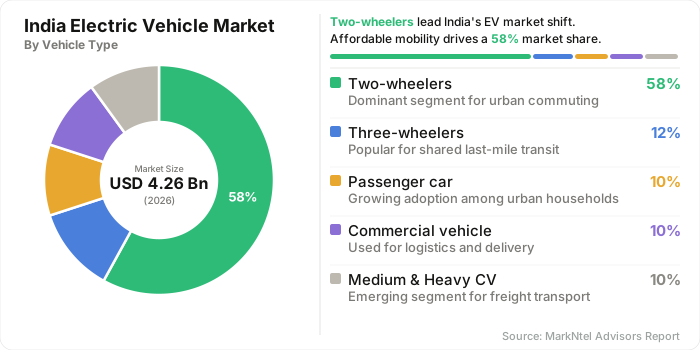
- Two-wheelers held an estimated 58% market share in 2026.
- Battery Electric Vehicles held an estimated 88% share by propulsion type in 2026.
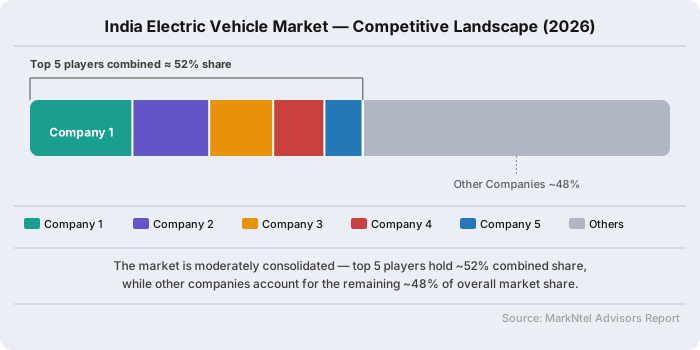
- The market remained moderately consolidated in 2026, with top five players collectively holding 52% overall share.
India Electric Vehicle Market Size and Outlook
The electric vehicle market in India was valued at USD 3.78 billion in 2025 and is projected to increase to USD 4.26 billion in 2026, reaching USD 12.29 billion by 2032, registering a CAGR of 19.31% during 2026–2032. This growth reflects India's transition toward mainstream EV adoption. According to Vahan Portal data, EV sales reached 2.3 million units in 2025, representing 8% of new vehicle registrations. Electric two-wheelers led with 1.28 million units (57%), followed by electric three-wheelers at 8 lakh units (35%). Uttar Pradesh accounted for over 0.4 million units (18%), highlighting strong state-level adoption.
India Electric Vehicle Market Key Indicators
- The Ministry of Heavy Industries has approved 72,300 public EV charging stations under the PM E-DRIVE Scheme .A nationwide charging network reduces range anxiety, improves charging accessibility, and significantly accelerates EV adoption across vehicle segments.
- Under the PLI Scheme for Automobile & Auto Components, 85 companies have committed investments exceeding USD 8.1 billion Large-scale investments strengthen domestic EV manufacturing, component localization, and technological innovation, expanding India's electric mobility ecosystem.
- The Government has awarded 50 GWh of Advanced Chemistry Cell (ACC) battery manufacturing capacity under the PLI Scheme. Domestic battery-cell production lowers import dependence, improves supply-chain resilience, and supports cost-effective electric vehicle manufacturing.
- Under the PM E-DRIVE Scheme, the Government has approved deployment of 14,028 electric buses across major Indian cities. Large-scale public transport electrification stimulates demand for electric buses, charging infrastructure, battery manufacturing, and associated component industries.
- India generated 64 TWh of renewable electricity during FY 2024–25, according to the Ministry of New and Renewable Energy. Growing renewable power generation enhances the sustainability of EV charging and supports India's long-term transition toward low-carbon transportation.
India EV Infrastructure Readiness: 52,718 Public Charging Stations and 16,561 Fast-Charging Stations Strengthen Nationwide Adoption
Rapid expansion of public charging infrastructure: India had 52,718 public EV charging stations as of July 2026, including 16,561 stations equipped with fast chargers for cars. This represents a substantial expansion from 29,277 public charging stations in August 2025, indicating that the public charging network grew by approximately 80% in less than one year.
Fast-charging capacity is becoming increasingly important: Fast chargers represented approximately 31% of India's public charging stations by July 2026. The availability of 16,561 fast-charging locations improves the feasibility of intercity EV travel and addresses one of the principal barriers to passenger-EV adoption—long charging times.
Government investment is creating the next infrastructure layer: The PM E-DRIVE Scheme has allocated USD 230 million specifically for public EV charging infrastructure, including charging stations, battery-swapping stations, and battery-charging stations. The scheme targets deployment across cities and highways, while its implementation framework provides subsidies of up to 100% for both upstream infrastructure and EVSE at eligible government locations and up to 80% for upstream infrastructure at other locations.
Large-scale charging pipeline: PM E-DRIVE is designed to support approximately 72,000 public charging stations, creating capacity for the next phase of EV penetration rather than merely addressing existing demand. The planned network prioritizes 50 national highway corridors, metro cities, toll plazas, railway stations, airports, fuel outlets, and state highways.
Battery swapping is emerging as a complementary infrastructure model: India's 2025 charging-infrastructure guidelines explicitly incorporate battery swapping and battery-charging stations into the national framework. The model is particularly relevant to high-utilization electric two- and three-wheelers, last-mile delivery, and commercial fleets, where charging downtime directly affects vehicle utilization. In March 2026, the Government supported commercialization of an automated swapping system capable of completing a battery exchange in under 40 seconds, demonstrating the potential for rapid-energy replenishment infrastructure.
Infrastructure deployment is increasingly aligned with EV adoption: FAME-II had already supported 1.43 million electric two-wheelers, 165,029 electric three-wheelers, and 22,644 electric four-wheelers by June 2025, while PM E-DRIVE was designed to support more than 2.8 million EVs. The simultaneous expansion of vehicle incentives and charging infrastructure indicates that India is building both EV demand and energy-replenishment capacity rather than relying on one-sided adoption.
Overall infrastructure readiness: India's charging ecosystem has moved beyond the early-stage pilot phase, with 52,718 public stations and 16,561 fast-charging locations providing a substantially stronger foundation for EV adoption. However, infrastructure remains unevenly distributed across states and cities, and the gap between installed infrastructure and the government's 72,000-station PM E-DRIVE target indicates considerable room for further deployment. Therefore, India can be characterized as having rapidly improving but not yet fully mature EV infrastructure, with fast charging and battery swapping likely to become increasingly important as EV penetration expands.
India Electric Vehicle Market Scope
| Category | Segments |
|---|---|
| By Vehicle Type | Passenger Cars, Commercial Vehicles, Medium & Heavy Commercial Vehicles, Two Wheelers, Three Wheelers |
| By Propulsion Type | Battery Electric Vehicle (BEV), Hybrid Electric Vehicle (HEV), Plug-in hybrid electric vehicles, Fuel-cell electric vehicles |
| By Charging Type | AC Charging, DC Fast Charging, Wireless Charging |
| By Range | Less than 200 km, 200–400 km, Above 400 km |
| By End User | Personal Use, Commercial/Fleet Operators, Public Transportation |
| By Battery Type | Lithium-Ion Battery, Lithium Iron Phosphate (LFP), Nickel Manganese Cobalt (NMC), Solid-State Battery, Nickel Metal Hydride (NiMH |
India Electric Vehicle Market Growth Drivers
Rapid Localization of EV Battery Manufacturing Strengthening India's Electric Vehicle Ecosystem
The rapid expansion of domestic battery manufacturing is emerging as a Key growth catalyst for the India electric vehicle market by reducing import dependence, improving supply-chain resilience, and lowering production costs. The Government of India continues to promote local value addition through manufacturing initiatives, while automakers increasingly source battery cells and components domestically. A stronger indigenous battery ecosystem is expected to enhance price competitiveness, improve technology access, and accelerate electric vehicle production across passenger cars, commercial vehicles, and two- and three-wheelers.
For instance, Tata Group's battery business, Agratas, is progressing with its 20 GWh gigafactory in Sanand, Gujarat, with production targeted to begin in 2026. The facility represents an investment of approximately USD 1.5 billion and is expected to supply lithium-ion battery cells for Tata Motors' expanding electric vehicle portfolio. The project demonstrates the industry's growing emphasis on localized battery manufacturing to improve cost efficiency, strengthen supply security, and support long-term growth of India's electric vehicle market.
Recent Trends
Battery-as-a-Service Business Models Reshaping Electric Vehicle Affordability in India
Battery-as-a-Service (BaaS) is emerging as a transformative trend in the India electric vehicle market by reducing the high upfront purchase cost associated with battery ownership. Under this model, customers purchase the vehicle while paying separately for battery usage through subscription or pay-per-use plans, making electric vehicles more financially accessible. As automakers seek to improve affordability and accelerate mass-market adoption, BaaS is evolving into a key competitive differentiator, particularly in the passenger EV segment, while creating new recurring revenue opportunities for manufacturers.
A significant milestone came in February 2026, when Maruti Suzuki launched the e VITARA with a Battery-as-a-Service model. The vehicle was introduced at an introductory price of approximately USD 12,100, with customers paying USD 0.042per kilometre for battery usage under the subscription plan. This flexible ownership approach lowers entry costs and demonstrates how innovative financing models are becoming a strategic tool to accelerate EV adoption and broaden the addressable customer base in India.
India Electric Vehicle Market Opportunities and Challenges
Rare Earth Magnet Import Dependency Paves the Way for Domestic Permanent Magnet Manufacturing
The India electric vehicle industry faces a critical supply-chain vulnerability in rare earth permanent magnets (REPM), essential components for EV traction motors, as China currently commands nearly 90% of global REPM production while India's domestic demand is met almost entirely through imports. With India's REPM consumption expected to double by 2030 from 2025 levels, driven by rising electric vehicle, renewable energy, and electronics demand, manufacturers remain exposed to supply disruptions and pricing volatility tied to a single dominant overseas source, threatening the scalability of India's expanding EV motor production base.
This import dependency is accelerating growth-centric opportunity around domestic magnet manufacturing self-reliance. In November 2025, the Union Cabinet approved approximately USD 870 million Production-Linked Incentive scheme to establish India's first integrated sintered REPM manufacturing facilities, targeting 6,000 MTPA of capacity through sales-linked incentives and capital subsidies. EV manufacturers sourcing from these domestically incentivized magnet producers are positioned to secure stable motor-component supply chains, reduce import exposure, and strengthen long-term cost competitiveness as India pursues a 20% share of the global REPM market by 2030.
Segmentation Insights
Two Wheelers, with an Estimated Market Share of 58%, Would Remain the Dominant Vehicle Type in the India Electric Vehicle Market
Two-wheelers are estimated to account for approximately 58% of the India electric vehicle market by vehicle type, supported by their affordability, low operating costs, and suitability for daily urban commuting. Rising fuel prices, expanding charging accessibility, and government demand incentives continue to strengthen consumer adoption across metropolitan and Tier II cities. Under the PM E-DRIVE Scheme, the Government of India has allocated incentives for 2.479 million electric two-wheelers through March 2026, reinforcing policy support for large-scale electrification of personal mobility and sustaining the segment's leadership.
Further strengthening the segment, TVS Motor Company launched the updated TVS iQube portfolio at Bharat Mobility Global Expo 2025, introducing enhanced connectivity, improved battery options, and greater riding range to cater to India's expanding electric scooter market. Similar investments by leading manufacturers such as Ola Electric, Bajaj Auto, and Ather Energy continue to intensify competition while improving product accessibility. These developments demonstrate how continuous innovation, supported by government incentives, is reinforcing two-wheelers as the largest and fastest-evolving segment within India's electric vehicle ecosystem. Based on the Vehicle type, the market is further bifurcated into:
- Two -wheelers
- Three-wheelers
- Passenger car
- Commercial vehicle
- Medium & heavy commercial vehicle
Battery Electric Vehicles (BEVs), with an Estimated Market Share of 88%, Would Continue to Lead the India Electric Vehicle Market by Propulsion Type
This significant growth is supported by dedicated government incentives, expanding charging infrastructure, and increasing domestic battery manufacturing. Unlike hybrid and fuel-cell technologies, BEVs remain the primary focus of India's electrification strategy through initiatives such as the PM E-DRIVE Scheme, which supports electric two-wheelers, three-wheelers, buses, trucks, and ambulances. Continued investments in battery technology and localized manufacturing are further enhancing affordability, vehicle range, and long-term adoption across multiple vehicle categories.
upporting this trend, Tata Motors launched the Harrier.ev in June 2025, introducing its all-wheel-drive electric SUV built on the company's dedicated acti.ev Plus architecture with fast-charging capability and advanced connected technologies. The launch reflects the rapid expansion of India's premium BEV portfolio while demonstrating manufacturers' growing emphasis on higher-performance electric vehicles. Such continuous product innovation, combined with sustained policy support, is expected to reinforce BEVs' dominant position as the preferred propulsion technology in the Indian electric vehicle market. based on the propulsion type, the market is further segmented into:
- Battery electric vehicle
- Hybrid electric vehicle
- Plug in hybrid electric vehicle
- Fuel-cell electric vehicle
With Top Five Competitors Accounting for Approximately 52% Market Share, the India Electric Vehicle Market Remains Moderately consolidated
The India electric vehicle market remains moderately consolidated, with the top five companies, Tata Motors, Ola Electric, TVS Motor Company, Mahindra & Mahindra Ltd., and Bajaj Auto, collectively accounting for an estimated 52% of the overall market. Competition is driven by product innovation, battery technology, localized manufacturing, charging ecosystem expansion, dealership networks, and participation across multiple vehicle categories, including passenger vehicles, commercial vehicles, electric buses, two-wheelers, and three-wheelers.
Key Companies in the India Electric Vehicle Market
- Tata Motors
- Mahindra & Mahindra Ltd.
- JSW MG Motor India Pvt. Ltd.
- Ola Electric
- Ather Energy
- TVS Motor Company
- Bajaj Auto
- Olectra Greentech Limited
- Hyundai Motor India
- BYD India
- Others
India Electric Vehicle Industry News and Recent Developments
June 2026: Tata.ev Launches the New Punch.ev with Battery-as-a-Service to Expand Affordable EV Ownership
In June 2026, Tata.ev introduced the updated Punch.ev with a starting ex-showroom price of approximately USD 11,270. The company also launched a Battery-as-a-Service (BaaS) ownership model, reducing the initial purchase price to about USD 7,550 while offering a lifetime battery warranty and improved real-world driving range. The initiative is intended to lower upfront ownership costs and encourage broader adoption of electric passenger vehicles across urban and semi-urban markets.
Impact Analysis: The launch demonstrates the industry's transition toward innovative ownership models that reduce cost barriers for first-time EV buyers. By combining lower acquisition costs with battery assurance and improved charging convenience, Tata Motors is strengthening mass-market EV accessibility while intensifying competition in India's affordable electric passenger vehicle segment.
July 2026: Hyundai Motor India Introduces Battery-as-a-Service for CRETA Electric
In July 2026, Hyundai Motor India announced a Battery-as-a-Service (BaaS) model for the CRETA Electric, enabling customers to purchase the vehicle from approximately USD 12,780 while paying separately for battery usage. The initiative is designed to reduce upfront purchase costs and improve affordability for customers considering electric mobility, complementing Hyundai's broader strategy to expand EV adoption across India.
Impact Analysis: The introduction of flexible battery ownership reflects an emerging competitive strategy among automakers to improve EV affordability. Such financing innovations are expected to accelerate consumer adoption, increase market competitiveness, and support India's long-term transition toward electric mobility by lowering initial ownership costs.
June 2026: Tata Motors Secures More Than 3,400 Electric Commercial Vehicle Orders
In June 2026, Tata Motors announced that it had secured more than 3,400 orders for electric commercial vehicles across freight transportation, logistics, municipal services, and passenger mobility applications. The orders span multiple fleet operators and reinforce the company's leadership in India's commercial EV segment as businesses increasingly adopt zero-emission transportation solutions.
Impact Analysis: Large fleet procurement highlights the accelerating electrification of commercial transportation in India. Rising institutional demand for electric trucks and buses is expected to improve manufacturing scale, encourage charging infrastructure expansion, and strengthen the commercial viability of zero-emission logistics and public transportation.
May 2026: Ola Electric Approves USD 233 Million Investment in EV and Battery Cell Manufacturing
In May 2026, Ola Electric's board approved an investment of approximately USD 233 million in its electric vehicle and battery cell businesses. The investment is intended to expand battery manufacturing capacity, increase automation, strengthen localization of battery production, and improve operational efficiency while supporting the development of future electric two-wheelers.
Impact Analysis: The investment reinforces India's domestic battery manufacturing ecosystem and supports supply chain localization. Enhanced in-house battery production can reduce import dependence, improve manufacturing competitiveness, and strengthen long-term cost efficiency across the country's electric vehicle industry.
June 2026: Hyundai Motor India Commits to Developing Tamil Nadu as Its Flagship EV Hub
In June 2026, Hyundai Motor India reaffirmed its partnership with the Government of Tamil Nadu and announced plans to develop the state as its flagship electric vehicle manufacturing hub in India. The initiative focuses on strengthening EV production capabilities, expanding manufacturing infrastructure, enhancing supplier localization, and supporting future electric mobility investments within the state.
Impact Analysis: The collaboration strengthens India's EV manufacturing ecosystem by encouraging industrial investment, local component sourcing, and production capacity expansion. Concentrating EV manufacturing within established automotive clusters is expected to improve supply chain efficiency and reinforce India's position as a regional electric vehicle production hub.
Frequently Asked Questions
- Market Segmentation
- Introduction
- Product Definition
- Research Process
- Assumptions
- Executive Summary
- India Electric Vehicle Market Supply Chain Data Analysis 2022-2032
- India Electric Vehicle Market Import and Export Data Analysis 2022-2032
- India Electric Vehicle Production (Thousand Units) Trend 2022-2032
- India Electric Vehicle Production (Thousand Units) Trend by Type of Vehicle
- Passenger Cars
- Commercial Vehicles
- Two Wheelers
- Three Wheeler
- Company Wise Production Plants and Statistics
- Installed Production Capacity
- . Actual Production
- Planned Production Target
- India Electric Vehicle Production (Thousand Units) Trend by Type of Vehicle
- India Electric Vehicle Market Policies, Regulations, and Product Standards
- India Electric Vehicle Market Trends & Developments
- India Electric Vehicle Market Dynamics
- Growth Factors
- Challenges
- India Electric Vehicle Market Hotspot & Opportunities
- India Electric Vehicle Market Outlook, 2022-2032
- Market Size & Outlook
- By Revenues (USD Million)
- By Unit Sold (Thousand Units)
- Market Segmentation & Outlook
- By Vehicle Type- Market Size & Forecast 2022-2032, USD million & Thousand Units
- Passenger Cars
- Sedan
- Hatchback
- SUV
- Commercial Vehicles
- Light Commercial Vehicles
- Electric Light Trucks
- Electric Minivans
- Medium & Heavy Commercial Vehicles
- Electric Trucks Electric Bus
- Two Wheelers
- Scooters
- Motorcycles
- Moped
- Three Wheelers
- Passenger Carrier
- Load Carrier
- Passenger Cars
- By Propulsion Type- Market Size & Forecast 2022-2032, USD million & Thousand Units
- Battery Electric Vehicle (BEV)
- Hybrid Electric Vehicle (HEV)
- Plug-in hybrid electric vehicles
- Fuel-cell electric vehicles
- By Charging Type- Market Size & Forecast 2022-2032, USD million & Thousand Units
- AC Charging
- DC Fast Charging
- Wireless Charging
- By Range- Market Size & Forecast 2022-2032, USD million & Thousand Units
- Less than 200 km
- 200–400 km
- Above 400 km
- By End User- Market Size & Forecast 2022-2032, USD million & Thousand Units
- Personal Use
- Commercial/Fleet Operators
- Public Transportation
- By Battery Type- Market Size & Forecast 2022-2032, USD million & Thousand Units
- Lithium-Ion Battery
- Lithium Iron Phosphate (LFP)
- Nickel Manganese Cobalt (NMC)
- Solid-State Battery
- Nickel Metal Hydride (NiMH)
- By Region- Market Size & Forecast 2022-2032, USD million & Thousand Units
- North
- Delhi
- UP
- Punjab
- Haryana
- Others
- South
- Karnataka
- Tamil Nadu
- Telangana
- Others
- East
- West Bengal
- Bihar
- North East States
- West
- Maharashtra
- Gujarat
- Rajasthan
- Madhya Pradesh
- North
- By Company
- Competition Characteristics
- Market Share & Analysis
- By Vehicle Type- Market Size & Forecast 2022-2032, USD million & Thousand Units
- Market Size & Outlook
- India Electric Passenger Cars Market Outlook, 2022-2032
- Market Size & Outlook
- By Revenues (USD Million)
- By Unit Sold (Thousand Units)
- Market Segmentation & Outlook
- By Propulsion Type- Market Size & Forecast 2022-2032, USD million & Thousand Units
- By Charging Type- Market Size & Forecast 2022-2032, USD million & Thousand Units
- By Range- Market Size & Forecast 2022-2032, USD million & Thousand Units
- By End User- Market Size & Forecast 2022-2032, USD million & Thousand Units
- By Battery Type- Market Size & Forecast 2022-2032, USD million & Thousand Units
- By Region- Market Size & Forecast 2022-2032, USD million & Thousand Units
- Market Size & Outlook
- India Electric Commercial Vehicles Market Outlook, 2022-2032
- Market Size & Outlook
- By Revenues (USD Million)
- By Unit Sold (Thousand Units)
- Market Segmentation & Outlook
- By Propulsion Type- Market Size & Forecast 2022-2032, USD million & Thousand Units
- By Charging Type- Market Size & Forecast 2022-2032, USD million & Thousand Units
- By Range- Market Size & Forecast 2022-2032, USD million & Thousand Units
- By End User- Market Size & Forecast 2022-2032, USD million & Thousand Units
- By Battery Type- Market Size & Forecast 2022-2032, USD million & Thousand Units
- By Region- Market Size & Forecast 2022-2032, USD million & Thousand Units
- Market Size & Outlook
- India Electric Two Wheelers Market Outlook, 2022-2032
- Market Size & Outlook
- By Revenues (USD Million)
- By Unit Sold (Thousand Units)
- Market Segmentation & Outlook
- By Propulsion Type- Market Size & Forecast 2022-2032, USD million & Thousand Units
- By Charging Type- Market Size & Forecast 2022-2032, USD million & Thousand Units
- By Range- Market Size & Forecast 2022-2032, USD million & Thousand Units
- By End User- Market Size & Forecast 2022-2032, USD million & Thousand Units
- By Battery Type- Market Size & Forecast 2022-2032, USD million & Thousand Units
- By Region- Market Size & Forecast 2022-2032, USD million & Thousand Units
- Market Size & Outlook
- India Electric Three Wheelers Market Outlook, 2022-2032
- Market Size & Outlook
- By Revenues (USD Million)
- By Unit Sold (Thousand Units)
- Market Segmentation & Outlook
- By Propulsion Type- Market Size & Forecast 2022-2032, USD million & Thousand Units
- By Charging Type- Market Size & Forecast 2022-2032, USD million & Thousand Units
- By Range- Market Size & Forecast 2022-2032, USD million & Thousand Units
- By End User- Market Size & Forecast 2022-2032, USD million & Thousand Units
- By Battery Type- Market Size & Forecast 2022-2032, USD million & Thousand Units
- By Region- Market Size & Forecast 2022-2032, USD million & Thousand Units
- Market Size & Outlook
- India Electric Vehicle Market Key Strategic Imperatives for Success & Growth
- Competitive Outlook
- Company Profiles
- Tata Motors
- Business Description
- Product Portfolio
- Collaborations & Alliances
- Recent Developments
- Financial Details
- Others
- Mahindra & Mahindra Ltd.
- Business Description
- Product Portfolio
- Collaborations & Alliances
- Recent Developments
- Financial Details
- Others
- JSW MG Motor India Pvt. Ltd.
- Business Description
- Product Portfolio
- Collaborations & Alliances
- Recent Developments
- Financial Details
- Others
- Ola Electric
- Business Description
- Product Portfolio
- Collaborations & Alliances
- Recent Developments
- Financial Details
- Others
- Ather Energy
- Business Description
- Product Portfolio
- Collaborations & Alliances
- Recent Developments
- Financial Details
- Others
- TVS Motor Company
- Business Description
- Product Portfolio
- Collaborations & Alliances
- Recent Developments
- Financial Details
- Others
- Bajaj Auto
- Business Description
- Product Portfolio
- Collaborations & Alliances
- Recent Developments
- Financial Details
- Others
- Olectra Greentech Limited
- Business Description
- Product Portfolio
- Collaborations & Alliances
- Recent Developments
- Financial Details
- Others
- Hyundai Motor India
- Business Description
- Product Portfolio
- Collaborations & Alliances
- Recent Developments
- Financial Details
- Others
- BYD India
- Business Description
- Product Portfolio
- Collaborations & Alliances
- Recent Developments
- Financial Details
- Others
- Others
- Tata Motors
- Company Profiles
- Disclaimer
MarkNtel Advisors follows a robust and iterative research methodology designed to ensure maximum accuracy and minimize deviation in market estimates and forecasts. Our approach combines both bottom-up and top-down techniques to effectively segment and quantify various aspects of the market. A consistent feature across all our research reports is data triangulation, which examines the market from three distinct perspectives to validate findings. Key components of our research process include:
1. Scope & Research Design At the outset, MarkNtel Advisors define the research objectives and formulate pertinent questions. This phase involves determining the type of research—qualitative or quantitative—and designing a methodology that outlines data collection methods, target demographics, and analytical tools. They also establish timelines and budgets to ensure the research aligns with client goals.
2. Sample Selection and Data Collection In this stage, the firm identifies the target audience and determines the appropriate sample size to ensure representativeness. They employ various sampling methods, such as random or stratified sampling, based on the research objectives. Data collection is carried out using tools like surveys, interviews, and observations, ensuring the gathered data is reliable and relevant.
3. Data Analysis and Validation Once data is collected, MarkNtel Advisors undertake a rigorous analysis process. This includes cleaning the data to remove inconsistencies, employing statistical software for quantitative analysis, and thematic analysis for qualitative data. Validation steps are taken to ensure the accuracy and reliability of the findings, minimizing biases and errors.

4. Data Forecast and FinalizationThe final phase involves forecasting future market trends based on the analyzed data. MarkNtel Advisors utilize predictive modeling and time series analysis to anticipate market behaviors. The insights are then compiled into comprehensive reports, featuring visual aids like charts and graphs, and include strategic recommendations to inform client decision-making
We offer flexible licensing options to cater to varying organizational needs. Choose the pricing pack that best suits your requirements:
Buy Now Inquire Before Buying
 Request Customization
 Talk to our Consultant