

US EV Battery Management System Market Research Report: Growth Drivers & Forecast (2026-2032)
By Component (Integrated Circuits, Cut-off FETs and Drivers, Temperature Sensors, Fuel-Gauge/Current-Measurement Devices, Microcontrollers, Communication Interface ICs, Other Compo ... nents), By Battery Chemistry (Lithium-ion, Solid-state, Nickel-based, Other Chemistries), By Topology (Centralized, Modular, Distributed, Wireless (Cable-less)), By Communication Technology (Wired CAN, Wired Ethernet, Wireless), By Propulsion Type (Battery Electric Vehicles (BEV), Hybrid Electric Vehicles (HEV), Plug-in Hybrid Electric Vehicles (PHEV)), By Vehicle Type (Passenger Cars, Light Commercial Vehicles, Medium and Heavy Commercial Vehicles, Off-highway and Specialty Vehicles), By Sales Channel (OEM-fitted, Aftermarket/Retrofit), and others Read more
- Automotive
- Aug 2026
- Pages 125
- Report Format: PDF, Excel, PPT
US EV Battery Management System Market
Projected 18.06% CAGR from 2026 to 2032
Study Period
2026-2032
Market Size (2026)
USD 2.63 Billion
Market Size (2032)
USD 7.12 Billion
Base Year
2025
Projected CAGR
18.06%
Leading Segments
By Component: Integrated Circuits
US EV Battery Management System Market Key Takeaways
- The US EV battery management system market size was valued at USD 2.21 billion in 2025 and is projected to grow from USD 2.63 billion in 2026 to USD 7.12 billion by 2032.
- The industry is projected to sustain growth at a steady CAGR of 18.06% during 2026-2032.
- Western US holds the largest share of about 48% in 2026.
- By component, integrated circuits hold a significant share of about 36% in 2026.
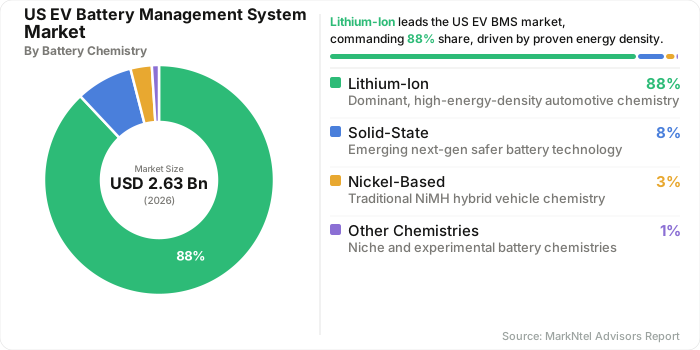
- By battery chemistry, lithium-ion seized a significant share of about 88% in 2026.
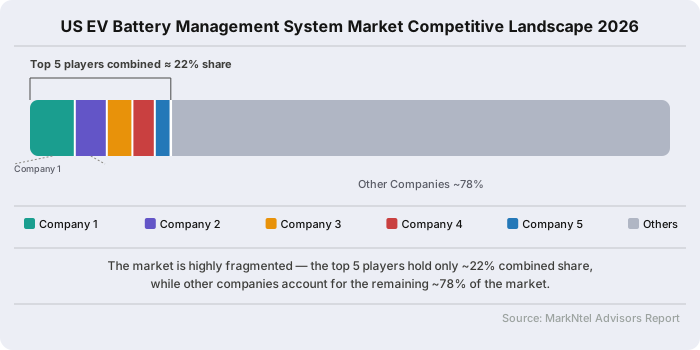
- The industry is highly fragmented. However, the top five players collectively account for nearly a 22% share.
US EV Battery Management System Market Size and Outlook
The US EV battery management system market size was valued at USD 2.21 billion in 2025 and is projected to grow from USD 2.63 billion in 2026 to USD 7.12 billion by 2032. Along with this, the market is estimated to grow at a CAGR of around 18.06% during the forecast period, i.e., 2026-32.
The demand for electric vehicle battery management system in the United States is supported by continued EV adoption, expanding battery deployment, and rising requirements for battery safety and performance. In 2025, U.S. electric-car sales reached approximately 1.5 million units, while EV batteries deployed in the country represented around 10% of global EV battery deployment. Policy and industrial initiatives are also strengthening the ecosystem, including the DOE’s January 2025 proposal for up to USD 725 million for domestic battery materials, components, and advanced batteries and its March 2026 announcement of up to USD 500 million for critical-mineral processing, battery manufacturing, and recycling. Opportunities in AI-enabled diagnostics, wireless BMS, fast-charging management, thermal-runaway detection, and predictive battery-health monitoring are expected to increase system sophistication, supporting a positive long-term outlook.
US EV Battery Management System Market Key Indicators
- U.S. electric-car sales reached approximately 1.5 million units in 2025, remaining close to the previous year's level despite major policy changes. While growth moderated, this represents a substantial installed base of vehicles requiring sophisticated battery monitoring and protection systems. Each additional EV requires a BMS to monitor cell voltage, temperature, current, state of charge, and battery health, sustaining underlying BMS component demand.
- Toyota began production at its USD 13.9 billion North Carolina battery plant in 2025, with the facility expected eventually to operate 14 production lines and reach 30 GWh of annual capacity. The plant supplies batteries for Toyota's hybrid and electric vehicles manufactured in the United States. Expanding domestic battery output creates additional demand for BMS controllers, monitoring ICs, temperature sensors, current sensing, and battery-control software across multiple vehicle platforms.
- U.S. government and private-sector investment in domestic battery and EV supply chains reached approximately USD 120 billion, according to the Department of Energy's supply-chain assessment. Government-backed financing represented about USD 33 billion of this investment through battery grants, DOE loans, and the 48C tax credit. This investment is expanding domestic cell, component, materials, and vehicle production, creating a broader industrial customer base for BMS semiconductors and battery-control technologies.
- Hyundai and SK On's U.S. battery joint venture planned 35 GWh of annual cell production, sufficient to support approximately 300,000 EVs, with production beginning in the second half of 2025. Hyundai Mobis assembles packs from these cells for U.S.-manufactured Hyundai, Kia, and Genesis vehicles. Such large-scale cell production increases demand for pack-level BMS hardware and software capable of coordinating thousands of individual cells across increasingly complex battery architectures.
US EV Battery Management System Market Scope
| Category | Segments |
|---|---|
| By Component | Integrated Circuits, Cut-off FETs and Drivers, Temperature Sensors, Fuel-Gauge/Current-Measurement Devices, Microcontrollers, Communication Interface ICs, Other Components |
| By Battery Chemistry | Lithium-ion, Solid-state, Nickel-based, Other Chemistries |
| By Topology | Centralized, Modular, Distributed, Wireless (Cable-less |
| By Communication Technology | Wired CAN, Wired Ethernet, Wireless |
| By Propulsion Type | Battery Electric Vehicles (BEV), Hybrid Electric Vehicles (HEV), Plug-in Hybrid Electric Vehicles (PHEV |
| By Vehicle Type | Passenger Cars, Light Commercial Vehicles, Medium and Heavy Commercial Vehicles, Off-highway and Specialty Vehicles |
| By Sales Channel | OEM-fitted, Aftermarket/Retrofit |
US EV Battery Management System Market Growth Drivers
Rapid EV Adoption and Increasing Battery Pack Complexity Driving BMS Demand
Rapid EV adoption remains a fundamental growth driver for the U.S. EV battery management system (BMS) market, as every electric vehicle requires a BMS to monitor cell voltage and temperature, manage charging and discharging, balance cells, and protect the battery from operating faults. According to the IEA’s 2026 data, U.S. electric-car sales reached approximately 1.5 million units in 2025, only slightly below 2024 despite major policy changes. This represents a substantial installed base of vehicles requiring sophisticated battery-management technologies.
The underlying battery ecosystem is also expanding rapidly. The U.S. has developed a pipeline exceeding 1,100 GWh/year of battery manufacturing capacity, according to the U.S. Department of Energy's latest supply-chain review. In addition, DOE's current battery technology program targets 300-mile EV range and charging times of 15 minutes or less, requirements that increase the need for precise battery monitoring, thermal management, cell balancing, and charging control.
Therefore, the combination of 1.5 million annual U.S. EV sales in 2025, expanding domestic battery production, longer-range batteries, and increasingly rapid charging is driving automakers toward more advanced BMS architectures, supporting continued market growth in 2026 and beyond.
Recent Trends
Growing Adoption of AI-Enabled Predictive Battery Management Systems
AI-enabled and predictive battery management is becoming a key trend in the U.S. EV battery management system (BMS) market as automakers and fleet operators increasingly use real-world battery data to improve battery-health prediction, charging optimization, fault detection, and range management. A strong recent example is Ford Pro’s 2025 expansion of its connected EV platform, which introduced real-time Battery Range Monitoring and Energy Consumption Insights for commercial EV customers. These capabilities allow fleet operators to monitor battery performance and energy consumption and use the resulting data to optimize vehicle operations.
The trend is also supported by the increasing importance of battery longevity. The U.S. Department of Energy notes that EV batteries can potentially last 12–15 years in moderate climates, but battery life varies with charging patterns, cell chemistry, driving behavior, and thermal conditions. This variability increases the value of predictive BMS technologies that can continuously evaluate battery condition and anticipate degradation.
Consequently, BMS suppliers are moving toward AI-based state-of-health estimation, predictive diagnostics, adaptive charging, digital battery models, and cloud-connected analytics. For example, Ford’s fleet platform demonstrates how battery data can already be converted into operational insights, while next-generation BMS solutions can take this further by predicting degradation and potential faults. This shift toward data-driven, predictive battery management is increasing the functionality and value of BMS systems and supporting market growth.
US EV Battery Management System Market Opportunities and Challenges
Growing Battery Safety Concerns Creating Demand for Advanced BMS Technologies
Thermal runaway remains one of the most critical challenges for the U.S. EV battery management system (BMS) market because lithium-ion cells can experience rapid, uncontrollable heat generation when subjected to internal faults, overcharging, mechanical damage, or extreme operating conditions. NHTSA’s 2025–2026 Battery Safety Initiative specifically identifies battery thermal runaway, high-voltage charging failures, and battery diagnostics as priority research areas. The agency is also investigating EV battery incidents and advancing safety requirements covering battery fire risks. Recent NIST testing in April 2026 further demonstrated the challenge: under certain heating conditions, some 21700 cells had only 40–90 seconds between early thermal-runaway indicators and ignition at 25–50% state of charge.
This safety challenge is creating significant opportunities for advanced predictive BMS technologies capable of identifying abnormal cell behavior before thermal runaway occurs. NHTSA is specifically researching battery diagnostics and prognostics, including early detection, diagnosis, and intervention, creating opportunities for AI-based algorithms, high-resolution temperature sensors, cell-level voltage monitoring, predictive thermal models, and automated emergency shutdown systems. For instance, DOE-supported Aspen Aerogels is expanding PyroThin thermal-barrier technology designed to slow or prevent propagation from an overheating cell to neighboring cells.
Such developments demonstrate how safety concerns are driving integration of BMS-based early-warning systems and advanced thermal-management technologies, thereby supporting higher-value and more sophisticated BMS solutions in U.S. EVs.
Segmentation Insights
Integrated Circuits Account for Approximately 36% Share
Integrated Circuits (ICs) represent approximately 36% of revenue, making them the leading component segment in the U.S. EV battery management system market. Their dominance is primarily attributed to the growing complexity of EV battery packs, which require highly accurate cell-voltage monitoring, temperature sensing, state-of-charge estimation, cell balancing, fault detection, and battery protection. Modern battery-monitoring ICs integrate multiple functions into compact devices, helping automakers improve reliability while reducing system complexity and component count.
The shift toward higher-voltage battery architectures, larger battery packs, faster charging, and advanced battery chemistries is further increasing demand for sophisticated ICs capable of handling greater numbers of cells with high measurement accuracy. Recent product developments reinforce this trend; for example, Texas Instruments introduced the BQ79826Z-Q1 in June 2026, supporting monitoring of up to 26 cells and integrating electrochemical impedance spectroscopy for enhanced battery diagnostics. Such innovations are increasing the functionality and value of ICs within next-generation BMS architectures, supporting their leading revenue position. Based on component, the scope has been segmented into
- Integrated Circuits
- Cut-off FETs and Drivers
- Temperature Sensors
- Fuel-Gauge/Current-Measurement Devices
- Microcontrollers
- Communication Interface ICs
- Other Components
Lithium-ion Batteries Represent Approximately 88% of Total Market Revenue
Lithium-ion batteries represent approximately 88% of total EV battery management system revenue, making them the leading battery-chemistry segment. Their dominance is primarily attributed to their high energy density, established manufacturing ecosystem, proven reliability, and widespread adoption across EV platforms. The chemistry also benefits from a mature supply chain and declining battery costs, supporting continued large-scale deployment.
The growing use of LFP and NMC lithium-ion chemistries across different EV segments further strengthens demand for compatible BMS technologies. Lithium-ion batteries require sophisticated systems for cell-voltage monitoring, temperature control, state-of-charge and state-of-health estimation, and cell balancing, creating substantial demand for BMS hardware and software. In contrast, solid-state batteries remain at an earlier commercialization stage despite their faster projected growth. Consequently, the large installed base and continued expansion of lithium-ion-powered EVs are expected to maintain its leading position in BMS revenue generation over the near term. By battery chemistry, the scope has been classified into
- Lithium-ion
- Solid-state
- Nickel-based
- Other Chemistries
US EV Battery Management System Market Geographical Outlook
Western US Accounts for Approximately 48% of US EV Battery Management System Demand, Driven by EV and Battery Manufacturing Expansion
Western US accounts for approximately 48% of US EV battery management system demand, supported by its established EV manufacturing base, battery production capacity, and concentration of advanced battery technology companies. Nevada is a major regional hub, where Panasonic’s Sparks facility produced more than 11 billion EV battery cells by July 2025 and manufactures approximately 5.7 million cells daily, creating substantial demand for battery monitoring and management technologies.
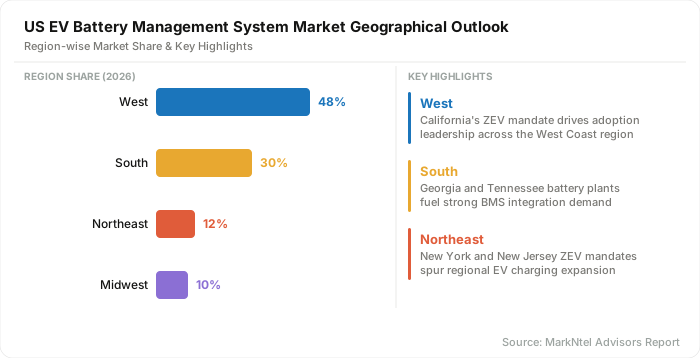
In addition, California hosts major EV and battery-technology activity, while Arizona has emerged as another battery-manufacturing location, strengthening the regional supply chain. The Western region also benefits from continued investment in domestic EV battery production and localized component manufacturing. Panasonic’s Nevada facility currently has approximately 41 GWh of annual capacity, demonstrating the scale of battery manufacturing concentrated in the broader Western ecosystem. This combination of large-scale battery production, EV deployment, and technology development supports the region's leading position in US EV BMS demand.
US EV Battery Management System Market Competitive Analysis
Top Five Companies Account for Approximately 45% Share
The U.S. EV battery management system market is highly fragmented, with leading companies such as Analog Devices, Inc., Infineon Technologies AG, NXP Semiconductors N.V., STMicroelectronics N.V., and Texas Instruments Incorporated collectively accounting for approximately 22% of the global automotive BMS hardware market share.
Key Players in US EV Battery Management System Market
- Analog Devices, Inc.
- Infineon Technologies AG
- NXP Semiconductors N.V.
- Texas Instruments Incorporated
- Renesas Electronics Corporation
- STMicroelectronics N.V.
- Microchip Technology Incorporated
- BorgWarner Inc.
- Sensata Technologies Holding plc
- Eaton Corporation plc
- Others
US EV Battery Management System Industry News and Recent Developments
June 2026: Texas Instruments Launches High-Cell-Count Battery Monitor
Texas Instruments introduced the BQ79826Z-Q1 battery monitor in June 2026. The device supports up to 26 battery cells and integrates electrochemical impedance spectroscopy (EIS), enabling earlier detection of battery degradation and abnormal conditions. The product is designed for safer, higher-performing EV and energy-storage battery systems.
Impact Analysis: The launch strengthens Texas Instruments’ position in advanced EV BMS technologies by enabling higher cell-count battery monitoring within a single device. EIS integration can improve early identification of degradation and abnormal battery behavior, supporting enhanced safety and battery-life management. The technology is expected to encourage adoption of intelligent, data-driven BMS architectures as automakers increasingly require more precise diagnostics for high-capacity EV battery packs.
November 2025: Infineon Launches High-Voltage BMS Microcontroller
Infineon Technologies introduced the PSoC 4 HVPA-SPM 1.0 in November 2025 for high-voltage lithium-ion EV batteries. The device integrates battery monitoring, processing, and communication functions, supports ASIL-D, and enables precise current, voltage, and temperature measurement. Its design targets software-defined and zonal vehicle architectures, strengthening advanced BMS capabilities
Impact Analysis: Infineon’s high-voltage BMS microcontroller expands capabilities for next-generation EV battery systems by combining monitoring, processing, and communication functions. ASIL-D support strengthens functional-safety capabilities, while precise measurement of battery parameters enables improved battery control and diagnostics. The product can support the industry's shift toward software-defined and zonal vehicle architectures, creating greater demand for integrated, high-performance BMS electronics in future EV platforms.
October 2025: NXP Introduces EIS-Enabled EV BMS Chipset
NXP Semiconductors announced an industry-first BMS chipset with integrated electrochemical impedance spectroscopy (EIS) in October 2025. The technology synchronizes measurements across battery cells at nanosecond-level precision, providing deeper battery-health information. The solution is designed to improve EV safety, longevity, performance, and charging capabilities through more advanced diagnostics.
Impact Analysis: NXP’s EIS-enabled BMS chipset advances battery-health monitoring by providing more detailed information about individual cell conditions. Improved diagnostic accuracy can help automakers identify degradation earlier, optimize charging strategies, and enhance battery safety and longevity. The technology also supports the transition toward intelligent BMS architectures capable of managing increasingly complex EV battery packs, thereby creating opportunities for higher-value battery-management electronics and software.
Frequently Asked Questions
- Market Segmentation
- Introduction
- Product Definition
- Research Process
- Assumptions
- Executive Summary
- US EV Battery Management System Market Policies, Regulations, and Product Standards
- US EV Battery Management System Market Trends & Developments
- US EV Battery Management System Market Dynamics
- Growth Factors
- Challenges
- US EV Battery Management System Market Hotspot & Opportunities
- US EV Battery Management System Market Outlook, 2022-2032
- Market Size & Outlook
- By Revenues (USD Million)
- Market Segmentation & Outlook
- By Component- Market Size & Forecast 2022-2032, USD Million
- Integrated Circuits
- Cut-off FETs and Drivers
- Temperature Sensors
- Fuel-Gauge/Current-Measurement Devices
- Microcontrollers
- Communication Interface ICs
- Other Components
- By Battery Chemistry- Market Size & Forecast 2022-2032, USD Million
- Lithium-ion
- Solid-state
- Nickel-based
- Other Chemistries
- By Topology- Market Size & Forecast 2022-2032, USD Million
- Centralized
- Modular
- Distributed
- Wireless (Cable-less)
- By Communication Technology- Market Size & Forecast 2022-2032, USD Million
- Wired CAN
- Wired Ethernet
- Wireless
- By Propulsion Type- Market Size & Forecast 2022-2032, USD Million
- Battery Electric Vehicles (BEV)
- Hybrid Electric Vehicles (HEV)
- Plug-in Hybrid Electric Vehicles (PHEV)
- By Vehicle Type- Market Size & Forecast 2022-2032, USD Million
- Passenger Cars
- Light Commercial Vehicles
- Medium and Heavy Commercial Vehicles
- Off-highway and Specialty Vehicles
- By Sales Channel- Market Size & Forecast 2022-2032, USD Million
- OEM-fitted
- Aftermarket/Retrofit
- By Region- Market Size & Forecast 2022-2032, USD Million
- Northeast
- Midwest
- South
- West
- By Company
- Competition Characteristics
- Market Share & Analysis
- By Component- Market Size & Forecast 2022-2032, USD Million
- Market Size & Outlook
- US Electric Passenger Cars Battery Management System Market Outlook, 2022-2032
- Market Size & Outlook
- By Revenues (USD Million)
- Market Segmentation & Outlook
- By Battery Chemistry- Market Size & Forecast 2022-2032, USD Million
- By Topology- Market Size & Forecast 2022-2032, USD Million
- By Communication Technology- Market Size & Forecast 2022-2032, USD Million
- By Propulsion Type- Market Size & Forecast 2022-2032, USD Million
- By Vehicle Type- Market Size & Forecast 2022-2032, USD Million
- By Sales Channel- Market Size & Forecast 2022-2032, USD Million
- By Region- Market Size & Forecast 2022-2032, USD Million
- Market Size & Outlook
- US Electric Light Commercial Vehicles Battery Management System Market Outlook, 2022-2032
- Market Size & Outlook
- By Revenues (USD Million)
- Market Segmentation & Outlook
- By Battery Chemistry- Market Size & Forecast 2022-2032, USD Million
- By Topology- Market Size & Forecast 2022-2032, USD Million
- By Communication Technology- Market Size & Forecast 2022-2032, USD Million
- By Propulsion Type- Market Size & Forecast 2022-2032, USD Million
- By Vehicle Type- Market Size & Forecast 2022-2032, USD Million
- By Sales Channel- Market Size & Forecast 2022-2032, USD Million
- By Region- Market Size & Forecast 2022-2032, USD Million
- Market Size & Outlook
- US Electric Medium and Heavy Commercial Vehicles Battery Management System Market Outlook, 2022-2032
- Market Size & Outlook
- By Revenues (USD Million)
- Market Segmentation & Outlook
- By Battery Chemistry- Market Size & Forecast 2022-2032, USD Million
- By Topology- Market Size & Forecast 2022-2032, USD Million
- By Communication Technology- Market Size & Forecast 2022-2032, USD Million
- By Propulsion Type- Market Size & Forecast 2022-2032, USD Million
- By Vehicle Type- Market Size & Forecast 2022-2032, USD Million
- By Sales Channel- Market Size & Forecast 2022-2032, USD Million
- By Region- Market Size & Forecast 2022-2032, USD Million
- Market Size & Outlook
- US Electric Off-highway and Specialty Vehicles Battery Management System Market Outlook, 2022-2032
- Market Size & Outlook
- By Revenues (USD Million)
- Market Segmentation & Outlook
- By Battery Chemistry- Market Size & Forecast 2022-2032, USD Million
- By Topology- Market Size & Forecast 2022-2032, USD Million
- By Communication Technology- Market Size & Forecast 2022-2032, USD Million
- By Propulsion Type- Market Size & Forecast 2022-2032, USD Million
- By Vehicle Type- Market Size & Forecast 2022-2032, USD Million
- By Sales Channel- Market Size & Forecast 2022-2032, USD Million
- By Region- Market Size & Forecast 2022-2032, USD Million
- Market Size & Outlook
- US EV Battery Management System Market Key Strategic Imperatives for Success & Growth
- Competitive Outlook
- Company Profiles
- Analog Devices, Inc.
- Business Description
- Product Portfolio
- Collaborations & Alliances
- Recent Developments
- Financial Details
- Others
- Infineon Technologies AG
- Business Description
- Product Portfolio
- Collaborations & Alliances
- Recent Developments
- Financial Details
- Others
- NXP Semiconductors N.V.
- Business Description
- Product Portfolio
- Collaborations & Alliances
- Recent Developments
- Financial Details
- Others
- Texas Instruments Incorporated
- Business Description
- Product Portfolio
- Collaborations & Alliances
- Recent Developments
- Financial Details
- Others
- Renesas Electronics Corporation
- Business Description
- Product Portfolio
- Collaborations & Alliances
- Recent Developments
- Financial Details
- Others
- STMicroelectronics N.V.
- Business Description
- Product Portfolio
- Collaborations & Alliances
- Recent Developments
- Financial Details
- Others
- Microchip Technology Incorporated
- Business Description
- Product Portfolio
- Collaborations & Alliances
- Recent Developments
- Financial Details
- Others
- BorgWarner Inc.
- Business Description
- Product Portfolio
- Collaborations & Alliances
- Recent Developments
- Financial Details
- Others
- Sensata Technologies Holding plc
- Business Description
- Product Portfolio
- Collaborations & Alliances
- Recent Developments
- Financial Details
- Others
- Eaton Corporation plc
- Business Description
- Product Portfolio
- Collaborations & Alliances
- Recent Developments
- Financial Details
- Others
- Analog Devices, Inc.
- Company Profiles
- Disclaimer
MarkNtel Advisors follows a robust and iterative research methodology designed to ensure maximum accuracy and minimize deviation in market estimates and forecasts. Our approach combines both bottom-up and top-down techniques to effectively segment and quantify various aspects of the market. A consistent feature across all our research reports is data triangulation, which examines the market from three distinct perspectives to validate findings. Key components of our research process include:
1. Scope & Research Design At the outset, MarkNtel Advisors define the research objectives and formulate pertinent questions. This phase involves determining the type of research—qualitative or quantitative—and designing a methodology that outlines data collection methods, target demographics, and analytical tools. They also establish timelines and budgets to ensure the research aligns with client goals.
2. Sample Selection and Data Collection In this stage, the firm identifies the target audience and determines the appropriate sample size to ensure representativeness. They employ various sampling methods, such as random or stratified sampling, based on the research objectives. Data collection is carried out using tools like surveys, interviews, and observations, ensuring the gathered data is reliable and relevant.
3. Data Analysis and Validation Once data is collected, MarkNtel Advisors undertake a rigorous analysis process. This includes cleaning the data to remove inconsistencies, employing statistical software for quantitative analysis, and thematic analysis for qualitative data. Validation steps are taken to ensure the accuracy and reliability of the findings, minimizing biases and errors.

4. Data Forecast and FinalizationThe final phase involves forecasting future market trends based on the analyzed data. MarkNtel Advisors utilize predictive modeling and time series analysis to anticipate market behaviors. The insights are then compiled into comprehensive reports, featuring visual aids like charts and graphs, and include strategic recommendations to inform client decision-making
We offer flexible licensing options to cater to varying organizational needs. Choose the pricing pack that best suits your requirements:
Buy Now Inquire Before Buying
 Request Customization
 Talk to our Consultant







