India Battery Market Research Report: Trends & Forecast (2026-2032)
By Battery Type (Primary Batteries, Secondary Batteries), By Technology (Lead-acid, Lithium ion, Nickel-metal hydride, Nickel-cadmium, Sodium-sulfur, Solid-state, Flow Battery, Eme ... rging chemistries), By Application (Automotive (HEV, PHEV, and EV), Industrial (Motive, Stationary (Telecom, UPS, ESS), Portable & Consumer Electronics, Power Tools, SLI, Other Applications), By Form Factor (Cylindrical cells, Prismatic cells, Pouch cells, Button/coin cells, Others), By Power Capacity (<1 kWh, 1–10 kWh, 10–100 kWh, >100 kWh), By End User Industry (Automotive & Transportation, Utilities & Renewable Energy, Consumer Goods & Electronics, Industrial & Logistics, Telecom & Data Centres), and others Read more
- Energy
- Apr 2026
- Pages 135
- Report Format: PDF, Excel, PPT
India Battery Market
Projected 8.81% CAGR from 2026 to 2032
Study Period
2026-2032
Market Size (2026)
USD 13.98 Billion
Market Size (2032)
USD 23.20 Billion
Base Year
2025
Projected CAGR
8.81%
Leading Segments
By end-user industry: Automotive & Transportation
India Battery Market Key Takeaways
- India Battery market size was valued at around USD 12.65 billion in 2025 and is projected to grow from USD 13.98 billion in 2026 to USD 23.20 billion by 2032, exhibiting a CAGR of 8.81% during 2026-2032.
- Western region holds the largest share of about 34%.
- By Technology, the Lithium ion holds a significant share of about 55%.
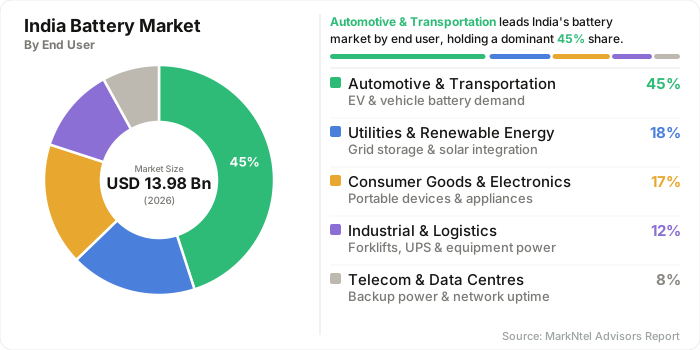
- By end-user industry, the automotive & transportation segment seized a significant share of about 45% in 2026.
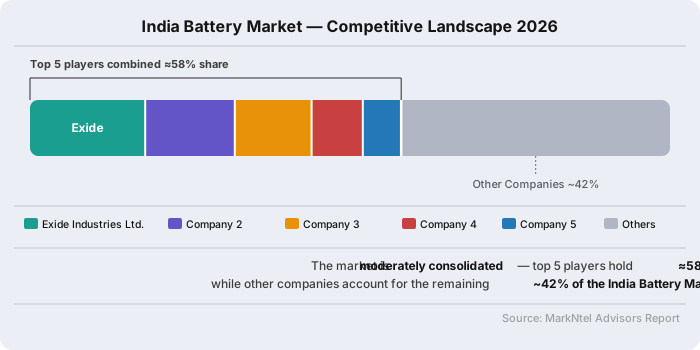
- The industry is moderately consolidated, with over 50 companies participating. However, the top five players collectively account for nearly 58% share.
India Battery Market Size and Outlook
The Global Battery market size was valued at USD 12.65 billion in 2025 and is projected to grow from USD 13.98 billion in 2026 to USD 23.20 billion by 2032. Along with this, the market is estimated to grow at a CAGR of around 8.81% during the forecast period, i.e., 2026-32.
The market is primarily driven by driven by the rapid adoption of electric vehicles, expanding renewable energy storage deployment, and increasing investments in domestic lithium-ion battery manufacturing infrastructure. Over the past half-decade, electric mobility in India has experienced remarkable growth, reflecting a structural shift in consumer preferences. Official registration figures reveal that the share of EVs in total vehicle registrations rose from under 1% to approximately 7.5% by FY 2024–25. This growth is most prominent in the two-wheeler and three-wheeler segments, which rely heavily on lithium-ion battery packs and constitute the majority of India’s electrified transport fleet. Such rapid uptake underscores the increasing demand for advanced battery solutions, both for automotive and energy storage applications .
In parallel, the market is witnessing a significant technological shift toward next-generation batteries. Solid-state and sodium-ion technologies are emerging as critical trends due to their potential to enhance safety, energy density, and long-term sustainability. For instance, Inventus Battery Energy Technologies in India has developed an all-solid-state lithium-metal battery prototype with an energy density of around 350 Wh/kg using its proprietary Ceramion+™ solid electrolyte. This project, supported by the National Research Development Corporation, exemplifies efforts to accelerate commercialization of advanced battery technologies in the country .
Future investments and government support are set to further accelerate market growth. The Advanced Chemistry Cell Production-Linked Incentive scheme aims to build 50 GWh of domestic battery manufacturing capacity, attracting large-scale investments from companies such as Reliance New Energy, Ola Electric, and Rajesh Exports. The program is designed to create a competitive domestic battery ecosystem, reduce dependence on imported cells, and support both EV and renewable energy storage demand over the coming decade.
Overall, India’s battery market outlook reflects a convergence of strong policy support, rapid EV penetration, technological advancements, and large-scale industrial investments. With next-generation solid-state and sodium-ion batteries entering commercialization, alongside substantial capacity expansions under government initiatives, the market is poised for sustained growth. These developments not only enhance India’s energy security and supply chain resilience but also position the country as a strategic hub for advanced battery manufacturing and energy storage solutions in Asia.
India Battery Market Key Indicators
- Himadri Speciality Chemical partnered with Australian firm Sicona to develop India’s first silicon-carbon anode material plant, which can improve battery energy density by about 20% and enhance charging performance by nearly 40% compared with conventional graphite-based lithium batteries.
- India plans major battery manufacturing expansion, with over 30 battery gigafactories expected to become operational by 2030, targeting a combined production capacity of more than 290 GWh. These large-scale investments aim to support electric vehicles and energy storage systems, strengthening India’s domestic battery manufacturing ecosystem.
- According to the IEA, India’s electricity demand grew 5.8% in 2024 and is projected to rise 6.3% annually from 2025–2027, driving utilities to adopt battery energy storage systems for grid balancing and peak-load management, expanding the stationary battery market.
- Amara Raja Batteries plans to launch a 4–6 GWh lithium iron phosphate (LFP) battery production facility in India to strengthen domestic EV and energy storage supply chains, reduce import dependence, and meet growing demand for safe, cost‑effective batteries.
India Battery Market Scope
| Category | Segments |
|---|---|
| By Battery Type | (Primary Batteries, Secondary Batteries), |
| By Technology | (Lead-acid, Lithium ion, Nickel-metal hydride, Nickel-cadmium, Sodium-sulfur, Solid-state, Flow Battery, Emerging chemistries), |
| By Application | (Automotive (HEV, PHEV, and EV), Industrial (Motive, Stationary (Telecom, UPS, ESS), Portable & Consumer Electronics, Power Tools, SLI, Other Applications), |
| By Form Factor | (Cylindrical cells, Prismatic cells, Pouch cells, Button/coin cells, Others), |
| By Power Capacity | (<1 kWh, 1–10 kWh, 10–100 kWh, >100 kWh), |
| By End User Industry | (Automotive & Transportation, Utilities & Renewable Energy, Consumer Goods & Electronics, Industrial & Logistics, Telecom & Data Centres), |
India Battery Market Growth Drivers
Rapid Electric Vehicle (EV) Adoption
India’s accelerating shift toward electric mobility has become a major catalyst for battery demand, influencing cell manufacturing, battery pack assembly, and investments in advanced chemistry technologies. According to government-compiled VAHAN portal data, electric vehicles represented nearly 8% of total new vehicle registrations in 2025, with overall EV sales reaching approximately 2.3 million units. This increase reflects improving consumer acceptance, supportive policies, and expanding charging infrastructure across the country .
At the regional level, strong adoption of further illustrate the growing EV ecosystem. The Maharashtra Economic Survey 2025–26 reported that electric vehicle registrations in the state increased by about 13% in 2025–26, with the total EV population surpassing 927,061 units . Such growth in large automotive markets directly strengthens the demand for traction batteries used in electric vehicles.
The expanding EV fleet is also significantly increasing the requirement for lithium-ion batteries. Industry estimates suggest that India’s lithium-ion battery demand could reach around 115 GWh by 2030, largely driven by electric mobility growth. Policy support continues to accelerate this transition. The FAME-II (Faster Adoption and Manufacturing of Electric Vehicles) scheme, launched in 2019 with a budget of approximately USD 1.38 billion, has already supported over 1.6 million EVs strengthening the national EV ecosystem .
Overall, the rapid rise in EV adoption, supported by government incentives and expanding vehicle registrations across states, is significantly increasing the demand for lithium-ion batteries. As electrification accelerates in India’s transport sector, battery production and deployment are expected to grow steadily in the coming years.
Recent Trends
Emerging Solid-State Battery Innovations
India’s battery ecosystem is increasingly focusing on solid-state battery technology as manufacturers and research institutions look for safer and more efficient alternatives to conventional lithium-ion batteries that use liquid electrolytes. Solid-state batteries utilize solid electrolytes instead of flammable liquid components, which significantly improves thermal stability and reduces safety risks such as leakage or thermal runaway. These batteries can also deliver higher energy density and longer operational life, making them suitable for next-generation electric vehicles and advanced energy storage systems. As EV adoption rises and renewable energy integration expands, such advanced battery technologies are gaining attention across the country’s research and industrial sectors.
Several companies and research organizations are investing in the development and commercialization of this technology. For example, in March 2025, Vikram Solar announced plans to establish a solid-state battery manufacturing facility with an initial capacity of about 1 GWh, scalable to nearly 5 GWh in later phases. The project aims to strengthen domestic energy storage capabilities and support India’s renewable energy transition by developing indigenous battery technologies. Such investments also align with the broader push to build local battery manufacturing capacity and reduce dependence on imported battery components.
Overall, the advancement of solid-state battery technologies reflects India’s growing focus on next-generation battery innovation. As research collaborations and pilot manufacturing facilities expand, solid-state batteries are expected to enhance safety, performance, and efficiency in electric mobility and large-scale energy storage applications.
India Battery Market Opportunities and Challenges
Critical Mineral Import Dependence Accelerating Battery Recycling Ecosystem Development
India’s battery manufacturing industry faces a significant structural challenge due to its high dependence on imported critical minerals such as lithium, cobalt, and nickel, which are essential for lithium-ion battery production. India currently has limited domestic reserves and refining capacity for these materials, forcing manufacturers to rely heavily on international supply chains. According to industry analysis, India is nearly 100% dependent on imports for key battery minerals, exposing the sector to price volatility and geopolitical supply disruptions.
For example, this challenge increases the lithium-ion battery imports. In FY 2023–24, India imported lithium-ion batteries worth approximately USD 2.9 billion, with more than 84% of imports sourced from China and Hong Kong, highlighting the country’s reliance on external suppliers for battery cells and components.
However, this dependency is also creating opportunities for domestic battery recycling and material recovery industries. Recycling technologies enable valuable metals such as lithium, cobalt, and nickel to be recovered from used batteries, reducing import reliance. For instance, Attero Recycling has announced plans to expand its lithium-ion battery recycling capacity to about 200,000 tonnes annually in the coming years, with long-term expansion targets reaching nearly 300,000 tonnes per year.
Although dependence on imported battery minerals remains a key constraint for India’s battery ecosystem, expanding recycling capacity and circular supply chains present a strong opportunity to strengthen domestic raw material availability and support long-term industry growth.
Segmentation Insights
Lithium-Ion Technology Leading in Battery industry
Lithium-ion batteries represent the largest technology segment in the India battery market, accounting for approximately 55% of the total share. Their leadership is primarily driven by their high energy density, lightweight structure, and longer cycle life compared with conventional battery technologies such as lead-acid or nickel-cadmium. These advantages make lithium-ion batteries particularly suitable for modern applications including electric vehicles, portable electronics, and renewable energy storage systems. India’s accelerating transition toward electric mobility has significantly increased demand for lithium-ion battery packs, especially for electric two-wheelers, three-wheelers, and passenger vehicles that rely on high-performance rechargeable batteries.
In addition, the growing deployment of solar power systems and energy storage solutions is supporting the adoption of lithium-ion batteries because of their efficiency and faster charging capabilities. Government initiatives promoting domestic cell manufacturing and advanced chemistry battery production are also strengthening this segment. As industries continue shifting toward electrification and cleaner energy solutions, lithium-ion batteries are expected to maintain their dominant position in the Indian battery ecosystem due to their technological advantages and wide-ranging applications. Based on technology the scope has been segmented into:
- Lead-acid
- Li-ion
- Nickel-metal hydride
- Nickel-cadmium
- Sodium-sulfur
- Solid-state
- Flow Battery
- Emerging chemistries
Automotive & Transportation Sector Dominates Battery Demand
The automotive and transportation sector holds around 45% share of the India battery market, making it the largest end-user industry. This dominance is closely linked to the rapid expansion of electric mobility across passenger vehicles, two-wheelers, buses, and commercial fleets. Electric vehicles rely heavily on rechargeable battery systems, making batteries the most critical component in vehicle electrification. The increasing adoption of electric two-wheelers and three-wheelers in urban transportation has significantly boosted battery demand in recent years. Additionally, logistics companies and public transportation systems are gradually transitioning toward electric fleets to reduce fuel costs and emissions, further accelerating battery consumption. Growth in hybrid electric vehicles and plug-in hybrid vehicles is also supporting battery deployment within the transportation ecosystem. Beyond road vehicles, batteries are widely used in railway backup systems and emerging electric mobility solutions. As India continues promoting cleaner transportation and energy-efficient mobility, the automotive sector will remain the primary driver of battery demand due to its large-scale electrification and continuous technological advancements in vehicle battery systems. Based on end user the market is dominant by:
- Automotive & Transportation
- Utilities & Renewable Energy
- Consumer Goods & Electronics
- Industrial & Logistics
- Telecom & Data Centres
India Battery Market Geographical Outlook
The Western region holds the largest regional share accounting for approximately 34% of the total India Battery industry, particularly Gujarat and Maharashtra, due to its strong industrial ecosystem, well-established automotive manufacturing base, and increasing investments in electric mobility and battery production. These states host major automotive manufacturing clusters, electronics production facilities, and renewable energy projects that generate substantial demand for advanced battery technologies, especially lithium-ion batteries used in electric vehicles and energy storage systems. Cities such as Pune, Mumbai, and Ahmedabad function as key industrial centers where automobile manufacturers, component suppliers, and energy infrastructure companies are concentrated, thereby strengthening regional battery consumption. In addition, favorable state policies supporting electric mobility and advanced battery manufacturing have attracted significant private investments in the region.
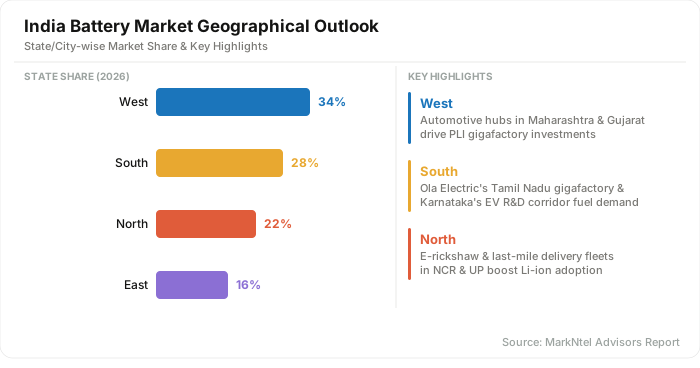
For instance, Tata Group announced an initial investment of approximately USD 1.5 billion to establish a lithium-ion battery gigafactory in Gujarat, aimed at supplying batteries for Tata Motors’ electric vehicle production and enhancing domestic battery manufacturing capabilities.
The presence of large-scale industrial infrastructure, automotive production hubs, and strategic battery investments continues to position the Western region as the leading center for battery manufacturing and demand in India.
India Battery Industry Competitive Analysis
The battery industry is moderately consolidated, with over 50 companies operating. The top five players, Exide Industries Ltd., Amara Raja Energy & Mobility Ltd., Luminous Power Technologies Pvt. Ltd., HBL Power Systems Ltd., and Tata AutoComp GY Batteries Pvt. Ltd., collectively account for nearly 58% of the total share. Exide Industries leads nationally, while Amara Raja dominates the southern states, and Luminous holds a strong presence in residential and solar storage applications across India.
Key Companies in the Battery industry
- Exide Industries Ltd.
- Amara Raja Energy & Mobility Ltd.
- Luminous Power Technologies Pvt. Ltd.
- HBL Power Systems Ltd.
- Tata AutoComp GY Batteries Pvt. Ltd.
- Okaya Power Pvt. Ltd.
- Ola Electric Mobility Pvt. Ltd.
- Reliance New Energy Ltd.
- Aqueouss
- Panasonic Energy India Co. Ltd.
- LG Energy Solution
- JSW Energy Battery Division
- Others
Global Battery Industry News and Recent Developments
December 2025: SCCL and Altmin Sign MoU to Establish India’s First Large-Scale Battery-Grade Lithium Refinery in Telangana
Singareni Collieries Company (SCCL) and Altmin signed an MoU to set up India’s first large-scale battery-grade lithium refinery in Telangana, investing Rs 2,250 crore, targeting 2027 operations. The project aims to support India’s EV and energy storage ecosystem while reducing import dependence on refined lithium.
Impact analysis: This project strengthens India’s domestic battery materials ecosystem by enabling local processing of lithium, a critical component for lithium-ion batteries. Establishing refining capacity within the country reduces reliance on imported refined lithium and supports the expansion of electric vehicle manufacturing and energy storage systems. The investment also positions Telangana as a strategic hub for battery supply chain development and clean energy manufacturing.
July 2025: Exide Industries Commissions 3 GWh Lithium-Ion Battery Manufacturing Line in Pune
Exide Industries commissioned a 3 GWh lithium-ion battery production line in Pune after investing about USD 250 million. The facility is part of the company’s strategy to expand domestic lithium-ion cell manufacturing capacity and support India’s growing electric vehicle and energy-storage markets, while also engaging with OEM partners for future battery supply.
Impact Analysis: The commissioning of this production line strengthens India’s domestic battery manufacturing ecosystem by increasing local lithium-ion cell capacity. It reduces dependence on imported battery cells and supports the rapidly expanding electric vehicle sector, particularly in two-wheeler mobility. Additionally, large-scale investments by established battery manufacturers such as Exide help accelerate technological capability, improve supply-chain reliability, and position India as an emerging hub for advanced battery production and energy storage solutions.
July 2025: Reliance Industries to Operationalise Clean Energy Gigafactories in Jamnagar
Reliance Industries announced that its clean energy gigafactories in Jamnagar, Gujarat, are expected to become operational within the next four to six quarters. These facilities will manufacture key components including solar panels, battery storage systems, and electrolysers, forming part of the company’s integrated renewable energy manufacturing ecosystem.
Impact Analysis: The development strengthens India’s domestic clean energy and battery manufacturing ecosystem by establishing large-scale integrated production of renewable technologies. Local manufacturing of batteries and related energy storage systems supports the expansion of electric mobility and renewable power integration. Additionally, large gigafactory investments enhance supply chain resilience, reduce dependence on imported battery components, and accelerate India’s transition toward sustainable energy infrastructure.
*Reports Delivery Format - Market research studies from MarkNtel Advisors are offered in PDF, Excel and PowerPoint formats. Within 24 hours of the payment being successfully received, the report will be sent to your email address.
Frequently Asked Questions
- Market Segmentation
- Introduction
- Product Definition
- Research Process
- Assumptions
- Executive Summary
- India Battery Market Policies, Regulations, and Product Standards
- India Battery Market Trends & Developments
- India Battery Market Dynamics
- Growth Factors
- Challenges
- India Battery Market Hotspot & Opportunities
- India Battery Market Outlook, 2022-2032F
- Market Size & Outlook
- By Revenues (USD Million)
- Market Share & Outlook
- By Battery Type- Market Size & Forecast 2022-2032, USD Million
- Primary Batteries
- Secondary Batteries
- By Technology- Market Size & Forecast 2022-2032, USD Million
- Lead-acid
- Lithium ion
- Nickel-metal hydride
- Nickel-cadmium
- Sodium-sulfur
- Solid-state
- Flow Battery
- Emerging chemistries
- By Application- Market Size & Forecast 2022-2032, USD Million
- Automotive (HEV, PHEV, and EV)
- Industrial (Motive, Stationary (Telecom, UPS, ESS)
- Portable & Consumer Electronics
- Power Tools
- SLI
- Other Applications
- By Form Factor- Market Size & Forecast 2022-2032, USD Million
- Cylindrical cells
- Prismatic cells
- Pouch cells
- Button/coin cells
- Others
- By Power Capacity- Market Size & Forecast 2022-2032, USD Million
- <1 kWh
- 1–10 kWh
- 10–100 kWh
- >100 kWh
- By End User Industry- Market Size & Forecast 2022-2032, USD Million
- Automotive & Transportation
- Utilities & Renewable Energy
- Consumer Goods & Electronics
- Industrial & Logistics
- Telecom & Data Centres
- By Region- Market Size & Forecast 2022-2032, USD Million
- South
- Tamil Nadu
- Karnataka
- Andhra Pradesh
- Telangana
- Kerala
- West
- Madhya Pradesh
- Maharashtra
- Gujarat
- Goa
- East
- Odisha
- Jharkhand
- West Bengal
- Bihar
- Chhattisgarh
- North
- Delhi
- Punjab
- Haryana
- Uttar Pradesh
- Rajasthan
- Uttarakhand
- Himachal Pradesh
- South
- By Company
- Competition Characteristics
- Market Share & Analysis
- By Battery Type- Market Size & Forecast 2022-2032, USD Million
- Market Size & Outlook
- India Primary Batteries Market Outlook, 2022-2032
- Market Size & Outlook
- By Revenues (USD Million)
- Market Share & Outlook
- By Technology- Market Size & Forecast 2022-2032, USD Million
- By Application- Market Size & Forecast 2022-2032, USD Million
- By Form Factor- Market Size & Forecast 2022-2032, USD Million
- By Power Capacity- Market Size & Forecast 2022-2032, USD Million
- By End User Industry- Market Size & Forecast 2022-2032, USD Million
- By Region- Market Size & Forecast 2022-2032, USD Million
- Market Size & Outlook
- India Secondary Batteries Market Outlook, 2022-2032
- Market Size & Outlook
- By Revenues (USD Million)
- Market Share & Outlook
- By Technology- Market Size & Forecast 2022-2032, USD Million
- By Application- Market Size & Forecast 2022-2032, USD Million
- By Form Factor- Market Size & Forecast 2022-2032, USD Million
- By Power Capacity- Market Size & Forecast 2022-2032, USD Million
- By End User Industry- Market Size & Forecast 2022-2032, USD Million
- By Region- Market Size & Forecast 2022-2032, USD Million
- Market Size & Outlook
- India Battery Market Key Strategic Imperatives for Success & Growth
- Competitive Outlook
- Company Profiles
- Exide Industries Ltd.
- Business Description
- Product Portfolio
- Collaborations & Alliances
- Recent Developments
- Financial Details
- Others
- Amara Raja Energy & Mobility Ltd.
- Business Description
- Product Portfolio
- Collaborations & Alliances
- Recent Developments
- Financial Details
- Others
- Luminous Power Technologies Pvt. Ltd.
- Business Description
- Product Portfolio
- Collaborations & Alliances
- Recent Developments
- Financial Details
- Others
- HBL Power Systems Ltd.
- Business Description
- Product Portfolio
- Collaborations & Alliances
- Recent Developments
- Financial Details
- Others
- Tata AutoComp GY Batteries Pvt. Ltd.
- Business Description
- Product Portfolio
- Collaborations & Alliances
- Recent Developments
- Financial Details
- Others
- Okaya Power Pvt. Ltd.
- Business Description
- Product Portfolio
- Collaborations & Alliances
- Recent Developments
- Financial Details
- Others
- Ola Electric Mobility Pvt. Ltd.
- Business Description
- Product Portfolio
- Collaborations & Alliances
- Recent Developments
- Financial Details
- Others
- Reliance New Energy Ltd.
- Business Description
- Product Portfolio
- Collaborations & Alliances
- Recent Developments
- Financial Details
- Others
- Aqueouss
- Business Description
- Product Portfolio
- Collaborations & Alliances
- Recent Developments
- Financial Details
- Others
- Panasonic Energy India Co. Ltd.
- Business Description
- Product Portfolio
- Collaborations & Alliances
- Recent Developments
- Financial Details
- Others
- LG Energy Solution
- Business Description
- Product Portfolio
- Collaborations & Alliances
- Recent Developments
- Financial Details
- Others
- JSW Energy Battery Division
- Business Description
- Product Portfolio
- Collaborations & Alliances
- Recent Developments
- Financial Details
- Others
- Exide Industries Ltd.
- Company Profiles
- Disclaimer
MarkNtel Advisors follows a robust and iterative research methodology designed to ensure maximum accuracy and minimize deviation in market estimates and forecasts. Our approach combines both bottom-up and top-down techniques to effectively segment and quantify various aspects of the market. A consistent feature across all our research reports is data triangulation, which examines the market from three distinct perspectives to validate findings. Key components of our research process include:
1. Scope & Research Design At the outset, MarkNtel Advisors define the research objectives and formulate pertinent questions. This phase involves determining the type of research—qualitative or quantitative—and designing a methodology that outlines data collection methods, target demographics, and analytical tools. They also establish timelines and budgets to ensure the research aligns with client goals.
2. Sample Selection and Data Collection In this stage, the firm identifies the target audience and determines the appropriate sample size to ensure representativeness. They employ various sampling methods, such as random or stratified sampling, based on the research objectives. Data collection is carried out using tools like surveys, interviews, and observations, ensuring the gathered data is reliable and relevant.
3. Data Analysis and Validation Once data is collected, MarkNtel Advisors undertake a rigorous analysis process. This includes cleaning the data to remove inconsistencies, employing statistical software for quantitative analysis, and thematic analysis for qualitative data. Validation steps are taken to ensure the accuracy and reliability of the findings, minimizing biases and errors.

4. Data Forecast and FinalizationThe final phase involves forecasting future market trends based on the analyzed data. MarkNtel Advisors utilize predictive modeling and time series analysis to anticipate market behaviors. The insights are then compiled into comprehensive reports, featuring visual aids like charts and graphs, and include strategic recommendations to inform client decision-making
We offer flexible licensing options to cater to varying organizational needs. Choose the pricing pack that best suits your requirements:
Buy Now Inquire Before Buying
 Request Customization
 Talk to our Consultant