

By Product Type (Air-Cooled Chillers, Water-Cooled Chillers, Absorption Chillers), By Compressor / Technology Type (Screw Chillers, Scroll Chillers, Reciprocating Chillers, Centrifugal Chillers (Oil-L... ... ugal Chillers (Oil-Lubricated Centrifugal, Oil-Free / Magnetic Bearing Centrifugal)), By End Users (Oil & Gas, Chemicals & Petrochemicals, Food & Beverage, Healthcare, Plastics & Rubber, Hospitality, Residential, Power Utilities, Others), By Capacity (Less than 150 Tons, 150-1000 Tons, 1001-2000 Tons, Above 2000 Tons), and others Read more
- Environment
- Aug 2026
- 165
- PDF, Excel, PPT
Romania Chillers Market Key Takeaways
- The Romania chillers market was valued at USD 26.12 billion in 2025 and is projected to reach USD 29.22 billion by 2032 from USD 27.39 billion in 2026.
- The market is expected to grow at a CAGR of approximately 1.09% during 2026–2032.
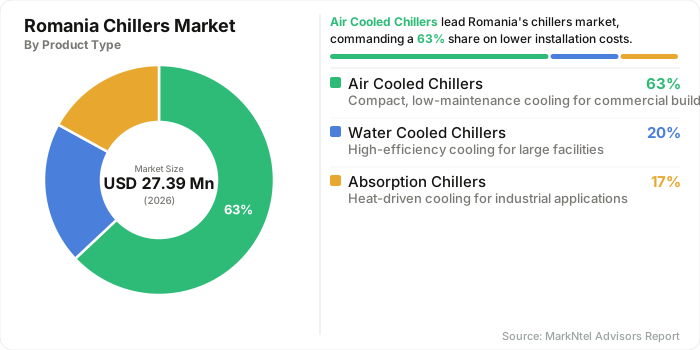
- By product type, air-cooled chillers held 63% of the market share in 2026.
- By capacity, the 150–1000 tons range held dominance with 52% market share in 2026.
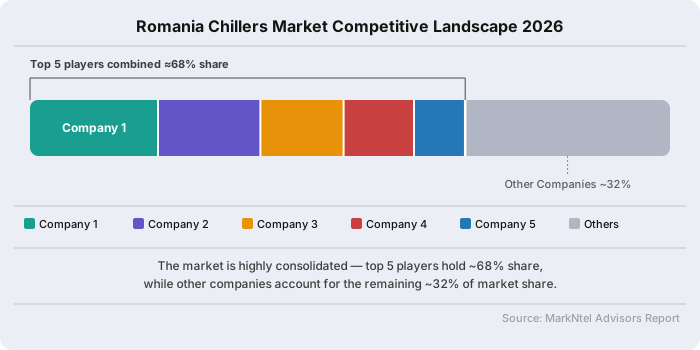
- The Romania chillers market remains moderately consolidated, with the top five players collectively accounting for approximately 68% of the total market share.
Romania Chillers Market Size & Outlook
The Romania chillers industry was valued at USD 26.12 billion in 2025 and is currently standing at USD 27.39 billion in 2026. The industry is projected to grow to USD 29.22 billion by 2032, showcasing a CAGR of around 1.09% during the forecast period, i.e., 2026–32. The market is witnessing steady growth, supported by rising investments across healthcare, data centers, manufacturing, and commercial infrastructure that require advanced cooling systems for efficient and reliable operations. At the same time, continued foreign investment, industrial expansion, and the country's focus on sustainable buildings are helping create favourable opportunities.
In 2026, Romania's expanding healthcare infrastructure continued to generate significant demand for high-capacity cooling systems. Construction progressed on three regional hospitals, including the USD 818 million Craiova regional emergency hospital, the USD 742 million Cluj regional emergency hospital, and the USD 715 million Iași regional emergency hospital, with the Cluj construction contract signed in May 2026. These modern healthcare facilities require advanced air handling systems to comply with stringent indoor air quality and infection control standards, creating sustained opportunities for chiller manufacturers.
In 2025 and 2026, Romania's digital infrastructure and manufacturing sectors emerged as major growth avenues for the market. The proposed Black Sea AI gigafactory, designed with hybrid cooling infrastructure, the first phase of the Cluj quantum AI data centre, and the announced 800 MW AIC and Clusterpower AI campus are expected to accelerate demand for high density liquid cooling systems and liquid-cooled chillers as AI workloads increase. Meanwhile, Sany International announced an integrated green energy hub, incorporating a 70 MW data center.
Government policies have continued to reinforce investments in energy efficient infrastructure and advanced cooling technologies. The Romanian government approved a USD 1.16 billion manufacturing investment scheme in June 2026 to encourage new production facilities and technological upgrades, while implementation of the EU F gas regulation is accelerating the replacement of legacy refrigeration and chiller systems with low GWP refrigerant technologies.
In parallel, Romania's integrated national energy and climate plan, the revised national recovery and resilience plan, and the higher FDI screening threshold are supporting sustainable industrial development and encouraging wider adoption of energy efficient HVAC and chiller systems across commercial and industrial projects.
Romania Chillers Market Key Indicators
- Romania’s construction activity is creating a growing installed base of commercial and industrial buildings requiring centralized cooling systems. Eurostat data show that Romania’s construction production increased 9.4% year-on-year in March 2026, following a 14.0% increase in February 2026. Sustained construction activity increases the pipeline of offices, retail facilities, hotels, industrial buildings, and other large structures where chillers are used for centralized HVAC, thereby supporting demand for new chiller installations and replacement systems.
- Romania’s industrial and logistics real-estate expansion is strengthening demand for cooling equipment in large-format facilities. Modern industrial and logistics stock reached approximately 8.17 million sq. m at the end of 2025, while annual leasing activity exceeded 1 million sq. m. Around 464,000 sq. m of additional industrial space was under construction or in the pipeline for delivery by the end of 2026. Expansion of warehouses, distribution centers, and manufacturing facilities creates demand for high-capacity chillers for process cooling, temperature control, and worker-comfort applications.
- Romania’s retail real-estate expansion is increasing the addressable base for centralized commercial cooling systems. Modern retail stock reached approximately 4.78 million sq. m by Q4 2025, after 187,000 sq. m of new retail space was delivered during 2025, representing a 10% increase from 2024. Shopping centers and retail parks typically require substantial HVAC capacity because of their large enclosed areas and high occupancy, supporting demand for water-cooled and air-cooled chillers.
- The country’s manufacturing and industrial base continues to generate specialized cooling requirements despite near-term production weakness. Romania produced 545,510 automobiles in 2025, including 297,182 vehicles by Dacia and 248,328 by Ford Otosan. Although total automotive production declined 2.6%, the scale of domestic vehicle manufacturing sustains demand for industrial cooling applications across assembly, plastics, painting, compressed-air, and other temperature-sensitive processes, supporting replacement and process-chiller demand.
- Rising cooling intensity is another structural demand indicator for chillers in Romania. Romania recorded approximately 144 cooling degree days in 2025, above countries such as Hungary at 126 and France at 101, indicating a meaningful requirement for space cooling during warmer periods. Increasing cooling loads in commercial, industrial, and institutional buildings can encourage investment in higher-capacity and energy-efficient chiller systems.
Romania Chillers Market Scope
| Category | Segments |
|---|---|
| By Product Type | Air-Cooled Chillers, Water-Cooled Chillers, Absorption Chillers |
| By Compressor / Technology Type | Screw Chillers, Scroll Chillers, Reciprocating Chillers, Centrifugal Chillers (Oil-Lubricated Centrifugal, Oil-Free / Magnetic Bearing Centrifugal |
| By End Users | Oil & Gas, Chemicals & Petrochemicals, Food & Beverage, Healthcare, Plastics & Rubber, Hospitality, Residential, Power Utilities, Others |
| By Capacity | Less than 150 Tons, 150-1000 Tons, 1001-2000 Tons, Above 2000 Tons |
Romania Chillers Market Growth Driver
Escalating Heatwaves Driving a Structural Rise in Cooling Demand and Household AC Penetration
Escalating heatwaves are fundamentally reshaping cooling demand across Romania, creating sustained opportunities for both residential air conditioning systems and commercial chiller installations. Increasingly frequent periods of extreme heat are encouraging first-time household air conditioner purchases while simultaneously raising peak cooling requirements across hospitals, offices, retail facilities, hotels, manufacturing plants, and other large commercial buildings that rely on central chilled water systems. This structural shift is expanding both equipment installations and replacement demand as end users seek more reliable and energy-efficient cooling solutions.
In 2026, Romania experienced temperatures of up to 41°C between late June and early July, following another year of severe heat events in 2025 when temperatures exceeded 40°C across southern and western regions. The trend reflects a broader climatic shift, with 63 of 92 summer days in 2024 affected by heatwave conditions, contributing to more than 600 heat-related deaths. Longer periods of elevated temperatures are extending cooling system operating hours and increasing peak thermal loads, prompting commercial facilities and public institutions to modernize ageing HVAC infrastructure with higher-efficiency chiller systems capable of maintaining indoor comfort under more demanding operating conditions.
Despite rising cooling requirements, Romania remains significantly underpenetrated, creating substantial long-term growth potential. Household air conditioner penetration stands at only 16.41%. The opportunity is further reinforced by sharp regional disparities, with penetration reaching 58.7% in Bucharest but only 0.63% in Harghita County. As cooling increasingly shifts from a seasonal convenience to an essential requirement, rising AC ownership will support the broader HVAC ecosystem, while higher cooling loads across commercial and institutional buildings continue to accelerate investment in advanced central chiller systems.
Romania Chillers Market Trend
AI-Driven Chiller Optimization and IoT-Enabled Building Automation
The market is witnessing a gradual shift from conventional cooling equipment toward intelligent, connected, and energy-optimized chiller systems as building owners increasingly prioritize operational efficiency, predictive maintenance, and regulatory compliance. Rather than focusing solely on equipment efficiency, end users are investing in building automation and control systems (BACS), IoT enabled sensors, AI driven analytics, and remote monitoring platforms that continuously optimize chiller performance, minimize energy consumption, and reduce unplanned equipment downtime throughout the system lifecycle.
In 2026, this transition gained stronger regulatory support through the European Union's energy performance of buildings directive. Under the framework, buildings operating HVAC systems with a rated output exceeding 70 kW are required to implement building automation and control systems by 31 December 2029, while requirements for continuous indoor environmental quality monitoring became applicable from 29 May 2026. These regulations are encouraging facility owners to modernize existing HVAC infrastructure with digitally connected chillers capable of real time monitoring, automated fault detection, energy benchmarking, and predictive maintenance.
The trend is becoming increasingly relevant for Romania's expanding healthcare facilities, commercial buildings, and AI focused data centers, where advanced liquid and hybrid cooling systems integrated with intelligent monitoring platforms help optimize energy performance, improve operational reliability, and support compliance with evolving EU energy efficiency standards.
Romania Chillers Market Challenges & Opportunities
Rising Electricity Costs Are Accelerating the Transition to High Efficiency Chiller Systems
Romania's evolving electricity pricing environment has significantly increased operating costs for cooling-intensive facilities, creating financial pressure across hospitals, manufacturing plants, hotels, commercial buildings, and data centers that rely on central chiller systems. Following the gradual withdrawal of electricity price support mechanisms, businesses became increasingly exposed to market-based electricity prices, while prolonged summer heatwaves further extended cooling hours and increased peak electricity consumption.
Operating expenses increased further following the rise in Romania's standard VAT rate to 21%, effective 1 August 2025, increasing the overall cost of electricity for commercial and industrial consumers. As chillers represent one of the largest electricity-consuming assets in hospitals, data centers, manufacturing facilities, hotels, and commercial buildings, higher energy costs are making ageing, low-efficiency systems increasingly expensive to operate, prompting end users to reassess long-term cooling strategies and capital investment priorities.
Rising electricity prices are strengthening the business case for replacing conventional chillers with high-efficiency systems that deliver superior IPLV and COP performance, magnetic bearing compressors, heat recovery capabilities, and low GWP refrigerants. Rather than focusing solely on initial equipment costs, commercial and industrial operators are increasingly prioritizing lifecycle operating savings, lower maintenance requirements, and compliance with the EU F-Gas phase-down, accelerating replacement demand for advanced chiller technologies.
Government-backed financial support is reinforcing this transition. In March 2025, the Romanian government enacted a USD 625 million state aid scheme for energy-intensive industries, following the European Commission's approval, helping eligible companies mitigate rising electricity costs while supporting investments that improve energy efficiency and reduce carbon emissions. In addition, the Romanian fund for energy efficiency continues to provide guaranteed loans and ESCO financing for industrial energy efficiency projects, creating an additional financing avenue for high-efficiency chiller upgrades.
Segmentation Insights
Air-Cooled Chillers Leading the Market Through Flexible Installation and Lower Operating Complexity
Air-cooled chillers held an estimated 63% market share in the Romania chillers market in 2026, supported by their widespread adoption across commercial buildings, healthcare facilities, hotels, educational institutions, retail complexes, and light industrial applications. Their ability to operate without cooling towers or extensive water infrastructure makes them particularly suitable for retrofit projects and medium-sized developments, where installation simplicity, lower capital investment, and reduced maintenance requirements remain key purchasing considerations for building owners.
The segment continues to benefit from Romania's expanding pipeline of hospitals, commercial developments, and manufacturing facilities, alongside growing investments in energy-efficient HVAC systems. Modern air-cooled chillers equipped with variable speed compressors, intelligent controls, and low global warming potential refrigerants are improving operational efficiency while supporting compliance with evolving European energy and environmental regulations. Based on product type, the market is further bifurcated into:
- Air-Cooled Chillers
- Water-Cooled Chillers
- Absorption Chillers
150 To 1000 Tons Dominating the Market Through Widespread Commercial and Industrial Applications
The 150 to 1000 tons’ capacity segment accounted for an estimated 52% market share in the Romania chillers market in 2026, owing to its suitability across a broad range of commercial and industrial applications. Chillers within this capacity range are extensively deployed in hospitals, manufacturing facilities, hotels, shopping centers, office complexes, universities, and medium-sized data centers, where they provide the cooling capacity required for continuous operations while maintaining high energy efficiency and operational reliability.
Growing investments in healthcare infrastructure, commercial real estate, industrial expansion, and digital infrastructure continue to reinforce demand for this capacity range. The segment also benefits from increasing adoption of modular chiller configurations, variable speed technologies, and advanced Building Automation and Control Systems that enable improved energy optimization and operational flexibility. Based on capacity, the market is further bifurcated into:
- Less than 150 Tons
- 150 to 1000 Tons
- 1001 to 2000 Tons
- Above 2000 Tons
Romania Chillers Market Competitive Analysis
The Romania chillers market is moderately consolidated, with competition driven by product efficiency, energy performance, low global warming potential refrigerant technologies, intelligent building automation capabilities, after-sales service networks, and customized cooling solutions for commercial and industrial applications. Major participants include Daikin Industries Ltd., Carrier Corporation, Trane Technologies, Johnson Controls, and Mitsubishi Electric, with the top five companies collectively accounting for approximately 68% of the total market share.
Key Companies in Romania Chillers Market
- Daikin Industries Ltd.
- Carrier Corporation
- Trane Technologies
- Johnson Controls
- LG Electronics
- Mitsubishi Electric
- Clivet S.p.A.
- Midea Building Technologies
- Hitachi Cooling & Heating
- Dunham-Bush
Romania Chillers Market Industry News & Recent Developments
2026: Daikin Launches Comprehensive R-290 Chiller Portfolio to Advance Sustainable Cooling Solutions
In March 2026, Daikin launched its complete R-290 refrigerant chiller portfolio for commercial and industrial applications, offering cooling capacities ranging from 17 kW to 2,000 kW through modular heat pumps and inverter chiller systems. The new portfolio is designed to support decarbonisation objectives and compliance with Europe's evolving F Gas regulations by promoting the adoption of low Global Warming Potential refrigerants. The launch further expands the availability of energy efficient and environmentally sustainable cooling solutions for commercial buildings and industrial facilities.
Impact Analysis: The launch reinforces the industry's transition toward low Global Warming Potential refrigerants and high efficiency cooling technologies across Europe. As regulatory pressure on conventional refrigerants continues to intensify, the expanded R-290 portfolio is expected to accelerate replacement demand for sustainable chiller systems, encourage wider adoption of environmentally compliant cooling technologies, and strengthen innovation in commercial and industrial HVAC applications across the Romania Chillers Market.
- Market Segmentation
- Introduction
- Product Definition
- Research Process
- Assumptions
- Executive Summary
- Romania Chillers Production Trend 2022-2032
- Romania Chillers Production Trend by Type
- Air-Cooled Chillers
- Water-Cooled Chillers
- Absorption Chillers
- Company-Wise Production Plants and Statistics
- Installed Production Capacity
- Actual Production
- Planned Production Target
- Romania Chillers Production Trend by Type
- Romania Chillers Pricing Analysis 2022-2032
- Romania Chillers Pricing Trend 2022-2032
- Romania Chillers Pricing Trend by Regions 2022-2032
- North America
- South America
- Europe
- Middle East & Africa
- Asia Pacific
- Romania Chillers Pricing by Type 2022-2032
- Air-Cooled Chillers
- Water-Cooled Chillers
- Absorption Chillers
- Romania Chillers Market Policies, Regulations, and Product Standards
- Romania Chillers Market Trends & Developments
- Romania Chillers Market Dynamics
- Growth Factors
- Challenges
- Romania Chillers Market Hotspot & Opportunities
- Romania Chillers Market Outlook, 2022-2032
- Market Size & Outlook
- By Revenues (USD Million)
- By Quantity Sold (Thousand Units)
- Market Segmentation & Outlook
- By Product Type- Market Size & Forecast 2022-2032, USD Million & Thousand Units
- Air-Cooled Chillers
- Water-Cooled Chillers
- Absorption Chillers
- By Compressor / Technology Type- Market Size & Forecast 2022-2032, USD Million & Thousand Units
- Screw Chillers
- Scroll Chillers
- Reciprocating Chillers
- Centrifugal Chillers
- Oil-Lubricated Centrifugal
- Oil-Free / Magnetic Bearing Centrifugal
- By End Users- Market Size & Forecast 2022-2032, USD Million & Thousand Units
- Oil & Gas
- Chemicals & Petrochemicals
- Food & Beverage
- Healthcare
- Plastics & Rubber
- Hospitality
- Residential
- Power Utilities
- Others
- By Capacity- Market Size & Forecast 2022-2032, USD Million & Thousand Units
- Less than 150 Tons
- 150-1000 Tons
- 1001-2000 Tons
- Above 2000 Tons
- By Region- Market Size & Forecast 2022-2032, USD Million & Thousand Units
- North
- South
- East
- West
- By Company
- Competition Characteristics
- Market Share & Analysis
- By Product Type- Market Size & Forecast 2022-2032, USD Million & Thousand Units
- Market Size & Outlook
- Romania Air-Cooled Chillers Market Outlook, 2022-2032
- Market Size & Outlook
- By Revenues (USD Million)
- By Quantity Sold (Thousand Units)
- Market Segmentation & Outlook
- By Product Type- Market Size & Forecast 2022-2032, USD Million & Thousand Units
- By Compressor / Technology Type- Market Size & Forecast 2022-2032, USD Million & Thousand Units
- By End Users- Market Size & Forecast 2022-2032, USD Million & Thousand Units
- By Capacity- Market Size & Forecast 2022-2032, USD Million & Thousand Units
- By Region- Market Size & Forecast 2022-2032, USD Million & Thousand Units
- Market Size & Outlook
- Romania Water-Cooled Chillers Market Outlook, 2022-2032
- Market Size & Outlook
- By Revenues (USD Million)
- By Quantity Sold (Thousand Units)
- Market Segmentation & Outlook
- By Product Type- Market Size & Forecast 2022-2032, USD Million & Thousand Units
- By Compressor / Technology Type- Market Size & Forecast 2022-2032, USD Million & Thousand Units
- By End Users- Market Size & Forecast 2022-2032, USD Million & Thousand Units
- By Capacity- Market Size & Forecast 2022-2032, USD Million & Thousand Units
- By Region- Market Size & Forecast 2022-2032, USD Million & Thousand Units
- Market Size & Outlook
- Romania Absorption Chillers Market Outlook, 2022-2032
- Market Size & Outlook
- By Revenues (USD Million)
- By Quantity Sold (Thousand Units)
- Market Segmentation & Outlook
- By Product Type- Market Size & Forecast 2022-2032, USD Million & Thousand Units
- By Compressor / Technology Type- Market Size & Forecast 2022-2032, USD Million & Thousand Units
- By End Users- Market Size & Forecast 2022-2032, USD Million & Thousand Units
- By Capacity- Market Size & Forecast 2022-2032, USD Million & Thousand Units
- By Region- Market Size & Forecast 2022-2032, USD Million & Thousand Units
- Market Size & Outlook
- Romania Chillers Market Key Strategic Imperatives for Success & Growth
- Competitive Outlook
- Company Profiles
- Daikin Industries Ltd.
- Business Description
- Product Portfolio
- Collaborations & Alliances
- Recent Developments
- Financial Details
- Others
- Carrier Corporation
- Business Description
- Product Portfolio
- Collaborations & Alliances
- Recent Developments
- Financial Details
- Others
- Trane Technologies
- Business Description
- Product Portfolio
- Collaborations & Alliances
- Recent Developments
- Financial Details
- Others
- Johnson Controls
- Business Description
- Product Portfolio
- Collaborations & Alliances
- Recent Developments
- Financial Details
- Others
- LG Electronics
- Business Description
- Product Portfolio
- Collaborations & Alliances
- Recent Developments
- Financial Details
- Others
- Mitsubishi Electric
- Business Description
- Product Portfolio
- Collaborations & Alliances
- Recent Developments
- Financial Details
- Others
- Clivet S.p.A.
- Business Description
- Product Portfolio
- Collaborations & Alliances
- Recent Developments
- Financial Details
- Others
- Midea Building Technologies
- Business Description
- Product Portfolio
- Collaborations & Alliances
- Recent Developments
- Financial Details
- Others
- Hitachi Cooling & Heating
- Business Description
- Product Portfolio
- Collaborations & Alliances
- Recent Developments
- Financial Details
- Others
- Dunham-Bush
- Business Description
- Product Portfolio
- Collaborations & Alliances
- Recent Developments
- Financial Details
- Others
- Daikin Industries Ltd.
- Company Profiles
- Disclaimer

MarkNtel Advisors follows a robust and iterative research methodology designed to ensure maximum accuracy and minimize deviation in market estimates and forecasts. Our approach combines both bottom-up and top-down techniques to effectively segment and quantify various aspects of the market. A consistent feature across all our research reports is data triangulation, which examines the market from three distinct perspectives to validate findings. Key components of our research process include:
1. Scope & Research Design At the outset, MarkNtel Advisors define the research objectives and formulate pertinent questions. This phase involves determining the type of research—qualitative or quantitative—and designing a methodology that outlines data collection methods, target demographics, and analytical tools. They also establish timelines and budgets to ensure the research aligns with client goals.
2. Sample Selection and Data Collection In this stage, the firm identifies the target audience and determines the appropriate sample size to ensure representativeness. They employ various sampling methods, such as random or stratified sampling, based on the research objectives. Data collection is carried out using tools like surveys, interviews, and observations, ensuring the gathered data is reliable and relevant.
3. Data Analysis and Validation Once data is collected, MarkNtel Advisors undertake a rigorous analysis process. This includes cleaning the data to remove inconsistencies, employing statistical software for quantitative analysis, and thematic analysis for qualitative data. Validation steps are taken to ensure the accuracy and reliability of the findings, minimizing biases and errors.

4. Data Forecast and FinalizationThe final phase involves forecasting future market trends based on the analyzed data. MarkNtel Advisors utilize predictive modeling and time series analysis to anticipate market behaviors. The insights are then compiled into comprehensive reports, featuring visual aids like charts and graphs, and include strategic recommendations to inform client decision-making
We offer flexible licensing options to cater to varying organizational needs. Choose the pricing pack that best suits your requirements:
Buy Now Inquire Before Buying
 Request Customization