

India Automobile Market Research Report: Trends, Forecast & Opportunities (2026-2032)
By Vehicle Type (Two-wheelers, Three-wheelers, Passenger Cars, Commercial Vehicles), By Fuel Type (Internal Combustion Engine (Petrol/Diesel), LPG / CNG, Battery Electric Vehicles, ... Hybrid Electric Vehicles, Plug-in Hybrid Electric Vehicles, Fuel-Cell Electric Vehicles), By Ownership Type (Personal Use, Commercial Use), By Price Segment (Economy Vehicles, Mid-range Vehicles, Luxury & Premium Vehicles), and others Read more
- Automotive
- Apr 2026
- Pages 135
- Report Format: PDF, Excel, PPT
India Automobile Market
Projected 8.34% CAGR from 2026 to 2032
Study Period
2026-2032
Market Size (2026)
USD 192.75 Billion
Market Size (2032)
USD 311.72 Billion
Base Year
2025
Projected CAGR
8.34%
Leading Segments
By Fuel Type: Internal Combustion Engine (Petrol/Diesel)
India Automobile Market Report Key Takeaways:
- The India automobile market size was valued at USD 185.75 billion in 2025 and is projected to grow from USD 192.75 billion in 2026 to USD 311.72 billion by 2032, exhibiting a CAGR of 8.34% during the forecast period.
- North India is the leading region with a significant share of 31.92% in 2026.
- By Fuel type, the Internal Combustion Engine segment represented a significant share of about 86% in the India automobile market in 2026.
- By Vehicle type, the Passenger cars segment represented a significant share of about 55% in the India automobile market in 2026.
Market Insights & Analysis: India Automobile Market (2026-32):
The India automobile market size was valued at USD 185.75 billion in 2025 and is projected to grow from USD 192.75 billion in 2026 to USD 311.72 billion by 2032, exhibiting a CAGR of 8.34% during the forecast period. i.e., 2026-32.
India’s automobile market has shown strong growth recently, driven by consistent increases in vehicle production and sales across major segments such as passenger cars, two-wheelers, and commercial vehicles. Domestic demand has been boosted by rising disposable income among urban households and growing rural consumption, contributing to stronger retail sales and higher vehicle registrations. According to official production data, total automotive output hit record highs in late 2025, indicating widespread growth across price ranges and vehicle types. Economic factors like better access to credit and stable employment have supported consumers' willingness to invest in both personal and commercial mobility solutions.
Demographic trends in India have amplified market potential, with a young and growing population fueling demand for affordable personal transportation and first‑time vehicle purchases. Expansion of urban agglomerations has catalyzed car ownership in tier II and tier III cities, while improved rural incomes have elevated the adoption of two-wheelers and utility vehicles. Concurrently, commercial users, particularly logistics and delivery fleets, have scaled their vehicle fleets to support e‑commerce and last‑mile distribution growth. Investment in physical infrastructure, including national highway corridors and expressways, has improved connectivity and reduced total ownership costs, making vehicle acquisition more attractive across diverse end‑user segments.
Recent regulatory developments have also played a significant role in shaping market dynamics. The 2025–26 Economic Survey highlighted targeted tax reforms that rationalized the GST structure on small vehicles, trucks, and buses, which has reduced on‑road pricing for mainstream categories and enhanced price competitiveness. In parallel, production‑linked incentive (PLI) schemes aimed at automobiles, auto components, and advanced chemistry cell batteries have attracted new investments, expanded domestic manufacturing capacities, and elevated India’s position in global value chains. These interventions have strengthened production facilities and encouraged technology transfers from multinational manufacturers establishing or expanding operations in the country.
Looking ahead, the India automobile market is poised for sustained growth driven by technological shifts and evolving consumer preferences. Automakers are investing in electrification, connected vehicle technologies, and advanced safety systems that align with global mobility trends and regulatory expectations. Export markets remain a strategic focus, with rising overseas demand for India‑manufactured vehicles supporting capacity utilization and scale advantages. Coupled with a demographic dividend and ongoing investments in mobility infrastructure, these factors are expected to enhance long‑term demand and solidify India’s role as a major automotive hub in the Asia‑Pacific region.
India Automobile Market Scope:
| Category | Segments |
|---|---|
| By Vehicle Type | (Two-wheelers, Three-wheelers, Passenger Cars, Commercial Vehicles), |
| By Fuel Type | (Internal Combustion Engine (Petrol/Diesel), LPG / CNG, Battery Electric Vehicles, Hybrid Electric Vehicles, Plug-in Hybrid Electric Vehicles, Fuel-Cell Electric Vehicles), |
| By Ownership Type | (Personal Use, Commercial Use), |
| By Price Segment | (Economy Vehicles, Mid-range Vehicles, Luxury & Premium Vehicles), |
India Automobile Market Driver:
Structural Growth in Household Income and Consumption Capacity
A foundational driver currently expanding India’s automobile market volume is the sustained structural increase in household income and consumption capacity. According to India’s official Economic Survey 2025–26, net national per capita income at current prices is estimated to have risen to around USD 2,650 in FY 2025–26, up from earlier years, reflecting a meaningful uplift in individual economic capacity. This structural income growth has broadened the base of potential automobile buyers, particularly in urban and semi‑urban segments where vehicle ownership is closely associated with higher discretionary spending.
This rise in income has directly influenced consumer demand for vehicles by increasing effective purchasing power, especially among middle‑income households transitioning toward personal mobility as a priority expenditure. Data from national accounts also indicate that private final consumption expenditure (PFCE) was projected to grow at about 7.4 % in FY 2025–26, signifying stronger household spending propensity across goods and durables categories . As household budgets expand, the share of the budget allocated to high‑value durables like automobiles naturally increases, resulting in higher registrations and retail sales across passenger vehicles, two‑wheelers, and commercial vehicles.
The effect of rising incomes is structural rather than cyclical because it elevates the underlying demand curve for automobiles, not merely short‑term adoption. Higher household income levels systematically raise the number of households that can afford vehicle ownership, translating into greater market volume rather than just pricing shifts. This structural driver also supports sales in lower‑tier cities and rural markets, where incremental increases in disposable income now make vehicle purchases feasible for broader segments.
India Automobile Market Trend:
Expanding Connected and Digital Vehicle Ecosystems
India’s automobile industry is undergoing a structural shift toward the integration of connected vehicle technologies and digital mobility ecosystems, driven by rising consumer preference for in‑vehicle connectivity and advanced telematics features. Vehicles with connected features comprised 27.4 % of new vehicles sold in India in 2025.
This trend has prompted substantive changes across the value chain, with automakers partnering with telecommunications and technology providers to embed 4G/LTE‑enabled modules, over‑the‑air update capabilities, and artificial intelligence‑enhanced digital interfaces. Strategic alliances such as collaborations for next‑generation smart cockpit systems are enabling features like voice‑enabled assistants, predictive maintenance alerts, and personalized digital services. This evolution is also supported by early development of protocols for connected commercial vehicles, indicating broader ecosystem readiness.
The expansion of digital vehicle ecosystems is expected to persist, fueled by India’s growing high‑speed network infrastructure, increasing affordability of data services, and consumer demand for safety‑centric technologies such as advanced driver assistance systems and telematics‑based services. As vehicles transition from purely mechanical products to software‑enabled platforms, both OEMs and suppliers are adapting business models to include subscription‑based digital services and continuous feature upgrades, fundamentally reshaping industry operating practices and long‑term market trajectories.
India Automobile Market Opportunity:
Expanding Public EV Charging Infrastructure for New Entrants
India’s electric vehicle (EV) transition has created a structural opportunity for new entrants to build and operate public EV charging infrastructure, driven by policy support and rapid electrification. Under the PM Electric Drive Revolution in Innovative Vehicle Enhancement (PM E‑DRIVE) scheme, the government has set an allocation of USD 214 million to support the installation of over 72,000 EV chargers across India by FY 2026, offering subsidies covering 70 %–100 % of upfront installation costs. This reflects a clear regulatory and financial impetus for infrastructure expansion.
This opportunity translates directly into tangible market demand because charging infrastructure remains insufficient relative to EV adoption, creating a service gap that new players can fill. Despite growth in public charging points, users still face range anxiety and limited network reach, particularly outside major metropolitan areas, highlighting unmet demand across both urban and semi‑urban geographies.
Government and state initiatives, including plans for additional EV charging targets under upcoming EV policies, are designed to stimulate private sector participation and accelerate infrastructure build‑out. For example, the Delhi government, for instance, has announced plans to install over 7,000 public EV charging stations by 2026 and is actively inviting private sector partnerships to implement fast-charging hubs across the city.
Importantly, this opportunity is especially advantageous for new and smaller players because incumbent automakers and energy firms have historically under‑invested in charging networks, leaving operational and commercial segments open. Policy incentives reduce entry costs and risk, allowing innovative business models such as modular charging stations, on‑demand charging services, or micro‑grid integrations to compete effectively. As policy frameworks continue to prioritize electrification and grid support, emerging players can differentiate through localized scale, flexible partner networks, and specialized service offerings, positioning them for scalable growth.
India Automobile Market Challenge:
Inadequate EV Charging Infrastructure and Reliability Gaps
A critical structural barrier in India’s automobile market is the insufficient and unreliable electric vehicle (EV) charging infrastructure, which constrains adoption, impedes operational efficiency, and dampens investor confidence. Despite significant growth in installed charging points, official data shows there are just over 29,000 public charging stations nationwide, with less than one fast charger per 1,000 EVs in many regions. This shortfall contributes directly to consumer range anxiety, discouraging potential buyers and slowing broader electrification efforts.
The challenge persists due to structural gaps in grid readiness, fragmented network deployment, and regulatory bottlenecks that deter rapid expansion of high‑capacity charging hubs. Analysts note that although public chargers have increased several‑fold since 2022, reliability issues such as non‑functional equipment, inconsistent maintenance, and uneven geographic distribution significantly lower actual usability. These operational limitations directly impact consumer behaviour and commercial fleet planning, forcing many buyers to delay or avoid EV purchases.
This infrastructure constraint materially restricts market expansion because it affects the total cost of ownership and practical usability of EVs, not merely perception. Without a dependable charging network, long‑distance travel remains unattractive, and adoption beyond urban cores is limited, hindering scale economies for manufacturers and charge point operators alike. The result is slower investment commitment from incumbents and potential entrants, making infrastructure readiness a decisive barrier to sustainable market growth.
India Automobile Market (2026-32) Segmentation Analysis:
The India Automobile Market study of MarkNtel Advisors evaluates & highlights the major trends and influencing factors in each segment. It includes predictions for the period 2026–32 at the country level. Based on the analysis, the market has been further classified as;
Based on Fuel Type:
- Internal Combustion Engine (Petrol/Diesel)
- LPG / CNG
- Battery Electric Vehicles
- Hybrid Electric Vehicles
- Plug-in Hybrid Electric Vehicles
- Fuel-Cell Electric Vehicles
Among the various fuel-type segments, Internal Combustion Engine (ICE) vehicles, primarily petrol and diesel, continue to lead the India market with a market share of 86%. Their dominance is sustained by extensive refueling infrastructure, lower upfront costs, and widespread familiarity among consumers and service providers. According to Vahan vehicle registration data, ICE vehicles account for the majority of total passenger car registrations in 2025, reflecting entrenched consumer preference. Established OEMs such as Maruti Suzuki, Hyundai, and Tata Motors heavily invest in ICE platforms, enabling economies of scale that reinforce affordability and market leadership.
The segment’s leadership is also driven by end-user demand characteristics: urban and semi-urban consumers prioritize cost-effectiveness, service accessibility, and driving range, all of which ICE vehicles reliably deliver. Commercial fleets, including taxis and logistics vehicles, similarly prefer diesel engines for fuel efficiency and operational flexibility. Investment flows into ICE vehicle production remain robust, with domestic manufacturing plants optimized for petrol and diesel variants, ensuring consistent supply and aftermarket support.
Policy and regulatory factors further reinforce ICE segment dominance in the short term. While India promotes electrification and alternative fuels, petrol and diesel infrastructure remains ubiquitous and government-supported, reducing adoption barriers for new buyers. Until charging networks, CNG pipelines, and fuel-cell solutions achieve comparable reach, ICE vehicles will continue to command the largest market share, underpinning structural volume leadership across both passenger and commercial segments.
Based on Vehicle Type:
- Two-wheelers
- Three-wheelers
- Passenger Cars
- Commercial Vehicles
Within India’s automotive segmentation, the Passenger Cars segment (comprising SUVs, Sedans, Hatchbacks, and Coupes) holds the leading position in terms of market volume with a market share of 55%, sustained demand, and strategic industry investment. Established OEMs such as Maruti Suzuki, Hyundai, and Tata Motors continue to prioritize passenger car portfolios, launching models across price bands that align with diverse consumer affordability brackets.

According to The Economic Times, passenger vehicle dispatches in India registered a 13% year-on-year increase in January 2026, largely driven by the recent rationalization of GST rates. These tax adjustments effectively reduced on-road prices, thereby enhancing affordability and stimulating demand across the passenger car segment. Further, The Economic Times highlights that the GST Council’s initiative to streamline automobile taxation into fewer slabs, including the adjustment of many vehicles to an 18% bracket, represents a strategic policy intervention. This measure simplifies the tax structure, reduces compliance complexity, and supports sustained growth in domestic automobile demand.
End‑user demand characteristics further solidify the segment’s leadership: Indian consumers show a clear preference for compact SUVs and hatchbacks that balance fuel efficiency, space, and affordability. Financing accessibility through vehicle loans with competitive interest rates has lowered entry barriers for first‑time car buyers. As passenger cars remain central to personal mobility aspirations and lifestyle upgrades, the segment’s dominant market share is reinforced by robust sales, strong OEM focus, and policy alignments that enhance ownership economics and long‑term value propositions.
India Automobile Market (2026-32) Regional Analysis:
North India stands out as the largest and most dominant regional market in India’s automotive sector, contributing roughly 31.9% of total industry revenue in 2025, reflecting both demand concentration and structural advantages. The region’s economic powerhouses, particularly Delhi NCR and surrounding states such as Haryana, Uttar Pradesh, Punjab, and Rajasthan, combine high urbanization rates with rising disposable incomes, fueling robust demand for both passenger and commercial vehicles. Delhi alone recorded a record 8.2 lakh vehicle registrations in 2025 , largely driven by private ownership and growing middle‑class affordability, indicating intense end‑user uptake.

This dominance is reinforced by a superior transportation infrastructure that supports seamless vehicle use across the region. National highways and expressways enhanced under projects such as the Bharat Mala Pariyojana have greatly improved connectivity between production hubs, consumption markets, and logistics corridors, reducing travel times and transaction costs. The expansion of these networks, including significant increases in four‑lane highways, has strengthened mobility and made personal and commercial vehicle ownership more practical across urban and semi‑urban belts.
The India automobile manufacturing market is moderately consolidated, driven by strong domestic demand, established OEM presence, and a well-developed supply chain ecosystem.
India Automobile Manufacturing Market Competitive Landscape
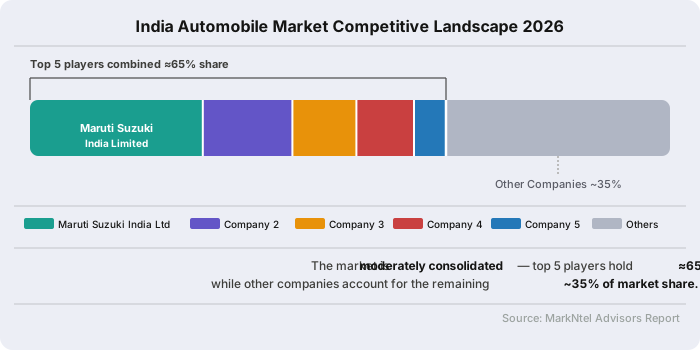
The market is moderately consolidated, with the top five players accounting for approximately 65% of the total market share. Leading companies include Maruti Suzuki India, Hyundai Motor India, Tata Motors, Mahindra & Mahindra, and Hero MotoCorp.
Key Automobile Manufacturing Companies in India
- TVS Motor Company
- Hero MotoCorp
- Honda Motorcycle
- Royal Enfield
- Bajaj Auto
- Suzuki Motorcycle India
- Maruti Suzuki India
- Tata Motors
- Hyundai Motor India
- Mahindra & Mahindra
- Others
Gain a Competitive Edge with Our India Automobile Market Report:
- The India Automobile Market Report by MarkNtel Advisors provides a detailed & thorough analysis of market size & share, growth rate, competitive landscape, and key players. This comprehensive analysis helps businesses gain a holistic understanding of the market dynamics & make informed decisions.
- This report also highlights current market trends & future projections, allowing businesses to identify emerging opportunities & potential challenges. By understanding market forecasts, companies can align their strategies & stay ahead of the competition.
- The India Automobile Market Report aids in assessing & mitigating risks associated with entering or operating in the market. By understanding market dynamics, regulatory frameworks, and potential challenges, businesses can develop strategies to minimize risks & optimize their operations.
*Reports Delivery Format - Market research studies from MarkNtel Advisors are offered in PDF, Excel and PowerPoint formats. Within 24 hours of the payment being successfully received, the report will be sent to your email address.
Frequently Asked Questions
- Market Segmentation
- Introduction
- Product Definition
- Research Process
- Assumptions
- Executive Summary
- India Automobile Market Regulations, Policies & Standards
- India Automobile Market Trends & Developments
- India Automobile Market Pricing Analysis
- India Automobile Market Strategic Insights
- India Automobile Market Import/Export Analysis
- India Automobile Market Dynamics
- Growth Drivers
- Challenges
- India Automobile Market Hotspots & Opportunities
- India Automobile Market Value Chain Analysis
- India Automobile Market Outlook, 2022- 2032F
- Market Size & Analysis
- Market Revenues (USD Million)
- By Quantity sold (Million Units)
- Market Share & Analysis
- By Vehicle Type-Market Size & Forecast 2022-2032, USD Million and Million Units
- Two-wheelers
- Motorcycles
- Scooters
- Mopeds
- Three-wheelers
- Passenger Cars
- SUV
- Sedan
- Hatchback
- Coupe
- Commercial Vehicles
- Light Commercial Vehicles
- Light Truck
- Light Bus
- Minivans
- Medium & Heavy Commercial Vehicle
- Truck
- Bus
- Light Commercial Vehicles
- Two-wheelers
- By Fuel Type-Market Size & Forecast 2022-2032, USD Million and Million Units
- Internal Combustion Engine (Petrol/Diesel)
- LPG / CNG
- Battery Electric Vehicles
- Hybrid Electric Vehicles
- Plug-in Hybrid Electric Vehicles
- Fuel-Cell Electric Vehicles
- By Ownership Type-Market Size & Forecast 2022-2032, USD Million and Million units
- Personal Use
- Commercial Use
- By Price Segment-Market Size & Forecast 2022-2032, USD Million and Million units
- Economy Vehicles
- Mid-range Vehicles
- Luxury & Premium Vehicles
- By Region-Market Size & Forecast 2022-2032, USD Million and Million Units
- North
- National Capital Region (Delhi NCR)
- Uttar Pradesh
- Punjab
- Rajasthan
- South
- Karnataka
- Tamil Nadu
- Kerala
- East
- West Bengal
- Odisha
- West
- Maharashtra
- Gujarat
- Madhya Pradesh
- North
- By Vehicle Type-Market Size & Forecast 2022-2032, USD Million and Million Units
- By Competitors
- Competition Characteristics
- Market Share & Analysis
- Market Size & Analysis
- India Personal Use Automobile Market Outlook, 2022- 2032F
- Market Size & Analysis
- Market Revenues (USD Million)
- By Quantity Sold (Million Units)
- Market Share & Analysis
- By Vehicle Type-Market Size & Forecast 2022-2032, USD Million and Million Units
- By Fuel type- Market Size & Forecast 2022-2032, USD Million and Million Units
- By Price Segment-Market Size & Forecast 2022-2032, USD Million and Million Units
- Market Size & Analysis
- India Commercial Use Automobile Market Outlook, 2022- 2032F
- Market Size & Analysis
- Market Revenues (USD Million)
- By Quantity Sold (Million Units)
- Market Share & Analysis
- By Vehicle Type-Market Size & Forecast 2022-2032, USD Million and Million Units
- By Fuel Type- Market Size & Forecast 2022-2032, USD Million and Million Units
- By Price Segment-Market Size & Forecast 2022-2032, USD Million and Million Units
- Market Size & Analysis
- India Automobile Market Key Strategic Imperatives for Growth & Success
- Competitive Outlook
- Company Profiles
- TVS Motor Company
- Business Description
- Product Portfolio
- Strategic Alliances or Partnerships
- Recent Developments
- Financial Details
- Others
- Hero MotoCorp
- Business Description
- Product Portfolio
- Strategic Alliances or Partnerships
- Recent Developments
- Financial Details
- Others
- Honda Motorcycle
- Business Description
- Product Portfolio
- Strategic Alliances or Partnerships
- Recent Developments
- Financial Details
- Others
- Royal Enfield
- Business Description
- Product Portfolio
- Strategic Alliances or Partnerships
- Recent Developments
- Financial Details
- Others
- Bajaj Auto
- Business Description
- Product Portfolio
- Strategic Alliances or Partnerships
- Recent Developments
- Financial Details
- Others
- Suzuki Motorcycle India
- Business Description
- Product Portfolio
- Strategic Alliances or Partnerships
- Recent Developments
- Financial Details
- Others
- Maruti Suzuki India
- Business Description
- Product Portfolio
- Strategic Alliances or Partnerships
- Recent Developments
- Financial Details
- Others
- Tata Motors
- Business Description
- Product Portfolio
- Strategic Alliances or Partnerships
- Recent Developments
- Financial Details
- Others
- Hyundai Motor India
- Business Description
- Product Portfolio
- Strategic Alliances or Partnerships
- Recent Developments
- Financial Details
- Others
- Mahindra & Mahindra
- Business Description
- Product Portfolio
- Strategic Alliances or Partnerships
- Recent Developments
- Financial Details
- Others
- Others
- TVS Motor Company
- Company Profiles
- Disclaimer
MarkNtel Advisors follows a robust and iterative research methodology designed to ensure maximum accuracy and minimize deviation in market estimates and forecasts. Our approach combines both bottom-up and top-down techniques to effectively segment and quantify various aspects of the market. A consistent feature across all our research reports is data triangulation, which examines the market from three distinct perspectives to validate findings. Key components of our research process include:
1. Scope & Research Design At the outset, MarkNtel Advisors define the research objectives and formulate pertinent questions. This phase involves determining the type of research—qualitative or quantitative—and designing a methodology that outlines data collection methods, target demographics, and analytical tools. They also establish timelines and budgets to ensure the research aligns with client goals.
2. Sample Selection and Data Collection In this stage, the firm identifies the target audience and determines the appropriate sample size to ensure representativeness. They employ various sampling methods, such as random or stratified sampling, based on the research objectives. Data collection is carried out using tools like surveys, interviews, and observations, ensuring the gathered data is reliable and relevant.
3. Data Analysis and Validation Once data is collected, MarkNtel Advisors undertake a rigorous analysis process. This includes cleaning the data to remove inconsistencies, employing statistical software for quantitative analysis, and thematic analysis for qualitative data. Validation steps are taken to ensure the accuracy and reliability of the findings, minimizing biases and errors.

4. Data Forecast and FinalizationThe final phase involves forecasting future market trends based on the analyzed data. MarkNtel Advisors utilize predictive modeling and time series analysis to anticipate market behaviors. The insights are then compiled into comprehensive reports, featuring visual aids like charts and graphs, and include strategic recommendations to inform client decision-making
We offer flexible licensing options to cater to varying organizational needs. Choose the pricing pack that best suits your requirements:
Buy Now Inquire Before Buying
 Request Customization
 Talk to our Consultant







