

Latin America Electric Bicycle Market Research Report: Forecast (2026-2032)
By Propulsion (Pedal Assisted, Throttle Assisted (Power on demand) By Application (Urban Commute, Trekking, Cargo), By Battery Type (Lithium Ion Battery, Lead Acid Battery, Others ... (Nickel Metal Hydride, Nickel Cadmium, etc.)) By Battery Capacity (Less than 250 W, 251 W to 450 W, 451 W to 650 W, Above 651 W), and others Read more
- Automotive
- Apr 2026
- Pages 146
- Report Format: PDF, Excel, PPT
Latin America Electric Bicycle Market
Projected 10.42% CAGR from 2026 to 2032
Study Period
2026-2032
Market Size (2026)
USD 1.39 Billion
Market Size (2032)
USD 2.52 Billion
Base Year
2025
Projected CAGR
10.42%
Leading Segments
By Application, Urban Commute
Latin America Electric Bicycle Market Key Takeaways
- The Latin America electric bicycle market was valued at USD 1.26 billion in 2025 and is expected to grow from USD 1.39 billion in 2026 to USD 2.52 billion by 2032, registering a CAGR of 10.42% during the forecast period.
- Brazil leads the regional landscape, accounting for approximately 40% of the total market share.
- Based on propulsion, pedal-assisted e-bikes dominate the segment with nearly 75% share.
- By application, the urban commute segment captured around 55% share in 2026.
- The Latin America electric bicycle industry remains moderately fragmented, with the top five companies holding a combined share of about 38%.
Latin America Electric Bicycle Market Size and Outlook
The Latin America electric bicycle market was estimated at USD 1.26 billion in 2025 and is anticipated to reach USD 1.39 billion in 2026. It is further projected to grow to approximately USD 2.52 billion by 2032, registering a CAGR of around 10.42% during the forecast period (2026–2032).
The E-bicycle market in Latin America is projected to expand steadily, supported by increasing environmental concerns and the growing adoption of technologically advanced electric bicycles, which are enhancing efficiency, user experience, and overall appeal as sustainable urban mobility solutions. According to the 2025 OECD environmental country notes, population exposure to PM2.5 in countries such as Mexico continues to exceed the WHO safe limit of 5 µg/m³, with major cities recording concentrations between 10.7 and 17.2 µg/m³. These elevated pollution levels are intensifying the need for sustainable transportation in Latin America, encouraging both policymakers and consumers to adopt low-emission mobility solutions.
The situation is further exacerbated by regional pollution trends as the 2026 air quality update indicates that several cities across Chile, Brazil, Peru, and Bolivia are experiencing PM2.5 levels 3–5 times higher than WHO standards , highlighting severe environmental stress in urban centers. Additionally, global rankings in 2024 place countries such as Mexico, Peru, and Chile among the top most polluted worldwide, reinforcing the urgency for immediate action.
Furthermore, in Brazil, seasonal wildfires are contributing to significant pollution spikes, with PM2.5 concentrations reaching 3–5 times recommended limits, further accelerating awareness of green mobility initiatives.
Transport emissions remain a major contributor to declining air quality, pushing governments to prioritize urban transport electrification strategies. This policy shift is directly supporting the adoption of electric bicycles, particularly in densely populated cities where congestion and emissions are highest. As a result, the Latin America is increasingly benefiting from regulatory backing, infrastructure investments, and growing public awareness.
Advancements in digital integration are transforming electric bicycles into intelligent mobility solutions, incorporating features such as real-time tracking, performance monitoring, and enhanced battery management, thereby improving efficiency, user experience, and overall functionality in modern urban transportation systems.
At the same time, private-sector investments are strengthening the overall ecosystem as in 2024, Stellantis announced an investment plan of approximately USD 6.0 billion for 2025–2030 in Latin America, aimed at expanding low-emission vehicle ecosystems and supporting sustainable mobility adoption. Such investments are expected to enhance supply chains, improve technological capabilities, and indirectly boost electric bicycle adoption.
The convergence of worsening air quality, strong policy support, and increasing investment in clean mobility is creating a robust growth environment. As environmental pressures intensify and innovation accelerates, the market is expected to experience sustained expansion, driven by rising demand for efficient, low-emission transportation solutions.
Latin America Electric Bicycle Market Key Indicators
- The United Nations Development Programme reports that transport accounts for nearly 39% of total greenhouse gas emissions in the region, making it a primary target for decarbonization policies . This has accelerated government incentives for e-bikes in Latin America, as policymakers prioritize carbon emission reduction transportation strategies, directly supporting the growth of the Latin America electric bicycle industry.
- As per the United Nations Development Programme, approximately 45% of electricity generation in Latin America is sourced from hydropower, creating a low-carbon energy ecosystem. This strengthens the appeal of sustainable transportation in Latin America, as electric bicycles benefit from cleaner energy inputs, reinforcing their role within the Latin America electric bicycle landscape and improving overall environmental efficiency.
- The Organisation for Economic Co-operation and Development (2025 Outlook) highlights that international bond issuance reached USD 121.77 billion in 2024, with increasing allocation toward climate-focused projects . This financial momentum is driving urban mobility solutions in Latin America, strengthening long-term investment potential.
Latin America Electric Bicycle Market Scope:
| Category | Segments |
|---|---|
| By Type | Bathroom Sanitary Fittings [Toilet Seats, Faucets, Showers & Hand Showers, Accessories, Wall Cabinets], Kitchen Sanitary Fittings [Faucets, Cabinets] |
| By End User | Residential, Commercial & Retail, Hospitality, Healthcare, Government & Transport, Others |
| By Sales Channel | Direct Sales, Dealers & Distributors |
Latin America Electric Bicycle Market Growth Drivers
Rising Environmental Awareness
Growing environmental risks across the region are significantly accelerating the shift toward cleaner transport solutions. As per the 2025 Lancet Countdown report, exposure to extreme wildfire risk in Latin America increased by 26.4% during 2020–2024, while wildfire-related PM2.5 concentrations rose by 6.7%, impacting a large share of the population . This surge in air pollution is intensifying public health concerns and increasing awareness around the need for low-emission mobility alternatives.
Further reinforcing this trend, the 2026 OECD Environmental Performance Review highlights that countries such as Colombia have witnessed a renewed increase in PM2.5 emissions, alongside rising waste generation and energy consumption levels through 2023 . These escalating environmental pressures are prompting governments to strengthen policies focused on emission reduction and sustainable urban development.
Such developments are directly supporting the adoption of green mobility initiatives and accelerating demand for urban transport electrification solutions. As air quality concerns grow, both consumers and policymakers are increasingly favoring electric bicycles as an efficient, low-carbon commuting option, particularly in densely populated urban areas.
Rising pollution levels and climate-related risks are acting as strong catalysts for cleaner mobility adoption. As environmental challenges intensify, this driver will continue to play a crucial role in boosting demand and supporting sustained expansion of the Latin America electric bicycle market.
Recent Trends
Rise of Smart and Connected E-Bikes
A prominent trend across the region is the transition toward smart e-bike technology, supported by real, on-ground deployments rather than just global innovation spillover. This shift is increasingly visible through the integration of digital platforms, battery networks, and data-driven operations into electric two-wheelers, enhancing both user experience and operational efficiency.
One of the most notable examples is the rollout of Gogoro’s battery-swapping infrastructure in Chile and Colombia in partnership with Copec. Introduced in 2024, this ecosystem enables riders to access connected electric bikes supported by cloud-based systems that provide real-time monitoring, efficient energy management, and seamless swapping through strategically located stations. This significantly reduces downtime and eliminates dependency on conventional charging infrastructure.
These smart “swap-and-go” stations, deployed in cities such as Santiago and Bogotá, are designed to support high-demand segments like electric bicycles for logistics and delivery, where uptime, route optimization, and cost efficiency are critical. The connected framework allows operators to monitor battery usage, predict maintenance needs, and improve fleet productivity.
This trend signifies a strong transition within the Latin America electric bicycle industry toward advanced, technology-enabled mobility solutions, where enhanced connectivity and data-driven intelligence are becoming increasingly important. These capabilities improve operational efficiency, optimize performance, and strengthen user experience, ultimately supporting sustained long-term growth.
Latin America Electric Bicycle Market Opportunities and Challenges
Infrastructure Gaps Driving Connected Mobility Expansion
Insufficient cycling infrastructure and limited charging support continue to restrict widespread adoption across several urban centers. Disconnected bike lanes, the absence of protected routes, and inadequate parking facilities reduce user safety and convenience. Even with ongoing improvements, cities such as Lima and sections of Mexico City still experience gaps in continuous networks, limiting the effectiveness of sustainable transportation in Latin America and slowing daily usage adoption.
Simultaneously, this limitation is opening up new growth prospects, as public authorities are ramping up investments in cycling infrastructure aligned with wider clean mobility and emission-reduction objectives. For example, Bogotá has further enhanced its 630+ km cycling network . These initiatives are improving accessibility and encouraging a shift toward cleaner commuting alternatives.
Moreover, better infrastructure is unlocking demand in high-growth segments such as last-mile logistics. Businesses are increasingly adopting last-mile delivery electric bikes due to improved route reliability and lower operating costs. In parallel, shared mobility operators are expanding services in infrastructure-ready cities, boosting consumer confidence.
As investments continue and connectivity improves, these infrastructure upgrades will play a crucial role in accelerating adoption and supporting long-term growth of electric mobility solutions across the region.
Segmentation Insights
Pedal-Assisted Electric Bicycles Dominate the Latin America Market
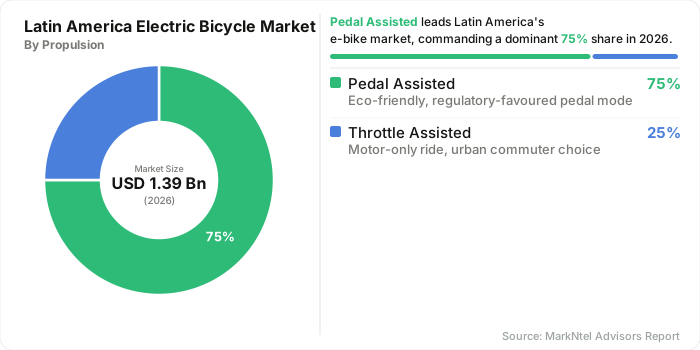
The pedal assisted alone contributes approximately 75% share of the overall revenue in the Latin America Electric Bicycle sector, highlighting their clear leadership over throttle-based variants. This strong position is largely attributed to their compatibility with changing commuting patterns and supportive policy frameworks across the region.
Unlike throttle-powered models, pedal-assisted e-bikes activate the motor only when the rider pedals, resulting in improved energy efficiency and extended battery life. This makes them highly suitable for everyday commuting and longer intra-city travel, where consistent performance and lower charging frequency are important. In densely populated urban centers such as São Paulo and Mexico City, users increasingly favor these systems for their ability to maneuver through traffic while optimizing power usage.
Regulatory advantages further strengthen their dominance, as in many Latin American countries, pedal-assisted e-bikes are treated similarly to traditional bicycles, eliminating the need for licensing or registration. This ease of adoption significantly boosts consumer acceptance and supports expansion within the Latin America electric bicycle industry.
Moreover, these models contribute to broader sustainable transportation in Latin America goals by reducing emissions while encouraging physical activity. Their alignment with urban mobility solutions in Latin America and environmental policies makes them a preferred option.
Overall, efficiency, regulatory ease, and urban suitability continue to drive the sustained dominance of pedal-assisted e-bikes across the regional market. The market is categorized based on propulsion into the following segments:
- Pedal Assisted
- Throttle Assisted (Power on demand)
Urban commute leads the application segment
The urban commute segment holds nearly 55% of total revenue share in the Latin America electric bicycle market, establishing it as the leading application category. Its dominance is largely fueled by rising urban population density, persistent traffic congestion, and the increasing demand for affordable and time-saving transportation options across metropolitan areas.
E-bikes designed for city commuting are optimized for short-to-medium distances, making them highly suitable for daily office travel, errands, and first- and last-mile connectivity. In major cities such as Bogotá and Santiago, commuters are increasingly adopting e-bikes to bypass traffic bottlenecks and reduce reliance on fuel-powered vehicles. The expansion of cycling lanes and improved infrastructure further supports this transition by enhancing rider safety and accessibility.
Cost efficiency is another key factor driving segment growth. Urban commuter e-bikes involve lower upfront and operational expenses compared to conventional vehicles, making them an attractive option for a wide consumer base. Moreover, favorable regulations and government incentives for e-bikes in Latin America are accelerating adoption.
From an environmental standpoint, this segment contributes significantly to carbon emission reduction transportation by minimizing urban emissions. Its growing role within urban mobility solutions in Latin America reinforces its importance.
The convenience, affordability, and sustainability continue to solidify the leadership of urban commuting in the Latin America electric bicycle industry. The study covers the following key application segments:
- Urban Commute
- Trekking
- Cargo
Latin America Electric Bicycle Market Geographical Outlook
The Brazil region accounts for approximately 40% of Latin America electric bicycle demand, making it the leading country in the region. This dominance is primarily driven by its large urban population, expanding metropolitan areas, and increasing pressure on existing transport systems, which are accelerating the shift toward alternative mobility solutions.
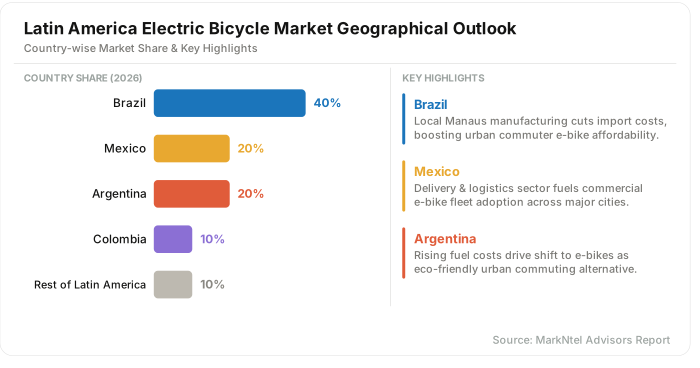
One of the key factors supporting adoption is the rising level of urban air pollution, its annual average PM2.5 concentration increased from 12.9 µg/m³ in 2023 to 14.9 µg/m³ in 2024, highlighting worsening air quality conditions . This has intensified public awareness and policy focus on cleaner transportation options, encouraging the uptake of electric bicycles as part of broader carbon emission reduction transportation strategies.
Major cities such as São Paulo and Rio de Janeiro are witnessing growing demand for e-bikes due to heavy traffic congestion and long commute times. Electric bicycles offer a practical solution by enabling faster, flexible, and cost-efficient urban travel. Additionally, expanding cycling infrastructure and improved road connectivity are supporting daily usage.
Affordability and lower operating costs further strengthen market penetration, especially among middle-income consumers. At the same time, the increasing role of e-bikes in delivery and logistics is contributing to demand growth. The combination of environmental concerns, urban mobility challenges, and economic advantages continues to reinforce Brazil’s leadership in the Latin America electric bicycle industry.
Latin America Electric Bicycle Market Competitive Analysis
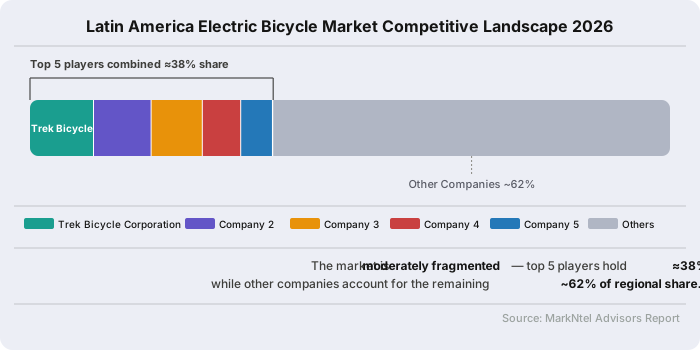
The Latin America electric bicycle landscape is moderately fragmented, with a mix of global manufacturers and regional players competing across various product categories, including pedal-assisted and throttle-assisted models. The market structure reflects strong participation from both established international brands and emerging domestic companies catering to diverse consumer needs and price segments. The top five companies, including Trek Bike Corporation, Merida Bikes, Caloi, Haibike, and Lev Bicycles, collectively account for approximately 38% of the total market share.
Major Companies in Latin America Electric Bicycle Market
- E Mov Inc.
- Trek Bike Corporation
- Brazil Electric Bike
- Merida Bikes
- Caloi
- Ridley Bikes
- Haibike
- Lev Bicycles
- Vela Bikes
- E-Moving
- Others
Latin America Electric Bicycle Industry News and Recent Developments:
November 2024: Whoosh Plans Rapid Expansion of E-Bike Sharing Fleet Across Latin America
Whoosh announced plans to double its micromobility fleet in Latin America by year-end, expanding beyond Brazil and Chile into new markets.
Impact Analysis: This development signals accelerating Latin America electric bicycle market growth, driven by rising adoption of shared mobility models. Fleet expansion and strong usage metrics highlight increasing consumer acceptance of electric bicycle market trends in Latin America, particularly in urban commuting. The entry into new countries and scaling of operations will further strengthen micromobility infrastructure, encouraging investments and boosting long-term demand for e-bikes across the region.
June 2024: LOBO EV Secures Large Ecuador Order to Expand Latin America Presence
LOBO EV Technologies received its largest 2024 order from Ecuadorian wholesalers, comprising nine containers of e-bikes, e-trikes, and solar-powered e-tricycles. The company also reported consistent orders from Brazil, Chile, and Suriname, highlighting growing regional demand for electric mobility solutions.
Impact Analysis: This development highlights accelerating market growth, driven by rising demand across commuting and delivery applications. Bulk procurement signals increasing adoption of urban mobility solutions in Latin America, particularly for income-generating uses. Additionally, the inclusion of solar-powered vehicles supports sustainability trends, strengthening the region’s electric mobility ecosystem and encouraging further investments and distribution expansion.
Frequently Asked Questions
- Market Segmentation
- Introduction
- Research Process
- Assumption
- Market Definition
- Executive Summary
- Latin America Electric Bicycle Battery Pack Local Production Investment Outlook, By Country 2022-2026
- Latin America Electric Bicycle Market Start-up Ecosystem
- Latin America Electric Bicycle Market Trends & Development
- Latin America Electric Bicycle Market Dynamics
- Growth Drivers
- Challenges
- Latin America Electric Bicycle Market Supply Chain Analysis
- Latin America Electric Bicycle Market Policies, Regulations, and Product Standards
- Latin America Electric Bicycle Market Hotspot and Opportunities
- Latin America Electric Bicycle Market Outlook, 2022-2032F
- Market Size and Analysis
- By Revenue (USD Million)
- By Unit Sold (Thousands)
- Market Share and Analysis
- By Propulsion- (USD Million & Thousand Units)
- Pedal Assisted
- Throttle Assisted (Power on demand)
- By Application- (USD Million & Thousand Units)
- Urban Commute
- Trekking
- Cargo
- By Battery Type- (USD Million & Thousand Units)
- Lithium Ion Battery
- Lead Acid Battery
- Others (Nickel Metal Hydride, Nickel Cadmium, etc.)
- By Battery Capacity- (USD Million & Thousand Units)
- Less than 250 W
- 251 W to 450 W
- 451 W to 650 W
- Above 651 W
- By Country
- Mexico
- Brazil
- Argentina
- Columbia
- Chile
- Peru
- Rest of Latin America
- By Company
- Competition Characteristics
- Market Share & Analysis
- By Propulsion- (USD Million & Thousand Units)
- Market Size and Analysis
- Mexico Electric Bicycle Market Outlook, 2022-2032F
- Market Size & Analysis
- By Revenue (USD Million)
- By Unit Sold (Thousands)
- Market Share and Analysis
- By Propulsion- (USD Million & Thousand Units)
- By Application- (USD Million & Thousand Units)
- By Battery Type- (USD Million & Thousand Units)
- By Battery Capacity- (USD Million & Thousand Units)
- Market Size & Analysis
- Brazil Electric Bicycle Market Outlook, 2022-2032F
- Market Size & Analysis
- By Revenue (USD Million)
- By Unit Sold (Thousands)
- Market Share and Analysis
- By Propulsion- (USD Million & Thousand Units)
- By Application- (USD Million & Thousand Units)
- By Battery Type- (USD Million & Thousand Units)
- By Battery Capacity- (USD Million & Thousand Units)
- Market Size & Analysis
- Argentina Electric Bicycle Market Outlook, 2022-2032F
- Market Size & Analysis
- By Revenue (USD Million)
- By Unit Sold (Thousands)
- Market Share and Analysis
- By Propulsion- (USD Million & Thousand Units)
- By Application- (USD Million & Thousand Units)
- By Battery Type- (USD Million & Thousand Units)
- By Battery Capacity- (USD Million & Thousand Units)
- Market Size & Analysis
- Columbia Electric Bicycle Market Outlook, 2022-2032F
- Market Size & Analysis
- By Revenue (USD Million)
- By Unit Sold (Thousands)
- Market Share and Analysis
- By Propulsion- (USD Million & Thousand Units)
- By Application- (USD Million & Thousand Units)
- By Battery Type- (USD Million & Thousand Units)
- By Battery Capacity- (USD Million & Thousand Units)
- Market Size & Analysis
- Chile Electric Bicycle Market Outlook, 2022-2032F
- Market Size & Analysis
- By Revenue (USD Million)
- By Unit Sold (Thousands)
- Market Share and Analysis
- By Propulsion- (USD Million & Thousand Units)
- By Application- (USD Million & Thousand Units)
- By Battery Type- (USD Million & Thousand Units)
- By Battery Capacity- (USD Million & Thousand Units)
- Market Size & Analysis
- Peru Electric Bicycle Market Outlook, 2022-2032F
- Market Size & Analysis
- By Revenue (USD Million)
- By Unit Sold (Thousands)
- Market Share and Analysis
- By Propulsion- (USD Million & Thousand Units)
- By Application- (USD Million & Thousand Units)
- By Battery Type- (USD Million & Thousand Units)
- By Battery Capacity- (USD Million & Thousand Units)
- Market Size & Analysis
- Latin America Electric Bicycle Market Key Strategic Imperatives for Success and Growth
- Competitive Outlook
- Company Profiles
- E Mov Inc.
- Business Description
- Product Portfolio
- Strategic Alliances or Partnerships
- Recent Developments
- Financial Details
- Others
- Trek Bike Corporation
- Business Description
- Product Portfolio
- Strategic Alliances or Partnerships
- Recent Developments
- Financial Details
- Others
- Brazil Electric Bike
- Business Description
- Product Portfolio
- Strategic Alliances or Partnerships
- Recent Developments
- Financial Details
- Others
- Merida Bikes
- Business Description
- Product Portfolio
- Strategic Alliances or Partnerships
- Recent Developments
- Financial Details
- Others
- Caloi
- Business Description
- Product Portfolio
- Strategic Alliances or Partnerships
- Recent Developments
- Financial Details
- Others
- Ridley Bikes
- Business Description
- Product Portfolio
- Strategic Alliances or Partnerships
- Recent Developments
- Financial Details
- Others
- Haibike
- Business Description
- Product Portfolio
- Strategic Alliances or Partnerships
- Recent Developments
- Financial Details
- Others
- Lev Bicycles
- Business Description
- Product Portfolio
- Strategic Alliances or Partnerships
- Recent Developments
- Financial Details
- Others
- Vela Bikes
- Business Description
- Product Portfolio
- Strategic Alliances or Partnerships
- Recent Developments
- Financial Details
- Others
- E-Moving
- Business Description
- Product Portfolio
- Strategic Alliances or Partnerships
- Recent Developments
- Financial Details
- Others
- Others
- E Mov Inc.
- Company Profiles
- Disclaimer
MarkNtel Advisors follows a robust and iterative research methodology designed to ensure maximum accuracy and minimize deviation in market estimates and forecasts. Our approach combines both bottom-up and top-down techniques to effectively segment and quantify various aspects of the market. A consistent feature across all our research reports is data triangulation, which examines the market from three distinct perspectives to validate findings. Key components of our research process include:
1. Scope & Research Design At the outset, MarkNtel Advisors define the research objectives and formulate pertinent questions. This phase involves determining the type of research—qualitative or quantitative—and designing a methodology that outlines data collection methods, target demographics, and analytical tools. They also establish timelines and budgets to ensure the research aligns with client goals.
2. Sample Selection and Data Collection In this stage, the firm identifies the target audience and determines the appropriate sample size to ensure representativeness. They employ various sampling methods, such as random or stratified sampling, based on the research objectives. Data collection is carried out using tools like surveys, interviews, and observations, ensuring the gathered data is reliable and relevant.
3. Data Analysis and Validation Once data is collected, MarkNtel Advisors undertake a rigorous analysis process. This includes cleaning the data to remove inconsistencies, employing statistical software for quantitative analysis, and thematic analysis for qualitative data. Validation steps are taken to ensure the accuracy and reliability of the findings, minimizing biases and errors.

4. Data Forecast and FinalizationThe final phase involves forecasting future market trends based on the analyzed data. MarkNtel Advisors utilize predictive modeling and time series analysis to anticipate market behaviors. The insights are then compiled into comprehensive reports, featuring visual aids like charts and graphs, and include strategic recommendations to inform client decision-making
We offer flexible licensing options to cater to varying organizational needs. Choose the pricing pack that best suits your requirements:
Buy Now Inquire Before Buying
 Request Customization
 Talk to our Consultant







