

South Korea Magnet Free Electric Axle System Market Research Report: Forecast (2026-2032)
South Korea Magnet Free Electric Axle System Market Growth - By Product Type (Induction Motors, Switched Reluctance Motors, Externally Excited Synchronous Motors (EESM), Permanent ... Magnet Motors), By Distribution Channel (OEM Direct Supply, Aftermarket Sales), By End User (Passenger Cars, Hatchback, Sedan, SUV, Commercial Vehicles, Light Commercial Vehicles (LCV), Medium & Heavy Commercial Vehicles (MHCV)), By Technology (Power Electronics (SiC Inverters), Thermal Management Systems, Control Units and Integrated Modules), and others Read more
- Automotive
- Nov 2025
- Pages 164
- Report Format: PDF, Excel, PPT
South Korea Magnet Free Electric Axle System Market
Projected 10.05% CAGR from 2026 to 2032
Study Period
2026-2032
Market Size (2025)
887 USD Million
Market Size (2032)
1734 USD Million
Base Year
2025
Projected CAGR
10.05%
Leading Segments
By Product Type: Induction Motors
South Korea Magnet Free Electric Axle System Market Size: Forecast (2026-2032)
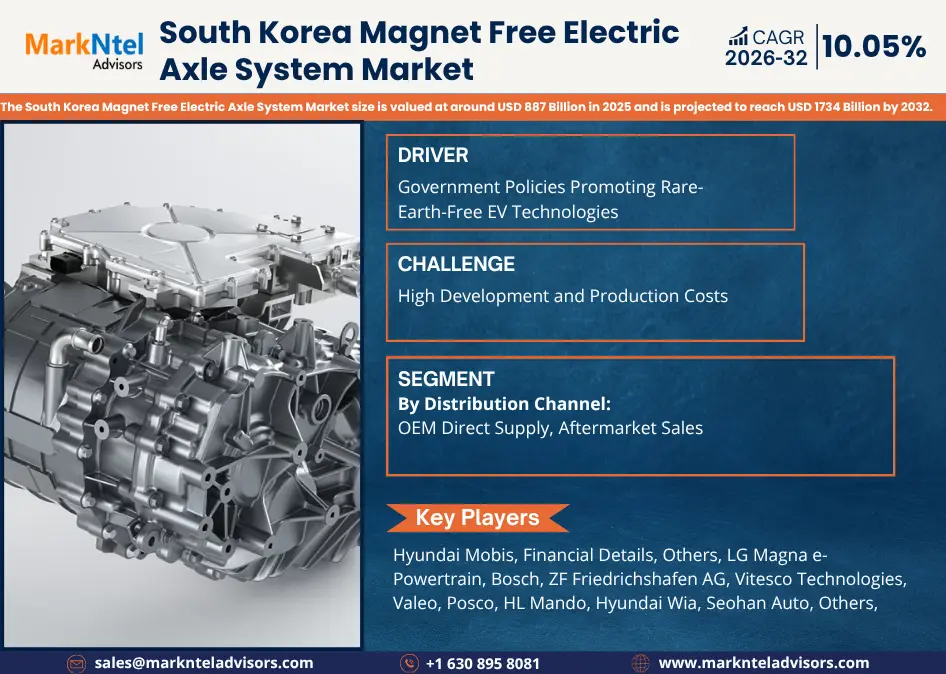
The South Korea Magnet Free Electric Axle System Market size is valued at around USD 887 Million in 2025 and is projected to reach USD 1734 Million by 2032. Along with this, the market is estimated to grow at a CAGR of around 10.05% during the forecast period, i.e., 2026-32.
South Korea Magnet Free Electric Axle System Market Outlook:
South Korea’s Magnet-Free Electric Axle Systems Industry is witnessing strong momentum, driven by the nation’s rapid transition to clean mobility and its strategic push for rare-earth independence. Additionally, aligned with the Green Mobility Strategy (2023) and the Carbon Neutrality Roadmap 2050, the government is promoting technologies that improve drivetrain efficiency, reduce material dependency, and support long-term sustainability. Consequently, magnet-free e-axles, which integrate the motor, inverter, and transmission into one compact unit, are becoming vital components in next-generation EV architectures.
This market expansion is closely tied to South Korea’s rising EV output and industrial diversification. In 2025, the country recorded a sharp increase in electric vehicle production as manufacturers enhanced domestic capacity to meet export and local demand. Hyundai Motor Group expanded its Jeonju plant for electric commercial vehicles, while Hyundai Mobis upgraded its Cheonan and Asan facilities to supply integrated e-axle modules and inverters for upcoming EV platforms. Similarly, Hanon Systems established an additional production line in Daejeon, focusing on thermal management solutions that boost e-axle performance and reliability.
Moreover, the localization of silicon-carbide (SiC) semiconductor production in Busan has strengthened the national supply chain for high-efficiency power electronics—an essential enabler of magnet-free systems. Together, these connected advancements in policy, technology, and manufacturing are transforming South Korea into a regional hub for high-performance, sustainable magnet-free e-axle innovation, supporting both domestic growth and expanding EV exports through 2030.
South Korea Magnet Free Electric Axle System Market Scope:
| Category | Segments |
|---|---|
| By Product Type | Induction Motors, Switched Reluctance Motors, Externally Excited Synchronous Motors (EESM), Permanent Magnet Motors |
| By Distribution Channel | OEM Direct Supply, Aftermarket Sales |
| By End User | Passenger Cars, Hatchback, Sedan, SUV, Commercial Vehicles, Light Commercial Vehicles (LCV), Medium & Heavy Commercial Vehicles (MHCV) |
| By Technology | Power Electronics (SiC Inverters), Thermal Management Systems, Control Units and Integrated Modules), and others |
South Korea Magnet Free Electric Axle System Market Recent Developments:
- May, 2024: Hyundai Mobis signs a Memorandum of Understanding (MOU) with the Ulsan city government to build a new EV-module plant. The investment is about USD65.8 million, and the factory will be dedicated to the Genesis EV models.
- 2024: Vitesco Technologies expanded its EV powertrain plant in Icheon, South Korea, adding a 2,800 m2 manufacturing extension to scale production of its electric axle systems. The upgraded facility now has an annual capacity exceeding 200,000 units, supplying advanced e-axle modules for Hyundai, Kia, etc.
South Korea Magnet Free Electric Axle System Market Drivers:
Government Policies Promoting Rare-Earth-Free EV Technologies
The South Korean government is directly supporting the growth of the magnet-free electric axle systems market through policies encouraging sustainable, high-efficiency EV drivetrain technologies. Under the Green Mobility Strategy (2023), the Ministry of Trade, Industry, and Energy (MOTIE) has prioritized R&D funding for rare-earth-free motor systems, SiC-based inverters, and domestic e-axle production to strengthen the national EV component ecosystem. Additionally, the government’s Carbon Neutrality Roadmap 2050 targets full electrification of passenger transport, which includes developing lightweight, recyclable, and energy-efficient drivetrains.
In 2025, the Ministry of Trade, Industry, and Energy (MOTIE) also introduced a rare-earth supply chain task force to reduce import dependency and promote magnet-free technologies. Combined with tax incentives for EV parts manufacturing and investments in local production clusters like Cheonan and Asan, these initiatives form a strong policy framework that directly drives innovation, localization, and commercialization of magnet-free electric axle systems across South Korea’s rapidly expanding EV market.
Growing Domestic EV Production and Exports
The surge in South Korea’s electric-vehicle (EV) manufacturing and export activities is directly boosting demand for advanced power-train solutions like magnet-free electric-axle systems. For instance, in 2025, South Korea produced 407,009 EVs, which accounted for 11% of total automobile production.
Furthermore, for the full year 2023, South Korea exported 349,000 electric vehicles, representing a 58.1% increase over the previous year, and the export value of eco-friendly vehicles hit USD24.2 billion. As OEMs ramp up production and global sales of EVs, more advanced, efficient drivetrain components, such as magnet-free e-axles, are required. This export-oriented production growth therefore serves as a powerful growth driver for the magnet-free electric-axle systems market in South Korea.
South Korea Magnet Free Electric Axle System Market Trends:
3-in-1 E-Axle Integration Gaining Momentum
The South Korea magnet-free electric axle systems industry is increasingly shifting toward 3-in-1 integrated e-axle architectures, where the motor, inverter, and reduction gearbox are combined into a single compact module over the traditional 2-in-1 modules in the country. This design trend improves efficiency, reduces manufacturing complexity, and enhances packaging flexibility for EVs. In November 2023, Vitesco Technologies began production of its EMR4 e-axle at the Icheon plant, a fully integrated unit supporting 400 V and 800 V systems with up to 160 kW output.
Similarly, Hanon Systems is expanding its Daejeon facility to develop integrated cooling and motor modules for e-axle applications, supporting Hyundai and Kia EV platforms. Thus, 3-in-1 modular e-axle integration is becoming a defining trend, paving the way for compact, efficient, and magnet-free drivetrain production in South Korea.
South Korea Magnet Free Electric Axle System Market Challenges:
High Development and Production Costs
South Korea’s push into magnet-free electric-axle systems faces a significant cost hurdle, both in development and manufacturing. The motors, high-voltage inverters, and gear-reducers integrated into such e-axles require advanced engineering and premium materials, driving higher costs. As domestic output scales, higher unit costs remain a challenge for suppliers still refining rare-earth-free motor architectures, silicon-carbide (SiC) power electronics, and precision assembly processes. Until volumes rise and learning curves advance, the cost gap versus traditional magnet-based e-axles may restrain wider adoption.
South Korea Magnet Free Electric Axle System Market (2026-32) Segmentation Analysis:
The South Korea Magnet Free Electric Axle System Market Report and Forecast 2026-2032 offers a detailed analysis of the market based on the following segments:
Based on the End User
- Passenger Cars
- Hatchback
- Sedan
- SUV
- Commercial Vehicles
- Light Commercial Vehicles (LCV)
- Medium & Heavy Commercial Vehicles (MHCV)
In South Korea’s Magnet-Free Electric Axle System Industry, the passenger car segment holds clear dominance, driven by rapid electrification and strong domestic manufacturing. This dominance is reinforced by the surge in electric and hybrid passenger models, led by automakers such as Hyundai, Kia, and Genesis. For instance, Hyundai’s IONIQ 5 and Kia’s EV9 feature integrated e-axle systems that enhance range and energy recovery, highlighting the country’s shift toward magnet-free propulsion. With SUVs and sedans forming the bulk of these sales, passenger cars remain the primary end-user category driving innovation, production, and deployment of magnet-free electric axle technologies in South Korea.
Based on the Technology
- Power Electronics (SiC Inverters)
- Thermal Management Systems
- Control Units and Integrated Modules
In this market, the power electronics segment has emerged as the leading contributor due to its critical role in controlling energy flow and enhancing drivetrain efficiency. Power electronics, mainly inverters, converters, and control units, enable precise torque distribution and high-speed motor performance, which are essential for magnet-free architectures. For instance, Hyundai plans to replace its existing silicon power module with a third-generation Silicon Carbide (SiC) unit from STMicroelectronics, offering higher power density and energy efficiency to deliver improved vehicle performance, extended range, and faster charging.
Similarly, LG Innotek and Hyundai Mobis are investing heavily in advanced SiC-based inverters to improve energy density and reduce power loss. Hence, power electronics dominate this market as the technological core enabling performance, sustainability, and local manufacturing competitiveness.
Leading Manufacturers of the South Korea Magnet Free Electric Axle System Market:
Hyundai Mobis
Established in 1977, Hyundai Mobis is a core automotive component arm of the Hyundai Motor Group and one of South Korea’s leading suppliers of electrification systems. The company plays a crucial role in developing magnet-free electric axle modules, aiming to reduce rare earth dependence while enhancing motor efficiency. With a strong domestic R&D base and global manufacturing presence, Hyundai Mobis supports large-scale integration of e-axle systems into Hyundai and Kia electric vehicles.
LG Magna e-Powertrain
Founded in 2021 as a joint venture between LG Electronics and Magna International, LG Magna e-Powertrain operates key facilities in Incheon, South Korea. The company focuses on designing rare-earth-free electric drive systems, including motors, inverters, and integrated e-axles. Leveraging LG’s electronics expertise and Magna’s drivetrain engineering, it plays a major role in advancing scalable, high-efficiency e-mobility solutions for global and domestic automakers.
HL Mando
Established in 1962, HL Mando is a major Korean supplier of electric powertrains and intelligent chassis systems. With headquarters in Seongnam-si, the company is actively developing magnet-free electric axles optimized for torque control, compact design, and thermal efficiency. Its investments in AI-driven production and smart mobility technologies strengthen South Korea’s position in advanced EV component manufacturing.
Bosch, ZF Friedrichshafen AG, Vitesco Technologies, Valeo, Posco, Hyundai Wia, Seohan Auto, and Others are the key players in the South Korea Magnet Free Electric Axle System Market.
South Korea Magnet Free Electric Axle System Market (2026-32): Regional Projection
The central region of South Korea, particularly Chungcheong (Cheonan, Asan, and Dangjin), has emerged as a dominant center for the country’s evolving magnet-free electric axle system industry due to its strong automotive production base and supplier concentration. A large number of automotive component manufacturers operate in this region, forming a robust ecosystem for electric drivetrain innovation. Additionally, Chungcheong ranks as the third-largest vehicle production hub in South Korea, following Ulsan and Gyeonggi, giving it a strategic advantage in supplying next-generation EV powertrains.
Major companies such as Hyundai Mobis and Hanon Systems operate R&D and production facilities here, supporting the shift toward rare-earth-free and energy-efficient e-axles. Likewise, the South Korean government’s Green Mobility Strategy (2023) and regional industrial complexes like Asan Techno Valley further enhance localized manufacturing capacity. This concentration of manufacturers, infrastructure, and policy support positions the central region as the core growth engine for magnet-free e-axle development in the nation.
Gain a Competitive Edge with Our South Korea Magnet Free Electric Axle System Market Report
- South Korea Magnet Free Electric Axle System Market Report by MarkNtel Advisors provides a detailed & thorough analysis of market size & share, growth rate, competitive landscape, and key players. This comprehensive analysis helps businesses gain a holistic understanding of the market dynamics & make informed decisions.
- This report also highlights current market trends & future projections, allowing businesses to identify emerging opportunities & potential challenges. By understanding market forecasts, companies can align their strategies & stay ahead of the competition.
- South Korea Magnet Free Electric Axle System Market Report aids in assessing & mitigating risks associated with entering or operating in the market. By understanding market dynamics, regulatory frameworks, and potential challenges, businesses can develop strategies to minimize risks & optimize their operations.
*Reports Delivery Format - Market research studies from MarkNtel Advisors are offered in PDF, Excel and PowerPoint formats. Within 24 hours of the payment being successfully received, the report will be sent to your email address.
Frequently Asked Questions
- Market Segmentation
- Introduction
- Product Definition
- Research Process
- Assumptions
- Executive Summary
- South Korea Magnet Free Electric Axle System Market Regulations, Policies & Standards
- South Korea Magnet Free Electric Axle System Market Trends & Developments
- South Korea Magnet Free Electric Axle System Market Pricing Analysis
- South Korea Magnet Free Electric Axle System Market Strategic Insights
- South Korea Magnet Free Electric Axle System Market Dynamics
- Growth Drivers
- Challenges
- Trends
- Opportunities
- South Korea Magnet Free Electric Axle System Market Hotspots & Opportunities
- South Korea Magnet Free Electric Axle System Market Value Chain Analysis
- South Korea Magnet Free Electric Axle System Market Outlook, 2020- 2032F
- Market Size & Analysis
- Market Revenues (USD Million)
- Market Share & Analysis
- By Product Type
- Induction Motors- Market Size & Forecast 2020-2032, USD Million
- Switched Reluctance Motors- Market Size & Forecast 2020-2032, USD Million
- Externally Excited Synchronous Motors (EESM)- Market Size & Forecast 2020-2032, USD Million
- Permanent Magnet Motors- Market Size & Forecast 2020-2032, USD Million
- By Distribution Channel
- OEM Direct Supply- Market Size & Forecast 2020-2032, USD Million
- Aftermarket Sales- Market Size & Forecast 2020-2032, USD Million
- By End User
- Passenger Cars- Market Size & Forecast 2020-2032, USD Million
- Hatchback- Market Size & Forecast 2020-2032, USD Million
- Sedan- Market Size & Forecast 2020-2032, USD Million
- SUV- Market Size & Forecast 2020-2032, USD Million
- Commercial Vehicles- Market Size & Forecast 2020-2032, USD Million
- Light Commercial Vehicles (LCV)- Market Size & Forecast 2020-2032, USD Million
- Medium & Heavy Commercial Vehicles (MHCV)- Market Size & Forecast 2020-2032, USD Million
- Passenger Cars- Market Size & Forecast 2020-2032, USD Million
- By Technology
- Power Electronics (SiC Inverters)- Market Size & Forecast 2020-2032, USD Million
- Thermal Management Systems- Market Size & Forecast 2020-2032, USD Million
- Control Units and Integrated Modules- Market Size & Forecast 2020-2032, USD Million
- By Region
- North
- South
- East
- West
- Central
- By Competitors
- Competition Characteristics
- Market Share & Analysis
- By Product Type
- Market Size & Analysis
- South Korea Magnet Free Electric Axle System for Passenger Cars Market Outlook, 2020- 2032F
- Market Size & Analysis
- Market Revenues (USD Million)
- Market Share & Analysis
- By Product Type- Market Size & Forecast 2020-2032, USD Million
- By Distribution Channel- Market Size & Forecast 2020-2032, USD Million
- By End User- Market Size & Forecast 2020-2032, USD Million
- Market Size & Analysis
- South Korea Magnet Free Electric Axle System for Commercial Vehicles Market Outlook, 2020- 2032F
- Market Size & Analysis
- Market Revenues (USD Million)
- Market Share & Analysis
- By Product Type- Market Size & Forecast 2020-2032, USD Million
- By Distribution Channel- Market Size & Forecast 2020-2032, USD Million
- By End User- Market Size & Forecast 2020-2032, USD Million
- Market Size & Analysis
- South Korea Magnet Free Electric Axle System Market Key Strategic Imperatives for Growth & Success
- Competitive Outlook
- Company Profiles
- Hyundai Mobis
- Business Description
- Product Portfolio
- Strategic Alliances or Partnerships
- Recent Developments
- Financial Details
- Others
- LG Magna e-Powertrain
- Business Description
- Product Portfolio
- Strategic Alliances or Partnerships
- Recent Developments
- Financial Details
- Others
- Bosch
- Business Description
- Product Portfolio
- Strategic Alliances or Partnerships
- Recent Developments
- Financial Details
- Others
- ZF Friedrichshafen AG
- Business Description
- Product Portfolio
- Strategic Alliances or Partnerships
- Recent Developments
- Financial Details
- Others
- Vitesco Technologies
- Business Description
- Product Portfolio
- Strategic Alliances or Partnerships
- Recent Developments
- Financial Details
- Others
- Valeo
- Business Description
- Product Portfolio
- Strategic Alliances or Partnerships
- Recent Developments
- Financial Details
- Others
- Posco
- Business Description
- Product Portfolio
- Strategic Alliances or Partnerships
- Recent Developments
- Financial Details
- Others
- HL Mando
- Business Description
- Product Portfolio
- Strategic Alliances or Partnerships
- Recent Developments
- Financial Details
- Others
- Hyundai Wia
- Business Description
- Product Portfolio
- Strategic Alliances or Partnerships
- Recent Developments
- Financial Details
- Others
- Seohan Auto
- Business Description
- Product Portfolio
- Strategic Alliances or Partnerships
- Recent Developments
- Financial Details
- Others
- Others
- Hyundai Mobis
- Company Profiles
- Disclaimer
MarkNtel Advisors follows a robust and iterative research methodology designed to ensure maximum accuracy and minimize deviation in market estimates and forecasts. Our approach combines both bottom-up and top-down techniques to effectively segment and quantify various aspects of the market. A consistent feature across all our research reports is data triangulation, which examines the market from three distinct perspectives to validate findings. Key components of our research process include:
1. Scope & Research Design At the outset, MarkNtel Advisors define the research objectives and formulate pertinent questions. This phase involves determining the type of research—qualitative or quantitative—and designing a methodology that outlines data collection methods, target demographics, and analytical tools. They also establish timelines and budgets to ensure the research aligns with client goals.
2. Sample Selection and Data Collection In this stage, the firm identifies the target audience and determines the appropriate sample size to ensure representativeness. They employ various sampling methods, such as random or stratified sampling, based on the research objectives. Data collection is carried out using tools like surveys, interviews, and observations, ensuring the gathered data is reliable and relevant.
3. Data Analysis and Validation Once data is collected, MarkNtel Advisors undertake a rigorous analysis process. This includes cleaning the data to remove inconsistencies, employing statistical software for quantitative analysis, and thematic analysis for qualitative data. Validation steps are taken to ensure the accuracy and reliability of the findings, minimizing biases and errors.

4. Data Forecast and FinalizationThe final phase involves forecasting future market trends based on the analyzed data. MarkNtel Advisors utilize predictive modeling and time series analysis to anticipate market behaviors. The insights are then compiled into comprehensive reports, featuring visual aids like charts and graphs, and include strategic recommendations to inform client decision-making
We offer flexible licensing options to cater to varying organizational needs. Choose the pricing pack that best suits your requirements:
Buy Now Inquire Before Buying
 Request Customization
 Talk to our Consultant







