

Egypt Logistics Market Research Report: Trends, Forecast & Opportunities (2026-2032)
By Service (Transportation, Warehousing and storage, Distribution and fulfillment, Freight forwarding, Customs brokerage, Contract logistics, Value-added logistics services), By Ty ... pe (Forward Logistics, Reverse Logistics), By Mode of Transport (Roadways, Waterways, Airways, Railways), By Model (2PL (Second Party Logistics), 3PL (Third Party Logistics), 4PL (Fourth Party Logistics)), By Scope of Operation (Domestic Logistics, International Freight), By End Use (FMCG & Retail, Food & Agriculture, Automotive & Industrial Manufacturing, Pharmaceuticals & Healthcare, Electronics, Chemicals, Oil & Gas, Construction & Infrastructure, Others), and others Read more
- Automotive
- Aug 2026
- Pages 145
- Report Format: PDF, Excel, PPT
Egypt Logistics Market
Projected 3.73% CAGR from 2026 to 2032
Study Period
2026-2032
Market Size (2026)
USD 19.37 Billion
Market Size (2032)
USD 24.13 Billion
Base Year
2025
Projected CAGR
3.73%
Leading Segments
By Service Type: Transportation
Egypt Logistics Market Key Takeaways
- The Egypt logistics market is estimated at USD 18.67 billion in 2025, rising to USD 19.37 billion in 2026 and USD 24.13 billion by 2032.
- The industry is projected to witness steady growth at a 73% CAGR during 2026-32.
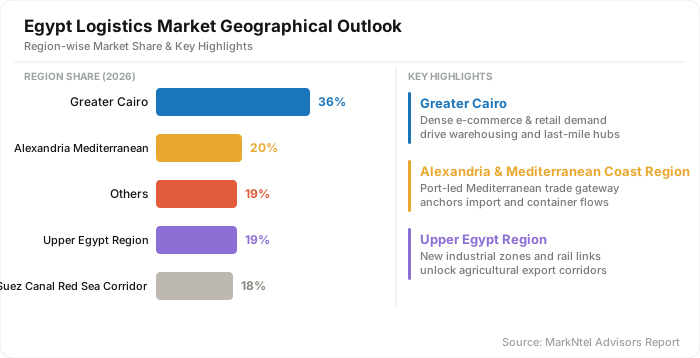
- Greater Cairo is projected to lead the market, accounting for approximately a 36% share in 2026.
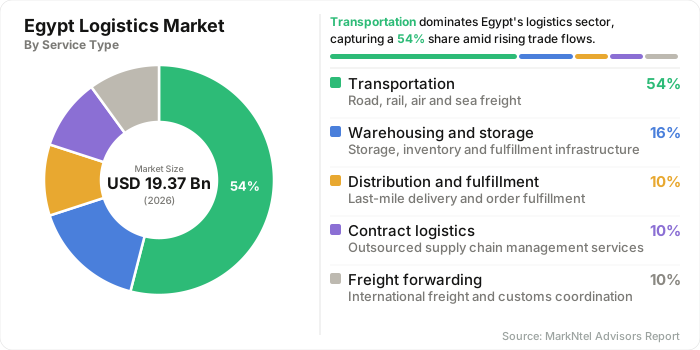
- By service, transportation is estimated to dominate with approximately a 54% share in 2026.
- By transport mode, roadways are estimated to hold approximately a 58% share in 2026.
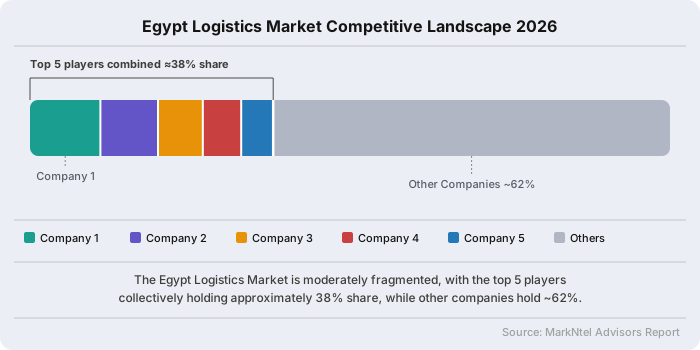
- The industry remains moderately fragmented, with a share of 38%.
Egypt Logistics Market Size and Outlook
The logistics market in Egypt is estimated to accelerate from USD 18.67 billion in 2025 to USD 19.37 billion in 2026, supported by expanding port throughput and logistics infrastructure. In 2025, Egypt Marine Ports Company handled more than 800,000 TEUs, with throughput rising 41% year-on-year, demonstrating stronger cargo-handling activity.
In 2026, the government continued developing integrated logistics corridors, including the 133-feddan Borg El Arab dry port and logistics zone, while SCZONE attracted USD 7.1 billion in investments during the current fiscal year, strengthening industrial and logistics demand. These developments are expanding Egypt’s freight, warehousing, port, and multimodal logistics capacity.
Egypt Logistics Market Key Indicators
- Alexandria Port handled more than 82 million tonnes of cargo during FY2025/26, compared with 8 million tonnes in FY2024/25, representing approximately 10% growth, according to Egypt’s Ministry of Transport. Rising cargo volumes increase requirements for container handling, trucking, freight forwarding, customs clearance, warehousing, and last-mile distribution, strengthening logistics demand across the Alexandria and Mediterranean Coast region.
- In 2025, SCZONE signed an agreement for the development of the 20-square-kilometer KEZAD East Port Said industrial and logistics zone, strengthening the area's manufacturing and distribution infrastructure. Expansion around East Port Said is expected to generate additional demand for container transport, warehousing, distribution centers, customs services, freight forwarding, and supply-chain management, while improving Egypt's ability to connect Mediterranean shipping flows with industrial production.
- The Qantara West Industrial Zone recorded 46 projects with investments of approximately USD 1.185 billion in 2025, according to the Suez Canal Economic Zone. The projects span manufacturing activities requiring supply-chain infrastructure. New industrial facilities increase inbound movement of raw materials and machinery and outbound movement of finished products, creating additional requirements for road freight, warehousing, distribution, customs handling, and logistics services across the Suez Canal and Nile Delta connectivity corridor.
- SCZONE's development framework integrates six ports across the Mediterranean and Red Sea with industrial and logistics zones, creating a connected network for manufacturing, maritime transportation, and cargo distribution. The network remained a key focus of development activity in 2025–2026. Port-industrial integration reduces transfer distances between production and shipping facilities, supporting multimodal logistics, freight forwarding, container handling, storage, and distribution while reinforcing Egypt's position as a strategic trade gateway between Europe, Asia, and Africa.
- Egypt's transport development program includes the Taba–Arish railway corridor, with approximately 500 km of railway infrastructure planned to strengthen connectivity across Sinai. The project remained part of national transport-development activity in 2025–2026. Improved rail connectivity can diversify freight movement beyond road transport, strengthen links between Red Sea and Mediterranean gateways, and create longer-term opportunities for multimodal freight, bulk transportation, industrial distribution, and logistics services in the Sinai and Suez Canal regions.
Egypt Logistics Market Scope
| Category | Segments |
|---|---|
| By Service | Transportation, Warehousing and storage, Distribution and fulfillment, Freight forwarding, Customs brokerage, Contract logistics, Value-added logistics services |
| By Type | Forward Logistics, Reverse Logistics |
| By Mode of Transport | Roadways, Waterways, Airways, Railways |
| By Model | 2PL (Second Party Logistics), 3PL (Third Party Logistics), 4PL (Fourth Party Logistics |
| By Scope of Operation | Domestic Logistics, International Freight |
| By End Use | FMCG & Retail, Food & Agriculture, Automotive & Industrial Manufacturing, Pharmaceuticals & Healthcare, Electronics, Chemicals, Oil & Gas, Construction & Infrastructure, Others |
Egypt Logistics Market Growth Drivers
Rapid Growth of E-Commerce and Last-Mile Deliveries
Egypt’s e-commerce expansion is strengthening logistics demand by increasing the volume and frequency of parcel movements across major consumer markets. In 2025, Jumia inaugurated a 27,000-square-meter integrated warehouse in Cairo, designed to expand storage and distribution capacity and improve delivery coverage, including underserved markets in Upper Egypt. The investment reflects the shift toward larger, strategically located fulfillment facilities as online retail volumes rise. Greater Cairo remains particularly important because its dense consumer base generates substantial requirements for inventory storage, order processing, sorting, and time-sensitive last-mile deliveries.
The growth of digital commerce is also increasing logistics intensity because online orders require multiple logistics touchpoints, from seller pickup and centralized sorting to final delivery and returns. Egypt’s Digital Egypt program continued supporting digital services and electronic transactions in 2025, while the Central Bank of Egypt promoted electronic payment adoption, supporting the broader digital-commerce ecosystem. As online purchasing becomes more integrated into consumer behavior, logistics providers are expanding courier networks, fulfillment capabilities, and delivery coverage beyond Cairo and Alexandria. This is increasing demand for flexible, technology-enabled last-mile logistics across Egypt.
Recent Trends
Integrated Logistics Corridors Are Reshaping Egypt’s Freight Network
Egypt is accelerating the development of integrated logistics corridors that connect production centers, dry ports, logistics zones, railways, roads, and maritime gateways. In 2025, the Ministry of Transport identified seven integrated logistics corridors, including the Ain Sokhna–Alexandria corridor, linking Red Sea and Mediterranean ports with industrial areas. This network is strengthening multimodal freight movement and improving connections between inland production centers and export gateways.
Building on these corridors, Egypt is developing 33 dry ports and logistics zones to move cargo processing closer to industrial and consumption centers. A notable development in 2026 was the Safaga 2 terminal, located within the Safaga–Qena–Abu Tartur logistics corridor. The terminal combines container handling, general-cargo facilities, warehousing, and rail connectivity, extending organized logistics infrastructure into Upper Egypt.
This infrastructure expansion is increasingly linked with technology. In 2026, Egypt launched a fully automated terminal at Ain Sokhna Port, strengthening the Red Sea component of the Sokhna–Alexandria corridor. The combination of multimodal connectivity and automated port operations is increasing Egypt’s capacity for freight forwarding, warehousing, trucking, rail logistics, and integrated supply-chain services.
Egypt Logistics Market Opportunities and Challenges
Customs Clearance Complexity Leading to Demand for Digital Trade and Compliance Services
Egypt’s logistics operators continue to face operational pressure from complex customs, inspection, and documentation requirements, particularly for imported cargo moving through multiple regulatory checkpoints. In 2026, the government expanded its Unified Risk Management system, with a target to increase the number of trusted economic operators on the Green Track by 20% from the existing base of 650 operators by December 2026. The reform indicates that customs processing remains an important efficiency consideration for importers, freight forwarders, customs brokers, and logistics providers, where clearance delays can affect cargo release, storage requirements, and delivery schedules.
The same requirement is creating opportunities for digital customs brokerage, shipment tracking, compliance management, and automated documentation services. In February 2026, GOEIC began implementing an USD 11 million digital risk-based inspection and tracking project, covering approximately 10,000 industrial product categories and more than 320 accredited laboratories. The system is designed to automate inspection procedures and improve goods-release efficiency. For logistics providers, this creates scope to integrate customs documentation, regulatory compliance, shipment visibility, and clearance coordination into higher-value digital logistics services, reducing administrative friction while improving cargo-flow predictability.
Segmentation Insights
Expanding Port and Regional Connectivity Supporting Transportation Services with Approximately 54% Share
Transportation remains a core component of the Egypt logistics industry, supported by the expansion of logistics infrastructure connecting production areas with domestic and international trade routes. The segment is gaining momentum from the development of specialized logistics infrastructure beyond Egypt’s established commercial centers. In 2026, Egypt’s Ministry of Transport advanced the development of a logistics zone at Arish Port covering approximately 603 feddans, as part of the broader expansion of the port and its supporting logistics facilities. The project is designed to strengthen cargo handling and logistics activities serving Sinai’s industrial and agricultural base while improving export connectivity.
Complementing the port development, the government is implementing a 12-km railway connection linking Arish Port with Egypt’s national railway network. This creates an additional freight interface between maritime cargo and inland transportation, supporting the movement of goods between the port, production areas, and wider domestic markets. The combination of port capacity, logistics-zone development, and multimodal connectivity is strengthening transportation requirements in northern Sinai. As new logistics infrastructure connects previously less-integrated production regions with national trade networks, transportation providers are gaining opportunities across cargo movement, port drayage, inland distribution, and multimodal freight services. Based on the service type, the market is further segmented into:
- Transportation
- Warehousing and storage
- Distribution and fulfillment
- Freight forwarding
- Customs brokerage
- Contract logistics
- Value-added logistics services
Roadways Leading Egypt Logistics Market by Transport Mode with Approximately 58% Share
Roadways are estimated to account for approximately 58% of the Egypt logistics market by transport mode, reflecting their essential role in connecting ports, industrial facilities, warehouses, distribution centers, and end markets. The segment’s importance is reinforced by Egypt’s expanding container-handling capacity, which increases the volume of cargo requiring inland transportation after arriving at maritime gateways. In 2025, Damietta Port’s Tahya Misr 2 container terminal entered commercial operation, adding significant container-handling capacity and strengthening the port’s position as a regional transshipment and logistics hub. The terminal is designed to handle up to 3.5 million TEUs annually, creating additional cargo flows between the port and inland industrial and consumption centers.
This expansion supports demand for container trucking, port drayage, first-mile transportation, and distribution services because maritime cargo ultimately requires inland movement to reach its destination. As Egypt continues expanding container infrastructure and integrating ports with domestic supply chains, road transport benefits directly from higher cargo throughput. Consequently, its flexibility and ability to provide door-to-door connectivity continue to underpin its leading position within Egypt’s logistics transportation mix. Based on the mode of transport, the market is further segmented into:
- Roadways
- Waterways
- Airways
- Railways
Greater Cairo Region Leads Egypt Logistics Market with Approximately 36% Share
The Greater Cairo Region accounts for an estimated 36% of Egypt’s logistics market, supported by its concentration of manufacturing, wholesale trade, distribution facilities, and investment activity. The region encompasses major logistics-linked industrial locations including Badr, Obour, and New Cairo, creating consistent freight requirements between factories, warehouses, commercial centers, and consumer markets. Government data also show continued industrial expansion around eastern Cairo, with new investments planned across Badr and Obour.
This industrial concentration is increasingly being supported by dedicated logistics infrastructure. In 2026, Egypt's General Authority for Land and Dry Ports signed a contract with Medlog to develop a dry port and logistics zone in 10th of Ramadan City, strengthening connections between eastern Cairo's industrial base and national freight networks. The project is particularly relevant to the region's logistics position because 10th of Ramadan serves manufacturing activity across the Cairo-Suez axis.
Greater Cairo's role is therefore shifting beyond consumer distribution toward integrated industrial logistics, combining warehousing, inland freight, customs-related services, and multimodal connectivity. This expanding industrial-logistics ecosystem supports its position as Egypt's leading regional logistics market.
Egypt Logistics Market Competitive Analysis
The Egypt Logistics Market is moderately fragmented, with competition distributed among integrated logistics providers, freight forwarding companies, express delivery operators, shipping and port-logistics companies, contract logistics providers, and warehousing specialists. Major participants include DHL Group, DSV A/S, Kuehne+Nagel, CMA CGM Group/CEVA Logistics, and DP World. The top five players collectively account for an estimated 38% of the Egypt logistics market in 2026, while the remaining market is shared among regional and domestic logistics providers.
Key Companies in the Egypt Logistics Market
- DHL Group
- DSV A/S
- Kuehne+Nagel
- CMA CGM Group / CEVA Logistics
- DP World
- Aramex
- FedEx
- UPS
- P. Moller - Maersk
- Expeditors International
- Others
Egypt Logistics Industry News and Recent Developments
June 2026: DP World Launches Egypt’s First Integrated Logistics Distribution Centre
DP World launched Egypt’s first fully integrated Logistics Distribution Centre (LDC) at Sokhna Logistics Park in July 2026. The facility is designed to provide international companies with a single distribution hub for serving Egypt as well as regional and global markets. The launch was attended by Egypt’s Prime Minister, highlighting the facility’s strategic relevance to national logistics development.
Impact Analysis: The development expands Egypt’s integrated warehousing and distribution infrastructure and strengthens Sokhna’s role as a logistics gateway. It also supports the shift toward consolidated distribution models combining port access, warehousing, and regional fulfillment.
June 2026: Safaga 2 Terminal Begins Commercial Trial Operations
Egypt commenced commercial trial operations at the Safaga 2 multipurpose terminal in June 2026, with the first vessels carrying 5,000 vehicles and 2,642 TEUs arriving at the facility. Developed in partnership with Abu Dhabi Ports Group, the terminal forms part of the Safaga–Qena–Abu Tartour logistics corridor and is intended to connect Upper Egypt with international markets.
Impact Analysis: The terminal expands Red Sea cargo-handling capacity while improving logistics access for Upper Egypt, mining activities, industrial zones, and export-oriented businesses. Its corridor integration can increase demand for inland transportation, warehousing, customs clearance, and freight-forwarding services.
Frequently Asked Questions
- Market Segmentation
- Introduction
- Product Definition
- Research Process
- Assumptions
- Executive Summary
- Egypt Logistics Market Policies, Regulations, and Product Standards
- Egypt Logistics Market Trends & Developments
- Egypt Logistics Market Dynamics
- Growth Factors
- Challenges
- Egypt Logistics Market Hotspot & Opportunities
- Egypt Logistics Market Outlook, 2022-2032
- Market Size & Outlook
- By Revenues (USD Million)
- Market Segmentation & Outlook
- By Service- Market Size & Forecast 2022-2032, USD Million
- Transportation
- Warehousing and storage
- Distribution and fulfillment
- Freight forwarding
- Customs brokerage
- Contract logistics
- Value-added logistics services
- By Type- Market Size & Forecast 2022-2032, USD Million
- Forward Logistics
- Reverse Logistics
- By Mode of Transport- Market Size & Forecast 2022-2032, USD Million
- Roadways
- Waterways
- Airways
- Railways
- By Model- Market Size & Forecast 2022-2032, USD Million
- 2PL (Second Party Logistics)
- 3PL (Third Party Logistics)
- 4PL (Fourth Party Logistics)
- By Scope of Operation- Market Size & Forecast 2022-2032, USD Million
- Domestic Logistics
- International Freight
- By End Use- Market Size & Forecast 2022-2032, USD Million
- FMCG & Retail
- Food & Agriculture
- Automotive & Industrial Manufacturing
- Pharmaceuticals & Healthcare
- Electronics
- Chemicals, Oil & Gas
- Construction & Infrastructure
- Others
- By Region - Market Size & Forecast 2022-2032, USD Million
- Greater Cairo Region
- Alexandria & Mediterranean Coast Region
- Suez Canal & Red Sea Corridor
- Nile Delta Region
- Upper Egypt Region
- Western Desert & Frontier Regions
- By Company
- Competition Characteristics
- Market Share & Analysis
- By Service- Market Size & Forecast 2022-2032, USD Million
- Market Size & Outlook
- Egypt Forward Logistics Market Outlook, 2022-2032
- Market Size & Outlook
- By Revenues (USD Million)
- Market Segmentation & Outlook
- By Type- Market Size & Forecast 2022-2032, USD Million
- By Mode of Transport- Market Size & Forecast 2022-2032, USD Million
- By Model- Market Size & Forecast 2022-2032, USD Million
- By Scope of Operation- Market Size & Forecast 2022-2032, USD Million
- By End Use- Market Size & Forecast 2022-2032, USD Million
- By Region - Market Size & Forecast 2022-2032, USD Million
- Market Size & Outlook
- Egypt Reverse Logistics Market Outlook, 2022-2032
- Market Size & Outlook
- By Revenues (USD Million)
- Market Segmentation & Outlook
- By Type- Market Size & Forecast 2022-2032, USD Million
- By Mode of Transport- Market Size & Forecast 2022-2032, USD Million
- By Model- Market Size & Forecast 2022-2032, USD Million
- By Scope of Operation- Market Size & Forecast 2022-2032, USD Million
- By End Use- Market Size & Forecast 2022-2032, USD Million
- By Region - Market Size & Forecast 2022-2032, USD Million
- Market Size & Outlook
- Egypt Logistics Market Key Strategic Imperatives for Success & Growth
- Competitive Outlook
- Company Profiles
- DHL Group
- Business Description
- Product Portfolio
- Collaborations & Alliances
- Recent Developments
- Financial Details
- Others
- DSV A/S
- Business Description
- Product Portfolio
- Collaborations & Alliances
- Recent Developments
- Financial Details
- Others
- Kuehne+Nagel
- Business Description
- Product Portfolio
- Collaborations & Alliances
- Recent Developments
- Financial Details
- Others
- CMA CGM Group / CEVA Logistics
- Business Description
- Product Portfolio
- Collaborations & Alliances
- Recent Developments
- Financial Details
- Others
- DP World
- Business Description
- Product Portfolio
- Collaborations & Alliances
- Recent Developments
- Financial Details
- Others
- Aramex
- Business Description
- Product Portfolio
- Collaborations & Alliances
- Recent Developments
- Financial Details
- Others
- FedEx
- Business Description
- Product Portfolio
- Collaborations & Alliances
- Recent Developments
- Financial Details
- Others
- UPS
- Business Description
- Product Portfolio
- Collaborations & Alliances
- Recent Developments
- Financial Details
- Others
- A.P. Moller - Maersk
- Business Description
- Product Portfolio
- Collaborations & Alliances
- Recent Developments
- Financial Details
- Others
- Expeditors International
- Business Description
- Product Portfolio
- Collaborations & Alliances
- Recent Developments
- Financial Details
- Others
- Others
- DHL Group
- Company Profiles
- Disclaimer
MarkNtel Advisors follows a robust and iterative research methodology designed to ensure maximum accuracy and minimize deviation in market estimates and forecasts. Our approach combines both bottom-up and top-down techniques to effectively segment and quantify various aspects of the market. A consistent feature across all our research reports is data triangulation, which examines the market from three distinct perspectives to validate findings. Key components of our research process include:
1. Scope & Research Design At the outset, MarkNtel Advisors define the research objectives and formulate pertinent questions. This phase involves determining the type of research—qualitative or quantitative—and designing a methodology that outlines data collection methods, target demographics, and analytical tools. They also establish timelines and budgets to ensure the research aligns with client goals.
2. Sample Selection and Data Collection In this stage, the firm identifies the target audience and determines the appropriate sample size to ensure representativeness. They employ various sampling methods, such as random or stratified sampling, based on the research objectives. Data collection is carried out using tools like surveys, interviews, and observations, ensuring the gathered data is reliable and relevant.
3. Data Analysis and Validation Once data is collected, MarkNtel Advisors undertake a rigorous analysis process. This includes cleaning the data to remove inconsistencies, employing statistical software for quantitative analysis, and thematic analysis for qualitative data. Validation steps are taken to ensure the accuracy and reliability of the findings, minimizing biases and errors.

4. Data Forecast and FinalizationThe final phase involves forecasting future market trends based on the analyzed data. MarkNtel Advisors utilize predictive modeling and time series analysis to anticipate market behaviors. The insights are then compiled into comprehensive reports, featuring visual aids like charts and graphs, and include strategic recommendations to inform client decision-making
We offer flexible licensing options to cater to varying organizational needs. Choose the pricing pack that best suits your requirements:
Buy Now Inquire Before Buying
 Request Customization
 Talk to our Consultant







