

By Deployment (Public, Private, Hybrid), By Service (Infrastructure as a Service (IaaS) (Primary Storage, Disaster Recovery and Backup, Archiving, Compute), Platform as a Service (......PaaS) (Application Development and Platforms, Application Testing and Quality, Analytics and Reporting, Integration and Orchestration, Data Management), Software as a Service (SaaS) (Customer Relationship Management (CRM), Enterprise Resource Management (ERM), Human Capital Management (HCM), Content Management, Collaboration and Productive Suites, Supply Chain Management (SCM), Others)), By Organization Size (Small and Medium-sized Enterprises (SMEs), Large Enterprises), By End User (BFSI, Telecommunications, IT and ITeS, Government and Public Sector, Retail and Consumer Goods, Manufacturing, Energy and Utilities, Media and Entertainment, Healthcare and Life Sciences), and others Read more
- ICT & Electronics
- May 2026
- 145
- PDF, Excel, PPT
UAE Cloud Services Market Key Takeaways
- The UAE Cloud Services Market reached USD 6.15 billion in 2026 and USD 5.86 billion in 2025, projected to hit USD 9.34 billion by 2032 at 7.21% CAGR.
- Software as a Service (SaaS) dominates the service segment, contributing approximately 50% of total market revenue in 2026.
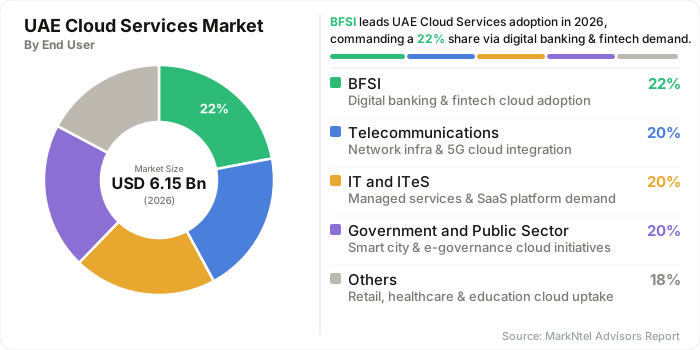
- BFSI leads end-user segments in this industry with nearly 22% market share in 2026.
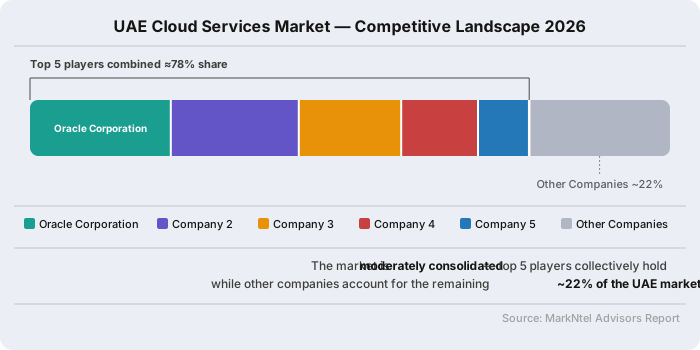
- The competitive landscape remains moderately consolidated, with the top five players collectively accounting for nearly 78% of total market share.
UAE Cloud Services Market Size and Outlook
The UAE cloud services market is projected to witness sustained growth at a steady CAGR of 7.21% during the forecast period, supported by sustained enterprise and government investments in digital infrastructure. The expanding enterprise digital transformation pipeline continues to drive demand for scalable computing, AI-enabled services, and advanced storage capabilities across sectors.
Government-led initiatives are significantly shaping adoption patterns across the UAE. Abu Dhabi’s AED 13 billion Digital Strategy 2025–2027 mandates 100% migration of mission-critical workloads to sovereign cloud environments, while Dubai requires cloud-native architectures for all new smart city services. These initiatives are accelerating AI cloud investment expansion and strengthening national AI capabilities. Simultaneously, public sector cloud modernization is enabling secure, compliant, and performance-driven cloud adoption across ministries and large-scale government ecosystems.
Private sector investments are rapidly expanding hyperscale infrastructure capacity. Microsoft and G42 announced a 200 MW UAE data center capacity expansion expected before the end of 2026, supporting sovereign AI and hyperscale cloud growth. Similar investment patterns are seen, as Oracle is expanding its Abu Dhabi cloud region with more than 4,000 Nvidia Blackwell GPUs, enabling OCI Supercluster infrastructure and supporting hyperscale AI compute expansion across enterprise and government applications.
Large-scale ecosystem developments are further reinforcing long-term growth in the industry, which is projected to expand from USD 6.15 billion in 2026 to USD 9.34 billion by 2032. As the “Stargate UAE” AI data center project in Abu Dhabi, backed by OpenAI, NVIDIA, Cisco, and SoftBank, is expected to begin operations in 2026 with 200 MW initial capacity and 5 GW expansion potential. In conclusion, these developments position the UAE cloud services industry as a global hub for sovereign AI and advanced cloud innovation in the upcoming years.
UAE Cloud Services Market Key Indicators
- The UAE Digital Economy Strategy is accelerating structural transformation, targeting nearly 19.4% GDP contribution within the next decade. This policy-backed trajectory reinforces the UAE cloud services market by aligning public and private sector digital priorities with scalable cloud frameworks. As a result, regulatory-driven demand signals are becoming more pronounced, reflecting how national-level digital ambitions are directly shaping long-term enterprise cloud adoption patterns.
- A notable acceleration in financial ecosystem expansion is evident at Dubai International Financial Centre, where active registered companies reached 7,700 in H1 2025, rising from 6,153 in H1 2024, marking a 25% year-on-year increase. Additionally, 1,081 new firms entered within six months, reflecting a 32% rise. This surge highlights strengthening institutional cloud adoption, as regulatory-intensive financial entities increasingly rely on secure cloud environments to meet compliance-driven operational requirements.
- A breakthrough in AI infrastructure development emerged through the U.S.–UAE technology partnership, permitting annual exports of up to 500,000 advanced Nvidia Blackwell GPUs beginning in 2025. The initiative is expected to strengthen hyperscale computing capacity, accelerate sovereign AI deployment, and support large-scale regional data center expansion. This development signals rising digital infrastructure readiness, as the UAE continues positioning itself as a strategically important hub for next-generation cloud and AI workloads.
UAE Cloud Services Market Scope
| Category | Segments |
|---|---|
| By Deployment | Public, Private, Hybrid |
| By Service | Infrastructure as a Service (IaaS) (Primary Storage, Disaster Recovery and Backup, Archiving, Compute), Platform as a Service (PaaS) (Application Development and Platforms, Application Testing and Quality, Analytics and Reporting, Integration and Orchestration, Data Management), Software as a Service (SaaS) (Customer Relationship Management (CRM), Enterprise Resource Management (ERM), Human Capital Management (HCM), Content Management, Collaboration and Productive Suites, Supply Chain Management (SCM), Others |
| By Organization Size | Small and Medium-sized Enterprises (SMEs), Large Enterprises |
| By End User | BFSI, Telecommunications, IT and ITeS, Government and Public Sector, Retail and Consumer Goods, Manufacturing, Energy and Utilities, Media and Entertainment, Healthcare and Life Sciences |
UAE Cloud Services Market Growth Drivers
Digital Economy Expansion and Startup Momentum
The UAE cloud services market is being structurally accelerated by coordinated national strategies, including the UAE Digital Economy Strategy and the UAE Artificial Intelligence Office AI Strategy 2031. These frameworks collectively position cloud as a backbone of economic transformation, embedding policy-driven cloud adoption across public and private sectors . As digital priorities intensify, digital economy expansion is directly translating into sustained enterprise demand for scalable and secure cloud ecosystems.
Simultaneously, the rapid expansion of innovation ecosystems is reinforcing demand fundamentals. Hub71 reported USD 2.17 billion in startup funding in 2024, alongside USD 1.2 billion in revenues, highlighting strong venture activity. This momentum is strengthening AI infrastructure demand, as startups increasingly depend on cloud-native AI tools, SaaS platforms, and hyperscale environments. The ecosystem’s global reach, with thousands of applications annually, further amplifies cloud consumption patterns.
Moreover, the convergence of public investment and private innovation is unlocking cloud ecosystem scalability, enabling enterprises to transition toward flexible, high-performance architectures. Increasing reliance on data-centric innovation frameworks is also driving deeper integration of analytics, AI, and storage capabilities within cloud platforms. Collectively, these forces are reinforcing long-term structural demand, positioning cloud adoption as an indispensable pillar of the UAE’s evolving digital economy landscape.
Recent Trends
Rise of Sovereign AI Infrastructure and Intelligent Cloud Integration
The UAE Cloud Services Industry is witnessing a decisive shift toward sovereign cloud deployment, driven by rising emphasis on data residency, cybersecurity, and regulatory alignment. Organizations increasingly prioritize localized environments to ensure compliance while maintaining operational control. Simultaneously, demand for AI-native cloud architecture is accelerating, as enterprises embed advanced analytics and automation directly into cloud ecosystems to enable real-time decision-making and scalable digital operations.
A key development reinforcing this transition is the expansion of sovereign infrastructure by Oracle through its Alloy-enabled platforms. In 2025, du launched the “National Hypercloud,” delivering UAE-resident cloud and AI services to regulated sectors . This reflects intensifying hyperscaler localization strategies, where global providers adapt offerings to meet national compliance, performance, and data sovereignty requirements across critical industries.
In parallel, the integration of smart technologies such as RFID, NFC, and QR codes is enabling intelligent cloud integration across digital ecosystems. The growing adoption of edge-enabled cloud processing further enhances low-latency performance for real-time applications. Taken together, these trends underscore a structural shift toward localized, AI-driven, and compliance-centric cloud ecosystems shaping the UAE’s future cloud trajectory.
UAE Cloud Services Market Opportunities and Challenges
Data Protection Regulations Driving Localization and Cloud Modernization
The UAE cloud services market is encountering structural pressure from evolving data governance compliance requirements under the UAE Personal Data Protection Law. Enterprises operating global cloud architectures must redesign systems to meet strict rules governing data processing and residency. These mandates intensify cross-border data restrictions, increasing migration complexity, extending deployment timelines, and raising compliance costs, particularly for sectors handling sensitive financial, healthcare, and consumer datasets.
At the same time, these constraints are catalyzing localized cloud infrastructure growth, as, in 2025, Alibaba Cloud launched its second Dubai data center as part of a broader USD 53 billion global cloud and AI infrastructure investment plan, strengthening regional hosting capacity and enterprise-grade AI capabilities. This expansion reflects the rising sovereign data hosting expansion, enabling organizations to comply with national data protection laws.
Additionally, enterprises are increasingly adopting compliance-driven cloud transformation strategies, embedding governance, security, and monitoring directly into cloud architectures. The UAE cloud services industry is therefore shifting from regulatory resistance toward opportunity-led modernization. In conclusion, the regulatory complexity is evolving into a long-term enabler, reshaping localized cloud ecosystems while reinforcing enterprise cloud strategies aligned with national compliance and data sovereignty objectives.
Segmentation Insights
Cloud-Native Applications and Enterprise Software Driving SaaS Dominance
The UAE cloud services market is led by the software as a service (SaaS) segment, accounting for approximately 50% of total revenue. This dominance is driven by strong cloud-native application adoption, as enterprises increasingly deploy ready-to-use software solutions without heavy infrastructure investments. SaaS platforms enable rapid scalability, lower upfront costs, and seamless updates, making them highly attractive across industries seeking operational efficiency and faster digital transformation outcomes.
A key factor reinforcing this leadership is the widespread use of enterprise applications such as CRM, ERM, and HCM systems, which are critical for managing customer engagement, resources, and workforce operations. Increasing SaaS platform utilization across sectors like BFSI, retail, and government is further strengthening demand. Additionally, the rise of collaboration tools and content management systems is accelerating the adoption of these services.
Compared to IaaS and PaaS, SaaS benefits from faster deployment cycles and reduced technical complexity, enabling broader accessibility among enterprises. Growing mid-market digitalization is also contributing to sustained uptake, as small and medium-sized businesses adopt cost-effective cloud solutions. In conclusion, SaaS leadership reflects its central role in enabling scalable, user-centric, and enterprise-ready cloud ecosystems across the UAE. Based on service, the scope has been divided into:
- Infrastructure as a Service (IaaS)
- Primary Storage
- Disaster Recovery and Backup
- Archiving
- Compute
- Platform as a Service (PaaS)
- Application Development and Platforms
- Application Testing and Quality
- Analytics and Reporting
- Integration and Orchestration
- Data Management
- Software as a Service (SaaS)
- Customer Relationship Management (CRM)
- Enterprise Resource Management (ERM)
- Human Capital Management (HCM)
- Content Management
- Collaboration and Productive Suites
- Supply Chain Management (SCM)
- Others
BFSI Emerges as the Largest End-User Vertical
The UAE cloud services industry is significantly led by the BFSI segment, contributing approximately 22% of total revenue and emerging as the largest end-use vertical. This dominance is primarily driven by increasing financial services digitalization, as banks and financial institutions modernize legacy systems to enhance operational efficiency and customer experience. The sector’s strong reliance on secure, scalable cloud platforms is reinforcing its position as a key demand generator within the cloud ecosystem.
A critical factor supporting BFSI leadership is the growing need for secure transaction processing and real-time data management across digital banking, payments, and insurance services. Regulatory frameworks and compliance requirements are further accelerating cloud adoption, as institutions prioritize robust data protection and audit capabilities. Additionally, rising fintech integration and digital payment ecosystems are expanding cloud use cases across both traditional banks and emerging financial service providers.
Compared to other sectors such as retail, healthcare, and manufacturing, BFSI demonstrates higher cloud maturity and investment capacity. The increasing adoption of risk and compliance analytics is also strengthening demand for advanced cloud-based solutions. In conclusion, BFSI’s dominance reflects its early digital transformation, regulatory intensity, and continuous innovation, positioning it as a cornerstone of cloud adoption growth in the UAE. The report maps demand across the following key end-use industries:
- BFSI
- Telecommunications
- IT and ITeS
- Government and Public Sector
- Retail and Consumer Goods
- Manufacturing
- Energy and Utilities
- Media and Entertainment
- Healthcare and Life Sciences
- Others
UAE Cloud Services Market Competitive Analysis
The UAE cloud services industry is moderately consolidated, with the top five players, like Amazon Web Services, Microsoft, Google, Oracle, and Alibaba Cloud, collectively estimated to hold nearly 78% market share. AWS and Microsoft maintain leadership through hyperscale infrastructure, sovereign cloud partnerships, and enterprise integration capabilities, while Google, Oracle, and Alibaba are strengthening regional AI and localization strategies. The structure reflects high concentration among global hyperscalers, although regional telecom operators and niche SaaS providers continue expanding presence across regulated and mid-market segments.
Leading Players in the UAE Cloud Services Industry
- Amazon Web Services, Inc.
- Microsoft Corporation
- Google LLC
- Oracle Corporation
- Alibaba Cloud
- IBM Corporation
- SAP SE
- Salesforce, Inc.
- Adobe Inc.
- Etisalat
- Others
UAE Cloud Services Industry News and Recent Developments
April 2025: Microsoft–du Hyperscale Data Center Partnership Strengthens AI Infrastructure
Microsoft partnered with du on a AED 2 billion hyperscale data center project in the UAE. The facility is designed to support large-scale cloud computing and AI workloads, aligning with national priorities around sovereign cloud and advanced digital infrastructure. The initiative enhances in-country processing capabilities while reinforcing the UAE’s ambition to become a regional hub for AI-driven cloud services.
Impact Analysis: This development significantly strengthens hyperscale infrastructure capacity, enabling enterprises to deploy AI and data-intensive workloads locally with improved latency and compliance. It reinforces sovereign cloud adoption by ensuring data residency within national boundaries. Additionally, the partnership intensifies competition among global cloud providers while accelerating enterprise migration to advanced cloud environments. Over time, such investments are expected to attract regional workloads, positioning the UAE as a strategic cloud and AI hub in the Middle East.
January 2025: Oracle Workforce Development Initiative Highlights Talent Supply Gap
Oracle announced a plan to train 350,000 professionals in artificial intelligence and digital technologies across the region. The initiative aims to address the rising demand for cloud, AI, and data-related skills as enterprises accelerate digital transformation. However, despite its scale, the program is insufficient relative to rapidly increasing requirements, particularly in specialized roles such as FinOps and AI-ops engineering.
Impact Analysis: The initiative underscores a critical talent bottleneck that could constrain cloud adoption and AI deployment across industries. While training programs will expand the talent pool, the gap between supply and demand may persist, increasing labor costs and project timelines. This imbalance is likely to drive greater automation, managed services adoption, and reliance on global talent. In the long term, workforce development will remain a decisive factor influencing the pace and efficiency of cloud ecosystem expansion in the UAE.
- Market Segmentation
- Introduction
- Product Definition
- Research Process
- Assumptions
- Executive Summary
- UAE Cloud Services Market Policies, Regulations, and Product Standards
- UAE Cloud Services Market Trends & Developments
- UAE Cloud Services Market Dynamics
- Growth Factors
- Challenges
- UAE Cloud Services Market Hotspot & Opportunities
- UAE Cloud Services Market Outlook, 2022-2032F
- Market Size & Outlook
- By Revenues (USD Million)
- Market Share & Outlook
- By Deployment- Market Size & Forecast 2022-2032, USD Million
- Public
- Private
- Hybrid
- By Service- Market Size & Forecast 2022-2032, USD Million
- Infrastructure as a Service (IaaS)
- Primary Storage
- Disaster Recovery and Backup
- Archiving
- Compute
- Platform as a Service (PaaS)
- Application Development and Platforms
- Application Testing and Quality
- Analytics and Reporting
- Integration and Orchestration
- Data Management
- Software as a Service (SaaS)
- Customer Relationship Management (CRM)
- Enterprise Resource Management (ERM)
- Human Capital Management (HCM)
- Content Management
- Collaboration and Productive Suites
- Supply Chain Management (SCM)
- Others
- Infrastructure as a Service (IaaS)
- By Organization Size- Market Size & Forecast 2022-2032, USD Million
- Small and Medium-sized Enterprises (SMEs)
- Large Enterprises
- By End User- Market Size & Forecast 2022-2032, USD Million
- BFSI
- Telecommunications
- IT and ITeS
- Government and Public Sector
- Retail and Consumer Goods
- Manufacturing
- Energy and Utilities
- Media and Entertainment
- Healthcare and Life Sciences
- Others
- By Region- Market Size & Forecast 2022-2032, USD Million
- Dubai
- Abu Dhabi & Al Ain
- Sharjah & Northern Emirates
- By Company
- Competition Characteristics
- Market Share & Analysis
- By Deployment- Market Size & Forecast 2022-2032, USD Million
- Market Size & Outlook
- UAE Infrastructure as a Service (IaaS) Market Outlook, 2022-2032
- Market Size & Outlook
- By Revenues (USD Million)
- Market Share & Outlook
- By Service- Market Size & Forecast 2022-2032, USD Million
- By Organization Size- Market Size & Forecast 2022-2032, USD Million
- By End User- Market Size & Forecast 2022-2032, USD Million
- By Region- Market Size & Forecast 2022-2032, USD Million
- Market Size & Outlook
- UAE Platform as a Service (PaaS) Market Outlook, 2022-2032
- Market Size & Outlook
- By Revenues (USD Million)
- Market Share & Outlook
- By Service- Market Size & Forecast 2022-2032, USD Million
- By Organization Size- Market Size & Forecast 2022-2032, USD Million
- By End User- Market Size & Forecast 2022-2032, USD Million
- By Region- Market Size & Forecast 2022-2032, USD Million
- Market Size & Outlook
- UAE Software as a Service (SaaS) Market Outlook, 2022-2032
- Market Size & Outlook
- By Revenues (USD Million)
- Market Share & Outlook
- By Service- Market Size & Forecast 2022-2032, USD Million
- By Organization Size- Market Size & Forecast 2022-2032, USD Million
- By End User- Market Size & Forecast 2022-2032, USD Million
- By Region- Market Size & Forecast 2022-2032, USD Million
- Market Size & Outlook
- UAE Cloud Services Market Key Strategic Imperatives for Success & Growth
- Competitive Outlook
- Company Profiles
- Amazon Web Services, Inc.
- Business Description
- Product Portfolio
- Collaborations & Alliances
- Recent Developments
- Financial Details
- Others
- Microsoft Corporation
- Business Description
- Product Portfolio
- Collaborations & Alliances
- Recent Developments
- Financial Details
- Others
- Google LLC
- Business Description
- Product Portfolio
- Collaborations & Alliances
- Recent Developments
- Financial Details
- Others
- Oracle Corporation
- Business Description
- Product Portfolio
- Collaborations & Alliances
- Recent Developments
- Financial Details
- Others
- Alibaba Cloud
- Business Description
- Product Portfolio
- Collaborations & Alliances
- Recent Developments
- Financial Details
- Others
- IBM Corporation
- Business Description
- Product Portfolio
- Collaborations & Alliances
- Recent Developments
- Financial Details
- Others
- SAP SE
- Business Description
- Product Portfolio
- Collaborations & Alliances
- Recent Developments
- Financial Details
- Others
- Salesforce, Inc.
- Business Description
- Product Portfolio
- Collaborations & Alliances
- Recent Developments
- Financial Details
- Others
- Adobe Inc.
- Business Description
- Product Portfolio
- Collaborations & Alliances
- Recent Developments
- Financial Details
- Others
- Etisalat
- Business Description
- Product Portfolio
- Collaborations & Alliances
- Recent Developments
- Financial Details
- Others
- Others
- Amazon Web Services, Inc.
- Company Profiles
- Disclaimer

MarkNtel Advisors follows a robust and iterative research methodology designed to ensure maximum accuracy and minimize deviation in market estimates and forecasts. Our approach combines both bottom-up and top-down techniques to effectively segment and quantify various aspects of the market. A consistent feature across all our research reports is data triangulation, which examines the market from three distinct perspectives to validate findings. Key components of our research process include:
1. Scope & Research Design At the outset, MarkNtel Advisors define the research objectives and formulate pertinent questions. This phase involves determining the type of research—qualitative or quantitative—and designing a methodology that outlines data collection methods, target demographics, and analytical tools. They also establish timelines and budgets to ensure the research aligns with client goals.
2. Sample Selection and Data Collection In this stage, the firm identifies the target audience and determines the appropriate sample size to ensure representativeness. They employ various sampling methods, such as random or stratified sampling, based on the research objectives. Data collection is carried out using tools like surveys, interviews, and observations, ensuring the gathered data is reliable and relevant.
3. Data Analysis and Validation Once data is collected, MarkNtel Advisors undertake a rigorous analysis process. This includes cleaning the data to remove inconsistencies, employing statistical software for quantitative analysis, and thematic analysis for qualitative data. Validation steps are taken to ensure the accuracy and reliability of the findings, minimizing biases and errors.

4. Data Forecast and FinalizationThe final phase involves forecasting future market trends based on the analyzed data. MarkNtel Advisors utilize predictive modeling and time series analysis to anticipate market behaviors. The insights are then compiled into comprehensive reports, featuring visual aids like charts and graphs, and include strategic recommendations to inform client decision-making
FILL THE FORM TO GET THE FREE SAMPLE PAGES
We offer flexible licensing options to cater to varying organizational needs. Choose the pricing pack that best suits your requirements:
Buy Now Inquire Before Buying
 Talk to our Consultant
 Request Customization