

Japan AI Data Center Market Research Report: Size, Share, Trends & Forecast (2026-2032)
By Infrastructure Layer (Compute Infrastructure (GPUs, CPUs, TPUs, Custom AI Accelerators), Storage Infrastructure (High-performance SSD, Object & Distributed Storage), Networking ... Infrastructure (High-speed Interconnects, Optical Networking), Power Infrastructure (UPS, Transformers), Thermal Management Systems (Liquid Cooling, Immersion Cooling)), By Data Center Architecture Type (AI Hyperscale Data Centers, AI Colocation Data Centers, AI Enterprise Data Centers, AI Edge / Distributed AI Facilities), By Rack Power Density (Standard Density (<15 kW/rack), High Density (15–30 kW/rack), Ultra-High Density (>30 kW/rack, AI factories)), By Deployment Model (Cloud-Based, On-Premises, Hybrid), By Application (AI Model Training Platforms, AI Model Inference Systems, Big Data Analytics, Computer Vision Processing, Natural Language Processing (NLP), Autonomous Systems & Robotics, Cybersecurity & Fraud Detection), By End User (BFSI, Government, Healthcare, IT & Telecom, Automotive, Media & Entertainment, Others), and others Read more
- ICT & Electronics
- May 2026
- Pages 170
- Report Format: PDF, Excel, PPT
Japan AI Data Center Market
Projected 13.82% CAGR from 2026 to 2032
Study Period
2026-2032
Market Size (2026)
USD 3.67 Billion
Market Size (2032)
USD 7.98 Billion
Base Year
2025
Projected CAGR
13.82%
Leading Segments
By End User: BFSI
Japan AI Data Center Market Key Takeaways
- The Japan AI Data Center Market reached a valuation of USD 3.22 billion in 2025 and is anticipated to expand from USD 3.67 billion in 2026 to USD 7.98 billion by 2032.
- The industry is projected to register a substantial growth at a CAGR of 13.82% over the forecast period.
- In terms of infrastructure, compute infrastructure dominates the market with an estimated share of around 45% in 2026.
- Based on end users, the IT & telecom segment leads with nearly 40% share in 2026.
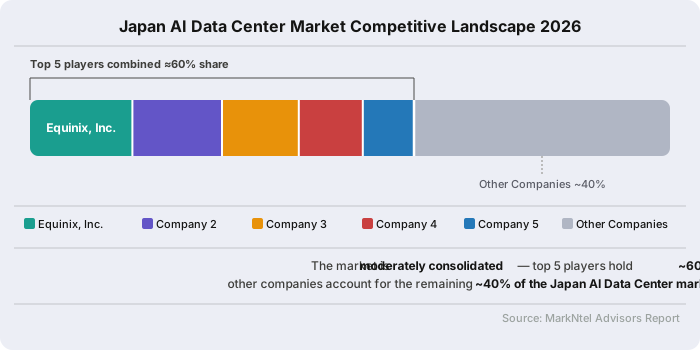
- The competitive landscape remains moderately consolidated, with the top five players collectively holding close to 60% of the overall market share.
Japan AI Data Center Market Size and Outlook
Japan’s AI-driven digital infrastructure landscape is entering a phase of rapid expansion, underpinned by increasing enterprise adoption and supportive regulatory frameworks. The Japan AI data center market size, was valued at USD 3.22 billion in 2025, is projected to grow from USD 3.67 billion in 2026 to USD 7.98 billion by 2032, registering a CAGR of 13.82% during the forecast period. The growth reflects the increasing reliance on AI data centers in Japan to support compute-intensive workloads across industries such as BFSI, healthcare, IT & telecom, automotive, manufacturing, and government.
The expanding artificial intelligence ecosystem further reinforces this trajectory, as Japan’s broader AI landscape was valued at approximately USD 8.9 billion in 2024 and is expected to reach USD 27.9 billion by 2029, creating sustained demand for high-performance computing, inference, and analytics infrastructure.
A key structural driver shaping long-term growth is the Japanese government’s formal institutionalisation of AI as a national priority. The implementation of the Act on the Promotion of Research and Development and Utilization of AI-Related Technologies established a centralized AI Strategic Office, ensuring coordinated development and deployment across public and private sectors. This policy framework not only strengthens investment confidence but also accelerates Japan AI infrastructure market growth by mandating AI integration across critical economic sectors.
In parallel, strong capital commitments from leading technology providers are validating the market’s expansion trajectory. Oracle Corporation invested to enhance cloud and AI infrastructure in Japan, followed by a strategic collaboration with NTT DATA Japan to deploy sovereign cloud solutions across domestic data centers .
Additionally, KDDI Corporation partnered with Sharp Corporation to convert an existing manufacturing facility in Osaka into a GPU-powered AI data center equipped with advanced processors, targeting operational readiness by 2026 .
Further reinforcing capacity expansion, Sakura Internet Inc. secured substantial government funding to develop sovereign AI supercomputing capabilities and expand its domestic GPU infrastructure. These developments highlight increasing hyperscale data centers deployment, ensuring scalability and performance for next-generation AI applications.
In conclusion, Japan’s AI data center industry is poised for sustained growth, driven by strong regulatory backing, accelerating enterprise AI adoption, and significant infrastructure investments, collectively positioning the country as a leading hub for advanced AI computing in the Asia-Pacific region.
Japan AI Data Center Market Key Indicators
- A sharp escalation in power requirements is emerging as a defining characteristic of Japan’s digital infrastructure expansion. The International Energy Agency estimates an increase of nearly 15 TWh in data center electricity demand by 2030, representing close to an 80% surge. This trajectory underscores the intensifying reliance on high energy consumption data centers Japan, as AI-driven processing continues to scale across enterprise and cloud environments.
- Japan’s telecom landscape is approaching full 5G maturity, fundamentally altering how data is processed and delivered. With population coverage already exceeding 98% and expected to reach near-total saturation by 2030 , real-time AI applications are becoming more viable. This widespread connectivity is catalyzing edge data center deployment Japan, enabling decentralized infrastructure to handle latency-sensitive workloads efficiently.
- Enterprise cloud adoption in Japan has crossed a critical threshold, with over 80% of businesses utilizing cloud services, and 88.2% of these companies confirming effectiveness in operations. This high penetration rate is sustaining demand for AI data center applications (cloud, AI training), as enterprises increasingly depend on scalable infrastructure to manage AI-driven analytics and production workloads.
- Strategic policy interventions are playing a pivotal role in strengthening domestic AI capabilities. The allocation of approximately USD 0.48 billion in subsidies under Japan’s economic security framework reflects a targeted push to localize critical computing infrastructure. By recognizing AI as a strategic asset, the government is actively reinforcing government incentives for data centers in Japan, ensuring long-term capacity development and technological resilience.
- Long-term fiscal planning is providing a stable foundation for infrastructure scaling. The government’s commitment of approximately USD 66 billion toward AI and semiconductor development through 2030 demonstrates sustained public sector involvement. This level of financial backing is accelerating hyperscale investments in Japan, supporting continuous expansion of high-capacity data center ecosystems across the country.
- Japan maintains one of the world’s largest digital economies, creating persistent infrastructure demand. According to JETRO, the country’s ICT sector contributes approximately USD 370 billion and represents nearly 10% of national nominal GDP . The scale of digital transformation across industries is driving substantial enterprise AI workload growth, increasing the need for high-capacity domestic AI data center infrastructure.
Japan AI Data Center Market Scope
| Category | Segments |
|---|---|
| By Infrastructure Layer | Compute Infrastructure (GPUs, CPUs, TPUs, Custom AI Accelerators), Storage Infrastructure (High-performance SSD, Object & Distributed Storage), Networking Infrastructure (High-speed Interconnects, Optical Networking), Power Infrastructure (UPS, Transformers), Thermal Management Systems (Liquid Cooling, Immersion Cooling |
| By Data Center Architecture Type | AI Hyperscale Data Centers, AI Colocation Data Centers, AI Enterprise Data Centers, AI Edge / Distributed AI Facilities) |
| By Rack Power Density | Standard Density (<15 kW/rack), High Density (15–30 kW/rack), Ultra-High Density (>30 kW/rack, AI factories |
| By Deployment Model | Cloud-Based, On-Premises, Hybrid |
| By Application | AI Model Training Platforms, AI Model Inference Systems, Big Data Analytics, Computer Vision Processing, Natural Language Processing (NLP), Autonomous Systems & Robotics, Cybersecurity & Fraud Detection |
| By End User | BFSI, Government, Healthcare, IT & Telecom, Automotive, Media & Entertainment, Others |
Japan AI Data Center Market Growth Drivers
Rising AI Adoption in Japan Enterprises
The rising AI adoption in Japan enterprises is significantly accelerating the need for advanced data center infrastructure, as organizations increasingly depend on high-performance computing to manage complex digital workloads.
With businesses integrating AI across operations, the requirement for scalable and efficient systems has intensified, leading to a surge in demand for AI-ready infrastructure. This shift is particularly evident as enterprises prioritize real-time data processing, automation, and intelligent decision-making capabilities.
A major contributor to this rapid expansion of generative AI use cases, which require substantial computational power and storage capacity. Reflecting this momentum, Microsoft has committed approximately USD 10 billion toward strengthening AI infrastructure, cybersecurity, and workforce development in Japan. A significant portion of this investment is directed toward expanding cloud and data center capabilities, enabling enterprises to efficiently train and deploy advanced AI models at scale.
Similarly, Amazon Web Services announced an investment of around USD 15.24 billion through 2027 to expand its cloud infrastructure in Tokyo and Osaka . This initiative aims to support the accelerating growth of generative AI applications, ensuring that enterprises have access to robust and scalable digital infrastructure.
These strategic investments highlight how enterprise AI adoption is driving sustained demand for next-generation data centers, reinforcing their critical role in Japan’s evolving digital ecosystem.
Recent Trends
Shift to Renewable-Powered AI Campuses
Japan’s AI data center industry is witnessing a growing shift toward large-scale renewable-powered infrastructure developments as operators prioritize sustainability, energy security, and decentralized computing capacity.
This transition is being driven by the rapid expansion of AI workloads and the increasing need for environmentally efficient computing ecosystems. As a result, green data centers are becoming a defining trend across the country’s next-generation digital infrastructure landscape.
A prominent example is SoftBank Corp., which began construction of the “Hokkaido Tomakomai AI Data Center”. The facility is designed to operate entirely on locally procured renewable energy and is expected to become one of Japan’s largest AI computing hubs. The project will feature a site area of approximately 700,000 square meters and power capacity exceeding 300 MW, supporting large-scale AI processing and high-density computing operations.
The development also reflects the increasing adoption of sustainable data center practices, as operators seek locations with abundant renewable resources, cooler climates, and lower infrastructure concentration risks compared with Tokyo and Osaka. In parallel, the industry is experiencing rising AI-driven data center automation, enabling operators to optimize energy efficiency and workload management for advanced generative AI applications.
These developments indicate that renewable-powered AI campuses are evolving from niche projects into a mainstream infrastructure strategy, positioning Japan as a regional leader in sustainable AI Data Center Market.
Japan AI Data Center Market Opportunities and Challenges
Rising Infrastructure Bottlenecks Reshaping AI Data Center Expansion Strategy
Japan AI data center market is increasingly facing structural bottlenecks in its primary hub, Tokyo, where infrastructure limitations are slowing expansion. One of the most critical challenges is the delay in securing power grid access, which can extend up to 10 years for large-scale facilities. In addition, land constraints Japan data centers have intensified, with land prices in power-secured zones reaching premiums of up to 770% above benchmark levels, significantly elevating project costs and restricting scalability within core metropolitan areas .
However, these constraints are simultaneously unlocking new growth avenues beyond Tokyo. Developers and operators are actively shifting investments toward secondary regions, creating strong hyperscale expansion opportunities in Japan. Cities such as Osaka and Hokkaido are gaining prominence due to comparatively better land availability and improved access to energy infrastructure, enabling faster deployment timelines and cost optimization.
A prominent example is AirTrunk, which announced in December 2025 the development of a 100 MW hyperscale data center in Osaka, reinforcing the region’s emergence as a key digital infrastructure hub. This transition is also contributing to broader Japan data center regional distribution, reducing overdependence on Tokyo while enhancing network resilience and geographic diversity.
The infrastructure constraints in Tokyo present near-term growth barriers, they are simultaneously accelerating regional diversification, positioning Japan as more balanced and scalable AI data center Industry.
Segmentation Insights
Rising Demand for AI-Ready Compute Infrastructure
The compute infrastructure segment accounts for nearly 45% of the Japan AI data center market revenue, primarily due to the country’s accelerating investment in GPU-dense AI computing systems.
The rapid deployment of generative AI models, large language models, and enterprise AI applications is substantially increasing the need for advanced processing capabilities, strengthening the role of hyperscale data centers in supporting high-density workloads.
A major example supporting this dominance is Japan’s ABCI 3.0 supercomputing infrastructure developed by the National Institute of Advanced Industrial Science and Technology. The system integrates 6,128 NVIDIA H200 GPUs and delivers peak AI performance of 6.22 exaflops in half precision, making it one of the world’s most advanced AI computing platforms. The infrastructure is specifically designed to accelerate AI research, model training, and inference operations at scale, highlighting the growing emphasis on AI data center applications (cloud, AI training) across Japan’s digital ecosystem.
Additionally, the increasing demand for AI-ready infrastructure in Japan is compelling operators to prioritize compute-heavy architectures equipped with high-performance accelerators, high-bandwidth networking, and scalable GPU clusters.
Collectively, these developments demonstrate that compute infrastructure remains the foundational component enabling Japan’s next-generation AI data center market. Segmentation based on the infrastructure layer includes the following components:
- Compute Infrastructure
- GPUs
- CPUs
- TPUs
- Custom AI Accelerators
- Storage Infrastructure
- High-performance SSDs
- Object & Distributed Storage
- Networking Infrastructure
- High-speed Interconnects
- Optical Networking
- Power Infrastructure
- UPS
- Transformers
- Thermal Management Systems
- Liquid Cooling
- Immersion Cooling
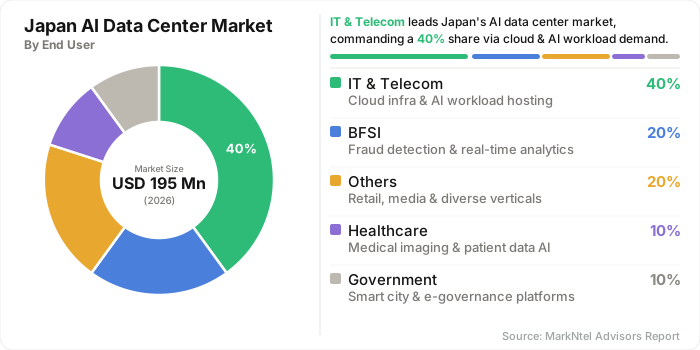
IT & Telecom Sector Emerging as a Key Consumer of AI Data Center Capacity
The growing integration of AI into telecom network operations is a key factor underpinning the dominance of the IT & Telecom segment in Japan’s AI data center industry, which accounts for nearly 40% of total revenue.
Telecom operators are increasingly leveraging AI to enhance network efficiency, automate operations, and deliver real-time services, thereby driving substantial demand for AI data center applications (cloud, AI training).
A strong example is SoftBank Corp., which developed its “Large Telecom Model”, a generative AI system trained and operated entirely within domestic data centers. The model demonstrated over 90% accuracy in predicting communication quality during large-scale events, highlighting the practical deployment of AI in telecom infrastructure. This advancement reflects how telecom companies are transitioning toward AI-driven network management, requiring scalable and high-performance computing environments.
Moreover, the expansion of advanced connectivity technologies continues to accelerate edge data center deployment, as telecom providers invest in distributed infrastructure to support low-latency AI inference and real-time data processing. These developments are further strengthening the demand for AI-ready infrastructure, particularly for GPU-intensive workloads and cloud-integrated services.
The IT & Telecom sector’s leadership is driven by its early and large-scale adoption of AI, positioning it as a primary consumer of next-generation data center capacity. The study identifies the following key end-user segments:
- BFSI
- Government
- Healthcare
- IT & Telecom
- Automotive
- Media & Entertainment
- Others
Japan AI Data Center Market Competitive Analysis
The competitive landscape of the Japan AI Data Center Industry reflects a moderately consolidated structure, where global hyperscale cloud providers coexist with well-established domestic infrastructure operators. Competition is distributed across key segments such as hyperscale deployments, colocation services, and enterprise-grade data center solutions. Major players such as Amazon Web Services, Microsoft, Equinix, Inc., NTT Global Data Centers Corporation, and MC Digital Realty, Inc. together hold an estimated 60% share of the overall market, underscoring the concentration of capacity and investment among a limited group of leading operators.
Major Players in Japan AI Data Center Market
- Equinix, Inc.
- NTT Global Data Centers Corporation
- MC Digital Realty, Inc.
- Amazon Web Services, Inc.
- Microsoft Corporations
- KDDI Corporation
- IDC Frontier Inc.
- Colt Data Centre Services Group Limited
- AirTrunk Operating Pty Ltd
- Sakura Internet Inc.
- Others
Japan AI Data Center Industry News and Recent Developments
April 2026: NTT DATA Opens Keihanna OSK11 High-Capacity Data Center
NTT DATA opened the Keihanna OSK11 Data Center in Kyoto with approximately 30MW capacity. The facility is designed to support hyperscalers and enterprise AI workloads with advanced cooling and high-efficiency infrastructure systems. It marks NTT’s continued expansion of data center capacity in Japan.
Impact Analysis: This development strengthens Japan’s domestic AI infrastructure backbone by increasing scalable colocation capacity for enterprise and hyperscale workloads. It supports rising demand for generative AI applications and cloud computing services while improving regional distribution of data center infrastructure beyond Tokyo. The facility enhances Japan’s readiness for large-scale AI deployment across industries.
February 2026: KDDI Launches Osaka Sakai AI Data Center with NVIDIA Blackwell Systems
KDDI launched its Osaka Sakai Data Center equipped with NVIDIA Blackwell GPUs and advanced liquid cooling systems. The facility is designed for AI training and inference workloads, targeting industrial applications in manufacturing and pharmaceuticals. It strengthens Japan’s AI infrastructure capacity in the Kansai region.
Impact Analysis: This facility enhances Japan’s ability to support high-density AI workloads with efficient cooling and GPU acceleration. It reduces dependency on Tokyo-centric infrastructure and enables faster AI adoption in industrial sectors. The deployment of advanced AI-ready architecture also signals a shift toward energy-efficient and inference-focused data center design.
July 2025: SoftBank Deploys NVIDIA Blackwell-Based DGX SuperPOD
SoftBank Corp. announced the deployment of a large-scale NVIDIA DGX SuperPOD powered by over 4,000 NVIDIA Blackwell GPUs. The infrastructure contributes to a total AI computing capacity exceeding 10,000 GPUs and delivers approximately 13.7 exaflops of performance, supporting large-scale generative AI model training and enterprise AI workloads.
Impact Analysis: This deployment significantly strengthens Japan’s domestic AI computing capabilities, reducing reliance on overseas infrastructure while accelerating innovation in generative AI and advanced analytics. The scale of GPU integration reinforces the dominance of compute-intensive architectures and drives increased demand for hyperscale data centers. It also enhances the country’s competitiveness in sovereign AI development, encouraging further investments in Japan AI data center industryt.
Frequently Asked Questions
- Market Segmentation
- Introduction
- Product Definition
- Research Process
- Assumptions
- Executive Summary
- Japan AI Data Center Market Policies, Regulations, and Product Standards
- Japan AI Data Center Market Trends & Developments
- Japan AI Data Center Market Dynamics
- Growth Factors
- Challenges
- Japan AI Data Center Market Hotspot & Opportunities
- Japan AI Data Center Market Outlook, 2022-2032F
- Market Size & Outlook
- By Revenues (USD Million)
- Market Share & Outlook
- By Infrastructure Layer - Market Size & Forecast 2022-2032, USD Million
- Compute Infrastructure
- GPUs
- CPUs
- TPUs
- Custom AI Accelerators
- Storage Infrastructure
- High-performance SSD
- Object & Distributed Storage
- Networking Infrastructure
- High-speed Interconnects
- Optical Networking
- Power Infrastructure
- UPS
- Transformers
- Thermal Management Systems
- Liquid Cooling
- Immersion Cooling
- Compute Infrastructure
- By Data Center Architecture Type- Market Size & Forecast 2022-2032, USD Million
- AI Hyperscale Data Centers
- AI Colocation Data Centers
- AI Enterprise Data Centers
- AI Edge / Distributed AI Facilities
- By Rack Power Density - Market Size & Forecast 2022-2032, USD Million
- Standard Density (<15 kW/rack)
- High Density (15–30 kW/rack)
- Ultra-High Density (>30 kW/rack, AI factories)
- By Deployment Model - Market Size & Forecast 2022-2032, USD Million
- Cloud-Based
- On-Premises
- Hybrid
- By Application- Market Size & Forecast 2022-2032, USD Million
- AI Model Training Platforms
- AI Model Inference Systems
- Big Data Analytics
- Computer Vision Processing
- Natural Language Processing (NLP)
- Autonomous Systems & Robotics
- Cybersecurity & Fraud Detection
- By End User - Market Size & Forecast 2022-2032, USD Million
- BFSI
- Government
- Healthcare
- IT & Telecom
- Automotive
- Media & Entertainment
- Others
- By Region - Market Size & Forecast 2022-2032, USD Million
- Hokkaido
- Tohoku
- Kanto
- Chubu
- Rest of Japan
- By Company
- Competition Characteristics
- Market Share & Analysis
- By Infrastructure Layer - Market Size & Forecast 2022-2032, USD Million
- Market Size & Outlook
- Japan AI Hyperscale Data Centers Market Outlook, 2022-2032
- Market Size & Outlook
- By Revenues (USD Million)
- Market Share & Outlook
- By Data Center Architecture Type- Market Size & Forecast 2022-2032, USD Million
- By Rack Power Density - Market Size & Forecast 2022-2032, USD Million
- By Deployment Model - Market Size & Forecast 2022-2032, USD Million
- By Application- Market Size & Forecast 2022-2032, USD Million
- By End User - Market Size & Forecast 2022-2032, USD Million
- By Region - Market Size & Forecast 2022-2032, USD Million
- Market Size & Outlook
- Japan AI Colocation Data Centers Market Outlook, 2022-2032
- Market Size & Outlook
- By Revenues (USD Million)
- Market Share & Outlook
- By Data Center Architecture Type- Market Size & Forecast 2022-2032, USD Million
- By Rack Power Density - Market Size & Forecast 2022-2032, USD Million
- By Deployment Model - Market Size & Forecast 2022-2032, USD Million
- By Application- Market Size & Forecast 2022-2032, USD Million
- By End User - Market Size & Forecast 2022-2032, USD Million
- By Region - Market Size & Forecast 2022-2032, USD Million
- Market Size & Outlook
- Japan AI Enterprise Data Centers Market Outlook, 2022-2032
- Market Size & Outlook
- By Revenues (USD Million)
- Market Share & Outlook
- By Data Center Architecture Type- Market Size & Forecast 2022-2032, USD Million
- By Rack Power Density - Market Size & Forecast 2022-2032, USD Million
- By Deployment Model - Market Size & Forecast 2022-2032, USD Million
- By Application- Market Size & Forecast 2022-2032, USD Million
- By End User - Market Size & Forecast 2022-2032, USD Million
- By Region - Market Size & Forecast 2022-2032, USD Million
- Market Size & Outlook
- Japan AI Edge / Distributed AI Facilities Market Outlook, 2022-2032
- Market Size & Outlook
- By Revenues (USD Million)
- Market Share & Outlook
- By Data Center Architecture Type- Market Size & Forecast 2022-2032, USD Million
- By Rack Power Density - Market Size & Forecast 2022-2032, USD Million
- By Deployment Model - Market Size & Forecast 2022-2032, USD Million
- By Application- Market Size & Forecast 2022-2032, USD Million
- By End User - Market Size & Forecast 2022-2032, USD Million
- By Region - Market Size & Forecast 2022-2032, USD Million
- Market Size & Outlook
- Japan AI Data Center Market Key Strategic Imperatives for Success & Growth
- Competitive Outlook
- Company Profiles
- Equinix, Inc.
- Business Description
- Product Portfolio
- Collaborations & Alliances
- Recent Developments
- Financial Details
- Others
- NTT Global Data Centers Corporation
- Business Description
- Product Portfolio
- Collaborations & Alliances
- Recent Developments
- Financial Details
- Others
- MC Digital Realty, Inc.
- Business Description
- Product Portfolio
- Collaborations & Alliances
- Recent Developments
- Financial Details
- Others
- Amazon Web Services, Inc.
- Business Description
- Product Portfolio
- Collaborations & Alliances
- Recent Developments
- Financial Details
- Others
- Microsoft Corporation
- Business Description
- Product Portfolio
- Collaborations & Alliances
- Recent Developments
- Financial Details
- Others
- KDDI Corporation
- Business Description
- Product Portfolio
- Collaborations & Alliances
- Recent Developments
- Financial Details
- Others
- IDC Frontier Inc.
- Business Description
- Product Portfolio
- Collaborations & Alliances
- Recent Developments
- Financial Details
- Others
- Colt Data Centre Services Group Limited
- Business Description
- Product Portfolio
- Collaborations & Alliances
- Recent Developments
- Financial Details
- Others
- AirTrunk Operating Pty Ltd
- Business Description
- Product Portfolio
- Collaborations & Alliances
- Recent Developments
- Financial Details
- Others
- Sakura Internet Inc.
- Business Description
- Product Portfolio
- Collaborations & Alliances
- Recent Developments
- Financial Details
- Others
- Others
- Equinix, Inc.
- Company Profiles
- Disclaimer
MarkNtel Advisors follows a robust and iterative research methodology designed to ensure maximum accuracy and minimize deviation in market estimates and forecasts. Our approach combines both bottom-up and top-down techniques to effectively segment and quantify various aspects of the market. A consistent feature across all our research reports is data triangulation, which examines the market from three distinct perspectives to validate findings. Key components of our research process include:
1. Scope & Research Design At the outset, MarkNtel Advisors define the research objectives and formulate pertinent questions. This phase involves determining the type of research—qualitative or quantitative—and designing a methodology that outlines data collection methods, target demographics, and analytical tools. They also establish timelines and budgets to ensure the research aligns with client goals.
2. Sample Selection and Data Collection In this stage, the firm identifies the target audience and determines the appropriate sample size to ensure representativeness. They employ various sampling methods, such as random or stratified sampling, based on the research objectives. Data collection is carried out using tools like surveys, interviews, and observations, ensuring the gathered data is reliable and relevant.
3. Data Analysis and Validation Once data is collected, MarkNtel Advisors undertake a rigorous analysis process. This includes cleaning the data to remove inconsistencies, employing statistical software for quantitative analysis, and thematic analysis for qualitative data. Validation steps are taken to ensure the accuracy and reliability of the findings, minimizing biases and errors.

4. Data Forecast and FinalizationThe final phase involves forecasting future market trends based on the analyzed data. MarkNtel Advisors utilize predictive modeling and time series analysis to anticipate market behaviors. The insights are then compiled into comprehensive reports, featuring visual aids like charts and graphs, and include strategic recommendations to inform client decision-making
We offer flexible licensing options to cater to varying organizational needs. Choose the pricing pack that best suits your requirements:
Buy Now Inquire Before Buying
 Request Customization
 Talk to our Consultant







