

Vietnam Tire Market Research Report: Forecast (2026-2032)
By Tire Type (Radial, Bias), By Vehicle Type (Two-Wheeler, Three-Wheeler, Passenger Car, Light Commercial Vehicle (LCV), Medium & Heavy Commercial Vehicle (MHCV), Off-the-Road Vehi ... cle (OTR)), By Demand Type (OEM, Replacement), By Sales Channel (Direct Sales, Dealer/Distributor, Online Platform), by Tire Size (Tire Size 1, Tire Size 2, Tire Size 3, Tire Size 4, Tire Size 5), By Price Category (Economy, Mid-Range, Premium), and others Read more
- Tire
- Aug 2026
- Pages 145
- Report Format: PDF, Excel, PPT
Vietnam Tire Market
Projected 5.62% CAGR from 2026 to 2032
Study Period
2026-2032
Market Size (2026)
USD 1.83 Billion
Market Size (2032)
USD 2.54 Billion
Base Year
2025
Projected CAGR
5.62%
Leading Segments
By Tire Type: Radial
Vietnam Tire Market Key Takeaways
- The Vietnam tire market is projected to grow from USD 1.77 billion in 2025 to USD 1.83 billion in 2026 and USD 2.54 billion by 2032.
- The industry is projected to witness steady growth at a 5.62% CAGR during 2026–2032.
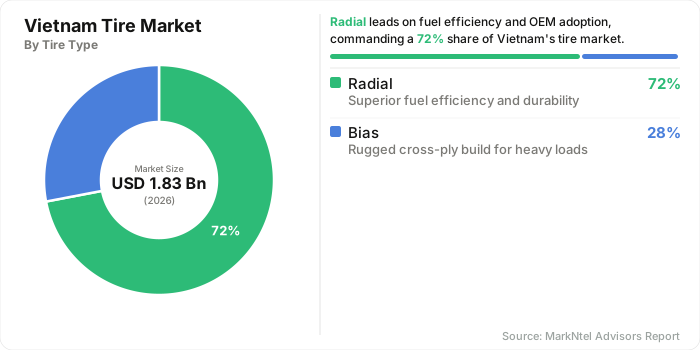
- Based on tire type, radial tires are expected to remain dominant, accounting for approximately 72% market share in 2026.
- By demand type, replacement tires are anticipated to lead with approximately 68% market share in 2026.
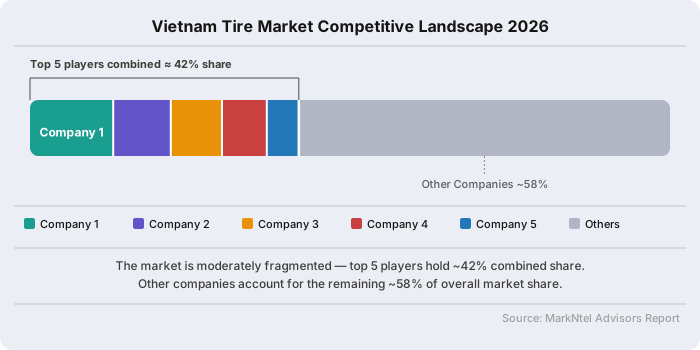
- The industry is moderately consolidated, estimated to account for approximately 42% of organized passenger-tire sales.
Vietnam Tire Market Size and Outlook
The tire market in Vietnam is projected to increase from USD 1.77 billion in 2025 to USD 1.83 billion in 2026 and USD 2.54 billion by 2032, advancing at a 5.62% CAGR during 2026–2032. The market is entering a broader product-application phase, with demand spanning passenger cars, motorcycles, commercial vehicles, agricultural equipment, and industrial machinery. Vietnam’s localized automotive-component ecosystem includes tires and inner tubes among 287 domestically produced components, supporting local product availability.
At the same time, the established motorcycle-manufacturing base and expanding automotive supply chain provide multiple recurring demand pools. These factors should sustain market expansion while encouraging suppliers to develop application-specific tire portfolios for Vietnam’s increasingly diverse vehicle and equipment base.
Vietnam Tire Market Key Indicators
- Vietnam transported over 2.2 billion tonnes of freight by road in 2025, increasing 7% year-on-year, according to the Ministry of Construction. Rapid growth in road freight increases truck mileage and operating intensity, directly supporting demand for commercial-vehicle tires and replacement tires.
- Vietnam’s total freight transportation reached 03 billion tonnes in 2025, increasing 14.1%, while freight turnover rose 13.1% to 612.3 billion tonne-kilometers. Higher freight volumes and vehicle-kilometers indicate stronger fleet utilization, accelerating tire wear and creating recurring replacement demand across trucks and other commercial vehicles.
- Vietnam’s automobile output increased 39.1% in 2025, according to the Ministry of Industry and Trade. Stronger vehicle production increases OEM tire procurement while expanding the installed vehicle base, which subsequently generates additional replacement demand throughout vehicle lifecycles.
- Passenger transportation reached 18 billion passenger trips in 2025, increasing 22.2%, while passenger traffic rose 13.6% to 312 billion passenger-kilometers. Increasing passenger mobility raises operating intensity across cars, buses, taxis, and motorcycles, supporting recurring demand for passenger and commercial replacement tires.
- Vietnam’s manufacturing of rubber and plastic products increased 16.1% in the first half of 2025, according to the Ministry of Industry and Trade. Stronger rubber-product manufacturing indicates expanding downstream processing capabilities and supports the domestic industrial ecosystem supplying tire manufacturing and related rubber-based components.
- Vietnam exceeded 3,000 km of expressways by the end of 2025 and is targeting 5,000 km by 2030. Expanding high-speed road infrastructure increases interprovincial mobility and freight connectivity, raising vehicle mileage and consequently accelerating tire consumption and replacement cycles.
Vietnam’s Tire Exports Reach USD 2.9 Billion as Trade Surplus Hits USD 2.4 Billion
Vietnam’s tire trade data indicates a strong export-oriented manufacturing base, while imports remain important for selected cost-competitive and specialized products. Tire imports declined from USD 536 million in 2022 to USD 474 million in 2024, while import volume decreased from 107 thousand tons to 92 thousand tons, indicating improving domestic supply relative to import dependence. Thailand and China remained the principal suppliers in 2024, contributing USD 202 million and USD 164 million, respectively, or approximately 77% of total import value. Their combined volume reached 72 thousand tons, accounting for nearly 78% of imports, reflecting the importance of competitively priced regional supply for replacement and commercial-vehicle applications.
In contrast, Vietnam’s tire exports increased from USD 2.2 billion in 2022 to USD 2.9 billion in 2024, while export volume rose from 500 thousand tons to 539 thousand tons. This generated an estimated USD 2.4 billion trade surplus and a 447-thousand-ton volume surplus in 2024, reinforcing Vietnam’s position as a major tire manufacturing and export hub. The United States absorbed USD 1.3 billion, approximately 45% of export value, creating substantial demand for Vietnam-produced tires. Brazil, Russia, Canada, and Mexico provided additional diversification.
The export momentum is supported by domestic automotive demand. Vietnam’s estimated domestic car production reached 388,500 units in 2024, up 27% year-on-year. Additionally, Vietnam’s 2024 tire sales increased 3.8% in the car segment, while motorcycle tire sales rose 15.3%, supporting both OEM and replacement demand.
Vietnam Tire Market Scope
| Category | Segments |
|---|---|
| By Tire Type | Radial, Bias |
| By Vehicle Type | Two-Wheeler, Three-Wheeler, Passenger Car, Light Commercial Vehicle (LCV), Medium & Heavy Commercial Vehicle (MHCV), Off-the-Road Vehicle (OTR) |
| By Demand Type | OEM, Replacement |
| By Sales Channel | Direct Sales, Dealer/Distributor, Online Platform), by Tire Size (Tire Size 1, Tire Size 2, Tire Size 3, Tire Size 4, Tire Size 5 |
| By Price Category | Economy, Mid-Range, Premium |
Vietnam Tire Market Growth Drivers
Rapid Expressway Expansion Increasing Tire Utilization and Commercial-Mobility Demand
Vietnam’s accelerated road-infrastructure expansion is creating a direct structural tailwind for tire consumption by increasing vehicle connectivity, travel intensity, and freight movement across provinces. By the end of 2025, the country had 3,345 km of main expressways in operation or technically opened, together with 458 km of interchanges and connecting roads, exceeding the national 3,000-km target. The Ministry of Construction reported that nearly 400 km of additional expressways entered operation during H1 2026, further improving connectivity between industrial centers, logistics corridors, and major urban markets.
This infrastructure expansion has a direct implication for tire demand because longer, faster road journeys increase vehicle utilization and accelerate tire wear, particularly among trucks, buses, passenger cars, and logistics fleets. The government is targeting 5,000 km of expressways by 2030, indicating that the current infrastructure build-out is not a one-time development but a continuing demand catalyst. Moreover, improved road connectivity is expected to support greater movement of manufactured goods and agricultural products between production regions and consumption centers, increasing mileage accumulated by commercial fleets and consequently strengthening recurring tire replacement requirements.
Recent Trends
Tire Recycling and Retreading Strengthen Sustainability Focus
Vietnam’s tire industry is increasingly moving toward tire lifecycle management, driven by regulatory requirements for the collection and recycling of used tires and growing emphasis on resource efficiency. Under Vietnam’s EPR framework, tire and inner-tube producers and importers are required to fulfill recycling responsibilities, creating a stronger incentive for manufacturers to develop collection, retreading, and material-recovery capabilities. This is particularly relevant because retreading can extend the usable life of tire casings while reducing demand for new raw materials.
Da Nang Rubber Joint Stock Company (DRC) provides a direct industry example. The company has been recognized by Vietnam’s environmental authorities as an eligible used-tire recycling entity and operates a retread-tire factory with an annual capacity of approximately 110,000 tires. DRC’s activities demonstrate how Vietnamese manufacturers are integrating tire reuse into their business models rather than treating sustainability solely as an environmental-compliance issue. The company’s continued focus on retreaded products supports material conservation, extends tire service life, and creates an additional aftermarket revenue stream. Consequently, recycling and retreading are emerging as practical components of Vietnam’s transition toward a more circular tire industry.
Vietnam Tire Market Opportunities and Challenges
Raw-Material Cost Volatility Leading to Higher-Value Tire Manufacturing
Vietnam’s tire producers remain exposed to fluctuations in natural-rubber costs because rubber is a core input in tire manufacturing. In 2025, Vietnam produced 1.35 million tonnes of natural rubber, up only 1.4% year-on-year, while the Ministry of Industry and Trade reported that tighter global supply and recovering automotive demand were keeping rubber prices elevated. Such cost pressure can squeeze tire manufacturers’ margins, particularly where producers compete in price-sensitive replacement markets and cannot fully pass input-cost increases to customers.
At the same time, elevated input costs are encouraging movement toward higher-value, technologically differentiated products, creating an opportunity to improve margins rather than compete solely on price. Vietnam’s rubber industry exported USD 2.1 billion of C/O-certified rubber during January–November 2025, reflecting stronger movement toward value-added and traceable products. This direction aligns with tire manufacturers’ capacity upgrades; for example, DRC commissioned its Phase 3 radial-truck-tire expansion in December 2025, raising annual capacity to 1 million tires. Such investments can support premium radial products and improve manufacturers’ ability to absorb raw-material volatility.
Segmentation Insights
Radial Tires Hold 72% Share as Vietnam’s Automotive Production Expands
Radial tires are estimated to hold approximately a 72% share in 2026, reflecting their widespread application across passenger cars, trucks, buses, and modern commercial vehicles. Their durability, improved fuel efficiency, heat dissipation, and suitability for higher-speed operations make them increasingly preferable as Vietnam’s vehicle base modernizes. The demand environment is reinforced by domestic automotive manufacturing Vietnam’s automobile output increased 39.1% in 2025, according to the Ministry of Industry and Trade. This expansion strengthens demand for radial tires across both OEM and replacement applications.
A notable 2025 development supporting this segment was Casumina’s completion and commissioning of additional equipment for its Patagonia M/T steel-belted tire production line in June 2025. The investment increased the company’s steel-belted tire production capacity to 1.5 million tires annually, primarily targeting export markets. The development demonstrates continued investment in advanced tire manufacturing technology and production capacity by Vietnam-based manufacturers, while strengthening the availability of domestically produced radial products for international and regional applications. Based on the tire type, the market is further bifurcated into:
- Radial
- Bias
Replacement Tires, estimated 68% Share, supported by Rising Vehicle Utilization and Aftermarket Services
Replacement tires are estimated to account for approximately 68% share in 2026, supported by Vietnam’s expanding vehicle usage and the recurring need for tire replacement caused by mileage, tread wear, road conditions, and commercial operating intensity. Government statistics show that transportation activity strengthened substantially in 2025. During Q1 2025, freight transport reached 715.8 million tonnes, increasing 15.4% year-on-year, while freight traffic rose 14.7% to 138.6 billion tonne-kilometers. Passenger transport also expanded, with 1.414 billion passengers carried, up 17.6%. These indicators demonstrate higher vehicle utilization, particularly across commercial fleets, creating greater wear-related demand for replacement tires.
The aftermarket opportunity is further reinforced by Vietnam’s automotive component ecosystem. The Ministry of Industry and Trade identifies automotive tires and inner tubes among the 287 localized automotive components currently produced domestically, demonstrating an established manufacturing base supporting replacement availability. The Ministry also reports that Vietnam imports approximately USD 2–3.5 billion of automotive components annually for vehicle production, assembly, and repair, indicating substantial activity across the broader aftermarket and maintenance ecosystem. Consequently, tire dealers, workshops, repair centers, and component distributors remain important channels connecting manufacturers with the replacement market. Based on the demand type, the tire industry in Vietnam is further bifurcated into:
- OEM
- Replacement
Vietnam Tire Market Competitive Analysis
The Vietnam tire industry remains moderately consolidated, with strong competition between international manufacturers and established domestic producers. Bridgestone Corporation, Michelin SCA, The Yokohama Rubber Co., Ltd., Kumho Tire Co., Inc., and Sailun Group Co., Ltd. form the leading five among the identified companies, collectively estimated to hold approximately 42% of organized passenger-tire sales, while Casumina and DRC strengthen domestic competition.
Key Companies in the Vietnam Tire Market
- Bridgestone Corporation
- Michelin SCA
- The Yokohama Rubber Co., Ltd.
- Kumho Tire Co., Inc.
- Sailun Group Co., Ltd.
- The Southern Rubber Industry JSC (Casumina)
- Da Nang Rubber Joint Stock Company (DRC)
- Pirelli & C. S.p.A.
- The Goodyear Tire & Rubber Company
- Continental AG
- Others
Vietnam Tire Industry News and Recent Developments
May 2026: DRC Launches Three New Agricultural Tire Sizes for Vietnam’s Mechanized Farming Market
Danang Rubber Joint Stock Company (DRC) introduced three new agricultural tire sizes in 2026, designed for modern farming equipment used in Vietnam. The company stated that the new models are developed to address requirements for heavy-load capacity, traction, and durability as agricultural mechanization expands. The launch broadens DRC’s specialized tire portfolio beyond passenger, truck, and motorcycle applications and strengthens its positioning in Vietnam’s agricultural equipment segment.
Impact Analysis: The launch demonstrates Vietnamese tire manufacturers’ increasing focus on specialized applications, enabling DRC to capture demand from agricultural machinery while diversifying beyond conventional replacement-tire categories
Frequently Asked Questions
- Market Segmentation
- Introduction
- Product Definition
- Research Process
- Assumptions
- Executive Summary
- Vietnam Tire Market Production (Thousand Units) Trend 2022-2032
- Company-Wise Production Plants and Statistics
- List of all the Manufacturing Plants
- Installed Capacity in (Units or Tons)
- Actual Production Capacity
- Type of Tires Produced
- New Plants & Plant Closure Details
- Others
- . Planned Production Target
- List of all the Manufacturing Plants
- Company-Wise Production Plants and Statistics
- Vietnam Tire Market Pricing Analysis 2022-2032
- Vietnam Tire Market Pricing Trend (USD/Units) 2022-2032
- By Type of Tires (USD/Units)
- Three-Wheeler
- Two-Wheelers
- Passenger Car
- Light Commercial Vehicle (LCV)
- Medium & Heavy Commercial Vehicle (MHCV)
- Off-the-Road Vehicle (OTR)
- Competitor-Wise Price Benchmarking
- Historical Price YoY Increase by Brands
- By Type of Tires (USD/Units)
- Vietnam Tire Market Pricing Trend (USD/Units) 2022-2032
- Vietnam Tire Market Supply Chain Analysis
- Vietnam Tire Market Import & Export Data Analysis
- Vietnam Tire Market Policies, Regulations, and Product Standards
- Vietnam Tire Market Trends & Developments
- Vietnam Tire Market Dynamics
- Growth Factors
- Challenges
- Vietnam Tire Market Hotspot & Opportunities
- Vietnam Tire Market Outlook, 2022-2032
- Market Size & Outlook
- By Revenues (USD Million)
- By Unit Sold (Thousand Units)
- Market Segmentation & Outlook
- By Tire Type - Market Size & Forecast 2022-2032, USD Million & Thousand Units
- Radial
- Bias
- By Vehicle Type- Market Size & Forecast 2022-2032, USD Million & Thousand Units
- Two-Wheeler
- Three-Wheeler
- Passenger Car
- Light Commercial Vehicle (LCV)
- Medium & Heavy Commercial Vehicle (MHCV)
- Off-the-Road Vehicle (OTR)
- By Demand Type- Market Size & Forecast 2022-2032, USD Million & Thousand Units
- OEM
- Replacement
- By Sales Channel- Market Size & Forecast 2022-2032, USD Million & Thousand Units
- Direct Sales
- Dealer/Distributor
- Online Platform
- by Tire Size- Market Size & Forecast 2022-2032, USD Million & Thousand Units
- Tire Size 1
- Tire Size 2
- Tire Size 3
- Tire Size 4
- Tire Size 5
- By Price Category- Market Size & Forecast 2022-2032, USD Million & Thousand Units
- Economy
- Mid-Range
- Premium
- By Region- Market Size & Forecast 2022-2032, USD Million & Thousand Units
- Northern Vietnam
- Central Vietnam
- Southern Vietnam
- By Company
- Competition Characteristics
- Market Share & Analysis
- By Tire Type - Market Size & Forecast 2022-2032, USD Million & Thousand Units
- Market Size & Outlook
- Vietnam Radial Tire Market Outlook, 2022-2032
- Market Size & Outlook
- By Revenues (USD Million)
- By Unit Sold (Thousand Units)
- Market Segmentation & Outlook
- By Vehicle Type- Market Size & Forecast 2022-2032, USD Million & Thousand Units
- By Demand Type- Market Size & Forecast 2022-2032, USD Million & Thousand Units
- By Sales Channel- Market Size & Forecast 2022-2032, USD Million & Thousand Units
- by Tire Size- Market Size & Forecast 2022-2032, USD Million & Thousand Units
- By Price Category- Market Size & Forecast 2022-2032, USD Million & Thousand Units
- By Region- Market Size & Forecast 2022-2032, USD Million & Thousand Units
- Market Size & Outlook
- Vietnam Bias Tire Market Outlook, 2022-2032
- Market Size & Outlook
- By Revenues (USD Million)
- By Unit Sold (Thousand Units)
- Market Segmentation & Outlook
- By Vehicle Type- Market Size & Forecast 2022-2032, USD Million & Thousand Units
- By Demand Type- Market Size & Forecast 2022-2032, USD Million & Thousand Units
- By Sales Channel- Market Size & Forecast 2022-2032, USD Million & Thousand Units
- by Tire Size- Market Size & Forecast 2022-2032, USD Million & Thousand Units
- By Price Category- Market Size & Forecast 2022-2032, USD Million & Thousand Units
- By Region- Market Size & Forecast 2022-2032, USD Million & Thousand Units
- Market Size & Outlook
- Vietnam Tire Market Key Strategic Imperatives for Success & Growth
- Competitive Outlook
- Company Profiles
- Bridgestone Corporation
- Business Description
- Product Portfolio
- Collaborations & Alliances
- Recent Developments
- Financial Details
- Others
- Michelin SCA
- Business Description
- Product Portfolio
- Collaborations & Alliances
- Recent Developments
- Financial Details
- Others
- The Yokohama Rubber Co., Ltd.
- Business Description
- Product Portfolio
- Collaborations & Alliances
- Recent Developments
- Financial Details
- Others
- Kumho Tire Co., Inc.
- Business Description
- Product Portfolio
- Collaborations & Alliances
- Recent Developments
- Financial Details
- Others
- Sailun Group Co., Ltd.
- Business Description
- Product Portfolio
- Collaborations & Alliances
- Recent Developments
- Financial Details
- Others
- The Southern Rubber Industry JSC (Casumina)
- Business Description
- Product Portfolio
- Collaborations & Alliances
- Recent Developments
- Financial Details
- Others
- Da Nang Rubber Joint Stock Company (DRC)
- Business Description
- Product Portfolio
- Collaborations & Alliances
- Recent Developments
- Financial Details
- Others
- Pirelli & C. S.p.A.
- Business Description
- Product Portfolio
- Collaborations & Alliances
- Recent Developments
- Financial Details
- Others
- The Goodyear Tire & Rubber Company
- Business Description
- Product Portfolio
- Collaborations & Alliances
- Recent Developments
- Financial Details
- Others
- Continental AG
- Business Description
- Product Portfolio
- Collaborations & Alliances
- Recent Developments
- Financial Details
- Others
- Others
- Bridgestone Corporation
- Company Profiles
- Disclaimer
MarkNtel Advisors follows a robust and iterative research methodology designed to ensure maximum accuracy and minimize deviation in market estimates and forecasts. Our approach combines both bottom-up and top-down techniques to effectively segment and quantify various aspects of the market. A consistent feature across all our research reports is data triangulation, which examines the market from three distinct perspectives to validate findings. Key components of our research process include:
1. Scope & Research Design At the outset, MarkNtel Advisors define the research objectives and formulate pertinent questions. This phase involves determining the type of research—qualitative or quantitative—and designing a methodology that outlines data collection methods, target demographics, and analytical tools. They also establish timelines and budgets to ensure the research aligns with client goals.
2. Sample Selection and Data Collection In this stage, the firm identifies the target audience and determines the appropriate sample size to ensure representativeness. They employ various sampling methods, such as random or stratified sampling, based on the research objectives. Data collection is carried out using tools like surveys, interviews, and observations, ensuring the gathered data is reliable and relevant.
3. Data Analysis and Validation Once data is collected, MarkNtel Advisors undertake a rigorous analysis process. This includes cleaning the data to remove inconsistencies, employing statistical software for quantitative analysis, and thematic analysis for qualitative data. Validation steps are taken to ensure the accuracy and reliability of the findings, minimizing biases and errors.

4. Data Forecast and FinalizationThe final phase involves forecasting future market trends based on the analyzed data. MarkNtel Advisors utilize predictive modeling and time series analysis to anticipate market behaviors. The insights are then compiled into comprehensive reports, featuring visual aids like charts and graphs, and include strategic recommendations to inform client decision-making
We offer flexible licensing options to cater to varying organizational needs. Choose the pricing pack that best suits your requirements:
Buy Now Inquire Before Buying
 Request Customization
 Talk to our Consultant







