

UAE Tire Market Research Report Forecast: (2026-2032)
By Type of Vehicles (Passenger Car, Light Commercial Vehicle, Medium and Heavy Commercial Vehicles, Off the Road (OTR), Two Wheelers), By Demand Category (OEM, Aftermarket), By Typ ... e of Tire (Radial, Bias), By Sales Channel (Direct Sales, Exclusive Outlets & Multi-brand Stores, Online), By Price Category (Budget, Economy, Premium), By Tire Size (Tire Size 1, Tire Size 2, Tire Size 3, Tire Size 4, Tire Size 5), and others Read more
- Tire
- Feb 2026
- Pages 135
- Report Format: PDF, Excel, PPT
UAE Tire Market
Projected 8.94% CAGR from 2026 to 2032
Study Period
2026-2032
Market Size (2025)
USD 1.34 Billion
Market Size (2032)
USD 2.24 Billion
Base Year
2025
Projected CAGR
8.94%
Leading Segments
By Vehicle Type: Passenger Car
The UAE Tire Market Report Key Takeaways:
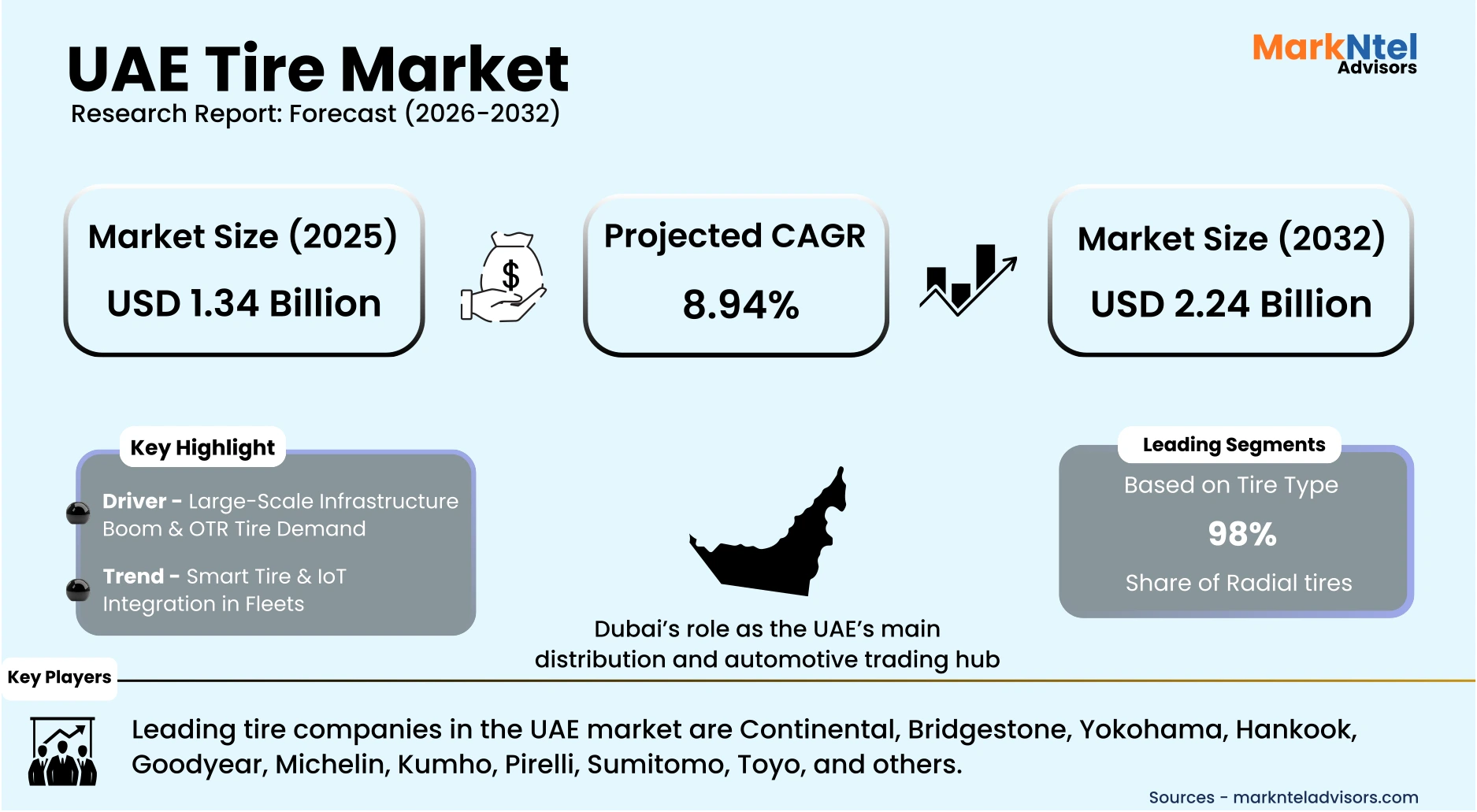
- Market size was valued at approximately USD 1.34 billion in 2025 and is projected to reach USD 2.24 billion by 2032. The estimated CAGR from 2026 to 2032 is around 8.94%, indicating strong growth.
- In 2025, passenger cars led the UAE tire market with 58% shares, due to the country’s large private vehicle fleet, high daily commuting reliance, and strong SUV/luxury car penetration.
- In 2025, radial tires captured 98% of the UAE tire market mainly due to their superior durability, better heat resistance, improved fuel efficiency, and stronger road grip, which suits the UAE’s high-speed highways and extreme temperatures.
- Based on region, Dubai held the largest share (~29%) of the UAE tire market in 2025 due to its high vehicle population, heavy daily commuting, and strong demand from taxis, ride-hailing, and car rental fleets.
- Leading tire companies in the UAE market are Continental, Bridgestone, Yokohama, Hankook, Goodyear, Michelin, Kumho, Pirelli, Sumitomo, Toyo, and others.
Market Insights & Analysis: The UAE Tire Market (2026-32):
The UAE Tire Market size was valued at around USD 1.34 billion in 2025 and is projected to reach USD 2.24 billion by 2032. Along with this, the market is estimated to grow at a CAGR of around 8.94% during the forecast period, i.e., 2026-32.
The growth of the market is driven primarily by the burgeoning vehicle sales owing to improving per capita income & living standards, vehicles becoming a status symbol, surging number of private vehicle ownership, and an escalating number of female drivers across the UAE.
In addition, the rising focus of the UAE government toward economic diversification is leading to massive investments in infrastructure developments, which, in turn, is introducing several constructions projects and propelling the demand for heavy commercial vehicles. Hence, the demand for robust tires for these vehicles is escalating swiftly across the country and driving the market.
Besides, the rapidly expanding tourism in the UAE is playing a crucial role in fueling the demand for vehicles for public transportation, along with sports vehicles for adventure & off-roading activities, thereby driving the tire market.
Moreover, escalating migration due to the availability of various job opportunities, coupled with numerous Multi-National Companies (MNCs) being established in the UAE, are infusing the demand for vehicles & boosting the tire market. Furthermore, the active participation of prominent automakers & tire manufacturers in expanding their product portfolio & visibility across the UAE is another crucial aspect projected to augment the overall market growth in the years to come.
The UAE Tire Industry Recent Development:
- March 2024: Bahwan Motors Auto Accessories (BMAA) launched “Accelus” tires in the UAE, manufactured by Ralson India Ltd. (Ralson). The launch focuses on Truck & Bus Radial (TBR) tires aimed at lowering total cost of ownership for fleets and owner-operators, strengthening the UAE’s commercial replacement tire ecosystem.
- April 2024: YOKOHAMA announced it will supply ADVAN racing tires for the inaugural Abu Dhabi Autonomous Racing League (A2RL) race held on April 27, 2024, reinforcing the UAE’s positioning as a hub for high-performance and future mobility initiatives.
- May 2024: Prometeon Tyre Group launched its first Prometeon-branded Serie 02 tire range, including G02 ON-OFF (mixed construction/off-road) and G210 (heavy regional applications), tailored to demanding GCC/UAE operating conditions and construction-led tire consumption.
- December 2024: AISIN Corporation revealed its new tire brand “AITERRA” at Automechanika Dubai 2024, signalling entry into tires with a focus on sustainability and technology, aligned with the UAE’s growing premium aftermarket and innovation trend.
UAE Tire Market Scope:
| Category | Segments |
|---|---|
| By Type of Vehicles | (Passenger Car, Light Commercial Vehicle, Medium and Heavy Commercial Vehicles, Off the Road (OTR), Two Wheelers), |
| By Demand Category | (OEM, Aftermarket), |
| By Type of Tire | (Radial, Bias), |
| By Sales Channel | (Direct Sales, Exclusive Outlets & Multi-brand Stores, Online), |
| By Price Category | (Budget, Economy, Premium), |
| By Tire Size | (Tire Size 1, Tire Size 2, Tire Size 3, Tire Size 4, Tire Size 5), |
The UAE Tire Market Driver:
Large-Scale Infrastructure Boom & OTR Tire Demand
The dominant driver of UAE tire consumption is the country’s massive, ongoing infrastructure and mega‑project cycle, particularly in construction, transport, and energy sectors, which continuously expands demand for off‑road (OTR) and heavy-duty tires. Under national visions like UAE Vision 2030 and Dubai 2040, the UAE is executing hundreds of large‑scale projects that require a vast fleet of heavy plant and OTR equipment such as excavators, loaders, dump trucks, and cranes.
For example, Dubai’s Expo 2020 district is being developed into a smart city, while the Dubai Metro expansion (including the new Route 2020 and planned Line 4) and the Dubai South logistics hub are driving intensive construction activity. In Abu Dhabi, projects like the Etihad Rail network (connecting the Northern Emirates and neighboring GCC countries), the Barakah Nuclear Energy Plant, and the development of Masdar City and Musaffah Industrial City are keeping OTR machinery in constant use. These machines operate 24/7 in harsh desert conditions, high temperatures, sand, and abrasive surfaces, which cause rapid wear and short operating life for OTR tires, necessitating frequent replacements and higher replacement volumes.
Additionally, the UAE’s role as a major logistics and port hub (ports like Jebel Ali, Khalifa Port, and Hamriyah) further boosts demand for port‑use and terminal equipment tires. This continuous fleet expansion and high utilization across construction, energy, and logistics sectors mean that even modest project delays or expansions directly translate into higher tire sales and replacement cycles. As long as the UAE continues to prioritize world‑class infrastructure and urban development, this construction‑linked OTR demand will remain the single most powerful engine for the local tire market in the near term.
The UAE Tire Market Opportunity:
Localized Tire Manufacturing & Backward Integration
The most significant future opportunity in the UAE tire market lies in establishing local tire manufacturing and backward integration under the UAE’s “Operation 300bn” industrialization strategy. Currently, the UAE is heavily dependent on imports for all tire types, especially high‑performance and specialty tires for luxury vehicles, EVs, and off‑road equipment, which exposes the market to supply chain volatility, import duties, and long lead times. By attracting global tire OEMs or supporting local conglomerates to set up compounding, retreading, and partial manufacturing plants in free zones or industrial hubs (like Abu Dhabi or Dubai), the UAE can capture high‑value segments such as EV‑specific tires, heat‑resistant desert tires, and smart tires tailored for local conditions. This would reduce import bills, improve supply chain resilience, and enable faster customization (e.g., compounding for 50°C+ desert heat and sand erosion). Joint ventures between local industrial groups and international tire makers, supported by government incentives and access to regional logistics, can position the UAE as a regional hub for advanced tire solutions. Seizing this opportunity would transform the UAE from a pure tire market into a regional tire manufacturing and technology center, unlocking long‑term growth and higher margins for the domestic industry.
The UAE Tire Market Challenge:
Heavy Dependence on Imports & Limited Local Production
The most critical constraint in the UAE tire market is its heavy reliance on imported tires and the absence of a robust, globally competitive local tire manufacturing base. The UAE imports the vast majority of tires from major producers in China, India, Japan, South Korea, and Europe, which makes the market vulnerable to global supply chain disruptions (like port congestion or geopolitical tensions), fluctuating freight costs, and changing import tariffs. This dependence translates into longer lead times, reduced bargaining power on pricing, and higher landed costs for distributors and end‑users, especially for specialized tires (e.g., off‑road, high‑performance, or EV tires).
Moreover, the lack of local production limits the ability to quickly adapt tire formulations to UAE‑specific conditions, such as extreme heat, sandy roads, and high‑speed desert driving, forcing reliance on “global” products that may not be optimized locally. Without a strong domestic manufacturing ecosystem, the UAE also struggles to capture higher‑value activities like R&D, compound development, and advanced tire technologies (e.g., smart tire integration). Until this structural supply‑side gap is addressed, high import dependency will continue to act as a key brake on market stability, pricing control, and long‑term industrial self‑sufficiency in the UAE tire sector.
The UAE Tire Market Trend:
Smart Tire & IoT Integration in Fleets
The fastest-evolving trend reshaping the UAE tire market is the adoption of smart tires integrated with IoT sensors, particularly across commercial fleets, logistics operators, construction fleets, and public transport. These smart tires continuously capture real-time pressure, temperature, tread depth, and load data and transmit it into fleet telematics platforms, enabling operators to monitor tire health remotely. This is highly relevant in the UAE because extreme heat, long-haul highway routes, and heavy-load driving conditions sharply increase the risk of blowouts, rapid tread wear, and uneven degradation, making tire performance directly linked to safety, downtime, and operating cost. As fleet owners shift from reactive replacement to predictive tire maintenance, tire management is becoming an analytics-led function. The result is measurable: better inflation control alone can reduce unnecessary rolling resistance and deliver fuel efficiency improvements of ~8–12%, while also extending casing life and improving uptime. Key market instance strengthening the trend:
- Feb 2024: Bridgestone launched Webfleet in the UAE, partnering with Al Masaood Tyres, Batteries & Accessories (TBA) Division and Nasser Bin Abdullatif Alserkal. This rollout significantly accelerated connected tire monitoring and telematics-driven predictive maintenance across UAE fleets, strengthening the transition toward digitized tire lifecycle management.
Consequently, smart tires are no longer limited to premium fleets; they are increasingly penetrating mid-sized logistics and construction operators, where the cost-benefit of fewer breakdowns and longer tire life is compelling.
The UAE Tire Market (2026-32): Segmentation Analysis
The UAE Tire Market study of MarkNtel Advisors evaluates & highlights the major trends & influencing factors in each segment & includes predictions for the period 2026–2032 at the global, regional, and national levels. Based on the analysis, the market has been further classified as:
Based on Vehicle Type:
- Passenger Car
- Light Commercial Vehicle
- Medium and Heavy Commercial Vehicle
- Off the Road
- Two Wheelers
In 2025, passenger cars led the UAE tire market with ~58% share, supported by the country’s high private vehicle ownership, heavy dependence on daily commuting, and the strong penetration of SUVs and luxury cars (which typically require wider, performance-grade tires with faster replacement cycles). Moreover, high temperatures and long highway travel accelerate tread wear, increasing demand for replacement tires in this segment. Light commercial vehicles (LCVs) followed as a high-growth segment, driven by expanding last-mile delivery, logistics, and e-commerce activity across Dubai and Abu Dhabi. Going forward, passenger cars are projected to remain the dominant segment, as vehicle additions continue, premium tire demand rises, and replacement consumption stays consistently high across SUVs and sedans.
Based on Tire Type:
- Radial
- Bias
In 2025, radial tires dominated the UAE tire market with 98% share, primarily because they offer higher durability, superior heat resistance, better fuel efficiency, and stronger road grip, all essential under the UAE’s extreme temperatures and high-speed highway conditions. Additionally, the rising share of SUVs, premium sedans, and performance vehicles further supports radial tire uptake since most OEM fitments and replacement preferences are radial. Radial tires also provide improved comfort and tread life, reducing long-term cost per km for consumers and fleet operators.
Meanwhile, bias (cross-ply) tires maintained only a marginal presence, largely limited to niche off-road or specialized applications. Over the coming years, radial tires are expected to remain the dominant segment, driven by continued vehicle fleet expansion, replacement demand, and preference for premium high-performance tire standards.
The UAE Tire Market (2026-32): Regional Projection
Geographically, the UAE Tire Market expands across:
- Ras-al-Khaimah
- Dubai
- Abu Dhabi
- Sharjah
- Others
Dubai is projected to remain the leading region in the UAE tire market beyond 2025, supported by its 29% share in 2025 and the emirate’s concentration of both private and commercial vehicle movement. The city has the country’s most active road network due to high vehicle ownership, heavy daily commuting, and frequent inter-city travel, which accelerates tread wear and boosts replacement demand. Moreover, Dubai’s dominance is further strengthened by its large base of taxis, ride-hailing operators, and car rental fleets, where tires are replaced at shorter intervals compared to private vehicles. This fleet-driven tire consumption is clearly reflected in recent commercial developments within the emirate:
- In October 2025: Al Saeedi Group extended its strategic tyre solutions partnership with dnata at Dubai Airports (DXB & DWC) under a 5-year contract, ensuring long-term tire supply, repair, and fitting services for dnata’s airport fleet, highlighting the continuous high-volume tire requirement generated by Dubai’s aviation-linked mobility ecosystem.
Additionally, Dubai’s role as the UAE’s main distribution and automotive trading hub ensures faster penetration of premium radial and performance tires, reinforcing its long-term regional dominance in the UAE tire market.
Gain a Competitive Edge with Our UAE Tire Market Report
- The UAE Tire Market Report by MarkNtel Advisors provides a detailed & thorough analysis of market size & share, growth rate, competitive landscape, and key players. This comprehensive analysis helps businesses gain a holistic understanding of the market dynamics & make informed decisions.
- This report also highlights current market trends & future projections, allowing businesses to identify emerging opportunities & potential challenges. By understanding market forecasts, companies can align their strategies & stay ahead of the competition.
- The UAE Tire Market Report aids in assessing & mitigating risks associated with entering or operating in the market. By understanding market dynamics, regulatory frameworks, and potential challenges, businesses can develop strategies to minimize risks & optimize their operations.
*Reports Delivery Format - Market research studies from MarkNtel Advisors are offered in PDF, Excel and PowerPoint formats. Within 24 hours of the payment being successfully received, the report will be sent to your email address.
Frequently Asked Questions
- Market Segmentation
- Introduction
- Product Definition
- Research Process
- Assumptions
- Executive Summary
- The UAE Tire Market Supply Chain Analysis
- The UAE Tire Market Trends & Developments
- The UAE Tire Market Dynamics
- Growth Drivers
- Challenges
- The UAE Tire Market Import Export Statistics
- The UAE Tire Market Regulations, Policies, and Product Standards
- The UAE Tire Market Outlook 2022-2032F
- Market Size & Analysis
- By Revenue (USD Million)
- By Units Sold (Thousand Units)
- Market Segmentation & Analysis
- By Type of Vehicles
- Passenger Car- Market Size & Forecast 2022-2032, Thousand Units
- Light Commercial Vehicle- Market Size & Forecast 2022-2032, Thousand Units
- Medium and Heavy Commercial Vehicles- Market Size & Forecast 2022-2032, Thousand Units
- Off the Road (OTR) - Market Size & Forecast 2022-2032, Thousand Units
- Two Wheelers- Market Size & Forecast 2022-2032, Thousand Units
- By Demand Category
- OEM- Market Size & Forecast 2022-2032, Thousand Units
- Aftermarket- Market Size & Forecast 2022-2032, Thousand Units
- By Type of Tire
- Radial- Market Size & Forecast 2022-2032, Thousand Units
- Bias- Market Size & Forecast 2022-2032, Thousand Units
- By Sales Channel
- Direct Sales- Market Size & Forecast 2022-2032, Thousand Units
- Exclusive Outlets & Multi-brand Stores- Market Size & Forecast 2022-2032, Thousand Units
- Online- Market Size & Forecast 2022-2032, Thousand Units
- By Price Category
- Budget- Market Size & Forecast 2022-2032, Thousand Units
- Economy- Market Size & Forecast 2022-2032, Thousand Units
- Premium- Market Size & Forecast 2022-2032, Thousand Units
- By Tire Size
- Tire Size 1- Market Size & Forecast 2022-2032, Thousand Units
- Tire Size 2 - Market Size & Forecast 2022-2032, Thousand Units
- Tire Size 3 - Market Size & Forecast 2022-2032, Thousand Units
- Tire Size 4 - Market Size & Forecast 2022-2032, Thousand Units
- Tire Size 5 - Market Size & Forecast 2022-2032, Thousand Units
- By Region
- Ras-al-Khaimah
- Dubai
- Abu Dhabi
- Sharjah
- Others
- By Company
- Competition Characteristics
- Volume Shares
- By Type of Vehicles
- Market Size & Analysis
- The UAE Passenger Car Tire Market Outlook, 2022-2032F
- Market Size & Analysis
- Market Revenue (USD Million)
- By Units Sold (Thousand Units)
- Market Segmentation & Analysis
- By Type of Vehicle- Market Size & Forecast 2022-2032, Thousand Units
- Hatchback- Market Size & Forecast 2022-2032, Thousand Units
- Sedan- Market Size & Forecast 2022-2032, Thousand Units
- SUV- Market Size & Forecast 2022-2032, Thousand Units
- By Demand Category- Market Size & Forecast 2022-2032, Thousand Units
- By Type of Tire- Market Size & Forecast 2022-2032, Thousand Units
- By Sales Channel- Market Size & Forecast 2022-2032, Thousand Units
- By Price Category- Market Size & Forecast 2022-2032, Thousand Units
- By Tire Size- Market Size & Forecast 2022-2032, Thousand Units
- By Type of Vehicle- Market Size & Forecast 2022-2032, Thousand Units
- Market Size & Analysis
- The UAE Light Commercial Vehicle Tire Market Outlook, 2022-2032F
- Market Size & Analysis
- Market Revenue (USD Million)
- By Units Sold (Thousand Units)
- Market Segmentation & Analysis
- By Type of Vehicle- Market Size & Forecast 2022-2032, Thousand Units
- Light Trucks- Market Size & Forecast 2022-2032, Thousand Units
- Light Buses- Market Size & Forecast 2022-2032, Thousand Units
- Pick-up Trucks and Vans- Market Size & Forecast 2022-2032, Thousand Units
- By Demand Category- Market Size & Forecast 2022-2032, Thousand Units
- By Type of Tire- Market Size & Forecast 2022-2032, Thousand Units
- By Sales Channel- Market Size & Forecast 2022-2032, Thousand Units
- By Price Category- Market Size & Forecast 2022-2032, Thousand Units
- By Tire Size- Market Size & Forecast 2022-2032, Thousand Units
- By Type of Vehicle- Market Size & Forecast 2022-2032, Thousand Units
- Market Size & Analysis
- The UAE Medium and Heavy Commercial Vehicle Tire Market Outlook, 2022-2032F
- Market Size & Analysis
- Market Revenue (USD Million)
- By Units Sold (Thousand Units)
- Market Segmentation & Analysis
- By Type of Vehicle- Market Size & Forecast 2022-2032, Thousand Units
- Buses- Market Size & Forecast 2022-2032, Thousand Units
- Trucks- Market Size & Forecast 2022-2032, Thousand Units
- By Demand Category- Market Size & Forecast 2022-2032, Thousand Units
- By Type of Tire- Market Size & Forecast 2022-2032, Thousand Units
- By Sales Channel- Market Size & Forecast 2022-2032, Thousand Units
- By Price Category- Market Size & Forecast 2022-2032, Thousand Units
- By Tire Size- Market Size & Forecast 2022-2032, Thousand Units
- By Type of Vehicle- Market Size & Forecast 2022-2032, Thousand Units
- Market Size & Analysis
- The UAE Two-Wheeler Tire Market Outlook, 2022-2032F
- Market Size & Analysis
- Market Revenue (USD Million)
- By Units Sold (Thousand Units)
- Market Segmentation & Analysis
- By Type of Vehicle- Market Size & Forecast 2022-2032, Thousand Units
- Scooters and Mopeds- Market Size & Forecast 2022-2032, Thousand Units
- Motorcycles- Market Size & Forecast 2022-2032, Thousand Units
- By Demand Category- Market Size & Forecast 2022-2032, Thousand Units
- By Type of Tire- Market Size & Forecast 2022-2032, Thousand Units
- By Sales Channel- Market Size & Forecast 2022-2032, Thousand Units
- By Price Category- Market Size & Forecast 2022-2032, Thousand Units
- By Tire Size- Market Size & Forecast 2022-2032, Thousand Units
- By Type of Vehicle- Market Size & Forecast 2022-2032, Thousand Units
- Market Size & Analysis
- The UAE OTR Vehicle Tire Market Outlook, 2022-2032F
- Market Size & Analysis
- Market Revenue (USD Million)
- By Units Sold (Thousand Units)
- Market Segmentation & Analysis
- By Type of Vehicle- Market Size & Forecast 2022-2032, Thousand Units
- Earthmoving Equipment- Market Size & Forecast 2022-2032, Thousand Units
- Agricultural Vehicles- Market Size & Forecast 2022-2032, Thousand Units
- Material Handling Vehicles- Market Size & Forecast 2022-2032, Thousand Units
- By Demand Category- Market Size & Forecast 2022-2032, Thousand Units
- By Type of Tire- Market Size & Forecast 2022-2032, Thousand Units
- By Sales Channel- Market Size & Forecast 2022-2032, Thousand Units
- By Price Category- Market Size & Forecast 2022-2032, Thousand Units
- By Tire Size- Market Size & Forecast 2022-2032, Thousand Units
- By Type of Vehicle- Market Size & Forecast 2022-2032, Thousand Units
- Market Size & Analysis
- The UAE Tire Market Key Strategic Imperatives for Success & Growth
- Competition Outlook
- Company Profiles
- Continental AG
- Business Description
- Type Portfolio
- Strategic Alliances or Partnerships
- Recent Developments
- Financial Details
- Others
- Bridgestone Corporation
- Business Description
- Type Portfolio
- Strategic Alliances or Partnerships
- Recent Developments
- Financial Details
- Others
- Pirelli & C. S.p.A.
- Business Description
- Type Portfolio
- Strategic Alliances or Partnerships
- Recent Developments
- Financial Details
- Others
- Yokohama Rubber Company Limited
- Business Description
- Type Portfolio
- Strategic Alliances or Partnerships
- Recent Developments
- Financial Details
- Others
- Hankook Tire Co., Ltd.
- Business Description
- Type Portfolio
- Strategic Alliances or Partnerships
- Recent Developments
- Financial Details
- Others
- Goodyear Tire & Rubber Company
- Business Description
- Type Portfolio
- Strategic Alliances or Partnerships
- Recent Developments
- Financial Details
- Others
- Toyo Tire and Rubber Company
- Business Description
- Type Portfolio
- Strategic Alliances or Partnerships
- Recent Developments
- Financial Details
- Others
- Michelin Group
- Business Description
- Type Portfolio
- Strategic Alliances or Partnerships
- Recent Developments
- Financial Details
- Others
- Sumitomo Rubber Industries Limited
- Business Description
- Type Portfolio
- Strategic Alliances or Partnerships
- Recent Developments
- Financial Details
- Others
- Kumho
- Business Description
- Type Portfolio
- Strategic Alliances or Partnerships
- Recent Developments
- Financial Details
- Others
- Others
- Continental AG
- Company Profiles
- Disclaimer
MarkNtel Advisors follows a robust and iterative research methodology designed to ensure maximum accuracy and minimize deviation in market estimates and forecasts. Our approach combines both bottom-up and top-down techniques to effectively segment and quantify various aspects of the market. A consistent feature across all our research reports is data triangulation, which examines the market from three distinct perspectives to validate findings. Key components of our research process include:
1. Scope & Research Design At the outset, MarkNtel Advisors define the research objectives and formulate pertinent questions. This phase involves determining the type of research—qualitative or quantitative—and designing a methodology that outlines data collection methods, target demographics, and analytical tools. They also establish timelines and budgets to ensure the research aligns with client goals.
2. Sample Selection and Data Collection In this stage, the firm identifies the target audience and determines the appropriate sample size to ensure representativeness. They employ various sampling methods, such as random or stratified sampling, based on the research objectives. Data collection is carried out using tools like surveys, interviews, and observations, ensuring the gathered data is reliable and relevant.
3. Data Analysis and Validation Once data is collected, MarkNtel Advisors undertake a rigorous analysis process. This includes cleaning the data to remove inconsistencies, employing statistical software for quantitative analysis, and thematic analysis for qualitative data. Validation steps are taken to ensure the accuracy and reliability of the findings, minimizing biases and errors.

4. Data Forecast and FinalizationThe final phase involves forecasting future market trends based on the analyzed data. MarkNtel Advisors utilize predictive modeling and time series analysis to anticipate market behaviors. The insights are then compiled into comprehensive reports, featuring visual aids like charts and graphs, and include strategic recommendations to inform client decision-making
We offer flexible licensing options to cater to varying organizational needs. Choose the pricing pack that best suits your requirements:
Buy Now Inquire Before Buying
 Request Customization
 Talk to our Consultant







