

India Two-Wheeler Tire Market Research Report: Forecast (2026-2032)
By Tire Type (Radial, Bias), By Vehicle Type (Scooter and Moped, Motorcycle), By Demand Type (OEMs, Replacement), By Price Category (Budget, Economy, Premium), By Sales Channel (On ... line, Multi Brand Stores, Exclusive Outlets, Direct Sales), By Tire Size (Tire Size 1, Tire Size 2, Tire Size 3, Tire Size 4, Tire Size 5), and others Read more
- Tire
- Jul 2026
- Pages 140
- Report Format: PDF, Excel, PPT
India Two-Wheeler Tire Market
Projected 10.64% CAGR from 2026 to 2032
Study Period
2026-2032
Market Size (2026)
USD 4.52 Billion
Market Size (2032)
USD 8.29 Billion
Base Year
2025
Projected CAGR
10.64%
Leading Segments
By Vehicle Type: Scooter and Moped
India Two-Wheeler Tire Market Key Takeaways
- India two-wheeler tire market size was valued at around USD 4.12 billion in 2025 and is projected to grow from USD 4.52 billion in 2026 to USD 8.29 billion by 2032.
- The industry is projected to witness steady growth at a CAGR of around 10.64% during 2026-2032.
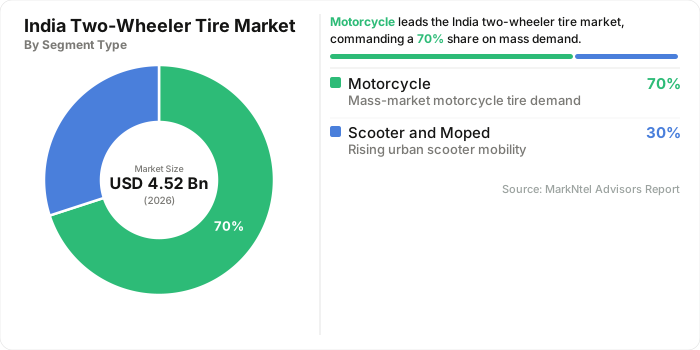
- By vehicle type, motorcycles dominated the market with approximately 70% share in 2026.
- By demand type, the replacement segment accounted for approximately 70% of the market share in 2026.
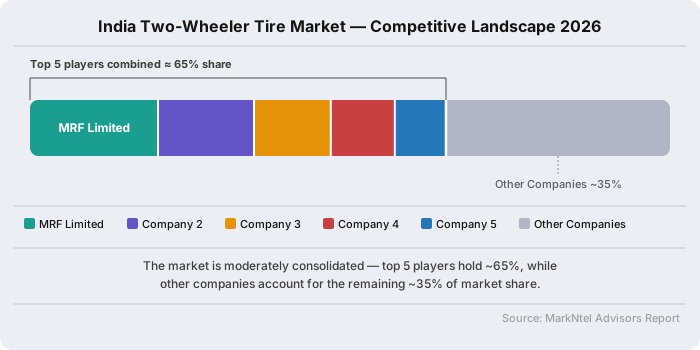
- The industry is moderately consolidated, with the top five players collectively account for approximately 65% market share.
India Two-Wheeler Tire Market Size and Outlook
The two-wheeler tire market in India was valued at USD 4.12 billion in 2025 and is projected to grow from USD 4.52 billion in 2026 to USD 8.29 billion by 2032, registering a CAGR of approximately 10.64% during 2026–2032. Market growth is primarily supported by rising urban mobility requirements, expanding last-mile delivery networks, and accelerating electric two-wheeler adoption across the country.
Two-wheelers remain India's dominant personal mobility mode due to their affordability, fuel efficiency, and maneuverability across congested urban environments. Their widespread use for daily commuting, commercial transportation, and delivery services is increasing vehicle utilization and annual mileage, resulting in faster tire wear and stronger replacement demand.
The rapid expansion of India's quick-commerce ecosystem is further intensifying this demand. The industry is projected to expand at a CAGR of approximately 67% through 2030, driven by increasing digital penetration, evolving consumer preferences, and the expansion of delivery networks beyond metropolitan areas into Tier 2 and Tier 3 cities. Companies such as Swiggy, Zomato, and Blinkit are scaling their operations to address this growing demand.
The simultaneous electrification of last-mile delivery fleets is creating an additional growth avenue for tire manufacturers. In 2025, Blinkit reported achieving 100% electric-vehicle-based deliveries across Delhi-NCR, demonstrating the rapid adoption of electric two-wheelers in high-frequency logistics operations. These vehicles typically operate over intensive daily delivery cycles, accelerating tire wear while creating demand for specialized EV tires engineered to support higher torque, increased vehicle weight, improved durability, and greater energy efficiency.
India Two-Wheeler Tire Market Key Indicators
- According to the Society of Indian Automobile Manufacturers (SIAM), domestic two-wheeler sales reached approximately 21.18 million units in FY2025–26, representing one of the highest sales volumes recorded by the industry. The growth was supported by improving rural demand, higher disposable incomes, and continued preference for affordable personal mobility solutions. Motorcycles and scooters remained the dominant mode of transportation across urban and semi-urban regions due to their cost efficiency and convenience. Rising two-wheeler sales directly increase OEM tire demand while simultaneously expanding the installed vehicle base, creating long-term opportunities for replacement tire manufacturers.
- As per the Ministry of Statistics and Programme Implementation (MoSPI), India produced approximately 24.53 million two-wheelers during FY2024–25, reaffirming its position as the world's largest two-wheeler manufacturing hub. Strong domestic demand, expanding export opportunities, and ongoing investments by vehicle manufacturers supported production growth. India continues to serve as a major production center for motorcycles and scooters catering to both domestic and international markets. Higher production volumes increase tire procurement by OEMs, supporting sustained growth in tire manufacturing and strengthening demand across the automotive supply chain.
- The Ministry of Heavy Industries reported that the PM E-DRIVE Scheme allocated incentives for nearly 2.48 million electric two-wheelers through March 2026, reflecting the government's commitment to accelerating electric mobility adoption. Furthermore, 136 electric two-wheeler models had been approved under the scheme by December 2025, providing consumers with a wider range of electric vehicle options. The growing electrification of the two-wheeler fleet is reshaping product requirements across the automotive sector. Increasing EV adoption is driving demand for specialized tires with low rolling resistance, enhanced durability, and optimized performance characteristics tailored for electric motorcycles and scooters.
- The Ministry of Rural Development reports that, more than 7.84 lakh kilometers of rural roads had been constructed under the Pradhan Mantri Gram Sadak Yojana (PMGSY) by March 2025, while over 99% of eligible habitations had been connected through all-weather roads. Improved connectivity has significantly enhanced access to markets, healthcare facilities, educational institutions, and employment centers across rural India. The development has increased mobility and vehicle usage in previously underserved regions. Greater road connectivity supports higher motorcycle ownership and utilization, resulting in increased tire wear and stronger replacement tire demand.
- The Ministry of Road Transport and Highways (MoRTH) reported that India has more than 210 million registered two-wheelers, making it the largest vehicle category in the country. The extensive vehicle parc reflects decades of strong motorcycle and scooter adoption driven by affordability, fuel efficiency, and suitability for diverse transportation needs. This large installed base continues to expand as new vehicle registrations remain strong. A growing two-wheeler population creates recurring replacement cycles throughout vehicle lifespans, ensuring a stable and expanding aftermarket opportunity for tire manufacturers.
- According to SIAM, India exported approximately 5.18 million two-wheelers during FY2025–26, establishing a new industry record. Strong demand from Africa, Latin America, South Asia, and the Middle East contributed to export growth. Indian manufacturers continue to leverage competitive production costs and extensive manufacturing capabilities to strengthen their global market presence. Rising exports increase OEM tire demand as manufacturers require higher tire volumes to support growing international vehicle shipments.
- The Ministry of Road Transport and Highways reported that India's National Highway network exceeded 146,000 kilometers in 2025, compared with about 91,000 kilometers a decade earlier. Continuous investments in highway construction, economic corridors, and expressways have improved intercity connectivity and reduced travel times across the country. Enhanced transportation infrastructure supports greater vehicle mobility and travel frequency. Increased road usage and longer commuting distances contribute to higher tire consumption and accelerate replacement demand across the two-wheeler fleet.
- According to the Ministry of Heavy Industries, the Indian automotive sector contributes approximately 7.1% of national GDP and nearly 49% of manufacturing GDP. The sector remains one of the country's largest industrial ecosystems, supporting extensive manufacturing, exports, employment generation, and technology development. Continued policy support and industrial investments are strengthening the industry's long-term growth prospects. A robust automotive sector encourages sustained investment across the tire value chain, supporting capacity expansion, product innovation, and market growth.
India Two-Wheeler Tire Market Scope
| Category | Segments |
|---|---|
| By Tire Type | Radial, Bias |
| By Vehicle Type | Scooter and Moped, Motorcycle |
| By Demand Type | OEMs, Replacement |
| By Price Category | Budget, Economy, Premium |
| By Sales Channel | Online, Multi Brand Stores, Exclusive Outlets, Direct Sales |
| By Tire Size | Tire Size 1, Tire Size 2, Tire Size 3, Tire Size 4, Tire Size 5 |
India Two-Wheeler Tire Market Growth Drivers
Expanding Rural Road Connectivity Strengthening Two-Wheeler Tire Demand
The continuous improvement of rural road infrastructure is emerging as a key growth driver for the India two-wheeler tire industry. According to the Ministry of Rural Development, over 7.84 lakh km of rural roads had been constructed under the Pradhan Mantri Gram Sadak Yojana (PMGSY) as of March 2025, significantly improving connectivity across villages and remote regions. Additionally, more than 99% of eligible habitations identified under PMGSY have been connected through all-weather roads, enhancing access to employment centers, educational institutions, healthcare facilities, and local markets.
Improved road connectivity has increased the dependence on motorcycles and scooters as primary modes of transportation in rural and semi-rural areas. Higher vehicle utilization for commuting, agriculture-related activities, and local trade is contributing to increased tire wear and replacement frequency. As rural mobility continues to expand alongside infrastructure development, demand for durable and cost-effective two-wheeler tires is expected to remain strong across both OEM and replacement segments.
Recent Trends
Accelerating Electric Two-Wheeler Adoption Driving Demand for EV-Specific Tires
The growing adoption of electric two-wheelers is emerging as a significant trend in the India two-wheeler tire industry. According to the Ministry of Heavy Industries (MHI), the PM E-DRIVE Scheme has allocated incentives for approximately 2.48 million electric two-wheelers through March 2026, demonstrating the government’s continued commitment to expanding electric mobility. Additionally, the scheme approved 136 electric two-wheeler models as of December 2025, supporting wider consumer choice and market penetration. As electric scooters and motorcycles gain popularity, demand is increasing for tires specifically designed to accommodate higher battery weight, instant torque delivery, and enhanced energy efficiency requirements.
The trend is encouraging tire manufacturers to develop low rolling resistance compounds, improved tread patterns, and durable tire constructions optimized for electric vehicles. For instance, Apollo Tyres expanded the deployment of its WAV tire range for electric two-wheelers across multiple EV platforms in India during 2025–2026. The tires incorporate low rolling resistance technology and specialized tread designs aimed at improving battery efficiency and managing the unique load characteristics of electric scooters. Such developments highlight the increasing focus on EV-specific tire innovation as manufacturers seek to enhance vehicle range, performance, and safety.
India Two-Wheeler Tire Market Opportunities and Challenges
Growing Tire Wear in High-Utilization Delivery Fleets Driving Demand for High-Mileage and Durable Two-Wheeler Tires
The rapid expansion of India's e-commerce, food delivery, and quick-commerce sectors has significantly increased the utilization of two-wheelers, creating a major challenge for the tire industry. Delivery riders typically travel substantially longer distances than personal vehicle users while operating under frequent stop-and-go traffic conditions, carrying heavier payloads, and navigating poor urban road infrastructure. These demanding operating conditions accelerate tread wear, shorten tire replacement cycles, and increase maintenance costs for fleet operators, making tire durability a critical purchasing criterion. The challenge is expected to intensify as government initiatives promoting digital commerce and urban mobility continue to support the expansion of last-mile delivery services across Tier 2 and Tier 3 cities.
This evolving market dynamic is creating a strong opportunity for manufacturers to develop high-mileage, wear-resistant, and application-specific two-wheeler tires capable of delivering longer service life and lower total operating costs. Manufacturers are increasingly focusing on advanced tread compounds, reinforced carcass construction, and optimized tread patterns to improve durability without compromising grip or fuel efficiency. Supporting this trend, Eurogrip launched the Trailhound SCR and Trailhound STR tires in India in February 2025, expanding its premium motorcycle tire portfolio with products engineered for enhanced durability, grip, and performance across diverse road conditions, reflecting the industry's continued investment in advanced tire technologies.
Segmentation Insights
Motorcycles Dominate the India Two-Wheeler Tire Demand Owing to Strong Commuter and Performance Bike Demand
Motorcycles accounted for the largest share of the India two-wheeler tire market, estimated at around 70%, supported by their widespread adoption across commuter, executive, and premium motorcycle categories. According to the Society of Indian Automobile Manufacturers (SIAM), motorcycles represented approximately 63% of total domestic two-wheeler sales in FY2025–26, significantly outperforming scooters and mopeds. The segment continues to benefit from rising mobility requirements in rural and semi-urban regions, where motorcycles remain the preferred transportation mode due to their affordability, fuel efficiency, and suitability for diverse road conditions.
Furthermore, manufacturers are increasingly introducing premium and adventure-oriented tire products, such as TVS Eurogrip’s Trailhound Wild motorcycle tire range launched in November 2025, reflecting growing investment in motorcycle-specific tire technologies.The dominance of motorcycles is further reinforced by higher annual mileage and more frequent tire replacement requirements compared to other two-wheeler categories. Supported by strong commuter motorcycle demand and continued product innovation, motorcycles are expected to maintain their leadership position in the India two-wheeler tire market. Based on vehicle type, the market is categorized into:
- Scooter and Moped
- Motorcycle
Expanding Two-Wheeler Parc Drives Replacement Tires as the Leading Demand Segment
The replacement segment accounted for an estimated 70% share of the India two-wheeler tire market, supported by the country’s large and continuously expanding vehicle parc. According to the Ministry of Road Transport and Highways, India has more than 210 million registered two-wheelers, creating a substantial aftermarket opportunity for tire manufacturers. Additionally, VAHAN data shows that two-wheeler registrations exceeded 20 million units in FY2026, adding millions of vehicles that will require periodic tire replacement throughout their operating life.
The dominance of the replacement segment is reinforced by recurring tire replacement cycles, increasing vehicle age, and extensive usage of motorcycles for daily commuting and commercial activities. As tires are replaced multiple times during a vehicle's lifespan, aftermarket demand significantly exceeds OEM demand generated from new vehicle production. Supported by the growing two-wheeler population and recurring maintenance requirements, the replacement segment is expected to remain the leading demand category in the market. Based on demand type, the market is categorized into:
- OEMs
- Replacement
India Two-Wheeler Tire Market Competitive Analysis
India two-wheeler tire market exhibits a moderately consolidated competitive structure, with the top five manufacturers collectively accounting for approximately 65% of the organized market. Industry leaders such as MRF Ltd., CEAT Limited, Apollo Tyres Ltd., TVS Srichakra Limited, and JK Tyre & Industries Ltd. have strengthened their positions through extensive dealer networks, strong OEM relationships with leading two-wheeler manufacturers, and broad product portfolios spanning commuter, premium, and performance tire categories.
Key Companies in the India Two-Wheeler Tire Market
- MRF Ltd.
- CEAT Limited
- Apollo Tyres Ltd.
- TVS Srichakra Limited
- JK Tyre & Industries Ltd.
- Michelin
- Pirelli Tyre S.p.A.
- Continental AG
- Bridgestone Corporation
- Maxxis International
India Two-Wheeler Tire Industry News and Recent Developments
September 2025: CEAT Highlights Growth Prospects for Entry-Level Motorcycle Tires Following GST Reduction
CEAT identified entry-level motorcycle tires as a key beneficiary of India's GST reduction on new pneumatic tires from 28% to 18%. The company indicated that lower tire prices could stimulate demand, particularly across rural and semi-urban regions where commuter motorcycles account for a significant share of vehicle ownership. The tax reduction is expected to improve affordability across the replacement tire market while supporting broader industry demand growth.
Impact Analysis: The GST reduction is expected to accelerate replacement tire purchases by lowering ownership costs for consumers. Increased affordability could strengthen tire demand in price-sensitive regions, support higher replacement cycles, and contribute to sustained volume growth across India’s commuter motorcycle tire segment.
Frequently Asked Questions
- Market Segmentation
- Introduction
- Product Definition
- Research Process
- Assumptions
- Executive Summary
- India Two-Wheeler Tire Market Production (Thousand Units) Trend 2022-2032
- India Two-Wheeler Tire Market (Thousand Units) Trend By Tire Type
- Radial
- Bias
- India Two-Wheeler Tire Market (Thousand Units) Trend By Tire Type
4.2. Company-Wise Production Plants and Statistics
4.2.1. Installed Production Capacity
4.2.2. Actual Production
4.2.3. Planned Production Target
- India Two-Wheeler Tire Market Supply Chain Analysis 2022-2032
- India Two-Wheeler Tire Market Import and Export Data Analysis 2022-2032
- India Two-Wheeler Tire Market Policies, Regulations, and Product Standards
- India Two-Wheeler Tire Market Trends & Developments
- India Two-Wheeler Tire Market Dynamics
- Growth Factors
- Challenges
- India Two-Wheeler Tire Market Hotspot & Opportunities
- India Two-Wheeler Tire Market Outlook, 2022-2032
- Market Size & Outlook
- By Revenues (USD Million)
- By Quantity Sold (Thousand Units)
- Market Segmentation & Outlook
- By Tire Type- Market Size & Forecast 2022-2032, USD Million
- Radial
- Bias
- By Vehicle Type- Market Size & Forecast 2022-2032, USD Million
- Scooter and Moped
- Motorcycle
- By Demand Type- Market Size & Forecast 2022-2032, USD Million
- OEMs
- Replacement
- By Price Category- Market Size & Forecast 2022-2032, USD Million
- Budget
- Economy
- Premium
- By Sales Channel- Market Size & Forecast 2022-2032, USD Million
- Online
- Multi Brand Stores
- Exclusive Outlets
- Direct Sales
- By Tire Size- Market Size & Forecast 2022-2032, USD Million
- Tire Size 1
- Tire Size 2
- Tire Size 3
- Tire Size 4
- Tire Size 5
- By Region- Market Size & Forecast 2022-2032, USD Million
- North
- East
- West
- South
- By Company
- Competition Characteristics
- Market Share & Analysis
- By Tire Type- Market Size & Forecast 2022-2032, USD Million
- Market Size & Outlook
- India Radial Tire Market Outlook, 2022-2032
- Market Size & Outlook
- By Revenues (USD Million)
- By Quantity Sold (Thousand Units)
- Market Segmentation & Outlook
- By Vehicle Type- Market Size & Forecast 2022-2032, USD Million
- By Demand Type- Market Size & Forecast 2022-2032, USD Million
- By Price Category- Market Size & Forecast 2022-2032, USD Million
- By Sales Channel- Market Size & Forecast 2022-2032, USD Million
- By Tire Size- Market Size & Forecast 2022-2032, USD Million
- By Region- Market Size & Forecast 2022-2032, USD Million
- Market Size & Outlook
- India Bias Tire Market Outlook, 2022-2032
- Market Size & Outlook
- By Revenues (USD Million)
- By Quantity Sold (Thousand Units)
- Market Segmentation & Outlook
- By Vehicle Type- Market Size & Forecast 2022-2032, USD Million
- By Demand Type- Market Size & Forecast 2022-2032, USD Million
- By Price Category- Market Size & Forecast 2022-2032, USD Million
- By Sales Channel- Market Size & Forecast 2022-2032, USD Million
- By Tire Size- Market Size & Forecast 2022-2032, USD Million
- By Region- Market Size & Forecast 2022-2032, USD Million
- Market Size & Outlook
- India Two-Wheeler Tire Market Key Strategic Imperatives for Success & Growth
- Competitive Outlook
- Company Profiles
- MRF Ltd.
- Business Description
- Product Portfolio
- Collaborations & Alliances
- Recent Developments
- Financial Details
- Others
- CEAT Limited
- Business Description
- Product Portfolio
- Collaborations & Alliances
- Recent Developments
- Financial Details
- Others
- Apollo Tyres Ltd.
- Business Description
- Product Portfolio
- Collaborations & Alliances
- Recent Developments
- Financial Details
- Others
- TVS Srichakra Limited
- Business Description
- Product Portfolio
- Collaborations & Alliances
- Recent Developments
- Financial Details
- Others
- JK Tyre & Industries Ltd.
- Business Description
- Product Portfolio
- Collaborations & Alliances
- Recent Developments
- Financial Details
- Others
- Michelin
- Business Description
- Product Portfolio
- Collaborations & Alliances
- Recent Developments
- Financial Details
- Others
- Pirelli Tyre S.p.A.
- Business Description
- Product Portfolio
- Collaborations & Alliances
- Recent Developments
- Financial Details
- Others
- Continental AG
- Business Description
- Product Portfolio
- Collaborations & Alliances
- Recent Developments
- Financial Details
- Others
- Bridgestone Corporation
- Business Description
- Product Portfolio
- Collaborations & Alliances
- Recent Developments
- Financial Details
- Others
- Maxxis International
- Business Description
- Product Portfolio
- Collaborations & Alliances
- Recent Developments
- Financial Details
- Others
- Others
- MRF Ltd.
- Company Profiles
- Disclaimer
MarkNtel Advisors follows a robust and iterative research methodology designed to ensure maximum accuracy and minimize deviation in market estimates and forecasts. Our approach combines both bottom-up and top-down techniques to effectively segment and quantify various aspects of the market. A consistent feature across all our research reports is data triangulation, which examines the market from three distinct perspectives to validate findings. Key components of our research process include:
1. Scope & Research Design At the outset, MarkNtel Advisors define the research objectives and formulate pertinent questions. This phase involves determining the type of research—qualitative or quantitative—and designing a methodology that outlines data collection methods, target demographics, and analytical tools. They also establish timelines and budgets to ensure the research aligns with client goals.
2. Sample Selection and Data Collection In this stage, the firm identifies the target audience and determines the appropriate sample size to ensure representativeness. They employ various sampling methods, such as random or stratified sampling, based on the research objectives. Data collection is carried out using tools like surveys, interviews, and observations, ensuring the gathered data is reliable and relevant.
3. Data Analysis and Validation Once data is collected, MarkNtel Advisors undertake a rigorous analysis process. This includes cleaning the data to remove inconsistencies, employing statistical software for quantitative analysis, and thematic analysis for qualitative data. Validation steps are taken to ensure the accuracy and reliability of the findings, minimizing biases and errors.

4. Data Forecast and FinalizationThe final phase involves forecasting future market trends based on the analyzed data. MarkNtel Advisors utilize predictive modeling and time series analysis to anticipate market behaviors. The insights are then compiled into comprehensive reports, featuring visual aids like charts and graphs, and include strategic recommendations to inform client decision-making
We offer flexible licensing options to cater to varying organizational needs. Choose the pricing pack that best suits your requirements:
Buy Now Inquire Before Buying
 Request Customization
 Talk to our Consultant







