

Saudi Arabia Cloud Services Market Research Report: Forecast (2026-2032)
By Deployment (Public, Private, Hybrid), By Service (Infrastructure as a Service (IaaS), Platform as a Service (PaaS), Software as a Service (SaaS)), By Organization Size (Small an ... d Medium-sized Enterprises (SMEs), Large Enterprises), By End User (BFSI, Telecommunications, IT and ITeS, Government and Public Sector, Retail and Consumer Goods, Manufacturing, Energy and Utilities, Media and Entertainment, Healthcare and Life Sciences, Others), By Region (Riyadh, Jeddah, Damam, Mecca & Madinah, Others) Read more
- ICT & Electronics
- Mar 2026
- Pages 170
- Report Format: PDF, Excel, PPT
Saudi Arabia Cloud Services Market
Projected 9.23% CAGR from 2026 to 2032
Study Period
2026-2032
Market Size (2026)
USD 3.51 Billion
Market Size (2032)
USD 5.96 Billion
Base Year
2025
Projected CAGR
9.23%
Leading Segments
By End User: Government & public sector
Saudi Arabia Cloud Services Market Report Key Takeaways:
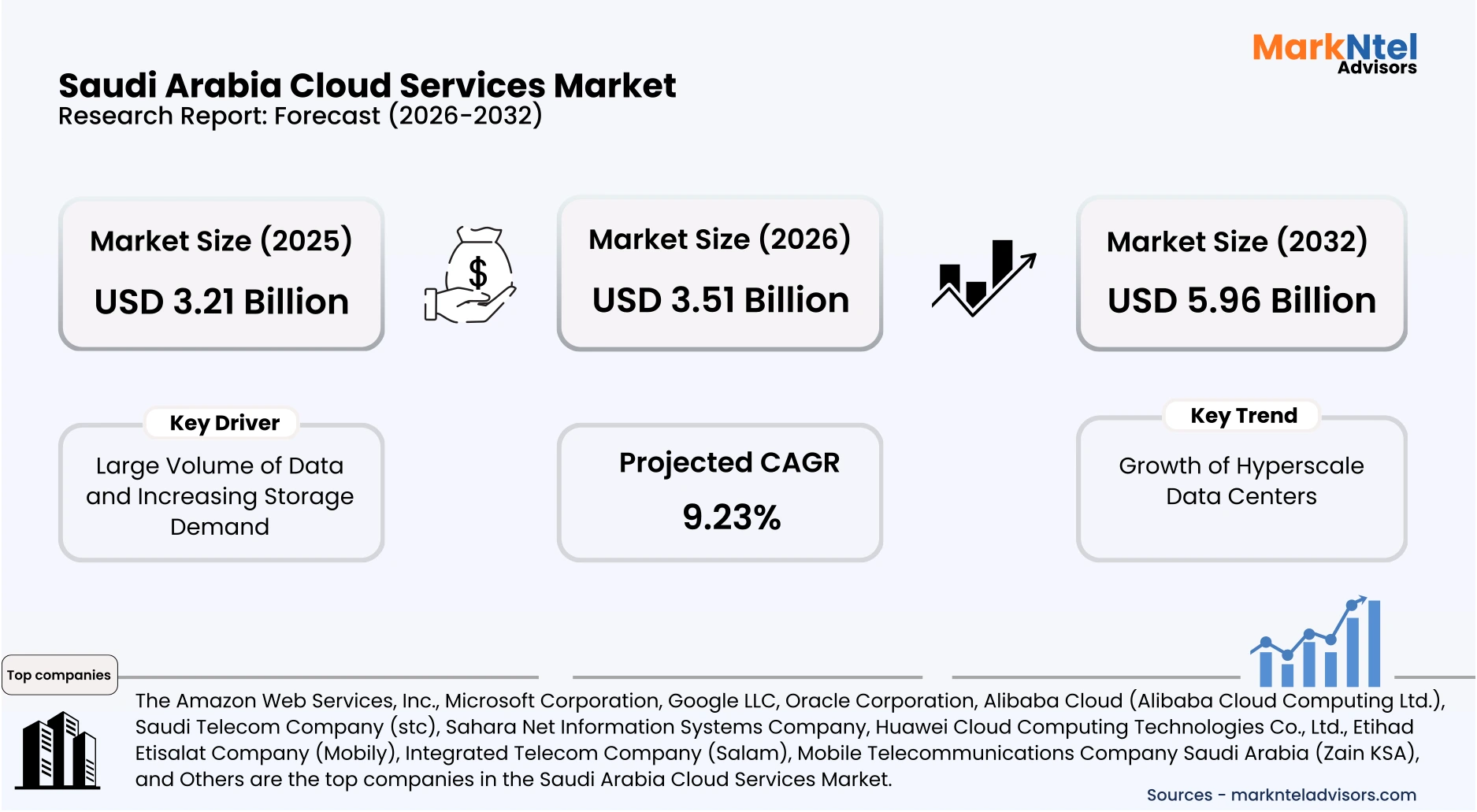
- The Saudi Arabia Cloud Services market size was valued at USD 3.21 billion in 2025 and is projected to grow from USD 3.51 billion in 2026 to USD 5.96 billion by 2032, exhibiting a CAGR of 9.23% during the forecast period.
- Riyadh holds the largest market share of about 40% in the Saudi Arabia Cloud Services Market in 2026.
- By service, the software as a service (SaaS) segment represented a significant share of about 42% in the Saudi Arabia Cloud Services Market in 2026.
- By end user, the Government & public sector segment seized a significant share of about 25% in the Saudi Arabia Cloud Services Market in 2026.
- Leading cloud services companies in the Saudi Arabia are Amazon Web Services, Inc., Microsoft Corporation, Google LLC, Oracle Corporation, Alibaba Cloud (Alibaba Cloud Computing Ltd.), Saudi Telecom Company (stc), Sahara Net Information Systems Company, Huawei Cloud Computing Technologies Co., Ltd., Etihad Etisalat Company (Mobily), Integrated Telecom Company (Salam), Mobile Telecommunications Company Saudi Arabia (Zain KSA), and Others.
Market Insights & Analysis: Saudi Arabia Cloud Services Market (2026-32):
The Saudi Arabia Cloud Services Market size was valued at USD 3.21 billion in 2025 and is projected to grow from USD 3.51 billion in 2026 to USD 5.96 billion by 2032. Along with this, the market is estimated to grow at a CAGR of around 9.23% during the forecast period, i.e., 2026-32.
The Saudi Arabia Cloud Services Market is projected to expand steadily, driven by increasing data generation across industries and the rapid expansion of hyperscale data centers, which are strengthening the country’s digital infrastructure and accelerating cloud adoption among enterprises.
Rapid digitalization across industries such as banking, retail, logistics, and e-commerce is significantly increasing the demand for scalable cloud storage and high-performance computing infrastructure. As companies generate large datasets related to customer information, operational analytics, and financial transactions, cloud platforms are becoming essential for secure storage, data processing, and real-time analytics.
One of the major contributors to rising data generation in the country is the rapid adoption of digital payment systems. According to the Saudi Central Bank, electronic payments accounted for 79% of total retail transactions in Saudi Arabia in 2024, increasing from 70% in 2023. During the same period, the total number of non-cash electronic payment transactions reached approximately 12.6 billion, highlighting the significant growth in financial data generated by digital banking platforms, payment gateways, and fintech applications. The increasing reliance on electronic transactions is therefore driving demand for secure cloud infrastructure capable of storing and processing large volumes of transactional data.
Similarly, the expansion of e-commerce platforms and point-of-sale (POS) systems is contributing to rising enterprise data storage requirements. POS transaction value in Saudi Arabia reached approximately USD 178.18 billion in 2024, reflecting the substantial amount of consumer purchase data generated by retailers, payment networks, and financial institutions. As retailers adopt digital sales channels and integrated payment technologies, cloud platforms are becoming essential for managing transaction databases, customer analytics, and inventory systems.
The development of hyperscale data centers is also strengthening the cloud ecosystem in Saudi Arabia. For instance, AMD, Cisco, and Saudi AI firm HUMAIN announced plans to develop a 100-megawatt AI data center in Saudi Arabia, with future expansion targeting up to 1 gigawatt of capacity by 2030 to support global artificial intelligence and cloud computing workloads . Such facilities are designed to deliver the large-scale computing power required for advanced technologies, including AI, machine learning, and big data analytics.
In addition, major infrastructure investments are expanding cloud data storage capacity across the country. A Tier-3 data center facility scheduled for operation in 2026 is being developed as part of a USD 1.9 billion multi-city data center project, aimed at strengthening digital infrastructure and supporting enterprise cloud workloads .
Similarly, Microsoft completed construction of its data center region in the Eastern Province in 2024, consisting of multiple availability zones that are expected to go live in 2026, providing secure and scalable cloud services for organizations across Saudi Arabia .
The rapid growth of digital transactions, expansion of e-commerce platforms, and increasing investments in hyperscale data centers are collectively strengthening Saudi Arabia’s cloud ecosystem. As enterprises continue to generate large volumes of digital data and adopt AI-driven technologies, demand for scalable cloud services is expected to rise significantly in the coming years.
Saudi Arabia Cloud Services Market Recent Developments:
- 2025: Oracle Corporation announced plans to invest USD 14 billion in Saudi Arabia over the next decade to expand its cloud and artificial intelligence infrastructure. The investment aims to strengthen local cloud capabilities, support digital transformation, and advance the Kingdom’s technology ecosystem under Vision 2030 .
- 2025: Cisco announced new initiatives in Saudi Arabia to strengthen its cloud and AI ecosystem. The company launched cloud services data centers supporting security services and the Webex collaboration platform, while also expanding AI talent development and local manufacturing plans to support the Kingdom’s digital transformation under Vision 2030.
Saudi Arabia Cloud Services Market Scope:
| Category | Segments |
|---|---|
| By Deployment | (Public, Private, Hybrid), |
| By Service | (Infrastructure as a Service (IaaS), Platform as a Service (PaaS), Software as a Service (SaaS)), |
| By Organization Size | (Small and Medium-sized Enterprises (SMEs), Large Enterprises), |
| By End User | (BFSI, Telecommunications, IT and ITeS, Government and Public Sector, Retail and Consumer Goods, Manufacturing, Energy and Utilities, Media and Entertainment, Healthcare and Life Sciences, Others), |
Saudi Arabia Cloud Services Market Driver:
Large Volume of Data and Increasing Storage Demand
The rapid expansion of digital government services in Saudi Arabia is generating large volumes of administrative and identity data. Managing authentication records, service logs, and user information from online public services is increasing the need for secure and scalable cloud storage and computing infrastructure.
A key example is the Ministry of Interior’s Absher platform, which processed over 430 million electronic transactions in 2024, covering services such as passports, identity verification, and residency management. These large transaction volumes generate extensive datasets that require secure storage and high-capacity cloud computing infrastructure.
Similarly, the General Directorate of Passports (Jawazat) handled over 56 million transactions through the Absher platform in 2024, covering services such as visa issuance, residency permits, and travel documentation. These continuous digital operations produce large volumes of identity and travel-related data that must be securely managed within a centralized digital infrastructure.
Furthermore, Saudi Arabia is expanding digital public services through the introduction of a five-year resident ID system aimed at streamlining services for more than 13 million residents. The initiative is expected to eliminate approximately 65 million in-person government office visits, shifting these interactions to digital channels and substantially increasing the volume of digital records requiring secure storage and processing.
The continued expansion of digital government platforms is generating substantial volumes of administrative and identity data in Saudi Arabia. As public services increasingly transition to online systems, demand for scalable and secure cloud infrastructure is expected to grow, supporting the long-term development of the Saudi Arabia cloud services market.
Saudi Arabia Cloud Services Market Trend:
Growth of Hyperscale Data Centers
Saudi Arabia is experiencing rapid growth in hyperscale data centers as enterprises and government agencies adopt cloud computing and AI technologies. These facilities provide large-scale computing, storage, and networking capacity required to support data-intensive applications, advanced analytics, and cloud-based workloads.
The Kingdom has already made notable progress in strengthening its data center ecosystem. As of 2024–2025, Saudi Arabia had approximately 222 megawatts (MW) of installed data center IT power capacity, with major facilities concentrated in key digital hubs such as Riyadh, Jeddah, and Dammam . These cities host large enterprise and hyperscale data centers that support cloud computing platforms, digital government services, and AI-driven applications used across sectors, including finance, logistics, telecommunications, and e-commerce.
Government initiatives and private-sector investments are further accelerating the expansion of hyperscale infrastructure. Under Saudi Arabia’s digital infrastructure strategy, the country plans to add around 760 MW of additional data center capacity by 2030. This planned expansion reflects the growing demand for advanced digital infrastructure required to support cloud services, data-intensive technologies, and AI-powered platforms operating across the Kingdom’s rapidly evolving digital economy.
The expansion of hyperscale data centers is strengthening Saudi Arabia’s digital infrastructure and enabling large-scale cloud computing capabilities. As AI adoption and enterprise data workloads continue to increase, hyperscale facilities will play a crucial role in supporting the long-term growth of the Saudi Arabia cloud services market.
Saudi Arabia Cloud Services Market Opportunity:
Projects Under Vision 2030 Goals Offering Lucrative Growth Opportunities
Large-scale digital infrastructure initiatives under Saudi Arabia’s Vision 2030 strategy are creating strong opportunities for the expansion of cloud services across the Kingdom. These projects aim to transform the national economy through advanced technologies such as artificial intelligence (AI), big data analytics, and Internet of Things (IoT) platforms, all of which require scalable cloud infrastructure to store, process, and analyze massive volumes of data generated by digital ecosystems.
One of the most prominent examples is the development of NEOM, a smart city project designed as a digitally integrated ecosystem powered by AI, autonomous mobility, and real-time analytics. To support these technologies, NEOM plans to build a 1.5-gigawatt AI-powered data center with DataVolt, with the first phase worth about USD 5 billion expected by 2028, enabling large-scale cloud computing and high-performance data processing.
In addition to national megaprojects, global hyperscale providers are expanding cloud infrastructure to support Saudi Arabia’s Vision 2030 digital transformation. For example, Amazon Web Services (AWS) plans to invest over USD 5.3 billion to establish a cloud region in the Kingdom by 2026, enabling enterprises and government entities to run applications, store data locally, and deploy AI-powered cloud services.
Mega smart city projects and hyperscale cloud investments under Vision 2030 are strengthening Saudi Arabia’s digital ecosystem. Growing AI workloads and large data volumes will increase demand for scalable cloud services, creating strong growth opportunities for cloud service providers in the country.
Saudi Arabia Cloud Services Market Challenge:
Regulatory Compliance and Data Protection Requirements
Strict data protection regulations in Saudi Arabia are creating additional financial and operational challenges for organizations adopting cloud services. The country introduced the Personal Data Protection Law (PDPL) to strengthen governance over the collection, storage, and processing of personal data across digital platforms. Under this regulation, companies operating cloud-based systems must implement robust data-security frameworks, including encryption technologies, secure data storage environments, compliance monitoring mechanisms, and regular cybersecurity audits.
These requirements significantly increase the cost and complexity of cloud implementation. Organizations must invest in specialized compliance teams, advanced cybersecurity solutions, and internal governance structures to ensure that sensitive customer and business data is handled in accordance with national regulations. Failure to comply with the PDPL can lead to severe penalties, with fines reaching approximately USD 1.33 million for violations related to improper data handling or unauthorized data transfers.
Such regulatory obligations can delay cloud migration strategies, particularly for small and medium-sized enterprises that may lack sufficient financial and technical resources to implement comprehensive compliance frameworks.
While the PDPL strengthens data protection and digital trust, the associated compliance costs and operational complexities can slow the pace of cloud adoption. Consequently, regulatory requirements may act as a short-term constraint on the growth of the Saudi Arabia cloud services market.
Saudi Arabia Cloud Services Market (2026-32) Segmentation Analysis:
The Saudi Arabia Cloud Services Market study of MarkNtel Advisors evaluates & highlights the major trends and influencing factors in each segment. It includes predictions for the period 2026–32 at the country level. Based on the analysis, the market has been further classified as;
Based on Service:
- Infrastructure as a Service (IaaS)
- Platform as a Service (PaaS)
- Software as a Service (SaaS)
The software as a service (SaaS) segment dominates the Saudi Arabia Cloud Services market with 42% market share, due to its flexible deployment model, lower infrastructure requirements, and strong demand for cloud-based enterprise applications.
Unlike traditional software systems that require on-premise servers and extensive IT management, SaaS solutions are delivered through cloud platforms, allowing organizations to access applications via the internet while reducing hardware, maintenance, and upgrade costs. This operational efficiency makes SaaS particularly attractive for businesses seeking rapid digital transformation.
The dominance of SaaS is further supported by its widespread adoption across multiple industries, including banking, retail, healthcare, telecommunications, and logistics. Enterprises are increasingly utilizing SaaS platforms for Customer Relationship Management (CRM), Enterprise Resource Management (ERM), Human Capital Management (HCM), and Supply Chain Management (SCM) to improve operational efficiency and enable data-driven decision-making.
Additionally, the growing need for digital collaboration and remote work capabilities is accelerating the use of SaaS-based content management systems, collaboration platforms, and productivity suites. These tools enable organizations to streamline internal communication, document management, and workflow automation across distributed teams.
With Saudi Arabia continuing to advance its digital economy and enterprise cloud adoption, SaaS platforms are expected to maintain strong demand due to their scalability, cost-effectiveness, and ability to support modern business operations.
Based on End User:
- BFSI
- Telecommunications
- IT and ITeS
- Government and Public Sector
- Retail and Consumer Goods
- Manufacturing
- Energy and Utilities
- Media and Entertainment
- Healthcare and Life Sciences
- Others
The Government & public sector segment dominates the Saudi Arabia Cloud Services Market with 25% market share, primarily driven by the Kingdom’s extensive digital transformation agenda and increasing deployment of cloud-enabled public service platforms.
Government entities are progressively shifting from traditional IT infrastructure to cloud-based environments to enhance operational efficiency, improve data management, and deliver faster and more accessible public services.
This dominance is strongly supported by national digitalization initiatives under Vision 2030, which emphasize the modernization of government operations and the development of integrated e-government systems. Various ministries and public agencies are adopting cloud technologies to support digital identity systems, government portals, document management platforms, and centralized data exchange networks.
Cloud infrastructure also plays a critical role in supporting national digital services such as residency and immigration systems, electronic licensing platforms, taxation portals, and digital healthcare records. These platforms generate substantial datasets and require scalable computing capacity, secure storage, and real-time processing capabilities, making cloud services essential for maintaining reliable and efficient public sector operations.
With continued investments in digital infrastructure and expansion of e-government services, the Government and Public Sector segment is expected to remain a major contributor to cloud service adoption across Saudi Arabia.
Saudi Arabia Cloud Services Market (2026-32): Regional Projection
Riyadh dominates the Saudi Arabia Cloud Services market with an estimated 40% share, due to its position as the country’s primary administrative, financial, and technological center. The city hosts the headquarters of major government institutions, financial organizations, telecommunications companies, and large enterprises, all of which generate significant volumes of operational and transactional data. As these organizations increasingly transition toward digital platforms for data management, analytics, and service delivery, the demand for scalable cloud computing infrastructure in Riyadh continues to grow.
The city also serves as the focal point for major cloud infrastructure investments and hyperscale data center developments in the Kingdom. Global technology providers are increasingly establishing cloud regions and data facilities in Riyadh to support enterprise workloads, government digital services, and emerging technologies such as artificial intelligence and advanced analytics.
A significant example of this infrastructure expansion occurred in 2024, when Oracle launched its second cloud region in Riyadh. The facility allows enterprises and public sector organizations to utilize Oracle Cloud Infrastructure (OCI) services, including cloud databases, analytics platforms, and AI-enabled applications. This expansion enhances local computing capacity and enables organizations to process large-scale digital workloads more efficiently within Saudi Arabia.
With continuous investments in digital infrastructure and the concentration of major enterprises and government agencies, Riyadh remains the leading hub for cloud service adoption and technological innovation in the Saudi Arabia cloud services market.
Gain a Competitive Edge with Our Saudi Arabia Cloud Services Market Report:
- Saudi Arabia Cloud Services Market Report by MarkNtel Advisors provides a detailed & thorough analysis of market size & share, growth rate, competitive landscape, and key players. This comprehensive analysis helps businesses gain a holistic understanding of the market dynamics & make informed decisions.
- This report also highlights current market trends & future projections, allowing businesses to identify emerging opportunities & potential challenges. By understanding market forecasts, companies can align their strategies & stay ahead of the competition.
- Saudi Arabia Cloud Services Market Report aids in assessing & mitigating risks associated with entering or operating in the market. By understanding market dynamics, regulatory frameworks, and potential challenges, businesses can develop strategies to minimize risks & optimize their operations.
*Reports Delivery Format - Market research studies from MarkNtel Advisors are offered in PDF, Excel and PowerPoint formats. Within 24 hours of the payment being successfully received, the report will be sent to your email address.
Frequently Asked Questions
- Market Segmentation
- Introduction
- Product Definition
- Research Process
- Assumptions
- Executive Summary
- Saudi Arabia Cloud Services Market Policies, Regulations, and Product Standards
- Saudi Arabia Cloud Services Market Trends & Developments
- Saudi Arabia Cloud Services Market Dynamics
- Growth Factors
- Challenges
- Saudi Arabia Cloud Services Market Hotspot & Opportunities
- Saudi Arabia Cloud Services Market Outlook, 2022-2032F
- Market Size & Outlook
- By Revenues (USD Million)
- Market Share & Outlook
- By Deployment- Market Size & Forecast 2022-2032, USD Million
- Public
- Private
- Hybrid
- By Service- Market Size & Forecast 2022-2032, USD Million
- Infrastructure as a Service (IaaS)
- Primary Storage
- Disaster Recovery and Backup
- Archiving
- Compute
- Platform as a Service (PaaS)
- Application Development and Platforms
- Application Testing and Quality
- Analytics and Reporting
- Integration and Orchestration
- Data Management
- Software as a Service (SaaS)
- Customer Relationship Management (CRM)
- Enterprise Resource Management (ERM)
- Human Capital Management (HCM)
- Content Management
- Collaboration and Productive Suites
- Supply Chain Management (SCM)
- Others
- Infrastructure as a Service (IaaS)
- By Organization Size- Market Size & Forecast 2022-2032, USD Million
- Small and Medium-sized Enterprises (SMEs)
- Large Enterprises
- By End User- Market Size & Forecast 2022-2032, USD Million
- BFSI
- Telecommunications
- IT and ITeS
- Government and Public Sector
- Retail and Consumer Goods
- Manufacturing
- Energy and Utilities
- Media and Entertainment
- Healthcare and Life Sciences
- Others
- By Region- Market Size & Forecast 2022-2032, USD Million
- Riyadh
- Jeddah
- Damam
- Mecca & Madinah
- Others
- By Company
- Competition Characteristics
- Market Share & Analysis
- By Deployment- Market Size & Forecast 2022-2032, USD Million
- Market Size & Outlook
- Saudi Arabia Infrastructure as a Service (IaaS) Market Outlook, 2022-2032
- Market Size & Outlook
- By Revenues (USD Million)
- Market Share & Outlook
- By Service- Market Size & Forecast 2022-2032, USD Million
- By Organization Size- Market Size & Forecast 2022-2032, USD Million
- By End User- Market Size & Forecast 2022-2032, USD Million
- By Region- Market Size & Forecast 2022-2032, USD Million
- Market Size & Outlook
- Saudi Arabia Platform as a Service (PaaS) Market Outlook, 2022-2032
- Market Size & Outlook
- By Revenues (USD Million)
- Market Share & Outlook
- By Service- Market Size & Forecast 2022-2032, USD Million
- By Organization Size- Market Size & Forecast 2022-2032, USD Million
- By End User- Market Size & Forecast 2022-2032, USD Million
- By Region- Market Size & Forecast 2022-2032, USD Million
- Market Size & Outlook
- Saudi Arabia Software as a Service (SaaS) Market Outlook, 2022-2032
- Market Size & Outlook
- By Revenues (USD Million)
- Market Share & Outlook
- By Service- Market Size & Forecast 2022-2032, USD Million
- By Organization Size- Market Size & Forecast 2022-2032, USD Million
- By End User- Market Size & Forecast 2022-2032, USD Million
- By Region- Market Size & Forecast 2022-2032, USD Million
- Market Size & Outlook
- Saudi Arabia Cloud Services Market Key Strategic Imperatives for Success & Growth
- Competitive Outlook
- Company Profiles
- Amazon Web Services, Inc.
- Business Description
- Product Portfolio
- Collaborations & Alliances
- Recent Developments
- Financial Details
- Others
- Microsoft Corporation
- Business Description
- Product Portfolio
- Collaborations & Alliances
- Recent Developments
- Financial Details
- Others
- Google LLC
- Business Description
- Product Portfolio
- Collaborations & Alliances
- Recent Developments
- Financial Details
- Others
- Oracle Corporation
- Business Description
- Product Portfolio
- Collaborations & Alliances
- Recent Developments
- Financial Details
- Others
- Alibaba Cloud (Alibaba Cloud Computing Ltd.)
- Business Description
- Product Portfolio
- Collaborations & Alliances
- Recent Developments
- Financial Details
- Others
- Saudi Telecom Company (stc)
- Business Description
- Product Portfolio
- Collaborations & Alliances
- Recent Developments
- Financial Details
- Others
- Sahara Net Information Systems Company
- Business Description
- Product Portfolio
- Collaborations & Alliances
- Recent Developments
- Financial Details
- Others
- Huawei Cloud Computing Technologies Co., Ltd.
- Business Description
- Product Portfolio
- Collaborations & Alliances
- Recent Developments
- Financial Details
- Others
- Etihad Etisalat Company (Mobily)
- Business Description
- Product Portfolio
- Collaborations & Alliances
- Recent Developments
- Financial Details
- Others
- Integrated Telecom Company (Salam)
- Business Description
- Product Portfolio
- Collaborations & Alliances
- Recent Developments
- Financial Details
- Others
- Mobile Telecommunications Company Saudi Arabia (Zain KSA)
- Business Description
- Product Portfolio
- Collaborations & Alliances
- Recent Developments
- Financial Details
- Others
- Amazon Web Services, Inc.
- Company Profiles
- Disclaimer
MarkNtel Advisors follows a robust and iterative research methodology designed to ensure maximum accuracy and minimize deviation in market estimates and forecasts. Our approach combines both bottom-up and top-down techniques to effectively segment and quantify various aspects of the market. A consistent feature across all our research reports is data triangulation, which examines the market from three distinct perspectives to validate findings. Key components of our research process include:
1. Scope & Research Design At the outset, MarkNtel Advisors define the research objectives and formulate pertinent questions. This phase involves determining the type of research—qualitative or quantitative—and designing a methodology that outlines data collection methods, target demographics, and analytical tools. They also establish timelines and budgets to ensure the research aligns with client goals.
2. Sample Selection and Data Collection In this stage, the firm identifies the target audience and determines the appropriate sample size to ensure representativeness. They employ various sampling methods, such as random or stratified sampling, based on the research objectives. Data collection is carried out using tools like surveys, interviews, and observations, ensuring the gathered data is reliable and relevant.
3. Data Analysis and Validation Once data is collected, MarkNtel Advisors undertake a rigorous analysis process. This includes cleaning the data to remove inconsistencies, employing statistical software for quantitative analysis, and thematic analysis for qualitative data. Validation steps are taken to ensure the accuracy and reliability of the findings, minimizing biases and errors.

4. Data Forecast and FinalizationThe final phase involves forecasting future market trends based on the analyzed data. MarkNtel Advisors utilize predictive modeling and time series analysis to anticipate market behaviors. The insights are then compiled into comprehensive reports, featuring visual aids like charts and graphs, and include strategic recommendations to inform client decision-making
We offer flexible licensing options to cater to varying organizational needs. Choose the pricing pack that best suits your requirements:
Buy Now Inquire Before Buying
 Request Customization
 Talk to our Consultant







