

Brazil Electronic Waste Recycling Market Research Report: Growth Drivers & Forecast (2026-2032)
By Source (Household Appliances, Consumer Electronics, IT & Telecommunication, Mobile Computing Devices), By Material Recovered (Metals, Plastics, Glass, others), By Technology (Me ... chanical Recycling, Hydrometallurgical processing, Pyrometallurgical processing, Manual disassembly, Advanced sorting technologies), By End User (Commercial Enterprises, Industrial & Manufacturing, Government & Public Institutions, Electronics Manufacturers / OEMs), and others Read more
- Environment
- Jul 2026
- Pages 140
- Report Format: PDF, Excel, PPT
Brazil Electronic Waste Recycling Market
Projected 8.63% CAGR from 2026 to 2032
Study Period
2026-2032
Market Size (2026)
USD 1.15 Billion
Market Size (2032)
USD 1.89 Billion
Base Year
2025
Projected CAGR
8.63%
Leading Segments
By Technology: Mechanical Recycling
Brazil Electronic Waste Recycling Key Takeaways
- The Brazil electronic waste recycling market was valued at USD 1.12 billion in 2025 and is projected to grow from USD 1.15 billion in 2026 to USD 1.89 billion by 2032.
- The industry is projected to witness steady growth at a CAGR of 8.63% during the forecast period.
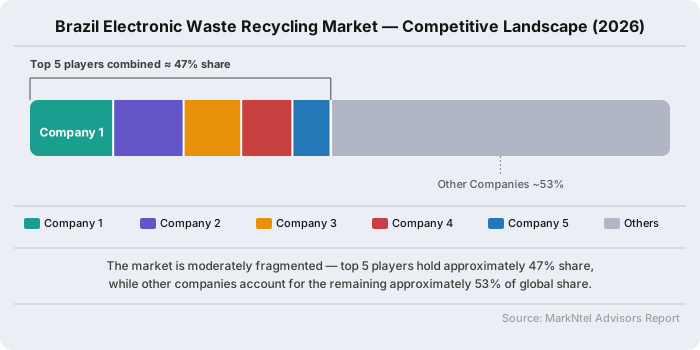
- The market is moderately fragmented, with the top five players collectively accounting for approximately 47% of the total market share in 2026.
- Mechanical recycling is the dominant processing technology, accounting for approximately 59% of the market.
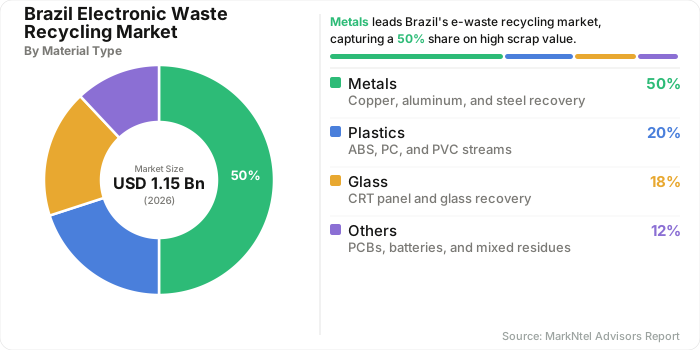
- Metals represent the largest recovered material segment, contributing approximately 50% of the total material recovered from Brazil's electronic waste.
Brazil Electronic Waste Recycling Market Size and Outlook
Brazil's electronic waste recycling market reached USD 1.12 billion in 2025 and is projected to expand to USD 1.89 billion by 2032, advancing at a CAGR of 8.63%, driven by the country's rapidly growing installed base of electrical and electronic equipment.
According to Brazil's Ministry of Development, Industry, Trade and Services, sales of electrical and electronic goods increased by 29% in 2024, marking the sector's strongest performance in a decade (gov.br/mdic). Meanwhile, industry revenue rose to USD 44.53 billion, up from USD 40.19 billion in 2023, according to ABINEE. This sharp increase in electronics consumption is steadily expanding the volume of end-of-life equipment available for collection, material recovery, and recycling.
Demand for e-waste recycling spans residential, commercial, and institutional end users, ranging from household appliance replacements to corporate IT refresh cycles and public-sector equipment disposal. The residential segment remains a key contributor, with sales of white goods, including refrigerators, stoves, and washing machines, rising 17% in 2024, from 13.3 million units to 15.6 million units. At the same time, Brazil's formal recycling infrastructure has continued to expand. ABREE, the country's collective reverse logistics management entity, collected and treated 230,576 tonnes of electronics, household appliances, and related components between 2021 and 2025.
Moreover, leading companies are strengthening organized take-back programs. For Instance, Telefónica Brasil expanded its Vivo Recicle program from 12 tonnes of e-waste recovered in 2023 to more than 37 tonnes in 2024, while committing to collect 225 tonnes between 2024 and 2035 through approximately 1,800 collection points. Furthermore, industrial policy continues to support market growth. The appliance industry association Eletros projects USD 982.16 million in new sector investments through 2027, while the federal Nova Indústria Brasil program is promoting domestic manufacturing alongside circular economy initiatives.
With rising electronics consumption, expanding corporate circular economy commitments, and continued investment in formal collection and recycling infrastructure, Brazil is strengthening its e-waste management ecosystem. These events are expected to support sustained demand for material recovery and recycling services, driving above-average market growth through 2032 across an increasingly formalized end-of-life electronics value chain.
Brazil Electronic Recycling Waste Market Key Indicators
- The International Telecommunication Union and UNITAR's Global E-waste Monitor 2024 records Brazil generating 2,443 kilotons of e-waste in 2022, equal to 11.4 kg per capita. This volume of discarded appliances, computers, and consumer electronics directly enlarges the feedstock base available to formal and informal recyclers across the country.
- Brazil's National Telecommunications Agency (Anatel) reported 270.2 million active mobile lines nationwide by the close of 2025, an increase of 6.8 million accesses over the year. This expanding handset base builds a growing future stream of end-of-life smartphones requiring collection and material recovery.
- Green Eletron, Brazil's federally recognized e-waste and battery reverse-logistics manager under Decree 10.240/2020, collected over 12,500 tonnes of electronic waste, batteries, and accessories in 2025, its highest annual volume on record; this scaling collection capacity signals accelerating throughput available to downstream processing and recycling operators.
- The Brazilian Electric Vehicle Association (ABVE) reported 181,542 battery-electric and plug-in hybrid vehicle sales in 2025, representing a 44.5% increase over 2024. This rapidly expanding EV fleet is expected to generate a substantial volume of end-of-life lithium-ion batteries in the coming years, accelerating demand for specialized battery collection, recycling, and critical mineral recovery technologies across Brazil's e-waste recycling value chain.
Brazil Electronic Waste Recycling Market Scope
| Category | Segments |
|---|---|
| By Source | Household Appliances, Consumer Electronics, IT & Telecommunication, Mobile Computing Devices |
| By Material Recovered | Metals, Plastics, Glass, others |
| By Technology | Mechanical Recycling, Hydrometallurgical processing, Pyrometallurgical processing, Manual disassembly, Advanced sorting technologies |
| By End User | Commercial Enterprises, Industrial & Manufacturing, Government & Public Institutions, Electronics Manufacturers / OEMs |
Brazil Electronic Waste Recycling Market Growth Drivers
Stricter Environmental Enforcement Accelerating Formalization of Brazil's E-Waste Reverse Logistics Network
Brazil's regulatory enforcement is becoming a major catalyst for the formalization of the country's e-waste reverse logistics ecosystem. Under the National Solid Waste Policy (Law No. 12.305/2010), manufacturers, importers, distributors, and retailers of electrical and electronic equipment are legally required to establish and finance reverse logistics systems for post-consumer waste collection and recycling. Non-compliance carries significant financial and operational risks. Under the Environmental Crimes Law (Law No. 9.605/1998), violations such as failing to meet collection targets, remaining outside the National Waste Information System (SINIR), or submitting inaccurate traceability records may result in fines of up to USD 50 million per violation.
Regulatory oversight has intensified in recent years. IBAMA's Normative Instruction No. 24, issued in December 2024, links import authorization for e-waste and related materials to compliance with sectoral reverse logistics agreements, strengthening customs enforcement against non-compliant importers. In addition, a 2026 draft amendment to Decree No. 10.240/2020 proposes extending mandatory take-back obligations to e-commerce platforms and distance-selling operators, closing a key regulatory gap. At the state level, environmental agencies increasingly require proof of reverse logistics compliance as a condition for renewing operating licenses, encouraging manufacturers and retailers to partner with licensed recyclers and strengthen formal collection networks.
Recent Trends
Flexible Hydrometallurgical Battery Recycling Emerging as the Next Phase of Brazil's E-Waste Processing Industry
Brazil's e-waste recycling industry is witnessing a gradual shift toward flexible hydrometallurgical battery recycling as recyclers prepare for rising volumes of lithium-ion batteries from electric vehicles, consumer electronics, and energy storage systems. The technology is gaining attention because it can recover critical minerals such as lithium, nickel, cobalt, and manganese with higher recovery rates while consuming less energy than conventional pyrometallurgical methods.
In 2025, researchers at the University of São Paulo (USP), together with Tupy, advanced a pilot-scale recycling process capable of treating multiple lithium-ion battery chemistries through a single processing route, demonstrating the commercial potential of flexible hydrometallurgy. The development reflects a broader industry movement toward high-value material recovery and circular manufacturing rather than conventional metal extraction. As Brazil expands its electric mobility ecosystem and domestic battery value chain, investment in advanced hydrometallurgical technologies is expected to accelerate, positioning the technology as one of the country's most significant e-waste recycling trends through the forecast period.
Brazil Electronic Waste Recycling Market Opportunities and Challenges
Low Domestic Precious Metal Recovery Fueling Investment in Urban Mining Technologies
Brazil recovers only about 20% of the precious metals contained in electronic waste through domestic urban mining and recycling, according to a January 2025 report citing research by the Federal Fluminense University (UFF) on discarded printed circuit boards. Most recovered circuit boards are mechanically processed and exported for final refining because Brazil has limited commercial-scale facilities capable of chemically extracting high-value metals such as gold, silver, and palladium. As a result, a significant share of the economic value embedded in e-waste is transferred to overseas refiners instead of being retained within the country. This gap is creating opportunities for specialized urban mining companies investing in advanced metal recovery technologies.
This challenge is creating significant opportunities for specialized urban mining startups focused on developing domestic precious metal recovery capabilities. To capitalize on this opportunity, Recicli, a Brazilian cleantech company, secured USD 0.20 million in funding in August 2024 to expand its processing capacity, targeting 20–24 tonnes of e-waste in 2025 and projecting annual revenue of approximately USD 12.08 million by 2028. The growing investment reflects increasing interest in strengthening Brazil's domestic precious metal recovery capabilities and reducing reliance on foreign refiners.
Segmentation Insights
Metals Dominate as the Most Valuable Material Recovered from Brazil's Electronic Waste
Metals represent the largest share of materials recovered from Brazil's electronic waste, accounting for approximately 50% of the material composition of discarded electronics by weight. This is significantly higher than plastics (27%) and other materials, including glass, ceramics, and composites (22%). Copper, aluminum, iron, gold, and palladium generate the highest recovery value, making metal extraction the primary revenue source for recyclers.
The Centro de Tecnologia Mineral (CETEM) estimates that nearly 70% of the heavy metals found in Brazilian landfills originate from improperly discarded electronic waste, highlighting the opportunity to improve formal recovery. To address this gap, Circoola Brasil uses artificial intelligence to identify, classify, and direct metal-bearing devices to certified recyclers, while Umicore's facilities in Americana, Guarulhos, and Manaus recover more than 95% of critical metals from spent electric vehicle and rechargeable batteries. Expanding formal collection systems and advanced recovery technologies will continue to strengthen metals as the dominant material recovery segment in Brazil. By material recovered the market is further segmented into the following sub-categories:
- Metals
- Plastics
- Glass
- Others
Advanced Shredding and Mechanical Separation Reinforce Mechanical Recycling's Leadership in Brazil's E-Waste Industry
Mechanical recycling is estimated to account for approximately 59% of Brazil's e-waste processing technologies, making it the leading recycling method ahead of hydrometallurgical processing, pyrometallurgical processing, bio-metallurgical recovery, manual dismantling, and refurbishment. Its dominance is supported by its ability to efficiently process large volumes of mixed electronic waste while enabling the effective recovery of ferrous and non-ferrous metals, plastics, and other recyclable materials prior to advanced refining processes.
The growing preference for mechanical recycling is reflected in continued investments across Brazil's recycling ecosystem. At Waste Expo Brasil 2025, Rotex Máquinas introduced the TS55 two-shaft shredder, capable of processing up to 55 tonnes of mixed electronic and metal scrap per hour, enhancing high-capacity shredding and material separation capabilities. Complementing this trend, Ambipar inaugurated Latin America's largest urban mining facility for electronic waste and household appliances in São José dos Campos in December 2024. The plant employs advanced mechanical separation technologies to recover plastics, iron, aluminum, copper, and precious metals, processing approximately 20,000 tonnes of e-waste into secondary raw materials during its first year of operation.
These developments underscore the increasing adoption of advanced mechanical recycling technologies, reinforcing the segment's leadership in Brazil's evolving e-waste recycling market. By technology the market is further segmented into the following sub-categories:
- Mechanical Recycling
- Hydrometallurgical processing
- Pyrometallurgical processing
- Manual disassembly
- Advanced sorting technologies
Brazil Electronic Waste Recycling Market Competitive Landscape
The Brazil Electronic Waste Recycling Market is moderately fragmented, with the top five players Ambi par Group, Umicore Brasil, Green Eletron, ABREE, and Sinctronics collectively accounting for approximately 47% of the total market share in 2026.
Major Companies in the Brazil Electronic Waste Recycling Market
- Ambi par Group
- Umicore Brasil
- Green Eletron
- ABREE
- Sinctronics
- Sucata Digital
- Descarte Certo
- Recicli
- Veolia Brasil
- Sims Lifecycle Services
Brazil Electronic Waste Recycling Market News and Recent Developments
2025 – Samsung Launches Samsung Recicla Empresarial to Expand Business-to-Business E-Waste Collection in Brazil
In May 2025, Samsung Electronics launched Samsung Recicla Empresarial, extending its e-waste take-back program to businesses across Brazil. The service offers direct pickup of electronics of any brand, including IT equipment, industrial batteries, and appliances, following a 58% increase in consumer e-waste collection in 2024.
Impact: The initiative expands Brazil's formal B2B reverse logistics network, increases the supply of end-of-life electronics to licensed recyclers, reduces collection barriers for businesses, and strengthens the country's circular economy ecosystem.
2025 – Simpress Invests USD 0.49 million to Expand IT Equipment Refurbishment Capacity in Brazil
In 2025, Simpress invested approximately USD 0.49 million (R$ 2.5 million) to expand its IT equipment refurbishment center, increasing processing capacity to 1,700 devices per day. The investment followed an 87.6% increase in refurbished equipment shipments, from 8,900 units in 2023 to 16,700 units in 2024, with a further 65% growth projected for 2025.
Impact: The expansion strengthens Brazil's electronics reuse ecosystem, extends device lifecycles, reduces immediate e-waste generation, and complements long-term material recovery through certified refurbishment.
Frequently Asked Questions
- Market Segmentation
- Introduction
- Product Definition
- Research Process
- Assumptions
- Executive Summary
- Brazil Electronic Waste Recycling Market Policies, Regulations, and Product Standards
- Brazil Electronic Waste Recycling Market Trends & Developments
- Brazil Electronic Waste Recycling Market Dynamics
- Growth Factors
- Challenges
- Brazil Electronic Waste Recycling Market Hotspot & Opportunities
- Brazil Electronic Waste Recycling Market Outlook, 2022-2032
- Market Size & Outlook
- By Revenues (USD Million)
- Market Segmentation & Outlook
- By Source- Market Size & Forecast 2022-2032, USD Million
- Household Appliances
- Consumer Electronics
- IT & Telecommunication
- Mobile Computing Devices
- By Material Recovered- Market Size & Forecast 2022-2032, USD Million
- Metals
- Plastics
- Glass
- others
- By Technology- Market Size & Forecast 2022-2032, USD Million
- Mechanical Recycling
- Hydrometallurgical processing
- Pyrometallurgical processing
- Manual disassembly
- Advanced sorting technologies
- By End User- Market Size & Forecast 2022-2032, USD Million
- Commercial Enterprises
- Industrial & Manufacturing
- Government & Public Institutions
- Electronics Manufacturers / OEMs
- By Region - Market Size & Forecast 2022-2032, USD Million
- North
- South
- East
- West
- Central
- By Company
- Competition Characteristics
- Market Share & Analysis
- By Source- Market Size & Forecast 2022-2032, USD Million
- Market Size & Outlook
- Brazil Mechanical Recycling Market Outlook, 2022-2032
- Market Size & Outlook
- By Revenues (USD Million)
- Market Segmentation & Outlook
- By Material Recovered- Market Size & Forecast 2022-2032, USD Million
- By Technology- Market Size & Forecast 2022-2032, USD Million
- By End User- Market Size & Forecast 2022-2032, USD Million
- By Region - Market Size & Forecast 2022-2032, USD Million
- Market Size & Outlook
- Brazil Hydrometallurgical processing Market Outlook, 2022-2032
- Market Size & Outlook
- By Revenues (USD Million)
- Market Segmentation & Outlook
- By Material Recovered- Market Size & Forecast 2022-2032, USD Million
- By Technology- Market Size & Forecast 2022-2032, USD Million
- By End User- Market Size & Forecast 2022-2032, USD Million
- By Region - Market Size & Forecast 2022-2032, USD Million
- Market Size & Outlook
- Brazil Pyrometallurgical processing Market Outlook, 2022-2032
- Market Size & Outlook
- By Revenues (USD Million)
- Market Segmentation & Outlook
- By Material Recovered- Market Size & Forecast 2022-2032, USD Million
- By Technology- Market Size & Forecast 2022-2032, USD Million
- By End User- Market Size & Forecast 2022-2032, USD Million
- By Region - Market Size & Forecast 2022-2032, USD Million
- Market Size & Outlook
- Brazil Manual disassembly Market Outlook, 2022-2032
- Market Size & Outlook
- By Revenues (USD Million)
- Market Segmentation & Outlook
- By Material Recovered- Market Size & Forecast 2022-2032, USD Million
- By Technology- Market Size & Forecast 2022-2032, USD Million
- By End User- Market Size & Forecast 2022-2032, USD Million
- By Region - Market Size & Forecast 2022-2032, USD Million
- Market Size & Outlook
- Brazil Advanced sorting technologies Market Outlook, 2022-2032
- Market Size & Outlook
- By Revenues (USD Million)
- Market Segmentation & Outlook
- By Material Recovered- Market Size & Forecast 2022-2032, USD Million
- By Technology- Market Size & Forecast 2022-2032, USD Million
- By End User- Market Size & Forecast 2022-2032, USD Million
- By Region - Market Size & Forecast 2022-2032, USD Million
- Market Size & Outlook
- Brazil Electronic Waste Recycling Market Key Strategic Imperatives for Success & Growth
- Competitive Outlook
- Company Profiles
- Ambipar Group
- Business Description
- Product Portfolio
- Collaborations & Alliances
- Recent Developments
- Financial Details
- Others
- Umicore Brasil
- Business Description
- Product Portfolio
- Collaborations & Alliances
- Recent Developments
- Financial Details
- Others
- Green Eletron
- Business Description
- Product Portfolio
- Collaborations & Alliances
- Recent Developments
- Financial Details
- Others
- ABREE
- Business Description
- Product Portfolio
- Collaborations & Alliances
- Recent Developments
- Financial Details
- Others
- Sinctronics
- Business Description
- Product Portfolio
- Collaborations & Alliances
- Recent Developments
- Financial Details
- Others
- Sucata Digital
- Business Description
- Product Portfolio
- Collaborations & Alliances
- Recent Developments
- Financial Details
- Others
- Descarte Certo
- Business Description
- Product Portfolio
- Collaborations & Alliances
- Recent Developments
- Financial Details
- Others
- Recicli
- Business Description
- Product Portfolio
- Collaborations & Alliances
- Recent Developments
- Financial Details
- Others
- Veolia Brasil
- Business Description
- Product Portfolio
- Collaborations & Alliances
- Recent Developments
- Financial Details
- Others
- Sims Lifecycle Services
- Business Description
- Product Portfolio
- Collaborations & Alliances
- Recent Developments
- Financial Details
- Others
- Ambipar Group
- Company Profiles
- Disclaimer
MarkNtel Advisors follows a robust and iterative research methodology designed to ensure maximum accuracy and minimize deviation in market estimates and forecasts. Our approach combines both bottom-up and top-down techniques to effectively segment and quantify various aspects of the market. A consistent feature across all our research reports is data triangulation, which examines the market from three distinct perspectives to validate findings. Key components of our research process include:
1. Scope & Research Design At the outset, MarkNtel Advisors define the research objectives and formulate pertinent questions. This phase involves determining the type of research—qualitative or quantitative—and designing a methodology that outlines data collection methods, target demographics, and analytical tools. They also establish timelines and budgets to ensure the research aligns with client goals.
2. Sample Selection and Data Collection In this stage, the firm identifies the target audience and determines the appropriate sample size to ensure representativeness. They employ various sampling methods, such as random or stratified sampling, based on the research objectives. Data collection is carried out using tools like surveys, interviews, and observations, ensuring the gathered data is reliable and relevant.
3. Data Analysis and Validation Once data is collected, MarkNtel Advisors undertake a rigorous analysis process. This includes cleaning the data to remove inconsistencies, employing statistical software for quantitative analysis, and thematic analysis for qualitative data. Validation steps are taken to ensure the accuracy and reliability of the findings, minimizing biases and errors.

4. Data Forecast and FinalizationThe final phase involves forecasting future market trends based on the analyzed data. MarkNtel Advisors utilize predictive modeling and time series analysis to anticipate market behaviors. The insights are then compiled into comprehensive reports, featuring visual aids like charts and graphs, and include strategic recommendations to inform client decision-making
We offer flexible licensing options to cater to varying organizational needs. Choose the pricing pack that best suits your requirements:
Buy Now Inquire Before Buying
 Request Customization
 Talk to our Consultant







