

By Membrane Technology (Microfiltration, Ultrafiltration, Nanofiltration, Reverse Osmosis, Electrodialysis), By Membrane Material (Polymeric, Ceramic, Thin film Composite), By Module Configuration (Sp... ... le Configuration (Spiral Wound Modules, Hollow fiber modules, Tubular Modules, Plate & Frame Modules, Ceramic Monolith Modules, Capillary Modules, Others), By Application (Municipal Water Treatment, Industrial Water Treatment, Wastewater, Desalination, Water Reuse and Recycling), By End-user Industry (Municipal, Pulp and Paper, Chemical, Food and Beverage, Healthcare, Power, Other), and others Read more
- Environment
- May 2026
- 245
- PDF, Excel, PPT
North America Membrane Water and Wastewater Treatment Market Report Key Takeaways
- The North America membrane water and wastewater treatment market was valued at USD 5.50 billion in 2025, is projected to reach USD 5.83 billion in 2026, and further expand to USD 8.27 billion by 2032, reflecting a steady CAGR of 6.00%, driven by rising demand for advanced water purification, infrastructure modernization, and stringent environmental regulations.
- The United States dominates the regional market with an estimated 84% share, supported by large-scale municipal water treatment investments, strong industrial water demand, and rapid adoption of advanced membrane technologies across desalination and wastewater reuse applications.
- By technology, Reverse Osmosis (RO) leads the market with a 40% share, driven by its high efficiency in contaminant removal, widespread use in desalination and industrial water treatment, and continuous improvements in energy-efficient membrane designs.
- By end-user, municipalities account for the largest share at 43%, supported by growing urban water demand, aging water infrastructure replacement programs, and increasing focus on safe drinking water standards and wastewater recycling initiatives.
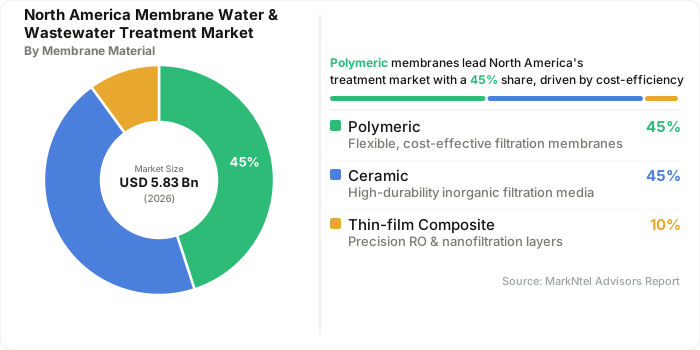
- By membrane material, polymeric membranes dominate with a 45% share, owing to their cost-effectiveness, high filtration efficiency, chemical stability, and broad applicability across municipal, industrial, and commercial water treatment systems.
- The market is moderately consolidated, with a group of top 5 leaders collectively holding an estimated 70% share of the high-performance membrane systems market. This dominance is driven by strong R&D capabilities, extensive installed base, and integrated water treatment solution offerings across North America.
North America Membrane Water and Wastewater Treatment Market Size and Outlook
The North America membrane water and wastewater treatment market is projected to grow at a CAGR of 6.00% during the forecast period, supported by increasing industrialization, rapid urban population growth, rising wastewater generation, and the growing need for efficient water treatment solutions across major cities in the region.
Climate variability and recurring drought conditions, particularly in western regions of the United States, have strengthened reliance on advanced membrane-based filtration systems. Aging water infrastructure across municipalities has increased replacement and modernization requirements, accelerating the adoption of high-efficiency treatment technologies. Municipal utilities continue shifting toward membrane filtration systems to manage stricter effluent quality expectations and improve long-term operational reliability.
Regulatory pressure has intensified through progressively tighter water quality standards enforced by the U.S. Environmental Protection Agency across drinking and wastewater systems. In 2024, the EPA finalized enforceable limits for PFAS compounds in drinking water, prompting utilities to accelerate membrane and advanced filtration upgrades. In Canada, provincial water quality frameworks and federal environmental compliance programs are reinforcing the adoption of advanced membrane-based treatment processes.
For instance, Lorne Park Water Treatment Plant (Peel Region), where the facility expansion includes large-scale membrane filtration (UF systems) to meet stricter drinking water quality standards and support population growth. This upgrade is explicitly designed to improve compliance with Ontario’s drinking water regulations and manage emerging contaminants more effectively.
Industrial end-users are increasingly deploying membrane systems for high-purity water and wastewater recycling across semiconductors, pharmaceuticals, and food processing facilities.
Municipal utilities are expanding deployments of membrane bioreactors to enhance wastewater reuse capacity and reduce freshwater dependence in growing urban centers. The commercial and residential sectors are gradually adopting compact, decentralized membrane systems for on-site treatment and water reuse applications.
Leading companies such as Veolia are expanding membrane technology portfolios alongside digital water monitoring and process optimization solutions, supporting the growth of the market from USD 5.83 billion in 2026 to USD 8.27 billion by 2032. Additionally, prominent water and wastewater treatment Manufacturers are increasing localized production capacity and forming regional partnerships to strengthen supply chains across North American treatment infrastructure projects. Therefore, the future of North America membrane water and wastewater treatment market is expected to be driven by sustainability targets, energy-efficient system adoption, and continued infrastructure resilience investments across public and private sectors.
North America Membrane Water and Wastewater Treatment Market Key Indicators
- The US EPA finalized the first national maximum contaminant levels (MCLs) for six per- and polyfluoroalkyl substances (PFAS), set as low as 4 parts per trillion for PFOA and PFOS, in April 2024, with compliance required across approximately public water systems by 2029; nanofiltration and reverse osmosis membranes are the primary commercially proven technologies capable of meeting these thresholds, creating direct procurement pressure across North American municipal utilities.
- The US EPA's Lead and Copper Rule Improvements (LCRI), finalized in October 2024, mandate replacement of all lead service lines in the United States within 10 years; utilities executing replacement programmes are co-investing in point-of-entry membrane systems to eliminate residual heavy metal and particulate contamination, generating parallel capital deployment in membrane treatment infrastructure.
- The U.S. EPA’s National Pollutant Discharge Elimination System (NPDES), regulates hundreds of industrial and municipal point-source discharges under the Clean Water Act of 1972, with increasingly stringent permit requirements for nutrients, PFAS, pathogens, and industrial contaminants driving adoption of advanced wastewater treatment technologies. Industrial sectors, including pharmaceuticals, semiconductors, and food and beverage manufacturing, are increasingly deploying membrane bioreactors, reverse osmosis, and ultrafiltration systems because these technologies support high-efficiency multi-contaminant removal, water reuse, and compliance with evolving discharge standards across North America.
North America Membrane Water and Wastewater Treatment Market Scope
| Category | Segments |
|---|---|
| By Membrane Technology | (Microfiltration, Ultrafiltration, Nanofiltration, Reverse Osmosis, Electrodialysis), |
| By Membrane Material | (Polymeric, Ceramic, Thin film Composite), |
| By Module Configuration | (Spiral Wound Modules, Hollow fiber modules, Tubular Modules, Plate & Frame Modules, Ceramic Monolith Modules, Capillary Modules, Others), |
| By Application | (Municipal Water Treatment, Industrial Water Treatment, Wastewater, Desalination, Water Reuse and Recycling), |
| By End-user Industry | (Municipal, Pulp and Paper, Chemical, Food and Beverage, Healthcare, Power, Other), |
North America Membrane Water and Wastewater Treatment Growth Drivers
Water Scarcity and Reuse Initiatives
Water scarcity has become a major structural driver for the membrane water and wastewater treatment market in North America as drought frequency intensifies across water-stressed regions. The U.S. Environmental Protection Agency expanded its Water Reuse Action Plan 2.0 in 2026 to accelerate recycled water adoption for industry, energy, and technology sectors. EPA stated that rising manufacturing activity, data center growth, and fluctuating precipitation patterns are increasing pressure on long-term water availability nationwide. These conditions are encouraging utilities and industrial operators to deploy advanced membrane filtration and reverse osmosis systems for wastewater reclamation.
The driver has materially intensified because municipalities and industrial facilities increasingly view treated wastewater reuse as a dependable alternative water source rather than an emergency measure. California’s Orange County Groundwater Replenishment System now processes approximately 130 million gallons daily using microfiltration, reverse osmosis, and ultraviolet purification technologies. The facility currently supplies nearly 45% of central Orange County’s water demand, demonstrating the scale at which advanced membrane treatment supports regional water resilience. Recent California regulatory approvals for direct potable reuse are also encouraging similar infrastructure investments across Texas, Colorado, Utah, and other drought-sensitive states.
The market impact is volume-driven because reuse programs require large-scale installation of physical treatment infrastructure across municipal, institutional, and industrial networks.
In 2026, the EPA’s WRAP 2.0 framework introduced new actions supporting recycled water deployment for industrial cooling, food processing, and data center operations. Universities and public institutions are also investing in reclamation facilities, including the University of Texas WaterHub project, designed to reclaim up to one million gallons daily. T hese long-term projects expand membrane system procurement volumes by creating continuous demand for filtration modules, replacement membranes, and wastewater treatment capacity upgrades.
Recent Trends
Integration of Digital Water Management and Smart Membrane Monitoring Systems
A major trend reshaping the North America membrane water and wastewater treatment market is the integration of digital monitoring and smart water management platforms.
Utilities and industrial operators are increasingly deploying AI-enabled sensors, predictive analytics, and remote membrane performance tracking to improve treatment efficiency. The trend accelerated after utilities faced rising operational costs, workforce shortages, and stricter compliance monitoring requirements across treatment facilities. The U.S. Environmental Protection Agency has also expanded digital infrastructure initiatives supporting data-driven utility modernization and cybersecurity preparedness.
This shift is structurally changing operational models by moving utilities from reactive maintenance toward predictive and automated treatment management systems.
Companies including Xylem and Veolia are expanding digital water platforms that monitor membrane fouling, optimize chemical dosing, and reduce energy consumption. In 2025, QUA, an Aquatech company, launched EDR-Q™ for high-recovery desalination and industrial water reuse applications, expanding advanced membrane treatment capabilities. These systems improve asset lifespan and lower operational downtime, increasing adoption among municipal, industrial, and institutional end-user segments. In 2026, DuPont introduced new FilmTec™ Fortilife™ reverse osmosis membrane elements in April, intended for Zero Liquid Discharge (ZLD) and Minimal Liquid Discharge (MLD) systems, to enhance industrial water recovery and brine concentration efficiency.
The trend is expected to persist owing to the utilities that are increasingly prioritizing lifecycle efficiency and long-term operating cost reductions over conventional treatment systems. Ceramic and low-fouling membranes support higher recovery rates and more stable performance under variable wastewater compositions and reuse applications. For instance, CERAFILTEC supplied ceramic membrane bioreactor technology for xAI’s Memphis wastewater reuse project, enabling treatment of nearly 13 million gallons per day for cooling applications. Government-backed infrastructure modernization programs across the United States and Canada are also encouraging the adoption of energy-efficient treatment technologies. As decentralized treatment and water reuse projects expand, digitally optimized membrane systems are expected to become standard across next-generation facilities.
Opportunities and Challenges
Aging Wastewater Infrastructure Creating Opportunities for Smart Treatment and Pumping System Investments
A major challenge affecting the North American membrane water and wastewater treatment market is the deterioration of aging municipal wastewater infrastructure across the United States and Canada. Many wastewater treatment plants were constructed decades ago and now face operational inefficiencies, leakage losses, rising maintenance costs, and limited contaminant removal capability. The American Society of Civil Engineers reported in 2025 that a substantial share of U.S. wastewater infrastructure requires modernization or replacement to maintain regulatory compliance and operational reliability . Older facilities are increasingly unable to manage rising wastewater volumes generated by urban population growth and industrial expansion.
The challenge is simultaneously creating major investment opportunities in membrane bioreactors, smart pumping systems, and digitally automated wastewater treatment infrastructure. Utilities are increasingly replacing conventional activated sludge systems with membrane-based treatment technologies that improve effluent quality and support wastewater reuse applications. For instance, Integrated water services partnered with CROM in 2026 to launch the NXT|MBR™ modular wastewater treatment platform for municipal and water reuse projects, targeting long-life decentralized treatment infrastructure investments . Municipalities are also investing in automated flow-control systems and predictive maintenance platforms to modernize aging wastewater networks.
The opportunity is expanding further through federal infrastructure funding and long-term resilience planning initiatives across North America. For instance, BluMetric Environmental secured a USD 1.5 million contract in 2026 for a membrane bioreactor wastewater treatment plant in Florida, designed for residential wastewater reuse expansion. The project includes scalable treatment capacity for future infrastructure growth .
Calgon Carbon announced a nearly USD 100 million investment in 2026 to expand drinking water and PFAS treatment infrastructure capacity at its Ohio facility ahead of future EPA compliance deadlines. Utilities are increasingly prioritizing decentralized wastewater reuse facilities, advanced sludge treatment systems, and energy-efficient pumping technologies in capital planning strategies. As regulatory compliance requirements tighten, investments in advanced membrane filtration and wastewater transfer infrastructure are expected to increase steadily.
Segmentation Analysis
Municipal Utilities as Centralized Demand Hubs Accelerating Membrane-Based Water and Wastewater Infrastructure Expansion
Municipalities are the leading end-users for membrane-based wastewater treatment with a market share of 43% because wastewater generation is inherently centralized, regulated, and continuously increasing in urban systems, while membranes are one of the few technologies that can reliably meet tightening discharge and reuse standards at scale.
Municipal wastewater streams are highly variable and heavily contaminated, including domestic sewage, stormwater, and small industrial inputs. Therefore, conventional treatment alone often cannot meet modern discharge norms, especially for nutrients (nitrogen, phosphorus), pathogens, and emerging contaminants. Membrane systems (UF/MF/RO) solve this by providing a physical barrier that ensures consistent effluent quality regardless of inflow variability, which is critical for city-scale operations where water quality cannot fluctuate.
Municipal systems manage continuous and high-volume wastewater streams from entire urban populations, requiring consistent treatment reliability and strict compliance with discharge standards under frameworks such as the U.S. EPA Clean Water Act regulations. This makes membrane technologies, especially MBR, UF, and RO, critical for achieving stable effluent quality and meeting tightening nutrient and contaminant limits.
In addition, rising water scarcity and increasing emphasis on water reuse have transformed municipal wastewater from a disposal challenge into a resource recovery opportunity. Projects across major cities are integrating advanced membrane systems to produce reclaimed water for industrial use, irrigation, and potable reuse, further strengthening demand. For instance, the City of San Diego Public Utilities Department is building one of the largest membrane-based wastewater reuse systems in the U.S. It converts treated wastewater into drinking water using membrane filtration and reverse osmosis with UV advanced oxidation , showing how municipalities adopt membranes for potable reuse at scale.
Combined with large-scale government funding and the urgent need to upgrade aging treatment infrastructure, municipalities consistently invest at a higher and more sustained rate than any other end-user segment. This structural dependence on regulation, population-scale demand, and reuse-driven water strategies ensures that municipalities will continue to dominate membrane-based wastewater treatment adoption in North America. By end user type, the market is classified into:
- Municipal
- Pulp and Paper
- Chemical
- Food and Beverage
- Healthcare
- Power
- Other
Polymeric Membranes as Cost-Efficient Backbone Driving Large-Scale Municipal Wastewater Treatment Adoption
Polymeric membranes dominate the North American membrane water and wastewater treatment market with a share of 45% due to their cost efficiency, scalability, and strong compatibility with municipal-scale operations. Municipal utilities manage large and continuous wastewater flows, making affordability and ease of replacement critical. Polymeric materials such as PVDF and PES offer a lower capital and operational cost compared to ceramic membranes while still ensuring high contaminant removal efficiency. Their adaptability to ultrafiltration (UF), microfiltration (MF), and membrane bioreactor (MBR) systems makes them the default choice for large urban wastewater infrastructure.
Leading companies actively reinforce this dominance through large-scale municipal deployments. Toray Industries supplies flat-sheet polymeric membranes widely used in city wastewater plants for nutrient removal and reuse applications. Veolia provided its ZeeWeed hollow fiber polymeric membrane technology for the Brightwater Wastewater Treatment Plant in the Seattle metropolitan region, one of the most significant municipal membrane bioreactor (MBR) installations in North America. The facility represents a large-scale application of advanced polymeric membranes in centralized wastewater treatment infrastructure designed to meet stringent environmental discharge standards.
This project plays a critical role in demonstrating the scalability of membrane-based systems for high-population urban regions, with the plant serving wastewater treatment needs for approximately 1.4 million residents.
Therefore, Polymeric membranes benefit from long-term municipal procurement cycles, infrastructure replacement demand, and increasing reuse initiatives. Ceramic membranes remain limited due to high cost, while thin-film composites and spiral wound configurations are more specialized in RO applications. As the government and industries continue upgrading aging wastewater infrastructure and expanding reuse capacity, polymeric membranes maintain structural dominance due to their economic and operational alignment with large-scale public water systems. By membrane material, the market is further segmented into the following categories:
- Polymeric
- Ceramic
- Thin-film composite
North American Membrane Water and Wastewater Treatment Market Geographical Analysis
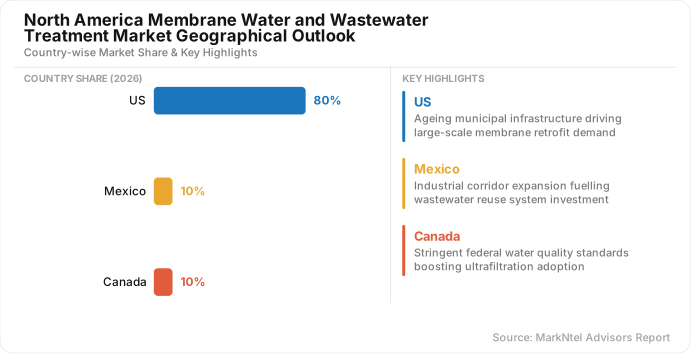
The United States dominates the North American membrane water and wastewater treatment market, with 80% share, significantly larger than Canada and Mexico. This leadership is primarily driven by extensive infrastructure development, high industrial water demand, and a highly structured regulatory environment that continuously pushes advanced treatment adoption. Large-scale municipal networks and aging water systems create consistent upgrade cycles, increasing reliance on membrane-based technologies such as reverse osmosis, ultrafiltration, and microfiltration across both potable water and wastewater applications.
A major structural advantage of the US market is its strong industrial base, which includes water-intensive sectors such as semiconductors, pharmaceuticals, chemicals, food and beverage, and energy production. For instance, semiconductor manufacturing is described as requiring ultrapure water thousands of times cleaner than drinking water for wafer rinsing and etching. These industries require ultra-pure water standards , which conventional treatment systems cannot consistently achieve. As a result, membrane filtration systems have become a standard component in industrial water treatment design. At the same time, federal investment programs such as the Infrastructure Investment and Jobs Act, which allocates billions of dollars toward water infrastructure modernization, are accelerating large-scale adoption and replacement of legacy systems across states.
Regulatory frameworks further strengthen US dominance by mandating strict water quality and discharge standards. Agencies such as the US Environmental Protection Agency enforce compliance under the Clean Water Act and Safe Drinking Water Act, requiring advanced contaminant removal in municipal and industrial systems . The introduction of stricter contaminant limits, including PFAS regulations finalized in 2024, has significantly increased the need for high-efficiency membrane technologies, particularly in drinking water treatment facilities. This regulatory pressure ensures continuous technology upgrades rather than one-time installations.
Combined with strong R&D ecosystems, public–private partnerships, and large-scale infrastructure investments, these factors collectively establish the United States as the clear leader in the regional membrane water and wastewater treatment market.
North America Membrane Water and Wastewater Treatment Market Competitive Landscape
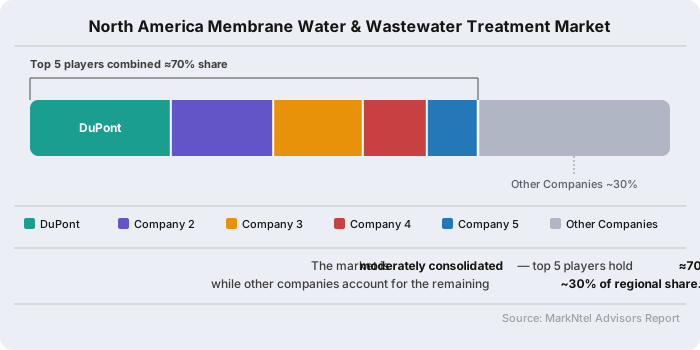
The North America membrane water and wastewater treatment industry is moderately consolidated at the top end, with a small group of global water technology leaders controlling a significant portion of high-value RO, UF, NF, and industrial separation membrane systems used across municipal, industrial, and desalination applications. The leading companies DuPont, Toray Industries, Koch Separation Solutions, Veolia Water Technologies, and SUEZ Water Technologies & Solutions collectively account for an estimated 70% combined share of the high-performance membrane systems market, driven by their strong dominance in reverse osmosis membrane manufacturing, integrated water treatment solutions, long-term municipal contracts, and advanced industrial wastewater treatment technologies.
Major Key Players in North America for Membrane Water and Wastewater Treatment Market
- Aquatech International LLC
- Dow
- DuPont
- Toray
- Koch Separation Solutions
- Pentair
- Pall Corporation
- Suez Water Technologies & Solutions
- Hydranautics
- H2O Innovation
- Evoqua Water Technologies
- IDE Technologies
- Kurita Water Industries Ltd
- Organo Corporation
- Ovivo
- Paques
- Veolia Water Solutions & Technologies
North America Membrane Water and Wastewater Treatment Market News and Recent Developments
2025: Transfilm Technology Launches New Membrane Company (North America )
Transfilm Technology has launched a new dedicated membrane-focused company targeting the North American water treatment market. The move is aimed at expanding advanced membrane solutions for filtration applications, particularly in industrial and municipal water treatment systems. The development reflects growing demand for high-efficiency membrane technologies such as reverse osmosis (RO) and ultrafiltration (UF). North America’s tightening water quality regulations and infrastructure upgrades are driving entry of new specialized players. This launch also signals increased competition in the membrane manufacturing and supply ecosystem.
Impact Analysis: The launch of a new membrane-focused company by Transfilm Technology is expected to intensify competition in the North American membrane market by increasing the number of specialized players. It reflects growing opportunities for niche innovators in advanced filtration technologies such as reverse osmosis and ultrafiltration. This development is likely to support faster adoption of high-efficiency membrane systems across municipal and industrial water treatment applications. It also indicates that established companies may face increased pressure to accelerate innovation and differentiate their product portfolios. Overall, the move highlights the expanding and increasingly fragmented nature of the regional membrane industry.
2025: Kurita America and Avista Technologies Merge to Form a Water Treatment Powerhouse
Kurita America and Avista Technologies have merged to strengthen their position in the global water treatment and membrane solutions market. The merger combines Kurita’s chemical treatment expertise with Avista’s membrane performance and cleaning technologies. This integration is expected to create a more vertically aligned water treatment solutions provider, offering end-to-end services. The deal reflects a broader industry trend toward consolidation to improve efficiency and technological integration. It also enhances capability in optimizing membrane lifecycle performance, fouling control, and operational efficiency.
Market Impact: The merger between Kurita America and Avista Technologies is expected to significantly reshape the North American water treatment market by strengthening integrated solution offerings that combine chemical treatment and membrane performance optimization. It will likely enhance operational efficiency and lifecycle management of membrane systems through bundled services. This consolidation may increase competitive pressure on smaller and mid-sized players that lack vertically integrated capabilities. It also reflects a broader industry shift toward end-to-end water treatment solutions rather than standalone product offerings. Overall, the merger reinforces a trend of consolidation aimed at improving technological depth and market reach in the membrane sector.
2025: DuPont Launches High-Performance FilmTec™ Hypershell™ Element for Energy-Efficient Dairy Processing
DuPont has introduced a new FilmTec™ Hypershell™ reverse osmosis membrane element designed for dairy processing applications. The product is aimed at improving efficiency in milk, whey, and lactose concentration processes while reducing energy consumption. It offers up to 50% higher productivity or significant energy savings compared to conventional RO elements. The launch reflects increasing demand for high-performance membranes in food and beverage processing. It also strengthens DuPont’s position in advanced membrane solutions for industrial water separation applications.
Market Impact Analysis: This launch strengthens DuPont’s leadership in high-efficiency reverse osmosis membranes and intensifies competition in the dairy and industrial membrane segment. It is likely to accelerate the adoption of energy-optimized membrane technologies in food processing industries. The product also reinforces the shift toward sustainability-focused filtration systems with lower operational costs. Overall, it enhances technological competition among global membrane manufacturers in high-value application segments.
2025: Viomi Launches MASTER M1 AI Water Purifier in the United States, Advancing Smart Reverse Osmosis Systems
Viomi has introduced its MASTER M1 AI-enabled reverse osmosis water purifier in the U.S. residential market. The system integrates advanced RO membrane filtration with smart AI-based monitoring features. It is designed to improve water quality by removing contaminants while maintaining essential minerals through a remineralization stage. The product also includes real-time water quality tracking, filter monitoring, and app-based control. This launch reflects the growing shift toward intelligent and connected home water purification systems in North America.
Impact analysis: This launch reflects the increasing penetration of smart reverse osmosis systems in the North American residential water treatment market. It indicates a shift toward AI-enabled filtration technologies that enhance user control, monitoring, and system efficiency. The development is expected to intensify competition in the premium home water purifier segment, where innovation and smart features are becoming key differentiators. Overall, it highlights the expanding adoption of intelligent membrane-based water purification systems in the U.S. consumer market.
- Market Segmentation
- Introduction
- Product Definition
- Research Process
- Assumptions
- Executive Summary
- North America Membrane Water and Wastewater Treatment (WWT) Market Policies, Regulations, and Product Standards
- North America Membrane Water and Wastewater Treatment (WWT) Market Trends & Developments
- North America Membrane Water and Wastewater Treatment (WWT) Market Dynamics
- Growth Factors
- Challenges
- North America Membrane Water and Wastewater Treatment (WWT) Market Hotspots & Opportunities
- North America Membrane Water and Wastewater Treatment (WWT) Market Outlook, 2022-2032F
- Market Size & Outlook
- By Revenues (USD Million)
- Market Share & Analysis
- By Membrane Technology- Market Size & Forecast 2022-2032, USD Million
- Microfiltration
- Ultrafiltration
- Nanofiltration
- Reverse Osmosis
- Electrodialysis
- By Membrane Material- Market Size & Forecast 2022-2032, USD Million
- Polymeric
- Ceramic
- Thin film Composite
- By Module Configuration- Market Size & Forecast 2022-2032, USD Million
- Spiral Wound Modules
- Hollow fiber modules
- Tubular Modules
- Plate & Frame Modules
- Ceramic Monolith Modules
- Capillary Modules
- Others
- By Application - Market Size & Forecast 2022-2032, USD Million
- Municipal Water Treatment
- Industrial Water Treatment
- Wastewater
- Desalination
- Water Reuse and Recycling
- By End-user Industry- Market Size & Forecast 2022-2032, USD Million
- Municipal
- Pulp and Paper
- Chemical
- Food and Beverage
- Healthcare
- Power
- Other
- By Country
- United States
- Canada
- Mexico
- By Company
- Competition Characteristics
- Market Share & Analysis
- By Membrane Technology- Market Size & Forecast 2022-2032, USD Million
- Market Size & Outlook
- United States Membrane Water and Wastewater Treatment (WWT) Market Outlook, 2022-2032F
- Market Size & Outlook
- By Revenues (USD Million)
- Market Share & Analysis
- By Membrane Technology- Market Size & Forecast 2022-2032, USD Million
- By Membrane Material- Market Size & Forecast 2022-2032, USD Million
- By Module Configuration- Market Size & Forecast 2022-2032, USD Million
- By Application - Market Size & Forecast 2022-2032, USD Million
- By End-user Industry- Market Size & Forecast 2022-2032, USD Million
- Market Size & Outlook
- Canada Membrane Water and Wastewater Treatment (WWT) Market Outlook, 2022-2032F
- Market Size & Outlook
- By Revenues (USD Million)
- Market Share & Analysis
- By Membrane Technology- Market Size & Forecast 2022-2032, USD Million
- By Membrane Material- Market Size & Forecast 2022-2032, USD Million
- By Module Configuration- Market Size & Forecast 2022-2032, USD Million
- By Application - Market Size & Forecast 2022-2032, USD Million
- By End-user Industry- Market Size & Forecast 2022-2032, USD Million
- Market Size & Outlook
- Mexico Membrane Water and Wastewater Treatment (WWT) Market Outlook, 2022-2032F
- Market Size & Outlook
- By Revenues (USD Million)
- Market Share & Analysis
- By Membrane Technology- Market Size & Forecast 2022-2032, USD Million
- By Membrane Material- Market Size & Forecast 2022-2032, USD Million
- By Module Configuration- Market Size & Forecast 2022-2032, USD Million
- By Application - Market Size & Forecast 2022-2032, USD Million
- By End-user Industry- Market Size & Forecast 2022-2032, USD Million
- Market Size & Outlook
- North America Membrane Water and Wastewater Treatment (WWT) Market Key Strategic Imperatives for Success & Growth
- Competitive Outlook
- Company Profiles
- Aquatech International LLC
- Business Description
- Product Portfolio
- Collaborations & Alliances
- Recent Developments
- Financial Details
- Others
- Dow
- Business Description
- Product Portfolio
- Collaborations & Alliances
- Recent Developments
- Financial Details
- Others
- DuPont
- Business Description
- Product Portfolio
- Collaborations & Alliances
- Recent Developments
- Financial Details
- Others
- Toray
- Business Description
- Product Portfolio
- Collaborations & Alliances
- Recent Developments
- Financial Details
- Others
- Koch Separation Solutions
- Business Description
- Product Portfolio
- Collaborations & Alliances
- Recent Developments
- Financial Details
- Others
- Pentair
- Business Description
- Product Portfolio
- Collaborations & Alliances
- Recent Developments
- Financial Details
- Others
- Pall Corporation
- Business Description
- Product Portfolio
- Collaborations & Alliances
- Recent Developments
- Financial Details
- Others
- Suez Water Technologies & Solutions
- Business Description
- Product Portfolio
- Collaborations & Alliances
- Recent Developments
- Financial Details
- Others
- Hydranautics
- Business Description
- Product Portfolio
- Collaborations & Alliances
- Recent Developments
- Financial Details
- Others
- H2O Innovation
- Business Description
- Product Portfolio
- Collaborations & Alliances
- Recent Developments
- Financial Details
- Others
- Evoqua Water Technologies
- Business Description
- Product Portfolio
- Collaborations & Alliances
- Recent Developments
- Financial Details
- Others
- IDE Technologies
- Business Description
- Product Portfolio
- Collaborations & Alliances
- Recent Developments
- Financial Details
- Others
- Kurita Water Industries Ltd
- Business Description
- Product Portfolio
- Collaborations & Alliances
- Recent Developments
- Financial Details
- Others
- Organo Corporation
- Business Description
- Product Portfolio
- Collaborations & Alliances
- Recent Developments
- Financial Details
- Others
- Ovivo
- Business Description
- Product Portfolio
- Collaborations & Alliances
- Recent Developments
- Financial Details
- Others
- Paques
- Business Description
- Product Portfolio
- Collaborations & Alliances
- Recent Developments
- Financial Details
- Others
- Aquatech International LLC
- Company Profiles
- Disclaimer

MarkNtel Advisors follows a robust and iterative research methodology designed to ensure maximum accuracy and minimize deviation in market estimates and forecasts. Our approach combines both bottom-up and top-down techniques to effectively segment and quantify various aspects of the market. A consistent feature across all our research reports is data triangulation, which examines the market from three distinct perspectives to validate findings. Key components of our research process include:
1. Scope & Research Design At the outset, MarkNtel Advisors define the research objectives and formulate pertinent questions. This phase involves determining the type of research—qualitative or quantitative—and designing a methodology that outlines data collection methods, target demographics, and analytical tools. They also establish timelines and budgets to ensure the research aligns with client goals.
2. Sample Selection and Data Collection In this stage, the firm identifies the target audience and determines the appropriate sample size to ensure representativeness. They employ various sampling methods, such as random or stratified sampling, based on the research objectives. Data collection is carried out using tools like surveys, interviews, and observations, ensuring the gathered data is reliable and relevant.
3. Data Analysis and Validation Once data is collected, MarkNtel Advisors undertake a rigorous analysis process. This includes cleaning the data to remove inconsistencies, employing statistical software for quantitative analysis, and thematic analysis for qualitative data. Validation steps are taken to ensure the accuracy and reliability of the findings, minimizing biases and errors.

4. Data Forecast and FinalizationThe final phase involves forecasting future market trends based on the analyzed data. MarkNtel Advisors utilize predictive modeling and time series analysis to anticipate market behaviors. The insights are then compiled into comprehensive reports, featuring visual aids like charts and graphs, and include strategic recommendations to inform client decision-making
We offer flexible licensing options to cater to varying organizational needs. Choose the pricing pack that best suits your requirements:
Buy Now Inquire Before Buying
 Request Customization