

India Sludge Dewatering System Market Research Report: Size, Share, Trends & Forecast (2026-2032)
By Technology / Equipment Type (Belt Filter Press, Centrifuge Systems, Screw Press, Filter Press, Rotary Drum Thickener, Vacuum Filters, Drying Beds & Lagoons, Electro-dewatering S ... ystems, Thermal Drying Systems), By Sludge Type (Primary Sludge, Secondary/Biological Sludge, Mixed Sludge, Industrial Sludge, Chemical Sludge, Hazardous Sludge), By Application (Municipal Wastewater Treatment, Industrial Wastewater Treatment, Drinking Water Treatment, Sludge Recycling & Resource Recovery, Septage Treatment), By End-Use Industry (Municipal Corporations & STPs, Food & Beverage, Pulp & Paper, Textile, Chemicals & Petrochemicals, Pharmaceuticals, Oil & Gas), By Automation Level (Manual Systems, Semi-Automatic Systems, Fully Automatic Systems), and others Read more
- Environment
- May 2026
- Pages 140
- Report Format: PDF, Excel, PPT
India Sludge Dewatering System Market
Projected 8.40% CAGR from 2026 to 2032
Study Period
2026-2032
Market Size (2026)
USD 228 Million
Market Size (2032)
USD 370 Million
Base Year
2025
Projected CAGR
8.40%
Leading Segments
By technology: Belt Filter Press
India Sludge Dewatering System Market Report Key Takeaways
- The Indian sludge dewatering system market was valued at USD 210 million in 2025 and is projected to reach USD 228 million in 2026 and USD 370 million by 2032, growing at a CAGR of 8.40%, driven by rising sewage treatment capacity expansion and stricter wastewater discharge regulations across urban and industrial sectors.
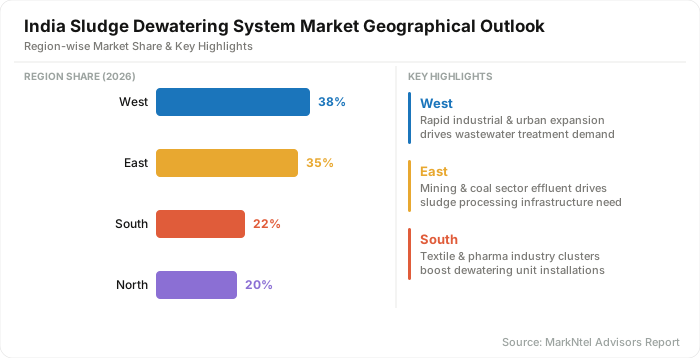
- Western India accounts for the largest regional share at 38%, supported by high urbanization, strong industrial base, and large-scale municipal wastewater infrastructure in states like Maharashtra and Gujarat.
- Centrifuge systems dominate the market with a 36% share due to their high efficiency in handling large sludge volumes, better separation performance, and suitability for municipal and industrial wastewater treatment plants.
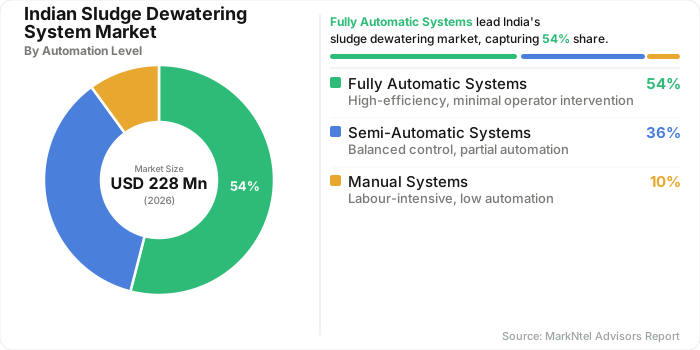
- Fully automatic systems lead the automation segment with a 54% share, reflecting increasing adoption of advanced, low-labour, and high-efficiency sludge handling solutions in modern sewage treatment plants across India.
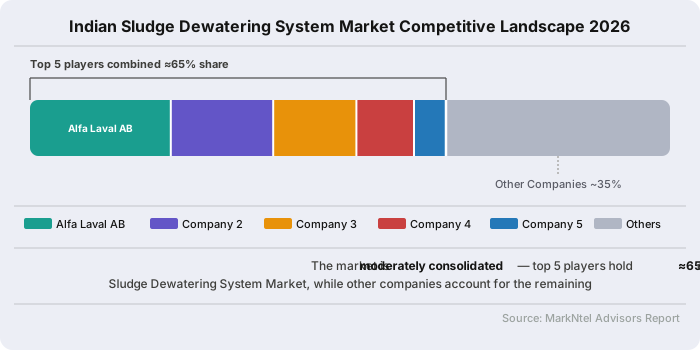
- The market is moderately consolidated, led by global and domestic players across key technologies like centrifuges, belt filter presses, and screw presses. Major companies together hold around 65% market share, supported by a strong presence in municipal STPs, industrial wastewater plants, and long-term O&M contracts
India Sludge Dewatering System Market Size and Outlook
The India Sludge Dewatering System Market is projected to register a CAGR of around 8.40% during the forecast period, driven by rising investments in urban sanitation infrastructure, wastewater treatment capacity expansion, sewage management projects, and industrial effluent treatment systems across the country.
The Government of India’s AMRUT 2.0 initiative targets universal sewerage and septage management coverage in 500 cities by 2026, creating sustained demand for centrifuges, belt filter presses, and screw press technologies used in municipal sludge treatment operations. Urban local bodies are increasingly integrating sludge handling systems into sewage treatment projects to reduce disposal costs and improve water recovery efficiency.
Industrial wastewater compliance requirements are also strengthening market adoption across sectors, including food processing, pharmaceuticals, chemicals, pulp and paper, and textiles. Manufacturing facilities are deploying advanced dewatering systems to reduce sludge transportation volumes, lower landfill dependency, and comply with stricter discharge norms issued by state pollution control authorities. Companies supplying automated and energy-efficient systems are benefiting from rising operational cost sensitivity among industrial users seeking lower power consumption and reduced maintenance expenditures. Increased integration of SCADA-enabled monitoring within treatment facilities is further accelerating technology modernization across large industrial clusters.
Rural sanitation expansion and greywater management programs are additionally supporting long-term demand for decentralized sludge treatment infrastructure across semi-urban and peri-urban regions. Under Swachh Bharat Mission-Gramin guidelines, faecal sludge management systems, including co-treatment and sludge processing facilities, are being encouraged in areas lacking centralized sewer networks. This policy direction is increasing procurement opportunities for compact dewatering systems suited for localized water and wastewater treatment applications. Demand from institutional users such as hospitals, educational campuses, and public utility facilities is also increasing due to rising emphasis on wastewater recycling and environmentally compliant sludge disposal practices.
Future market prospects remain favorable as India continues expanding sewage treatment capacity and upgrading water infrastructure under long-term urban development programs. Uttar Pradesh’s 2026 sewerage assessment reported ongoing development, tendering, and planning of hundreds of sewage treatment projects under Namami Gange, AMRUT, and SBM 2.0 programs, indicating sustained equipment procurement requirements. Concurrently, Jal Jeevan Mission 2.0’s enhanced funding allocation and digital water governance framework are expected to improve wastewater monitoring, operational accountability, and treatment efficiency nationwide. These structural reforms are likely to support broader adoption of high-capacity, automated, and resource-efficient sludge dewatering technologies over the coming years.
India Sludge Dewatering System Market Key Indicators
- IIT Guwahati Microalgal Biorefinery Project developed scalable phytoremediation and microalgal biorefinery systems during 2025 that utilize algae for industrial and domestic wastewater treatment while simultaneously producing biofuels. The project demonstrated the removal of up to 85% of pollutants from wastewater streams, highlighting growing investment toward algae-based green wastewater treatment technologies in India.
- IIT Madras–incubated start-up JSP Enviro developed and successfully installed an advanced next-generation wastewater treatment system across Tamil Nadu industrial units in 2025. The technology integrates energy-efficient biological and hybrid treatment processes designed to handle high-strength industrial effluents while improving treatment efficiency and reducing sludge generation. The deployment demonstrates increasing commercialization of deep-tech water solutions from academic incubators in India, particularly in industrial clusters facing stricter discharge norms and rising water reuse demand, highlighting a shift toward scalable, low-footprint, and automation-enabled wastewater treatment technologies.
- The Ministry of Housing and Urban Affairs reported that India’s urban population is projected to exceed 600 million people by 2036; rising residential and commercial construction activity is increasing installation demand for water pumps, purification systems, HVAC equipment, and wastewater treatment infrastructure across new buildings.
- India’s manufacturing policy is shifting towards infrastructure-led and integrated industrial hub development, supported by initiatives such as 3 chemical parks, 7 PM MITRA textile parks, MSME clusters, and ₹10,000-crore Biopharma SHAKTI under the Union Budget. Public capital expenditure has also increased significantly from ₹2 lakh crore in FY2014–15 to ₹12.2 lakh crore in FY2026–27 (BE), strengthening core infrastructure and industrial ecosystems. MSMEs, with around 7.47 crore enterprises contributing 35.4% of manufacturing output, are central to this distributed manufacturing base. This is creating indirect demand for industrial water treatment and sludge dewatering systems, as new manufacturing parks, chemical clusters, and MSME hubs require compliant wastewater management infrastructure to meet environmental regulations and sustain large-scale operations.
India Sludge Dewatering System Market Scope
| Category | Segments |
|---|---|
| By Technology / Equipment Type | Belt Filter Press, Centrifuge Systems, Screw Press, Filter Press, Rotary Drum Thickener, Vacuum Filters, Drying Beds & Lagoons, Electro-dewatering Systems, Thermal Drying Systems |
| By Sludge Type | Primary Sludge, Secondary/Biological Sludge, Mixed Sludge, Industrial Sludge, Chemical Sludge, Hazardous Sludge |
| By Application | Municipal Wastewater Treatment, Industrial Wastewater Treatment, Drinking Water Treatment, Sludge Recycling & Resource Recovery, Septage Treatment |
| By End-Use Industry | Municipal Corporations & STPs, Food & Beverage, Pulp & Paper, Textile, Chemicals & Petrochemicals, Pharmaceuticals, Oil & Gas |
| By Automation Level | Manual Systems, Semi-Automatic Systems, Fully Automatic Systems |
India Sludge Dewatering System Market Growth Drivers
Rising Industrial Wastewater Generation and Compliance-Oriented Sludge Management Requirements
A major structural driver strengthening India’s sludge dewatering system market is the sharp rise in industrial wastewater generation, combined with stricter sludge disposal compliance requirements across manufacturing sectors. The Central Pollution Control Board (CPCB) has expanded implementation and monitoring of Online Continuous Effluent Monitoring Systems (OCEMS) across highly polluting industries, CETPs, and treatment facilities during 2025–2026, increasing operational accountability for wastewater handling. This has accelerated the adoption of sludge dewatering systems among industries seeking to reduce sludge volumes and comply with discharge regulations.
The driver has intensified further due to ongoing industrial expansion and new manufacturing infrastructure investments across industrial corridors and smart industrial cities. In March 2026, the Indian government approved approximately USD 3.63 billion for the development of 100 industrial parks to strengthen domestic manufacturing capacity, while states, including Andhra Pradesh, accelerated industrial hub development incorporating sewage an d wastewater treatment infrastructure. These developments are increasing wastewater generation from chemicals, pharmaceuticals, engineering, textiles, and processing industries, directly expanding recurring demand for sludge treatment and dewatering systems.
Demand growth is materially visible in industrial regions facing mounting environmental compliance pressure and treatment infrastructure gaps. In 2025, Karnataka pollution authorities highlighted wastewater management risks in Bengaluru’s Peenya industrial area, where over 13,000 industries generated substantial industrial effluent volumes without adequate common treatment infrastructure. Simultaneously, Greater Noida initiated additional sewage treatment capacity projects to support industrial and urban wastewater management requirements under stricter environmental oversight. These developments are increasing pro curement of automated sludge handling technologies capable of supporting continuous industrial wastewater treatment operations and long-term regulatory compliance.
Recent Trends
Integration of Smart and Digitally Monitored Sludge Dewatering Systems
A significant trend transforming India’s sludge dewatering system market is the increasing integration of smart monitoring technologies, sensors, and SCADA-enabled automation within wastewater treatment operations. Municipal utilities and industrial facilities are adopting digitally connected dewatering systems to optimize sludge processing efficiency, reduce unplanned downtime, and improve real-time operational visibility. This trend has accelerated during 2025–2026 as treatment operators face rising pressure to control energy costs, improve resource utilization, and maintain regulatory compliance across expanding wastewater infrastructure networks.
The adoption of smart dewatering technologies is structurally reshaping procurement strategies and plant operating models across both municipal and industrial end-user segments. Under AMRUT 2.0 and related urban infrastructure programs, utilities are increasingly incorporating automated monitoring and digital process control systems into sewage treatment upgrades to strengthen operational accountability and improve treatment performance. For instance, CSIR-NEERI demonstrated the growing shift toward smart and mechanized sludge management in India by developing an advanced faecal sludge treatment facility in Chandrapur based on its indigenous Mechanical Dewatering & Drying System (MDDS) technology. The project reflects the broader market trend of adopting automated sludge processing solutions that improve operational efficiency, reduce manual handling requirements, support continuous treatment monitoring, and enable environmentally compliant resource recovery from treated sludge.
The trend is expected to remain structurally important due to India’s long-term emphasis on efficient urban water management, wastewater reuse, and infrastructure digitization. The Ministry of Housing and Urban Affairs has continued to promote technology-driven wastewater management frameworks that support automation, energy optimization, and smart utility operations under ongoing urban reform initiatives. As sewage generation volumes continue increasing across major cities and industrial zones, utilities and private operators are expected to accelerate investments in intelligent sludge dewatering systems that enhance operational efficiency, improve compliance tracking, and reduce lifecycle operating costs.
India Sludge Dewatering System Market Opportunities and Challenges
Variability in Sludge Composition Creating Demand for Customized Dewatering Solutions
A major challenge limiting operational efficiency in India’s sludge dewatering system market is the highly variable composition of sludge generated across industries and municipal wastewater treatment facilities. Sludge from textile, pharmaceutical, food processing, and chemical industries differs significantly in moisture content, organic load, grease concentration, heavy metals, and fibrous materials, making standardized dewatering systems less effective across applications. A 2025 study on faecal sludge treatment in Telangana further highlighted substantial variation in sludge characteristics due to differences in sanitation systems, wastewater composition , and treatment conditions.
This variability materially increases treatment complexity, operational costs, and equipment optimization requirements for market participants. Textile processing clusters in Tiruppur reported mounting accumulation of biosludge and mixed waste salts during 2025, reflecting the operational difficulties associated with handling industrial sludge streams containing chemicals , dyes, and concentrated residues. Similarly, wastewater treatment operators in food processing facilities continue facing challenges linked to high oil, grease, and protein content that reduce filterability and increase chemical conditioning requirements during sludge dewatering operations.
However, this challenge is simultaneously creating a strong market opportunity for emerging players offering customized and application-specific sludge dewatering solutions.
Indian manufacturers, including Dynamic Equipment Pvt. Ltd., are introducing modular multi-disc screw press and screw dehydrator systems specifically designed for the textile and pharmaceutical , food processing, and chemical wastewater applications. Additionally, VA Tech WABAG – Zero Liquid Discharge and Industrial TTRO Expansion expanded investments aggregated up to USD 3.60 billion in zero liquid discharge and industrial tertiary treatment reverse osmosis systems through projects for GAIL and Indian Oil Corporation in 2025. These investments reflect growing demand for customized sludge treatment, industrial wastewater reuse, and application-specific dewatering technologies across India’s refinery and petrochemical sectors.
Segmentation Analysis
Centrifuge Systems Lead Due to High Throughput Efficiency and Advanced Automation
Centrifuge systems lead the sludge dewatering system in India with a market share of 36% because they deliver higher sludge dryness, faster processing speed, and lower land dependency compared to belt presses and drying beds, making them highly suitable for large municipal and industrial wastewater projects. Their dominance is strongly linked to India’s rapid sewage treatment capacity expansion under Namami Gange, AMRUT, and Smart Cities Mission, where urban utilities require continuous high-volume sludge handling systems with lower operating downtime. Large wastewater engineering companies such as Alfa Laval and Veolia are actively supplying advanced decanter centrifuge technologies for Indian sewage and industrial treatment facilities .
Recent innovations, including automated polymer dosing, energy-efficient decanter designs, SCADA-enabled monitoring, and high-solids separation technologies, are further strengthening centrifuge adoption across municipalities and industrial sectors. Alfa Laval introduced its Aldec G3 VecFlow centrifuge platform, focused on reducing turbulence, lowering energy consumption, and improving sludge cake dryness, directly improving operating economics for Indian treatment operators. These innovations lower sludge transportation costs, improve energy recovery, and support India’s circular wastewater management goals, reinforcing centrifuge systems as the preferred large-scale dewatering technology. By technology, the market is further subdivided into the following categories:
- Belt Filter Press
- Centrifuge Systems
- Screw Press
- Filter Press
- Rotary Drum Thickener
- Vacuum Filters
- Drying Beds & Lagoons
- Electro-dewatering Systems
- Thermal Drying Systems
Fully Automatic Systems Lead Due to Operational Efficiency, Compliance Enforcement, and Digital Water Infrastructure Shift
Fully automatic sludge dewatering systems dominate the Indian market with a share of 54% because they significantly reduce manpower dependency while ensuring stable, continuous sludge processing in high-load municipal and industrial wastewater plants. Their leadership is driven by the need to manage rising sewage volumes from expanding urban clusters and industrial zones under programmes like Smart Cities Mission and AMRUT, where treatment plants are increasingly designed for 24/7 automated operation. Compared to manual and semi-automatic systems, fully automated setups provide consistent cake dryness, reduced downtime, and better process control, which is critical in India’s variable influent conditions.
Strong regulatory enforcement from Pollution Control Boards has accelerated adoption, as compliance now requires real-time monitoring, reporting, and controlled discharge quality. This has pushed utilities and industries to invest in SCADA-integrated systems with automated chemical dosing, online sensors, and remote operation capability. For instance, fully automatic systems use DO sensors, SCADA, and AI control to switch aeration ON/OFF based on actual load instead of running continuously. In real STP deployments, intelligent automation reduced electricity use by 40% due to demand-based aeration control .
Innovation is further strengthening dominance through IoT-enabled predictive maintenance, AI-based sludge load optimisation, and energy-efficient motor and polymer dosing systems. These technologies reduce operating cost, improve equipment lifespan, and minimise human intervention errors. As wastewater infrastructure scales across tier-2 and tier-3 cities, fully automatic systems are becoming the default choice due to superior reliability, lower lifecycle cost, and the ability to integrate with digital water management platforms. By automation level, the market is further subdivided into following categories:
- Manual Systems
- Semi-Automatic Systems
- Fully Automatic Systems
India Sludge Dewatering System Market Geographical analysis
West India is expected to dominate the Indian sludge dewatering system with a share of 38% due to its high industrial concentration, extensive municipal wastewater infrastructure, and strong presence of water-intensive industries across Maharashtra and Gujarat. The region contains some of India’s largest chemical, pharmaceutical, petrochemical, textile, food processing, and refinery clusters, all of which generate substantial industrial sludge requiring advanced dewatering systems. For instance, the Combined Wastewater Treatment Plant (CWWTP) project for Reliance Industries Limited (formerly IPCL) and the Wastewater Treatment Plant (WWTP) project for Indian Oil Corporation Limited, Gujarat Refinery, demonstrate the large-scale industrial wastewater and sludge treatment requirements across western India’s petrochemical and refinery sectors.
Maharashtra leads regional demand through large-scale sewage treatment projects in Mumbai, Pune, and other urban centers, alongside industrial effluent treatment investments across MIDC industrial zones. Increasing investments in wastewater reuse, STP expansion, and sludge management infrastructure are accelerating demand for centrifuge and screw press technologies. For instance, the Maharashtra government’s decision to increase land allocation for the proposed Worli Sewage Treatment Plant (STP) to nearly 28,000 sq. m demonstrates the growing priority being given to wastewater treatment and sludge management infrastructure in Mumbai. The expanded land allocation is intended to support higher sewage treatment capacity, modernization of wastewater infrastructure, and improved sludge handling capabilities under the Mumbai Sewage Disposal Project (MSDP). The project is considered critical public infrastructure due to rising urban wastewater volumes and increasing environmental compliance requirements in densely populated urban areas like Mumbai.
Similarly, Union Minister Piyush Goyal highlighted the importance of advanced sewage treatment infrastructure during the inauguration of the Dahisar River Rejuvenation Project in Mumbai. The project includes fully automated membrane bioreactor (MBR)-based STPs designed to reduce untreated sewage discharge and enable treated water reuse for non-potable applications such as gardening, road cleaning, and construction activities. These developments indicate increasing investments in automated STPs, river-cleaning initiatives, and wastewater recycling projects, which are directly supporting demand for advanced sludge dewatering systems, including centrifuges, screw presses, and filter press technologies across Maharashtra.
Additionally, West India benefits from comparatively stronger municipal wastewater investments, higher adoption of circular water economy initiatives, and expanding sewage reuse policies. Maharashtra’s state-level wastewater reuse policy for 424 urban local bodies and ongoing STP modernization projects like the Kopri sewage project a re supporting long-term market growth for sludge dewatering systems.
India Sludge Dewatering System Market Competitive Landscape
India's Sludge Dewatering System industry is moderately consolidated, with a strong presence of global water technology leaders. The leading players Veolia Water Technologies, SUEZ Water Technologies & Solutions, ANDRITZ AG, Alfa Laval, and Thermax Limited collectively account for an estimated 65% share of the Indian sludge dewatering system, driven by their strong installed base in municipal STPs, industrial wastewater plants, and long-term O&M contracts.
Major players of the Indian Sludge Dewatering System
- Veolia Water Technologies
- SUEZ Water Technologies & Solutions
- ANDRITZ AG
- Alfa Laval
- Huber Technology
- Aqseptence Group
- Thermax Limited
- Triveni Engineering & Industries Ltd.
- Ion Exchange (India) Ltd.
- WOG Technologies
India Sludge Dewatering System Market News and Recent Developments
2026: WABAG wins PPP contract to refurbish and operate 45 MLD wastewater recycling plant in Chennai
VA Tech WABAG has secured a Public-Private Partnership (PPP) contract from Chennai Metropolitan Water Supply and Sewerage Board (CMWSSB) to refurbish a 45 MLD TTRO wastewater recycling plant in Kodungaiyur, Chennai. The plant treats municipal wastewater and supplies high-quality recycled water to nearby industrial corridors like Manali–Ennore. WABAG will upgrade the existing facility to restore full capacity within 18 months. After refurbishment, it will operate and maintain the plant for around 18.5 years. The project is focused on improving water reuse efficiency and strengthening industrial water supply reliability in Chennai. It is part of the broader urban wastewater recycling infrastructure development in the city.
Impact analysis: This project increases demand for advanced sludge treatment and dewatering systems as part of large-scale wastewater recycling plants. Refurbishment of existing infrastructure signals a shift from new builds to upgrade + efficiency improvement projects, expanding aftermarket opportunities. Long-term O&M contracts create stable revenue models, encouraging more PPP participation in sludge and wastewater management. Industrial water reuse growth strengthens demand for efficient sludge handling technologies linked to RO-based treatment systems.
2025: WABAG secures USD 45.6 million World Bank-funded BWSSB contract for energy-efficient water reuse facilities in Bengaluru
VA Tech WABAG has received a ₹380 crore order from the Bangalore Water Supply and Sewerage Board (BWSSB), funded by the World Bank. The project involves designing, building, and operating advanced wastewater treatment and water reuse plants in Bengaluru. It includes tertiary treatment systems, biogas generation from sludge, solar sludge drying beds, and pumping infrastructure. The plants will treat wastewater for industrial reuse, reducing dependency on freshwater sources. Construction is planned over 30 months, followed by 10 years of operation and maintenance by WABAG. The project is part of Karnataka’s water security and disaster resilience program, focusing on sustainable urban water management.
Impact analysis: This order strengthens demand for advanced sludge dewatering and energy-efficient wastewater treatment systems in India. It directly boosts the adoption of technologies like biogas recovery and solar sludge drying, increasing system complexity and value addition. Municipal bodies like BWSSB are increasingly shifting toward reuse-driven wastewater infrastructure instead of disposal-based systems. This creates strong growth opportunities for EPC players like WABAG, as well as equipment suppliers in dewatering, filtration, and sludge handling.
2025: TruAlt Bioenergy and GAIL India sign a strategic joint venture agreement to scale compressed biogas (CBG) projects in India
TRuAlt Bioenergy and GAIL (India) have entered into a strategic joint venture to develop compressed biogas (CBG) plants across India. GAIL is set to acquire a 49% stake in TruAlt’s subsidiary Leafiniti Bioenergy, while TruAlt retains 51%. The JV plans to build multiple greenfield CBG plants, mainly using agricultural and sugar mill waste as feedstock. In the first phase, around six plants of 12 TPD capacity each will be developed, producing nearly 24,000 tonnes of CBG annually. The project also generates by-products like organic manure, supporting circular agriculture and rural income. It aims to strengthen India’s clean fuel ecosystem and reduce dependence on fossil fuels.
Impact analysis: This JV indirectly supports growth in sludge and bio-waste processing infrastructure, especially in biogas-linked systems. CBG plants generate large volumes of digestate, increasing demand for dewatering, drying, and solid-liquid separation technologies. It strengthens the market for sludge handling equipment used in anaerobic digestion and waste-to-energy plants. The expansion of decentralized biogas facilities will push the adoption of compact, modular dewatering systems in rural and semi-urban India.
2025: EcoYou operates 125+ bio-CBG plants globally, strengthening India’s position in green bioenergy technology
EcoYou’s Energy Division has developed and deployed more than 125 large-scale biogas and compressed biogas (CBG) plants globally. These systems process industrial and agricultural waste such as dairy effluents, agro-residues, and spent wash. The total installed capacity handles around 20 million cubic meters of waste annually.
Impact analysis: This expansion increases demand for high-capacity sludge and digestate dewatering systems linked to CBG plants. As more biogas facilities scale, sludge output rises, pushing the need for efficient solid-liquid separation technologies. It strengthens the market for integrated systems combining digestion, dewatering, and energy recovery in one chain. India benefits as global technology transfer improves the efficiency of domestic sludge treatment infrastructure. Overall, it expands the sludge dewatering market beyond municipal wastewater into bioenergy and industrial waste sectors.
2025: Schneider Electric wins contract to automate India’s largest water treatment plant in Mumbai (Bhandup 2000 MLD facility)
Schneider Electric has been awarded a contract to automate the Bhandup Water Treatment Plant in Mumbai, which has a capacity of around 2000 MLD. The project is part of Maharashtra’s effort to improve potable water supply for millions of residents. It involves the deployment of Schneider Electric’s EcoStruxure-based digital automation systems for monitoring and control. The plant is being developed by Welspun Enterprises with technology support from global partners like Veolia. Automation will improve energy efficiency, reduce operational losses, and enhance water quality management. The facility is part of a larger integrated water system serving Mumbai’s growing urban demand.
Impact analysis: This project significantly strengthens demand for large-scale automated sludge and wastewater treatment systems in India. High-capacity plants like 2000 MLD require advanced sludge handling, pushing the adoption of efficient dewatering technologies. It accelerates the shift toward a fully digital, IoT-enabled treatment infrastructure, increasing system complexity and value per project. Overall, it supports the long-term expansion of India’s sludge dewatering market through urban water infrastructure upgrades.
Frequently Asked Questions
- Market Segmentation
- Introduction
- Product Definition
- Research Process
- Assumptions
- Executive Summary
- India Sludge Dewatering System Market Policies, Regulations, and Product Standards
- India Sludge Dewatering System Market Trends & Developments
- India Sludge Dewatering System Market Dynamics
- Growth Factors
- Challenges
- India Sludge Dewatering System Market Hotspot & Opportunities
- India Sludge Dewatering System Market Outlook, 2022-2032F
- Market Size & Outlook
- By Revenues (USD Million)
- Market Share & Outlook
- By Technology / Equipment Type- Market Size & Forecast 2022-2032, USD Million
- Belt Filter Press
- Centrifuge Systems
- Screw Press
- Filter Press
- Rotary Drum Thickener
- Vacuum Filters
- Drying Beds & Lagoons
- Electro-dewatering Systems
- Thermal Drying Systems
- By Sludge Type- Market Size & Forecast 2022-2032, USD Million
- Primary Sludge
- Secondary/Biological Sludge
- Mixed Sludge
- Industrial Sludge
- Chemical Sludge
- Hazardous Sludge
- By Application- Market Size & Forecast 2022-2032, USD Million
- Municipal Wastewater Treatment
- Industrial Wastewater Treatment
- Drinking Water Treatment
- Sludge Recycling & Resource Recovery
- Septage Treatment
- By End-Use Industry- Market Size & Forecast 2022-2032, USD Million
- Municipal Corporations & STPs
- Food & Beverage
- Pulp & Paper
- Textile
- Chemicals & Petrochemicals
- Pharmaceuticals
- Oil & Gas
- By Automation Level- Market Size & Forecast 2022-2032, USD Million
- Manual Systems
- Semi-Automatic Systems
- Fully Automatic Systems
- By region- Market Size & Forecast 2022-2032, USD Million
- North
- National Capital Region (Delhi NCR)
- Uttar Pradesh
- Punjab
- Rajasthan
- South
- Karnataka
- Tamil Nadu
- Kerala
- East
- West Bengal
- Odisha
- West
- Maharashtra
- Gujarat
- Madhya Pradesh
- North
- By Company
- Competition Characteristics
- Market Share & Analysis
- By Technology / Equipment Type- Market Size & Forecast 2022-2032, USD Million
- Market Size & Outlook
- India Manual Systems Market Outlook, 2022-2032
- Market Size & Outlook
- By Revenues (USD Million)
- Market Share & Outlook
- By Sludge Type- Market Size & Forecast 2022-2032, USD Million
- By Application- Market Size & Forecast 2022-2032, USD Million
- By End-Use Industry- Market Size & Forecast 2022-2032, USD Million
- By Automation Level- Market Size & Forecast 2022-2032, USD Million
- By region- Market Size & Forecast 2022-2032, USD Million
- Market Size & Outlook
- India Semi-Automatic Systems Market Outlook, 2022-2032
- Market Size & Outlook
- By Revenues (USD Million)
- Market Share & Outlook
- By Sludge Type- Market Size & Forecast 2022-2032, USD Million
- By Application- Market Size & Forecast 2022-2032, USD Million
- By End-Use Industry- Market Size & Forecast 2022-2032, USD Million
- By Automation Level- Market Size & Forecast 2022-2032, USD Million
- By region- Market Size & Forecast 2022-2032, USD Million
- Market Size & Outlook
- India Sludge Dewatering System Market Key Strategic Imperatives for Success & Growth
- Competitive Outlook
- Company Profiles
- Fully Automatic Systems
- Business Description
- Product Portfolio
- Collaborations & Alliances
- Recent Developments
- Financial Details
- Others
- Veolia Water Technologies
- Business Description
- Product Portfolio
- Collaborations & Alliances
- Recent Developments
- Financial Details
- Others
- SUEZ Water Technologies & Solutions
- Business Description
- Product Portfolio
- Collaborations & Alliances
- Recent Developments
- Financial Details
- Others
- ANDRITZ AG
- Business Description
- Product Portfolio
- Collaborations & Alliances
- Recent Developments
- Financial Details
- Others
- Alfa Laval
- Business Description
- Product Portfolio
- Collaborations & Alliances
- Recent Developments
- Financial Details
- Others
- Huber Technology
- Business Description
- Product Portfolio
- Collaborations & Alliances
- Recent Developments
- Financial Details
- Others
- Aqseptence Group
- Business Description
- Product Portfolio
- Collaborations & Alliances
- Recent Developments
- Financial Details
- Others
- Thermax Limited
- Business Description
- Product Portfolio
- Collaborations & Alliances
- Recent Developments
- Financial Details
- Others
- Triveni Engineering & Industries Ltd.
- Business Description
- Product Portfolio
- Collaborations & Alliances
- Recent Developments
- Financial Details
- Others
- Ion Exchange (India) Ltd.
- Business Description
- Product Portfolio
- Collaborations & Alliances
- Recent Developments
- Financial Details
- Others
- Fully Automatic Systems
- Company Profiles
- Disclaimer
MarkNtel Advisors follows a robust and iterative research methodology designed to ensure maximum accuracy and minimize deviation in market estimates and forecasts. Our approach combines both bottom-up and top-down techniques to effectively segment and quantify various aspects of the market. A consistent feature across all our research reports is data triangulation, which examines the market from three distinct perspectives to validate findings. Key components of our research process include:
1. Scope & Research Design At the outset, MarkNtel Advisors define the research objectives and formulate pertinent questions. This phase involves determining the type of research—qualitative or quantitative—and designing a methodology that outlines data collection methods, target demographics, and analytical tools. They also establish timelines and budgets to ensure the research aligns with client goals.
2. Sample Selection and Data Collection In this stage, the firm identifies the target audience and determines the appropriate sample size to ensure representativeness. They employ various sampling methods, such as random or stratified sampling, based on the research objectives. Data collection is carried out using tools like surveys, interviews, and observations, ensuring the gathered data is reliable and relevant.
3. Data Analysis and Validation Once data is collected, MarkNtel Advisors undertake a rigorous analysis process. This includes cleaning the data to remove inconsistencies, employing statistical software for quantitative analysis, and thematic analysis for qualitative data. Validation steps are taken to ensure the accuracy and reliability of the findings, minimizing biases and errors.

4. Data Forecast and FinalizationThe final phase involves forecasting future market trends based on the analyzed data. MarkNtel Advisors utilize predictive modeling and time series analysis to anticipate market behaviors. The insights are then compiled into comprehensive reports, featuring visual aids like charts and graphs, and include strategic recommendations to inform client decision-making
We offer flexible licensing options to cater to varying organizational needs. Choose the pricing pack that best suits your requirements:
Buy Now Inquire Before Buying
 Request Customization
 Talk to our Consultant







