

GCC Water Quality Testing and Monitoring Market Research Report: Trends & Forecast (2026-2032)
By Product Type (Portable Water Quality Monitoring Systems, Online or Real-Time Water Quality Monitoring Systems, Benchtop / Laboratory Water Quality Analyzers), By Parameter (Phys ... ical Parameters (Temperature, Turbidity, Conductivity), Chemical Parameters (pH, Dissolved Oxygen, ORP, Nutrients, Chlorine, Heavy Metals), Biological Parameters (Total Coliform, E. coli, Algae, Other Microorganisms)), By Application (Industrial Wastewater and Effluent Monitoring, Municipal Drinking Water Utilities, Environmental Monitoring of Rivers, Lakes, and Oceans, Aquaculture and Agriculture, Research and Laboratory Use), By End User (Government Agencies and Environmental Bodies, Water Treatment Plants and Utilities, Industrial Facilities (Food, Beverage, Chemical, Pharmaceutical), Academic and Research Institutes), By Technology / Instrument Type (Sensors & probes (pH sensors, DO sensors, conductivity sensors), Analytical instruments (Spectrometers, chromatography systems, TOC analyzers), Electrochemical methods, Microbiological testing systems, Rapid / portable testing kits, IoT-based real-time monitoring systems), and others Read more
- Environment
- Apr 2026
- Pages 215
- Report Format: PDF, Excel, PPT
GCC Water Quality Testing and Monitoring Market
Projected 5.19% CAGR from 2026 to 2032
Study Period
2026-2032
Market Size (2026)
USD 231 Million
Market Size (2032)
USD 313 Million
Base Year
2025
Projected CAGR
5.19%
Leading Segments
By product type: Chemical Parameters
GCC Water Quality Testing and Monitoring Market Key Report Takeaways
- The GCC water quality testing and monitoring market was valued at USD 217 million in 2025 and is projected to grow from USD 231 million in 2026 to USD 313 million by 2032, exhibiting a CAGR of 5.19% during 2026–2032.
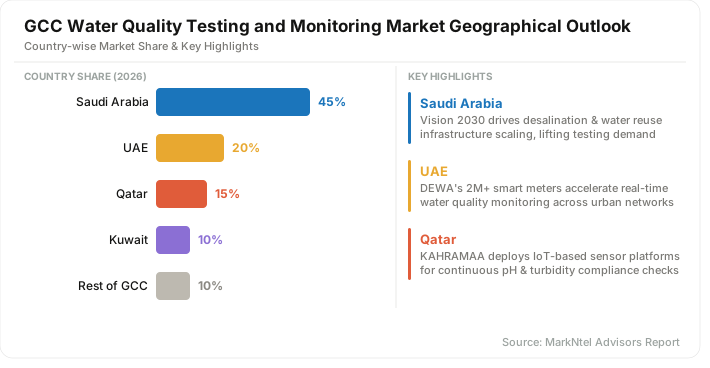
- Saudi Arabia represents approximately 45% of the total market revenue, supported by its position as the world’s largest producer of desalinated water and its substantial USD 80 billion national investment program in water infrastructure.
- By product type, chemical parameters account for nearly 46% of the market share. This dominance is attributed to the increasing adoption of continuous, sensor-integrated monitoring systems by municipal utilities and industrial operators across the GCC, replacing traditional manual sampling methods.
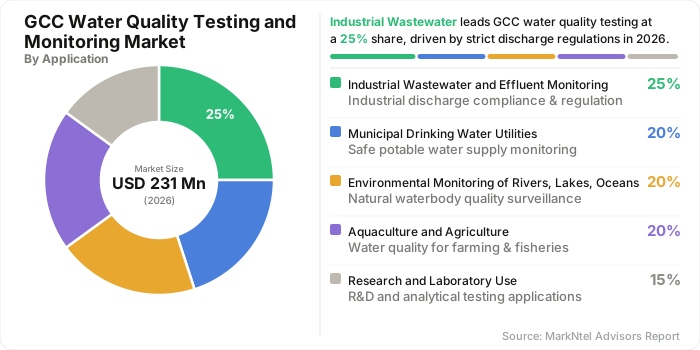
- In terms of application, industrial wastewater and effluent monitoring lead the market with an estimated 25% share. This growth is primarily driven by stringent and enforceable discharge regulations implemented by national authorities in Saudi Arabia, the UAE, and Qatar.
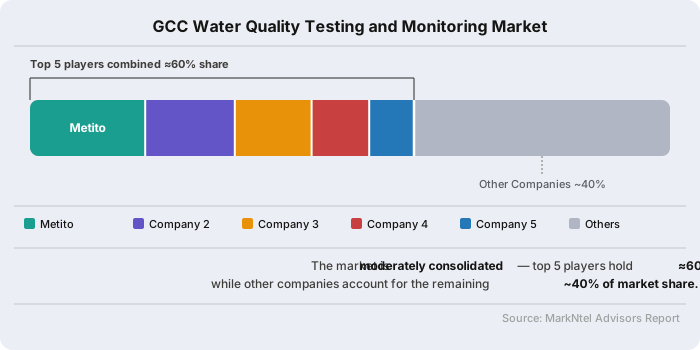
- The GCC water quality testing and monitoring market is moderately consolidated, with approximately 20–25 companies operating across the region. The top five players collectively hold around 60% of the total market share, indicating a competitive yet concentrated industry structure.
GCC Water Quality Testing and Monitoring Market Size and Outlook
The GCC water quality testing and monitoring market was valued at USD 217 million in 2025 and is projected to reach from USD 231 million in 2026 to USD 313 million by 2032, advancing at a CAGR of 5.19% during 2026–2032.
Water quality analytical testing has demonstrated steady expansion, supported by rising urban demand and increasing pressure on potable water systems. According to the World Bank, Gulf countries maintain some of the highest per-capita water consumption levels globally, reinforcing the need for continuous quality assessment. Rapid population growth in metropolitan areas such as Riyadh, Dubai, and Doha has intensified municipal monitoring requirements across distribution networks. This sustained demand from residential and municipal utilities has historically driven procurement of both laboratory and real-time testing systems.
Additionally, the further expansion is strongly shaped by regulatory enforcement and national water security agendas introduced across the region. The Ministry of Environment, Water and Agriculture mandates strict compliance with drinking water and wastewater discharge standards, requiring utilities and industries to adopt continuous monitoring solutions. In parallel, the Dubai Electricity and Water Authority has expanded smart water management systems integrating digital sensors and automated quality tracking. These frameworks have accelerated adoption among commercial buildings, desalination plants, and public utilities seeking compliance and operational efficiency.
Industrial and institutional end users are playing a growing role in shaping market demand through process optimization and environmental accountability. The Qatar Energy has implemented advanced water monitoring protocols across upstream and downstream operations to manage produced water and reduce environmental impact. Similarly, healthcare institutions and large hospitality operators are deploying on-site testing systems to ensure safe water use and regulatory adherence. These developments highlight how industrial wastewater management and institutional hygiene standards are expanding the scope of monitoring beyond traditional municipal applications.
Looking ahead, regional investment programs and sustainability commitments are expected to sustain long-term market growth. The Gulf Cooperation Council countries are increasingly aligning water strategies with circular economy principles, promoting reuse and advanced treatment technologies. National visions such as Saudi Vision 2030 and UAE Net Zero 2050 continue to prioritize water infrastructure modernization and digitalization . As desalination capacity expands and climate-related water stress intensifies, demand for precise, real-time water quality monitoring is projected to strengthen across all major end-user segments.
GCC Water Quality Testing and Monitoring Industry Key Indicators
- According to the Saline Water Conversion Corporation (SWCC), Saudi Arabia operates the world’s largest desalinated water production system, with output exceeding 11.5 million cubic meters per day and accounting for approximately 20–22% of global desalination capacity. The system comprises around 30 major desalination plants supported by an extensive purification and transmission network. These facilities require continuous monitoring of key water quality parameters such as pH, TDS, conductivity, turbidity, and residual disinfectants, with additional laboratory validation for chemical and microbiological safety. This operational complexity drives sustained demand for advanced multi-parameter analyzers, online sensor systems, and laboratory testing instruments across the GCC water monitoring market.
- According to Gulf Cooperation Council (GCC) water resource studies summarized by the Gulf Research Center and related academic publications, per capita water consumption in GCC countries averages approximately 550 liters per day, significantly above the global average. Regional desalination capacity is estimated at around 26.4 billion cubic meters per year, reflecting the GCC’s heavy reliance on non-conventional water sources. This large-scale desalination infrastructure, combined with extensive storage and distribution networks, necessitates continuoGCC Waterquality monitoring through multi-parameter sensors and periodic laboratory validation, thereby sustaining long-term demand for advanced water quality testing and monitoring systems.
- According to Kahramaa planning data, Qatar’s desalinated potable water production capacity reached approximately 538 million imperial gallons per day, following expansions at major desalination facilities. The national water distribution network expanded to nearly 7,900 kilometers by mid-2025, with planned expansion to approximately 8,200 kilometers by 2028. The system is centrally managed through a SCADA-enabled National Water Control Center that monitors water production, storage, transmission, and distribution quality, supporting real-time operational oversight across the national water infrastructure.
- Saudi Arabia’s Ministry of Environment, Water and Agriculture (MEWA) aims to maximize wastewater treatment 100% and reuse under Vision 2030, with official strategies targeting full treatment of collected wastewater and expanding reuse across sectors; however, reuse implementation varies across applications, and national wastewater treatment infrastructure is reported in the range of over 100 plants with ongoing expansion. This increasing reliance on treated wastewater drives stricter effluent quality compliance requirements and sustains demand for continuous monitoring instruments such as BOD analyzers, turbidity meters, and pathogen detection systems
GCC Water Quality Testing and Monitoring Market Scope
| Category | Segments |
|---|---|
| By Product Type | (Portable Water Quality Monitoring Systems, Online or Real-Time Water Quality Monitoring Systems, Benchtop / Laboratory Water Quality Analyzers), |
| By Parameter | (Physical Parameters (Temperature, Turbidity, Conductivity), Chemical Parameters (pH, Dissolved Oxygen, ORP, Nutrients, Chlorine, Heavy Metals), Biological Parameters (Total Coliform, E. coli, Algae, Other Microorganisms)), |
| By Application | (Industrial Wastewater and Effluent Monitoring, Municipal Drinking Water Utilities, Environmental Monitoring of Rivers, Lakes, and Oceans, Aquaculture and Agriculture, Research and Laboratory Use), |
| By End User | (Government Agencies and Environmental Bodies, Water Treatment Plants and Utilities, Industrial Facilities (Food, Beverage, Chemical, Pharmaceutical), Academic and Research Institutes), |
| By Technology / Instrument Type | (Sensors & probes (pH sensors, DO sensors, conductivity sensors), Analytical instruments (Spectrometers, chromatography systems, TOC analyzers), Electrochemical methods, Microbiological testing systems, Rapid / portable testing kits, IoT-based real-time monitoring systems), |
GCC Water Quality Testing and Monitoring Industry Growth Drivers
Escalating Water Scarcity and Desalination-Driven Regulatory Monitoring Expansion
Water scarcity in the GCC has emerged as the primary structural driver of demand for water quality testing and monitoring systems. GCC countries have extremely low natural freshwater availability, with some states at 100–500 m³ per capita annually, and rely heavily on non-renewable groundwater and desalination. Prolonged groundwater depletion, rising temperatures, and rapid urban population growth have further intensified dependence on desalinated and reused water sources. This structural shift has made ongoing water quality verification essential to ensure potable safety and regulatory compliance across supply networks.
In Saudi Arabia, the UAE, Oman, Kuwait, and Qatar, desalination expansion and water network upgrades are increasing monitoring system deployments. The UAE Water Security Strategy 2036 and Saudi Vision 2030 are driving significant investments in water infrastructure modernization and compliance enforcement frameworks. Demand spans municipal utilities, industrial facilities, oil & gas, and food processing sectors requiring continuous compliance monitoring. This has significantly expanded procurement of real-time analysers and online monitoring systems across both coastal and inland supply systems rapidly.
Additionally, Qatar General Electricity and Water Corporation (KAHRAMAA) began implementing Law No. 23 of 2025, mandating stricter regulation of desalinated water, groundwater, and treated wastewater. The law introduces penalties for non-compliance, encourages private sector participation, and promotes innovation in water resource management. KAHRAMAA operates a National Water Control Center with SCADA systems monitoring over 11,000 km of water networks and 42 reservoirs with a combined storage capacity of 2,417 million gallons. The law reshapes Qatar’s regulatory landscape, compelling utilities and industries to adopt advanced monitoring technologies
The driver is structurally expanding market volume as GCC systems shift from periodic laboratory testing toward continuous real-time monitoring architectures. Each new desalination and water reuse facility requires multiple inline sensors, analysers, and automated sampling systems, multiplying equipment intensity per plant and distribution systems. Alignment with WHO drinking water quality guidelines and stricter GCC regulatory standards has increased mandatory testing frequency across distribution networks across GCC states. Consequently, demand is rising in both installed base and recurring monitoring throughput rather than being limited to short-term pricing effects.
Recent Trends
Accelerating Adoption of IoT-Enabled Smart Water Quality Monitoring Systems in the GCC
The most significant trend reshaping the GCC water quality monitoring market is the government-led integration of IoT-enabled smart water management systems, driven by national water security strategies and regulatory mandates introduced in 2025–2026. This structural shift is embedding real-time monitoring, predictive analytics, and automated control into the region’s water infrastructure, ensuring long-term sustainability and resilience.
The GCC’s extreme water scarcity, with per capita consumption exceeding 550 liters daily against renewable surface water of only 4.14 billion cubic meters, has accelerated reliance on digital water management solutions. Since 2025, governments such as the UAE and Saudi Arabia have expanded smart city programs, mandating IoT-based monitoring in desalination and distribution networks. For example, Dubai Electricity and Water Authority (DEWA) deployed over 10,000 smart sensors across 3,000 kilometers of pipelines, while Abu Dhabi’s Environment Agency installed automated coastal buoys measuring seven water quality parameters every 15 minutes. These initiatives reflect a regulatory and infrastructural pivot toward continuous, data-driven oversight of water resources.
This trend is transforming the value chain by embedding IoT and cloud analytics into water utilities, industrial operations, and consumer systems. Utilities now operate predictive maintenance models, reducing leakage and contamination risks, while industries integrate smart purifiers that provide real-time quality data to meet compliance standards. Additionally, research conducted by New York University Abu Dhabi highlights the development of AI-driven systems capable of forecasting water quality variations with high accuracy.
End-users, including households and hospitals, increasingly adopt IoT-enabled purifiers aligned with Vision 2030 and Smart Dubai frameworks, integrating water monitoring into broader smart home ecosystems. The shift from reactive to proactive management is altering operating models, with utilities and private firms offering subscription-based monitoring services rather than one-time infrastructure investments.
Opportunities and Challenges
Regulatory Complexity and Infrastructure Gaps Driving Demand For Decentralized and Innovative Testing Solutions
The tightening of regulatory frameworks and rising water quality risks across the GCC are collectively increasing operational and compliance pressures for utilities. In United Arab Emirates, the 2025 water quality regulations mandate strict monitoring, quarterly testing, and corrective action within 24 hours, significantly increasing compliance costs and operational complexity. Similarly, in Saudi Arabia, the transition from Saline Water Conversion Corporation to Saudi Water Authority has introduced enhanced digital oversight and mandatory reporting requirements under Vision 2030.
These developments are forcing utilities to invest heavily in monitoring infrastructure while managing stricter regulatory accountability. At the same time, underlying environmental challenges are intensifying the need for advanced monitoring solutions across the region. In Oman, a 2025 study identified nitrate concentrations reaching 70 ppm and total dissolved solids exceeding 750 ppm in Muscat groundwater. These contamination levels significantly exceed safe thresholds, highlighting gaps in legacy water infrastructure and monitoring systems.
The upcoming investments across the GCC clearly reinforce how regulatory pressure and water scarcity are translating into tangible market opportunities for advanced monitoring solutions. In United Arab Emirates, large-scale projects such as the Al Nouf 1 desalination-linked IPP and the Ras Al Khaimah wastewater treatment plant are embedding real-time monitoring systems as core infrastructure requirements, while the USD 680 million Dubai Tasreef program integrates smart compliance-driven water tracking across urban networks.
Meanwhile, in Oman, USD 28.8 billion Nama Water roadmap emphasize decentralized and smart monitoring infrastructure. Collectively, these investments demonstrate that every new water asset desalination, reuse, or drainage is now paired with mandatory monitoring systems, creating sustained opportunities for IoT-enabled, portable, and AI-driven water quality testing solutions across the region.
Segmentation Insights
Industrial Wastewater and Effluent Monitoring Driving Segmental Leadership in GCC Water Quality Testing
Industrial wastewater and effluent monitoring dominates the GCC market with a market share of 25% due to stringent regulations targeting high-risk sectors such as oil & gas, petrochemicals, and heavy industries. In Saudi Arabia, National Water Company invested USD 959 million (2024–2025) to expand wastewater treatment and monitoring infrastructure, while Alkhorayef Water & Power Technologies secured a USD 460 million sewage treatment mod ernization contract in Al Ahsa. These investments reflect how regulatory enforcement under Vision 2030 is directly translating into increased deployment of effluent monitoring systems across industrial clusters.
This regulatory push is driving measurable market impact by accelerating demand for advanced analytical technologies such as spectrometers, TOC analyzers, and portable testing kits. Industrial operators are required to implement continuous monitoring systems to comply with discharge standards, creating higher entry barriers for firms lacking specialized capabilities. Since industrial effluents contain complex chemical and biological contaminants, they require multi-parameter, high-frequency testing, reinforcing the need for sophisticated monitoring infrastructure.
The dominance of this segment is further strengthened by long-term infrastructure and PPP models that ensure sustained demand. For instance, In April 2025, Miahona secured a ~USD 267 million contract from MODON to develop an industrial wastewater treatment plant in Jeddah’s 1st Industrial City under a 25-year Rehabilitation, Operation, and Transfer (ROT) model. The long-term concession includes rehabilitation, construction, operation, and maintenance, along with revenue generation through treated water sales. This significantly ensuring stable and recurring demand for industrial wastewater testing solutions across the GCC. By application market is further classified in to following sub-categories: -
- Industrial Wastewater and Effluent Monitoring
- Municipal Drinking Water Utilities
- Environmental Monitoring of Rivers, Lakes, and Oceans
- Aquaculture and Agriculture
- Research and Laboratory Use
Chemical Parameters Sustaining Dominance Through Compliance and Industrial Demand
Chemical parameters remain the leading segment in GCC water quality testing with a market share of 46% due to their direct link to compliance, safety, and industrial operations. Saudi Arabia’s KAUST (2026) introduced AI‑enhanced remote sensing systems to monitor pH, dissolved oxygen, and nutrient loads in Red Sea coastal waters, integrating satellite data with IoT sensors. This innovation enables predictive chemical mapping of effluents and desalination brine, reinforcing Saudi leadership in advanced monitoring.
In the UAE, DEWA (2025) expanded its smart water program by deploying online chlorine and heavy metal analyzers across municipal distribution pipelines. These analyzers, integrated with SCADA systems, provide continuous compliance checks against WHO standards, reducing manual sampling. The initiative highlights how chemical monitoring is embedded into smart infrastructure, ensuring public health safeguards and operational efficiency.
Industry deployments further reinforce this dominance by proving both technical and economic advantages at scale. For instance, in 2025, Saudi Arabia advanced its wastewater infrastructure with the launch of the USD 500 million Jubail II Industrial Wastewater Treatment Plant, developed under a 30‑year concession by Marafiq, Veolia, and Lamar Arabia. Designed to serve the USD 11 billion Amiral petrochemical complex, the facility integrates continuous analyzers for pH, chlorine, and heavy metals, ensuring strict compliance with national discharge standards and reinforcing Saudi Arabia’s leadership in industrial effluent monitoring. Also, Dubai’s utilities strengthened compliance monitoring by deploying advanced chemical analyzers supplied by industry vendors such as Advance Analytik. These systems, capable of continuously measuring chlorine, heavy metals, pH, and dissolved oxygen, were integrated into municipal networks to provide real‑time water quality data. By Parameters the market is further segmented into following categories:
- Physical Parameters
- Temperature
- Turbidity
- Conductivity
- Chemical Parameters
- pH
- Dissolved Oxygen
- ORP, Nutrients
- Chlorine
- Heavy Metals
- Biological Parameters
- Total Coliform
- E. coli
- Algae
- Other Microorganisms
GCC Water Quality Testing and Monitoring Market Geographical Analysis
Saudi Arabia represents the largest and most dominant market in the GCC water quality testing and monitoring sector with a market share of 45% due to its unparalleled water production scale and system complexity. The Kingdom produced approximately 11.5 million cubic meters of desalinated water per day in 2024, positioning it as the world’s leading producer, with plans to reach 13.3 million m³/day capacity. This massive production base largely operated by Saline Water Conversion Corporation creates continuous, high-frequency testing requirements across desalination, purification, and distribution stages. As water systems expand, the number of monitoring points and testing cycles increases proportionally, directly driving demand for both real-time and laboratory-based water quality solutions.
The structural dependence on desalination further intensifies monitoring needs, as desalinated water accounts for nearly 60–65% of municipal supply in Saudi Arabia. In Addition to this, desalinated water requires continuous chemical dosing validation, salinity control, and microbiological testing to ensure safety and regulatory compliance. The country’s extreme water scarcity characterized by minimal rainfall and negligible surface water makes water quality assurance a critical operational requirement rather than a periodic activity. This dependency establishes a constant demand environment where monitoring systems are integrated into core infrastructure, significantly increasing adoption intensity compared to other GCC markets with more diversified water sources.
Regulatory frameworks and national strategies further reinforce market expansion by mandating stricter quality monitoring across water systems. Initiatives under National Water Strategy 2030 emphasize wastewater reuse, desalination efficiency, and sustainable water management, supported by large-scale public investment.
End-user concentration and network scale further amplify demand, as Saudi Arabia operates one of the world’s largest water transmission systems, exceeding 7,500 kilometres of pipelines distributing desalinated water nationwide. Industrial clusters and urban centers depend heavily on this network, requiring multiple monitoring nodes across transport, storage, and distribution stages. Additionally, rising water demand estimated at nearly 20 billion cubic meters annually and growing at 5–7% continues to expand system load and testing frequency. This combination of high-volume production, extensive infrastructure, strict regulation , and concentrated end-user demand firmly establishes Saudi Arabia as the leading regional market in size, intensity, and technological adoption.
GCC Water Quality Testing and Monitoring Industry Competitive Landscape
The GCC water quality testing and monitoring market is moderately consolidated, with around 20–25 companies active across the region. The top five players Metito, ACWA Power, Almar Water Solutions, National Water Company (Saudi Arabia), and DEWA collectively account for an estimated 60% of the regional market share.
Major Companies in GCC Water Quality Testing and Monitoring Industry
- Metito
- ACWA Power
- Almar Water Solutions
- Wetico
- Miahona
- Alkhorayef Water & Power Technologies
- Desert Group
- Enviro Group
- Future Pipe Industries
- National Water Company (Saudi Arabia)
- DEWA
- Kahramaa
- Others
GCC Water Quality Testing and Monitoring Industry News and Recent Developments
2025: Metito Deploys EventLab Real‑Time Water Monitoring in GCC Utilities
Metito, in collaboration with Optiqua Technologies, introduced EventLab and MiniLab platforms across GCC utilities. EventLab uses patented optical sensor technology to provide real‑time detection of chemical contaminants across distribution networks and treatment plants. MiniLab enables rapid laboratory and field analysis with a 15‑minute turnaround time, supporting monitoring of algae toxins and industrial pollutants. The rollout covers multiple GCC states, with deployment in municipal networks and industrial facilities. The collaboration builds on Metito’s portfolio of 58+ years of water management expertise and expands its footprint in intelligent monitoring solutions.
Impact Analysis: The deployment enhances competitive positioning by offering utilities real‑time contamination detection, reducing response times and operational risks. By integrating EventLab into GCC networks, Metito accelerates technology adoption, raising demand for advanced analyzers and strengthening resilience against water security incidents. This innovation increases entry barriers for competitors reliant on conventional sensor systems.
2025: Nama Water Services Launches PPP Expansion of Wastewater Capacity in Oman
Nama Water Services (NWS) initiated landmark public–private partnership tenders for the Al Ansab STP Phase III and Al Amerat STP Phase II projects. The Al Ansab facility will expand by 82,000 m³/day, raising total capacity from 125,000 to 207,000 m³/day, while Al Amerat will triple capacity from 18,000 to 54,000 m³/day. The projects adopt a Build‑Own‑Operate‑Transfer (BOOT) model, with concession terms extending over multiple decades. The tender process is structured to attract international consortia, ensuring modern standards in design, financing, and operations.
Impact Analysis: This PPP expansion significantly increases Oman’s wastewater treatment supply capacity, reinforcing environmental resilience and enabling effluent reuse in agriculture and industry. By embedding BOOT contracts, Oman lowers entry barriers for global investors while raising competitive pressure on regional utilities. The projects accelerate demand for advanced monitoring technologies, as expanded facilities require continuous compliance testing and quality assurance systems.
Frequently Asked Questions
- Market Segmentation
- Introduction
- Product Definition
- Research Process
- Assumptions
- Executive Summary
- GCC Water Quality Testing and Monitoring Market Policies, Regulations, and Product Standards
- GCC Water Quality Testing and Monitoring Market Trends & Developments
- GCC Water Quality Testing and Monitoring Market Dynamics
- Growth Factors
- Challenges
- GCC Water Quality Testing and Monitoring Market Hotspot & Opportunities
- GCC Water Quality Testing and Monitoring Market Outlook, 2022-2032F
- Market Size & Outlook
- By Revenues (USD Million)
- Market Share & Analysis
- By Product Type- Market Size & Forecast 2022-2032, USD Million
- Portable Water Quality Monitoring Systems
- Online or Real-Time Water Quality Monitoring Systems
- Benchtop / Laboratory Water Quality Analyzers
- By Parameter- Market Size & Forecast 2022-2032, USD Million
- Physical Parameters
- Temperature
- Turbidity
- Conductivity
- Chemical Parameters
- pH
- Dissolved Oxygen
- ORP, Nutrients
- Chlorine
- Heavy Metals
- Biological Parameters
- Total Coliform
- E. coli
- Algae
- Other Microorganisms
- Physical Parameters
- By Application- Market Size & Forecast 2022-2032, USD Million
- Industrial Wastewater and Effluent Monitoring
- Municipal Drinking Water Utilities
- Environmental Monitoring of Rivers, Lakes, and Oceans
- Aquaculture and Agriculture
- Research and Laboratory Use
- By End User- Market Size & Forecast 2022-2032, USD Million
- Government Agencies and Environmental Bodies
- Water Treatment Plants and Utilities
- Industrial Facilities (Food, Beverage, Chemical, Pharmaceutical)
- Academic and Research Institutes
- By Technology / Instrument Type- Market Size & Forecast 2022-2032, USD Million
- Sensors & probes
- pH sensors
- DO sensors
- conductivity sensors
- Analytical instruments
- Spectrometers
- chromatography systems
- TOC analyzers
- Electrochemical methods
- Microbiological testing systems
- Rapid / portable testing kits
- IoT-based real-time monitoring systems
- Sensors & probes
- By Region
- By Company
- Competition Characteristics
- Market Share & Analysis
- By Product Type- Market Size & Forecast 2022-2032, USD Million
- Market Size & Outlook
- Saudi Arabia Water Quality Testing and Monitoring Market Outlook, 2022-2032F
- Market Size & Outlook
- By Revenues (USD Million)
- Market Share & Analysis
- By Product Type- Market Size & Forecast 2022-2032, USD Million
- By Parameter- Market Size & Forecast 2022-2032, USD Million
- By Application- Market Size & Forecast 2022-2032, USD Million
- By End User- Market Size & Forecast 2022-2032, USD Million
- By Technology / Instrument Type- Market Size & Forecast 2022-2032, USD Million
- By Region
- Market Size & Outlook
- Qatar Water Quality Testing and Monitoring Market Outlook, 2022-2032F
- Market Size & Outlook
- By Revenues (USD Million)
- Market Share & Analysis
- By Product Type- Market Size & Forecast 2022-2032, USD Million
- By Parameter- Market Size & Forecast 2022-2032, USD Million
- By Application- Market Size & Forecast 2022-2032, USD Million
- By End User- Market Size & Forecast 2022-2032, USD Million
- By Technology / Instrument Type- Market Size & Forecast 2022-2032, USD Million
- By Region
- Market Size & Outlook
- The UAE Water Quality Testing and Monitoring Market Outlook, 2022-2032F
- Market Size & Outlook
- By Revenues (USD Million)
- Market Share & Analysis
- By Product Type- Market Size & Forecast 2022-2032, USD Million
- By Parameter- Market Size & Forecast 2022-2032, USD Million
- By Application- Market Size & Forecast 2022-2032, USD Million
- By End User- Market Size & Forecast 2022-2032, USD Million
- By Technology / Instrument Type- Market Size & Forecast 2022-2032, USD Million
- By Region
- Market Size & Outlook
- Kuwait Water Quality Testing and Monitoring Market Outlook, 2022-2032F
- Market Size & Outlook
- By Revenues (USD Million)
- Market Share & Analysis
- By Product Type- Market Size & Forecast 2022-2032, USD Million
- By Parameter- Market Size & Forecast 2022-2032, USD Million
- By Application- Market Size & Forecast 2022-2032, USD Million
- By End User- Market Size & Forecast 2022-2032, USD Million
- By Technology / Instrument Type- Market Size & Forecast 2022-2032, USD Million
- By Region
- Market Size & Outlook
- Bahrain Water Quality Testing and Monitoring Market Outlook, 2022-2032F
- Market Size & Outlook
- By Revenues (USD Million)
- Market Share & Analysis
- By Product Type- Market Size & Forecast 2022-2032, USD Million
- By Parameter- Market Size & Forecast 2022-2032, USD Million
- By Application- Market Size & Forecast 2022-2032, USD Million
- By End User- Market Size & Forecast 2022-2032, USD Million
- By Technology / Instrument Type- Market Size & Forecast 2022-2032, USD Million
- By Region
- Market Size & Outlook
- Oman Water Quality Testing and Monitoring Market Outlook, 2022-2032F
- Market Size & Outlook
- By Revenues (USD Million)
- Market Share & Analysis
- By Product Type- Market Size & Forecast 2022-2032, USD Million
- By Parameter- Market Size & Forecast 2022-2032, USD Million
- By Application- Market Size & Forecast 2022-2032, USD Million
- By End User- Market Size & Forecast 2022-2032, USD Million
- By Technology / Instrument Type- Market Size & Forecast 2022-2032, USD Million
- By Company
- Market Size & Outlook
- GCC Water Quality Testing and Monitoring Market Key Strategic Imperatives for Success & Growth
- Competitive Outlook
- Company Profiles
- Metito
- Business Description
- Product Portfolio
- Collaborations & Alliances
- Recent Developments
- Financial Details
- Others
- ACWA Power
- Business Description
- Product Portfolio
- Collaborations & Alliances
- Recent Developments
- Financial Details
- Others
- Almar Water Solutions
- Business Description
- Product Portfolio
- Collaborations & Alliances
- Recent Developments
- Financial Details
- Others
- Wetico
- Business Description
- Product Portfolio
- Collaborations & Alliances
- Recent Developments
- Financial Details
- Others
- Miahona
- Business Description
- Product Portfolio
- Collaborations & Alliances
- Recent Developments
- Financial Details
- Others
- Alkhorayef Water & Power Technologies
- Business Description
- Product Portfolio
- Collaborations & Alliances
- Recent Developments
- Financial Details
- Others
- Desert Group
- Business Description
- Product Portfolio
- Collaborations & Alliances
- Recent Developments
- Financial Details
- Others
- Enviro Group
- Business Description
- Product Portfolio
- Collaborations & Alliances
- Recent Developments
- Financial Details
- Others
- Future Pipe Industries
- Business Description
- Product Portfolio
- Collaborations & Alliances
- Recent Developments
- Financial Details
- Others
- National Water Company (Saudi Arabia)
- Business Description
- Product Portfolio
- Collaborations & Alliances
- Recent Developments
- Financial Details
- Others
- DEWA
- Business Description
- Product Portfolio
- Collaborations & Alliances
- Recent Developments
- Financial Details
- Others
- Kahramaa
- Business Description
- Product Portfolio
- Collaborations & Alliances
- Recent Developments
- Financial Details
- Others
- Metito
- Company Profiles
- Disclaimer
MarkNtel Advisors follows a robust and iterative research methodology designed to ensure maximum accuracy and minimize deviation in market estimates and forecasts. Our approach combines both bottom-up and top-down techniques to effectively segment and quantify various aspects of the market. A consistent feature across all our research reports is data triangulation, which examines the market from three distinct perspectives to validate findings. Key components of our research process include:
1. Scope & Research Design At the outset, MarkNtel Advisors define the research objectives and formulate pertinent questions. This phase involves determining the type of research—qualitative or quantitative—and designing a methodology that outlines data collection methods, target demographics, and analytical tools. They also establish timelines and budgets to ensure the research aligns with client goals.
2. Sample Selection and Data Collection In this stage, the firm identifies the target audience and determines the appropriate sample size to ensure representativeness. They employ various sampling methods, such as random or stratified sampling, based on the research objectives. Data collection is carried out using tools like surveys, interviews, and observations, ensuring the gathered data is reliable and relevant.
3. Data Analysis and Validation Once data is collected, MarkNtel Advisors undertake a rigorous analysis process. This includes cleaning the data to remove inconsistencies, employing statistical software for quantitative analysis, and thematic analysis for qualitative data. Validation steps are taken to ensure the accuracy and reliability of the findings, minimizing biases and errors.

4. Data Forecast and FinalizationThe final phase involves forecasting future market trends based on the analyzed data. MarkNtel Advisors utilize predictive modeling and time series analysis to anticipate market behaviors. The insights are then compiled into comprehensive reports, featuring visual aids like charts and graphs, and include strategic recommendations to inform client decision-making
We offer flexible licensing options to cater to varying organizational needs. Choose the pricing pack that best suits your requirements:
Buy Now Inquire Before Buying
 Request Customization
 Talk to our Consultant







