

India Water Purifier Market Research Report: Forecast (2026-2032)
By Technology (Reverse Osmosis (RO), Ultraviolet (UV), Gravity-Based, Others (Water Softener, Sediment Filter)), By End User (Residential, Commercial), By Portability (Non Portable ... , Portable), By Capacity (5 ltr- 8 ltr, Above 8 ltr), By Sales Channel (Direct Sales, Online, Retail), and others Read more
- Environment
- Jun 2026
- Pages 89
- Report Format: PDF, Excel, PPT
India Water Purifier Market
Projected 13.54% CAGR from 2026 to 2032
Study Period
2026-2032
Market Size (2026)
USD 0.99 Billion
Market Size (2032)
USD 1.68 Billion
Base Year
2025
Projected CAGR
13.54%
Leading Segments
By End User: Residential
India Water Purifier Market Key Takeaways
- The India Water Purifier Market size was valued at USD 0.89 billion in 2025 and is estimated to reach USD 0.99 billion in 2026.
- Further, the market is projected to grow USD 1.68 billion by 2032, registering a CAGR of 13.54% during the forecast period (2026–2032).
- North India dominate the market due to higher disposable incomes, rapid urbanization, increasing health awareness, and growing demand for safe and purified drinking water solutions.
- By product type, RO (Reverse Osmosis) water purifiers account for 40% dominant share of the India market in 2026.
- Based on end user, the residential segment emerged as the leading contributor, accounting for an estimated 73% of the overall market demand in 2026, driven by growing middle-class adoption and health awareness.
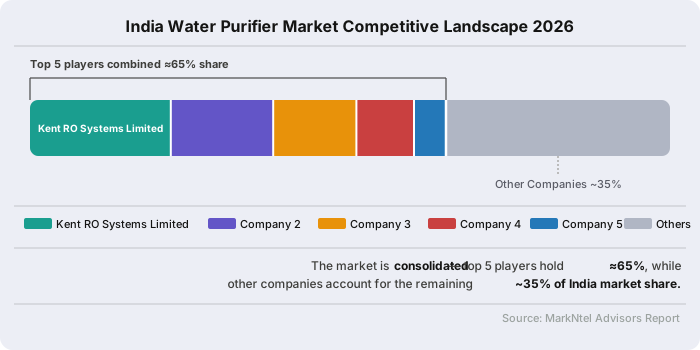
- The India water purifier market is moderately fragmented, with leading companies such as Kent RO Systems, Eureka Forbes (Aquaguard), Livpure, AO Smith, and Havells collectively holding 65% share, alongside numerous regional and unorganized players.
India Water Purifier Market Size and Outlook
The Water Purifier Industry in India was valued at USD 0.89 billion in 2025, is estimated at USD 0.99 billion in 2026, and is projected to reach USD 1.68 billion by 2032, growing at a CAGR of 13.54% during the forecast period (2026–2032), driven by rising concerns over drinking water quality, rapid urbanization, and increasing health awareness among consumers.
Market growth is strongly supported by structural water infrastructure challenges across India. According to the Government of India, initiatives under the Jal Jeevan Mission which has expanded household tap water access; however, water quality challenges persist in several regions. This gap between access and safe drinking water continues to drive demand for household water purifiers across urban and rural areas.
Urbanization remains a key demand driver, with major cities such as Delhi NCR, Mumbai, Bengaluru, and Chennai contributing significantly due to higher incomes, dense populations, and greater awareness of waterborne diseases. The market is further strengthened by rising health and hygiene awareness after COVID-19, with consumers increasingly adopting water purifiers as essential household appliances rather than discretionary products.
Government-led programs such as AMRUT (Atal Mission for Rejuvenation and Urban Transformation) continue to improve water supply infrastructure, but uneven water quality distribution and dependence on groundwater in several regions sustain demand for purification systems. While government agencies such as the Bureau of Indian Standards (BIS) continue to enforce strict water quality benchmarks (IS 10500 drinking water standards), manufacturers are increasingly aligning product innovation with these safety parameters, pushing higher adoption of advanced purification systems.
In conclusion, the India water purifier Industry is on a strong structural growth path, driven by persistent water quality concerns, urban expansion, rising health awareness, and improving but uneven public water infrastructure, supporting sustained demand through 2032.
India Water Purifier Market Key Indicators
- Increasing contamination from industrial waste, sewage discharge, and groundwater impurities is raising concerns about drinking water safety across India. In 2025–26, the Government of India tested nearly 63.96 lakh drinking water samples, of which more than 1.61 lakh samples were found contaminated. Several cities also reported outbreaks of diarrhoea, cholera, typhoid, jaundice, and other waterborne diseases linked to unsafe drinking water.
- Between 2025 and early 2026, over 5,500 people fell sick, and 34 deaths were reported across multiple Indian cities due to contaminated tap water supplies. Rising health risks and poor water quality are therefore increasing consumer demand for RO purifiers, UV filtration systems, and multi-stage household water purification technologies across urban and rural India.
- During the 2025 Maha Kumbh in Prayagraj, the Central Pollution Control Board (CPCB) reported faecal coliform levels of 49,000 MPN/100 ml in the Ganga at Sangam and 33,000 MPN/100 ml in the Yamuna, significantly exceeding the permissible limit of 2,500 MPN/100 ml. The contamination concerns heightened awareness regarding waterborne diseases and encouraged households in Prayagraj and nearby areas to adopt RO and UV water purification systems for safer drinking water.
- According to the Central Groundwater Board (CGWB), nearly 17% of India's assessed groundwater units are categorized as over-exploited, critical, or semi-critical, leading to increased dependence on deeper groundwater sources that often contain higher levels of dissolved solids, fluoride, arsenic, iron, and other contaminants. As groundwater quality deteriorates and water scarcity concerns rise, households are increasingly investing in RO and advanced purification systems to ensure safe drinking water.
India Water Purifier Market Scope
| Category | Segments |
|---|---|
| By Technology | Reverse Osmosis (RO), Ultraviolet (UV), Gravity-Based, Others (Water Softener, Sediment Filter |
| By End User | Residential, Commercial |
| By Portability | Non Portable, Portable |
| By Capacity | 5 ltr- 8 ltr, Above 8 ltr |
| By Sales Channel | Direct Sales, Online, Retail |
India Water Purifier Market Growth Driver
Rising Health and Hygiene Awareness
Rising health and hygiene awareness continues to be a key structural driver of the India water purifier market, as consumers increasingly prioritize access to safe and contamination-free drinking water. This shift is strongly supported by increasing incidences of waterborne diseases such as diarrhoea, cholera, and typhoid, which continue to be a public health concern in several regions, as highlighted in the Government of India health frameworks under the Ministry of Health and Family Welfare
According to WHO, India (2024–2025), India still records ~0.5 million deaths annually from diarrhoeal diseases. According to Government of India public health frameworks and WASH guidance, waterborne diseases such as typhoid, hepatitis A, and dysentery remain major health risks linked to unsafe drinking water in India (2024–2025), reinforcing the need for household-level water purification systems.
Under the Jal Jeevan Mission 2024 report, while rural tap water coverage has reached ~80.2% of households, water safety remains a key focus area, with continued monitoring of chemical contamination (arsenic, fluoride) and water quality compliance under BIS standards. The WASH (water, sanitation, and hygiene) scheme by UNICEF, is currently running in India to improve individuals' health and living standards.
In 2025, government-backed “Stop Diarrhoea Campaign 2025” under Jal Jeevan Mission further highlights continued public health concern around diarrhoeal diseases and water safety awareness campaigns across rural India. As a result, water purifiers are increasingly perceived not as luxury appliances but as essential household health infrastructure, particularly in urban and semi-urban regions.
In conclusion, rising health and hygiene awareness in India is structurally transforming consumer behaviour toward water purification, supported by government hygiene initiatives, increasing disease awareness, urban lifestyle changes, and post-pandemic health prioritization.
Recent Trends
The shift to Smart Technology Adoption Owing to Multi Tech Purification Systems
In the India water purifier industry, one of the most prominent recent trends is the rapid shift toward smart, connected, and multi step purification systems, driven by rising health awareness, urban water quality concerns, and increasing consumer preference for convenience-based appliances.
A major emerging trend is the adoption of smart RO water purifiers with digital monitoring features, including filter-life indicators, TDS control, and IoT-based usage tracking. For Instance, In July 2025, Aquaguard (Eureka Forbes) launched the Ritz Pro 2X smart IoT purifier and Aura RO 2X Life, featuring Nanopore filters that require no service for up to two years. They also introduced the Aspire Blaze 2X, offering instant hot water on demand.
Another key trend is the expansion of multi-technology purification systems (RO+UV+UF+Mineralizer), driven by variability in groundwater quality across India. For Instance, in 2025 Kent RO Systems introduced the Sapphire model featuring advanced RO+UF+UV multi step purification along with alkaline enhancement technology, delivering up to ~9.5 pH balanced water for improved taste and mineral support.
In parallel, India is witnessing a strong shift toward service-based models and subscription-led maintenance ecosystems. The market is also seeing premiumization of household appliances, where consumers are upgrading from basic filtration systems to branded RO systems with smart alerts, energy efficiency, and space-saving designs.
In conclusion, recent trends in the India water purifier market are strongly shaped by government-led water quality monitoring initiatives, rising urban infrastructure pressure, and consumer shift toward smart, technology-enabled purification systems, driving sustained innovation and premiumization across the industry.
India Water Purifier Market Opportunities and Challenges
Price Sensitivity Fueling Low-Cost Innovation
The India water purifier market faces a key challenge of high price sensitivity, particularly in Tier 2 and Tier 3 cities and among lower-middle-income households. While the metro cities such as Delhi NCR, Mumbai, Bengaluru, and Chennai show strong adoption of branded RO systems, a large portion of price-sensitive consumers continue to rely on basic filtration methods or low-cost, unbranded products, limiting penetration of advanced purification systems.
Additionally, the relatively higher cost of advanced RO+UV+UF+alkaline systems, annual maintenance contracts (AMC), and filter replacement cycles increases the total cost of ownership, which can slow replacement demand in price-sensitive segments. This is especially relevant in rural and semi-urban regions where affordability remains a key purchase determinant despite rising awareness of water quality issues.
However, this challenge is also creating strong market opportunities through low-cost product innovation and flexible ownership models. Leading companies are increasingly offering entry-level RO systems, EMI-based purchasing, rental models, and subscription-based maintenance services, making water purifiers more accessible across income groups. For instance, Livpure offers compact RO systems priced significantly lower than premium models, targeting Tier 2 and Tier 3 cities.
In addition, companies are optimizing costs through localized manufacturing, modular purifier designs, and energy-efficient systems, which help reduce upfront prices and servicing costs. As a result, affordability-driven innovation is gradually expanding the addressable market, transforming price sensitivity from a constraint into a key growth catalyst for long-term market expansion.
Segmentation Insights
RO systems remain the prominent technology segment owing to its Comprehensive Purification
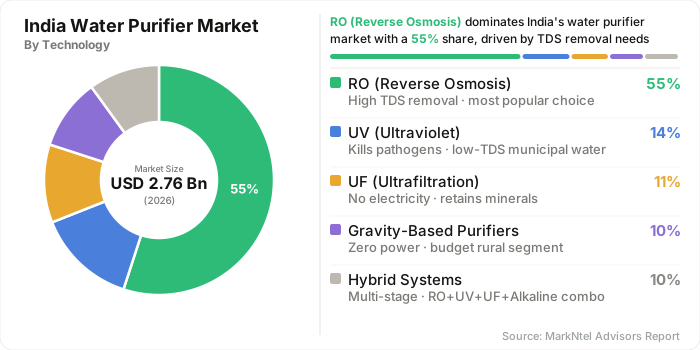
RO-based water purifiers account for 40%, the largest share of the India market, driven by widespread concerns over dissolved solids, heavy metals, and groundwater contamination in urban and semi-urban regions. Their dominance is reinforced by inconsistent water quality across municipal and borewell sources.
According to National Sample Survey Office (NSO), Ministry of Statistics & Programme Implementation (MoSPI), around 20–26% of urban households use electric water purifiers, including RO systems. UV and UF systems are also gaining traction in regions with relatively lower TDS levels, while hybrid systems (RO+UV+UF+alkaline) are increasingly preferred in metro cities due to demand for multi-layered protection and improved taste.
RO is preferred because it provides the most comprehensive purification solution for India’s highly variable and often contaminated water sources, making it the default choice for households. Advanced purification technologies such as mineral retention and alkaline enhancement systems are witnessing rising adoption, especially among health-conscious urban consumers seeking improved water quality and taste balance.
As a result, RO technology continues to serve as the core backbone of the India water purifier industry, while UV, UF, and hybrid systems complement demand across diverse water quality conditions. Based on technology, the market has been segmented into
- RO (Reverse Osmosis)
- UV (Ultraviolet)
- UF (Ultrafiltration)
- Gravity-based purifiers
- Hybrid systems (RO+UV+UF+Alkaline)
Residential is the Prevailing End-User Segment Owing to Rising Health Awareness
The residential sector accounts for the largest share of the India water purifier industry, i.e., 73%, driven by rising health awareness, urbanization, and increasing concerns over drinking water quality in households. According to the Government of India, urbanization and housing consumption patterns, nearly 35% of India’s population lives in urban areas, where water quality variability and dependence on mixed water sources significantly increase household adoption of purification systems.
The commercial segment, including offices, restaurants, and retail establishments, accounts for a nominal share of the market, supported by growing emphasis on employee health, workplace hygiene, and food safety compliance. Increasing urban commercial infrastructure and post-pandemic hygiene standards have further strengthened demand for point-of-use purification systems in business environments.
Government and public infrastructure adoption is gradually increasing under national programs such as the Jal Jeevan Mission, which has achieved 80% with rural household tap water coverage as of 2025, improving access to safe drinking water. However, household-level purification continues to dominate overall market demand. Based on end users, the market has been segmented into
- Residential
- Commercial (Offices, Retail, Restaurants)
- Healthcare Institutions
- Educational Institutions
- Government & Public Infrastructure
- Others
India Water Purifier Market Competitive Analysis
The India water purifier market is moderately consolidated, with strong presence of organized national players alongside a large unorganized and regional manufacturer base. Leading companies such as Kent RO Systems, Eureka Forbes (Aquaguard), AO Smith, Livpure, and Havells India collectively account for 65% of a significant share of the branded segment.
Key Companies in the Indian Water Purifier Market
- Eureka Forbes
- Kent RO Systems Limited
- Hindustan Unilever Limited
- Tata Chemicals Limited
- Ion Exchange
- Blue Star
- Nasaka
- Livpure
- LG
- A.O. Smith Corporation
India Water Purifier Market News and Recent Developments
Jan 2026: V-Guard Launches Upgraded Rejive RO Water Purifier Series
V-Guard Industries Ltd. launched its upgraded Rejive RO water purifier series in India, featuring advanced purification technologies such as high water recovery, alkaline enhancement, and energy-efficient filtration systems. The new models is introduced with improved storage capacity, long filter life, and BIS-compliant purification standards to address growing consumer demand for sustainable and low-maintenance water purification solutions.
Impact Analysis: The launch strengthens the market shift toward smart and sustainable purification systems in India by promoting water-saving RO technology and premium health-focused features. It also intensifies competition in the organized water purifier market, encouraging manufacturers to focus on energy efficiency, smart monitoring, and long-life filtration technologies.
July 2025: Launch of Longlife Nanopore Filtration Technology in Water Purifiers
Eureka Forbes introduced Aquaguard purifiers featuring Longlife Nanopore Filter technology, designed to extend filter durability and reduce maintenance frequency, offering up to two years of operational life without replacement.
Impact Analysis: This development significantly lowers long-term ownership and maintenance costs, making premium purification systems more affordable over time. It strengthens competitive positioning for Aquaguard in the mid-to-premium RO segment, increases customer retention through reduced servicing needs, and pushes the market toward high-durability, low-maintenance water purification solutions.
Frequently Asked Questions
- Market Segmentation
- Introduction
- Product Definition
- Research Process
- Assumptions
- Executive Summary
- India Water Purifier Market Policies, Regulations, and Product Standards
- India Water Purifier Market Trends & Developments
- India Water Purifier Market Dynamics
- Growth Factors
- Challenges
- India Water Purifier Market Hotspot & Opportunities
- India Water Purifier Market Outlook, 2022-2032
- Market Size & Outlook
- By Revenue (USD Million)
- By Quantity Sold (Thousand Units)
- Market Share & Outlook
- By Category- Market Size & Forecast 2026-2032, (USD Million & Thousand Units)
- Products
- Services
- By Technology- Market Size & Forecast 2026-2032, (USD Million & Thousand Units)
- Reverse Osmosis (RO)
- Ultraviolet (UV)
- Gravity-Based
- Others (Water Softener, Sediment Filter)
- By End User- Market Size & Forecast 2026-2032, (USD Million & Thousand Units)
- Residential
- Commercial
- By Portability- Market Size & Forecast 2026-2032, (USD Million & Thousand Units)
- Non Portable
- Portable
- By Capacity- Market Size & Forecast 2026-2032, (USD Million & Thousand Units)
- 5 ltr- 8 ltr
- Above 8 ltr
- By Sales Channel- Market Size & Forecast 2026-2032, (USD Million & Thousand Units)
- Direct Sales
- Online
- Retail
- By Region
- North
- South
- East
- West
- By Company
- Competition Characteristic
- Market Share & Analysis
- By Category- Market Size & Forecast 2026-2032, (USD Million & Thousand Units)
- Market Size & Outlook
- India Ultraviolet (UV) Technology Water Purifier Market Outlook, 2022-2032
- Market Size & Outlook
- By Revenue (USD Million)
- By Quantity Sold (Thousand Units)
- Market Share & Outlook
- By End User- Market Size & Forecast 2026-2032, (USD Million & Thousand Units)
- By Portability- Market Size & Forecast 2026-2032, (USD Million & Thousand Units)
- By Capacity- Market Size & Forecast 2026-2032, (USD Million & Thousand Units)
- By Sales Channel- Market Size & Forecast 2026-2032, (USD Million & Thousand Units)
- By Region
- Market Size & Outlook
- India Reverse Osmosis (RO) Technology Water Purifier Market Outlook, 2022-2032
- Market Size & Outlook
- By Revenue (USD Million)
- By Quantity Sold (Thousand Units)
- Market Share & Outlook
- By End User- Market Size & Forecast 2026-2032, (USD Million & Thousand Units)
- By Portability- Market Size & Forecast 2026-2032, (USD Million & Thousand Units)
- By Capacity- Market Size & Forecast 2026-2032, (USD Million & Thousand Units)
- By Sales Channel- Market Size & Forecast 2026-2032, (USD Million & Thousand Units)
- By Region
- Market Size & Outlook
- India Gravity-Based Water Purifier Market Outlook, 2022-2032
- Market Size & Outlook
- By Revenue (USD Million)
- By Quantity Sold (Thousand Units)
- Market Share & Outlook
- By End Use- Market Size & Forecast 2026-2032, (USD Million & Thousand Units)
- By Portability- Market Size & Forecast 2026-2032, (USD Million & Thousand Units)
- By Capacity- Market Size & Forecast 2026-2032, (USD Million & Thousand Units)
- By Sales Channel- Market Size & Forecast 2026-2032, (USD Million & Thousand Units)
- By Region
- Market Size & Outlook
- India Water Purifier Market Key Strategic Imperatives for Success and Growth
- Competitive Outlook
- Company Profile
- Eureka Forbes
- 13.1.1.1 Product Portfolio
- 13.1.1.2 Target Markets
- 13.1.1.3 Target End Users
- Research & Development
- Strategic Alliances
- Others
- Kent RO Systems Limited
- Product Portfolio
- Target Markets
- Target End Users
- Research & Development
- Strategic Alliances
- Others
- Hindustan Unilever Limited
- Product Portfolio
- Target Markets
- Target End Users
- Research & Development
- Strategic Alliances
- Others
- Tata Chemicals Limited
- Product Portfolio
- Target Markets
- Target End Users
- Research & Development
- Strategic Alliances
- Others
- Ion Exchange
- Product Portfolio
- Target Markets
- Target End Users
- Research & Development
- Strategic Alliances
- Others
- Blue Star
- Product Portfolio
- Target Markets
- Target End Users
- Research & Development
- Strategic Alliances
- 6Other
- Nasaka
- Product Portfolio
- Target Markets
- Target End Users
- Research & Development
- Strategic Alliances
- Others
- Livpure
- Product Portfolio
- Target Markets
- Target End Users
- Research & Development
- Strategic Alliances
- Others
- LG
- Product Portfolio
- Target Markets
- Target End Users
- Research & Development
- Strategic Alliances
- Others
- A.O. Smith Corporation
- Product Portfolio
- 13.1.10.2Target Markets
- 13.1.10.3Target End Users
- 13.1.10.4Research & Development
- Strategic Alliances
- Others
- Company Profile
- Disclaimer
MarkNtel Advisors follows a robust and iterative research methodology designed to ensure maximum accuracy and minimize deviation in market estimates and forecasts. Our approach combines both bottom-up and top-down techniques to effectively segment and quantify various aspects of the market. A consistent feature across all our research reports is data triangulation, which examines the market from three distinct perspectives to validate findings. Key components of our research process include:
1. Scope & Research Design At the outset, MarkNtel Advisors define the research objectives and formulate pertinent questions. This phase involves determining the type of research—qualitative or quantitative—and designing a methodology that outlines data collection methods, target demographics, and analytical tools. They also establish timelines and budgets to ensure the research aligns with client goals.
2. Sample Selection and Data Collection In this stage, the firm identifies the target audience and determines the appropriate sample size to ensure representativeness. They employ various sampling methods, such as random or stratified sampling, based on the research objectives. Data collection is carried out using tools like surveys, interviews, and observations, ensuring the gathered data is reliable and relevant.
3. Data Analysis and Validation Once data is collected, MarkNtel Advisors undertake a rigorous analysis process. This includes cleaning the data to remove inconsistencies, employing statistical software for quantitative analysis, and thematic analysis for qualitative data. Validation steps are taken to ensure the accuracy and reliability of the findings, minimizing biases and errors.

4. Data Forecast and FinalizationThe final phase involves forecasting future market trends based on the analyzed data. MarkNtel Advisors utilize predictive modeling and time series analysis to anticipate market behaviors. The insights are then compiled into comprehensive reports, featuring visual aids like charts and graphs, and include strategic recommendations to inform client decision-making
We offer flexible licensing options to cater to varying organizational needs. Choose the pricing pack that best suits your requirements:
Buy Now Inquire Before Buying
 Request Customization
 Talk to our Consultant







