

By Technology (Alkaline Electrolysis, Proton Exchange Membrane (PEM) Electrolysis, Solid Oxide Electrolysis (SOEC), Anion Exchange Membrane (AEM) Electrolysis), By Energy Source (Solar, Wind, Hybrid,... ... olar, Wind, Hybrid, Other Renewable Sources), By End-use Industry (Refining & Petrochemicals, Fertilizers & Ammonia, Steel & Heavy Industry, Mobility & Transportation, Power & Utilities, Chemicals & Other Industrial Users), and others Read more
- Energy
- Aug 2026
- 135
- PDF, Excel, PPT
Brazil Green Hydrogen Market Key Takeaways
- The brazil green hydrogen market was valued at USD 145 million in 2025 and is projected to reach USD 184 million in 2026 and USD 1,615 million by 2032, registering a CAGR of 43.3% during 2026–2032.
- Alkaline electrolysis dominates the technology segment, accounting for 58% of market share in 2026.
- Fertilizers & ammonia remains the leading end-use segment, accounting for nearly 46% share of the market in 2026.
- The market is moderately consolidated, with the top five companies accounting for 54% of the market in 2026.
Brazil Green Hydrogen Market Size and Outlook
The green hydrogen market in Brazil was valued at USD 145 million in 2025 and is projected to reach USD 184 million in 2026, before expanding to USD 1,615 million by 2032, registering a CAGR of around 43.3% during 2026–2032.
The market growth is supported by Brazil’s transition toward low-carbon industrial production, increasing renewable hydrogen investments, and rising adoption of hydrogen solutions across fertilizer, steel, chemicals, and export-oriented applications. According to the Ministry of Mines and Energy (MME, 2025), Brazil continues strengthening its National Hydrogen Program (PNH2) framework to accelerate hydrogen development through regulatory support, technological advancement, and industrial integration, creating a structured pathway for commercial-scale deployment.
The market expansion is further supported by Brazil’s renewable energy advantage and the emergence of large-scale hydrogen project pipelines. According to the International Energy Agency (IEA, 2025), renewable sources accounted for approximately 80% of Brazil’s electricity generation in 2024, providing a strong foundation for cost-competitive green hydrogen production.
In addition, Solatio (2025) has initiated land preparation activities for its 3 GW green hydrogen project in Piauí, with the first phase targeting 3 GW of electrolyzer capacity by leveraging the region’s solar and wind resources for domestic decarbonization and potential exports. These developments are expected to accelerate the Brazil renewable hydrogen industry, expand the large-scale green hydrogen project pipeline, and strengthen Brazil’s position within the low-carbon hydrogen economy.
Brazil Green Hydrogen Market Key Indicators
- According to the Ministry of Mines and Energy (MME), Brazil possesses the technical potential to produce up to 1.8 gigatonnes of low-carbon hydrogen annually, supported by its abundant wind, solar, and hydropower resources. The National Hydrogen Program (PNH2) and the 2024 Low-Carbon Hydrogen Legal Framework establish the foundation for scaling this production potential into a globally competitive export industry.
- As per the Ministry of Development, Industry, Trade and Services (MDIC), Law No. 14,990/2024 established the Low-Carbon Hydrogen Development Program (PHBC), providing approximately USD 3.3 billion in tax incentives through 2032 to accelerate green hydrogen production, industrial decarbonization, and hydrogen-derived fuel projects.
- According to the Empresa de Pesquisa Energética (EPE) and the International Renewable Energy Agency (IRENA), Brazil is expected to achieve one of the world's lowest renewable hydrogen production costs, with the Levelized Cost of Hydrogen (LCOH) projected at approximately USD 1.5–2.5/kg in the long term, driven by high-capacity-factor renewable resources and declining electrolyzer costs.
- By the Ministry of Mines and Energy (MME), Brazil has announced more than USD 290 billion in green and low-carbon hydrogen investment proposals across 18 states, representing one of the world's largest hydrogen project pipelines. These developments include multiple export-oriented hydrogen hubs and large-scale green ammonia projects progressing toward final investment decisions.
Brazil Green Hydrogen Market Scope
| Category | Segments |
|---|---|
| By Technology | Alkaline Electrolysis, Proton Exchange Membrane (PEM) Electrolysis, Solid Oxide Electrolysis (SOEC), Anion Exchange Membrane (AEM) Electrolysis |
| By Energy Source | Solar, Wind, Hybrid, Other Renewable Sources |
| By End-use Industry | Refining & Petrochemicals, Fertilizers & Ammonia, Steel & Heavy Industry, Mobility & Transportation, Power & Utilities, Chemicals & Other Industrial Users |
Brazil Green Hydrogen Market Growth Drivers
Industrial Decarbonization and Carbon Compliance Accelerate Green Hydrogen Adoption
According to the International Energy Agency (IEA, 2025), global energy-related CO₂ emissions reached approximately 37.8 gigatonnes in 2024, highlighting the urgent need to decarbonize hard-to-abate sectors such as steel, chemicals, refining, and fertilizers. Reinforcing this transition, Law No. 15.042/2024 establishes Brazil's Greenhouse Gas Emissions Trading System (SBCE), under which industrial facilities emitting more than 25,000 tCO₂e annually become subject to mandatory emissions caps beginning in December 2026. These regulatory and environmental drivers accelerate the adoption of renewable hydrogen across the Brazil renewable hydrogen industry, strengthening the country's clean hydrogen economy.
According to the Ministry of Mines and Energy (MME), Brazil selected 12 Hydrogen Hubs under the National Hydrogen Program (PNH2) in 2024 to promote renewable hydrogen production and industrial integration across key economic regions. The initiative connects hydrogen production with major steel, refining, fertilizer, and chemical clusters while strengthening domestic supply chains and export readiness. This coordinated policy framework supports long-term commercialization, reinforcing green hydrogen demand in Brazil and advancing the country's industrial decarbonization market.
Recent Trend
Expansion of Gigawatt-Scale Green Hydrogen Infrastructure
Brazil is rapidly transitioning from pilot initiatives to utility-scale hydrogen developments as project sizes and grid integration requirements continue to increase. According to Empresa de Pesquisa Energética (EPE, 2025), hydrogen-related projects account for 27.9 GW of grid connection requests submitted to Brazil's National Interconnected System through 2038, highlighting a robust pipeline of commercial-scale developments. In parallel, Unigel continues expanding its first industrial-scale green hydrogen project beyond its initial 60 MW alkaline electrolyzer installation, demonstrating the market's evolution toward the Brazil hydrogen infrastructure market and large-scale renewable hydrogen production.
The expansion is particularly evident at the Pecém Industrial and Port Complex, where export-oriented hydrogen infrastructure continues to mature. According to Fortescue Brasil (2025), its green hydrogen and ammonia project is planned in two phases totaling 1.2 GW, with a potential expansion to 2.1 GW in a third phase. Supporting this development, the World Bank (2025) approved USD 134 million to strengthen Ceará's Green Hydrogen Hub strategy and related infrastructure. These developments are accelerating Brazil gigawatt hydrogen projects while reinforcing the country's position as an emerging renewable hydrogen export hub.
Brazil Green Hydrogen Market Opportunities and Challenges
Water Resource Constraints Drive Demand for Seawater Desalination-Integrated Hydrogen Projects
Large-scale green hydrogen production requires a secure and sustainable water supply, creating a significant challenge for Brazil's emerging hydrogen hubs located along the water-stressed northeastern coastline. According to the International Renewable Energy Agency (IRENA, 2024), producing 1 kilogram of hydrogen through electrolysis requires approximately 9 litres of deionized water, while total process water demand can reach 18–24 litres per kilogram when purification and cooling are included. In addition, the World Resources Institute (WRI Aqueduct, 2024) classifies parts of Ceará and Rio Grande do Norte as regions facing high baseline water stress, increasing the need to balance industrial water consumption with municipal and agricultural demand. These constraints are intensifying the focus on Brazil hydrogen water management and sustainable hydrogen production solutions.
The increasing pressure on freshwater resources is accelerating investment in desalination-integrated hydrogen facilities. According to Fortescue Brasil (2025), the company's green hydrogen project at the Pecém Industrial and Port Complex incorporates a dedicated seawater desalination plant to provide high-purity process water for electrolysis without drawing on local freshwater supplies. This integrated approach is becoming a preferred development model for coastal hydrogen projects, combining renewable power generation, desalination, and hydrogen production within a single industrial ecosystem. The trend is strengthening desalination-powered hydrogen while supporting the long-term expansion of Brazil's coastal green hydrogen hubs.
Segmentation Insights
Alkaline Electrolysis Dominates Brazil’s Commercial Green Hydrogen Deployment
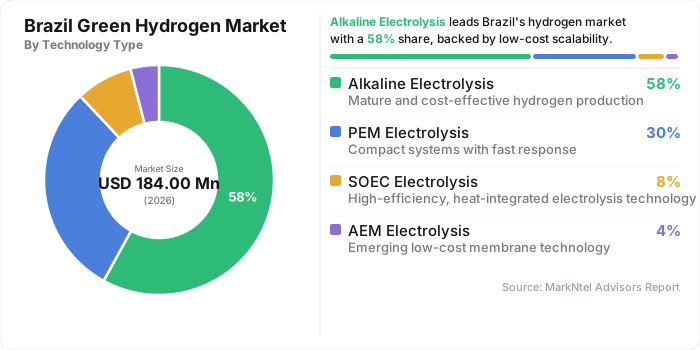
The Alkaline electrolysis segment dominates the Brazil green hydrogen industry in 2026, accounting for 58% of the currently operational electrolysis capacity, as it remains the only technology deployed at industrial scale in the country. According to thyssenkrupp nucera (2024), Unigel’s green hydrogen facility in Bahia operates with 60 MW of installed alkaline electrolysis capacity, representing Brazil’s first industrial-scale commercial green hydrogen production project. This deployment establishes alkaline technology as the leading platform for Brazil’s early-stage industrial-scale hydrogen production ecosystem due to its commercial maturity and scalability.
The segment’s leadership is expected to continue as Brazil expands its domestic hydrogen production capabilities through existing alkaline-based projects. According to Finep (2026), Clark Solutions receives USD 1.7 million in funding to develop domestic alkaline electrolyzer technology, strengthening Brazil’s local manufacturing capabilities. This planned expansion reinforces alkaline electrolysis as the dominant technology pathway during Brazil’s initial commercialization phase and strengthens the development of the Brazil alkaline electrolyzer industry. Based on Technology Type, the India green hydrogen industry is segmented into:
- Proton Exchange Membrane (PEM) Electrolysis
- Alkaline Electrolysis
- Solid Oxide Electrolysis (SOEC)
- Anion Exchange Membrane (AEM) Electrolysis
Fertilizers and Ammonia Segment Leads Early Green Hydrogen Adoption
The fertilizers & ammonia segment dominates the Brazil green hydrogen industry in 2026, accounting for 46% market share, driven by the sector’s direct requirement for hydrogen as a critical feedstock for ammonia manufacturing. According to the Ministry of Agriculture and Livestock (MAPA, 2024), Brazil relies heavily on imported fertilizers, with approximately 85% of fertilizer consumption supplied through imports, creating a strategic opportunity for domestic low-carbon ammonia production. This dependence positions renewable hydrogen-based ammonia as one of the most commercially attractive early applications within Brazil’s hydrogen ecosystem, supporting green ammonia production in Brazil market and fertilizer sector decarbonization.
The segment’s dominance is further supported by large-scale industrial projects integrating hydrogen production with ammonia output. According to Unigel (2024), its green hydrogen and ammonia project in Camaçari, Bahia, involves an initial investment of approximately USD 120 million, targeting Phase 1 production capacity of 10,000 tonnes per year of green hydrogen and 60,000 tonnes per year of green ammonia. The project demonstrates the commercial linkage between renewable hydrogen production and fertilizer manufacturing, strengthening the renewable hydrogen feedstock market and accelerating the adoption of low-carbon ammonia solutions in Brazil’s agricultural supply chain. By the end-user segment, the industry is segmented into:
- Fertilizers & Ammonia
- Refining & Petrochemicals
- Steel & Heavy Industry
- Mobility & Transportation
- Power & Utilities
- Chemicals & Other Industrial Users
Brazil Green Hydrogen Market Competitive Analysis
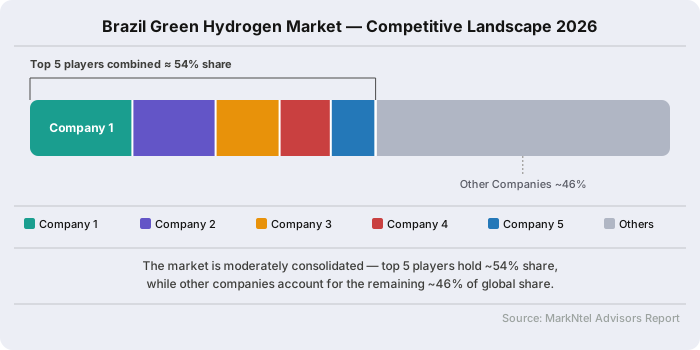
The Brazil green hydrogen industry is moderately consolidated, with the top five companies collectively accounting for approximately 54% of the market in 2026. Market leadership is driven by large-scale renewable energy portfolios, early commercial hydrogen production assets, integrated green ammonia projects, and strategic investments in hydrogen export infrastructure. The remaining market share is distributed among energy utilities, industrial gas companies, electrolyzer technology providers, and emerging hydrogen developers, reflecting Brazil’s evolving competitive landscape.
Top companies in the Brazil green hydrogen industry
- Centrais Elétricas Brasileiras S.A.
- Neoenergia S.A.
- Fortescue Ltd
- Casa dos Ventos Energias Renováveis S.A.
- ENGIE Brasil Energia S.A.
- Voltalia S.A.
- Unigel Participações S.A.
- Linde plc (White Martins Gases Industriais Ltda.)
- Air Liquide Brasil Ltda.
- Siemens Energy AG
Brazil Green Hydrogen Industry News and Recent Developments
October 2024: Unigel Expands Industrial Green Hydrogen and Ammonia Production Initiative in Bahia
Unigel continues developing Brazil’s first industrial-scale green hydrogen facility at the Camaçari Industrial Complex, Bahia, integrating renewable hydrogen production with ammonia manufacturing. According to Unigel (2024), the project involves an initial investment of approximately USD 120 million and targets Phase 1 production capacity of 10,000 tonnes per year of green hydrogen and 60,000 tonnes per year of green ammonia. The facility uses 60 MW of alkaline electrolysis technology supplied by thyssenkrupp nucera, creating a domestic reference project for commercial hydrogen production.
Impact Analysis: The Unigel project establishes an important foundation for Brazil’s green ammonia production ecosystem by demonstrating direct integration between renewable hydrogen generation and fertilizer manufacturing. The development supports industrial decarbonization, reduces dependence on conventional hydrogen production pathways, and provides operational experience for future large-scale hydrogen projects across Brazil’s chemical and agricultural sectors.
June 2025: Eletrobras Strengthens Renewable Energy Integration for Hydrogen Development
Eletrobras continues expanding its role in Brazil’s clean energy transition by leveraging its large renewable generation portfolio to support emerging hydrogen opportunities. According to Eletrobras (2025), the company maintains one of Brazil’s largest renewable electricity generation bases, with hydroelectric assets representing the majority of its installed capacity, creating a strategic advantage for supplying low-carbon electricity to future hydrogen projects. The company is evaluating hydrogen applications linked to renewable power availability and industrial decarbonization opportunities.
Impact Analysis: Eletrobras’ involvement strengthens the renewable electricity foundation required for large-scale hydrogen production and improves the competitiveness of Brazil’s renewable hydrogen supply chain. The participation of major utilities can reduce energy supply risks, support long-term power agreements, and accelerate the development of integrated hydrogen projects connected to Brazil’s existing clean power infrastructure.
- Market Segmentation
- Introduction
- Product Definition
- Research Process
- Assumptions
- Executive Summary
- Brazil Green Hydrogen Market Production Trend, 2022-2032
- Brazil Green Hydrogen Production Trend by Technology Type
- Alkaline Electrolysis
- Proton Exchange Membrane (PEM) Electrolysis
- Solid Oxide Electrolysis (SOEC)
- Anion Exchange Membrane (AEM) Electrolysis
- Company-Wise Production Plants and Statistics
- Installed Production Capacity
- Actual Production
- Planned Production Target
- Brazil Green Hydrogen Production Trend by Technology Type
- Brazil Green Hydrogen Market Pricing Analysis, By Type of Product, 2022-2032
- Brazil Green Hydrogen Market Pricing Trend (USD Million) 2022-2032
- Brazil Green Hydrogen Trend (USD Million) By Technology Type
- Alkaline Electrolysis
- Proton Exchange Membrane (PEM) Electrolysis
- Solid Oxide Electrolysis (SOEC)
- Anion Exchange Membrane (AEM) Electrolysis
- Brazil Green Hydrogen Market Policies, Regulations, and Product Standards
- Brazil Green Hydrogen Market Trends & Developments
- Brazil Green Hydrogen Market Dynamics
- Growth Factors
- Challenges
- Brazil Green Hydrogen Market Hotspot & Opportunities
- Brazil Green Hydrogen Market Outlook, 2022-2032
- Market Size & Outlook
- By Revenues (USD Million)
- Quantity Sold (Thousand Tons)
- Market Segmentation & Outlook
- By Technology- Market Size & Forecast 2022-2032, USD Million & Thousand Tons
- Alkaline Electrolysis
- Proton Exchange Membrane (PEM) Electrolysis
- Solid Oxide Electrolysis (SOEC)
- Anion Exchange Membrane (AEM) Electrolysis
- By Energy Source- Market Size & Forecast 2022-2032, USD Million & Thousand Tons
- Solar
- Wind
- Hybrid
- Other Renewable Sources
- By End-use Industry- Market Size & Forecast 2022-2032, USD Million & Thousand Tons
- Refining & Petrochemicals
- Fertilizers & Ammonia
- Steel & Heavy Industry
- Mobility & Transportation
- Power & Utilities
- Chemicals & Other Industrial Users
- By Region- Market Size & Forecast 2022-2032, USD Million & Thousand Tons
- North
- Northeast
- Central-West
- Southeast
- South
- By Company
- Competition Characteristics
- Market Share & Analysis
- By Technology- Market Size & Forecast 2022-2032, USD Million & Thousand Tons
- Market Size & Outlook
- Brazil Solar Power Green Hydrogen Market Outlook, 2022-2032
- Market Size & Outlook
- By Revenues (USD Million)
- Quantity Sold (Thousand Tons)
- Market Segmentation & Outlook
- By Technology- Market Size & Forecast 2022-2032, USD Million & Thousand Tons
- By End-use Industry- Market Size & Forecast 2022-2032, USD Million & Thousand Tons
- By Region- Market Size & Forecast 2022-2032, USD Million & Thousand Tons
- Market Size & Outlook
- Brazil Wind Power Green Hydrogen Market Outlook, 2022-2032
- Market Size & Outlook
- By Revenues (USD Million)
- Quantity Sold (Thousand Tons)
- Market Segmentation & Outlook
- By Technology- Market Size & Forecast 2022-2032, USD Million & Thousand Tons
- By End-use Industry- Market Size & Forecast 2022-2032, USD Million & Thousand Tons
- By Region- Market Size & Forecast 2022-2032, USD Million & Thousand Tons
- Market Size & Outlook
- Brazil Hybrid Power Green Hydrogen Market Outlook, 2022-2032
- Market Size & Outlook
- By Revenues (USD Million)
- Quantity Sold (Thousand Tons)
- Market Segmentation & Outlook
- By Technology- Market Size & Forecast 2022-2032, USD Million & Thousand Tons
- By End-use Industry- Market Size & Forecast 2022-2032, USD Million & Thousand Tons
- By Region- Market Size & Forecast 2022-2032, USD Million & Thousand Tons
- Market Size & Outlook
- Brazil Green Hydrogen Market Key Strategic Imperatives for Success & Growth
- Competitive Outlook
- Company Profiles
- Centrais Elétricas Brasileiras S.A.
- Business Description
- Product Portfolio
- Collaborations & Alliances
- Recent Developments
- Financial Details
- Others
- Neoenergia S.A.
- Business Description
- Product Portfolio
- Collaborations & Alliances
- Recent Developments
- Financial Details
- Others
- Fortescue Ltd
- Business Description
- Product Portfolio
- Collaborations & Alliances
- Recent Developments
- Financial Details
- Others
- Casa dos Ventos Energias Renováveis S.A.
- Business Description
- Product Portfolio
- Collaborations & Alliances
- Recent Developments
- Financial Details
- Others
- ENGIE Brasil Energia S.A.
- Business Description
- Product Portfolio
- Collaborations & Alliances
- Recent Developments
- Financial Details
- Others
- Voltalia S.A.
- Business Description
- Product Portfolio
- Collaborations & Alliances
- Recent Developments
- Financial Details
- Others
- Unigel Participações S.A.
- Business Description
- Product Portfolio
- Collaborations & Alliances
- Recent Developments
- Financial Details
- Others
- Linde plc (White Martins Gases Industriais Ltda.)
- Business Description
- Product Portfolio
- Collaborations & Alliances
- Recent Developments
- Financial Details
- Others
- Air Liquide Brasil Ltda.
- Business Description
- Product Portfolio
- Collaborations & Alliances
- Recent Developments
- Financial Details
- Others
- Siemens Energy AG
- Business Description
- Product Portfolio
- Collaborations & Alliances
- Recent Developments
- Financial Details
- Others
- Centrais Elétricas Brasileiras S.A.
- Company Profiles
- Disclaimer

MarkNtel Advisors follows a robust and iterative research methodology designed to ensure maximum accuracy and minimize deviation in market estimates and forecasts. Our approach combines both bottom-up and top-down techniques to effectively segment and quantify various aspects of the market. A consistent feature across all our research reports is data triangulation, which examines the market from three distinct perspectives to validate findings. Key components of our research process include:
1. Scope & Research Design At the outset, MarkNtel Advisors define the research objectives and formulate pertinent questions. This phase involves determining the type of research—qualitative or quantitative—and designing a methodology that outlines data collection methods, target demographics, and analytical tools. They also establish timelines and budgets to ensure the research aligns with client goals.
2. Sample Selection and Data Collection In this stage, the firm identifies the target audience and determines the appropriate sample size to ensure representativeness. They employ various sampling methods, such as random or stratified sampling, based on the research objectives. Data collection is carried out using tools like surveys, interviews, and observations, ensuring the gathered data is reliable and relevant.
3. Data Analysis and Validation Once data is collected, MarkNtel Advisors undertake a rigorous analysis process. This includes cleaning the data to remove inconsistencies, employing statistical software for quantitative analysis, and thematic analysis for qualitative data. Validation steps are taken to ensure the accuracy and reliability of the findings, minimizing biases and errors.

4. Data Forecast and FinalizationThe final phase involves forecasting future market trends based on the analyzed data. MarkNtel Advisors utilize predictive modeling and time series analysis to anticipate market behaviors. The insights are then compiled into comprehensive reports, featuring visual aids like charts and graphs, and include strategic recommendations to inform client decision-making
We offer flexible licensing options to cater to varying organizational needs. Choose the pricing pack that best suits your requirements:
Buy Now Inquire Before Buying
 Request Customization