Southeast Asia Third-Party Logistics Market Research Report: Forecast (2026-2032)
By Solution (Transportation Management (Domestic, International), Warehousing & Distribution, Dedicated Contract Carriage (DCC, Logistics software, Others (Financial, Information, ... etc)), By Transportation Mode (Rail, Road, Air, Sea), By End User (Manufacturing, Healthcare & Pharmaceuticals, Retail & E-commerce, Automotive, Consumer Goods, Food & Beverage, Others), and others Read more
- Automotive
- Jun 2026
- Pages 240
- Report Format: PDF, Excel, PPT
Southeast Asia Third-Party Logistics Market
Projected 6.2% CAGR from 2026 to 2032
Study Period
2026-2032
Market Size (2026)
USD 31.86 Billion
Market Size (2032)
USD 45.7 Billion
Base Year
2025
Projected CAGR
6.2%
Leading Segments
By Solutions: Transportation Management
Southeast Asia Third Party Logistics Market Key Takeaways
- Southeast Asia third party logistics market size was valued at USD 30.1 billion in 2025 and is projected to grow from USD 31.86 billion in 2026 to USD 45.7 billion by 2032.
- The industry is projected to reflect sustain growth at a steady CAGR of 6.2% during 2026-2032.
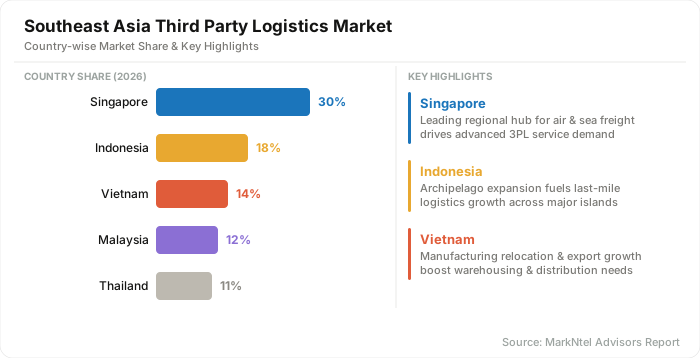
- Singapore holds the largest share of about 30% in 2026.
- By solution type, transportation management holds a significant share of about 58% in 2026.
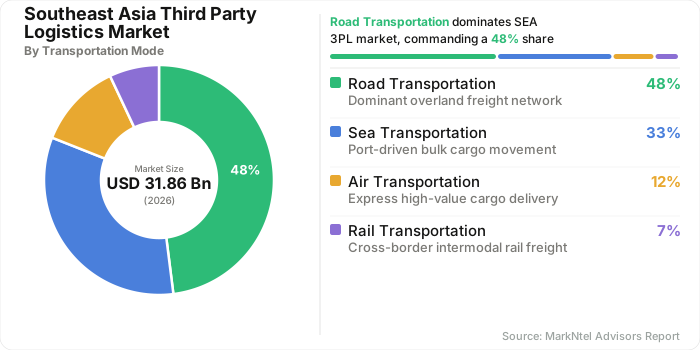
- By transportation mode, road transport seized a significant share of about 48% in 2026.
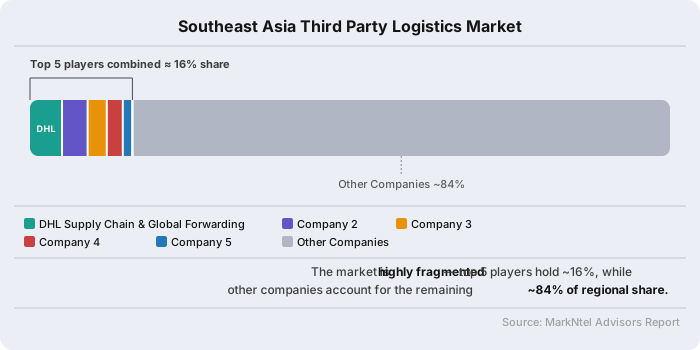
- The industry is highly fragmented. However, the top five players collectively account for nearly 16% share.
Southeast Asia Third Party Logistics Market Size and Outlook
The Southeast Asia third party logistics market is estimated to grow at a CAGR of around 6.2% during the forecast period, i.e., 2026-32, underpinned by rising trade volumes, industrial expansion, and deepening regional supply chain integration. In 2024, ASEAN recorded total merchandise trade of approximately USD 3.5 trillion, with intra-bloc trade accounting for 21.5% of that figure a base that continues to generate strong, sustained demand for logistics, warehousing, and freight services across member economies.
Infrastructure investment is a key enabler of this growth. The ADB estimates ASEAN requires approximately USD 210 billion in annual infrastructure investment through 2030 to sustain economic and trade connectivity. Thailand is among the most proactive governments acting on this need its Ministry of Transport's Action Plan on Logistics Development (2023–2027) covers 77 projects valued at THB 337.8 billion, focused on multimodal transport and freight network upgrades.
Singapore continues to anchor ASEAN's logistics ecosystem as a globally competitive hub. The Port of Singapore recorded approximately 44.7 million TEUs in container throughput in 2025, an 8.6% year-on-year increase, supported by ongoing port automation and capacity expansion. Malaysia is simultaneously scaling Port Klang, with the Ministry of Transport setting a 2025 throughput target of 15 million TEUs, backed by over RM16 billion in digital infrastructure investments attracted under the Malaysia Digital initiative in early 2025.
The Philippines is also emerging as a significant logistics node. The Philippine Port Authority projected national cargo throughput to reach 301.47 million metric tons in 2025, supported by over 81 government port development projects initiated in 2024 alone. Across all markets, logistics providers are deploying automation, AI-enabled warehouse systems, and digital tracking platforms steadily transforming ASEAN into a technology-driven, globally competitive logistics hub.
Overall, the Southeast Asia third party logistics market is evolving through a combination of rising trade activity, infrastructure expansion, and digital transformation, strengthening the region’s position as an emerging global logistics hub.
Southeast Asia Third Party Logistics Market Key Indicators
- Logistics cost as a share of GDP reflects supply chain efficiency and the need for logistics optimization. Armstrong & Associates estimates that logistics costs accounted for approximately 17.5% of ASEAN GDP in 2025. This relatively high level is driven by infrastructure bottlenecks, fragmented transportation networks, and cross-border complexities. As a result, businesses increasingly rely on third party logistics providers to improve efficiency, reduce transportation costs, and streamline supply chain operations.
- Trade activity remains a key indicator of the Southeast Asia third-party logistics industry, reflecting the region's increasing role in global supply chains. The ASEAN has emerged as a major trade connector between China and the United States. Between 2017 and 2023, Vietnam's imports from China increased by approximately USD 50 billion, while its exports to the United States grew by USD 60 billion. Additionally, ASEAN accounted for 20% of China's total trade in 2023, highlighting deepening regional integration and rising demand for freight forwarding, warehousing, transportation, and cross-border logistics services.
Southeast Asia Third Party Logistics Market Scope
| Category | Segments |
|---|---|
| By Solution | Transportation Management (Domestic, International), Warehousing & Distribution, Dedicated Contract Carriage (DCC, Logistics software, Others (Financial, Information, etc |
| By Transportation Mode | Rail, Road, Air, Sea |
| By End User | Manufacturing, Healthcare & Pharmaceuticals, Retail & E-commerce, Automotive, Consumer Goods, Food & Beverage, Others |
Southeast Asia Third Party Logistics Market Growth Drivers
Growing E-commerce Adoption and Digitalization Driving Demand for Third-Party Logistics Services
The rapid expansion of e-commerce is a major driver of the Southeast Asia third-party logistics (3PL) industry. According to the Google–Temasek–Bain e-Conomy SEA 2024 report, Southeast Asia's digital economy reached USD 263 billion in GMV in 2024, growing by 15% year-over-year. The e-commerce segment alone generated USD 159 billion in Gross Merchandise Value, making it the largest contributor to the region's digital economy. Rising online purchases are increasing demand for warehousing, order fulfillment, transportation, and last-mile delivery services, encouraging businesses to outsource logistics operations to specialized third party logistics providers.
Increasing internet penetration and smartphone adoption are further accelerating online shopping activity across the region. Southeast Asia's internet penetration rate reached approximately 82.4%, with the region now home to more than half a billion internet users. Improved digital connectivity has enabled consumers in both urban and rural areas to access online marketplaces, digital payments, and delivery platforms. This expanding digital consumer base is generating higher shipment volumes and creating sustained demand for logistics infrastructure and fulfillment networks.
The region is also experiencing an e-commerce boom driven by new shopping formats. Video commerce accounted for 20% of Southeast Asia's e-commerce GMV in 2024, up from less than 5% in 2022, while major platforms continue to report strong order growth. As online retailers compete on delivery speed, inventory availability, and customer experience, reliance on third-party logistics providers for warehousing, transportation, and reverse logistics is expected to increase further, supporting long-term growth of the Southeast Asian third party logistics market.
Recent Trends
Smart Warehousing and Automation Reshaping Southeast Asia’s 3PL Market
Adoption of smart warehousing and logistics automation is becoming a major trend in the Southeast Asia third-party logistics industry as logistics companies modernize supply chain operations to improve speed, efficiency, and inventory visibility. In 2025, Malaysia announced a target to establish 3,000 smart factories by 2030 under the New Industrial Master Plan 2030 (NIMP 2030), promoting robotics, AI, IoT, and warehouse automation technologies. The initiative is expected to require nearly USD 3.4 billion in financing, significantly accelerating adoption of automated logistics infrastructure.
Private logistics providers are also expanding automation investments across Asia-Pacific operations. In 2024, identified robotics, orchestration, and AI as key technology priorities for improving supply chain efficiency and warehouse productivity. DHL additionally invested over USD 46 million in automated life sciences warehouse facilities across Australia and New Zealand, supporting regional automation expansion beginning in 2025.
ASEAN countries are expected to increase investments in AI-driven fulfillment centers, autonomous material-handling systems, and smart logistics hubs to support rising cross-border trade and e-commerce volumes. As businesses prioritize faster deliveries, operational efficiency, and real-time inventory tracking, smart warehousing and logistics automation will become a critical competitive differentiator, significantly strengthening long-term growth of the Southeast Asia third party logistics market.
Southeast Asia Third Party Logistics Market Opportunities and Challenges
Infrastructure Gaps Fueling Third Party Logistics Modernization in Southeast Asia
Infrastructure deficits remain a major challenge for the Southeast Asia third-party logistics industry, as inadequate transport connectivity, congested ports, and limited multimodal infrastructure continue to increase freight costs and delivery delays across ASEAN countries. For instance, Indonesia's Tanjung Priok Port frequently experiences congestion due to rising cargo volumes, while Vietnam is investing in logistics infrastructure around Long Thanh International Airport to improve cargo handling efficiency. According to the Asian Development Bank (ADB), Southeast Asia requires infrastructure investments equivalent to 5.7% of GDP annually through 2030 to meet growing transportation and logistics needs.
However, these infrastructure limitations are creating opportunities for investment and logistics network expansion across Southeast Asia. According to the ASEAN Investment Report 2025, ASEAN attracted a record USD 225 billion in FDI inflows, reflecting strong investor interest in the region's manufacturing and supply chain sectors. The expansion of industrial parks, production facilities, and export-oriented industries is increasing demand for modern warehousing, transportation, freight forwarding, and distribution services, creating significant growth opportunities for third party logistics providers.
Consequently, although infrastructure gaps currently hinder logistics efficiency, they are also accelerating infrastructure modernization and investment across Southeast Asia. Rising FDI inflows, expanding manufacturing activity, and ongoing transport infrastructure developments are expected to strengthen regional supply chain connectivity and significantly boost long-term demand for advanced third-party logistics services.
Segmentation Insights
Transportation Management is Widely Used for Southeast Asia Third Party Logistics
Transportation Management alone contributes approximately 58% share of the overall revenue in the Southeast Asia third-party logistics (3PL) industry, driven by the region’s strong reliance on international trade, manufacturing exports, and rapidly growing e-commerce activities. ASEAN economies are highly interconnected through cross-border supply chains, increasing the demand for road freight, air cargo, ocean freight, and multimodal transportation services. Additionally, countries such as Indonesia and the Philippines require extensive transportation networks due to their geographically dispersed island structures.
The segment’s dominance is further supported by rising investments in logistics infrastructure, smart fleet technologies, and port modernization projects across Singapore, Vietnam, Thailand, and Malaysia. Increasing adoption of route optimization, real-time shipment tracking, and automated transportation planning is improving operational efficiency for logistics providers. Furthermore, the expansion of regional manufacturing hubs and the rapid rise of same-day and last-mile delivery services are continuously strengthening demand for transportation management solutions across Southeast Asia. Based on solutions, the scope has been segmented into
- Transportation Management
- Domestic
- International
- Warehousing & Distribution
- Dedicated Contract Carriage (DCC)
- Logistics software
- Others (Financial, Information, etc.)
Road Transportation emerging as the Leading Transportation Mode
Road transportation alone contributes approximately 48% share of the transportation segment revenue in the Southeast Asia third-party logistics industry, driven by the region’s expanding domestic trade activities, rapid e-commerce growth, and increasing demand for flexible freight movement. Road freight remains the most widely used transportation mode across Southeast Asia due to its cost efficiency, broad geographic reach, and ability to support short- and medium-distance deliveries. Countries such as Thailand, Vietnam, Malaysia, and Indonesia heavily depend on trucking networks for industrial distribution and retail supply chains.
The segment’s dominance is further supported by rising investments in highway infrastructure, cross-border road connectivity, and smart fleet management technologies. Growing manufacturing activities and the expansion of last-mile delivery networks are significantly increasing demand for road transportation services. Additionally, the flexibility of road transport in handling diverse cargo volumes and direct door-to-door deliveries continues to strengthen its position as the leading transportation mode within the Southeast Asia 3PL market. Based on transportation mode, the scope has been classified into
- Rail
- Road
- Air
- Sea
Southeast Asia Third Party Logistics Market Geographical Outlook
Singapore leads the Southeast Asia third-party logistics market, accounting for an estimated 30% of the regional market share, driven by its strategic maritime location, advanced port infrastructure, highly efficient customs systems, and strong regional connectivity. The country serves as the primary logistics and transshipment hub for ASEAN trade, enabling multinational companies to efficiently manage regional distribution and cross-border supply chains. Singapore also benefits from high warehouse automation, digital logistics integration, and strong government support for supply-chain modernization, strengthening its position as the preferred regional logistics hub.
Ongoing investments in warehousing capacity, distribution infrastructure, and logistics-focused real estate reflect growing demand for advanced supply-chain solutions and reinforce the country's attractiveness for regional trade and distribution operations. For instance, in May 2025, DP World opened its first large-scale warehouse facility in Singapore at the Mapletree Benoi Logistics Hub to enhance Asia-Pacific supply-chain operations. Similarly, in 2025, JD Property, together with Partners Group and EZA Hill, announced plans for a Singapore-based logistics REIT valued at more than USD 1 billion, underscoring strong investor confidence in Singapore's logistics infrastructure and regional distribution capabilities.
Southeast Asia Third Party Logistics Market Competitive Analysis
The Southeast Asia third-party logistics industry is highly fragmented, with the top five companies accounting for approximately 16% of the total market share. Major players operating in the market include DHL Supply Chain & Global Forwarding, DB Schenker, Kuehne+Nagel, Nippon Express, and CEVA Logistics.
Key players in the Southeast Asia Third-Party Logistics Market
- DHL Supply Chain & Global Forwarding
- DB Schenker
- Kuehne+Nagel International
- Nippon Express
- CEVA Logistics
- DSV
- CJ Logistics
- Maersk Logistics
- Kerry Logistics
- Sinotrans
- Others
Southeast Asia Third Party Logistics Industry News and Recent Developments
2025: Maersk Launches Asia Pacific’s Largest Distribution Center in Malaysia
In 2025, Maersk opened a major integrated distribution center in Malaysia to enhance warehousing, freight, and inland logistics operations across Southeast Asia. The facility improves cargo consolidation and multimodal connectivity, supporting growing FMCG and industrial supply chains. The expansion strengthens cross-border trade efficiency and increases demand for integrated third-party logistics services.
Impact Analysis: This facility enhances Southeast Asia’s 3PL ecosystem by integrating multimodal logistics under a single network. It improves cargo consolidation efficiency and supports high-volume manufacturing and retail distribution. The development reflects rising ASEAN trade flows and increases demand for end-to-end logistics solutions, strengthening cross-border supply-chain reliability and operational efficiency across the region.
2025: DP World Opens First Singapore Warehouse to Strengthen Asian Logistics Capabilities
In 2025, DP World opened its first logistics warehouse in Singapore at the Mapletree Benoi Logistics Hub, adding 13,000 square meters of bonded storage capacity. The facility strengthens the company's Asia-Pacific supply chain network by enhancing inventory management, distribution efficiency, and trade connectivity. Located in one of the world's leading logistics hubs, the warehouse supports growing regional trade flows and increases demand for integrated third-party logistics and warehousing services.
Impact Analysis: This development enhances Southeast Asia’s 3PL efficiency by improving bonded warehousing and freight consolidation capabilities. It supports faster import-export processing and strengthens e-commerce distribution networks. The facility reinforces Singapore’s transshipment dominance while increasing demand for integrated logistics solutions, multimodal transport connectivity, and efficient last-mile delivery systems across ASEAN trade routes.
2025: SEKO Logistics Launches New Singapore Logistics Hub to Strengthen APAC Operations
SEKO Logistics expanded its Asia-Pacific footprint in 2025 by relocating and upgrading its Singapore facility within the Changi Free Trade Zone. The new logistics hub enhances the company's e-commerce fulfillment, freight forwarding, and value-added logistics capabilities while improving connectivity across regional markets. The expansion is designed to support growing cross-border e-commerce volumes and strengthen supply chain efficiency throughout the Asia-Pacific region.
Impact Analysis: This expansion strengthens Southeast Asia’s e-commerce logistics ecosystem by improving delivery speed and cross-border fulfillment efficiency. It supports growing omnichannel retail demand and enhances integration between air freight and last-mile delivery networks. The development increases reliance on free-trade zones and accelerates adoption of agile, technology-driven logistics solutions across ASEAN markets.
Frequently Asked Questions
- Market Segmentation
- Introduction
- Product Definition
- Research Process
- Assumptions
- Executive Summary
- Southeast Asia Third-Party Logistics Market Trends & Insights
- Southeast Asia Third-Party Logistics Market Dynamics
- Drivers
- Challenges
- Southeast Asia Third-Party Logistics Market Growth Opportunities & Hotspots
- Southeast Asia Third-Party Logistics Market Policy & Regulations
- Southeast Asia Third-Party Logistics Market Outlook, 2026-2032F
- Market Size & Outlook
- By Revenues (USD Million)
- Market Share & Outlook
- By Solution- Market Size & Forecast 2026-2032F, USD Million
- Transportation Management
- Domestic
- International
- Warehousing & Distribution
- Dedicated Contract Carriage (DCC
- Logistics software
- Others (Financial, Information, etc)
- Transportation Management
- By Transportation Mode- Market Size & Forecast 2026-2032F, USD Million
- Rail
- Road
- Air
- Sea
- By End User- Market Size & Forecast 2026-2032F, USD Million
- Manufacturing
- Healthcare & Pharmaceuticals
- Retail & E-commerce
- Automotive
- Consumer Goods
- Food & Beverage
- Others
- By Country
- Indonesia
- Thailand
- Philippines
- Vietnam
- Malaysia
- Singapore
- Rest of Southeast Asia
- By Company
- Competition Characteristics
- Revenue Shares & Analysis
- By Solution- Market Size & Forecast 2026-2032F, USD Million
- Market Size & Outlook
- Indonesia Third-Party Logistics Market Outlook, 2026-2032F
- Market Size & Outlook
- By Revenues (USD Million)
- Market Share & Outlook
- By Solution- Market Size & Forecast 2026-2032F, USD Million
- By Transportation Mode- Market Size & Forecast 2026-2032F, USD Million
- By End User- Market Size & Forecast 2026-2032F, USD Million
- Market Size & Outlook
- Thailand Third-Party Logistics Market Outlook, 2026-2032F
- Market Size & Outlook
- By Revenues (USD Million)
- Market Share & Outlook
- By Solution- Market Size & Forecast 2026-2032F, USD Million
- By Transportation Mode- Market Size & Forecast 2026-2032F, USD Million
- By End User- Market Size & Forecast 2026-2032F, USD Million
- Market Size & Outlook
- Philippines Third-Party Logistics Market Outlook, 2026-2032F
- Market Size & Outlook
- By Revenues (USD Million)
- Market Share & Outlook
- By Solution- Market Size & Forecast 2026-2032F, USD Million
- By Transportation Mode- Market Size & Forecast 2026-2032F, USD Million
- By End User- Market Size & Forecast 2026-2032F, USD Million
- Market Size & Outlook
- Vietnam Third-Party Logistics Market Outlook, 2026-2032F
- Market Size & Outlook
- By Revenues (USD Million)
- Market Share & Outlook
- By Solution- Market Size & Forecast 2026-2032F, USD Million
- By Transportation Mode- Market Size & Forecast 2026-2032F, USD Million
- By End User- Market Size & Forecast 2026-2032F, USD Million
- Market Size & Outlook
- Malaysia Third-Party Logistics Market Outlook, 2026-2032F
- Market Size & Outlook
- By Revenues (USD Million)
- Market Share & Outlook
- By Solution- Market Size & Forecast 2026-2032F, USD Million
- By Transportation Mode- Market Size & Forecast 2026-2032F, USD Million
- By End User- Market Size & Forecast 2026-2032F, USD Million
- Market Size & Outlook
- Singapore Third-Party Logistics Market Outlook, 2026-2032F
- Market Size & Outlook
- By Revenues (USD Million)
- Market Share & Outlook
- By Solution- Market Size & Forecast 2026-2032F, USD Million
- By Transportation Mode- Market Size & Forecast 2026-2032F, USD Million
- By End User- Market Size & Forecast 2026-2032F, USD Million
- Market Size & Outlook
- Southeast Asia Third-Party Logistics Key Strategic Imperatives for Growth & Success
- Competitive Benchmarking
- Company Profiles
- DHL Supply Chain & Global Forwarding
- Business Description
- Product Portfolio
- Strategic Alliances or Partnerships
- Recent Developments
- Financial Details
- Others
- Nippon Express
- Business Description
- Product Portfolio
- Strategic Alliances or Partnerships
- Recent Developments
- Financial Details
- Others
- DB Schenkar
- Business Description
- Product Portfolio
- Strategic Alliances or Partnerships
- Recent Developments
- Financial Details
- Others
- Kuehne + Nagel International
- Business Description
- Product Portfolio
- Strategic Alliances or Partnerships
- Recent Developments
- Financial Details
- Others
- CEVA Logistics
- Business Description
- Product Portfolio
- Strategic Alliances or Partnerships
- Recent Developments
- Financial Details
- Others
- DSV
- Business Description
- Product Portfolio
- Strategic Alliances or Partnerships
- Recent Developments
- Financial Details
- Others
- CJ Logistics
- Business Description
- Product Portfolio
- Strategic Alliances or Partnerships
- Recent Developments
- Financial Details
- Others
- Maersk Logistics
- Business Description
- Product Portfolio
- Strategic Alliances or Partnerships
- Recent Developments
- Financial Details
- Others
- Keny Logistics
- Business Description
- Product Portfolio
- Strategic Alliances or Partnerships
- Recent Developments
- Financial Details
- Others
- Sinotrans
- Business Description
- Product Portfolio
- Strategic Alliances or Partnerships
- Recent Developments
- Financial Details
- Others
- Others
- DHL Supply Chain & Global Forwarding
- Company Profiles
- Disclaimer
MarkNtel Advisors follows a robust and iterative research methodology designed to ensure maximum accuracy and minimize deviation in market estimates and forecasts. Our approach combines both bottom-up and top-down techniques to effectively segment and quantify various aspects of the market. A consistent feature across all our research reports is data triangulation, which examines the market from three distinct perspectives to validate findings. Key components of our research process include:
1. Scope & Research Design At the outset, MarkNtel Advisors define the research objectives and formulate pertinent questions. This phase involves determining the type of research—qualitative or quantitative—and designing a methodology that outlines data collection methods, target demographics, and analytical tools. They also establish timelines and budgets to ensure the research aligns with client goals.
2. Sample Selection and Data Collection In this stage, the firm identifies the target audience and determines the appropriate sample size to ensure representativeness. They employ various sampling methods, such as random or stratified sampling, based on the research objectives. Data collection is carried out using tools like surveys, interviews, and observations, ensuring the gathered data is reliable and relevant.
3. Data Analysis and Validation Once data is collected, MarkNtel Advisors undertake a rigorous analysis process. This includes cleaning the data to remove inconsistencies, employing statistical software for quantitative analysis, and thematic analysis for qualitative data. Validation steps are taken to ensure the accuracy and reliability of the findings, minimizing biases and errors.

4. Data Forecast and FinalizationThe final phase involves forecasting future market trends based on the analyzed data. MarkNtel Advisors utilize predictive modeling and time series analysis to anticipate market behaviors. The insights are then compiled into comprehensive reports, featuring visual aids like charts and graphs, and include strategic recommendations to inform client decision-making
We offer flexible licensing options to cater to varying organizational needs. Choose the pricing pack that best suits your requirements:
Buy Now Inquire Before Buying
 Request Customization
 Talk to our Consultant