

Singapore ICT Market Research Report: Forecast (2026-2032)
By Type (IT Hardware, IT Software, IT Services, Telecommunication Services), By Size of Enterprise (Small & Medium Enterprises, Large Enterprises), By Deployment (On-Premise, Cloud ... , Hybrid), By End-User (IT & Telecom, BFSI, Government, Manufacturing, Energy & Utilities, Retail, Others (Education, Construction, Healthcare, Transportation, etc.)), and others Read more
- ICT & Electronics
- Jul 2026
- Pages 131
- Report Format: PDF, Excel, PPT
Singapore ICT Market
Projected 8.82% CAGR from 2026 to 2032
Study Period
2026-2032
Market Size (2026)
USD 59 Billion
Market Size (2032)
USD 98 Billion
Base Year
2025
Projected CAGR
8.82%
Leading Segments
By Deployment: On-Premise
Singapore ICT Market Key Takeaways
- The Singapore ICT Market was valued at USD 56 billion in 2025 and is projected to reach USD 98 billion by 2032 from USD 59 billion in 2026.
- The industry is projected to witness steady growth at a CAGR of approximately 8.82% during 2026–2032.
- By enterprise size, large enterprises held 66% of the industry size in 2026.
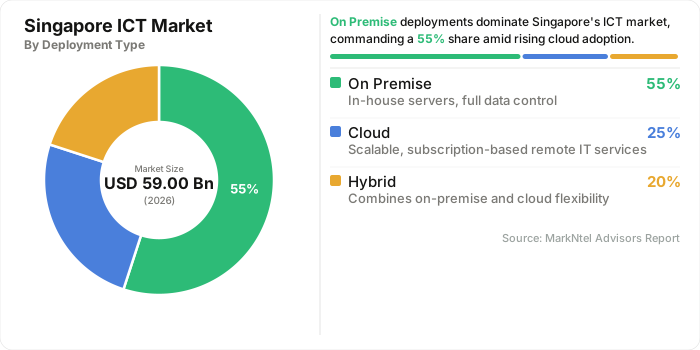
- By deployment model, on premise solutions led with 55% of the market size in 2026.
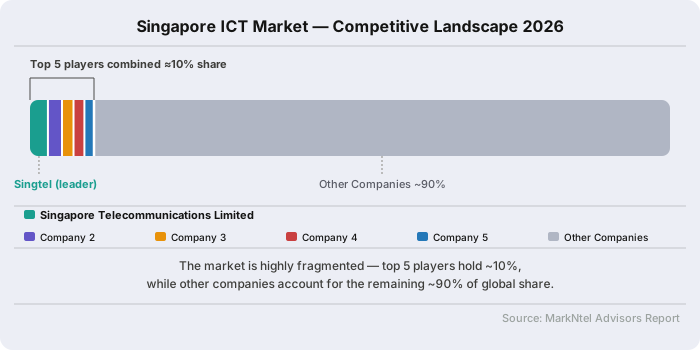
- The industry remains moderately fragmented, with the top five players collectively accounting for approximately 10% of the total market share.
Singapore ICT Market Size & Outlook
The Singapore ICT industry was valued at USD 56 billion in 2025 and is currently standing at USD 59 billion in 2026. The industry is projected to grow to USD 98 billion by 2032 showcasing a CAGR of around 8.82% during the forecast period, i.e., 2026–32. The industry is characterised by enterprise-led technology spending, concentrated hyperscale infrastructure, and sustained public-sector investment that collectively reinforce its position as a regional digital hub.
The government plays a dual role as both a major technology buyer and a long-term policy architect, making fiscal priorities and regulatory direction key determinants of enterprise procurement, infrastructure deployment, and digital investments. This could be clearly seen in the 2025 budget which provided a USD 2.3 billion allocation to the national productivity fund to attract high value technology investments. These measures are expected to channel enterprise investments toward cloud infrastructure and systems integration throughout the forecast period.
The regulatory environment is increasingly shaping technology purchasing decisions across both government and regulated industries. Singapore's deployment of isolated cloud and artificial intelligence services for its defence technology agency during 2025 reflects growing emphasis on sovereign cloud capabilities, secure digital infrastructure, and trusted computing environments for sensitive workloads. This direction is expected to strengthen demand for compliance driven cloud platforms, cybersecurity solutions, and specialised managed services as security requirements become more stringent.
Long term growth prospects remain supported by Singapore's commitment to invest USD 780 million in public artificial intelligence research between 2025 and 2030, strengthening national capabilities across compute infrastructure, research collaboration, and digital innovation. Continued capital allocation toward advanced technologies, together with sustained enterprise modernisation, is expected to expand demand for cloud platforms, enterprise software, data services, and digital infrastructure, supporting a resilient ICT market throughout the forecast period.
Singapore ICT Market Key Indicators
- In December 2025, EDB and IMDA launched DC-CFA2, opening at least 200 MW of new licensed data centre capacity, with a separate Jurong Island low-carbon park earmarked for up to 700 MW, subject to a mandatory PUE of 1.25 and minimum 50% green energy sourcing.
- Singapore's two standalone 5G networks achieved 95% nationwide outdoor coverage, establishing Singapore among the first countries globally to reach full standalone 5G deployment and underpinning enterprise connectivity across cloud, IoT, and edge computing applications.
- Singapore’s government committed USD3.3 billion in FY24 to ICT, with USD 2.1 billion allocated to infrastructure modernisation and digital services. This is a strong market-growth proxy because it shows actual budgeted demand for systems, cloud, cybersecurity, and integration. Use this as the main hard number for “ICT Industry Size and Digital Spend”.
- Singapore confirmed in June 2026 that it will expand data-centre capacity beyond the current 1.4 GW baseline, driven by AI workloads and new demand streams. This is a very useful quantifiable indicator for ICT market growth because it directly captures compute, cloud, hosting, and AI infrastructure demand. It also works well under “Digital Infrastructure” and “AI Integration Trend”.
Singapore ICT Market Scope
| Category | Segments |
|---|---|
| By Type | Hard, Soft, Risk, Administrative |
| By Operating Model | In-house, Outsourced |
| By Service Delivery | Integrated, Bundled, Single Service |
| By Enterprise Size | Large, Mid-Size, Small |
| By End User | Commercial, Residential, Government, Retail, Education, Healthcare, Hospitality, Others (Transportation, Utilities & Energy, etc. |
Singapore ICT Market Growth Driver
Public Sector Digitalisation and Smart Nation Programmes Drive ICT Demand
The primary growth driver for the Singapore ICT market is sustained public sector digitalisation under the Smart Nation agenda, which continues to direct technology investment across government agencies while encouraging wider enterprise adoption of digital solutions. Unlike one-time infrastructure projects, government digital programmes create recurring demand through continuous procurement of cloud platforms, digital public services, cybersecurity solutions, enterprise applications, and systems integration, providing long-term visibility for ICT vendors operating in Singapore.
This demand outlook strengthened further in 2025 when the country’s budget allocated a USD111.9 million enterprise compute initiative to help enterprises adopt artificial intelligence and a USD 780 million semiconductor research and development fabrication facility. These initiatives complement the government's broader smart nation strategy by accelerating digital capability development across both the public and private sectors rather than supporting isolated technology deployments.
The multiplier effect of public sector investment extends beyond direct government procurement. As agencies implement secure digital platforms, common digital standards, and trusted cloud frameworks, private enterprises increasingly align their technology investments with these standards to improve interoperability, compliance, and service delivery. This government led digital ecosystem is expected to sustain demand for cloud services, enterprise software, cybersecurity, digital consulting, and managed ICT services throughout the forecast period.
Singapore ICT Market Trend
AI Infrastructure and Enterprise AI Deployments Reshape ICT Investment
Artificial intelligence infrastructure has emerged as the defining technology trend within the ICT industry, shifting enterprise investment from conventional IT upgrades toward high-performance computing and cloud AI platforms. During 2025, industry analysis identified AI-related infrastructure as one of the fastest-growing areas of IT expenditure, reflecting increasing deployment of generative AI applications across financial services, healthcare, manufacturing, and logistics. This transition is expanding demand for advanced computing capacity and specialised ICT implementation services rather than traditional hardware refresh cycles.
The trend extends beyond software adoption to the underlying infrastructure required to support enterprise AI at scale. Growing demand for AI model training, inference workloads, and data processing is increasing requirements for high density data centres, cloud regions, storage platforms, and systems integration capabilities. As enterprises integrate artificial intelligence into business operations, technology vendors are increasingly competing on AI ready infrastructure, managed AI services, and industry specific deployment expertise. This shift is expected to accelerate investment across cloud computing, enterprise platforms, and digital infrastructure, reinforcing Singapore's role as a regional hub for enterprise AI deployment throughout the forecast period.
Singapore ICT Market Challenges & Opportunities
Energy Constraints Reshape Data Centre Expansion While Accelerating Green Digital Infrastructure Investment
Singapore's position as a regional cloud and digital infrastructure hub is increasingly challenged by the growing energy intensity of modern data centres. Rising deployment of artificial intelligence workloads, high performance computing, and hyperscale cloud infrastructure is driving significant increases in electricity demand, while the country's limited land and power resources constrain large scale capacity expansion. The 2026 southeast asia data centre construction industry outlook identifies energy availability and sustainability requirements as key factors influencing future data centre development across the region, with Singapore facing particularly stringent capacity considerations.
These constraints increase project costs, extend development timelines, and influence location decisions for cloud service providers and colocation operators. As computing requirements continue to rise, maintaining sustainable infrastructure expansion without compromising energy efficiency is expected to remain a critical challenge for this industry.
The same constraints are simultaneously creating new opportunities for sustainable digital infrastructure. Growing emphasis on energy efficient operations is accelerating investment in renewable electricity procurement, micro grid deployment, advanced cooling technologies, and intelligent energy management systems for data centres. Rather than competing solely on capacity, operators are increasingly differentiating themselves through sustainability performance and power efficiency.
The 2026 regional data centre outlook identifies sustainability as an increasingly important consideration for future infrastructure investment, encouraging wider adoption of green power agreements and low-carbon operating models. This transition is expected to create commercial opportunities for renewable energy providers, energy management technology vendors, infrastructure engineering firms, and ICT companies offering solutions that improve power efficiency while supporting continued expansion of cloud and AI computing capacity.
Segmentation Insights
Large Enterprises Lead ICT Spending Through Complex Digital Transformation Requirements
Large enterprises accounted for 66% of the Singapore ICT market in 2026, reflecting their substantial technology budgets, complex operational environments, and sustained investments in enterprise-wide digital transformation. Organizations across banking, manufacturing, telecommunications, logistics, and professional services increasingly prioritize integrated ICT ecosystems to improve operational efficiency, cybersecurity resilience, regulatory compliance, and customer experience. Their large-scale procurement requirements continue to drive demand for enterprise software, cloud platforms, IT services, advanced networking infrastructure, and managed technology solutions.
The dominance of large enterprises is further supported by their ability to adopt emerging technologies at scale while maintaining long-term modernization programs. These organizations typically deploy integrated platforms across multiple business functions, requiring continuous investments in systems integration, cybersecurity, data management, and enterprise applications. As Singapore strengthens its position as a regional headquarters location for multinational corporations, large enterprises are expected to remain the primary contributors to ICT expenditure through ongoing investments in resilient, scalable, and business-critical digital infrastructure. Based on the size of enterprise, the market is further bifurcated into:
- Small & Medium Enterprises
- Large Enterprises.
On-Premise Deployment Maintains Leadership Through Security and Regulatory Requirements
On-premise solutions held 55% of the Singapore ICT market in 2026, supported by strong demand from organizations managing sensitive data, mission-critical applications, and highly regulated business operations. Industries such as government, banking, healthcare, and telecommunications continue to prioritize direct control over infrastructure, data security, and system availability. Maintaining on-premise environments also enables organizations to satisfy stringent governance requirements while integrating legacy systems with modern enterprise applications.
Despite growing cloud adoption, many enterprises continue to rely on premise infrastructure for workloads requiring low latency, predictable performance, and enhanced security. Hybrid digital strategies increasingly position on premise environments as the foundation for core business applications while cloud platforms support scalable and less sensitive workloads. This balanced deployment approach enables organizations to optimize operational reliability, regulatory compliance, and long term infrastructure investments, allowing on premise solutions to retain their dominant position across Singapore's ICT industry. Based on the deployment, the market is further bifurcated into:
- On-Premise
- Cloud
- Hybrid
Singapore ICT Market Competitive Analysis
The Singapore ICT industry is moderately fragmented, with competition centred on enterprise digital transformation capabilities, cloud services, systems integration, artificial intelligence solutions, and long-term public and private sector technology partnerships. Major participants include Amazon Asia-Pacific Holdings Private Limited, IBM Singapore Pte. Ltd., Cognizant Technology Solutions Asia Pacific Pte. Ltd., SAP Asia Pte. Ltd., and Google Asia Pacific Pte. Ltd., with the top five companies collectively accounting for approximately 10% of the total market share.
Key Companies in Singapore ICT Market
- Amazon Asia-Pacific Holdings Private Limited
- IBM Singapore Pte. Ltd.
- Cognizant Technology Solutions Asia Pacific Pte. Ltd.
- SAP Asia Pte. Ltd.
- Google Asia Pacific Pte. Ltd.
- Wipro Singapore Pte. Ltd.
- Intel Technology Asia Pte. Ltd.
- Razer (Asia-Pacific) Pte. Ltd.
- GrabTaxi Holdings Pte. Ltd.
- Singapore Telecommunications Limited
- Others
Singapore ICT Market Industry News & Recent Developments
2025: GIC and Silver Lake Complete Acquisition of Zuora to Expand Singapore's Global SaaS Presence
Singapore's sovereign wealth fund GIC and global technology investor Silver Lake completed the USD 1.7 billion acquisition of Zuora in 2025, taking the subscription management software provider private. The transaction strengthens Singapore's participation in the global software-as-a-service ecosystem by expanding exposure to cloud-based billing, subscription management, and recurring revenue platforms that are increasingly adopted across digital enterprises. The acquisition also reinforces Singapore's position as a strategic investment hub for high value enterprise software and cloud technology businesses.
Impact Analysis: The acquisition underscores growing investor confidence in subscription-based enterprise software and cloud services, reinforcing Singapore's role in global ICT investment. Increased focus on SaaS platforms is expected to accelerate enterprise adoption of cloud applications, digital billing systems, and revenue management solutions while encouraging further investment in software innovation, fintech, and cloud-enabled business services across Singapore's ICT market.
2025: SAP Labs Singapore Expands AI Research and Development Capabilities
SAP Labs Singapore announced the expansion of its local research and development operations in 2025, increasing its workforce to 420 employees and committing to recruit nine artificial intelligence researchers by 2030 through the National University of Singapore Industrial Postgraduate Programme. The expansion strengthens Singapore's position as a regional innovation centre for enterprise software development while advancing research in artificial intelligence, cloud technologies, and next generation enterprise applications through closer industry and academic collaboration.
Impact Analysis: The expansion reflects increasing investment by global technology companies in Singapore's AI innovation ecosystem and reinforces the country's attractiveness as a regional R&D destination. Enhanced research capabilities are expected to accelerate enterprise AI development, strengthen cloud and software innovation, support high value digital talent creation, and generate additional demand for advanced ICT infrastructure and enterprise technology solutions across the Singapore ICT market.
Frequently Asked Questions
- Market Segmentation
- Introduction
- Product Definition
- Research Process
- Assumptions
- Executive Summary
- Singapore ICT Market Policies, Regulations, and Product Standards
- Singapore ICT Market Trends & Developments
- Singapore ICT Market Dynamics
- Growth Factors
- Challenges
- Singapore ICT Market Hotspot & Opportunities
- Singapore ICT Market Outlook, 2022-2032F
- Market Size & Outlook
- By Revenues (USD Million)
- Market Segmentation & Outlook
- By Type- Market Size & Forecast 2022-2032, USD Million
- IT Hardware
- IT Software
- IT Services
- Telecommunication Services
- By Size of Enterprise- Market Size & Forecast 2022-2032, USD Million
- Small & Medium Enterprises
- Large Enterprises
- By Deployment- Market Size & Forecast 2022-2032, USD Million
- On-Premise
- Cloud
- Hybrid
- By End-User- Market Size & Forecast 2022-2032, USD Million
- IT & Telecom
- BFSI
- Government
- Manufacturing
- Energy & Utilities
- Retail
- Others (Education, Construction, Healthcare, Transportation, etc.)
- By Company
- Competition Characteristics
- Market Share & Analysis
- By Type- Market Size & Forecast 2022-2032, USD Million
- Market Size & Outlook
- Singapore IT Hardware Market Outlook, 2022-2032
- Market Size & Outlook
- By Revenues (USD Million)
- Market Segmentation & Outlook
- By Size of Enterprise- Market Size & Forecast 2022-2032, USD Million
- By Deployment- Market Size & Forecast 2022-2032, USD Million
- By End-User- Market Size & Forecast 2022-2032, USD Million
- Market Size & Outlook
- Singapore IT Software Market Outlook, 2022-2032
- Market Size & Outlook
- By Revenues (USD Million)
- Market Segmentation & Outlook
- By Size of Enterprise- Market Size & Forecast 2022-2032, USD Million
- By Deployment- Market Size & Forecast 2022-2032, USD Million
- By End-User- Market Size & Forecast 2022-2032, USD Million
- Market Size & Outlook
- Singapore IT Services Market Outlook, 2022-2032
- Market Size & Outlook
- By Revenues (USD Million)
- Market Segmentation & Outlook
- By Size of Enterprise- Market Size & Forecast 2022-2032, USD Million
- By Deployment- Market Size & Forecast 2022-2032, USD Million
- By End-User- Market Size & Forecast 2022-2032, USD Million
- Market Size & Outlook
- Singapore Telecommunication Services Market Outlook, 2022-2032
- Market Size & Outlook
- By Revenues (USD Million)
- Market Segmentation & Outlook
- By Size of Enterprise- Market Size & Forecast 2022-2032, USD Million
- By Deployment- Market Size & Forecast 2022-2032, USD Million
- By End-User- Market Size & Forecast 2022-2032, USD Million
- Market Size & Outlook
- Singapore ICT Market Key Strategic Imperatives for Success & Growth
- Competitive Outlook
- Company Profiles
- Amazon Asia-Pacific Holdings Private Limited
- Business Description
- Product Portfolio
- Collaborations & Alliances
- Recent Developments
- Financial Details
- Others
- IBM Singapore Pte Ltd
- Business Description
- Product Portfolio
- Collaborations & Alliances
- Recent Developments
- Financial Details
- Others
- Cognizant Technology Solutions Asia Pacific Pte. Ltd.
- Business Description
- Product Portfolio
- Collaborations & Alliances
- Recent Developments
- Financial Details
- Others
- SAP Asia Pte. Ltd.
- Business Description
- Product Portfolio
- Collaborations & Alliances
- Recent Developments
- Financial Details
- Others
- Wipro Singapore Pte. Ltd.
- Business Description
- Product Portfolio
- Collaborations & Alliances
- Recent Developments
- Financial Details
- Others
- Google Asia Pacific Pte. Ltd.
- Business Description
- Product Portfolio
- Collaborations & Alliances
- Recent Developments
- Financial Details
- Others
- Intel Technology Asia Pte Ltd
- Business Description
- Product Portfolio
- Collaborations & Alliances
- Recent Developments
- Financial Details
- Others
- Razer (Asia-Pacific) Pte. Ltd.
- Business Description
- Product Portfolio
- Collaborations & Alliances
- Recent Developments
- Financial Details
- Others
- GrabTaxi Holdings Pte. Ltd. (Grab Holdings Inc.)
- Business Description
- Product Portfolio
- Collaborations & Alliances
- Recent Developments
- Financial Details
- Others
- Singapore Telecommunications Limited
- Business Description
- Product Portfolio
- Collaborations & Alliances
- Recent Developments
- Financial Details
- Others
- Amazon Asia-Pacific Holdings Private Limited
- Company Profiles
- Disclaimer
MarkNtel Advisors follows a robust and iterative research methodology designed to ensure maximum accuracy and minimize deviation in market estimates and forecasts. Our approach combines both bottom-up and top-down techniques to effectively segment and quantify various aspects of the market. A consistent feature across all our research reports is data triangulation, which examines the market from three distinct perspectives to validate findings. Key components of our research process include:
1. Scope & Research Design At the outset, MarkNtel Advisors define the research objectives and formulate pertinent questions. This phase involves determining the type of research—qualitative or quantitative—and designing a methodology that outlines data collection methods, target demographics, and analytical tools. They also establish timelines and budgets to ensure the research aligns with client goals.
2. Sample Selection and Data Collection In this stage, the firm identifies the target audience and determines the appropriate sample size to ensure representativeness. They employ various sampling methods, such as random or stratified sampling, based on the research objectives. Data collection is carried out using tools like surveys, interviews, and observations, ensuring the gathered data is reliable and relevant.
3. Data Analysis and Validation Once data is collected, MarkNtel Advisors undertake a rigorous analysis process. This includes cleaning the data to remove inconsistencies, employing statistical software for quantitative analysis, and thematic analysis for qualitative data. Validation steps are taken to ensure the accuracy and reliability of the findings, minimizing biases and errors.

4. Data Forecast and FinalizationThe final phase involves forecasting future market trends based on the analyzed data. MarkNtel Advisors utilize predictive modeling and time series analysis to anticipate market behaviors. The insights are then compiled into comprehensive reports, featuring visual aids like charts and graphs, and include strategic recommendations to inform client decision-making
We offer flexible licensing options to cater to varying organizational needs. Choose the pricing pack that best suits your requirements:
Buy Now Inquire Before Buying
 Request Customization
 Talk to our Consultant







