

Saudi Arabia Greenhouse Market Research Report: Size, Share, Trends & Forecast (2026-2032)
By Greenhouse Structure Type (Free-Standing Greenhouse, Gutter-Connected Greenhouse), By Production Model (Hydroponic Greenhouses, Soil-Based Greenhouses, Vertical Farming Systems, ... Organic Greenhouses), By Material (Plastic, Glass), By Technology (Climate-Controlled Greenhouses, Automated / Smart Greenhouses), By Energy Source (Conventional Energy-Powered, Solar-Powered), By Crop Type (Fruits & Vegetables, Flowers & Ornamentals, Nursery Crops, Others), By End-User (Commercial Growers, Government & Institutional Farms, Research & Educational Institutes, Household / Small-Scale Growers, Others), and others Read more
- Environment
- Mar 2026
- Pages 165
- Report Format: PDF, Excel, PPT
Saudi Arabia Greenhouse Market
Projected 13.68% CAGR from 2026 to 2032
Study Period
2026-2032
Market Size (2026)
USD 253 Million
Market Size (2032)
USD 413 Million
Base Year
2025
Projected CAGR
13.68%
Leading Segments
By End User: Commercial Growers
Saudi Arabia Greenhouse Market Report Key Takeaways:
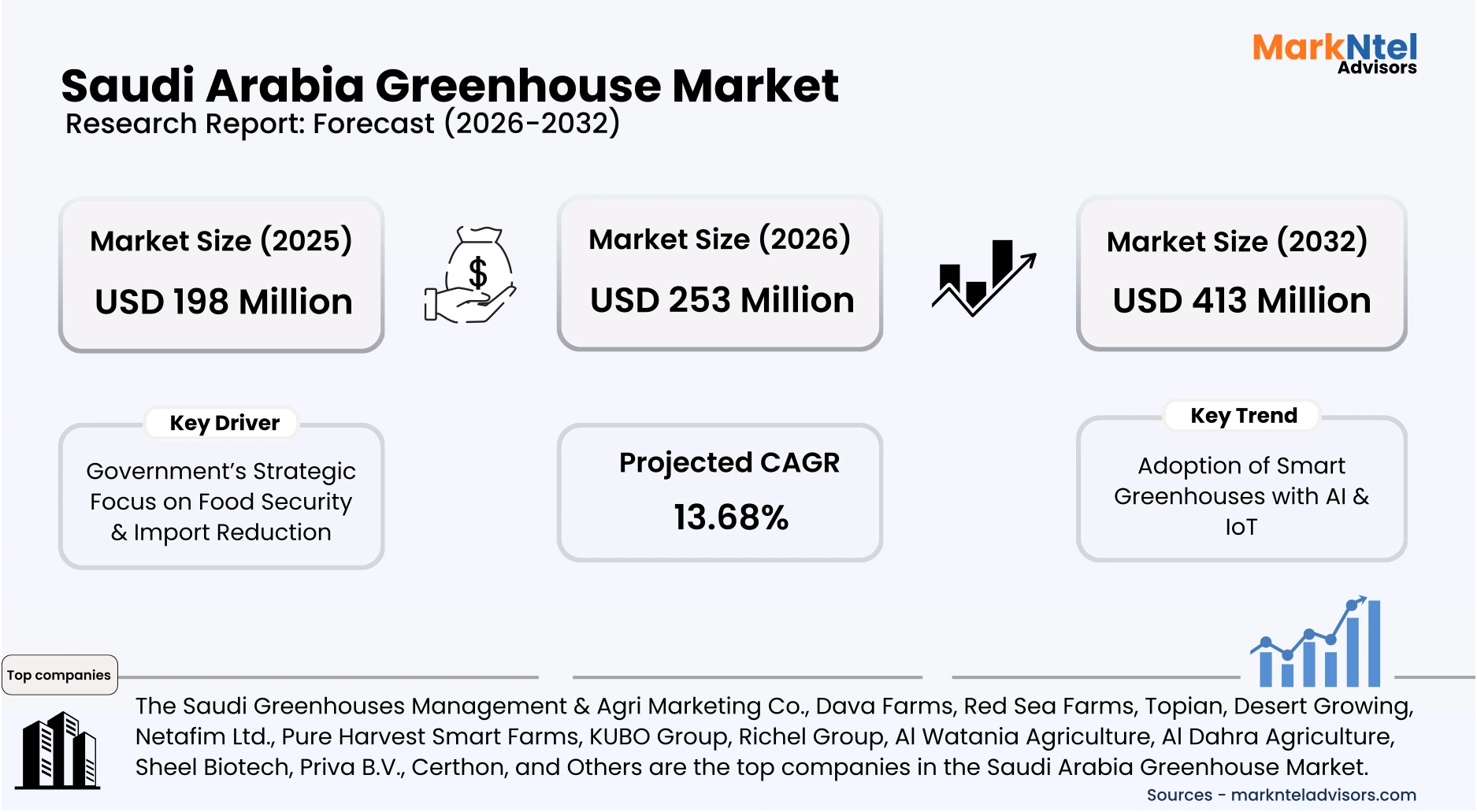
- The Saudi Arabia Greenhouse Market size was valued at USD 198 million in 2025 and is projected to grow from USD 253 million in 2026 to USD 413 million by 2032, exhibiting a CAGR of 13.68% during the forecast period.
- By greenhouse structure type, the free-standing greenhouses segment represented a significant share of about 55% in the Saudi Arabia Greenhouse Market in 2026.
- By end user, the commercial growers seized a significant share of about 63% in the Saudi Arabia Greenhouse Market in 2026.
- Leading greenhouse companies in Saudi Arabia are Saudi Greenhouses Management & Agri Marketing Co., Dava Farms, Red Sea Farms, Topian, Desert Growing, Netafim Ltd., Pure Harvest Smart Farms, KUBO Group, Richel Group, Al Watania Agriculture, Al Dahra Agriculture, Sheel Biotech, Priva B.V., Certhon, and Others.
Market Insights & Analysis: Saudi Arabia Greenhouse Market (2026-32):
The Saudi Arabia Greenhouse Market size was valued at around USD 198 million in 2025 and is projected to grow from USD 253 million in 2026 to USD 413 million by 2032. Along with this, the market is estimated to grow at a CAGR of around 13.68% during the forecast period, i.e., 2026-32.
The Saudi Arabia Greenhouse Market continues to expand steadily as part of the Kingdom’s strategic response to rising food security needs and import dependence. In 2024, greenhouse vegetable production in Saudi Arabia reached 797 thousand tons, registering a 10.6 % increase over 2023, with tomatoes and cucumbers as the leading crops. This increase reflects sustained growth in controlled‑environment cultivation and the expanding footprint of greenhouse infrastructure nationwide. Greenhouse cultivation in the Kingdom spanned around 7.8 thousand hectares with more than 121 thousand structures, indicating strong adoption of protected agriculture.
To further strengthen local produce supply, the Ministry of Environment, Water, and Agriculture has introduced urban vertical farms in Riyadh food markets. The initiative aims to establish 600–1,000 farms over the next five years, supplying an estimated 20–40 % of fresh vegetables that were traditionally imported, helping diversify food sources and improve availability in urban centers .
Alongside production growth, technology adoption is shaping the sector’s evolution. Saudi Arabia, in partnership with South Korea, launched a smart agriculture complex in Riyadh in 2025 that spans 4,000 m². The facility integrates AI, IoT, and vertical farming technologies to regulate irrigation, collect real‑time crop data, and optimize fertilizer use. This innovation boosts productivity, resource efficiency, and sustainability in greenhouse systems and represents a model for future high‑tech agriculture .
Private investment is also gaining momentum. In Hail’s Khotta region, an 85,000 m² polycarbonate greenhouse has entered its first development phase, focusing on tomatoes and strawberries. Initial plantings are scheduled for early 2026, and there are plans to expand capacity to 300,000 m², signaling strong investor confidence in greenhouse farming as a scalable domestic supply solution .
Overall, driven by rising greenhouse production, government initiatives to localize produce, integration of smart agriculture technologies, and growing private sector investment, the Saudi greenhouse market is poised for sustained growth. These trends are set to reinforce food security, reduce import dependency, and accelerate the adoption of advanced farming systems through 2030 and beyond.
Saudi Arabia Greenhouse Market Recent Developments:
- 2025: Saudi Greenhouses Management & Agri Marketing Co. partnered with NEOM food company Topian to establish a Horticulture Innovation Center at the University of Tabuk, advancing controlled‑environment agriculture research and sustainable greenhouse technology adoption between public and private sectors.
- 2025: The National Research and Development Center for Sustainable Agriculture (Estidamah) and Topian ran training programs in Riyadh on sustainable greenhouse management and operation, promoting best practices in climate‑controlled environments and boosting skilled workforce capacity across greenhouse operators.
Saudi Arabia Greenhouse Market Scope:
| Category | Segments |
|---|---|
| By Greenhouse Structure Type | (Free-Standing Greenhouse, Gutter-Connected Greenhouse), |
| By Production Model | (Hydroponic Greenhouses, Soil-Based Greenhouses, Vertical Farming Systems, Organic Greenhouses), |
| By Material | (Plastic, Glass), |
| By Technology | (Climate-Controlled Greenhouses, Automated / Smart Greenhouses), |
| By Energy Source | (Conventional Energy-Powered, Solar-Powered), |
| By Crop Type | (Fruits & Vegetables, Flowers & Ornamentals, Nursery Crops, Others), |
| By End-User | (Commercial Growers, Government & Institutional Farms, Research & Educational Institutes, Household / Small-Scale Growers, Others), |
Saudi Arabia Greenhouse Market Driver:
Government’s Strategic Focus on Food Security & Import Reduction
One of the most critical forces propelling the Saudi Arabia greenhouse market is the government’s strategic focus on food security and reducing reliance on food imports. Saudi Arabia’s arid climate, scarce arable land, and limited freshwater make conventional agriculture difficult, forcing the country to import as much as 80–85% of its food requirements, costing an estimated USD 27–32 billion annually as of early 2026 . This heavy reliance on imports exposes the Kingdom to global supply disruptions and price volatility, motivating state policy to expand domestic production capabilities.
Under Vision 2030, the Saudi government has elevated food self‑sufficiency targets, aiming to increase domestic production from approximately 20% toward 40% for key food categories by 2030. Controlled‑environment agriculture, including greenhouses, is central to this strategy because it enables year‑round cultivation of high‑value vegetables, herbs, and fruits with efficient water use, often up to 90% less than traditional farming through hydroponics and automated irrigation .
Government backing is substantial; the Agricultural Development Fund has approved over USD 1 billion in greenhouse investments to expand production capacity and technologies by 2025, targeting over 1 million tons of annual yield. Beyond 2025, Vision 2030 and the National Food Security Strategy continue to prioritize greenhouse and agri‑tech investments, with plans to integrate advanced climate control, desalination, and smart irrigation into the sector through 2030 and beyond .
Overall, transforming food security from vulnerability to resilience will drive continued investment in greenhouse infrastructure and technologies. As domestic production targets rise and reliance on imports declines, demand for efficient, high‑yield greenhouse systems will remain a cornerstone of Saudi Arabia’s agricultural growth.
Saudi Arabia Greenhouse Market Trend:
Adoption of Smart Greenhouses with AI & IoT
A major trend shaping the Saudi Arabia greenhouse market is the rapid adoption of smart greenhouse technologies that integrate artificial intelligence (AI) and the Internet of Things (IoT) to enhance productivity, resource efficiency, and sustainability. The Agricultural Development Fund (ADF) has invested approximately USD 220 million through 2025 to support high‑tech greenhouse farming nationwide, financing precision irrigation, automated climate control, and AI‑powered crop monitoring systems. These technologies have helped cut water use by up to 90% compared to traditional agriculture, aligning with the Kingdom’s water‑scarcity priorities .
In April 2025, the Ministry of Environment, Water and Agriculture, and the Republic of Korea jointly launched a 4,000 m² smart agriculture complex in Riyadh, embedding AI and IoT into greenhouses and vertical farms to optimize fertilizer use, regulate irrigation automatically, and significantly boost crop yields. The initiative also deploys AI‑enabled agricultural robots for data collection and harvesting processes.
Government programs emphasize smart agriculture’s role in Vision 2030, aiming to modernize food production and improve efficiency across the sector. High‑tech greenhouses now use real‑time sensor data to regulate temperature, humidity, and lighting, ensuring year‑round cultivation under desert conditions.
This trend reflects Saudi Arabia’s strategic move toward data‑driven, climate‑resilient agriculture by embedding IoT and AI into greenhouse systems, reducing operational costs, enhancing yields, and strengthening food‑security outcomes.
Saudi Arabia Greenhouse Market Opportunity:
Expansion of Organic and High-Value Specialty Crop Production
A significant opportunity in the Saudi Arabia greenhouse market lies in expanding organic and high‑value specialty crop production to meet rising domestic demand and strengthen export potential. According to the General Authority for Statistics, the total organic agriculture area reached 24,100 hectares in 2024, producing 98,300 tons of organic crops, up 3% year‑on‑year. This reflects growing investment in organic cultivation and consumer preference for safe, high‑nutritional produce . Organic farming also enjoys government recognition and an official Saudi National Organic Products Label, signaling regulatory support for quality and traceability.
Greenhouse programs support this opportunity by producing vegetables such as tomatoes and cucumbers with higher yields under controlled conditions, while organic practices enhance quality and market value. The Ministry of Environment, Water, and Agriculture has encouraged these practices as part of broader sustainable farming goals, which aim to balance resource efficiency with increased food output.
Beyond conventional vegetables, greenhouse cultivation combined with organic and specialty crop systems can target high‑value products like herbs, berries, and niche produce that command premium prices domestically and internationally. As local organic output expands and consumer awareness grows, Saudi growers can leverage this for regional exports focused on quality and sustainability.
Overall, expanding organic and specialty crops through greenhouse technologies positions the Saudi agriculture sector for premium market access and export growth, while meeting consumer demand for safe, high‑value food.
Saudi Arabia Greenhouse Market Challenge:
Requirement of High Initial Investment
A major challenge for the Saudi Arabia greenhouse market is the very high upfront investment required to establish advanced greenhouse facilities. Modern climate‑controlled greenhouses in the Kingdom designed to cope with extreme heat and water scarcity often involve sophisticated infrastructure like automated cooling, precision irrigation, and energy‑efficient systems. According to official planning data, the Agricultural Development Fund and the Ministry of Environment, Water, and Agriculture have outlined expansion plans that involve more than USD 1 billion in greenhouse sector investments through 2025, illustrating the scale of capital flowing into high‑tech greenhouse projects .
Government programs attempt to alleviate cost burdens by subsidizing much of the capital investment in some cases, covering up to 70–75% of project costs, yet the remaining share still demands large private financing and can deter smaller farmers from entering the market. Data indicate that advanced greenhouse construction costs can exceed around USD 1.2 million per hectare, reflecting the premium nature of controlled‑environment agriculture in desert climates.
These high costs extend beyond physical structures to include energy systems, climate control technology, and skilled workforce requirements. Smaller and medium‑scale producers may find it difficult to secure the necessary financing or achieve a reasonable return on investment in the short term without significant government support.
Overall, the costly initial investment for advanced greenhouses limits broader participation, concentrating high‑tech greenhouse adoption among larger entities and requiring continued government incentives to expand equitable market growth.
Saudi Arabia Greenhouse Market (2026-32) Segmentation Analysis:
The Saudi Arabia Greenhouse Market study of MarkNtel Advisors evaluates & highlights the major trends and influencing factors in each segment. It includes predictions for the period 2026–32 at the country level. Based on the analysis, the market has been further classified as;
Based on Greenhouse Structure Type:
- Free-Standing Greenhouses
- Gutter-Connected Greenhouses
Free-standing greenhouses lead the Saudi Arabia market with a 55% share due to their adaptability, scalability, and efficiency. Unlike gutter-connected greenhouses, these structures are independent units, allowing them to be constructed on diverse terrains without affecting neighboring units. They offer superior climate control, pest management, and irrigation efficiency, which are critical for high-value crops such as tomatoes, cucumbers, and strawberries.
Free-standing greenhouses also allow gradual expansion as production needs grow, reducing financial risk for investors and enabling better crop rotation and disease management. Their flexibility makes them suitable for both small-scale and large commercial operations, attracting private investment in the high-tech greenhouse sector. These advantages, coupled with government incentives for greenhouse cultivation under Vision 2030, make free-standing greenhouses the preferred choice for maximizing yield, quality, and operational efficiency.
Based on End User:
- Commercial Growers
- Government & Institutional Farms
- Research & Educational Institutes
- Household / Small-Scale Growers
- Others
Commercial growers dominate the market with a 63% share, reflecting the professionalization and large-scale adoption of greenhouse farming in Saudi Arabia. These growers leverage advanced technologies such as automated climate control, hydroponics, and IoT-enabled monitoring systems to optimize crop yield, quality, and resource efficiency. Commercial operations benefit from economies of scale, access to government subsidies, and collaborations with agri-tech providers, allowing them to produce fruits, vegetables, and high-value crops year-round. Their focus on profitability, efficiency, and consistent supply positions them as the primary market segment driving demand for modern greenhouse structures and technologies. By investing in high-tech infrastructure and innovative farming practices, commercial growers also contribute directly to national food security goals, reducing reliance on imports while promoting sustainable and efficient agricultural production.
Saudi Arabia Greenhouse Market (2026-32): Regional Projection
The Saudi Arabia greenhouse market is dominated by the Riyadh and Eastern Province regions, which account for the majority of greenhouse production and investment. These regions lead due to favorable infrastructure, access to key domestic markets, and proximity to government support programs promoting high-tech agriculture. Riyadh, as the capital, has a concentration of commercial growers and urban vertical farm initiatives, while the Eastern Province benefits from large-scale agricultural projects and private investments in controlled-environment farming.
For example, several smart greenhouse projects in Riyadh integrate AI and IoT technologies for precision irrigation and climate control, ensuring high yields year-round. Similarly, the Eastern Province hosts large polycarbonate greenhouse projects focusing on tomatoes and strawberries, signaling investor confidence and scalability. The combination of strong logistics, water management facilities, and government incentives has made these regions the primary hubs of greenhouse cultivation, driving overall growth and adoption of advanced greenhouse technologies across the Kingdom.
Gain a Competitive Edge with Our Saudi Arabia Greenhouse Market Report:
- Saudi Arabia Greenhouse Market Report by MarkNtel Advisors provides a detailed & thorough analysis of market size & share, growth rate, competitive landscape, and key players. This comprehensive analysis helps businesses gain a holistic understanding of the market dynamics & make informed decisions.
- This report also highlights current market trends & future projections, allowing businesses to identify emerging opportunities & potential challenges. By understanding market forecasts, companies can align their strategies & stay ahead of the competition.
- Saudi Arabia Greenhouse Market Report aids in assessing & mitigating risks associated with entering or operating in the market. By understanding market dynamics, regulatory frameworks, and potential challenges, businesses can develop strategies to minimize risks & optimize their operations.
*Reports Delivery Format - Market research studies from MarkNtel Advisors are offered in PDF, Excel and PowerPoint formats. Within 24 hours of the payment being successfully received, the report will be sent to your email address.
Frequently Asked Questions
- Market Segmentation
- Introduction
- Product Definition
- Research Process
- Assumptions
- Executive Summary
- Saudi Arabia Greenhouse Market Policies, Regulations, and Product Standards
- Saudi Arabia Greenhouse Market Trends & Developments
- Saudi Arabia Greenhouse Market Dynamics
- Growth Factors
- Challenges
- Saudi Arabia Greenhouse Market Hotspot & Opportunities
- Saudi Arabia Greenhouse Market Outlook, 2022-2032F
- Market Size & Outlook
- By Revenues (USD Million)
- Market Share & Outlook
- By Greenhouse Structure Type- Market Size & Forecast 2022-2032, USD Million
- Free-Standing Greenhouse
- Gutter-Connected Greenhouse
- By Production Model- Market Size & Forecast 2022-2032, USD Million
- Hydroponic Greenhouses
- Soil-Based Greenhouses
- Vertical Farming Systems
- Organic Greenhouses
- By Material- Market Size & Forecast 2022-2032, USD Million
- Plastic
- Polyethylene
- Polycarbonate
- Polymethyl Methacrylate (PMMA)
- Glass
- Horticulture
- Others
- Plastic
- By Technology- Market Size & Forecast 2022-2032, USD Million
- Climate-Controlled Greenhouses
- Automated / Smart Greenhouses
- By Energy Source- Market Size & Forecast 2022-2032, USD Million
- Conventional Energy-Powered
- Solar-Powered
- By Crop Type- Market Size & Forecast 2022-2032, USD Million
- Fruits & Vegetables
- Flowers & Ornamentals
- Nursery Crops
- Others
- By End-User- Market Size & Forecast 2022-2032, USD Million
- Commercial Growers
- Government & Institutional Farms
- Research & Educational Institutes
- Household / Small-Scale Growers
- Others
- By Region- Market Size & Forecast 2022-2032, USD Million
- East
- West
- South
- Central
- By Company
- Competition Characteristics
- Market Share & Analysis
- By Greenhouse Structure Type- Market Size & Forecast 2022-2032, USD Million
- Market Size & Outlook
- Saudi Arabia Free-Standing Greenhouse Market Outlook, 2022-2032
- Market Size & Outlook
- By Revenues (USD Million)
- Market Share & Outlook
- By Production Model- Market Size & Forecast 2022-2032, USD Million
- By Material- Market Size & Forecast 2022-2032, USD Million
- By Technology- Market Size & Forecast 2022-2032, USD Million
- By Energy Source- Market Size & Forecast 2022-2032, USD Million
- By Crop Type- Market Size & Forecast 2022-2032, USD Million
- By End-User- Market Size & Forecast 2022-2032, USD Million
- By Region- Market Size & Forecast 2022-2032, USD Million
- Market Size & Outlook
- Saudi Arabia Gutter-Connected Greenhouse Market Outlook, 2022-2032
- Market Size & Outlook
- By Revenues (USD Million)
- Market Share & Outlook
- By Production Model- Market Size & Forecast 2022-2032, USD Million
- By Material- Market Size & Forecast 2022-2032, USD Million
- By Technology- Market Size & Forecast 2022-2032, USD Million
- By Energy Source- Market Size & Forecast 2022-2032, USD Million
- By Crop Type- Market Size & Forecast 2022-2032, USD Million
- By End-User- Market Size & Forecast 2022-2032, USD Million
- By Region- Market Size & Forecast 2022-2032, USD Million
- Market Size & Outlook
- Saudi Arabia Greenhouse Market Key Strategic Imperatives for Success & Growth
- Competitive Outlook
- Company Profiles
- Saudi Greenhouses Management & Agri Marketing Co.
- Business Description
- Product Portfolio
- Collaborations & Alliances
- Recent Developments
- Financial Details
- Others
- Dava Farms
- Business Description
- Product Portfolio
- Collaborations & Alliances
- Recent Developments
- Financial Details
- Others
- Red Sea Farms
- Business Description
- Product Portfolio
- Collaborations & Alliances
- Recent Developments
- Financial Details
- Others
- Topian
- Business Description
- Product Portfolio
- Collaborations & Alliances
- Recent Developments
- Financial Details
- Others
- Desert Growing
- Business Description
- Product Portfolio
- Collaborations & Alliances
- Recent Developments
- Financial Details
- Others
- Netafim Ltd.
- Business Description
- Product Portfolio
- Collaborations & Alliances
- Recent Developments
- Financial Details
- Others
- Pure Harvest Smart Farms
- Business Description
- Product Portfolio
- Collaborations & Alliances
- Recent Developments
- Financial Details
- Others
- KUBO Group
- Business Description
- Product Portfolio
- Collaborations & Alliances
- Recent Developments
- Financial Details
- Others
- Richel Group
- Business Description
- Product Portfolio
- Collaborations & Alliances
- Recent Developments
- Financial Details
- Others
- Al Watania Agriculture
- Business Description
- Product Portfolio
- Collaborations & Alliances
- Recent Developments
- Financial Details
- Others
- Al Dahra Agriculture
- Business Description
- Product Portfolio
- Collaborations & Alliances
- Recent Developments
- Financial Details
- Others
- Sheel Biotech
- Business Description
- Product Portfolio
- Collaborations & Alliances
- Recent Developments
- Financial Details
- Others
- Priva B.V.
- Business Description
- Product Portfolio
- Collaborations & Alliances
- Recent Developments
- Financial Details
- Others
- Certhon
- Business Description
- Product Portfolio
- Collaborations & Alliances
- Recent Developments
- Financial Details
- Others
- Saudi Greenhouses Management & Agri Marketing Co.
- Company Profiles
- Disclaimer
MarkNtel Advisors follows a robust and iterative research methodology designed to ensure maximum accuracy and minimize deviation in market estimates and forecasts. Our approach combines both bottom-up and top-down techniques to effectively segment and quantify various aspects of the market. A consistent feature across all our research reports is data triangulation, which examines the market from three distinct perspectives to validate findings. Key components of our research process include:
1. Scope & Research Design At the outset, MarkNtel Advisors define the research objectives and formulate pertinent questions. This phase involves determining the type of research—qualitative or quantitative—and designing a methodology that outlines data collection methods, target demographics, and analytical tools. They also establish timelines and budgets to ensure the research aligns with client goals.
2. Sample Selection and Data Collection In this stage, the firm identifies the target audience and determines the appropriate sample size to ensure representativeness. They employ various sampling methods, such as random or stratified sampling, based on the research objectives. Data collection is carried out using tools like surveys, interviews, and observations, ensuring the gathered data is reliable and relevant.
3. Data Analysis and Validation Once data is collected, MarkNtel Advisors undertake a rigorous analysis process. This includes cleaning the data to remove inconsistencies, employing statistical software for quantitative analysis, and thematic analysis for qualitative data. Validation steps are taken to ensure the accuracy and reliability of the findings, minimizing biases and errors.

4. Data Forecast and FinalizationThe final phase involves forecasting future market trends based on the analyzed data. MarkNtel Advisors utilize predictive modeling and time series analysis to anticipate market behaviors. The insights are then compiled into comprehensive reports, featuring visual aids like charts and graphs, and include strategic recommendations to inform client decision-making
We offer flexible licensing options to cater to varying organizational needs. Choose the pricing pack that best suits your requirements:
Buy Now Inquire Before Buying
 Request Customization
 Talk to our Consultant







