

Global Rapid Food Testing Market Research Report Forecast (2026-2032)
Rapid Food Testing Market - By Testing Technology (Traditional Methods, Culture-Based Techniques, Chemical Titration), Advanced Methods, Rapid Testing, PCR (Polymerase Chain Reacti ... on), Chromatography (HPLC, GC-MS), Spectroscopy (NMR, FTIR), Immunoassays (ELISA), Next-Generation Sequencing (NGS), Biosensors, Atomic Absorption Spectroscopy, Microarray / Lab-on-Chip Platforms, Other Rapid Technologies), By Target Contaminant (Pathogens, Mycotoxins, Pesticide Residues, Antibiotic & Veterinary Drug Residues, Allergens, Heavy Metals, Others), By Offering (Diagnostic Instruments / Analyzers, Test Kits & Reagents, Services), By Food Testing (Meat & Seafood Products, Dairy Products, Processed Foods, Fruits & Vegetables, Others), By Test Duration (Less than 30 Minutes, 30–60 Minutes, More than 60 Minutes), By End-User (Food & Beverage Manufacturers, Food Retail & Distribution, Government & Regulatory Agencies, Food Testing Laboratories & Third-Party Testing, Horeca (Hotels, Restaurants, Cafés), Agriculture & Farming Sector, Others), Read more
- Food & Beverages
- Mar 2026
- Pages 443
- Report Format: PDF, Excel, PPT
Global Rapid Food Testing Market
Projected 7.66% CAGR from 2026 to 2032
Study Period
2026-2032
Market Size (2026)
USD 18.9 Billion
Market Size (2032)
USD 29.43 Billion
Largest Region
Europe
Projected CAGR
7.66%
Leading Segments
By Food Testing: Dairy Products
Global Rapid Food Testing Market Report Key Takeaways:
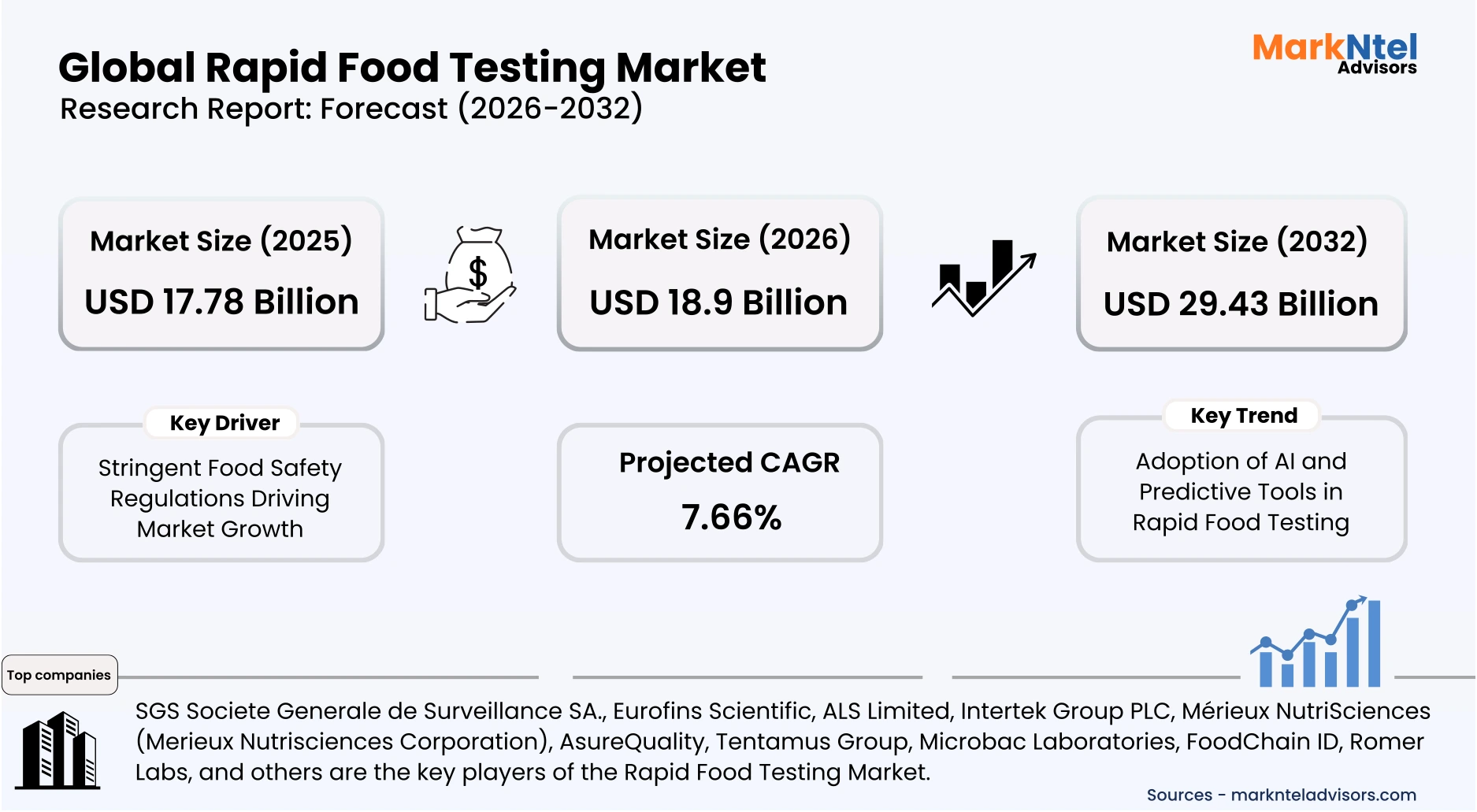
- The Global Rapid Food Testing Market size was valued at around USD 17.78 billion in 2025 and is projected to grow from USD 18.9 billion to USD 29.43 billion by 2032. The estimated CAGR from 2026 to 2032 is around 7.66%, indicating strong growth.
- By Food Testing, the dairy products segment holds 28% share of the Global Rapid Food Testing Market in 2026. Meat and seafood products emerged as the fastest-growing segment.
- By Target Contaminant, the pathogens represented 34% of the Global Rapid Food Testing Market size in 2026.
- By Region, Europe leads the Global Rapid Food Testing Market with a substantial 39% market share in 2026.
- The leading rapid food testing companies are SGS Societe Generale de Surveillance SA., Eurofins Scientific, ALS Limited, Intertek Group PLC, Mérieux NutriSciences (Merieux Nutrisciences Corporation), AsureQuality, Tentamus Group, Microbac Laboratories, FoodChain ID, Romer Labs, and others.
Market Insights & Analysis: Global Rapid Food Testing Market (2026- 2032):
The Global Rapid Food Testing Market size was valued at around USD 17.78 billion in 2025 and is projected to grow from USD 18.9 billion to USD 29.43 billion by 2032. Along with this, the market is estimated to grow at a CAGR of around 7.66% during the forecast period, i.e., 2026-32.
The Global Rapid Food Testing Market is experiencing rapid growth, driven by tightening regulatory compliance requirements and the increasing use of artificial intelligence and predictive analytics to enhance contamination detection and quality control.
Policymakers are increasingly prioritizing preventive risk management, traceability, and real-time verification, thereby reinforcing the need for rapid, high-accuracy analytical platforms across laboratories, processing facilities, and import-export control environments.
In the United States FDA has extended the compliance timeline for the FSMA Food Traceability Final Rule by 30 months while reaffirming its commitment to full implementation. Once enforced, the regulation will require detailed traceability recordkeeping and rapid data accessibility to support foodborne illness investigations and outbreak response. This reinforces the regulatory shift toward faster detection, real-time tracking, and accelerated follow-up testing, making rapid analytical and digital traceability solutions essential for achieving compliance across high-risk food categories.
At the global policy level, the Codex Alimentarius Commission’s adoption of enhanced safety, hygiene, and product-quality standards including measures covering traditional markets, seafood toxin prevention, and refined oil specifications is elevating international compliance benchmarks and expanding the scope of government-mandated surveillance testing across traded food categories.
Simultaneously, technological modernization is transforming food safety testing as manufacturers adopt AI-powered computer vision and predictive analytics to enhance defect detection, contamination screening accuracy, and automated production-line decision-making. For instance, PepsiCo has deployed AI-powered computer vision systems across its snack manufacturing facilities to automate product defect inspection. These systems enhance contamination and defect detection accuracy by nearly 95%, reducing dependence on manual inspection while significantly improving production throughput, quality consistency, and food safety compliance across processing operations.
Beyond 2025, forward-linked public investment commitments are expected to reinforce market expansion. For instance, India has launched a national digital traceability framework for fisheries and aquaculture to enhance export competitiveness and support seafood exports projected to reach USD 121 million by 2030, strengthening compliance, transparency, and adoption of rapid testing and digital monitoring across value chains.
Meanwhile, in Europe, the EU-funded FoodSafeR initiative is developing AI-enabled tools and machine-learning frameworks to enhance predictive microbiology, proactive hazard surveillance, and faster response to emerging food safety risks, strengthening data-driven safety governance across Europe beyond 2025.
Collectively, these policy reforms, digital traceability initiatives, and AI-enabled infrastructures are reshaping food safety governance and compliance expectations, making systems faster and more preventive and driving accelerating demand for rapid food testing across regulatory, industrial, and laboratory environments worldwide.
Global Rapid Food Testing Market Recent Developments:
- December 2025: Hardy Diagnostics has formed a strategic partnership with Switzerland-based NEMIS Technologies to introduce the N-Light™ rapid on-site pathogen detection platform across North America. The collaboration enhances food safety programs by enabling faster, chemiluminescence-based screening for contaminants at production facilities, supporting proactive risk mitigation and quality assurance.
- March 2025: Bio-Rad Laboratories introduced its XP-Design Assay Salmonella Serotyping Solution, a real-time PCR–based platform designed to deliver faster and more accurate detection and serotyping of Salmonella in food and environmental samples. The solution supports stronger surveillance, compliance, and risk-management across food safety operations.
Global Rapid Food Testing Market Scope:
| Category | Segments |
|---|---|
| By Testing Technology | Traditional Methods, Culture-Based Techniques, Chemical Titration), Advanced Methods, Rapid Testing, PCR (Polymerase Chain Reaction), Chromatography (HPLC, GC-MS), Spectroscopy (NMR, FTIR), Immunoassays (ELISA), Next-Generation Sequencing (NGS), Biosensors, Atomic Absorption Spectroscopy, Microarray / Lab-on-Chip Platforms, Other Rapid Technologies), |
| By Target Contaminant | Pathogens, Mycotoxins, Pesticide Residues, Antibiotic & Veterinary Drug Residues, Allergens, Heavy Metals, Others), |
| By Offering | Diagnostic Instruments / Analyzers, Test Kits & Reagents, Services), |
| By Food Testing | Meat & Seafood Products, Dairy Products, Processed Foods, Fruits & Vegetables, Others), |
| By Test Duration | Less than 30 Minutes, 30–60 Minutes, More than 60 Minutes), |
| By End-User | Food & Beverage Manufacturers, Food Retail & Distribution, Government & Regulatory Agencies, Food Testing Laboratories & Third-Party Testing, Horeca (Hotels, Restaurants, Cafés), Agriculture & Farming Sector, Others), |
Global Rapid Food Testing Market Drivers:
Stringent Food Safety Regulations Driving Market Growth
Stringent global food safety regulations are accelerating the adoption of rapid, high-accuracy testing and shifting systems from reactive enforcement to preventive, time-bound verification, compelling supply-chain stakeholders to deploy faster diagnostic solutions.
In the United States, the FDA’s Food Safety Modernization Act (FSMA) reinforces preventive controls, enhanced inspection frequency, and end-to-end traceability of high-risk foods. The FSMA Food Traceability Final Rule requires detailed recordkeeping of Key Data Elements and Critical Tracking Events, effectively demanding rapid laboratory testing and faster reporting cycles to support the timely removal of potentially contaminated products from circulation.
Across Europe, Regulation (EC) No. 178/2002 under the General Food Law establishes comprehensive safety oversight across every stage of the supply chain, supported by EFSA’s scientific risk-assessment framework. Recent EU updates aligning pesticide Maximum Residue Levels with Codex standards further institutionalize frequent, government-monitored testing to safeguard consumer health.
In India, the Food Safety and Standards Authority of India (FSSAI) 2025 Import Amendment Regulations mandate validated testing methods and five-day reporting timelines for imported foods, signaling a regulatory shift toward accelerated testing, compliance precision, and laboratory modernization.
Looking ahead, global authorities are investing in laboratory capacity, accreditation systems, digital traceability platforms, and mobile testing infrastructure to enable real-time surveillance and rapid compliance verification.
Tighter regulations, shorter reporting windows, and mandatory validated testing are structurally increasing testing volumes worldwide, driving sustained growth in the rapid food testing market and reinforcing the transition toward faster, science-based food safety systems.
Global Rapid Food Testing Market Trends:
Adoption of AI and Predictive Tools in Rapid Food Testing
The integration of artificial intelligence (AI), machine learning (ML), and predictive analytics into food safety ecosystems is emerging as a transformative trend, enabling a proactive rather than reactive approach to contamination control and outbreak prevention.
Governments and public health authorities are increasingly institutionalizing these technologies within regulatory and surveillance frameworks to strengthen risk detection, traceability, and compliance oversight across the global food supply chain.
In the United States, the FDA’s “New Era of Smarter Food Safety” blueprint prioritizes investments in big data platforms, predictive risk models, and AI-enabled monitoring tools to improve the speed and precision of outbreak prediction and response. By leveraging advanced analytics to identify anomalies and behavioral patterns linked to contamination events, regulators are shifting toward anticipatory prevention strategies instead of post-event intervention.
Complementing this, the U.S. CDC is advancing initiatives to deploy scalable AI/ML-driven systems that enhance operational intelligence and strengthen surveillance of infectious and foodborne diseases through internal innovation accelerators and digital public-health infrastructure.
Industry adoption is advancing in parallel, with genomics-based testing innovators such as Clear Labs applying AI and next-generation sequencing (NGS) to automate pathogen detection and verify product authenticity. These platforms enable faster, higher-resolution insights, reduce manual error, and improve laboratory throughput, reinforcing data-driven decision-making across quality and safety operations.
Collectively, these investments signal a structural shift toward intelligent, analytics-centric food safety systems that enhance reliability, resilience, and consumer protection across modern supply chains.
Global Rapid Food Testing Market Challenges:
High Cost of Advanced Technologies Impeding Market Growth
The high cost of advanced analytical technologies remains a major constraint to widespread adoption in the rapid food testing market, particularly for SMEs and resource-limited laboratories in developing regions.
Capital investments for modern diagnostic systems are substantial; for example, spectrophotometers alone can range from about USD 1,500 to over USD 50,000, with basic UV-Vis models priced around USD 1,500–5,000, mid-range systems USD 5,000–15,000, and high-end or automated fluorescence-enabled units exceeding USD 15,000–50,000+. Costs rise further with higher sensitivity, broader wavelength capacity, and digital automation features.
Beyond acquisition, operational expenditure significantly increases the financial burden. Laboratories must account for recurring costs associated with calibration, specialized reagents, maintenance contracts, software upgrades, and skilled technician training.
In many cases, per-sample testing costs for advanced platforms remain higher than conventional microbiological methods, discouraging smaller producers from frequent or preventive testing practices despite regulatory expectations.
The financial intensity of procuring and operating sophisticated rapid testing technologies limits accessibility for smaller market participants, slows modernization of testing infrastructure, and may hinder uniform regulatory compliance, ultimately restraining broader market expansion.
Global Rapid Food Testing Market (2026-32) Segmentation Analysis:
The Global Rapid Food Testing Market Report and Forecast 2026-2032 offers a detailed analysis of the market based on the following segments:
Based on Food Testing:
- Meat & Seafood Products
- Dairy Products
- Processed Foods
- Fruits & Vegetables
- Others
The dairy products segment holds the top spot in the Global Rapid Food Testing Market, with a market share of around 28%, owing to their high perishability, complex microbiological risk profile, and intensive regulatory monitoring requirements.
Products such as milk, cheese, yogurt, butter, infant formula, and milk powders are highly susceptible to pathogenic contamination (including Listeria, Salmonella, and E. coli), adulteration incidents, antibiotic and veterinary drug residues, and spoilage microorganisms. These risk factors necessitate frequent, batch-level, and time-sensitive testing across production, storage, transport, and retail stages.
Moreover, dairy processing environments operate on continuous production cycles and cold-chain logistics, reinforcing the need for rapid microbial screening, residue detection, compositional authenticity verification, and shelf-life stability testing.
Regulatory authorities such as the FDA, EFSA, FSSAI, and Codex Alimentarius mandate strict compliance programs for hygiene monitoring, contaminant limits, and traceability, which further elevate routine testing intensity compared with other food categories.
Consequently, the combination of elevated safety risk exposure, stringent regulatory enforcement, and high consumption volumes positions dairy products as the dominant segment driving demand for rapid food testing solutions.
Based on Target Contaminant:
- Pathogens
- Mycotoxins
- Pesticide Residues
- Antibiotic & Veterinary Drug Residues
- Allergens
- Heavy Metals
- Others
The pathogens category leads the Global Rapid Food Testing Industry with a 34% market share, owing to their significant public-health risk and stringent global regulatory oversight.
Bacterial contaminants such as Salmonella, Listeria, and E. coli are closely associated with high-profile foodborne illness outbreaks, hospitalizations, and economic losses across meat, dairy, produce, and ready-to-eat segments.
As governments tighten microbiological standards and mandate routine hazard-based monitoring under frameworks such as HACCP and ISO-aligned food safety programs, food processors, laboratories, and inspection agencies are prioritizing pathogen detection as a core compliance requirement.
Additionally, the expansion of international food trade, growing recall sensitivity, and heightened consumer expectations for safety and traceability are accelerating investment in rapid molecular diagnostics, culture-independent testing, and automated microbial surveillance systems.
Collectively, these factors reinforce the criticality of pathogen screening within preventive food safety strategies, driving its dominant contribution to overall testing demand across global regulatory, industrial, and commercial testing environments.
Global Rapid Food Testing Market (2026-32): Regional Projection
The Global Rapid Food Testing Market is dominated by the Europe region, which holds a commanding 39% market share, underpinned by its highly institutionalized food-safety governance framework, advanced industrial capabilities, and strong public-health oversight culture.
The region operates under some of the world’s most stringent regulatory mandates, led by the European Food Safety Authority (EFSA) and EU General Food Law, which enforce rigorous standards for traceability, contamination monitoring, and risk-based surveillance across the entire agri-food supply chain.
Europe’s expansive processed-food industry, high per-capita consumption, and extensive intra-regional and export-oriented trade activity further elevate the frequency and technical depth of testing requirements.
In addition, the region benefits from a dense network of accredited laboratories, early and widespread adoption of rapid analytical platforms, and sustained investments in molecular diagnostics, automation, and digital quality-assurance systems. Growing consumer expectations for transparency, retailer-driven quality audits, and structured recall mechanisms continue to reinforce recurring testing demand.
Collectively, these structural, regulatory, and technological advantages consolidate Europe’s position as the dominant and most advanced regional market participant.
Gain a Competitive Edge with Our Global Rapid Food Testing Market Report
- Global Rapid Food Testing Market Report by MarkNtel Advisors provides a detailed & thorough analysis of market size & share, growth rate, competitive landscape, and key players. This comprehensive analysis helps businesses gain a holistic understanding of the market dynamics & make informed decisions.
- This report also highlights current market trends & future projections, allowing businesses to identify emerging opportunities & potential challenges. By understanding market forecasts, companies can align their strategies & stay ahead of the competition.
- Global Rapid Food Testing Market Report aids in assessing & mitigating risks associated with entering or operating in the market. By understanding market dynamics, regulatory frameworks, and potential challenges, businesses can develop strategies to minimize risks & optimize their operations.
*Reports Delivery Format - Market research studies from MarkNtel Advisors are offered in PDF, Excel and PowerPoint formats. Within 24 hours of the payment being successfully received, the report will be sent to your email address.
Frequently Asked Questions
- Market Segmentation
- Introduction
- Product Definition
- Research Process
- Assumptions
- Executive Summary
- Global Rapid Food Testing Market Policies, Regulations, and Product Standards
- Global Rapid Food Testing Market Supply Chain Analysis
- Global Rapid Food Testing Market Import & Export Analysis
- Global Rapid Food Testing Market Trends & Developments
- Global Rapid Food Testing Market Dynamics
- Growth Drivers
- Challenges
- Global Rapid Food Testing Market Hotspot & Opportunities
- Global Rapid Food Testing Market Outlook, 2022-2032
- Market Size & Outlook
- By Revenues (USD Million)
- Market Share & Outlook
- By Testing Technology – Market Size & Forecast 2022-2032, USD Million
- Traditional Methods
- Culture-Based Techniques
- Chemical Titration
- Advanced Methods
- Rapid Testing
- PCR (Polymerase Chain Reaction)
- Chromatography (HPLC, GC-MS)
- Spectroscopy (NMR, FTIR)
- Immunoassays (ELISA)
- Next-Generation Sequencing (NGS)
- Biosensors
- Atomic Absorption Spectroscopy
- Microarray / Lab-on-Chip Platforms
- Other Rapid Technologies
- Traditional Methods
- By Target Contaminant – Market Size & Forecast 2022-2032, USD Million
- Pathogens
- Mycotoxins
- Pesticide Residues
- Antibiotic & Veterinary Drug Residues
- Allergens
- Heavy Metals
- Others
- By Offering – Market Size & Forecast 2022-2032, USD Million
- Diagnostic Instruments / Analyzers
- Test Kits & Reagents
- Services
- By Food Testing – Market Size & Forecast 2022-2032, USD Million
- Meat & Seafood Products
- Dairy Products
- Processed Foods
- Fruits & Vegetables
- Others
- By Test Duration – Market Size & Forecast 2022-2032, USD Million
- Less than 30 Minutes
- 30–60 Minutes
- More than 60 Minutes
- By End-User – Market Size & Forecast 2022-2032, USD Million
- Food & Beverage Manufacturers
- Food Retail & Distribution
- Government & Regulatory Agencies
- Food Testing Laboratories & Third-Party Testing
- Horeca (Hotels, Restaurants, Cafés)
- Agriculture & Farming Sector
- Others
- By Region
- North America
- South America
- Europe
- Middle East & Africa
- Asia-Pacific
- By Company
- Competition Characteristics
- Market Share & Analysis
- By Testing Technology – Market Size & Forecast 2022-2032, USD Million
- Market Size & Outlook
- North America Rapid Food Testing Market Outlook, 2021-2032F
- Market Size & Analysis
- By Revenue (USD Million)
- Market Share & Analysis
- By Testing Technology – Market Size & Forecast 2022-2032, USD Million
- By Target Contaminant – Market Size & Forecast 2022-2032, USD Million
- By Offering – Market Size & Forecast 2022-2032, USD Million
- By Food Testing – Market Size & Forecast 2022-2032, USD Million
- By Test Duration – Market Size & Forecast 2022-2032, USD Million
- By End-User – Market Size & Forecast 2022-2032, USD Million
- By Country
- The US
- Canada
- Mexico
- The US Rapid Food Testing Market Outlook, 2021-2032F
- Market Size & Analysis
- By Revenue (USD Million)
- Market Share & Analysis
- By Testing Technology – Market Size & Forecast 2022-2032, USD Million
- By Target Contaminant – Market Size & Forecast 2022-2032, USD Million
- By Offering – Market Size & Forecast 2022-2032, USD Million
- By Food Testing – Market Size & Forecast 2022-2032, USD Million
- By Test Duration – Market Size & Forecast 2022-2032, USD Million
- By End-User – Market Size & Forecast 2022-2032, USD Million
- Market Size & Analysis
- Canada Rapid Food Testing Market Outlook, 2021-2032F
- Market Size & Analysis
- By Revenue (USD Million)
- Market Share & Analysis
- By Testing Technology – Market Size & Forecast 2022-2032, USD Million
- By Target Contaminant – Market Size & Forecast 2022-2032, USD Million
- By Offering – Market Size & Forecast 2022-2032, USD Million
- By Food Testing – Market Size & Forecast 2022-2032, USD Million
- By Test Duration – Market Size & Forecast 2022-2032, USD Million
- By End-User – Market Size & Forecast 2022-2032, USD Million
- Market Size & Analysis
- Mexico Rapid Food Testing Market Outlook, 2021-2032F
- Market Size & Analysis
- By Revenue (USD Million)
- Market Share & Analysis
- By Testing Technology – Market Size & Forecast 2022-2032, USD Million
- By Target Contaminant – Market Size & Forecast 2022-2032, USD Million
- By Offering – Market Size & Forecast 2022-2032, USD Million
- By Food Testing – Market Size & Forecast 2022-2032, USD Million
- By Test Duration – Market Size & Forecast 2022-2032, USD Million
- By End-User – Market Size & Forecast 2022-2032, USD Million
- Market Size & Analysis
- Market Size & Analysis
- South America Rapid Food Testing Market Outlook, 2021-2032F
- Market Size & Analysis
- By Revenue (USD Million)
- Market Share & Analysis
- By Testing Technology – Market Size & Forecast 2022-2032, USD Million
- By Target Contaminant – Market Size & Forecast 2022-2032, USD Million
- By Offering – Market Size & Forecast 2022-2032, USD Million
- By Food Testing – Market Size & Forecast 2022-2032, USD Million
- By Test Duration – Market Size & Forecast 2022-2032, USD Million
- By End-User – Market Size & Forecast 2022-2032, USD Million
- By Country
- Brazil
- Argentina
- Rest of South America
- Brazil Rapid Food Testing Market Outlook, 2021-2032F
- Market Size & Analysis
- By Revenue (USD Million)
- Market Share & Analysis
- By Testing Technology – Market Size & Forecast 2022-2032, USD Million
- By Target Contaminant – Market Size & Forecast 2022-2032, USD Million
- By Offering – Market Size & Forecast 2022-2032, USD Million
- By Food Testing – Market Size & Forecast 2022-2032, USD Million
- By Test Duration – Market Size & Forecast 2022-2032, USD Million
- By End-User – Market Size & Forecast 2022-2032, USD Million
- Market Size & Analysis
- Argentina Rapid Food Testing Market Outlook, 2021-2032F
- Market Size & Analysis
- By Revenue (USD Million)
- Market Share & Analysis
- By Testing Technology – Market Size & Forecast 2022-2032, USD Million
- By Target Contaminant – Market Size & Forecast 2022-2032, USD Million
- By Offering – Market Size & Forecast 2022-2032, USD Million
- By Food Testing – Market Size & Forecast 2022-2032, USD Million
- By Test Duration – Market Size & Forecast 2022-2032, USD Million
- By End-User – Market Size & Forecast 2022-2032, USD Million
- Market Size & Analysis
- Market Size & Analysis
- Europe Rapid Food Testing Market Outlook, 2021-2032F
- Market Size & Analysis
- By Revenue (USD Million)
- Market Share & Analysis
- By Testing Technology – Market Size & Forecast 2022-2032, USD Million
- By Target Contaminant – Market Size & Forecast 2022-2032, USD Million
- By Offering – Market Size & Forecast 2022-2032, USD Million
- By Food Testing – Market Size & Forecast 2022-2032, USD Million
- By Test Duration – Market Size & Forecast 2022-2032, USD Million
- By End-User – Market Size & Forecast 2022-2032, USD Million
- By Country
- The UK
- Germany
- France
- Italy
- Spain
- Rest of Europe
- The UK Rapid Food Testing Market Outlook, 2021-2032F
- Market Size & Analysis
- By Revenue (USD Million)
- Market Share & Analysis
- By Testing Technology – Market Size & Forecast 2022-2032, USD Million
- By Target Contaminant – Market Size & Forecast 2022-2032, USD Million
- By Offering – Market Size & Forecast 2022-2032, USD Million
- By Food Testing – Market Size & Forecast 2022-2032, USD Million
- By Test Duration – Market Size & Forecast 2022-2032, USD Million
- By End-User – Market Size & Forecast 2022-2032, USD Million
- Market Size & Analysis
- Germany Rapid Food Testing Market Outlook, 2021-2032F
- Market Size & Analysis
- By Revenue (USD Million)
- Market Share & Analysis
- By Testing Technology – Market Size & Forecast 2022-2032, USD Million
- By Target Contaminant – Market Size & Forecast 2022-2032, USD Million
- By Offering – Market Size & Forecast 2022-2032, USD Million
- By Food Testing – Market Size & Forecast 2022-2032, USD Million
- By Test Duration – Market Size & Forecast 2022-2032, USD Million
- By End-User – Market Size & Forecast 2022-2032, USD Million
- Market Size & Analysis
- France Rapid Food Testing Market Outlook, 2021-2032F
- Market Size & Analysis
- By Revenue (USD Million)
- Market Share & Analysis
- By Testing Technology – Market Size & Forecast 2022-2032, USD Million
- By Target Contaminant – Market Size & Forecast 2022-2032, USD Million
- By Offering – Market Size & Forecast 2022-2032, USD Million
- By Food Testing – Market Size & Forecast 2022-2032, USD Million
- By Test Duration – Market Size & Forecast 2022-2032, USD Million
- By End-User – Market Size & Forecast 2022-2032, USD Million
- Market Size & Analysis
- Italy Rapid Food Testing Market Outlook, 2021-2032F
- Market Size & Analysis
- By Revenue (USD Million)
- Market Share & Analysis
- By Testing Technology – Market Size & Forecast 2022-2032, USD Million
- By Target Contaminant – Market Size & Forecast 2022-2032, USD Million
- By Offering – Market Size & Forecast 2022-2032, USD Million
- By Food Testing – Market Size & Forecast 2022-2032, USD Million
- By Test Duration – Market Size & Forecast 2022-2032, USD Million
- By End-User – Market Size & Forecast 2022-2032, USD Million
- Market Size & Analysis
- Spain Rapid Food Testing Market Outlook, 2021-2032F
- Market Size & Analysis
- By Revenue (USD Million)
- Market Share & Analysis
- By Testing Technology – Market Size & Forecast 2022-2032, USD Million
- By Target Contaminant – Market Size & Forecast 2022-2032, USD Million
- By Offering – Market Size & Forecast 2022-2032, USD Million
- By Food Testing – Market Size & Forecast 2022-2032, USD Million
- By Test Duration – Market Size & Forecast 2022-2032, USD Million
- By End-User – Market Size & Forecast 2022-2032, USD Million
- Market Size & Analysis
- Market Size & Analysis
- The Middle East & Africa Rapid Food Testing Market Outlook, 2021-2032F
- Market Size & Analysis
- By Revenue (USD Million)
- Market Share & Analysis
- By Testing Technology – Market Size & Forecast 2022-2032, USD Million
- By Target Contaminant – Market Size & Forecast 2022-2032, USD Million
- By Offering – Market Size & Forecast 2022-2032, USD Million
- By Food Testing – Market Size & Forecast 2022-2032, USD Million
- By Test Duration – Market Size & Forecast 2022-2032, USD Million
- By End-User – Market Size & Forecast 2022-2032, USD Million
- By Country
- Saudi Arabia
- The UAE
- South Africa
- Egypt
- Rest of the Middle East and Africa
- Saudi Arabia Rapid Food Testing Market Outlook, 2021-2032F
- Market Size & Analysis
- By Revenue (USD Million)
- Market Share & Analysis
- By Testing Technology – Market Size & Forecast 2022-2032, USD Million
- By Target Contaminant – Market Size & Forecast 2022-2032, USD Million
- By Offering – Market Size & Forecast 2022-2032, USD Million
- By Food Testing – Market Size & Forecast 2022-2032, USD Million
- By Test Duration – Market Size & Forecast 2022-2032, USD Million
- By End-User – Market Size & Forecast 2022-2032, USD Million
- Market Size & Analysis
- The UAE Rapid Food Testing Market Outlook, 2021-2032F
- Market Size & Analysis
- By Revenue (USD Million)
- Market Share & Analysis
- By Testing Technology – Market Size & Forecast 2022-2032, USD Million
- By Target Contaminant – Market Size & Forecast 2022-2032, USD Million
- By Offering – Market Size & Forecast 2022-2032, USD Million
- By Food Testing – Market Size & Forecast 2022-2032, USD Million
- By Test Duration – Market Size & Forecast 2022-2032, USD Million
- By End-User – Market Size & Forecast 2022-2032, USD Million
- Market Size & Analysis
- South Africa Rapid Food Testing Market Outlook, 2021-2032F
- Market Size & Analysis
- By Revenue (USD Million)
- Market Share & Analysis
- By Testing Technology – Market Size & Forecast 2022-2032, USD Million
- By Target Contaminant – Market Size & Forecast 2022-2032, USD Million
- By Offering – Market Size & Forecast 2022-2032, USD Million
- By Food Testing – Market Size & Forecast 2022-2032, USD Million
- By Test Duration – Market Size & Forecast 2022-2032, USD Million
- By End-User – Market Size & Forecast 2022-2032, USD Million
- Market Size & Analysis
- Egypt Rapid Food Testing Market Outlook, 2021-2032F
- Market Size & Analysis
- By Revenue (USD Million)
- Market Share & Analysis
- By Testing Technology – Market Size & Forecast 2022-2032, USD Million
- By Target Contaminant – Market Size & Forecast 2022-2032, USD Million
- By Offering – Market Size & Forecast 2022-2032, USD Million
- By Food Testing – Market Size & Forecast 2022-2032, USD Million
- By Test Duration – Market Size & Forecast 2022-2032, USD Million
- By End-User – Market Size & Forecast 2022-2032, USD Million
- Market Size & Analysis
- Market Size & Analysis
- Asia-Pacific Rapid Food Testing Market Outlook, 2021-2032F
- Market Size & Analysis
- By Revenue (USD Million)
- Market Share & Analysis
- By Testing Technology – Market Size & Forecast 2022-2032, USD Million
- By Target Contaminant – Market Size & Forecast 2022-2032, USD Million
- By Offering – Market Size & Forecast 2022-2032, USD Million
- By Food Testing – Market Size & Forecast 2022-2032, USD Million
- By Test Duration – Market Size & Forecast 2022-2032, USD Million
- By End-User – Market Size & Forecast 2022-2032, USD Million
- By Country
- China
- Japan
- India
- South Korea
- Australia
- Rest of Asia-Pacific
- China Rapid Food Testing Market Outlook, 2021-2032F
- Market Size & Analysis
- By Revenue (USD Million)
- Market Share & Analysis
- By Testing Technology – Market Size & Forecast 2022-2032, USD Million
- By Target Contaminant – Market Size & Forecast 2022-2032, USD Million
- By Offering – Market Size & Forecast 2022-2032, USD Million
- By Food Testing – Market Size & Forecast 2022-2032, USD Million
- By Test Duration – Market Size & Forecast 2022-2032, USD Million
- By End-User – Market Size & Forecast 2022-2032, USD Million
- Market Size & Analysis
- Japan Rapid Food Testing Market Outlook, 2021-2032F
- Market Size & Analysis
- By Revenue (USD Million)
- Market Share & Analysis
- By Testing Technology – Market Size & Forecast 2022-2032, USD Million
- By Target Contaminant – Market Size & Forecast 2022-2032, USD Million
- By Offering – Market Size & Forecast 2022-2032, USD Million
- By Food Testing – Market Size & Forecast 2022-2032, USD Million
- By Test Duration – Market Size & Forecast 2022-2032, USD Million
- By End-User – Market Size & Forecast 2022-2032, USD Million
- Market Size & Analysis
- India Rapid Food Testing Market Outlook, 2021-2032F
- Market Size & Analysis
- By Revenue (USD Million)
- Market Share & Analysis
- By Testing Technology – Market Size & Forecast 2022-2032, USD Million
- By Target Contaminant – Market Size & Forecast 2022-2032, USD Million
- By Offering – Market Size & Forecast 2022-2032, USD Million
- By Food Testing – Market Size & Forecast 2022-2032, USD Million
- By Test Duration – Market Size & Forecast 2022-2032, USD Million
- By End-User – Market Size & Forecast 2022-2032, USD Million
- Market Size & Analysis
- South Korea Rapid Food Testing Market Outlook, 2021-2032F
- Market Size & Analysis
- By Revenue (USD Million)
- Market Share & Analysis
- By Testing Technology – Market Size & Forecast 2022-2032, USD Million
- By Target Contaminant – Market Size & Forecast 2022-2032, USD Million
- By Offering – Market Size & Forecast 2022-2032, USD Million
- By Food Testing – Market Size & Forecast 2022-2032, USD Million
- By Test Duration – Market Size & Forecast 2022-2032, USD Million
- By End-User – Market Size & Forecast 2022-2032, USD Million
- Market Size & Analysis
- Australia Rapid Food Testing Market Outlook, 2021-2032F
- Market Size & Analysis
- By Revenue (USD Million)
- Market Share & Analysis
- By Testing Technology – Market Size & Forecast 2022-2032, USD Million
- By Target Contaminant – Market Size & Forecast 2022-2032, USD Million
- By Offering – Market Size & Forecast 2022-2032, USD Million
- By Food Testing – Market Size & Forecast 2022-2032, USD Million
- By Test Duration – Market Size & Forecast 2022-2032, USD Million
- By End-User – Market Size & Forecast 2022-2032, USD Million
- Market Size & Analysis
- Market Size & Analysis
- Global Rapid Food Testing Market Key Strategic Imperatives for Success & Growth
- Competition Outlook
- Company Profiles
- SGS Societe Generale de Surveillance SA.
- Business Description
- Product Portfolio
- Strategic Alliances or Partnerships
- Recent Developments
- Financial Details
- Others
- Eurofins Scientific
- Business Description
- Product Portfolio
- Strategic Alliances or Partnerships
- Recent Developments
- Financial Details
- Others
- ALS Limited
- Business Description
- Product Portfolio
- Strategic Alliances or Partnerships
- Recent Developments
- Financial Details
- Others
- Intertek Group PLC
- Business Description
- Product Portfolio
- Strategic Alliances or Partnerships
- Recent Developments
- Financial Details
- Others
- Mérieux NutriSciences (Merieux Nutrisciences Corporation)
- Business Description
- Product Portfolio
- Strategic Alliances or Partnerships
- Recent Developments
- Financial Details
- Others
- AsureQuality
- Business Description
- Product Portfolio
- Strategic Alliances or Partnerships
- Recent Developments
- Financial Details
- Others
- Tentamus Group
- Business Description
- Product Portfolio
- Strategic Alliances or Partnerships
- Recent Developments
- Financial Details
- Others
- Microbac Laboratories
- Business Description
- Product Portfolio
- Strategic Alliances or Partnerships
- Recent Developments
- Financial Details
- Others
- FoodChain ID
- Business Description
- Product Portfolio
- Strategic Alliances or Partnerships
- Recent Developments
- Financial Details
- Others
- Romer Labs
- Business Description
- Product Portfolio
- Strategic Alliances or Partnerships
- Recent Developments
- Financial Details
- Others
- Others
- SGS Societe Generale de Surveillance SA.
- Company Profiles
- Disclaimer
MarkNtel Advisors follows a robust and iterative research methodology designed to ensure maximum accuracy and minimize deviation in market estimates and forecasts. Our approach combines both bottom-up and top-down techniques to effectively segment and quantify various aspects of the market. A consistent feature across all our research reports is data triangulation, which examines the market from three distinct perspectives to validate findings. Key components of our research process include:
1. Scope & Research Design At the outset, MarkNtel Advisors define the research objectives and formulate pertinent questions. This phase involves determining the type of research—qualitative or quantitative—and designing a methodology that outlines data collection methods, target demographics, and analytical tools. They also establish timelines and budgets to ensure the research aligns with client goals.
2. Sample Selection and Data Collection In this stage, the firm identifies the target audience and determines the appropriate sample size to ensure representativeness. They employ various sampling methods, such as random or stratified sampling, based on the research objectives. Data collection is carried out using tools like surveys, interviews, and observations, ensuring the gathered data is reliable and relevant.
3. Data Analysis and Validation Once data is collected, MarkNtel Advisors undertake a rigorous analysis process. This includes cleaning the data to remove inconsistencies, employing statistical software for quantitative analysis, and thematic analysis for qualitative data. Validation steps are taken to ensure the accuracy and reliability of the findings, minimizing biases and errors.

4. Data Forecast and FinalizationThe final phase involves forecasting future market trends based on the analyzed data. MarkNtel Advisors utilize predictive modeling and time series analysis to anticipate market behaviors. The insights are then compiled into comprehensive reports, featuring visual aids like charts and graphs, and include strategic recommendations to inform client decision-making
We offer flexible licensing options to cater to varying organizational needs. Choose the pricing pack that best suits your requirements:
Buy Now Inquire Before Buying
 Request Customization
 Talk to our Consultant







