

Middle East & Africa Compressor Market Research Report: Growth Drivers & Forecast (2026-2032)
By Compressor Type (Air Compressors, Gas Compressors), By Technology (Reciprocating Compressors, Rotary Screw Compressors, Rotary Scroll Compressors, Centrifugal Compressors), By P ... ortability (Stationary, Portable), By Lubrication (Oil-Lubricated, Oil-Free), By End User (Oil & Gas, Chemicals & Petrochemicals, Construction, Manufacturing, Power & Utilities, Mining, Food & Beverage, Pharmaceuticals, Textiles, Others), By Pressure Rating (Low (Up to 20 bar), Medium (21–100 bar), High (101–300 bar), Ultra-High (Above 300 bar)),and others Read more
- Buildings, Construction, Metals & Mining
- Sep 2026
- Pages 295
- Report Format: PDF, Excel, PPT
Middle East & Africa Compressor Market
Projected 8.52% CAGR from 2026 to 2032
Study Period
2026-2032
Market Size (2026)
USD 3.19 Billion
Market Size (2032)
USD 5.21 Billion
Base Year
2025
Projected CAGR
8.52%
Leading Segments
By Compressor Type: Air Compressors
Middle East & Africa Compressor Market Key Takeaways
- The Middle East & Africa compressor market was valued at approximately USD 3.11 billion in 2025 and is estimated to reach USD 3.19 billion in 2026, expanding to USD 5.21 billion by 2032.
- The industry is projected to witness steady growth at an 8.52% CAGR during 2026–2032.
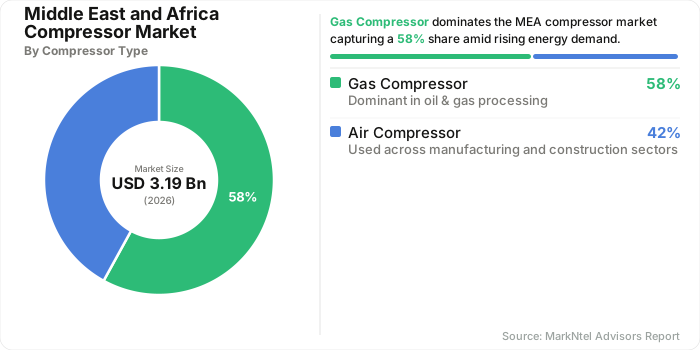
- By compressor type, gas compressors dominate with a 58% share in 2026.
- By lubrication, oil-lubricated compressors account for 82% of the market in 2026.
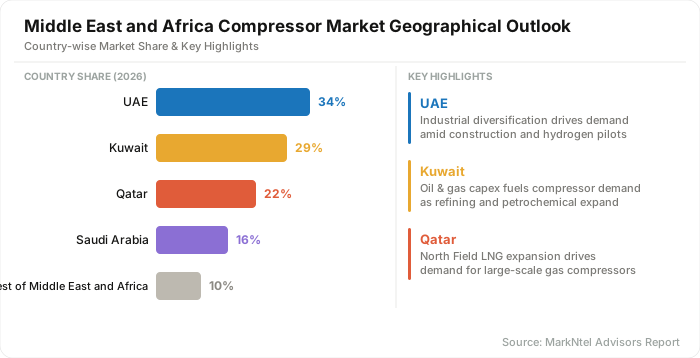
- Geographically, Saudi Arabia accounts for approximately 16% of the market in 2026.
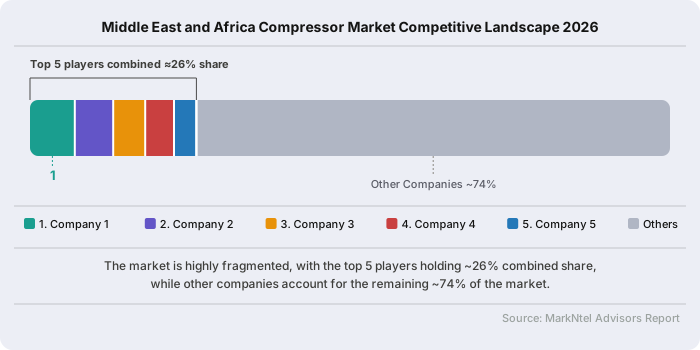
- The market is fragmented, with the top five companies collectively accounting for approximately 26% of the market.
Middle East & Africa Compressor Market Size and Outlook
The Middle East & Africa compressor market was valued at USD 3.11 billion in 2025, to 3.19 billion in 2026, and is projected to reach USD 5.21 billion by 2032, expanding at an 8.52% CAGR during 2026–32. Growth is being shaped by different compressor-use models across the region, integrated gas-processing chains in the GCC, pipeline-distance requirements in Africa, and centralized CNG compression infrastructure in Nigeria, with mining and manufacturing providing additional demand.
In the GCC, compressor requirements are closely tied to expanding gas-monetization chains. ADNOC Gas has increased investment in its Rich Gas Development programme to USD 13.2 billion, including USD 8.2 billion in EPC contracts for new processing capacity at Habshan and an NGL fractionation train at Ruwais. ADNOC has also approved a USD 6.2 billion Umm Shaif Gas Cap project. These developments require compression at multiple stages; gas must be pressurized for gathering and processing, while NGL separation requires refrigeration compressors. As new processing capacity is added, additional large process-compressor trains are therefore required within the same integrated network.
Africa generates a different requirement through long-distance gas transportation. Nigeria's approximately USD 22 billion pipeline investment requirement, including AKK and OB3, will extend gas supply toward northern industrial and power markets. Since pressure declines as gas travels through pipelines, longer transmission corridors require strategically placed compressor stations to maintain flow, making pipeline length and network expansion direct determinants of compressor installations.
Nigeria's CNG transition creates another distinctive demand model. The Presidential Initiative on CNG is developing 63 mother/compression stations, of which 28 were operational by mid-2026, supported by more than USD 1.02 billion in private investment. Compression is concentrated at mother stations, where gas is compressed before being transported to daughter stations, creating demand for larger centralized units rather than compressors at every retail location.
Meanwhile, Zambia's record copper production of 890,346 tonnes in 2025 supports compressed-air requirements in mineral processing, while Saudi Arabia's 8.9% industrial-production growth expands factory-level compressor applications.
Overall, MEA compressor demand is therefore being generated by three distinct procurement cycles: GCC gas-capacity expansion, African pipeline-network extension, and Nigeria's centralized CNG infrastructure rollout.
Middle East and Africa Compressor Market Key Indicators
- Middle East oil and gas investment is expected to reach approximately USD 130 billion in 2025, representing around 15% of global investment. This spending supports upstream and midstream projects requiring wellhead, process, gathering, boosting, and reinjection compression. Saudi Arabia, the UAE, and Qatar are therefore the most exposed markets to oil and gas capital expenditure.
- Natural gas supplied 70% of MENA’s electricity generation in 2024, making gas-fired power plants the region’s dominant generation source. These facilities require fuel-gas boosting compressors to raise pipeline pressure and compressed combustion-air systems. The large installed gas-fired fleet therefore creates recurring compressor demand through maintenance, replacement, and aftermarket requirements across the region over the coming years.
- QatarEnergy’s North Field South LNG expansion includes six gas turbines driving twelve centrifugal compressors across two mega-trains, according to Baker Hughes’ scope of supply. Each LNG train requires dedicated compression equipment, making announced liquefaction additions a direct indicator of future compressor orders. Qatar is consequently the region most affected by LNG train commissioning schedules.
- Saudi Arabia’s desalinated water capacity exceeded 16 million cubic meters per day by the end of 2025, representing a 247.8% increase since 2016. Reverse-osmosis facilities require high-pressure feedwater compression and instrument-air systems. Continued desalination capacity expansion can therefore increase compressor installations, making Saudi Arabia the most significant regional market for water-related compressor demand in the overall market.
- South Africa recorded mining production growth of 2.5% year-on-year in December 2025, led by iron ore growth of 19.0% and manganese ore growth of 40.4%. Mining operations use compressed-air systems for drilling, ventilation, and pneumatic ore handling. Rising mineral output therefore supports compressor utilization, replacement, spare parts, aftermarket service demand, and new equipment procurement.
- Nigeria’s Dangote Refinery supplied an average of 23.52 million litres of petrol daily in November 2025, indicating increasing refinery throughput. Higher processing volumes increase requirements for process-gas compressors in reforming and recovery units. Continued throughput expansion should support compressor maintenance, spare-parts demand, and potential debottlenecking investments, with demand concentrated around Nigeria’s refinery and petrochemical infrastructure.
- NEOM’s green hydrogen facility targets 600 tonnes of daily output using approximately 4 GW of renewable capacity and enters commissioning in 2026. Hydrogen production requires dedicated compression systems for storage and export. Successful commissioning could establish hydrogen compression as an emerging higher-value application in Saudi Arabia, although future demand depends on additional regional projects further.
Middle East & Africa Compressor Market Scope
| Category | Segments |
|---|---|
| By Compressor Type | Air Compressors, Gas Compressors |
| By Technology | Reciprocating Compressors, Rotary Screw Compressors, Rotary Scroll Compressors, Centrifugal Compressors |
| By Portability | Stationary, Portable |
| By Lubrication | Oil-Lubricated, Oil-Free |
| By End User | Oil & Gas, Chemicals & Petrochemicals, Construction, Manufacturing, Power & Utilities, Mining, Food & Beverage, Pharmaceuticals, Textiles, Others |
| By Pressure Rating | Low (Up to 20 bar), Medium (21–100 bar), High (101–300 bar), Ultra-High (Above 300 bar |
Middle East & Africa Compressor Market Growth Drivers
Industrial Diversification and Heavy-Industry Capacity Expansion Broadens Compressor Demand
Middle East and African industrial investment is expanding compressor demand beyond oil & gas because new manufacturing and heavy-industry facilities require compressed air as part of their production equipment and plant utilities. In Saudi Arabia, industrial production increased 8.9% year-on-year in February 2026, while manufacturing output continued to expand. The country’s food-manufacturing base alone includes more than 1,900 factories, with cumulative investment exceeding USD 23.4 billion. New food, pharmaceutical, chemical, and packaging facilities use compressed air for pneumatic conveying, filling, packaging, process instrumentation, and automated valves; oil-free compressors are specified where air can contact products. This creates incremental demand for both oil-free and industrial air compressors as production capacity is added.
The same capacity-expansion mechanism is visible across Africa’s cement and mining industries. Dangote Cement’s USD 1 billion expansion programme targets approximately 80 million tonnes of annual capacity by 2030 across seven African countries, while its Itori plant in Nigeria is planned to double from 6 to 12 Mtpa. These expansions require additional compressed-air systems for plant instrumentation, pneumatic valve actuation, automation, and packing operations. In Guinea, Chalco’s USD 700 million Boffa bauxite expansion is increasing mining activity, where compressed air is used for rock drilling and related mine equipment. Consequently, each new manufacturing, cement, or mining capacity addition expands the installed base of compressors across both regions, creating demand for new equipment as well as replacement and service requirements.
Recent Trends
Shift Toward Electrified and Renewable-Powered Compressed Air Systems
Industrial operators across the Middle East and Africa are increasingly exploring battery-powered, electric, and renewable-powered compressor systems as they seek to reduce emissions and dependence on conventional diesel and grid electricity. In the UAE, the Ministry of Industry and Advanced Technology’s Industrial Decarbonization Roadmap targets a 5% reduction in industrial-sector emissions by 2030, encouraging manufacturers to adopt lower-carbon technologies. This is creating opportunities for cleaner compressed-air equipment in construction, manufacturing, and oilfield applications.
The trend is also emerging in equipment deployment. In the UAE, Galadari Energy Solutions introduced Atlas Copco’s B-Air battery-powered compressor in February 2025, positioning the technology for construction and oilfield applications where portable, low-emission compression can replace diesel-driven equipment. In South Africa, mining companies are taking a broader approach by increasing renewable electricity supply for energy-intensive operations.
Sibanye-Stillwater has contracted 835 MW of renewable energy capacity, with 164 MW already operational, targeting renewable electricity to meet 64% of its South African electricity demand by 2028. This transition is relevant to compressors used in underground ventilation, drilling, and compressed-air systems.
As decarbonization progresses across GCC industrial sites and African mining operations, compressor procurement is gradually expanding toward battery-electric and electrically powered systems that can operate with renewable electricity, particularly in applications where diesel replacement offers clear emissions and operating-cost benefits.
Middle East & Africa Compressor Market Opportunities and Challenges
Rising Local-Content Requirements Pressure Import-Reliant Suppliers, Creating a First-Mover Advantage for Localized Compressor Manufacturing
The Middle East & Africa compressor industry remains dependent on imported equipment and components, while tightening local-content requirements are increasing compliance and investment pressure on compressor OEMs. In Saudi Arabia, Aramco’s iktva program achieved 70% local content and targets 75% by 2030, requiring suppliers to increase in-Kingdom manufacturing, sourcing, assembly, and service capabilities. For compressor manufacturers relying primarily on exports, this raises localization costs and requires capital deployment into regional production and aftermarket infrastructure to remain eligible for major energy-sector procurement programs.
However, the same localization push creates a significant opportunity for companies establishing regional manufacturing and service capabilities early. ADNOC increased its local manufacturing target to AED 90 billion (~USD 24.5 billion) by 2030, while the UAE’s National In-Country Value program redirected more than USD 13.1 billion into the domestic economy during H1 2024. Compressor OEMs that localize production, component sourcing, engineering, and maintenance can therefore improve eligibility for preferential procurement and strengthen relationships with national oil companies. As localization thresholds increase, regional manufacturing and aftermarket networks can become a competitive differentiator, allowing early movers to capture larger shares of major energy and industrial projects.
Segmentation Insights
Gas Compressors Lead at 58% as Middle East & Africa Accelerate Gas Production, LNG & Pipeline Infrastructure
Supported by the region’s expanding gas production, processing, transmission, storage and LNG infrastructure. The Middle East provides the largest demand base, particularly Saudi Arabia, where Aramco is targeting around 80% growth in sales-gas production capacity by 2030 and had 19.6 bscfd of raw-gas processing capacity at end-2025.
The Jafurah development and Master Gas System Phase III are creating direct compressor demand: MGS III alone includes 4,000 km of pipelines and 17 new gas-compression trains, while Jafurah Phase II includes gas-compression facilities. Company investment further validates the opportunity, with Baker Hughes supplying six gas-compression trains for Jafurah and expanding its Saudi manufacturing capabilities.
Africa broadens this demand beyond Saudi Arabia, with Algeria, Egypt and Nigeria supported by rising gas production, domestic gas utilization and processing requirements, while Mozambique adds LNG-led compression demand. African gas consumption is also being driven primarily by industrial and power-generation requirements in Algeria, Egypt and Nigeria. Therefore, gas compressors maintain the leading share because they are core process equipment rather than utility equipment, generating multiple installation points within gas projects and recurring aftermarket opportunities across both Middle Eastern and African gas infrastructures. By compressor type the market is further segmented into the following sub-categories:
- Air Compressors
- Gas Compressors
Oil-Lubricated Compressors Command 82% Share, Anchored by MEA’s Heavy-Duty Industrial Demand
Their advantage is particularly strong in harsh MEA operating conditions, where equipment must tolerate high ambient temperatures, dust, and long operating cycles. For example, Atlas Copco markets its oil-injected GA range in the UAE specifically for environments reaching 55°C, incorporating oversized coolers and heavy-duty filtration for tropical and dusty conditions.
Company-level product investment is directly reinforcing this installed-base advantage. Atlas Copco's Saudi and UAE portfolios include the GA 55⁺–75⁺ and GA 37–90 oil-injected screw compressors, combining IE4 motors, hybrid bearings, smart temperature control, intelligent sensors and SMARTLINK connectivity. The GA⁺ range extends service intervals to 8,000 hours, while the company also introduced the high-efficiency GA 90⁺–160 VSD⁺ oil-injected range with IE4/IE5 motors and Smart Injection technology for mining, metal processing and power applications.
The segment is therefore evolving through efficiency rather than being displaced by oil-free technology. Atlas Copco's Middle East operations actively promote synthetic lubricants for oil-injected compressors to reduce friction, extend oil life and lower energy consumption, addressing the fact that energy represents roughly 80% of compressor total cost of ownership. Meanwhile, oil-free compressors remain concentrated in purity-sensitive applications such as pharmaceuticals, food & beverage, and specialized processes. This narrower application base, combined with continued industrial deployment of oil-injected systems, supports the 82% dominance of oil-lubricated compressors across MEA. By lubrication, the market is further segmented into the following sub-categories:
- Oil-Lubricated
- Oil-Free
Middle East & Africa Compressor Market Geographical Analysis
Saudi Arabia Leads MEA Compressor Market with 16% Share as Gas Expansion and Industrial Diversification Accelerate Demand
Supported by its exceptionally concentrated oil & gas, petrochemical, manufacturing, mining, and infrastructure activity. The scale of investment is a key demand generator: Aramco invested USD 53.3 billion in 2024 and USD 52.2 billion in 2025, sustaining compressor-intensive upstream, midstream, refining, and gas-processing projects. Meanwhile, NIDLP reported more than 12,000 factories in 2024, expanding the installed base requiring compressed-air systems.
Gas infrastructure provides the most direct source of compressor demand. Recently, Aramco awarded more than USD 25 billion in gas-expansion contracts, including Jafurah Phase 2 and Master Gas System Phase 3. The latter includes approximately 4,000 km of pipelines and 17 new gas-compression trains, directly translating investment into compressor installations. Jafurah development and the Tanajib Gas Plant have subsequently progressed into operations, further expanding Saudi Arabia’s compression infrastructure.
Diversification is broadening demand beyond hydrocarbons. NIDLP’s targeted sectors contributed more than 39% to the macroeconomy and non-oil GDP, while non-oil exports rose 13.2% in 2024. Aramco’s gas-processing capacity reached approximately 19.6 billion standard cubic feet per day by end-2025, while an USD 11 billion Jafurah midstream investment transaction in 2025 attracted international capital. This combination of gas expansion, industrialization, and sustained CAPEX reinforces Saudi Arabia’s 16% regional leadership.
Middle East & Africa Compressor Market Competitive Landscape
The Middle East & Africa compressor market is moderately fragmented, with Siemens, Mitsubishi Heavy Industries, Kaeser Kompressoren, Atlas Copco, and Aerzener Maschinenfabrik collectively estimated to account for 26% of the market.
Major players in the Middle East & Africa compressor market
- Siemens AG
- Mitsubishi Heavy Industries Ltd.
- Kaeser Kompressoren GmbH
- Atlas Copco AB
- Aerzener Maschinenfabrik GmbH
- Baker Hughes
- Ingersoll Rand
- Ariel Corporation
- Burckhardt Compression
- MAN Energy Solutions
- Flowserve Corporation
- General Electric
Middle East & Africa Compressor Market News and Recent Developments
2025: Burckhardt Compression Secures Compressor Order for TA'ZIZ Chemicals Terminal in Abu Dhabi
Burckhardt Compression secured an order for three Laby® compressors and a complete ammonia boil-off gas reliquefaction system for the TA’ZIZ chemicals terminal in Abu Dhabi. The TA’ZIZ Industrial Chemicals Zone is expected to produce 4.7 million tonnes of chemicals annually by 2028.
Impact: The project strengthens demand for specialized oil-free compression in Gulf ammonia and chemicals infrastructure, while expanding Burckhardt Compression’s Middle East presence and positioning advanced compressor suppliers for upcoming downstream industrial projects.
2025: Savannah Energy Commissions USD 45 Million Gas-Compression System in Nigeria
Savannah Energy commissioned a USD 45 million gas-compression system at its Uquo facility in Nigeria, delivered at about 90% of budget. The system supports up to 80 mmscf/d of additional Uquo North-East gas volumes and strengthens deliverability through Accugas’ existing processing and pipeline network.
Impact: The project demonstrates growing investment in compression infrastructure to sustain Nigerian gas production and supply, creating opportunities for compressor OEMs and service providers as West African producers expand gas-to-power and industrial gas infrastructure.
2025: Ingersoll Rand Completes USD 185.2 Million Acquisition of TMIC and Adicomp
Ingersoll Rand completed the USD 185.2 million acquisition of Termomeccanica Industrial Compressors (TMIC) and Adicomp, adding more than 100 years of compressor expertise and engineered gas-compression capabilities, including renewable natural gas applications.
Impact: The acquisition strengthens Ingersoll Rand’s technology portfolio and global compressor capabilities, improving its ability to compete for gas-processing, industrial, and emerging low-carbon compression projects across the Middle East & Africa while intensifying competitive pressure on regional and international compressor suppliers.
Frequently Asked Questions
- Market Segmentation
- Introduction
- Product Definition
- Research Process
- Assumptions
- Executive Summary
- Middle East & Africa Compressor Market Policies, Regulations, and Product Standards
- Middle East & Africa Compressor Market Trends & Developments
- Middle East & Africa Compressor Market Dynamics
- Growth Factors
- Challenges
- Middle East & Africa Compressor Market Hotspot & Opportunities
- Middle East & Africa Compressor Market Outlook, 2022-2032
- Market Size & Outlook
- By Revenues (USD Million)
- By Unit Sold (Thousand)
- Market Share & Analysis
- By Compressor Type- Market Size & Forecast 2022-2032, USD Million & Thousand Units
- Air Compressors
- Gas Compressors
- By Technology- Market Size & Forecast 2022-2032, USD Million & Thousand Units
- Reciprocating Compressors
- Rotary Screw Compressors
- Rotary Scroll Compressors
- Centrifugal Compressors
- By Portability- Market Size & Forecast 2022-2032, USD Million & Thousand Units
- Stationary
- Portable
- By Lubrication- Market Size & Forecast 2022-2032, USD Million & Thousand Units
- Oil-Lubricated
- Oil-Free
- By End User- Market Size & Forecast 2022-2032, USD Million & Thousand Units
- Oil & Gas
- Chemicals & Petrochemicals
- Construction
- Manufacturing
- Power & Utilities
- Mining
- Food & Beverage
- Pharmaceuticals
- Textiles
- Others
- By Pressure Rating- Market Size & Forecast 2022-2032, USD Million & Thousand Units
- Low (Up to 20 bar)
- Medium (21–100 bar)
- High (101–300 bar)
- Ultra-High (Above 300 bar)
- By Region
- Saudi Arabia
- UAE
- Qatar
- Kuwait
- Oman
- Egypt
- South Africa
- Nigeria
- Algeria
- Rest of Middle East & Africa
- By Company
- Competition Characteristics
- Market Share & Analysis
- By Compressor Type- Market Size & Forecast 2022-2032, USD Million & Thousand Units
- Market Size & Outlook
- Saudi Arabia Compressor Market Outlook, 2022-2032F
- Market Size & Outlook
- By Revenues (USD Million)
- Market Share & Analysis
- By Compressor Type- Market Size & Forecast 2022-2032, USD Million & Thousand Units
- By Technology- Market Size & Forecast 2022-2032, USD Million & Thousand Units
- By Portability- Market Size & Forecast 2022-2032, USD Million & Thousand Units
- By Lubrication-Market Size & Forecast 2022-2032, USD Million & Thousand Units
- By End User - Market Size & Forecast 2022-2032, USD Million & Thousand Units
- By Pressure Rating -Market Size & Forecast 2022-2032, USD Million & Thousand Units
- Market Size & Outlook
- UAE Compressor Market Outlook, 2022-2032F
- Market Size & Outlook
- By Revenues (USD Million)
- Market Share & Analysis
- By Compressor Type- Market Size & Forecast 2022-2032, USD Million & Thousand Units
- By Technology- Market Size & Forecast 2022-2032, USD Million & Thousand Units
- By Portability- Market Size & Forecast 2022-2032, USD Million & Thousand Units
- By Lubrication-Market Size & Forecast 2022-2032, USD Million & Thousand Units
- By End User - Market Size & Forecast 2022-2032, USD Million & Thousand Units
- By Pressure Rating -Market Size & Forecast 2022-2032, USD Million & Thousand Units
- Market Size & Outlook
- Qatar Compressor Market Outlook, 2022-2032F
- Market Size & Outlook
- By Revenues (USD Million)
- Market Share & Analysis
- By Compressor Type- Market Size & Forecast 2022-2032, USD Million & Thousand Units
- By Technology- Market Size & Forecast 2022-2032, USD Million & Thousand Units
- By Portability- Market Size & Forecast 2022-2032, USD Million & Thousand Units
- By Lubrication-Market Size & Forecast 2022-2032, USD Million & Thousand Units
- By End User - Market Size & Forecast 2022-2032, USD Million & Thousand Units
- By Pressure Rating -Market Size & Forecast 2022-2032, USD Million & Thousand Units
- Market Size & Outlook
- Kuwait Compressor Market Outlook, 2022-2032F
- Market Size & Outlook
- By Revenues (USD Million)
- Market Share & Analysis
- By Compressor Type- Market Size & Forecast 2022-2032, USD Million & Thousand Units
- By Technology- Market Size & Forecast 2022-2032, USD Million & Thousand Units
- By Portability- Market Size & Forecast 2022-2032, USD Million & Thousand Units
- By Lubrication-Market Size & Forecast 2022-2032, USD Million & Thousand Units
- By End User - Market Size & Forecast 2022-2032, USD Million & Thousand Units
- By Pressure Rating -Market Size & Forecast 2022-2032, USD Million & Thousand Units
- Market Size & Outlook
- Oman Compressor Market Outlook, 2022-2032F
- Market Size & Outlook
- By Revenues (USD Million)
- Market Share & Analysis
- By Compressor Type- Market Size & Forecast 2022-2032, USD Million & Thousand Units
- By Technology- Market Size & Forecast 2022-2032, USD Million & Thousand Units
- By Portability- Market Size & Forecast 2022-2032, USD Million & Thousand Units
- By Lubrication-Market Size & Forecast 2022-2032, USD Million & Thousand Units
- By End User - Market Size & Forecast 2022-2032, USD Million & Thousand Units
- By Pressure Rating -Market Size & Forecast 2022-2032, USD Million & Thousand Units
- Market Size & Outlook
- Egypt Compressor Market Outlook, 2022-2032F
- Market Size & Outlook
- By Revenues (USD Million)
- Market Share & Analysis
- By Compressor Type- Market Size & Forecast 2022-2032, USD Million & Thousand Units
- By Technology- Market Size & Forecast 2022-2032, USD Million & Thousand Units
- By Portability- Market Size & Forecast 2022-2032, USD Million & Thousand Units
- By Lubrication-Market Size & Forecast 2022-2032, USD Million & Thousand Units
- By End User - Market Size & Forecast 2022-2032, USD Million & Thousand Units
- By Pressure Rating -Market Size & Forecast 2022-2032, USD Million & Thousand Units
- Market Size & Outlook
- South Africa Compressor Market Outlook, 2022-2032F
- Market Size & Outlook
- By Revenues (USD Million)
- Market Share & Analysis
- By Compressor Type- Market Size & Forecast 2022-2032, USD Million & Thousand Units
- By Technology- Market Size & Forecast 2022-2032, USD Million & Thousand Units
- By Portability- Market Size & Forecast 2022-2032, USD Million & Thousand Units
- By Lubrication-Market Size & Forecast 2022-2032, USD Million & Thousand Units
- By End User - Market Size & Forecast 2022-2032, USD Million & Thousand Units
- By Pressure Rating -Market Size & Forecast 2022-2032, USD Million & Thousand Units
- Market Size & Outlook
- Nigeria Compressor Market Outlook, 2022-2032F
- Market Size & Outlook
- By Revenues (USD Million)
- Market Share & Analysis
- By Compressor Type- Market Size & Forecast 2022-2032, USD Million & Thousand Units
- By Technology- Market Size & Forecast 2022-2032, USD Million & Thousand Units
- By Portability- Market Size & Forecast 2022-2032, USD Million & Thousand Units
- By Lubrication-Market Size & Forecast 2022-2032, USD Million & Thousand Units
- By End User - Market Size & Forecast 2022-2032, USD Million & Thousand Units
- By Pressure Rating -Market Size & Forecast 2022-2032, USD Million & Thousand Units
- Market Size & Outlook
- Algeria Compressor Market Outlook, 2022-2032F
- Market Size & Outlook
- By Revenues (USD Million)
- Market Share & Analysis
- By Compressor Type- Market Size & Forecast 2022-2032, USD Million & Thousand Units
- By Technology- Market Size & Forecast 2022-2032, USD Million & Thousand Units
- By Portability- Market Size & Forecast 2022-2032, USD Million & Thousand Units
- By Lubrication-Market Size & Forecast 2022-2032, USD Million & Thousand Units
- By End User - Market Size & Forecast 2022-2032, USD Million & Thousand Units
- By Pressure Rating -Market Size & Forecast 2022-2032, USD Million & Thousand Units
- Market Size & Outlook
- Middle East & Africa Compressor Market Key Strategic Imperatives for Success & Growth
- Competitive Outlook
- Company Profiles
- Siemens AG
- Business Description
- Product Portfolio
- Collaborations & Alliances
- Recent Developments
- Financial Details
- Others
- Mitsubishi Heavy Industries Ltd.
- Business Description
- Product Portfolio
- Collaborations & Alliances
- Recent Developments
- Financial Details
- Others
- Kaeser Kompressoren GmbH
- Business Description
- Product Portfolio
- Collaborations & Alliances
- Recent Developments
- Financial Details
- Others
- Atlas Copco AB
- Business Description
- Product Portfolio
- Collaborations & Alliances
- Recent Developments
- Financial Details
- Others
- Aerzener Maschinenfabrik GmbH
- Business Description
- Product Portfolio
- Collaborations & Alliances
- Recent Developments
- Financial Details
- Others
- Baker Hughes
- Business Description
- Product Portfolio
- Collaborations & Alliances
- Recent Developments
- Financial Details
- Others
- Ingersoll Rand
- Business Description
- Product Portfolio
- Collaborations & Alliances
- Recent Developments
- Financial Details
- Others
- Ariel Corporation
- Business Description
- Product Portfolio
- Collaborations & Alliances
- Recent Developments
- Financial Details
- Others
- Burckhardt Compression
- Business Description
- Product Portfolio
- Collaborations & Alliances
- Recent Developments
- Financial Details
- Others
- MAN Energy Solutions
- Business Description
- Product Portfolio
- Collaborations & Alliances
- Recent Developments
- Financial Details
- Others
- Flowserve Corporation
- Business Description
- Product Portfolio
- Collaborations & Alliances
- Recent Developments
- Financial Details
- Others
- General Electric
- Business Description
- Product Portfolio
- Collaborations & Alliances
- Recent Developments
- Financial Details
- Others
- Siemens AG
- Company Profiles
- Disclaimer
MarkNtel Advisors follows a robust and iterative research methodology designed to ensure maximum accuracy and minimize deviation in market estimates and forecasts. Our approach combines both bottom-up and top-down techniques to effectively segment and quantify various aspects of the market. A consistent feature across all our research reports is data triangulation, which examines the market from three distinct perspectives to validate findings. Key components of our research process include:
1. Scope & Research Design At the outset, MarkNtel Advisors define the research objectives and formulate pertinent questions. This phase involves determining the type of research—qualitative or quantitative—and designing a methodology that outlines data collection methods, target demographics, and analytical tools. They also establish timelines and budgets to ensure the research aligns with client goals.
2. Sample Selection and Data Collection In this stage, the firm identifies the target audience and determines the appropriate sample size to ensure representativeness. They employ various sampling methods, such as random or stratified sampling, based on the research objectives. Data collection is carried out using tools like surveys, interviews, and observations, ensuring the gathered data is reliable and relevant.
3. Data Analysis and Validation Once data is collected, MarkNtel Advisors undertake a rigorous analysis process. This includes cleaning the data to remove inconsistencies, employing statistical software for quantitative analysis, and thematic analysis for qualitative data. Validation steps are taken to ensure the accuracy and reliability of the findings, minimizing biases and errors.

4. Data Forecast and FinalizationThe final phase involves forecasting future market trends based on the analyzed data. MarkNtel Advisors utilize predictive modeling and time series analysis to anticipate market behaviors. The insights are then compiled into comprehensive reports, featuring visual aids like charts and graphs, and include strategic recommendations to inform client decision-making
We offer flexible licensing options to cater to varying organizational needs. Choose the pricing pack that best suits your requirements:
Buy Now Inquire Before Buying
 Request Customization
 Talk to our Consultant







