

United States Refrigeration Compressor Market Research Report: Size, Share, Trends & Forecast (2026-2032)
By Compressor Type (Reciprocating Compressors, Rotary Compressors, Scroll Compressors, Screw Compressors, Centrifugal Compressors), By Refrigerant Used (HFC-based, Hydrocarbon (Pro ... pane/R290, Isobutane/R600a), Ammonia (NH₃), CO₂ (R744), Others), By Capacity (Up to 5 HP, 5–20 HP, Above 20 HP), By End-use Industry (Food & Beverage, Pharmaceuticals & Healthcare, Chemicals, Retail, Logistics & Cold Chain, Hospitality, Others), and others Read more
- Environment
- Jul 2026
- Pages 140
- Report Format: PDF, Excel, PPT
United States Refrigeration Compressor Market
Projected 7.40% CAGR from 2026 to 2032
Study Period
2026-2032
Market Size (2026)
USD 5.16 Billion
Market Size (2032)
USD 7.92 Billion
Base Year
2025
Projected CAGR
7.40%
Leading Segments
By Compressor Type: Reciprocating Compressors
United States Refrigeration Compressor Market Key Takeaways
- The United States Refrigeration Compressor market was valued at USD 5.02 billion in 2025 and is projected to grow from USD 5.16 billion in 2026 to USD 7.92 billion by 2032.
- The industry is projected to witness steady growth at a CAGR of 7.40% during the forecast period (2026–2032).
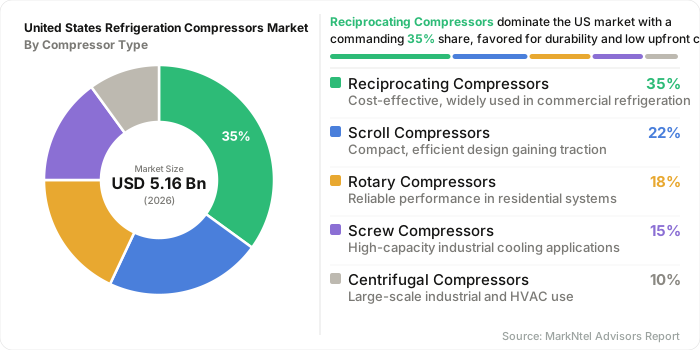
- Reciprocating compressors dominate the market with an estimated 35% share in 2026.
- HFC-based refrigerants account for the largest share of approximately 52% in 2026.
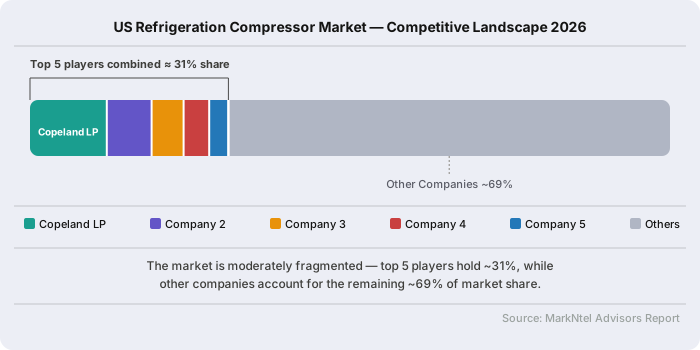
- The market is moderately consolidated, with the top five companies collectively accounting for approximately 31% of the total market share.
United States Refrigeration Compressor Market Size & Outlook
The refrigeration compressor market size in the US was valued at USD 5.02 billion in 2025 and is projected to reach USD 5.16 billion in 2026, advancing toward USD 7.92 billion by 2032 at a CAGR of 7.40%.
This growth is anchored in a convergent regulatory push: the Department of Energy's amended energy conservation standards for commercial refrigerators, freezers, and refrigerator-freezers took effect March 24, 2025, mandating higher-efficiency compressor designs across supermarket and food-service equipment. Simultaneously, the EPA's AIM Act Technology Transitions Rule began restricting the manufacture and installation of high-GWP HFC refrigeration systems on January 1, 2025, accelerating compressor redesign toward low-GWP and natural-refrigerant compatibility.
Commercial and institutional end users are driving a substantial share of this demand. USDA's National Agricultural Statistics Service reported that gross refrigerated warehouse capacity reached 3.99 billion cubic feet as of October 1, 2025, an 7.8% increase from 2023, led by California, Georgia, and Washington, directly expanding compressor installations across cold storage and food-distribution infrastructure.
Residential and light-commercial users are similarly affected, as the Technology Transitions Program's phased compliance dates through 2028 compel manufacturers to redesign compressors for lower-charge, lower-GWP refrigerant systems across households and small retail outlets. Additionally, industry players are responding with targeted product innovation. Copeland launched its YAW and YAV variable-speed compressor platforms on August 13, 2025, engineered to sustain heating capacity down to -25°F, supporting electrification across commercial and residential heat pump applications. Additionally, EPA's October 3, 2025, proposed reconsideration of GWP thresholds for supermarket and remote-condensing refrigeration systems offers manufacturers extended compliance flexibility, sustaining investment confidence in domestic compressor production.
Sustained regulatory tightening, expanding cold storage infrastructure, and manufacturer investment in next-generation compressor platforms are expected to reinforce long-term demand through 2032, positioning compressor technology as central to the country's food-safety, energy-efficiency, and decarbonization priorities.
United States Refrigeration Compressor Market Key Indicators
- Residential construction remains a key demand driver for the U.S. refrigeration compressor industry. The U.S. Census Bureau and the Department of Housing and Urban Development reported 1.36 million housing starts in 2025, reflecting sustained housing development activity. Each new housing unit generates demand for household refrigeration appliances, while the increasing installation of compressor-based air conditioning systems further supports compressor consumption. This ongoing expansion of the residential sector is expected to maintain steady demand for refrigeration compressors throughout the forecast period.
- Growing investments in semiconductor manufacturing are driving demand for industrial refrigeration compressors in the United States. As of July 2025, the U.S. Government Accountability Office reported that the Department of Commerce had awarded USD 30.9 billion in direct funding for 40 semiconductor manufacturing projects. These facilities require advanced process-cooling systems that use industrial-grade compressors to maintain precise cleanroom temperatures. The continued expansion of semiconductor fabrication is therefore expected to support sustained demand for refrigeration compressors across industrial applications.
- Rising poultry production and consumption are supporting demand for refrigeration compressors across the U.S. cold chain. According to the USDA's Economic Research Service, per capita broiler (chicken) availability is projected to reach 102.7 pounds in 2025, the highest among all animal proteins consumed in the country. Processing, storing, and distributing such large volumes of poultry requires reliable refrigeration and freezer systems throughout processing plants, cold storage facilities, and retail distribution networks. This continued demand for cold chain infrastructure is expected to drive the adoption of refrigeration compressors in the U.S. market.
United States Refrigeration Compressor Market Scope
| Category | Segments |
|---|---|
| By Compressor Type | Reciprocating Compressors, Rotary Compressors, Scroll Compressors, Screw Compressors, Centrifugal Compressors |
| By Refrigerant Used | HFC-based, Hydrocarbon (Propane/R290, Isobutane/R600a), Ammonia (NH₃), CO₂ (R744), Others |
| By Capacity | Up to 5 HP, 5–20 HP, Above 20 HP |
| By End-use Industry | Food & Beverage, Pharmaceuticals & Healthcare, Chemicals, Retail, Logistics & Cold Chain, Hospitality, Others |
United States Refrigeration Compressor Market Growth Drivers
Surging U.S. Data Center Construction Driving Large-Scale Cooling Compressor Demand
Data center construction has become the single largest source of new refrigeration and cooling capacity buildout in the United States. U.S. Census Bureau data show construction spending on data centers reached USD 41 billion in 2025, up 32% from the prior year and more than 344% above 2020 levels, with the category now large enough to be tracked separately from general office construction. Every hyperscale facility requires dedicated chiller plants and large-format compressor systems to manage the heat load generated by dense server racks, making data centers a direct and fast-growing demand channel for industrial refrigeration compressors.
The scale behind this buildout is substantial; five companies alone, Amazon, Alphabet, Microsoft, Meta, and Oracle, have disclosed a combined USD 700 billion in capital expenditure plans for 2026, the bulk earmarked for AI-related data center campuses across multiple states.
For compressor manufacturers, this shift favors suppliers capable of delivering high-capacity, energy-efficient chillers and CO2-based cooling packages engineered for continuous, high-density thermal loads rather than conventional commercial refrigeration duty cycles.
Recent Trends
Rising Demand for Connected Compressor Monitoring and Predictive Maintenance Services
Compressor and HVAC manufacturers are shifting from selling hardware alone to bundling it with connected monitoring and predictive maintenance services, a shift now visible in financial results. Carrier's aftermarket business, which includes remote monitoring and service contracts, delivered 20% growth in 2025, marking its fifth consecutive year of double-digit growth, while commercial HVAC orders tied to data center projects rose nearly 50% year-over-year in Q4 2025.
Carrier's BluEdge for Data Centers, launched in May 2025 under its QuantumLeap portfolio, delivers 24/7/365 remote monitoring with analytics-driven proactive diagnostics for data center thermal management. Comparable platforms are becoming standard industry practice: Copeland applies machine learning to decades of compressor performance history to flag component issues before failure, while Daikin's HERO Cloud Services traces refrigerant flow through animated piping diagrams with predictive logic that alerts operators to potential compressor faults and refrigerant leaks in VRV systems.
As data center and cold storage operators increasingly demand uptime guarantees over unit price alone, compressor manufacturers pairing hardware with connected diagnostics are positioned to capture a growing share of recurring aftermarket revenue through the rest of the decade.
United States Refrigeration Compressor Market Opportunities and Challenges
High-Flammability and High-Pressure Refrigerant Safety Regulations Driving Demand for Advanced Compressor Designs
Stricter refrigerant safety regulations in the United States are accelerating the development of next-generation refrigeration compressors. The updated ANSI/ASHRAE Standard 15-2024, including the 2025 addenda, introduces tighter safety requirements for systems using flammable refrigerants such as propane (R290) and A2L refrigerants. For example, self-contained systems using Group A3 refrigerants are limited to a maximum refrigerant charge of 150 grams, while larger refrigerant circuits must comply with additional installation and safety distance requirements.
These regulations are encouraging manufacturers to redesign refrigeration systems with lower refrigerant charges and improved safety performance. Compared with conventional non-flammable refrigerants such as R-410A, the new standards significantly reduce the allowable refrigerant volume within a system, making traditional compressor designs less suitable for many applications. As a result, demand is increasing for compressors specifically engineered to operate efficiently with low-charge, environmentally friendly refrigerants while meeting stringent safety requirements.
Manufacturers are already responding to this transition. In October 2025, Tecumseh's Master flux introduced the Nevada variable-speed rotary compressor, designed specifically for R290 and A2L refrigerants and optimized for reliable operation under the latest safety standards. As the adoption of low-global-warming-potential (low-GWP) refrigerants continues to expand, compressor manufacturers offering safety-compliant, high-efficiency, and purpose-built solutions are expected to gain a competitive advantage in the U.S. refrigeration compressors market.
Segmentation Insights
Reciprocating Compressors Remain the Most Widely Deployed Compressor Type
Reciprocating compressors account for approximately 35% of the refrigeration compressor market in 2026, making them the largest compressor type due to their widespread adoption in industrial refrigeration systems. Their leadership is primarily driven by their dominance in ammonia-based refrigeration, where they are extensively used in food processing facilities, cold storage warehouses, chemical plants, and pharmaceutical manufacturing. Their proven reliability, cost-effectiveness, ease of maintenance, and compatibility with natural refrigerants continue to make them the preferred choice for demanding low-temperature applications.
According to Evasco's Vice President of Industrial Refrigeration Business Development, reciprocating compressors remain the industry standard for two-stage, low-temperature ammonia refrigeration systems, where serviceability, operational reliability, and refrigerant compatibility outweigh the efficiency advantages offered by alternative compressor technologies. Reflecting continued technological advancement, in March 2025, Frascold introduced a next-generation semi-hermetic reciprocating compressor series capable of operating at temperatures of up to 165°C, expanding the technology beyond conventional refrigeration into industrial heat pumps, district heating, and process heating applications across the food, chemical, and pharmaceutical industries.
This innovation demonstrates that reciprocating compressors are evolving alongside changing industrial requirements rather than being displaced by newer architectures. Consequently, their established presence in industrial refrigeration, combined with continuous product innovation and expanding application scope, is expected to enable reciprocating compressors to retain their market leadership throughout the forecast period. By compressor type, the market is further segmented into the following sub-categories:
- Reciprocating Compressors
- Rotary Compressors
- Scroll Compressors
- Screw Compressors
- Centrifugal Compressors
Regulatory Extension Reinforces the Leadership of HFC-Based Refrigerants
HFC-based refrigerants account for an estimated 52% share of the U.S. refrigeration compressors market, supported by their extensive installed base and continued regulatory acceptance in key commercial refrigeration applications. In May 2026, the U.S. Environmental Protection Agency (EPA) finalized a rule temporarily increasing the allowable global warming potential (GWP) limit from 150–300 to 1,400 for supermarket refrigeration systems and remote condensing units used in retail food refrigeration. The revised regulation remains effective until January 1, 2032, allowing manufacturers to continue producing new refrigeration equipment compatible with widely used HFC blends such as R-448A and R-449A.
This regulatory extension provides a significant growth opportunity for compressor manufacturers serving the commercial refrigeration sector. Supermarkets and retail food refrigeration systems represent one of the largest applications for refrigeration compressors, and the extended compliance period enables businesses to continue investing in HFC-compatible equipment without immediate system redesign or replacement. As a result, manufacturers can sustain new equipment sales while customers benefit from proven, reliable, and cost-effective refrigeration technologies. This continued regulatory support is expected to reinforce the leadership of HFC-based refrigerants in the U.S. refrigeration compressor market throughout the forecast period.
United States Refrigeration Compressor Market Competitive Landscape
The U.S. refrigeration compressor market is moderately consolidated, with the top five players accounting for approximately 31% of the total market share. Leading companies, including Emerson Climate Technologies (Copeland), Carrier Global Corporation, Johnson Controls International plc (FRICK & YORK Refrigeration), Tecumseh Products Company LLC, and Heatcraft Refrigeration Products LLC, maintain their market positions through extensive product portfolios, strong distribution networks, and continuous investments in energy-efficient and low-global-warming-potential (low-GWP) refrigeration technologies.
Major Companies in the United States Refrigeration Compressor market
- Emerson Climate Technologies
- Carrier Global Corporation
- Johnson Controls International plc (FRICK & YORK Refrigeration)
- Tecumseh Products Company LLC
- Heatcraft Refrigeration Products LLC
- Hussmann Corporation
- Zero Zone Inc.
- Hillphoenix Inc.
- Parker Hannifin Corporation
- AAON, Inc.
United States Refrigeration Compressor Market News and Recent Developments
2024: Fra scold Launches TK HD Trans critical CO2 Compressor Series for Industrial Cooling
Fra Scold introduced its TK HD semi-hermetic reciprocating compressor line for continuous-duty trans critical CO2 applications, spanning 34 models with capacities from 3.7 to 72 kW across two motor options up to 50 HP. The series includes an inverter variant and supports heat pump applications up to 100°C, targeting round-the-clock industrial and commercial cooling loads.
Impact analysis: This launch strengthens compressor manufacturers' positioning as cold storage and industrial operators accelerate their shift toward CO2 as a natural refrigerant, expanding retrofit-compatible options for facilities transitioning away from high-GWP HFCs while supporting larger, more continuous refrigeration demand cycles.
2025: GEA Launches Grasso L XHP High-Pressure Screw Compressor for Ammonia Heat Pumps
GEA introduced the Grasso L XHP, a high-pressure screw compressor rated to 70 bar for ammonia (R717) heat pumps, offered in three models delivering 2 to 11 MW of heating capacity with discharge temperatures up to 140°C. Built on GEA's established Grasso screw platform with a newly engineered rotor profile, the compressor extends ammonia's application range beyond conventional refrigeration into high-temperature industrial process heating.
Impact analysis: The launch targets decarbonization projects at food, beverage, and district heating facilities seeking to replace fossil-fuel steam systems with electrified, natural-refrigerant heat pumps at an industrial scale.
2025: Copeland Launches Trans critical CO2 Scroll Compressor with Dynamic Vapor Injection
Copeland introduced a trans critical CO2 scroll compressor featuring dynamic vapor injection (DVI) technology, available in fixed- and variable-speed configurations, expanding its existing CO2 portfolio of semi-Hermetics, controls, and system components. The DVI process improves system efficiency and performance for booster-based supermarket refrigeration architectures common across North American food retail.
Impact analysis: This launch equips retailers, accelerating their shift to natural refrigerants, with a broader range of CO2-compatible compressor options, supporting compliance with tightening EPA GWP thresholds while improving energy performance in trans critical systems operating in warmer climates
2026: Trane Technologies and Garrett Motion Partner on Oil-Free Centrifugal Compressors
Trane Technologies and Garrett Motion announced a strategic collaboration integrating Garrett's automotive-proven, oil-free high-speed centrifugal compressor technology into Trane's commercial HVAC portfolio, spanning unitary rooftop units, modular chillers, and large-capacity chillers. Field testing and production begin in 2026, with the companies targeting major energy-efficiency gains already demonstrated in Trane's internal testing.
Impact analysis: The partnership signals a broader industry shift toward compressor technologies borrowed from adjacent high-volume sectors, positioning Trane to accelerate adoption of ultra-low-GWP refrigerants across its chiller lineup while differentiating its portfolio through exclusive access to Garrett's turbocharging-derived compressor platform.
Frequently Asked Questions
- Market Segmentation
- Introduction
- Product Definition
- Research Process
- Assumptions
- Executive Summary
- United States Refrigeration Compressor Market Policies, Regulations, and Product Standards
- United States Refrigeration Compressor Market Trends & Developments
- United States Refrigeration Compressor Market Dynamics
- Growth Factors
- Challenges
- United States Refrigeration Compressor Market Hotspot & Opportunities
- United States Refrigeration Compressor Market Outlook, 2022-2032F
- Market Size & Outlook
- By Revenues (USD Million)
- Market Segmentation & Outlook
- By Compressor Type - Market Size & Forecast 2022-2032, USD Million
- Reciprocating Compressors
- Rotary Compressors
- Scroll Compressors
- Screw Compressors
- Centrifugal Compressors
- By Refrigerant Used- Market Size & Forecast 2022-2032, USD Million
- HFC-based
- Hydrocarbon (Propane/R290, Isobutane/R600a)
- Ammonia (NH₃)
- CO₂ (R744)
- Others
- By Capacity- Market Size & Forecast 2022-2032, USD Million
- Up to 5 HP
- 5–20 HP
- Above 20 HP
- By End-use Industry- Market Size & Forecast 2022-2032, USD Million
- Food & Beverage
- Pharmaceuticals & Healthcare
- Chemicals
- Retail
- Logistics & Cold Chain
- Hospitality
- Others
- By Region- Market Size & Forecast 2022-2032, USD Million
- North
- South
- East
- West
- Central
- By Company
- Competition Characteristics
- Market Share & Analysis
- By Compressor Type - Market Size & Forecast 2022-2032, USD Million
- Market Size & Outlook
- United States Reciprocating Compressors Market Outlook, 2022-2032
- Market Size & Outlook
- By Revenues (USD Million)
- Market Segmentation & Outlook
- By Refrigerant Used- Market Size & Forecast 2022-2032, USD Million
- By Capacity- Market Size & Forecast 2022-2032, USD Million
- By End-use Industry- Market Size & Forecast 2022-2032, USD Million
- By region- Market Size & Forecast 2022-2032, USD Million
- Market Size & Outlook
- United States Rotary Compressors Market Outlook, 2022-2032
- Market Size & Outlook
- By Revenues (USD Million)
- Market Segmentation & Outlook
- By Refrigerant Used- Market Size & Forecast 2022-2032, USD Million
- By Capacity- Market Size & Forecast 2022-2032, USD Million
- By End-use Industry- Market Size & Forecast 2022-2032, USD Million
- By region- Market Size & Forecast 2022-2032, USD Million
- Market Size & Outlook
- United States Scroll Compressors Market Outlook, 2022-2032
- Market Size & Outlook
- By Revenues (USD Million)
- Market Segmentation & Outlook
- By Refrigerant Used- Market Size & Forecast 2022-2032, USD Million
- By Capacity- Market Size & Forecast 2022-2032, USD Million
- By End-use Industry- Market Size & Forecast 2022-2032, USD Million
- By region- Market Size & Forecast 2022-2032, USD Million
- Market Size & Outlook
- United States Screw Compressors Market Outlook, 2022-2032
- Market Size & Outlook
- By Revenues (USD Million)
- Market Segmentation & Outlook
- By Refrigerant Used- Market Size & Forecast 2022-2032, USD Million
- By Capacity- Market Size & Forecast 2022-2032, USD Million
- By End-use Industry- Market Size & Forecast 2022-2032, USD Million
- By region- Market Size & Forecast 2022-2032, USD Million
- Market Size & Outlook
- United States Centrifugal Compressors Market Outlook, 2022-2032
- Market Size & Outlook
- By Revenues (USD Million)
- Market Segmentation & Outlook
- By Refrigerant Used- Market Size & Forecast 2022-2032, USD Million
- By Capacity- Market Size & Forecast 2022-2032, USD Million
- By End-use Industry- Market Size & Forecast 2022-2032, USD Million
- By region- Market Size & Forecast 2022-2032, USD Million
- Market Size & Outlook
- United States Refrigeration Compressor Market Key Strategic Imperatives for Success & Growth
- Competitive Outlook
- Company Profiles
- Emerson Climate Technologies
- Business Description
- Product Portfolio
- Collaborations & Alliances
- Recent Developments
- Financial Details
- Others
- Carrier Global Corporation
- Business Description
- Product Portfolio
- Collaborations & Alliances
- Recent Developments
- Financial Details
- Others
- Johnson Controls International plc (FRICK & YORK Refrigeration)
- Business Description
- Product Portfolio
- Collaborations & Alliances
- Recent Developments
- Financial Details
- Others
- Tecumseh Products Company LLC
- Business Description
- Product Portfolio
- Collaborations & Alliances
- Recent Developments
- Financial Details
- Others
- Heatcraft Refrigeration Products LLC
- Business Description
- Product Portfolio
- Collaborations & Alliances
- Recent Developments
- Financial Details
- Others
- Hussmann Corporation
- Business Description
- Product Portfolio
- Collaborations & Alliances
- Recent Developments
- Financial Details
- Others
- Zero Zone Inc.
- Business Description
- Product Portfolio
- Collaborations & Alliances
- Recent Developments
- Financial Details
- Others
- Hill-phoenix Inc.
- Business Description
- Product Portfolio
- Collaborations & Alliances
- Recent Developments
- Financial Details
- Others
- Parker Hannifin Corporation
- Business Description
- Product Portfolio
- Collaborations & Alliances
- Recent Developments
- Financial Details
- Others
- AAON, Inc.
- Business Description
- Product Portfolio
- Collaborations & Alliances
- Recent Developments
- Financial Details
- Others
- Emerson Climate Technologies
- Company Profiles
- Disclaimer
MarkNtel Advisors follows a robust and iterative research methodology designed to ensure maximum accuracy and minimize deviation in market estimates and forecasts. Our approach combines both bottom-up and top-down techniques to effectively segment and quantify various aspects of the market. A consistent feature across all our research reports is data triangulation, which examines the market from three distinct perspectives to validate findings. Key components of our research process include:
1. Scope & Research Design At the outset, MarkNtel Advisors define the research objectives and formulate pertinent questions. This phase involves determining the type of research—qualitative or quantitative—and designing a methodology that outlines data collection methods, target demographics, and analytical tools. They also establish timelines and budgets to ensure the research aligns with client goals.
2. Sample Selection and Data Collection In this stage, the firm identifies the target audience and determines the appropriate sample size to ensure representativeness. They employ various sampling methods, such as random or stratified sampling, based on the research objectives. Data collection is carried out using tools like surveys, interviews, and observations, ensuring the gathered data is reliable and relevant.
3. Data Analysis and Validation Once data is collected, MarkNtel Advisors undertake a rigorous analysis process. This includes cleaning the data to remove inconsistencies, employing statistical software for quantitative analysis, and thematic analysis for qualitative data. Validation steps are taken to ensure the accuracy and reliability of the findings, minimizing biases and errors.

4. Data Forecast and FinalizationThe final phase involves forecasting future market trends based on the analyzed data. MarkNtel Advisors utilize predictive modeling and time series analysis to anticipate market behaviors. The insights are then compiled into comprehensive reports, featuring visual aids like charts and graphs, and include strategic recommendations to inform client decision-making
We offer flexible licensing options to cater to varying organizational needs. Choose the pricing pack that best suits your requirements:
Buy Now Inquire Before Buying
 Request Customization
 Talk to our Consultant







