

India Diesel Generator Market Research Report: Forecast (2026-2032)
By Power Rating (5 to 75 KVA, 76 KVA to 375 KVA, Above 1000 KVA), By Type (Stand By, Prime & Continuous Power, Peak Shaving), By End Users (Residential, Commercial, Healthcare, Gov ... ernment & Transport, Oil & Gas, Equipment Rental Companies), and others Read more
- Energy
- Jun 2026
- Pages 140
- Report Format: PDF, Excel, PPT
India Diesel Generator Market
Projected 5.19% CAGR from 2026 to 2032
Study Period
2026-2032
Market Size (2026)
USD 1428 Million
Market Size (2032)
USD 1935 Million
Base Year
2025
Projected CAGR
5.19%
Leading Segments
By Power Rating: 5 KVA to 75 KVA
India Diesel Generator Market Key Takeaways
- India diesel generator market size was valued at USD 1365 million in 2025 and is projected to grow from USD 1428 million in 2026 to USD 1935 million by 2032.
- The industry is projected to reflect sustain growth at a steady CAGR of 5.19% during 2026-2032.
- By power rating, 76 KVA to 375 KVA rating holds a significant share of about 22% in 2026.
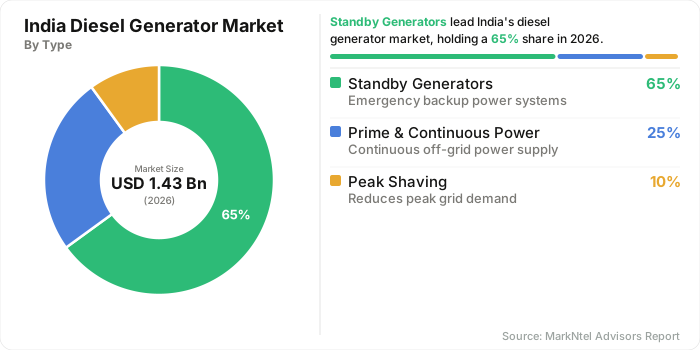
- By type, standby generators seized a significant share of about 65% in 2026.
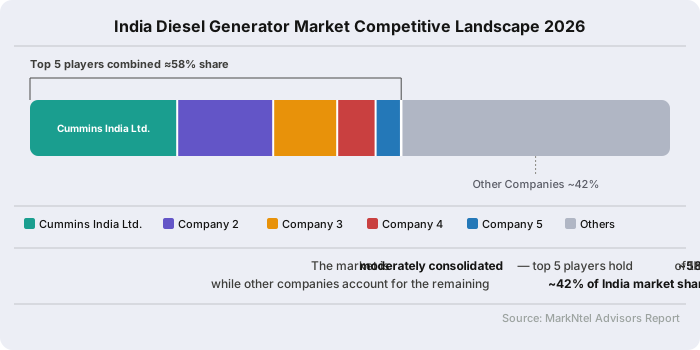
- The industry is moderately consolidated. However, the top five players collectively account for nearly 58% share.
India Diesel Generator Market Size and Outlook
The India diesel generator market is estimated to grow at a CAGR of around 5.19% during the forecast period, i.e., 2026-32, supported by increasing infrastructure development, industrial expansion, and rising demand for uninterrupted backup power across commercial and institutional sectors. The Government of India allocated nearly USD 135 billion toward capital expenditure in the Union Budget 2025–26, with major investments directed toward highways, railways, airports, metro projects, industrial corridors, and logistics infrastructure. These projects continue to create substantial demand for temporary and standby diesel-powered electricity solutions across construction sites, manufacturing plants, and commercial facilities.
The market is also undergoing technological transformation with the implementation of CPCB IV+ emission norms for diesel generators. Manufacturers such as Ashok Leyland and Cummins India Ltd. are increasingly focusing on low-emission and fuel-efficient gensets integrated with digital monitoring and advanced diagnostics. For Instance, Ashok Leyland introduced CPCB IV+ compliant diesel generators ranging from 15 kVA to 250 kVA for commercial and industrial applications, supporting improved fuel efficiency, reduced emissions, and lower operational noise in line with tightening environmental regulations.
India’s expanding digital economy and industrial modernization are expected to sustain long-term diesel generator demand. According to DD India, India added 387 MW IT data center capacity in 2025 compared with 191 MW IT in 2024, reflecting over 103% annual growth, while total operational capacity reached nearly 1,520 MW IT nationwide. Since data centres, telecom networks, healthcare facilities, and manufacturing units require uninterrupted power supply and redundancy systems, demand for reliable high-capacity diesel generators is expected to remain strong across major industrial and urban centres.
Overall, the India diesel generator market is expected to maintain positive growth momentum through 2032, supported by infrastructure investments, rapid industrialization, and increasing deployment of digital infrastructure. The transition toward CPCB IV+ compliant and fuel-efficient gensets is also expected to strengthen market competitiveness while supporting cleaner and more reliable backup power solutions across the country, driving the market from USD 1,428 million in 2026 to USD 1,935 million by 2032.
India Diesel Generator Market Key Indicators
- India's PLI scheme has attracted investments exceeding USD 14.73 billion across electronics, specialty steel, automobiles, auto components, solar, and pharmaceuticals, generating manufactured products worth USD 129.64 billion. Manufacturing FDI grew 18% from USD 16.12 billion in FY 2023–24 to USD 19.04 billion in FY 2024–25 directly expanding India's base of power-intensive industries that depend on diesel gensets for uninterrupted operations.
- India met a record peak power demand of 250 GW in FY 2024–25, with national energy shortages reduced to just 0.1%. However, this national average conceals severe localised stress. The NLDC's Short-Term National Resource Adequacy Plan projected a shortfall of 15–20 GW in summer 2025, with the Loss of Load Probability reaching 31% in May nearly a one-in-three chance of supply failure. By April 2026, demand hit a record 256 GW, with non-solar peak shortages of 5.4 GW recorded on a single day compelling businesses and industries to maintain diesel gensets as non-negotiable backup.
India Diesel Generator Market Scope
| Category | Segments |
|---|---|
| By Power Rating | 5 to 75 KVA, 76 KVA to 375 KVA, Above 1000 KVA |
| By Type | Stand By, Prime & Continuous Power, Peak Shaving |
| By End Users | Residential, Commercial, Healthcare, Government & Transport, Oil & Gas, Equipment Rental Companies |
India Diesel Generator Market Growth Drivers
Rapid Industrialization and infrastructure development
Rapid industrialization and infrastructure development in India is a major driver of the diesel generator (DG) industry, as construction sites, industrial hubs, and logistics corridors require reliable backup power where grid availability remains inconsistent. In FY2023–24, the Government of India allocated nearly USD 120 billion toward infrastructure capital expenditure, supporting roads, railways, metros, and urban projects.
A key example is the highway sector, where the National Highways Authority of India (NHAI) spent around USD 25 billion in 2023–24 and constructed 6,644 km of highways, highlighting strong construction activity that relies heavily on DG sets for temporary and backup power. In parallel, the PM Gati Shakti initiative is accelerating multi-modal infrastructure and logistics development through 200+ integrated projects, increasing power demand during execution phases.
Looking ahead, India is expected to maintain infrastructure spending above USD 130 billion annually through 2025–26, driven by expressways, metro expansions, industrial corridors, and smart city projects. These developments will continue to support demand for diesel generators across construction and industrial applications.
In essence, India’s expanding infrastructure pipeline is steadily increasing demand for reliable onsite power solutions. As industrial and construction activity grows beyond 2025, diesel generator adoption is expected to remain strong across both portable and high-capacity segments.
Recent Trends
Data Center Boom Fuelling High-Capacity Diesel Genset Demand
The data center boom has emerged as one of the most critical trends fuelling high-capacity diesel genset demand in India. According to Cushman & Wakefield's India Data Centre H1 2025 Update, India's installed capacity has reached 1.3 GW in H1 2025, with an additional 2.9 GW of supply expected by 2030.
Also KPMG highlights that India's grid fails to meet the 99.99999% ("five nines") reliability standard that data centers require, making diesel generator farms the sector's primary backup infrastructure a single 100 MW hyperscale campus requires a dedicated backup power plant of its own.
Moreover, microsoft committed USD 17.5 billion over four years to advance India's cloud and AI infrastructure, while Amazon announced USD 12.7 billion for data center expansions in Telangana and Maharashtra. Google confirmed a USD 15 billion AI data hub in Andhra Pradesh its largest investment outside the United States. In January 2025, Telangana alone secured investments worth approximately USD 2.9 billion to develop 550 MW of AI-optimized data centers, directly generating orders for generator sets.
Therefore, with over USD 67.5 billion in confirmed hyperscaler investments and national data center capacity projected to nearly triple by 2030, sustained demand for high-capacity diesel gensets (350 kVA–1,000+ kVA) is structurally assured. This segment will increasingly anchor revenue growth for India's diesel generator market through the decade.
India Diesel Generator Market Opportunities and Challenges
CPCB IV+ Regulations Reshaping India Diesel Generator Market into Low-Emission Systems
One of the most pressing challenges confronting India’s diesel generator industry is the enforcement of CPCB IV+ emission norms. Mandatory since July 2023 for all new gensets installations in the 19 kW to 800 kW range, these norms require advanced emission control technologies, including SCR and DPF systems, significantly increasing production and compliance costs for manufacturers. These expenses, driven by technological upgrades, redesign of engines, and certification requirements, are ultimately passed on to end users, making adoption difficult for price-sensitive commercial and industrial segments.
Despite these pressures, the regulatory shift unlocks a substantial opportunity by accelerating low-emission infrastructure development across the power backup ecosystem. Companies such as Cummins India have launched CPCB IV+ compliant genset ranges up to 800 kVA, incorporating advanced after-treatment systems that deliver nearly 90% reduction in particulate matter and NOx emissions. Similarly, in October 2024, Jakson Group expanded compliant genset deployments in Uttarakhand while co-promoting solar-plus-storage hybrid solutions with Cummins, highlighting the industry’s move toward cleaner and more integrated power systems.
While CPCB IV+ compliance increases upfront costs, it is actively reshaping the market toward low-emission infrastructure development, creating sustained demand for cleaner backup power solutions. This transition is driving manufacturers to invest in advanced emission-control technologies and hybrid systems, ensuring long-term growth while aligning the diesel generator industry with India’s broader environmental and sustainability goals.
Segmentation Insights
76 KVA to 375 KVA Emerges as the Leading Power Rating Segment
The 76 KVA to 375 KVA rating holds nearly 22% share of the India diesel generator industry revenue due to its strong balance between power capacity, operational flexibility, and cost efficiency. These generators are widely used across commercial buildings, hospitals, telecom towers, educational institutions, hotels, construction sites, and medium-scale manufacturing facilities where uninterrupted power supply is essential. The segment is highly preferred because it can support both standby and continuous power requirements.
Rising infrastructure development, rapid urbanization, and expansion of industrial and commercial facilities across India are further strengthening demand for this power range. Large-scale highway projects, metro construction, industrial parks, and growing data-center investments are increasing the need for reliable medium-capacity backup power systems. In addition, improving affordability and easier installation compared to higher-capacity DG sets continue to support adoption among businesses and institutional users.
In conclusion, the 76 KVA to 375 KVA segment remains the backbone of India’s diesel generator industry due to its wide industrial applicability and economic efficiency. Continued infrastructure and commercial expansion will further strengthen its market dominance in the coming years. Based on power rating, the scope has been segmented into
- 5 KVA to 75 KVA
- 76 KVA to 375 KVA
- 375.1 KVA to 750 KVA
- 750.1 KVA to 1000 KVA
- Above 1000 KVA
Standby Generators Emerge as the Leading Generator Type in India
Standby generators account for nearly 65% of the India diesel generator industry share, making them the largest segment by type due to their critical role in providing emergency backup power during grid outages and voltage fluctuations. These generators are extensively deployed across commercial buildings, hospitals, telecom towers, residential complexes, educational institutions, data centers, and industrial facilities where uninterrupted electricity supply is essential for daily operations.
The segment also benefits from its broad applicability across multiple sectors and availability in diverse power capacities ranging from small residential units to large industrial backup systems. Rapid urbanization, increasing commercial construction, rising data-center investments, and expansion of healthcare infrastructure are further driving standby generator demand. In addition, industries prefer standby DG sets because they offer reliable power continuity during peak load failures, natural disruptions, and maintenance shutdowns without interrupting operations.
Overall, standby generators remain the backbone of India’s diesel generator industry due to their widespread use across critical applications requiring uninterrupted power supply. Growing infrastructure, commercial expansion, and digitalization will continue supporting strong demand for standby power solutions in the coming years. Based on type, the market is categorized into
- Standby Generators
- Prime & Continuous Power
- Peak Shaving
India Diesel Generator Market Competitive Analysis
The India diesel generator market is moderately consolidated, with the top five players collectively accounting for approximately 58% of the organized market share. Major companies include Cummins India LTd., Kirloskar Oil Engines Ltd., Mahindra Powerol, Caterpillar, and Greaves Cotton Limited. The market remains competitive due to the presence of several regional and unorganized manufacturers, particularly in the low-capacity generator segment.
Major Companies in India Diesel Generator Industry
- Cummins India Ltd.
- Kirloskar Oil Engines Ltd.
- Mahindra Powerol
- Caterpillar
- Ashok Leyland
- Greaves Cotton Limited
- Jakson Group
- Kohler Co.
- Honda India Power Products
- Sudhir Power
- Others
India Diesel Generator Industry News and Recent Developments
May 2025: Mahindra Powerol Becomes India’s No.1 Genset Manufacturer
Mahindra Powerol emerged as India’s leading diesel generator manufacturer in FY2025 with approximately 23.8% market share by volume. The company’s growth was largely driven by strong telecom-sector demand, increasing infrastructure activities, and rising adoption of CPCB IV+ compliant generators across commercial and industrial applications. Mahindra Powerol also maintained strong leadership in telecom generators with more than 55% segment share during the year.
Impact Analysis: The achievement highlights rising market preference for technologically advanced and emission-compliant diesel generators in India. It is expected to intensify competition among organized manufacturers, encouraging greater investments in cleaner technologies, product innovation, nationwide service networks, and fuel-efficient backup power solutions for commercial and industrial customers.
2025: Greaves Cotton Expands CPCB IV+ Compliant Diesel Generator Portfolio
Greaves Cotton, through its engineering division, expanded its CPCB IV+ compliant diesel generator range across 5 kVA to 500 kVA applications for industrial, commercial, infrastructure, healthcare, and data-center sectors. The company highlighted lower emissions, improved fuel efficiency, and sustainable backup power solutions aligned with India’s stricter environmental regulations.
Impact Analysis: The expansion supports India’s transition toward cleaner and technologically advanced diesel generators under CPCB IV+ norms. Increasing adoption of compliant gensets is expected to accelerate replacement demand for older systems while strengthening growth opportunities across infrastructure, industrial, telecom, and commercial backup power applications
Frequently Asked Questions
- Market Segmentation
- Introduction
- Product Definition
- Research Process
- Assumptions
- Executive Summary
- Macroeconomic Outlook
- India Diesel Generator Market Porters Five Forces Analysis
- India Diesel Generator Market Supply Chain Analysis
- India Diesel Generator Market Trends & Insights
- India Diesel Generator Market Dynamics
- Drivers
- Challenges
- India Diesel Generator Market Growth Opportunities & Hotspots
- India Diesel Generator Market Policy & Regulations
- India Diesel Generator Market Pricing Analysis
- India Diesel Generator Market Outlook, 2026-2032F
- Market Size & Outlook
- By Revenue (USD Million)
- By Units Sold (Thousand Units)
- Market Share & Outlook
- By Power Rating (Thousand Units)
- 5 to 75 KVA
- 76 KVA to 375 KVA
- 375.1 to 750 KVA
- 750.1 KVA to 1000 KVA
- Above 1000 KVA
- By Type (Thousand Units)
- Stand By
- Prime & Continuous Power
- Peak Shaving
- By End Users (Thousand Units)
- Residential
- Commercial (Hospitality, Retail, Educational Institutions, etc.)
- Healthcare
- Government & Transport (Airports, Metro Stations, Govt. Buildings, Religious Centres, etc.)
- Oil & Gas
- Industrial (Manufacturing Facilities, Assembly Units, etc.)
- Equipment Rental Companies
- By Region
- North
- East
- West
- South
- By Company
- Market Share
- Competition Characteristics
- By Power Rating (Thousand Units)
- Market Size & Outlook
- North India Diesel Generator Market Outlook, 2026-2032F
- Market Size & Outlook
- By Revenue (USD Million)
- By Units Sold (Thousand)
- Market Share & Outlook
- By Power Rating- (Thousand Units)
- By Type- (Thousand Units)
- By End User- (Thousand Units)
- Market Size & Outlook
- South India Diesel Generator Market Outlook, 2026-2032F
- Market Size & Outlook
- By Revenue (USD Million)
- By Units Sold (Thousand)
- Market Share & Outlook
- By Power Rating- (Thousand Units)
- By Type- (Thousand Units)
- By End User- (Thousand Units)
- Market Size & Outlook
- East India Diesel Generator Market Outlook, 2026-2032F
- Market Size & Outlook
- By Revenue (USD Million)
- By Units Sold (Thousand)
- Market Share & Outlook
- By Power Rating- (Thousand Units)
- By Type- (Thousand Units)
- By End User- (Thousand Units)
- Market Size & Outlook
- South India Diesel Generator Market Outlook, 2026-2032F
- Market Size & Outlook
- By Revenue (USD Million)
- By Units Sold (Thousand)
- Market Share & Outlook
- By Power Rating- (Thousand Units)
- By Type- (Thousand Units)
- By End User- (Thousand Units)
- Market Size & Outlook
- India Diesel Generator Market Key Strategic Imperatives for Growth & Success
- Competitive Outlook
- Company Profiles
- Cummins India Ltd.
- Business Description
- Product Portfolio
- Strategic Alliances or Partnerships
- Recent Developments
- Financial Details
- Others
- Kirloskar Oil Engine Ltd.
- Business Description
- Product Portfolio
- Strategic Alliances or Partnerships
- Recent Developments
- Financial Details
- Others
- Mahindra Powerol
- Business Description
- Product Portfolio
- Strategic Alliances or Partnerships
- Recent Developments
- Financial Details
- Others
- Caterpillar
- Business Description
- Product Portfolio
- Strategic Alliances or Partnerships
- Recent Developments
- Financial Details
- Others
- Greaves Cotton Limited
- Business Description
- Product Portfolio
- Strategic Alliances or Partnerships
- Recent Developments
- Financial Details
- Others
- Ashok Leyland
- Business Description
- Product Portfolio
- Strategic Alliances or Partnerships
- Recent Developments
- Financial Details
- Others
- Kohler Co.
- Business Description
- Product Portfolio
- Strategic Alliances or Partnerships
- Recent Developments
- Financial Details
- Others
- Jakson Group
- Business Description
- Product Portfolio
- Strategic Alliances or Partnerships
- Recent Developments
- Financial Details
- Others
- Honda India Power Products
- Business Description
- Product Portfolio
- Strategic Alliances or Partnerships
- Recent Developments
- Financial Details
- Others
- Sudhir Power
- Business Description
- Product Portfolio
- Strategic Alliances or Partnerships
- Recent Developments
- Financial Details
- Others
- Others
- Business Description
- Product Portfolio
- Strategic Alliances or Partnerships
- Recent Developments
- Financial Details
- Others
- Cummins India Ltd.
- Company Profiles
- Disclaimer
MarkNtel Advisors follows a robust and iterative research methodology designed to ensure maximum accuracy and minimize deviation in market estimates and forecasts. Our approach combines both bottom-up and top-down techniques to effectively segment and quantify various aspects of the market. A consistent feature across all our research reports is data triangulation, which examines the market from three distinct perspectives to validate findings. Key components of our research process include:
1. Scope & Research Design At the outset, MarkNtel Advisors define the research objectives and formulate pertinent questions. This phase involves determining the type of research—qualitative or quantitative—and designing a methodology that outlines data collection methods, target demographics, and analytical tools. They also establish timelines and budgets to ensure the research aligns with client goals.
2. Sample Selection and Data Collection In this stage, the firm identifies the target audience and determines the appropriate sample size to ensure representativeness. They employ various sampling methods, such as random or stratified sampling, based on the research objectives. Data collection is carried out using tools like surveys, interviews, and observations, ensuring the gathered data is reliable and relevant.
3. Data Analysis and Validation Once data is collected, MarkNtel Advisors undertake a rigorous analysis process. This includes cleaning the data to remove inconsistencies, employing statistical software for quantitative analysis, and thematic analysis for qualitative data. Validation steps are taken to ensure the accuracy and reliability of the findings, minimizing biases and errors.

4. Data Forecast and FinalizationThe final phase involves forecasting future market trends based on the analyzed data. MarkNtel Advisors utilize predictive modeling and time series analysis to anticipate market behaviors. The insights are then compiled into comprehensive reports, featuring visual aids like charts and graphs, and include strategic recommendations to inform client decision-making
We offer flexible licensing options to cater to varying organizational needs. Choose the pricing pack that best suits your requirements:
Buy Now Inquire Before Buying
 Request Customization
 Talk to our Consultant







