India Air Purifier Market Research Report: Forecast (2026-2032)
By Filter Type (Type-I (HEPA + Carbon), Type-II (HEPA + Carbon + Ionizer), Type-III (HEPA + Carbon + UV), Type-IV (HEPA + Carbon + Electrostatic), Type-V (HEPA + Carbon + Ionizer + ... UV + Electrostatic), Others), By Mounting Type (Fixed, Portable), By End User (Residential, Corporate Offices, Educational Institutes, Hotels, Hospitals, Others), By Sales Channel (Supermarkets and Hypermarkets, Specialty Stores, Online, Others), By Color (White, Black, Metallic, Others), By Price (Up to USD 120, USD 121-150, USD 151-200, Above 200), and others Read more
- Environment
- Jul 2026
- Pages 140
- Report Format: PDF, Excel, PPT
India Air Purifier Market
Projected 11.34% CAGR from 2026 to 2032
Study Period
2026-2032
Market Size (2026)
USD 70 Million
Market Size (2032)
USD 133 Million
Base Year
2025
Projected CAGR
11.34%
Leading Segments
By Filter Type: Type-I (HEPA + Carbon)
India Air Purifier Market Key Takeaways
- India air purifier market size was valued at USD 63 million in 2025 and is projected to grow from USD 70 million in 2026 to USD 133 million by 2032.
- The industry is projected to reflect sustain growth at a steady CAGR of 11.34% during 2026-2032.
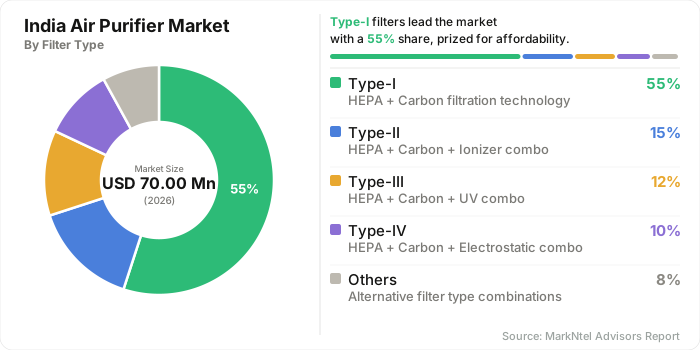
- By filter type, Type-I (HEPA + Carbon) air purifier holds a significant share of about 55% in 2026.
- By end user, residential seized a significant share of about 68% in 2026.
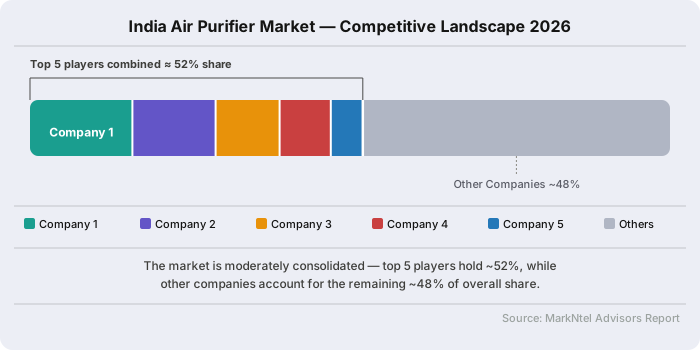
- The industry is moderately fragmented. However, the top five players collectively account for nearly 52% share.
India Air Purifier Market Size and Outlook
The air purifier market size in India was valued at USD 63 million in 2025 and is projected to grow from USD 70 million in 2026 to USD 133 million by 2032. Along with this, the market is estimated to grow at a CAGR of around 11.34% during the forecast period, i.e., 2026-32.
The market is witnessing robust growth, driven by worsening urban air pollution, increasing awareness of indoor air quality, and rising adoption of smart home appliances. Air purifiers are increasingly being viewed as essential health devices rather than discretionary consumer electronics, particularly in metropolitan regions such as Delhi-NCR, Mumbai, Bengaluru, and Kolkata, where particulate matter concentrations frequently exceed safe limits. According to the Central Pollution Control Board (CPCB), the Air Quality Index (AQI) categorizes values between 301–400 as "Very Poor" and 401–500 as "Severe," conditions that are regularly experienced across several Indian cities during winter months. These recurring pollution episodes have accelerated consumer demand for residential and commercial air purification solutions.
The market is also benefiting from increasing technological innovation by global and domestic manufacturers. In December 2025, Dyson launched the HushJet Purifier Compact in India, featuring a new HushJet airflow system capable of capturing 99.97% of airborne particles as small as 0.3 microns, operating at just 24 dB in sleep mode, and covering spaces of up to 1,076 sq. ft. The product also incorporates smart air-quality monitoring through the MyDyson app, reflecting the industry's transition toward connected and energy-efficient purification systems.
Government initiatives are further strengthening long-term market prospects. Under the National Clean Air Programme (NCAP), the Ministry of Environment, Forest and Climate Change continues implementing city-specific air pollution mitigation measures across 131 cities, while expanding ambient air-quality monitoring infrastructure nationwide. These initiatives are improving public awareness of air pollution and encouraging households, educational institutions, healthcare facilities, and corporate offices to invest in indoor air quality solutions as a preventive health measure.
Looking ahead, continued urbanization, increasing respiratory health awareness, stricter environmental policies, and ongoing product innovation are expected to sustain market expansion. The introduction of AI-enabled monitoring, longer-life HEPA filtration systems, and smart home integration by leading manufacturers is likely to enhance product adoption across both residential and commercial sectors, positioning India as one of the fastest-growing air purifier markets in Asia.
India Air Purifier Market Key Indicators
- Government investment in air-quality monitoring is improving public awareness and encouraging adoption of indoor air purification products. According to the Ministry of Environment, Forest and Climate Change, India currently operates 1,208 manual and real-time air quality monitoring stations across 460 towns and cities, with further expansion planned under NCAP. The government has also introduced early-warning systems, public grievance platforms, and city-level monitoring cells to strengthen pollution surveillance. Greater access to real-time air-quality information increases consumer awareness regarding pollution exposure and supports demand for residential and commercial air purifiers.
- The rising incidence of respiratory illnesses is a significant indicator supporting demand for air purifiers in India. According to the Ministry of Health & Family Welfare, data from six Central Government hospitals in Delhi reported 67,054 acute respiratory illness (ARI) emergency cases in 2022, 69,293 cases in 2023, and 68,411 cases in 2024. Hospital admissions for respiratory illnesses also increased from 9,878 in 2022 to 10,819 in 2024, highlighting the growing burden of pollution-related respiratory conditions. Increasing public awareness of asthma, COPD, allergies, and other respiratory disorders is encouraging households, healthcare facilities, and workplaces to invest in air purification systems to improve indoor air quality.
- According to the National Statistical Office (NSO) Household Social Consumption, Health Survey 2025, the Proportion of Population Reporting Ailments (PPRA) increased from 7.5% in 2017–18 to 13.1% in 2025. The survey also found that reported ailments rose from 6.8% to 12.2% in rural India and from 9.1% to 14.9% in urban India, indicating greater health awareness and increased utilization of healthcare services. This growing focus on preventive health is encouraging consumers to invest in products that improve indoor environments, including air purifiers, particularly in pollution-prone cities.
India Air Purifier Market Scope
| Category | Segments |
|---|---|
| By Filter Type | Type-I (HEPA + Carbon), Type-II (HEPA + Carbon + Ionizer), Type-III (HEPA + Carbon + UV), Type-IV (HEPA + Carbon + Electrostatic), Type-V (HEPA + Carbon + Ionizer + UV + Electrostatic), Others |
| By Mounting Type | Fixed, Portable |
| By End User | Residential, Corporate Offices, Educational Institutes, Hotels, Hospitals, Others |
| By Sales Channel | Supermarkets and Hypermarkets, Specialty Stores, Online, Others |
| By Color | White, Black, Metallic, Others |
| By Price | Up to USD 120, USD 121-150, USD 151-200, Above 200 |
India Air Purifier Market Growth Drivers
Rising Air Pollution Levels and Deteriorating Outdoor Air Quality Driving India Air Purifier Growth
Increasing air pollution levels and worsening outdoor air quality are among the strongest factors driving the adoption of air purifiers in India. Rising concentrations of particulate matter, particularly PM2.5, from vehicle emissions, industrial activities, fossil fuel combustion, construction dust, and waste burning are increasing health concerns among consumers. According to the State of Global Air 2024 report, long-term exposure to PM2.5 contributed to more than 4.9 million deaths globally in 2023, with India and China together accounting for 56% of the global PM2.5-related mortality burden due to high pollution exposure and large populations.
The severity of pollution episodes in Indian cities is further encouraging demand for indoor air purification solutions. For instance, in November 2024, Delhi experienced severe air pollution conditions, with AQI reaching 491 according to Central Pollution Control Board (CPCB) data, leading authorities to implement emergency pollution-control measures under the Graded Response Action Plan (GRAP). Such recurring pollution events are increasing awareness about indoor air quality and encouraging households, offices, and institutions to invest in air purification systems.
Government initiatives are also supporting long-term air-quality improvement efforts. Under the National Clean Air Programme (NCAP), launched by the Ministry of Environment, Forest and Climate Change (MoEFCC), India is implementing clean-air action plans across 131 cities in 24 states/Union Territories, targeting up to a 40% reduction in PM10 levels or achievement of national standards of 60 µg/m³ by 2025–26. Moreover, continued investments in electric mobility, industrial emission-control technologies, pollution monitoring infrastructure, and clean-energy initiatives are expected to sustain the need for air purifiers.
Persistent air pollution, increasing PM2.5 exposures, and recurring severe air-quality events are transforming air purifiers from optional appliances into health-focused products. Growing pollution awareness and government air-quality initiatives will continue to accelerate market expansion across residential and commercial segments.
Recent Trends
Growing Adoption of Smart and Connected Air Purifiers with IoT-Enabled Features
The India air purifier industry is increasingly shifting toward smart and connected devices as consumers seek real-time air-quality insights, remote operation, and automated purification capabilities. Rising smartphone adoption and increasing digital connectivity are supporting the integration of IoT technologies into household appliances. According to the Ministry of Statistics and Programme Implementation (MoSPI), Government of India’s Comprehensive Modular Survey: Telecom 2025, smartphone ownership among individuals aged 15–29 years reached 97.6% in urban areas and 95.5% in rural areas, creating a strong digital ecosystem for connected home appliances.
Manufacturers are leveraging this digital shift by introducing air purifiers equipped with mobile applications, smart sensors, and AI-based automation. For instance, Philips India launched the PureProtect Pro 4200 Series Smart Air Purifier (AC4221/61), which includes the Philips Air+ app for remote control, indoor and outdoor air-quality monitoring, AI-powered Auto+ mode, and voice compatibility with Google Assistant and Amazon Alexa. The device also features real-time AQI monitoring and automated purification adjustments based on detected air conditions.
Moreover, investments in IoT-enabled consumer electronics, artificial intelligence, and smart home ecosystems are expected to increase demand for connected air purification solutions. As Indian households become more digitally integrated, consumers are likely to prefer intelligent devices that provide automated pollution management and energy-efficient operation.
The growing preference for connected and intelligent appliances is transforming air purifiers from basic filtration devices into smart wellness solutions. Increasing digital adoption, AI integration, and demand for real-time air monitoring will continue to accelerate the growth of India’s air purifier industry.
India Air Purifier Market Opportunities and Challenges
Continuous Usage Requirements Create Electricity Concerns, Driving Demand for Energy-Efficient Air Purifiers
Continuous usage is important for air purifiers to maintain effective indoor air quality, particularly in Indian cities that experience prolonged periods of elevated pollution levels. However, many consumers hesitate to use air purifiers for extended durations due to concerns regarding continuous electricity consumption. Since these devices are often recommended to operate for several hours daily or even throughout the day during severe pollution periods, the requirement for prolonged usage can create uncertainty among households regarding long-term electricity requirements.
At the same time, this challenge is encouraging manufacturers to focus on developing energy-efficient air purification technologies that enable longer usage with reduced power requirements. Companies are integrating efficient DC motors, intelligent Auto Modes, and advanced air-quality sensors that automatically adjust purification performance based on indoor pollution levels, helping optimize electricity consumption without compromising filtration efficiency.
For instance, Philips’ 4000i Series Air Purifier (AC3854/51) features an energy-efficient design with a maximum power consumption of 60 W, which the company states are comparable to the electricity usage of a standard light bulb. The purifier also includes an Automatic Mode that continuously monitors indoor air quality and adjusts fan speed accordingly to maintain effective purification while improving energy efficiency. Such innovations encourage consumers to use air purifiers for longer durations, improve confidence in their practicality, and support wider adoption across residential applications.
As energy-efficient technologies continue to evolve, reduced electricity requirements and improved long-term usability are expected to minimize adoption barriers and support the sustained growth of the India air purifier industry.
Segmentation Insights
Type-I (HEPA + Carbon) Dominates with Nearly 55% Revenue Share
Type-I (HEPA + Carbon) air purifiers hold nearly 55% of the India air purifier industry due to their ability to effectively address the country's predominant air pollution challenges while remaining relatively affordable. HEPA filters capture 99.97% of airborne particles as small as 0.3 microns, including PM2.5, dust, pollen, and allergens, whereas activated carbon filters absorb harmful gases, smoke, odors, and volatile organic compounds (VOCs). This combination is particularly suitable for Indian cities, where pollution originates from vehicular emissions, industrial activities, construction dust, and seasonal biomass burning. The technology offers an optimal balance between filtration performance, operating cost, and maintenance compared with systems incorporating UV, ionizers, or electrostatic filters.
Consequently, most leading brands, including Dyson, Philips, Xiaomi, Honeywell, Coway, and Sharp, offer HEPA + Carbon as the standard filtration configuration across their residential product portfolios. Growing consumer awareness of indoor air quality and increasing demand for reliable, energy-efficient air purification solutions continue to reinforce the dominance of this filter type in the Indian market. Based on filter type, the scope has been segmented into
- Type-I (HEPA + Carbon)
- Type-II (HEPA + Carbon + Ionizer)
- Type-III (HEPA + Carbon + UV)
- Type-IV (HEPA + Carbon + Electrostatic)
- Type-V (HEPA + Carbon + Ionizer + UV + Electrostatic)
- Others
Residential Consumers Contribute Nearly 68% of Industry Revenue
Residential holds the dominant position, accounting for an estimated 68% of the total revenue, driven by increasing consumer awareness of indoor air quality and the growing need to protect families from harmful airborne pollutants. Frequent episodes of poor air quality in metropolitan cities have encouraged households to invest in air purifiers as a preventive health measure. Residential users primarily prefer portable air purifiers equipped with HEPA and activated carbon filters, which effectively remove fine particulate matter (PM2.5), allergens, dust, smoke, and odors while remaining cost-effective and easy to maintain.
Rising disposable incomes, expanding urban middle-class households, and the increasing adoption of smart home appliances have further supported demand. Manufacturers such as Dyson, Philips, Xiaomi, Honeywell, Coway, and Sharp have strengthened their residential portfolios by introducing compact, energy-efficient, and app-enabled air purifiers with real-time air quality monitoring and automatic purification modes. The combination of worsening urban pollution, growing health consciousness, and continuous product innovation is expected to keep the residential segment at the forefront of market demand over the forecast period. By end user, the market is categorized into
- Residential
- Corporate Offices
- Educational Institutes
- Hotels
- Hospitals
- Others
India Air Purifier Market Competitive Analysis
The India air purifier market is moderately fragmented, with the top five manufacturers collectively accounting for approximately 52% of the market by value in 2025. Key participants include Koninklijke Philips N.V., Xiaomi Corporation, Dyson Limited, Honeywell International Inc., and Daikin Industries, Ltd.
Major Companies in India Air Purifier Industry
- Koninklijke Philips N.V.
- Xiaomi Corporation
- Dyson Limited
- Honeywell International Inc.
- Daikin Industries, Ltd.
- Panasonic Holdings Corporation
- LG Electronics Inc.
- Eureka Forbes Limited
- Coway Co., Ltd.
- KENT RO Systems Limited
- Others
India Air Purifier Industry News and Recent Developments
November 2025: Dyson Limited Introduces Purifier Hot+Cool HP2 De-NOx and HP1 in India
In November 2025, Dyson Limited launched the Purifier Hot+Cool HP2 De-NOx (HP12) and Purifier Hot+Cool HP1 in India. These multifunctional devices integrate air purification, heating, and cooling into a single unit and feature HEPA 13 filtration, advanced gas filtration for nitrogen dioxide (NO₂), and smart connectivity through the MyDyson app. The products were introduced to address increasing indoor pollution concerns during winter while offering year-round climate control for residential users.
Impact Analysis: The launch strengthens Dyson's position in India's premium air purifier segment by offering a multifunctional solution combining air purification, heating, and cooling. Advanced HEPA H13 and NO₂ filtration address growing consumer concerns over urban air pollution, while smart connectivity enhances user convenience. The product is expected to increase adoption among high-income households seeking year-round indoor air quality and climate control solutions.
October 2025: Dyson Limited Launches Dyson Purifier Cool PC1–TP11 in India
In October 2025, Dyson Limited expanded its India air treatment portfolio by launching the Dyson Purifier Cool PC1–TP11, ahead of the winter pollution season. The smart air purifier combines a fully sealed HEPA and activated carbon filtration system with Dyson's Air Multiplier technology, capable of projecting over 290 litres of purified air per second. The purifier also supports the MyDyson mobile application and voice assistants, enabling remote monitoring and control. The launch strengthens Dyson's presence in India's premium smart air purifier segment as demand for intelligent indoor air quality solutions continues to rise.
Impact Analysis: The introduction of the Purifier Cool PC1–TP11 expands Dyson's premium product portfolio and reinforces the growing trend toward smart, connected air purification systems. Its high airflow capacity, advanced filtration technology, and app-based monitoring are expected to boost consumer preference for intelligent air quality management, encouraging premiumization and increasing competition in India's smart air purifier market.
-
Zonair3D Launches ZonAIR+ 300 S Air Purifier in India
Indian manufacturer Zonair3D launched the ZonAIR+ 300 S, a premium air purifier designed for large homes, offices, healthcare facilities, and commercial spaces. The product incorporates advanced multi-stage filtration technology for high-capacity indoor air purification and reflects the growing demand for commercial-grade air quality solutions in India.
Impact Analysis: The launch strengthens the domestic air purifier ecosystem by expanding high-capacity solutions for commercial, healthcare, and institutional applications. It reflects increasing demand for professional-grade indoor air quality management beyond residential use and is expected to encourage wider adoption across offices, hospitals, schools, and large public spaces, creating new growth opportunities in India's commercial air purifier segment.
Frequently Asked Questions
- Market Segmentation
- Introduction
- Product Definition
- Research Process
- Assumptions
- Executive Summary
- India Air Purifier Supply Chain Analysis
- India Air Purifier Import-Export Analysis
- India Air Purifier Market Policies, Regulations, and Product Standards
- India Air Purifier Market Production Trend 2022-2032
- India Air Purifier Market Production Trend By Filter Type
- Type-I (HEPA + Carbon)
- Type-II (HEPA + Carbon + Ionizer)
- Type-III (HEPA + Carbon + UV)
- Type-IV (HEPA + Carbon + Electrostatic)
- Type-V (HEPA + Carbon + Ionizer + UV + Electrostatic)
- Others
- Company Wise Production Plants and Statistics
- Installed Production Capacity
- Actual Production
- Planned Production Target
- India Air Purifier Market Production Trend By Filter Type
- India Air Purifier Market Pricing Analysis 2022-2032
- India Air Purifier Market Pricing Trend (USD/Units) 2022-2032
- India Air Purifier Market Pricing Trend (USD/Units) By Regions 2022-2032
- North
- South
- East
- West
- India Air Purifier Market Pricing Trend (USD/Units) By Filter Type 2022-2032
- Type-I (HEPA + Carbon)
- Type-II (HEPA + Carbon + Ionizer)
- Type-III (HEPA + Carbon + UV)
- Type-IV (HEPA + Carbon + Electrostatic)
- Type-V (HEPA + Carbon + Ionizer + UV + Electrostatic)
- Others
- India Air Purifier Market Trends & Developments
- India Air Purifier Market Dynamics
- Growth Factors
- Challenges
- India Air Purifier Market Hotspot & Opportunities
- India Air Purifier Market Outlook, 2022-2032
- Market Size & Outlook
- By Revenues (USD Million)
- By Quantity Sold (Thousand Units)
- Market Segmentation & Outlook
- By Filter Type- Market Size & Forecast 2022-2032, USD Million & Thousand Units
- Type-I (HEPA + Carbon)
- Type-II (HEPA + Carbon + Ionizer)
- Type-III (HEPA + Carbon + UV)
- Type-IV (HEPA + Carbon + Electrostatic)
- Type-V (HEPA + Carbon + Ionizer + UV + Electrostatic)
- Others
- By Mounting Type- Market Size & Forecast 2022-2032, USD Million & Thousand Units
- Fixed
- Portable
- By End User- Market Size & Forecast 2022-2032, USD Million & Thousand Units
- Residential
- Corporate Offices
- Educational Institutes
- Hotels
- Hospitals
- Others
- By Sales Channel- Market Size & Forecast 2022-2032, USD Million & Thousand Units
- Supermarkets and Hypermarkets
- Specialty Stores
- Online
- Others
- By Area Converge- Market Size & Forecast 2022-2032, USD Million & Thousand Units
- Up to 500 Sq. Ft
- 501-730 Sq. Ft
- 731-1000 Sq. Ft
- Above 1001 Sq. Ft
- By Color- Market Size & Forecast 2022-2032, USD Million & Thousand Units
- White
- Black
- Metallic
- Others
- By Price- Market Size & Forecast 2022-2032, USD Million & Thousand Units
- Up to USD 120
- USD 121-150
- USD 151-200
- Above 200
- By Region- Market Size & Forecast 2022-2032, USD Million & Thousand Units
- East
- North-east states
- Bihar
- West Bengal
- Odisha
- Jharkhand
- Others
- West
- Gujarat
- Maharashtra
- Rajasthan
- Goa
- Madhya Pradesh
- North
- Uttar Pradesh
- Delhi
- Haryana
- Punjab
- Others
- South
- Tamil Nadu
- Karnataka
- Andhra Pradesh
- Telangana
- Others
- East
- By Company
- Competition Characteristics
- Market Share & Analysis
- By Filter Type- Market Size & Forecast 2022-2032, USD Million & Thousand Units
- Market Size & Outlook
- India Type-I (HEPA + Carbon) Air Purifier Market Outlook, 2022-2032
- Market Size & Outlook
- By Revenues (USD Million)
- By Quantity Sold (Thousand Units)
- Market Segmentation & Outlook
- By Mounting Type- Market Size & Forecast 2022-2032, USD Million & Thousand Units
- By End User- Market Size & Forecast 2022-2032, USD Million & Thousand Units
- By Sales Channel- Market Size & Forecast 2022-2032, USD Million & Thousand Units
- By Area Converge- Market Size & Forecast 2022-2032, USD Million & Thousand Units
- By Color- Market Size & Forecast 2022-2032, USD Million & Thousand Units
- By Price- Market Size & Forecast 2022-2032, USD Million & Thousand Units
- By Region- Market Size & Forecast 2022-2032, USD Million & Thousand Units
- Market Size & Outlook
- India Type-II (HEPA + Carbon + Ionizer) Air Purifier Market Outlook, 2022-2032
- Market Size & Outlook
- By Revenues (USD Million)
- By Quantity Sold (Thousand Units)
- Market Segmentation & Outlook
- By Mounting Type- Market Size & Forecast 2022-2032, USD Million & Thousand Units
- By End User- Market Size & Forecast 2022-2032, USD Million & Thousand Units
- By Sales Channel- Market Size & Forecast 2022-2032, USD Million & Thousand Units
- By Area Converge- Market Size & Forecast 2022-2032, USD Million & Thousand Units
- By Color- Market Size & Forecast 2022-2032, USD Million & Thousand Units
- By Price- Market Size & Forecast 2022-2032, USD Million & Thousand Units
- By Region- Market Size & Forecast 2022-2032, USD Million & Thousand Units
- Market Size & Outlook
- India Type-III (HEPA + Carbon + UV) Air Purifier Market Outlook, 2022-2032
- Market Size & Outlook
- By Revenues (USD Million)
- By Quantity Sold (Thousand Units)
- Market Segmentation & Outlook
- By Mounting Type- Market Size & Forecast 2022-2032, USD Million & Thousand Units
- By End User- Market Size & Forecast 2022-2032, USD Million & Thousand Units
- By Sales Channel- Market Size & Forecast 2022-2032, USD Million & Thousand Units
- By Area Converge- Market Size & Forecast 2022-2032, USD Million & Thousand Units
- By Color- Market Size & Forecast 2022-2032, USD Million & Thousand Units
- By Price- Market Size & Forecast 2022-2032, USD Million & Thousand Units
- By Region- Market Size & Forecast 2022-2032, USD Million & Thousand Units
- Market Size & Outlook
- India Type-IV (HEPA + Carbon + Electrostatic) Air Purifier Market Outlook, 2022-2032
- Market Size & Outlook
- By Revenues (USD Million)
- By Quantity Sold (Thousand Units)
- Market Segmentation & Outlook
- By Mounting Type- Market Size & Forecast 2022-2032, USD Million & Thousand Units
- By End User- Market Size & Forecast 2022-2032, USD Million & Thousand Units
- By Sales Channel- Market Size & Forecast 2022-2032, USD Million & Thousand Units
- By Area Converge- Market Size & Forecast 2022-2032, USD Million & Thousand Units
- By Color- Market Size & Forecast 2022-2032, USD Million & Thousand Units
- By Price- Market Size & Forecast 2022-2032, USD Million & Thousand Units
- By Region- Market Size & Forecast 2022-2032, USD Million & Thousand Units
- Market Size & Outlook
- India Type-V (HEPA + Carbon + Ionizer + UV + Electrostatic) Air Purifier Market Outlook, 2022-2032
- Market Size & Outlook
- By Revenues (USD Million)
- By Quantity Sold (Thousand Units)
- Market Segmentation & Outlook
- By Mounting Type- Market Size & Forecast 2022-2032, USD Million & Thousand Units
- By End User- Market Size & Forecast 2022-2032, USD Million & Thousand Units
- By Sales Channel- Market Size & Forecast 2022-2032, USD Million & Thousand Units
- By Area Converge- Market Size & Forecast 2022-2032, USD Million & Thousand Units
- By Color- Market Size & Forecast 2022-2032, USD Million & Thousand Units
- By Price- Market Size & Forecast 2022-2032, USD Million & Thousand Units
- By Region- Market Size & Forecast 2022-2032, USD Million & Thousand Units
- Market Size & Outlook
- India Air Purifier Market Key Strategic Imperatives for Success & Growth
- Competitive Outlook
- Company Profiles
- Koninklijke Philips N.V.
- Business Description
- Product Portfolio
- Collaborations & Alliances
- Recent Developments
- Financial Details
- Others
- Xiaomi Corporation
- Business Description
- Product Portfolio
- Collaborations & Alliances
- Recent Developments
- Financial Details
- Others
- Dyson Limited
- Business Description
- Product Portfolio
- Collaborations & Alliances
- Recent Developments
- Financial Details
- Others
- Honeywell International Inc.
- Business Description
- Product Portfolio
- Collaborations & Alliances
- Recent Developments
- Financial Details
- Others
- Daikin Industries, Ltd.
- Business Description
- Product Portfolio
- Collaborations & Alliances
- Recent Developments
- Financial Details
- Others
- Panasonic Holdings Corporation
- Business Description
- Product Portfolio
- Collaborations & Alliances
- Recent Developments
- Financial Details
- Others
- LG Electronics Inc.
- Business Description
- Product Portfolio
- Collaborations & Alliances
- Recent Developments
- Financial Details
- Others
- Eureka Forbes Limited
- Business Description
- Product Portfolio
- Collaborations & Alliances
- Recent Developments
- Financial Details
- Others
- Coway Co., Ltd.
- Business Description
- Product Portfolio
- Collaborations & Alliances
- Recent Developments
- Financial Details
- Others
- KENT RO Systems Limited
- Business Description
- Product Portfolio
- Collaborations & Alliances
- Recent Developments
- Financial Details
- Others
- Blueair India Pvt. Ltd
- Business Description
- Product Portfolio
- Collaborations & Alliances
- Recent Developments
- Financial Details
- Others
- Koninklijke Philips N.V.
- Company Profiles
- Disclaimer
MarkNtel Advisors follows a robust and iterative research methodology designed to ensure maximum accuracy and minimize deviation in market estimates and forecasts. Our approach combines both bottom-up and top-down techniques to effectively segment and quantify various aspects of the market. A consistent feature across all our research reports is data triangulation, which examines the market from three distinct perspectives to validate findings. Key components of our research process include:
1. Scope & Research Design At the outset, MarkNtel Advisors define the research objectives and formulate pertinent questions. This phase involves determining the type of research—qualitative or quantitative—and designing a methodology that outlines data collection methods, target demographics, and analytical tools. They also establish timelines and budgets to ensure the research aligns with client goals.
2. Sample Selection and Data Collection In this stage, the firm identifies the target audience and determines the appropriate sample size to ensure representativeness. They employ various sampling methods, such as random or stratified sampling, based on the research objectives. Data collection is carried out using tools like surveys, interviews, and observations, ensuring the gathered data is reliable and relevant.
3. Data Analysis and Validation Once data is collected, MarkNtel Advisors undertake a rigorous analysis process. This includes cleaning the data to remove inconsistencies, employing statistical software for quantitative analysis, and thematic analysis for qualitative data. Validation steps are taken to ensure the accuracy and reliability of the findings, minimizing biases and errors.

4. Data Forecast and FinalizationThe final phase involves forecasting future market trends based on the analyzed data. MarkNtel Advisors utilize predictive modeling and time series analysis to anticipate market behaviors. The insights are then compiled into comprehensive reports, featuring visual aids like charts and graphs, and include strategic recommendations to inform client decision-making
We offer flexible licensing options to cater to varying organizational needs. Choose the pricing pack that best suits your requirements:
Buy Now Inquire Before Buying
 Request Customization
 Talk to our Consultant