UAE Halal Food Market Research Report: Forecast (2026-2030)
UAE Halal Food Market - By Product Type (Meat & Poultry Products, Dairy Products, Bakery & Confectionery, Beverages (Non-Alcoholic), Snacks, Ready-to-Eat Meals, Sauces & Condiments ... , Others), By Distribution Channel (Supermarkets/Hypermarkets, Convenience Stores, Specialty Stores, Online Retail, Others, By End User (Household, Foodservice (Hotels, Restaurants, Cafés), Institutions (Schools, Hospitals, etc.), and others Read more
- Food & Beverages
- Oct 2025
- Pages 135
- Report Format: PDF, Excel, PPT
UAE Halal Food Market
Projected 6.45% CAGR from 2026 to 2030
Study Period
2026-2030
Market Size (2025)
USD 16.29 Billion
Market Size (2030)
USD 22.27 Billion
Base Year
2025
Projected CAGR
6.45%
Leading Segments
By End-User: Household
Market Insights & Analysis: UAE Halal Food Market (2026-30):
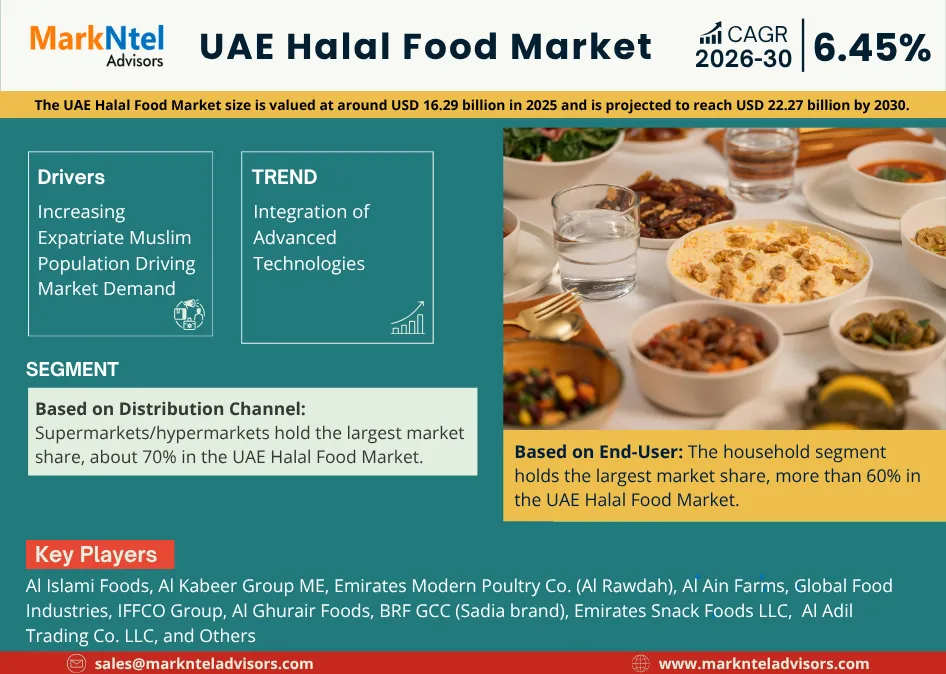
The UAE Halal Food Market size is valued at around USD 16.29 billion in 2025 and is projected to reach USD 22.27 billion by 2030. Along with this, the market is estimated to grow at a CAGR of around 6.45% during the forecast period, i.e., 2026-30. The market has registered a notable revenue growth in the past few years, backed by expanding Muslim expatriate population, growth in organized retail & E-commerce services, government support & certification infrastructure, increasing tourism & hospitality growth, and youth-driven demand for diverse halal offerings, etc.
The rapid expansion in organized retail chains and online grocery platforms offering halal food products has been contributing as one of the significant drivers for Saudi Arabia’s halal food industry, by enhancing consumer access to halal-certified products across both urban and remote areas. Retail chains and E-commerce platforms both provide great product variety, traceability, and convenience as per the consumer preferences, especially among the young and tech-savvy population of the country, thereby accelerating the overall market growth & expansion.
Additionally, the growing government support and industrial policies, such as the Make it in the Emirates campaign and the Halal National Mark to enhance local halal food production, are emerging as an opportunity area for the market players in the halal food market. These initiatives are designed to strengthen domestic halal food capabilities by encouraging investment in local manufacturing, processing, and reducing dependence on foreign suppliers.
Moreover, the rising adoption of advanced technologies, such as IoT devices, automated slaughtering systems, & AI-based quality checks, combined with traceability tools, such as blockchain & QR-based tracking systems, is emerging as one of the key trends for the UAE Halal Food Market. However, limited local manufacturing capacities are anticipated to hinder the growth & expansion of the halal food industry during the forecast period.
UAE Halal Food Market Scope:
| Category | Segments |
|---|---|
| By Product Type | Meat & Poultry Products, Dairy Products, Bakery & Confectionery, Beverages (Non-Alcoholic), Snacks, Ready-to-Eat Meals, Sauces & Condiments, Others |
| By Distribution Channel | Supermarkets/Hypermarkets, Convenience Stores, Specialty Stores, Online Retail, Others |
| By End User | Household, Foodservice (Hotels, Restaurants, Cafés), Institutions (Schools, Hospitals, etc.), and others |
UAE Halal Food Market Driver:
Increasing Expatriate Muslim Population Driving Market Demand – The diverse and wide-ranging presence of the expatriate Muslim community, primarily from countries such as Pakistan, India, Bangladesh, Indonesia, Egypt, and other nations in the country, which constitutes a significant portion of the total population, is increasing the demand for the UAE Halal Food Industry. As per the World Bank Data from 2020, expatriates accounted for approximately 88% of the UAE’s total population, while Emiratis accounted for around 11%. This strong Muslim presence generates a consistent demand for certified halal food products, as they maintain a strict adherence to halal dietary laws due to religious and cultural values, which prohibit the consumption of pork, alcohol, and improperly slaughtered meat.
To effectively regulate this demand, the UAE government has established a robust regulatory and certification framework, guided by the Emirates Authority for Standardization and Metrology (ESMA). These regulations ensure that all locally produced or imported halal food products comply with strict Islamic guidelines regarding safety, hygiene, and sourcing, therefore, fueling the overall growth of the UAE halal food industry.
UAE Halal Food Market Challenge:
Limited Local Manufacturing Capacities Hindering Market Growth – Lack of local production facilities in the country poses a significant challenge for the smooth growth & expansion of the UAE’s halal food industry. This shortfall is primarily driven by the region’s harsh climatic conditions & limited cultivable land, which restricts the availability of extensive agricultural and livestock resources, hindering the large-scale production of halal food products. As a result, the UAE remains heavily dependent on imports to meet domestic halal food demand. For instance, in 2024, according to the USDA Foreign Agricultural Service, the UAE imported significant components of the halal food segment, including poultry meat & meat products, accounting for around USD1.3 billion, and beef products accounted for around USD1.4 billion. This heavy import reliance often leads to vulnerabilities, including supply chain disruptions, price instability, and variations in halal authenticity across exporting nations. Therefore, the poor domestic productive capacity in the UAE restrains the overall growth & expansion of the halal food industry.
UAE Halal Food Market Trend:
Integration of Advanced Technologies – The growing integration of advanced technologies, like IoT devices, automated slaughtering systems, & AI-based quality checks, combined with traceability tools, such as blockchain & QR-based tracking systems, is emerging as a key trend for the UAE Halal Food Market. Unlike traditional methods, which typically count on manual documentation, prone to human error, delays, and restrict transparency throughout the supply chain, advanced food-tech innovations ensure transparency across the supply chain and give consumer greater confidence regarding the halal authenticity of their food.
Moreover, several companies, such as Majid Al Futtaim, OneAgrix, Tracer Tech, Verofax, and HalalChain by HLC Technologies, are involved in food-tech innovations in the country’s halal food sector. For instance, in 2025, Majid Al Futtaim signed a strategic MoU with the UAE’s Ministry of Industry and Advanced Technology under the “Make It in the Emirates” (MIITE) initiative, aiming to promote locally manufactured, high-quality products. Therefore, integration of advanced technologies in the manufacturing process is changing the growth trajectory of the halal food industry in the UAE.
UAE Halal Food Market (2026-30): Segmentation Analysis
The UAE Halal Food Market study of MarkNtel Advisors evaluates & highlights the major trends and influencing factors in each segment. It includes predictions for the period 2026–2030 at the national level. Based on the analysis, the market has been further classified as:
Based on Distribution Channel:
- Supermarkets/Hypermarkets
- Convenience Stores
- Specialty Stores
- Online Retail
- Others
Out of all these, supermarkets/hypermarkets hold the largest market share, about 70% in the UAE Halal Food Market. This is attributed to the presence of extensive food variety and wide accessibility in supermarkets/hypermarkets of the country. As of 2025, there are more than 3,000 supermarkets/hypermarkets operating in the UAE. These retail formats are signifying as a one-stop destination for consumers seeking halal products, including fresh meat & dairy, ready-to-eat meals, and snacks. Supermarkets have strong supply chain networks and partnerships with certified suppliers that ensure consistent availability and authenticity of halal food products.
Moreover, there are prominent retail chains, such as Carrefour, Lulu, and Union Coop, that are continuously expanding their footprints across the country, which further strengthens the dominance of supermarket/hypermarkets in the UAE. For instance, LuLu hypermarket is set to open over 20 new stores by 2025, across suburban areas of the country. Therefore, supermarkets/hypermarkets are the most prominent distribution channel, accelerating the overall revenue growth of the halal food industry in the country.
Based on End-User:
- Household
- Foodservice
- Institutions
Top UAE Halal Food Market Companies: Players, Analysis & Future Outlook
The leading halal food market players in the UAE include Al Islami Foods, Al Kabeer Group ME, Emirates Modern Poultry Co. (Al Rawdah), Al Ain Farms, Global Food Industries, IFFCO Group, Al Ghurair Foods, BRF GCC (Sadia brand), Emirates Snack Foods LLC, Hana Food Industries Co., Zain Poultry Farm, Al Maya Group, Al Adil Trading Co. LLC, and Others.
UAE Halal Food Industry Recent Development:
- 2025: Al Islami Foods launched a new range of Extra-Large Shrimps in UAE retail, featuring wild-caught, antibiotic- and hormone-free options to tap into keto and high-protein diet trends.
Gain a Competitive Edge with Our UAE Halal Food Market Report
- UAE Halal Food Market Report by MarkNtel Advisors provides a detailed & thorough analysis of market size & share, growth rate, competitive landscape, and key players. This comprehensive analysis helps businesses gain a holistic understanding of the market dynamics & make informed decisions.
- This report also highlights current market trends & future projections, allowing businesses to identify emerging opportunities & potential challenges. By understanding market forecasts, companies can align their strategies & stay ahead of the competition.
- UAE Halal Food Market Report aids in assessing & mitigating risks associated with entering or operating in the market. By understanding market dynamics, regulatory frameworks, and potential challenges, businesses can develop strategies to minimize risks & optimize their operations.
*Reports Delivery Format - Market research studies from MarkNtel Advisors are offered in PDF, Excel and PowerPoint formats. Within 24 hours of the payment being successfully received, the report will be sent to your email address.
Frequently Asked Questions
- Market Segmentation
- Introduction
- Product Definition
- Research Process
- Assumptions
- Executive Summary
- UAE Halal Food Market Policies, Regulations, and Product Standards
- UAE Halal Food Market Supply Chain Analysis
- UAE Halal Food Market Trends & Developments
- UAE Halal Food Market Dynamics
- Growth Drivers
- Challenges
- UAE Halal Food Market Hotspot & Opportunities
- UAE Halal Food Market Outlook, 2020–2030
- Market Size & Outlook
- By Revenues (USD Million)
- By Volume (Million Tons)
- Market Share & Outlook
- By Product Type
- Meat & Poultry Products – Market Size & Forecast 2020–2030, USD Million
- Dairy Products – Market Size & Forecast 2020–2030, USD Million
- Bakery & Confectionery – Market Size & Forecast 2020–2030, USD Million
- Beverages (Non-Alcoholic) – Market Size & Forecast 2020–2030, USD Million
- Snacks – Market Size & Forecast 2020–2030, USD Million
- Ready-to-Eat Meals – Market Size & Forecast 2020–2030, USD Million
- Sauces & Condiments – Market Size & Forecast 2020–2030, USD Million
- Others – Market Size & Forecast 2020–2030, USD Million
- By Distribution Channel
- Supermarkets/Hypermarkets – Market Size & Forecast 2020–2030, USD Million
- Convenience Stores – Market Size & Forecast 2020–2030, USD Million
- Specialty Stores – Market Size & Forecast 2020–2030, USD Million
- Online Retail – Market Size & Forecast 2020–2030, USD Million
- Others – Market Size & Forecast 2020–2030, USD Million
- By End User
- Household – Market Size & Forecast 2020–2030, USD Million
- Foodservice (Hotels, Restaurants, Cafés) – Market Size & Forecast 2020–2030, USD Million
- Institutions (Schools, Hospitals, etc.) – Market Size & Forecast 2020–2030, USD Million
- By Region
- Abu Dhabi & Al Ain
- Dubai
- Sharjah & Northern Emirates
- By Product Type
- Market Size & Outlook
- By Company
- Company Revenue Shares
- Competitor Characteristics
- UAE Halal Meat Market Outlook, 2020–2030
- Market Size & Outlook
- By Revenues (USD Million)
- By Volume (Million Tons)
- Market Share & Outlook
- By Type
- By Distribution Channel
- By End User
- By Region
- Market Size & Outlook
- UAE Supermarkets/Hypermarkets Halal Food Market Outlook, 2020–2030
- Market Size & Outlook
- By Revenues (USD Million)
- By Volume (Million Units)
- Market Share & Outlook
- By End-User – Market Size & Forecast 2020–2030, USD Million & Million Units
- By Product Type – Market Size & Forecast 2020–2030, USD Million & Million Units
- By Region – Market Size & Forecast 2020–2030, USD Million & Million Units
- Market Size & Outlook
- UAE Convenience Stores Halal Food Market Outlook, 2020–2030
- Market Size & Outlook
- By Revenues (USD Million)
- By Volume (Million Units)
- Market Share & Outlook
- By End-User – Market Size & Forecast 2020–2030, USD Million & Million Units
- By Product Type – Market Size & Forecast 2020–2030, USD Million & Million Units
- By Region – Market Size & Forecast 2020–2030, USD Million & Million Units
- Market Size & Outlook
- UAE Specialty Stores Market Outlook, 2020–2030
- Market Size & Outlook
- By Revenues (USD Million)
- By Volume (Million Units)
- Market Share & Outlook
- By End-User – Market Size & Forecast 2020–2030, USD Million & Million Units
- By Product Type – Market Size & Forecast 2020–2030, USD Million & Million Units
- By Region – Market Size & Forecast 2020–2030, USD Million & Million Units
- Market Size & Outlook
- UAE Online Retail Market Outlook, 2020–2030
- Market Size & Outlook
- By Revenues (USD Million)
- By Volume (Million Units)
- Market Share & Outlook
- By End-User – Market Size & Forecast 2020–2030, USD Million & Million Units
- By Product Type – Market Size & Forecast 2020–2030, USD Million & Million Units
- By Region – Market Size & Forecast 2020–2030, USD Million & Million Units
- Market Size & Outlook
- UAE Halal Food Market Key Strategic Imperatives for Success & Growth
- Competition Outlook
- Company Profiles
- Al Islami Foods
- Business Description
- Product Portfolio
- Strategic Alliances or Partnerships
- Recent Developments
- Financial Details
- Al Kabeer Group ME
- Business Description
- Product Portfolio
- Strategic Alliances or Partnerships
- Recent Developments
- Financial Details
- Emirates Modern Poultry Co. (Al Rawdah)
- Business Description
- Product Portfolio
- Strategic Alliances or Partnerships
- Recent Developments
- Financial Details
- Al Ain Farms
- Business Description
- Product Portfolio
- Strategic Alliances or Partnerships
- Recent Developments
- Financial Details
- Global Food Industries
- Business Description
- Product Portfolio
- Strategic Alliances or Partnerships
- Recent Developments
- Financial Details
- IFFCO Group
- Business Description
- Product Portfolio
- Strategic Alliances or Partnerships
- Recent Developments
- Financial Details
- Al Ghurair Foods
- Business Description
- Product Portfolio
- Strategic Alliances or Partnerships
- Recent Developments
- Financial Details
- BRF GCC (Sadia brand)
- Business Description
- Product Portfolio
- Strategic Alliances or Partnerships
- Recent Developments
- Financial Details
- Emirates Snack Foods LLC
- Business Description
- Product Portfolio
- Strategic Alliances or Partnerships
- Recent Developments
- Financial Details
- Business Description
- Product Portfolio
- Strategic Alliances or Partnerships
- Recent Developments
- Financial Details
- Hana Food Industries Co.
- Business Description
- Product Portfolio
- Strategic Alliances or Partnerships
- Recent Developments
- Financial Details
- Zain Poultry Farm
- Business Description
- Product Portfolio
- Strategic Alliances or Partnerships
- Recent Developments
- Financial Details
- Al Maya Group
- Business Description
- Product Portfolio
- Strategic Alliances or Partnerships
- Recent Developments
- Financial Details
- Al Adil Trading Co. LLC
- Business Description
- Product Portfolio
- Strategic Alliances or Partnerships
- Recent Developments
- Financial Details
- Others
- Al Islami Foods
- Company Profiles
- Disclaimer
MarkNtel Advisors follows a robust and iterative research methodology designed to ensure maximum accuracy and minimize deviation in market estimates and forecasts. Our approach combines both bottom-up and top-down techniques to effectively segment and quantify various aspects of the market. A consistent feature across all our research reports is data triangulation, which examines the market from three distinct perspectives to validate findings. Key components of our research process include:
1. Scope & Research Design At the outset, MarkNtel Advisors define the research objectives and formulate pertinent questions. This phase involves determining the type of research—qualitative or quantitative—and designing a methodology that outlines data collection methods, target demographics, and analytical tools. They also establish timelines and budgets to ensure the research aligns with client goals.
2. Sample Selection and Data Collection In this stage, the firm identifies the target audience and determines the appropriate sample size to ensure representativeness. They employ various sampling methods, such as random or stratified sampling, based on the research objectives. Data collection is carried out using tools like surveys, interviews, and observations, ensuring the gathered data is reliable and relevant.
3. Data Analysis and Validation Once data is collected, MarkNtel Advisors undertake a rigorous analysis process. This includes cleaning the data to remove inconsistencies, employing statistical software for quantitative analysis, and thematic analysis for qualitative data. Validation steps are taken to ensure the accuracy and reliability of the findings, minimizing biases and errors.

4. Data Forecast and FinalizationThe final phase involves forecasting future market trends based on the analyzed data. MarkNtel Advisors utilize predictive modeling and time series analysis to anticipate market behaviors. The insights are then compiled into comprehensive reports, featuring visual aids like charts and graphs, and include strategic recommendations to inform client decision-making
We offer flexible licensing options to cater to varying organizational needs. Choose the pricing pack that best suits your requirements:
Buy Now Inquire Before Buying
 Request Customization
 Talk to our Consultant