

UAE Catering Services Market Research Report: Forecast (2026-2032)
By Type (Outsourced, In-House), By End User (Construction Industry, Corporate Offices, Education, Healthcare, Oil & Gas, Defence & Law Enforcement, Government, In-Flight, Mining & ... EPC, Others), By Model (B2B, Retail/B2C), and others Read more
- Food & Beverages
- Jul 2026
- Pages 140
- Report Format: PDF, Excel, PPT
UAE Catering Services Market
Projected 6.22% CAGR from 2026 to 2032
Study Period
2026-2032
Market Size (2026)
USD 4.35 Billion
Market Size (2032)
USD 6.25 Billion
Base Year
2025
Projected CAGR
6.22%
Leading Segments
By Type: Outsourced
UAE Catering Services Market Key Takeaways
- The UAE catering services market size was valued at USD 4.13 billion in 2025 and is projected to grow from USD 4.35 billion in 2026 to USD 6.25 billion by 2032.
- The market is projected to register a CAGR of 6.22% during 2026–2032.
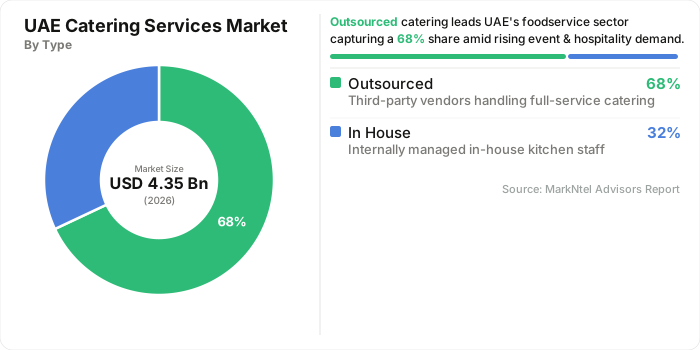
- Outsourced catering is the dominant segment based on type, accounting for about 68% revenue share in the market.
- The construction industry is the dominant segment based on end user, with an estimated share of around 35% in the Market.
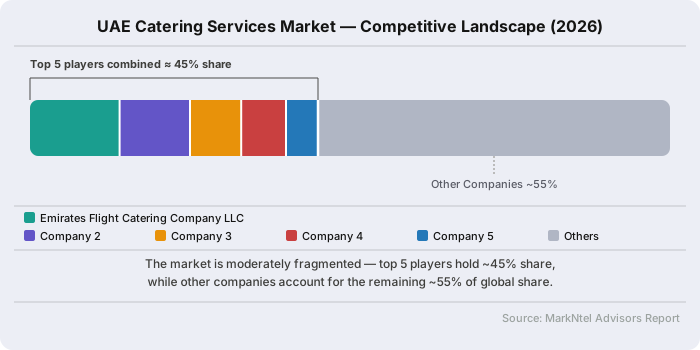
- The industry is fragmented, with the top five players collectively accounting for approximately 45% of the market share in 2026.
UAE Catering Services Market Size and Outlook
The UAE catering industry was valued at USD 4.13 billion in 2025 and is currently standing at USD 4.35 billion in 2026. The industry is projected to grow to USD 6.25 billion by 2032 showcasing a CAGR of around 6.22% during the forecast period, i.e., 2026–32.
The market is evolving alongside the country's transformation into a global tourism, aviation and business hub. Rising international arrivals, expanding airline operations, growing hotel capacity and an active calendar of exhibitions and corporate events continue to generate strong demand for catering services. At the same time, increasing outsourcing by businesses, healthcare providers, educational institutions and industrial facilities is widening the customer base, encouraging operators to expand capacity, diversify service offerings and invest in operational efficiency.
Growing aviation activity is encouraging catering providers to expand operational capacity and improve service efficiency. In 2025, Emirates flight catering invested in 53 next generation aircraft catering trucks under its five-year fleet renewal programme to support increasing airline operations at Dubai International Airport. Beyond capacity expansion, operators are also investing in automation and specialised equipment to improve turnaround times and operational reliability as airlines continue restoring and expanding international routes.
The market is also witnessing gradual diversification beyond traditional airline catering. Bustanica showcased an expanded portfolio of hospitality, retail and catering solutions during Gulfood 2026, reflecting the increasing focus on serving hotels, premium events and institutional clients alongside aviation customers. At the same time, sustainability is becoming a competitive differentiator. EKFC is advancing proof-of-concept electric aircraft catering trucks and electric hi-loaders, both expected to enter operations by 2026, supporting the UAE's broader decarbonisation agenda while improving operational efficiency.
Government initiatives are further influencing long-term market development through labour reforms and workforce localisation. The UAE Cabinet's Emiratisation programme requires eligible private-sector companies to increase skilled Emirati representation, with hospitality among the sectors subject to expanded compliance from 2026. Financial contributions for non-compliance are expected to encourage greater investment in workforce planning, training and retention, prompting catering companies to balance labour costs with productivity improvements as the catering services market in the UAE continues to mature.
UAE Catering Services Market Key Indicators
- The UAE economy expanded by 6.2% in 2025, with non-oil GDP growing 6.8% to USD 408 billion, supporting higher investments across tourism, hospitality, infrastructure and corporate sectors that generate demand for commercial catering services.
- Dubai International Airport handled 92.3 million passengers in 2025 while Zayed International Airport served over 29.4 million passengers in 2025, reflecting strong growth in international and transit travel that is driving demand for in-flight catering, airport lounges and aviation support services
- The UAE's travel and tourism sector generated USD 72.84 billion, contributing nearly 13% of GDP in 2025, reinforcing long-term demand across airline, hotel and event catering segments.
- Dubai welcomed 19.59 million international overnight visitors in 2025, a 5% increase year on year, strengthening demand for hotel banquets, event catering, airline meals and hospitality foodservice across the UAE
- Dubai's hospitality sector expanded to 827 hotels offering 154,264 rooms in 2025, while maintaining an average of 80% hotel occupancy, increasing the addressable market for outsourced catering, banquet services and institutional foodservice partnerships.
UAE Catering Services Market Scope
| Category | Segments |
|---|---|
| By Type | Outsourced, In-House |
| By End User | Construction Industry, Corporate Offices, Education, Healthcare, Oil & Gas, Defence & Law Enforcement, Government, In-Flight, Mining & EPC, Others |
| By Model | B2B, Retail/B2C |
UAE Catering Services Market Growth Drivers
Rising Tourism and Expanding Business Events Fuelling Catering Demand
The expansion of tourism and business events is a key growth driver for the UAE catering services market, creating sustained demand across hotels, airlines, convention centres, exhibition venues and corporate functions. Higher visitor arrivals are increasing food service requirements for accommodation providers, meetings, incentive travel, banquets and large-scale events, enabling catering companies to secure recurring institutional contracts while expanding service capacity across the hospitality ecosystem.
In 2025, Dubai welcomed 19.59 million international overnight visitors, while hotel occupancy reached 80%, highlighting consistently strong utilisation of hospitality infrastructure. Higher room occupancy and longer visitor activity are translating into greater demand for banquet services, hotel dining, conference catering and airline meal preparation. This expanding tourism base continues to strengthen catering volumes beyond seasonal peaks and supports long-term business visibility for service providers.
Business events are further reinforcing market growth. According to the Dubai government media office, Dubai secured 504 international business events in 2025, with these events expected to attract more than 272,000 delegates through 2029. Major events, including the Africa Energy Forum 2026, UNLEASH Middle East 2026 and SIBOS 2029, are expected to generate recurring demand for corporate catering, gala dinners, hospitality services and venue-based food operations. The growing international events pipeline is encouraging catering providers to strengthen production capabilities, expand event-focused service portfolios and build long-term partnerships with hotels, event organisers and corporate clients.
Recent Trends
Centralized Mega-Kitchens Transform High-Volume Catering Operations
The UAE catering services market is witnessing a growing shift toward centralized mega-kitchens and high-capacity food production facilities as operators seek to improve efficiency across large institutional contracts. These facilities enable caterers to prepare thousands of meals daily from a single location while serving aviation, corporate, healthcare, education, construction, and industrial clients across multiple sites. Centralized production supports bulk ingredient procurement, standardized food quality, stricter hygiene controls, automated preparation processes, and more efficient workforce utilization.
The trend is particularly relevant in the UAE, where expanding aviation activity, large-scale events, infrastructure projects, and workforce accommodation generate substantial demand for high-volume meal services. Leading operators are increasingly integrating automated cooking equipment, temperature-monitoring systems, digital inventory platforms, and route optimization into centralized kitchens to improve consistency and reduce operational waste. As catering contracts become larger and service expectations rise, investment in scalable production infrastructure is expected to become an increasingly important competitive differentiator across the UAE catering services market.
UAE Catering Services Market Challenges and Opportunities
Rising Sustainability Compliance Costs Creating Long Term Efficiency Opportunities
Commercial catering providers in the UAE face increasing operational challenges as sustainability and food waste regulations become more stringent. Commercial kitchens are required to comply with evolving waste management, hygiene and infrastructure standards, including grease management systems, HACCP-compliant workflow separation and fire safety specifications, increasing both fit out investments and ongoing operating expenses. For small and mid-sized caterers, meeting these requirements can lengthen project timelines and raise the cost of expanding or upgrading production facilities.
The compliance burden is expected to intensify as the UAE advances circular economy and waste reduction objectives. Dubai's integrated waste management strategy 2021 to 2041 targets zero waste to landfill by 2030, with a 60% waste diversion milestone for 2025 and expanded organics collection planned across hotels and food hubs by 2027. While these initiatives strengthen environmental performance, they also require catering operators to invest in waste segregation, monitoring systems and sustainable operational practices.
These evolving regulatory requirements are also accelerating the adoption of advanced waste management and resource-efficient technologies across commercial catering operations. As operators move beyond compliance-led investments, sustainable kitchen solutions are increasingly being viewed as long-term productivity enablers that reduce waste disposal costs, improve resource utilisation and strengthen environmental performance. This shift is creating new opportunities for technology providers, equipment manufacturers and specialised waste management companies serving the catering ecosystem.
Leading catering and hospitality operators are already demonstrating the commercial viability of this transition. In 2025, Emirates flight catering commissioned its first commercial bio digester before expanding to a significantly larger processing system in 2026 to increase food waste treatment capacity and reduce carbon emissions. Similar sustainability initiatives are also being implemented across Dubai Holding's hospitality portfolio through bio digesters and hydroponic farming solutions that support circular food management. As these technologies become commercially proven, they are expected to encourage wider adoption among mid-sized catering operators seeking to improve operational efficiency, strengthen ESG performance and meet evolving environmental standards.
Segmentation Insights
Outsourced Catering Maintaining Leadership Through Long Term Institutional Contracts
Outsourced catering holds the largest share of the UAE catering services market, accounting for approximately 68% of the market, owing to the growing preference among organisations to outsource foodservice operations to specialised providers. The model enables businesses to reduce capital expenditure, optimise workforce management and ensure consistent compliance with food safety and quality standards. Rising demand from construction sites, corporate offices, healthcare facilities, educational institutions and aviation operators continues to reinforce the segment's leadership across the country.
The segment is further strengthened by the growing outsourcing of catering services for large-scale events and institutional operations. In 2025, Emirates Flight Catering and DWTC Hospitality entered a strategic partnership to deliver integrated catering solutions for major exhibitions, conferences and events across the UAE and the GCC. The collaboration reflects the increasing preference for specialised outsourced catering providers capable of delivering high-volume food production, operational scalability and consistent service quality for complex event environments. Based on type, the market is further bifurcated into
- Outsourced
- Contractual
- Non Contractual
- In-House
Construction Industry Leading Demand Through Large Scale Workforce Expansion
The construction industry represents the largest end user in the UAE catering services market, accounting for an estimated 35% share of the market. The country's continuous investments in residential, commercial, industrial and infrastructure developments have sustained a large onsite workforce that requires daily meal services. Catering providers remain integral to construction operations by delivering nutritious, timely and large-volume meal solutions while ensuring compliance with occupational health and food safety standards.
The sustained pipeline of infrastructure and real estate developments continues to strengthen catering demand from construction camps and project sites. Ongoing expansion under national development initiatives, alongside investments in transport infrastructure, mixed-use developments and industrial projects, is maintaining high workforce concentrations that depend on outsourced foodservice providers. This is encouraging catering companies to expand central kitchen capacity, strengthen logistics networks and develop customised workforce nutrition programmes to support long-term construction activity across the UAE. Based on end user, the market is further bifurcated into
- Construction Industry
- Corporate Offices
- Education
- Healthcare
- Oil & Gas
- Defence & Law Enforcement
- Government
- In-Flight
- Mining & EPC
- Others
UAE Catering Services Market Competitive Analysis
The UAE catering services indutry is moderately fragmented, with competition distributed among airline catering specialists, contract catering providers, hospitality catering companies, institutional foodservice operators and integrated facility management firms. Major participants include The Emirates Group (Emirates Flight Catering Company LLC), Abu Dhabi National Hotels (ADNH Compass), NCC Holding (NCC Catering), Sodexo Middle East (Kelvin Catering Services LLC), and ADNEC Group (Capital Catering & Services LLC). The top five players collectively accounting for approximately 45% of the market share in 2026.
Key Companies in the UAE Catering Services Market
- The Emirates Group (Emirates Flight Catering Company LLC)
- ADNEC Group (Capital Catering & Services LLC)
- NCC Holding (NCC Catering)
- Sodexo Middle East (Kelvin Catering Services LLC)
- Al Habtoor Group (Metropolitan Catering Services LLC)
- Abu Dhabi National Hotels (ADNH Compass)
- Conntrak Catering Services LLC
- Intercat Hospitality LLC
- Abela & Co. LLC
- Ghassan Aboud Group (Grandiose Catering)
UAE Catering Services Industry News and Recent Developments
2025: ADNH Catering Expands Institutional Foodservice Through Food Nation Acquisition
In 2025, Abu Dhabi National Hotels Catering (ADNH Catering) acquired Food Nation Catering, strengthening its presence in the UAE's education catering segment while expanding its institutional foodservice portfolio. The acquisition broadened ADNH Catering's customer base and enhanced its ability to serve schools alongside existing corporate, healthcare and industrial clients. The transaction reflects rising demand for outsourced catering services across institutional end users, where organisations increasingly prefer specialised providers capable of delivering large scale, compliant and cost efficient meal services. The acquisition also reinforces the company's strategy of expanding through targeted investments to strengthen its market presence and capture growing outsourcing opportunities across the UAE.
Impact Analysis: The acquisition highlights the increasing consolidation of the UAE catering services market as providers expand sector-specific capabilities to address rising institutional demand. It is expected to strengthen competition, encourage further investments in specialised catering services and accelerate the adoption of long-term outsourced foodservice contracts across education and other institutional segments.
2025: Emirates Flight Catering Named Exclusive Catering Partner for Dubai Airshow
In September 2025, Emirates Flight Catering was appointed the exclusive catering partner for the Dubai Airshow under a four-year agreement, delivering catering services for exhibitors, hospitality lounges, VIP guests and event participants. The partnership reflects the growing reliance on specialised catering providers for large scale international exhibitions and business events that require high volume food production, operational efficiency and stringent service quality standards. The agreement further demonstrates the expanding demand for outsourced event catering as the UAE continues strengthening its position as a leading destination for global aviation, business and exhibition activities.
Impact Analysis: The partnership reinforces the growing importance of specialised event catering within the UAE catering services market. It is expected to create additional opportunities for outsourced catering providers, encourage investments in scalable production capabilities and strengthen the market's ability to support an expanding pipeline of international exhibitions, conferences and mega events.
Frequently Asked Questions
- Market Segmentation
- Introduction
- Product Definition
- Research Process
- Assumptions
- Executive Summary
- Macroeconomic Outlook
- UAE Catering Services Market Winning Strategies, 2024
- Investment Scenario
- Hotspots
- UAE Catering Services Market Pricing Analysis
- Price Per Plate
- Annual Price Increase Trend
- Key Factors Impacting Prices
- UAE Catering Services Market Policies, Regulations, and Product Standards
- UAE Catering Services Market Trends & Developments
- UAE Catering Services Market Dynamics
- Growth Factors
- Challenges
- UAE Catering Services Market Hotspot & Opportunities
- UAE Catering Services Market Outlook, 2022-2032
- Market Size & Outlook
- By Revenues (USD Million)
- By Number of Meals Served (Million Meals)
- Market Segmentation & Outlook
- By Type- Market Size & Forecast 2022-2032, USD Million & Million Meals
- Outsourced
- Contractual
- Non Contractual
- In-House
- Outsourced
- By End User- Market Size & Forecast 2022-2032, USD Million & Million Meals
- Construction Industry
- Corporate Offices
- Education
- Healthcare
- Oil & Gas
- Defence & Law Enforcement
- Government
- In-Flight
- Mining & EPC
- Others
- By Model- Market Size & Forecast 2022-2032, USD Million & Million Meals
- B2B
- Retail/B2C
- By Region- Market Size & Forecast 2022-2032, USD Million & Million Meals
- Abu Dhabi & Al Ain
- Dubai
- Sharjah & Northern Emirates
- By Company
- Competition Characteristics
- Market Share & Analysis
- By Type- Market Size & Forecast 2022-2032, USD Million & Million Meals
- Market Size & Outlook
- Abu Dhabi & Al Ain Catering Services Market Outlook, 2022-2032
- Market Size & Outlook
- By Revenues (USD Million)
- By Number of Meals Served (Million Meals)
- Market Segmentation & Outlook
- By End User- Market Size & Forecast 2022-2032, USD Million & Million Meals
- By Model- Market Size & Forecast 2022-2032, USD Million & Million Meals
- By Region- Market Size & Forecast 2022-2032, USD Million & Million Meals
- Market Size & Outlook
- Dubai Catering Services Market Outlook, 2022-2032
- Market Size & Outlook
- By Revenues (USD Million)
- By Number of Meals Served (Million Meals)
- Market Segmentation & Outlook
- By End User- Market Size & Forecast 2022-2032, USD Million & Million Meals
- By Model- Market Size & Forecast 2022-2032, USD Million & Million Meals
- By Region- Market Size & Forecast 2022-2032, USD Million & Million Meals
- Market Size & Outlook
- Sharjah & Northern Emirates Catering Services Market Outlook, 2022-2032
- Market Size & Outlook
- By Revenues (USD Million)
- By Number of Meals Served (Million Meals)
- Market Segmentation & Outlook
- By End User- Market Size & Forecast 2022-2032, USD Million & Million Meals
- By Model- Market Size & Forecast 2022-2032, USD Million & Million Meals
- By Region- Market Size & Forecast 2022-2032, USD Million & Million Meals
- Market Size & Outlook
- UAE Catering Services Market Key Strategic Imperatives for Success & Growth
- Competitive Outlook
- Company Profiles
- The Emirates Group (Emirates Flight Catering Company LLC)
- Business Description
- Product Portfolio
- Collaborations & Alliances
- Recent Developments
- Financial Details
- Others
- ADNEC Group (Capital Catering & Services LLC)
- Business Description
- Product Portfolio
- Collaborations & Alliances
- Recent Developments
- Financial Details
- Others
- NCC Holding (NCC Catering)
- Business Description
- Product Portfolio
- Collaborations & Alliances
- Recent Developments
- Financial Details
- Others
- Sodexo Middle East (Kelvin Catering Services LLC)
- Business Description
- Product Portfolio
- Collaborations & Alliances
- Recent Developments
- Financial Details
- Others
- Al Habtoor Group (Metropolitan Catering Services LLC)
- Business Description
- Product Portfolio
- Collaborations & Alliances
- Recent Developments
- Financial Details
- Others
- Abu Dhabi National Hotels(ADNH Compass)
- Business Description
- Product Portfolio
- Collaborations & Alliances
- Recent Developments
- Financial Details
- Others
- Conntrak Catering Services LLC
- Business Description
- Product Portfolio
- Collaborations & Alliances
- Recent Developments
- Financial Details
- Others
- Intercat Hospitality LLC
- Business Description
- Product Portfolio
- Collaborations & Alliances
- Recent Developments
- Financial Details
- Others
- Abela & Co. LLC
- Business Description
- Product Portfolio
- Collaborations & Alliances
- Recent Developments
- Financial Details
- Others
- Ghassan Aboud Group (Grandiose Catering)
- Business Description
- Product Portfolio
- Collaborations & Alliances
- Recent Developments
- Financial Details
- Others
- The Emirates Group (Emirates Flight Catering Company LLC)
- Company Profiles
- Disclaimer
MarkNtel Advisors follows a robust and iterative research methodology designed to ensure maximum accuracy and minimize deviation in market estimates and forecasts. Our approach combines both bottom-up and top-down techniques to effectively segment and quantify various aspects of the market. A consistent feature across all our research reports is data triangulation, which examines the market from three distinct perspectives to validate findings. Key components of our research process include:
1. Scope & Research Design At the outset, MarkNtel Advisors define the research objectives and formulate pertinent questions. This phase involves determining the type of research—qualitative or quantitative—and designing a methodology that outlines data collection methods, target demographics, and analytical tools. They also establish timelines and budgets to ensure the research aligns with client goals.
2. Sample Selection and Data Collection In this stage, the firm identifies the target audience and determines the appropriate sample size to ensure representativeness. They employ various sampling methods, such as random or stratified sampling, based on the research objectives. Data collection is carried out using tools like surveys, interviews, and observations, ensuring the gathered data is reliable and relevant.
3. Data Analysis and Validation Once data is collected, MarkNtel Advisors undertake a rigorous analysis process. This includes cleaning the data to remove inconsistencies, employing statistical software for quantitative analysis, and thematic analysis for qualitative data. Validation steps are taken to ensure the accuracy and reliability of the findings, minimizing biases and errors.

4. Data Forecast and FinalizationThe final phase involves forecasting future market trends based on the analyzed data. MarkNtel Advisors utilize predictive modeling and time series analysis to anticipate market behaviors. The insights are then compiled into comprehensive reports, featuring visual aids like charts and graphs, and include strategic recommendations to inform client decision-making
We offer flexible licensing options to cater to varying organizational needs. Choose the pricing pack that best suits your requirements:
Buy Now Inquire Before Buying
 Request Customization
 Talk to our Consultant







