Europe Building Insulation Material Market Research Report: Trends & Forecast (2026-2032)
By Material Type (Mineral Wool (Stone Wool, Glass Wool), Foamed Plastics (Expanded Polystyrene (EPS), Extruded Polystyrene (XPS), Polyurethane (PU), Polyisocyanurate (PIR)), Fiberg ... lass, Cellulose, Aerogels, Others), By Application (Floor / Basement Insulation, Wall Insulation, Roof / Ceiling Insulation), By End User (Residential, Non-Residential, Industrial, Commercial, Others), and others Read more
- Buildings, Construction, Metals & Mining
- Feb 2026
- Pages 165
- Report Format: PDF, Excel, PPT
Europe Building Insulation Material Market
Projected 4.5% CAGR from 2026 to 2032
Study Period
2026-2032
Market Size (2026)
USD 8.86 Billion
Market Size (2032)
USD 12.06 Billion
Base Year
2025
Projected CAGR
4.5%
Leading Segments
By End-User: Residential
Europe Building Insulation Material Market Report Key Takeaways:
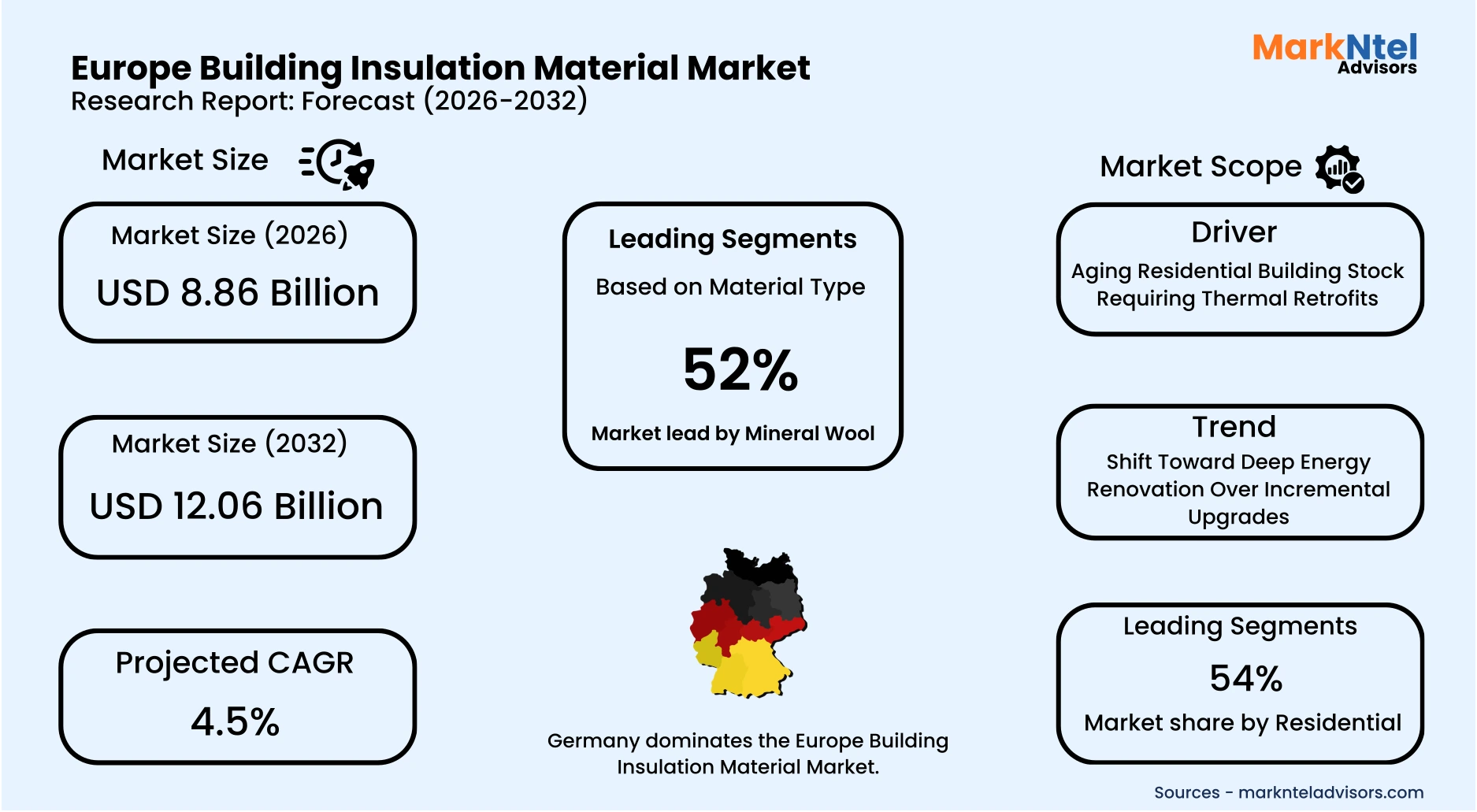
- Market size is estimated at USD 8.86 billion in 2026 and is projected to reach USD 12.06 billion by 2032. The estimated CAGR from 2026 to 2032 is around 4.5%, indicating strong growth.
- Germany is dominating this market by accounting for more than 26% of the market share in 2026.
- By Material Type, the mineral wool segment represented a significant share of about 52% in the Europe Building Insulation Material Market in 2026.
- By End-User, the residential sector represented a significant share of about 54% in the Europe Building Insulation Material Market in 2026.
- Leading building insulation material companies in Europe are Johns Manville Corporation, Saint-Gobain S.A., BASF SE, Kingspan Group plc, Knauf Insulation, Inc., Owens Corning, Huntsman Corporation, Rockwool International A/S, Firestone Building Products Company, Cabot Corporation, Dow Corning Corporation, Covestro AG, URSA Insulation, S.A., Paroc Group Oy, Atlas Roofing Corporation, and Others.
Market Insights & Analysis: Europe Building Insulation Material Market (2026-32):
The Europe Building Insulation Material Market size is valued at around USD 8.86 billion in 2026 and is projected to reach USD 12.06 billion by 2032. Along with this, the market is estimated to grow at a CAGR of around 4.5% during the forecast period, i.e., 2026-32.
The Europe Building Insulation Material Market has grown steadily as energy efficiency became a central policy priority in the region, with buildings accounting for about 40% of final energy consumption and 36% of energy-related CO₂ emissions in the EU, according to the European Commission’s Energy Performance of Buildings Directive (EPBD) documentation . This long-standing structural imbalance, coupled with an aging building stock where a majority predates modern efficiency norms, created persistent demand for thermal insulation in residential, commercial, industrial, and institutional buildings. The scale of this inefficiency has historically underpinned insulation uptake as a practical means to reduce heating energy use.
Current market expansion reflects strengthened regulatory frameworks and national incentive programs that directly support insulation adoption across end-users. The recast EPBD (2023/2024) requires EU member states to set ambitious renovation trajectories that improve energy performance, with deadlines for national plans scheduled through 2025 , reinforcing insulation upgrades in both existing and new buildings. In the UK, the government’s Great British Insulation Scheme, announced in 2025, extended funding to low-income households for wall, roof, and floor insulation to lower energy bills and cut emissions, illustrating how policy can drive residential demand. These measures have boosted demand from non-residential and institutional sectors that must meet tightening performance standards.
Economic and demographic factors have also contributed to market momentum, as urban population growth and rising living standards increase expectations for comfort and lower operational costs. Industrial end users such as warehouses and manufacturing facilities are investing in high-performance insulation to reduce energy losses and improve process efficiency, aligning with the International Energy Agency’s (IEA) emphasis on building and industrial efficiency as cost-effective carbon reduction levers. Commercial real estate owners are similarly upgrading building envelopes to meet tenant expectations and regulatory compliance, broadening insulation adoption beyond purely residential applications.
Looking ahead, forward-looking policy commitments and climate action frameworks are expected to sustain market prospects. In 2025, the EU’s Fit for 55 package and national climate plans tie building renovation and decarbonization to broader energy security goals, ensuring continued insulation demand across all end-user categories. Industry responses, including manufacturing capacity expansions and low-emission product innovations reported by major producers, further support long-term market stability. Combined regulatory certainty, demographic trends, and publicly reported policy actions position the Europe Building Insulation Material Market for sustained growth.
Europe Building Insulation Material Market Recent Developments:
- 2025 : BASF introduced Cavipor clay foam, a new mineral-based insulation material for energy-efficient renovations of walls, floors, and roofs, expanding sustainable thermal solutions in Europe. The product supports enhanced building envelopes and energy savings, with early use reported in roughly 2,000 homes across Germany, the Netherlands, Ireland, and the UK.
- 2025 : Saint-Gobain Glass partnered with LuxWall to bring INSIO transparent insulation to Europe, integrating vacuum glazing to reduce building energy losses and support energy-efficient façades. The solution targets window energy performance, historically responsible for about 40% of heating/cooling demand.
Europe Building Insulation Material Market Scope:
| Category | Segments |
|---|---|
| By Material Type | (Mineral Wool (Stone Wool, Glass Wool), Foamed Plastics (Expanded Polystyrene (EPS), Extruded Polystyrene (XPS), Polyurethane (PU), Polyisocyanurate (PIR)), Fiberglass, Cellulose, Aerogels, Others), |
| By Application | (Floor / Basement Insulation, Wall Insulation, Roof / Ceiling Insulation), |
| By End User | (Residential, Non-Residential, Industrial, Commercial, Others), |
Europe Building Insulation Material Market Driver:
Aging Residential Building Stock Requiring Thermal Retrofits
The aging residential building stock has become a structurally significant driver of growth in the Europe Building Insulation Material Market, reflecting historical housing development patterns across the region. More than 75% of residential buildings in the European Union were constructed before 1990 , when thermal insulation standards were limited or absent, resulting in persistently poor energy performance. Older homes typically exhibit higher heat loss, elevated energy consumption, and reduced indoor comfort. These structural inefficiencies have intensified the need for large-scale thermal retrofits across Europe’s residential sector.
The scale of this driver is evident in national assessments where governments have identified inefficient housing as a priority for renovation. In France, over 5 million homes are classified as highly energy-inefficient dwellings, making them subject to mandatory renovation measures that directly increase insulation demand . Similarly, more than 60% of residential buildings in Italy were constructed before 1980, driving insulation consumption during roof replacements, façade upgrades, and structural renovations. These national characteristics translate into consistent retrofit activity across major residential markets.
This driver materially expands market volume because aging homes typically require comprehensive building envelope upgrades rather than selective insulation measures. Thermal retrofits of older residential buildings often involve full wall, roof, and floor insulation to meet modern efficiency standards, significantly increasing material usage per project. The UK Parliament’s Energy Security and Net Zero Committee confirmed in 2025 that around 80% of homes expected to be occupied in 2050 already exist, underscoring the long-term reliance on retrofit-led solutions . As a result, thermal renovation of existing housing will remain a sustained and non-cyclical source of insulation demand across Europe.
Europe Building Insulation Material Market Trend:
Shift Toward Deep Energy Renovation Over Incremental Upgrades
The deep energy renovation trend has become a defining shift in the Europe Building Insulation Material Market as policymakers recognize that shallow fixes do not meet decarbonization or energy security goals. The EU’s Revised Energy Performance of Buildings Directive (EPBD) requires Member States to establish National Building Renovation Plans by the end of 2025 to cut energy use and emissions from existing buildings, prioritizing upgrades of the worst-performing stock rather than piecemeal improvements. The EU’s Renovation Wave strategy aims to renovate 35 million buildings by 2030 and double annual renovation rates, explicitly linking regulatory targets with deep retrofit approaches rather than minor measures .
This trend is reshaping industry practices and adoption patterns as comprehensive envelope upgrades, including wall, roof, and airtightness improvements, become the norm across residential, commercial, and institutional segments. Under the EPBD framework, worst-performing buildings must be prioritized for renovation, and minimum energy performance standards are being strengthened to enforce deeper upgrades, driving significant increases in insulation material volumes per project . The shift is supported by EU policy documents highlighting Mandatory National Renovation Plans that include clear 2030, 2040, and 2050 targets linked to insulation and energy performance.
This trend is expected to persist because it stems from binding regulatory requirements and long-term climate commitments rather than short-term incentives. The EU’s integrated approach, which combines renovation mandates with digital energy performance tools and long-term planning, signals that deep renovation will remain central to the evolution of the insulation market well beyond 2030 as Member States implement and monitor compliance.
Europe Building Insulation Material Market Opportunity:
Demand for High-Performance Insulation in Urban Renovations
Europe’s dense urban renovation environment has created strong demand for high-performance insulation solutions, particularly where space limitations, heritage protections, and safety regulations restrict the use of conventional materials. In 2025, the United Nations reported that over 74% of Europe’s population lives in urban areas, where construction activity is dominated by refurbishment rather than demolition and rebuilding. In such settings, energy performance improvements must be achieved without altering building footprints or protected façades. These structural constraints favor insulation materials that deliver high thermal resistance within reduced thickness.
Urban retrofit activity is further shaped by stricter safety and regulatory requirements, which directly influence material selection. Following post-Grenfell reforms, the UK government introduced tighter controls on external wall systems in multi-storey residential buildings, mandating non-combustible and performance-certified solutions. Comparable façade safety and heritage preservation rules apply in cities such as Paris, Rome, and Amsterdam, where modifications to external wall dimensions are tightly regulated . As a result, advanced insulation materials capable of meeting both thermal efficiency and fire safety standards without structural alteration are increasingly preferred.
National incentive frameworks are reinforcing these demand patterns by accelerating retrofit activity in existing urban buildings. In Italy, Conto Termico 3.0, introduced through an August 2025 decree, provides an annual funding envelope of approximately USD1 billion to support energy efficiency and small-scale renewable thermal interventions. The program covers up to 65% of eligible project costs, rising to 100% for public buildings and small municipalities, with insulation explicitly included as a qualifying measure. By prioritizing upgrades in existing structures over new construction, such policies strengthen sustained demand for high-performance insulation tailored to urban renovation constraints.
Europe Building Insulation Material Market Challenge:
High Upfront Cost of Building Insulation and Deep Renovation
High upfront costs remain a structural challenge in the Europe Building Insulation Material Market due to the capital-intensive nature of deep renovation projects. Comprehensive insulation upgrades require interventions across walls, roofs, floors, and building systems, significantly increasing initial expenditure compared to incremental improvements. The European Commission reported that only around 1% of buildings are renovated annually in the EU, while deep renovations account for just 0.2–0.3%, reflecting financial barriers rather than technical limitations. These low renovation rates highlight the difficulty of mobilizing capital for large-scale insulation upgrades.
The financial impact of this challenge is evident across major European housing markets. As per EU documentation confirms that deep energy renovation projects typically involve long payback periods, discouraging homeowners and building owners from undertaking full insulation retrofits without substantial financial support . Public authorities face similar constraints, as budget limitations slow renovation activity in schools, hospitals, and social housing. As a result, renovation activity often favors partial or phased upgrades instead of full insulation deployment.
This cost pressure materially restricts market expansion by delaying adoption decisions and limiting project scale. Many government incentive schemes require building owners to pre-finance renovation costs before reimbursement, reducing accessibility for lower-income households and small property owners. For insulation manufacturers and installers, inconsistent project pipelines hinder capacity expansion and investment planning. Consequently, despite strong regulatory drivers, high upfront costs continue to suppress renovation volumes and slow the pace of insulation market growth across Europe.
Europe Building Insulation Material Market (2026-32) Segmentation Analysis:
The Europe Building Insulation Material Market study of MarkNtel Advisors evaluates & highlights the major trends and influencing factors in each segment. It includes predictions for the period 2026–32 at the regional level. Based on the analysis, the market has been further classified as;
Based on Material Type:
- Mineral Wool
- Foamed Plastics
- Fiberglass
- Cellulose
- Aerogels
- Others
The mineral wool segment dominates the Europe Building Insulation Material Market with an estimated market share of 52%, supported by its alignment with Europe’s fire safety, sustainability, and decarbonization requirements. Mineral wool, including rock and glass wool, is non-combustible, durable, and suitable for deep renovation and high-density urban buildings, making it the preferred insulation material across residential, commercial, and public infrastructure projects. Its ability to meet stringent façade fire regulations and deliver both thermal and acoustic performance gives it a structural advantage over foamed plastics and emerging alternatives.
Industry investment patterns further reinforce this dominance, as leading manufacturers continue to expand mineral wool capacity to meet rising regulatory and sustainability-driven demand. In 2025, Knauf Insulation announced an investment of approximately USD 215 million in a new rock mineral wool manufacturing facility in the UK, with annual capacity exceeding 100,000 tonnes . The facility will deploy low-carbon electric melting technology, directly addressing growing demand for insulation with ultra-low embodied carbon while supporting national net-zero targets.
This expansion illustrates how mineral wool is positioned as both a compliance-ready and future-proof insulation solution. By simultaneously increasing supply capacity and reducing production emissions, manufacturers are reinforcing mineral wool’s cost efficiency, scalability, and regulatory acceptance. The large installed base of mineral wool across Europe also drives recurring demand through renovation, replacement, and retrofit activity. Collectively, regulatory preference, sustainability alignment, and sustained industrial investment firmly anchor mineral wool as the leading material segment in the European insulation market.
Based on the End-User:
- Residential
- Non-Residential
- Industrial
- Commercial
- Others
The residential segment accounts for approximately 54% of the Europe Building Insulation Material Market due to the sheer scale and inefficiency of Europe’s housing stock, which drives sustained insulation demand. The building sector is responsible for about 40% of final energy consumption in the EU, with residential buildings contributing the largest share of that total due to heating and thermal losses. Improving insulation in homes is therefore central to reducing energy use and achieving energy efficiency goals. As most renovations target whole-building performance to cut energy costs and emissions, insulation remains the principal upgrade activity in residential buildings.
Policy frameworks adopted and reinforced during 2024–2025 have further concentrated insulation demand within the residential sector. The revised Energy Performance of Buildings Directive mandates staged improvements for existing housing and prioritizes the worst-performing residential units for renovation. In parallel, national renovation and subsidy programs introduced or expanded in 2025 focus predominantly on owner-occupied housing and social residential stock to reduce household energy bills and emissions. These measures translate directly into higher project volumes and faster adoption of insulation materials in residential buildings compared to commercial or industrial assets.
Residential end-user characteristics also sustain long-term segment dominance. Housing renovations typically involve multi-component insulation across walls, roofs, floors, and façades, resulting in higher material intensity per project. Unlike commercial or industrial buildings, residential upgrades are driven by regulatory compliance, energy affordability concerns, and living comfort, ensuring consistent retrofit activity. As housing assets remain in use for decades and renovation cycles accelerate, residential buildings continue to generate stable, repeat insulation demand. Collectively, structural building characteristics, targeted policy support, and high insulation intensity firmly anchor residential buildings as the leading end-use segment in the European insulation market.
Europe Building Insulation Material Market (2026-32): Regional Projection
Germany dominates the Europe Building Insulation Material Market with an estimated market share of 26%, driven by the scale, age, and energy intensity of its building stock. Germany has the largest residential and public building floor area in Europe, with a significant portion constructed before modern thermal standards. Combined with a colder climate and high heating demand, this structural profile makes insulation upgrades a core requirement across residential, commercial, and institutional buildings. As a result, Germany consistently records higher insulation volumes per project than most other European markets.
This dominance is reinforced by Germany’s strong regulatory enforcement and large, long-term public investment commitments. As per the estimation of the German Energy Agency (DENA), Germany must invest approximately USD 130 billion to refurbish public buildings and achieve carbon neutrality by 2045, with insulation upgrades identified as a central component of the work . The report emphasizes that renovation activity must accelerate beyond current levels and calls for substantial upfront public funding to meet climate targets. Such large-scale, policy-backed refurbishment plans create a stable and material demand pipeline for insulation suppliers.
Germany’s leadership is further supported by its mature construction ecosystem and strong domestic insulation manufacturing base. Large-scale renovation of multi-family housing, social housing, and public buildings generates recurring insulation demand beyond new construction cycles. Earlier insulation installations also drive follow-on replacement and upgrade demand as standards tighten. Together, Germany’s building stock characteristics, regulatory certainty, and unprecedented public-sector investment firmly position the country as the largest single contributor to the Europe Building Insulation Material Market.
Gain a Competitive Edge with Our Europe Building Insulation Material Market Report:
- Europe Building Insulation Material Market Report by MarkNtel Advisors provides a detailed & thorough analysis of market size & share, growth rate, competitive landscape, and key players. This comprehensive analysis helps businesses gain a holistic understanding of the market dynamics & make informed decisions.
- This report also highlights current market trends & future projections, allowing businesses to identify emerging opportunities & potential challenges. By understanding market forecasts, companies can align their strategies & stay ahead of the competition.
- Europe Building Insulation Material Market Report aids in assessing & mitigating risks associated with entering or operating in the market. By understanding market dynamics, regulatory frameworks, and potential challenges, businesses can develop strategies to minimize risks & optimize their operations.
*Reports Delivery Format - Market research studies from MarkNtel Advisors are offered in PDF, Excel and PowerPoint formats. Within 24 hours of the payment being successfully received, the report will be sent to your email address.
Frequently Asked Questions
- Market Segmentation
- Introduction
- Product Definition
- Research Process
- Assumptions
- Executive Summary
- Europe Building Insulation Material Market Policies, Regulations, and Product Standards
- Europe Building Insulation Material Market Trends & Developments
- Europe Building Insulation Material Market Dynamics
- Growth Factors
- Challenges
- Europe Building Insulation Material Market Hotspot & Opportunities
- Europe Building Insulation Material Market Outlook, 2022-2032F
- Market Size & Outlook
- By Revenues (USD Million)
- Market Share & Analysis
- By Material Type- Market Size & Forecast 2022-2032, USD Million
- Mineral Wool
- Stone Wool
- Glass Wool
- Foamed Plastics
- Expanded Polystyrene (EPS)
- Extruded Polystyrene (XPS)
- Polyurethane (PU)
- Polyisocyanurate (PIR)
- Fiberglass
- Cellulose
- Aerogels
- Others
- Mineral Wool
- By Application- Market Size & Forecast 2022-2032, USD Million
- Floor / Basement Insulation
- Wall Insulation
- Roof / Ceiling Insulation
- By End User- Market Size & Forecast 2022-2032, USD Million
- Residential
- Non-Residential
- Industrial
- Commercial
- Others
- By Country
- Germany
- The UK
- France
- Italy
- Spain
- BENELUX
- Switzerland
- Rest of Europe
- By Company
- Competition Characteristics
- Market Share & Analysis
- By Material Type- Market Size & Forecast 2022-2032, USD Million
- Market Size & Outlook
- Germany Building Insulation Material Market Outlook, 2022-2032F
- Market Size & Outlook
- By Revenues (USD Million)
- Market Share & Analysis
- By Material Type- Market Size & Forecast 2022-2032, USD Million
- By Application- Market Size & Forecast 2022-2032, USD Million
- By End User- Market Size & Forecast 2022-2032, USD Million
- Market Size & Outlook
- The UK Building Insulation Material Market Outlook, 2022-2032F
- Market Size & Outlook
- By Revenues (USD Million)
- Market Share & Analysis
- By Material Type- Market Size & Forecast 2022-2032, USD Million
- By Application- Market Size & Forecast 2022-2032, USD Million
- By End User- Market Size & Forecast 2022-2032, USD Million
- Market Size & Outlook
- France Building Insulation Material Market Outlook, 2022-2032F
- Market Size & Outlook
- By Revenues (USD Million)
- Market Share & Analysis
- By Material Type- Market Size & Forecast 2022-2032, USD Million
- By Application- Market Size & Forecast 2022-2032, USD Million
- By End User- Market Size & Forecast 2022-2032, USD Million
- Market Size & Outlook
- Italy Building Insulation Material Market Outlook, 2022-2032F
- Market Size & Outlook
- By Revenues (USD Million)
- Market Share & Analysis
- By Material Type- Market Size & Forecast 2022-2032, USD Million
- By Application- Market Size & Forecast 2022-2032, USD Million
- By End User- Market Size & Forecast 2022-2032, USD Million
- Market Size & Outlook
- Spain Building Insulation Material Market Outlook, 2022-2032F
- Market Size & Outlook
- By Revenues (USD Million)
- Market Share & Analysis
- By Material Type- Market Size & Forecast 2022-2032, USD Million
- By Application- Market Size & Forecast 2022-2032, USD Million
- By End User- Market Size & Forecast 2022-2032, USD Million
- Market Size & Outlook
- BENELUX Building Insulation Material Market Outlook, 2022-2032F
- Market Size & Outlook
- By Revenues (USD Million)
- Market Share & Analysis
- By Material Type- Market Size & Forecast 2022-2032, USD Million
- By Application- Market Size & Forecast 2022-2032, USD Million
- By End User- Market Size & Forecast 2022-2032, USD Million
- Market Size & Outlook
- Switzerland Building Insulation Material Market Outlook, 2022-2032F
- Market Size & Outlook
- By Revenues (USD Million)
- Market Share & Analysis
- By Material Type- Market Size & Forecast 2022-2032, USD Million
- By Application- Market Size & Forecast 2022-2032, USD Million
- By End User- Market Size & Forecast 2022-2032, USD Million
- Market Size & Outlook
- Europe Building Insulation Material Market Key Strategic Imperatives for Success & Growth
- Competitive Outlook
- Company Profiles
- Johns Manville Corporation
- Business Description
- Product Portfolio
- Collaborations & Alliances
- Recent Developments
- Financial Details
- Others
- Saint-Gobain S.A.
- Business Description
- Product Portfolio
- Collaborations & Alliances
- Recent Developments
- Financial Details
- Others
- BASF SE
- Business Description
- Product Portfolio
- Collaborations & Alliances
- Recent Developments
- Financial Details
- Others
- Kingspan Group plc
- Business Description
- Product Portfolio
- Collaborations & Alliances
- Recent Developments
- Financial Details
- Others
- Knauf Insulation, Inc.
- Business Description
- Product Portfolio
- Collaborations & Alliances
- Recent Developments
- Financial Details
- Others
- Owens Corning
- Business Description
- Product Portfolio
- Collaborations & Alliances
- Recent Developments
- Financial Details
- Others
- Huntsman Corporation
- Business Description
- Product Portfolio
- Collaborations & Alliances
- Recent Developments
- Financial Details
- Others
- Rockwool International A/S
- Business Description
- Product Portfolio
- Collaborations & Alliances
- Recent Developments
- Financial Details
- Others
- Firestone Building Products Company
- Business Description
- Product Portfolio
- Collaborations & Alliances
- Recent Developments
- Financial Details
- Others
- Cabot Corporation
- Business Description
- Product Portfolio
- Collaborations & Alliances
- Recent Developments
- Financial Details
- Others
- Dow Corning Corporation
- Business Description
- Product Portfolio
- Collaborations & Alliances
- Recent Developments
- Financial Details
- Others
- Covestro AG
- Business Description
- Product Portfolio
- Collaborations & Alliances
- Recent Developments
- Financial Details
- Others
- URSA Insulation
- Business Description
- Product Portfolio
- Collaborations & Alliances
- Recent Developments
- Financial Details
- Others
- S.A.
- Business Description
- Product Portfolio
- Collaborations & Alliances
- Recent Developments
- Financial Details
- Others
- Paroc Group Oy
- Business Description
- Product Portfolio
- Collaborations & Alliances
- Recent Developments
- Financial Details
- Others
- Atlas Roofing Corporation
- Business Description
- Product Portfolio
- Collaborations & Alliances
- Recent Developments
- Financial Details
- Others
- Johns Manville Corporation
- Company Profiles
- Disclaimer
MarkNtel Advisors follows a robust and iterative research methodology designed to ensure maximum accuracy and minimize deviation in market estimates and forecasts. Our approach combines both bottom-up and top-down techniques to effectively segment and quantify various aspects of the market. A consistent feature across all our research reports is data triangulation, which examines the market from three distinct perspectives to validate findings. Key components of our research process include:
1. Scope & Research Design At the outset, MarkNtel Advisors define the research objectives and formulate pertinent questions. This phase involves determining the type of research—qualitative or quantitative—and designing a methodology that outlines data collection methods, target demographics, and analytical tools. They also establish timelines and budgets to ensure the research aligns with client goals.
2. Sample Selection and Data Collection In this stage, the firm identifies the target audience and determines the appropriate sample size to ensure representativeness. They employ various sampling methods, such as random or stratified sampling, based on the research objectives. Data collection is carried out using tools like surveys, interviews, and observations, ensuring the gathered data is reliable and relevant.
3. Data Analysis and Validation Once data is collected, MarkNtel Advisors undertake a rigorous analysis process. This includes cleaning the data to remove inconsistencies, employing statistical software for quantitative analysis, and thematic analysis for qualitative data. Validation steps are taken to ensure the accuracy and reliability of the findings, minimizing biases and errors.

4. Data Forecast and FinalizationThe final phase involves forecasting future market trends based on the analyzed data. MarkNtel Advisors utilize predictive modeling and time series analysis to anticipate market behaviors. The insights are then compiled into comprehensive reports, featuring visual aids like charts and graphs, and include strategic recommendations to inform client decision-making
We offer flexible licensing options to cater to varying organizational needs. Choose the pricing pack that best suits your requirements:
Buy Now Inquire Before Buying
 Request Customization
 Talk to our Consultant