

Qatar Facility Management Market Research Report Forecast: (2026-2032)
By Type (Hard, Soft, Risk, Administrative), By Operating Model (In-house, Outsourced), By Service Delivery (Integrated, Bundled, Single Service), By Enterprise Size (Large, Mid-Siz ... e, Small), By End User (Commercial, Residential, Government, Retail, Education, Healthcare, Hospitality, Others), and others Read more
- Buildings, Construction, Metals & Mining
- Jul 2026
- Pages 140
- Report Format: PDF, Excel, PPT
Qatar Facility Management Market
Projected 3.44% CAGR from 2026 to 2032
Study Period
2026-2032
Market Size (2026)
USD 13.8 Billion
Market Size (2032)
USD 16.9 Billion
Base Year
2025
Projected CAGR
3.44%
Leading Segments
By Type: Hard Facility Management
Qatar Facility Management Market Key Takeaways
- Qatar facility management market size was valued at around USD 7.2 billion in 2025 and is projected to grow from USD 13.8 billion in 2026 to USD 16.9 billion by 2032.
- The industry is projected to witness steady growth at a CAGR of around 3.44% during the forecast period, i.e., 2026-32.
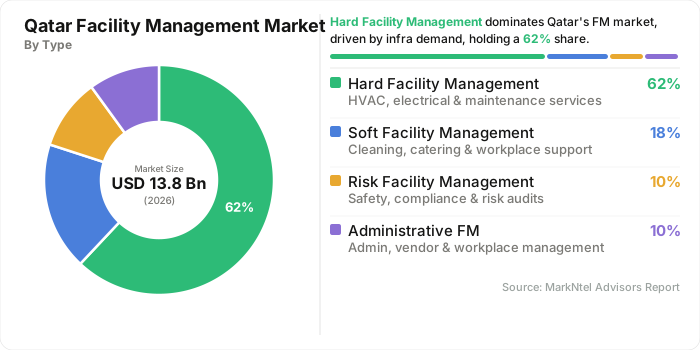
- By type, hard facility management dominated the market with approximately 62% share in 2026.
- By end user, the commercial segment accounted for approximately 42% of the market share in 2026.
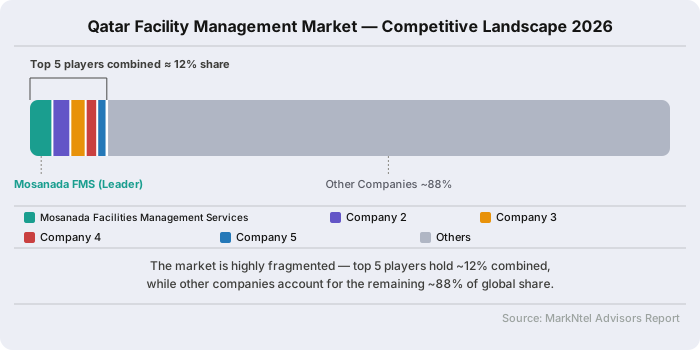
- The industry is highly fragmented, with the top five players Mosanada, FMM, Sodexo Qatar, EFS, and Al Asmakh collectively accounting for approximately 12% market share.
Qatar Facility Management Market Size and Outlook
The Qatar facility management market size was valued at USD 7.2 billion in 2025 and is projected to grow from USD13.8 billion in 2026 to USD 16.9 billion by 2032. Along with this, the market is estimated to grow at a CAGR of around 3.44 % during the forecast period, i.e., 2026-32.
Market expansion is increasingly supported by stricter workplace safety regulations, intensified compliance inspections, and growing demand for specialized risk management services across commercial, industrial, government, and worker accommodation facilities.
Regulatory enforcement is becoming a significant catalyst for facility management demand. According to Qatar's Ministry of Labour, the Occupational Safety and Health Department conducted 30,628 inspection visits nationwide in 2025, including 20,935 inspections targeting active worksites. The department also carried out 757 joint field-awareness campaigns and delivered 9,693 on-site awareness sessions at worker accommodation facilities, highlighting the increasing regulatory focus on occupational safety and living standards.
This enforcement momentum continued into the first quarter of 2026, when the department conducted 8,240 inspections, comprising 5,918 workplace visits and 2,322 inspections of worker accommodation facilities. During the same period, the Labour Inspection Department recorded 651 violations of the Wage Protection System and issued 445 rectification notices to non-compliant establishments.
For facility management providers, this intensified regulatory environment is expanding demand for compliance documentation, workplace safety audits, hazard reporting systems, worker accommodation inspections, emergency preparedness, and digital violation tracking. Rather than treating regulatory compliance as a periodic certification exercise, building owners and employers increasingly require continuous risk monitoring to reduce operational disruption and maintain inspection readiness.
Through 2032, facility management providers that integrate occupational safety monitoring, digital compliance management, and accommodation auditing into broader hard and soft FM contracts are expected to strengthen their competitive positioning. As Qatar's inspection regime expands in scope and frequency, risk management is likely to evolve from a supplementary service into an important differentiator in government and private-sector facility contracts.
Qatar Facility Management Market Key Indicators
- The Planning and Statistics Authority (PSA) reported 708 building permits issued in May 2026, with additions accounting for 41% of total permits, followed by new buildings at 27%. Existing buildings requiring upgrades and maintenance continue to dominate construction activity.
A growing stock of operational buildings increases demand for refurbishment, preventive maintenance, MEP services, and integrated facility management across commercial and public infrastructure. - According to the Ministry of Commerce and Industry (MOCI), 7,365 new commercial registrations were issued during 2025, reflecting continued business establishment across multiple economic sectors. Increasing commercial establishments directly expand demand for outsourced facility management services, including cleaning, security, HVAC maintenance, landscaping, and workplace management.
- Qatar Tourism reported that the country welcomed more than 5 million international visitors in 2025, marking the highest annual tourism volume on record. Rising tourism increases occupancy across hotels, entertainment venues, and mixed-use developments, strengthening demand for housekeeping, technical maintenance, catering, and integrated hospitality facility management services.
- The Ministry of Environment and Climate Change continues implementing the National Environment and Climate Change Strategy, promoting renewable energy adoption and energy-efficient buildings under Qatar National Vision 2030.Expansion of sustainable infrastructure increases demand for facility management companies specializing in energy management, building performance optimization, and environmental compliance.
- The Ministry of Public Health continues expanding healthcare infrastructure under the National Health Strategy, with new hospitals and specialized healthcare facilities being integrated into the national healthcare network. Expansion of healthcare facilities generates sustained demand for specialized facility management services covering HVAC, infection-control cleaning, medical waste management, security, and critical asset maintenance.
Qatar Facility Management Market Scope
| Category | Segments |
|---|---|
| By Type | Hard, Soft, Risk, Administrative |
| By Operating Model | In-house, Outsourced |
| By Service Delivery | Integrated, Bundled, Single Service |
| By Enterprise Size | Large, Mid-Size, Small |
| By End User | Commercial, Residential, Government, Retail, Education, Healthcare, Hospitality, Others |
Qatar Facility Management Market Growth Drivers
District Cooling and Energy-Efficiency Infrastructure Expanding Hard Facility Management Demand
The expansion of district cooling and energy-efficiency infrastructure is emerging as a major growth driver for the facility management market in Qatar. Large commercial developments, mixed-use projects, hospitals, airports, and government facilities increasingly depend on centralized cooling systems that require continuous technical maintenance, energy optimization, utility monitoring, and lifecycle asset management. This is creating sustained demand for specialized hard FM providers with expertise in HVAC, MEP systems, and predictive maintenance.
A strong example is KAHRAMAA's 2025 infrastructure update, which reported 72 operational district cooling plants with a combined capacity of more than 1.2 million refrigeration tons. In addition, 36 plants utilized treated sewage effluent, conserving 17.1 million cubic meters of potable water during the year. The government's continued focus on efficient cooling networks and resource conservation is encouraging building owners to adopt long-term maintenance contracts and performance-based energy management services.
As Qatar advances its sustainability and infrastructure-efficiency agenda, facility management companies capable of integrating cooling-system maintenance, energy analytics, and operational optimization are expected to experience stronger contract growth across both public and commercial assets.
Recent Trends
Long-Term Government Asset Management Creating Stable FM Demand
Qatar's transition from large-scale infrastructure construction to long-term asset operation is creating sustained growth opportunities for the facility management industry. Following extensive investments in transport networks, education, healthcare, utilities, and public buildings, government agencies are prioritizing lifecycle maintenance to maximize infrastructure performance. This shift is reinforcing demand for integrated FM services covering preventive maintenance, technical operations, cleaning, security, and asset optimization.
Supporting this trend, Facilities Management & Maintenance Company (FMM) showcased its digital maintenance capabilities, sustainability initiatives, and integrated FM solutions during the Qatar International Facility Management Conference & Exhibition (QIFMCE) 2025, emphasizing predictive maintenance and operational innovation aligned with Qatar National Vision 2030. The growing focus on preserving existing infrastructure rather than constructing new assets is expected to support long-term FM contract opportunities across government facilities and commercial developments while encouraging greater investment in technology-enabled maintenance services.
Qatar Facility Management Market Opportunities and Challenges
Rising Workforce Compliance Accelerating Demand for Digital Workforce Management Solutions
Qatar's facility management market is increasingly challenged by tightening workforce compliance requirements, which are raising operational complexity and service delivery costs for FM providers managing large labour-intensive contracts. According to the Ministry of Labour, the Labour Inspection Department identified 651 Wage Protection System (WPS) violations and issued 445 rectification notices during the first quarter of 2026, highlighting the government's continued emphasis on labour governance and regulatory enforcement. As facility management companies must ensure timely wage payments, maintain workforce records, comply with labour regulations, and manage dispersed workforces across multiple client sites, investments in compliance management and administrative oversight are becoming essential.
However, this regulatory environment is simultaneously creating significant opportunities for FM providers to differentiate themselves through digital workforce management solutions. By integrating automated payroll compliance, workforce scheduling, attendance monitoring, contractor management, and digital compliance reporting into their service offerings, companies can help clients reduce regulatory risks while improving operational efficiency and workforce productivity. As compliance increasingly becomes a critical component of facility operations, technology-enabled workforce governance is expected to evolve from a support function into a strategic value-added service, strengthening long-term client relationships and enhancing the competitiveness of integrated facility management providers.
Segmentation Insights
Hard Facility Management with 62% Market Share Remains the Largest Segment Driven by Stringent Workplace Compliance Requirements
Hard Facility Management is estimated to account for approximately 62% of the Qatar facility management industry, driven by the country's extensive portfolio of technically complex infrastructure requiring continuous operation and maintenance. Services including HVAC maintenance, electrical installations, plumbing systems, building management systems, fire protection systems, and energy management are essential to ensuring operational reliability, regulatory compliance, and asset longevity across commercial, industrial, healthcare, and government facilities. Government enforcement of workplace safety and building compliance is further strengthening demand for specialized hard FM services.
According to the Ministry of Labour, the Occupational Safety and Health Department conducted 30,628 inspection visits during 2025, including 20,935 inspections at active worksites, alongside 757 awareness campaigns and 9,693 on-site awareness sessions at workers' accommodations. The growing emphasis on compliance with technical, safety, and operational standards is encouraging organizations to adopt preventive maintenance and professional engineering services, reinforcing the leadership of the hard facility management segment. Based on type, the market is segmented into:
- Hard Facility Management
- Soft Facility Management
- Risk Management
- Administrative Facility Management
Commercial Segment Holding Approximately 42% Market Share Continue to Lead
The Commercial segment is estimated to represent 42% of the Qatar facility management market, supported by the country's expanding portfolio of office buildings, mixed-use developments, retail centers, hotels, and business districts. Commercial facilities increasingly outsource integrated facility management services to improve operational efficiency, enhance occupant experience, and optimize lifecycle asset performance. Growing demand for smart buildings, energy-efficient operations, and centralized asset management continues to reinforce the commercial segment's leadership within the market. The increasing concentration of multinational corporations and premium commercial properties further strengthens demand for comprehensive outsourced facility management solutions nationwide.
Government-backed development initiatives continue to strengthen commercial FM demand. According to the Ministry of Commerce and Industry (MOCI), Qatar issued more than 9,000 new commercial registrations during 2025, reflecting continued business expansion and increasing demand for professionally managed commercial facilities. In parallel, Qatar National Vision 2030 prioritizes sustainable urban development and efficient infrastructure management, encouraging long-term maintenance and operation of commercial assets. These developments continue to expand opportunities for integrated FM providers across corporate offices, retail complexes, and mixed-use developments. Based on end user, the market is segmented into:
- Commercial
- Residential
- Government
- Retail
- Education
- Healthcare
- Hospitality
- Others
Qatar Facility Management Market Competitive Landscape
The Qatar facility management market is Highly fragmented, with the top five companies Mosanada Facilities Management Services, Facilities Management & Maintenance Company (FMM), Sodexo Qatar Services, EFS Facilities Services, and Al Asmakh Facilities Management collectively accounting for approximately 12% of the market. Competition is driven by integrated service capabilities, long-term government contracts, technical expertise, digital FM solutions, and experience in managing large-scale commercial and public infrastructure assets.
Key Companies in the Qatar Facility Management Market
- Mosanada Facilities Management Services
- Facilities Management & Maintenance Company (FMM)
- Sodexo Qatar Services
- EFS Facilities Services
- Al Asmakh Facilities Management
- CBRE Qatar
- EMCOR Facilities Services Qatar WLL
- Elegancia Facility Management
- G4S Qatar WLL
- Waseef Asset Management
- Others
Qatar Facility Management Industry News and Recent Developments
October 2025: Elegancia Facility Management Awarded PPP Contract for 14 Public Schools
Elegancia Facility Management, part of Estithmar Holding, secured a Public-Private Partnership (PPP) contract to deliver integrated hard and soft facility management services for 14 newly developed public schools under Qatar's School Development Program. The schools are expected to accommodate more than 10,000 students and support Qatar's Third National Development Strategy (2024–2030). The scope includes MEP maintenance, cleaning, landscaping, security coordination, and asset management.
Impact Analysis: The contract demonstrates Qatar's increasing adoption of PPP models for public infrastructure operations. It expands opportunities for integrated FM providers while reinforcing long-term demand for lifecycle asset management, sustainability-focused maintenance, and performance-based FM services across the education sector.
September 2025: Ashghal Launched Major Roads and Asset Management Tenders
The Public Works Authority (Ashghal) issued several major tenders during September 2025 covering roads, drainage infrastructure, traffic management, and consultancy services for Asset Affairs. These projects include long-term maintenance and operational requirements aimed at preserving national infrastructure assets.
Impact Analysis: The release of multiple long-term infrastructure tenders reinforces sustained demand for facility management companies specializing in road asset maintenance, drainage systems, traffic management, and lifecycle infrastructure services, supporting Qatar's strategy of maintaining existing public assets.
Frequently Asked Questions
- Market Segmentation
- Introduction
- Product Definition
- Research Process
- Assumptions
- Executive Summary
- Qatar Facility Management Market Porter’s Five Forces Analysis
- Qatar Facility Management Market Policies, Regulations, and Product Standards
- Qatar Facility Management Market Trends & Developments
- Qatar Facility Management Market Dynamics
- Growth Factors
- Challenges
- Qatar Facility Management Market Hotspot & Opportunities
- Qatar Facility Management Market Outlook, 2022-2032
- Market Size & Outlook
- By Revenues (USD Million)
- Market Segmentation and Outlook
- By Type- Market Size & Forecast 2022-2032, USD Million
- Hard
- Soft
- Risk
- Administrative
- By Operating Model- Market Size & Forecast 2022-2032, USD Million
- In-house
- Outsourced
- By Service Delivery- Market Size & Forecast 2022-2032, USD Million
- Integrated
- Bundled
- Single Service
- By Enterprise Size- Market Size & Forecast 2022-2032, USD Million
- Large
- Mid-Size
- Small
- By End User- Market Size & Forecast 2022-2032, USD Million
- Commercial
- Residential
- Government
- Retail
- Education
- Healthcare
- Hospitality
- Others
- By Region- Market Size & Forecast 2022-2032, USD Million
- Al Rayyan
- Al Khor
- Ad Dawhah
- Al Wakrah
- Others
- By Company
- Competition Characteristics
- Market Share & Analysis
- By Type- Market Size & Forecast 2022-2032, USD Million
- Market Size & Outlook
- Qatar Hard Facility Management Market Outlook, 2022-2032
- Market Size & Outlook
- By Revenues (USD Million)
- Market Segmentation and Outlook
- By Operating Model- Market Size & Forecast 2022-2032, USD Million
- By Service Delivery- Market Size & Forecast 2022-2032, USD Million
- By Enterprise Size- Market Size & Forecast 2022-2032, USD Million
- By End User- Market Size & Forecast 2022-2032, USD Million
- By Region- Market Size & Forecast 2022-2032, USD Million
- Market Size & Outlook
- Qatar Soft Facility Management Market Outlook, 2022-2032
- Market Size & Outlook
- By Revenues (USD Million)
- Market Segmentation and Outlook
- By Operating Model- Market Size & Forecast 2022-2032, USD Million
- By Service Delivery- Market Size & Forecast 2022-2032, USD Million
- By Enterprise Size- Market Size & Forecast 2022-2032, USD Million
- By End User- Market Size & Forecast 2022-2032, USD Million
- By Region- Market Size & Forecast 2022-2032, USD Million
- Market Size & Outlook
- Qatar Risk Facility Management Market Outlook, 2022-2032
- Market Size & Outlook
- By Revenues (USD Million)
- Market Segmentation and Outlook
- By Operating Model- Market Size & Forecast 2022-2032, USD Million
- By Service Delivery- Market Size & Forecast 2022-2032, USD Million
- By Enterprise Size- Market Size & Forecast 2022-2032, USD Million
- By End User- Market Size & Forecast 2022-2032, USD Million
- By Region- Market Size & Forecast 2022-2032, USD Million
- Market Size & Outlook
- Qatar Administrative Facility Management Market Outlook, 2022-2032
- Market Size & Outlook
- By Revenues (USD Million)
- Market Segmentation and Outlook
- By Operating Model- Market Size & Forecast 2022-2032, USD Million
- By Service Delivery- Market Size & Forecast 2022-2032, USD Million
- By Enterprise Size- Market Size & Forecast 2022-2032, USD Million
- By End User- Market Size & Forecast 2022-2032, USD Million
- By Region- Market Size & Forecast 2022-2032, USD Million
- Market Size & Outlook
- Qatar Facility Management Market Key Strategic Imperatives for Success & Growth
- Competitive Outlook
- Company Profiles
- Waseef Asset Management
- Business Description
- Product Portfolio
- Collaborations & Alliances
- Recent Developments
- Financial Details
- Others
- Mosanada Facilities Management Services
- Business Description
- Product Portfolio
- Collaborations & Alliances
- Recent Developments
- Financial Details
- Others
- Facilities Management & Maintenance Company (FMM)
- Business Description
- Product Portfolio
- Collaborations & Alliances
- Recent Developments
- Financial Details
- Others
- Sodexo Qatar Services
- Business Description
- Product Portfolio
- Collaborations & Alliances
- Recent Developments
- Financial Details
- Others
- EFS Facilities Services
- Business Description
- Product Portfolio
- Collaborations & Alliances
- Recent Developments
- Financial Details
- Others
- Al Asmakh Facilities Management
- Business Description
- Product Portfolio
- Collaborations & Alliances
- Recent Developments
- Financial Details
- Others
- CBRE Qatar
- Business Description
- Product Portfolio
- Collaborations & Alliances
- Recent Developments
- Financial Details
- Others
- EMCOR Facilities Services Qatar WLL
- Business Description
- Product Portfolio
- Collaborations & Alliances
- Recent Developments
- Financial Details
- Others
- Elegancia Facility Management (Estithmar Holding)
- Business Description
- Product Portfolio
- Collaborations & Alliances
- Recent Developments
- Financial Details
- Others
- G4S Qatar WLL
- Business Description
- Product Portfolio
- Collaborations & Alliances
- Recent Developments
- Financial Details
- Others
- Others
- Waseef Asset Management
- Company Profiles
- Disclaimer
MarkNtel Advisors follows a robust and iterative research methodology designed to ensure maximum accuracy and minimize deviation in market estimates and forecasts. Our approach combines both bottom-up and top-down techniques to effectively segment and quantify various aspects of the market. A consistent feature across all our research reports is data triangulation, which examines the market from three distinct perspectives to validate findings. Key components of our research process include:
1. Scope & Research Design At the outset, MarkNtel Advisors define the research objectives and formulate pertinent questions. This phase involves determining the type of research—qualitative or quantitative—and designing a methodology that outlines data collection methods, target demographics, and analytical tools. They also establish timelines and budgets to ensure the research aligns with client goals.
2. Sample Selection and Data Collection In this stage, the firm identifies the target audience and determines the appropriate sample size to ensure representativeness. They employ various sampling methods, such as random or stratified sampling, based on the research objectives. Data collection is carried out using tools like surveys, interviews, and observations, ensuring the gathered data is reliable and relevant.
3. Data Analysis and Validation Once data is collected, MarkNtel Advisors undertake a rigorous analysis process. This includes cleaning the data to remove inconsistencies, employing statistical software for quantitative analysis, and thematic analysis for qualitative data. Validation steps are taken to ensure the accuracy and reliability of the findings, minimizing biases and errors.

4. Data Forecast and FinalizationThe final phase involves forecasting future market trends based on the analyzed data. MarkNtel Advisors utilize predictive modeling and time series analysis to anticipate market behaviors. The insights are then compiled into comprehensive reports, featuring visual aids like charts and graphs, and include strategic recommendations to inform client decision-making
We offer flexible licensing options to cater to varying organizational needs. Choose the pricing pack that best suits your requirements:
Buy Now Inquire Before Buying
 Request Customization
 Talk to our Consultant







