

GCC Cement Market Research Report: Forecast (2026-2032)
GCC Cement Market - By Product Type (Portland Cement, Blended Cement, Specialty Cement (Rapid Hardening, Expansive, Oil Well, White Cement)), By Application (Residential Construct ... ion, Commercial Construction, Infrastructure Development, Industrial Construction, Others (Specialty uses)), By Distribution Channel (Direct Sales to Construction Firms, Dealers and Distributors, Retail Stores, Online Platforms) and others Read more
- Buildings, Construction, Metals & Mining
- Nov 2025
- Pages 126
- Report Format: PDF, Excel, PPT
GCC Cement Market
Projected 4.97% CAGR from 2026 to 2032
Study Period
2026-2032
Market Size (2025)
101.9 Million tons
Market Size (2032)
141.1 Million tons
Base Year
2025
Projected CAGR
4.97%
Leading Segments
By Product Type: Portland Cement
GCC Cement Market Size: Forecast (2026-2032)
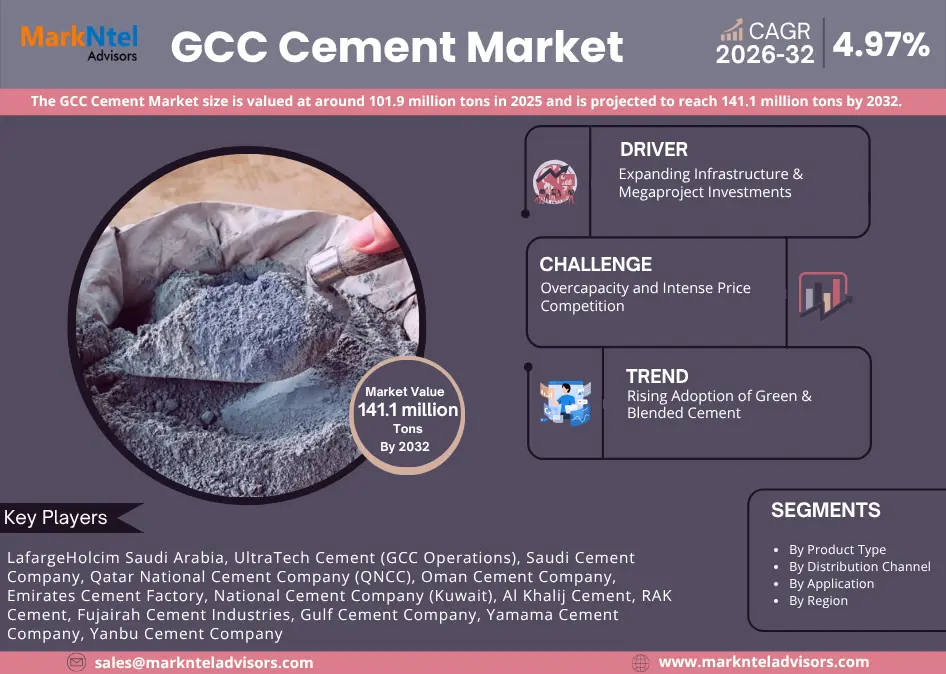
The GCC Cement Market size is valued at around 101.9 million tons in 2025 and is projected to reach 141.1 million tons by 2032. Along with this, the market is estimated to grow at a CAGR of around 4.97% during the forecast period, i.e., 2026-32.
GCC Cement Market Outlook:
The GCC Cement Market is experiencing sustained growth, primarily driven by extensive infrastructure and urban development projects across Saudi Arabia, the UAE, Qatar, and Oman. Governments are channeling significant investments into long-term national transformation programs such as Saudi Vision 2030 and UAE Vision 2050, which emphasize the construction of smart cities, industrial zones, and housing projects. For example, the USD 500 billion NEOM city in Saudi Arabia and the Etihad Rail network in the UAE are generating strong demand for high-quality cement. Moreover, economic diversification beyond oil is encouraging growth in logistics, manufacturing, and commercial real estate sectors—further expanding the region’s cement consumption base.
GCC Cement Market Scope:
| Category | Segments |
|---|---|
| By Product Type | Portland Cement, Blended Cement, Specialty Cement (Rapid Hardening, Expansive, Oil Well, White Cement) |
| By Application | Residential Construction, Commercial Construction, Infrastructure Development, Industrial Construction, Others (Specialty uses) |
| By Distribution Channel | Direct Sales to Construction Firms, Dealers and Distributors, Retail Stores, Online Platforms |
Simultaneously, the market is witnessing a shift toward sustainability and operational efficiency. Manufacturers are increasingly adopting green and blended cement technologies to align with carbon reduction goals and meet new building regulations. Ample limestone availability and the GCC’s strategic proximity to export markets like East Africa and South Asia enhance regional competitiveness. Additionally, the resurgence of tourism and hospitality investments, including the Red Sea Project and Dubai’s urban renewal initiatives, continues to fuel construction demand. As competition intensifies, producers are focusing on plant modernization and capacity optimization, signaling a market evolution toward innovation-led, sustainable growth.
GCC Cement Market Recent Developments:
- October 2025: Gulf Cement Company (UAE) merged into the Italian group Buzzi Unicem, marking a strategic move to strengthen operational excellence and global footprint. This integration is driven by the region’s emphasis on sustainable production and cost-efficiency in cement manufacturing.
GCC Cement Market Drivers:
Expanding Infrastructure & Megaproject Investments
The GCC Cement Market is primarily driven by extensive infrastructure development under national transformation plans such as Saudi Vision 2030 and UAE Vision 2050. Countries are investing heavily in smart cities, housing, and logistics projects, fueling continuous cement demand. For instance, Saudi Arabia’s NEOM project and the UAE’s around USD 8.2 billion Tasreef drainage network in Dubai are utilizing vast cement volumes. These large-scale projects enhance local consumption, optimize production capacity, and ensure steady growth opportunities for regional manufacturers.
Economic Diversification & Industrial Expansion
The GCC’s economic diversification efforts are accelerating industrial and commercial construction, thereby boosting cement demand. Governments are developing industrial hubs and free zones to attract foreign investment, such as Oman’s Duqm Industrial City and Saudi Arabia’s King Salman Energy Park (SPARK), which spans over 50 sq km to support energy and manufacturing sectors. These developments require large-scale civil works and continuous cement supply. As industrialization deepens, cement producers benefit from stable long-term contracts and rising infrastructure spending, reinforcing regional market growth and operational expansion across the GCC.
GCC Cement Market Trends:
Rising Adoption of Green & Blended Cement
A key trend shaping the GCC cement industry is the shift toward green and blended cement production to align with national decarbonization goals. Governments are tightening environmental standards under Saudi Vision 2030 and the UAE Net Zero 2050 initiatives, prompting manufacturers to reduce clinker usage and CO₂ emissions. For instance, Saudi-based City Cement partnered with Next Generation SCM in 2024 to launch a low-carbon concrete facility in Riyadh. This growing sustainability focus drives innovation, encourages R&D investments, and enhances regional competitiveness in environmentally responsible construction materials.
Technological Integration and Digitalization of Operations
Cement producers across the GCC are increasingly adopting digital manufacturing technologies such as automation, predictive maintenance, and energy optimization to improve efficiency and cost control. Rising energy costs and sustainability mandates are accelerating this transformation. For instance, the UAE’s Gulf Cement Company, after its merger with Buzzi Unicem in 2025, began implementing advanced process control and digital monitoring systems. Such modernization enhances production accuracy, reduces downtime, and ensures quality consistency. This digital evolution is redefining the regional market landscape, fostering smarter, leaner, and more sustainable cement operations.
GCC Cement Market Challenges:
Overcapacity and Intense Price Competition
One of the major challenges facing the market players of the GCC cement industry is overcapacity, which has created intense price competition among regional producers. The combined production capacity across GCC countries far exceeds domestic demand—estimated at over 120 million tonnes against an annual consumption of around 95 million tonnes in 2024. This imbalance, driven by earlier capacity expansions during the oil boom, pressures profit margins and discourages new investment. Smaller players, particularly in the UAE and Oman, face difficulties sustaining operations, prompting consolidation and strategic mergers to maintain market viability.
GCC Cement Market (2026-32) Segmentation Analysis:
The GCC Cement Market Report and Forecast 2026-2032 offers a detailed analysis of the market based on the following segments:
Based on Product Type
- Portland Cement
- Blended Cement
- Specialty Cement (Rapid Hardening, Expansive, Oil Well, White Cement)
Portland cement dominates the GCC Cement Market owing to its extensive use in large-scale structural, residential, and infrastructure projects that require high strength and durability. Its cost-effectiveness and adaptability to harsh climatic conditions make it a preferred choice. In 2025, the UAE’s Ministry of Energy and Infrastructure approved several coastal protection and housing projects in Fujairah and Ras Al Khaimah, all relying heavily on Portland cement-based mixes. Such continuous construction activity across the region sustains Portland cement’s demand, keeping it the leading product segment.
Based on Application
- Residential Construction
- Commercial Construction
- Infrastructure Development
- Industrial Construction
- Others (Specialty uses)
The infrastructure development segment holds the largest market share. In the GCC region, the Infrastructure Development application dominates cement consumption due to sweeping public-works programs in transport, water management, and urban connectivity. For instance, on 23 July 2024, the Al Sharqiyah Expressway (Phase 2) in Oman, covering approximately 52 km and including overpasses, wadi-crossing bridges, and pedestrian underpasses, was launched for USD 176.85 million. Similarly, the Adam‑Thumrait Road Dualization Project (2024) covers 400 km of major corridor upgrades, including drainage and box-culverts. These large-scale civil works draw huge volumes of cement and related materials, enabling manufacturers to secure long-term contracts, scale production, and optimize capacity utilization, thereby underpinning the region’s cement-market growth through 2032.
Leading Players of the GCC Cement Market:
- LafargeHolcim Saudi Arabia
LafargeHolcim Saudi Arabia, a subsidiary of Holcim Group, is a leading cement producer known for its sustainable product portfolio and advanced manufacturing practices. The company operates large integrated plants in the Eastern Province and supplies premium cement for infrastructure and mega projects such as NEOM and The Red Sea Development. Through its low-carbon solutions and circular economy initiatives, LafargeHolcim continues to strengthen its regional presence in the GCC cement industry.
- UltraTech Cement (GCC Operations)
UltraTech Cement, a part of the Aditya Birla Group, has expanded its footprint in the GCC through strategic investments and partnerships. The company focuses on high-performance cement blends that cater to diverse climatic conditions across the Gulf region. UltraTech’s GCC operations supply cement to key commercial and infrastructure projects, leveraging advanced production technology and logistics efficiency to meet growing construction demands sustainably.
- Saudi Cement Company
Founded in 1955 and headquartered in Dammam, Saudi Cement Company is among the oldest and largest cement producers in the Kingdom. It operates two major plants in Hofuf and Ain Dar, with a total production capacity exceeding 6 million tonnes annually. The company plays a critical role in supporting Saudi Arabia’s Vision 2030 infrastructure goals by supplying cement for urban development, industrial, and transportation projects nationwide.
Qatar National Cement Company (QNCC), Oman Cement Company, Emirates Cement Factory, National Cement Company (Kuwait), Al Khalij Cement, RAK Cement, Fujairah Cement Industries, Gulf Cement Company, Yamama Cement Company, Yanbu Cement Company, and others are the key players of the GCC Cement Market.
GCC Cement Market (2026-32): Regional Projection
The GCC Cement Market is dominated by Saudi Arabia, accounting for the largest production and consumption share across the region. This dominance stems from the Kingdom’s large-scale infrastructure and housing projects driven by Vision 2030, which promotes industrial diversification and smart-city development. Major initiatives such as NEOM, The Red Sea Project, and Diriyah Gate collectively demand millions of tonnes of cement annually. For instance, in 2025, the NEOM project’s ongoing construction of “The Line” and Oxagon city significantly boosted cement consumption across western Saudi Arabia.
Gain a Competitive Edge with Our GCC Cement Market Report
- GCC Cement Market Report by MarkNtel Advisors provides a detailed & thorough analysis of market size & share, growth rate, competitive landscape, and key players. This comprehensive analysis helps businesses gain a holistic understanding of the market dynamics & make informed decisions.
- This report also highlights current market trends & future projections, allowing businesses to identify emerging opportunities & potential challenges. By understanding market forecasts, companies can align their strategies & stay ahead of the competition.
- GCC Cement Market Report aids in assessing & mitigating risks associated with entering or operating in the market. By understanding market dynamics, regulatory frameworks, and potential challenges, businesses can develop strategies to minimize risks & optimize their operations.
*Reports Delivery Format - Market research studies from MarkNtel Advisors are offered in PDF, Excel and PowerPoint formats. Within 24 hours of the payment being successfully received, the report will be sent to your email address.
Frequently Asked Questions
- Market Segmentation
- Introduction
- Product Definition
- Research Process
- Assumptions
- Executive Summary
- GCC Cement Market Policies, Regulations, and Product Standards
- GCC Cement Market Supply Chain Analysis
- GCC Cement Market Trends & Developments
- GCC Cement Market Dynamics
- Growth Drivers
- Challenges
- GCC Cement Market Hotspot & Opportunities
- GCC Cement Market Outlook, 2020-2032
- Market Size & Outlook
- By Revenues (USD Million)
- By Volume (Million Tons)
- Market Share & Outlook
- By Product Type
- Portland Cement- Market Size & Forecast 2020-2032F, USD Million
- Blended Cement- Market Size & Forecast 2020-2032F, USD Million
- Specialty Cement (Rapid Hardening, Expansive, Oil Well, White Cement)- Market Size & Forecast 2020-2032F, USD Million
- By Application
- Residential Construction- Market Size & Forecast 2020-2032F, USD Million
- Commercial Construction- Market Size & Forecast 2020-2032F, USD Million
- Infrastructure Development- Market Size & Forecast 2020-2032F, USD Million
- Industrial Construction- Market Size & Forecast 2020-2032F, USD Million
- Others (Specialty uses)- Market Size & Forecast 2020-2032F, USD Million
- By Distribution Channel
- Direct Sales to Construction Firms- Market Size & Forecast 2020-2032F, USD Million
- Dealers and Distributors- Market Size & Forecast 2020-2032F, USD Million
- Retail Stores- Market Size & Forecast 2020-2032F, USD Million
- Online Platforms- Market Size & Forecast 2020-2032F, USD Million
- By Region
- Saudi Arabia
- United Arab Emirates
- Qatar
- Oman
- Kuwait
- Bahrain
- By Company
- Company Revenue Shares
- Competitor Characteristics
- By Product Type
- Market Size & Outlook
- GCC Portland Cement GCC Cement Market Outlook, 2020-2032
- Market Size & Analysis
- Market Share & Analysis
- By Application- Market Size & Forecast 2020-2032, USD Million
- By Distribution Channel- Market Size & Forecast 2020-2032F, USD Million
- GCC Blended Cement GCC Cement Market Outlook, 2020-2032
- Market Size & Analysis
- Market Revenues (USD Million)
- Market Share & Analysis
- By Application- Market Size & Forecast 2020-2032, USD Million
- By Distribution Channel- Market Size & Forecast 2020-2032F, USD Million
- Market Size & Analysis
- GCC Specialty Cement GCC Cement Market Outlook, 2020-2032
- Market Size & Analysis
- Market Revenues (USD Million)
- Market Share & Analysis
- By Application- Market Size & Forecast 2020-2032, USD Million
- By Distribution Channel- Market Size & Forecast 2020-2032F, USD Million
- Market Size & Analysis
- GCC Cement Market Key Strategic Imperatives for Success & Growth
- Competition Outlook
- Company Profiles
- LafargeHolcim Saudi Arabia
- Business Description
- Product Portfolio
- Strategic Alliances or Partnerships
- Recent Developments
- Financial Details
- Others
- UltraTech Cement (GCC Operations)
- Business Description
- Product Portfolio
- Strategic Alliances or Partnerships
- Recent Developments
- Financial Details
- Others
- Saudi Cement Company
- Business Description
- Product Portfolio
- Strategic Alliances or Partnerships
- Recent Developments
- Financial Details
- Others
- Qatar National Cement Company (QNCC)
- Business Description
- Product Portfolio
- Strategic Alliances or Partnerships
- Recent Developments
- Financial Details
- Others
- Oman Cement Company
- Business Description
- Product Portfolio
- Strategic Alliances or Partnerships
- Recent Developments
- Financial Details
- Others
- Emirates Cement Factory
- Business Description
- Product Portfolio
- Strategic Alliances or Partnerships
- Recent Developments
- Financial Details
- Others
- National Cement Company (Kuwait)
- Business Description
- Product Portfolio
- Strategic Alliances or Partnerships
- Recent Developments
- Financial Details
- Others
- Al Khalij Cement
- Business Description
- Product Portfolio
- Strategic Alliances or Partnerships
- Recent Developments
- Financial Details
- Others
- RAK Cement
- Business Description
- Product Portfolio
- Strategic Alliances or Partnerships
- Recent Developments
- Financial Details
- Others
- Fujairah Cement Industries
- Business Description
- Product Portfolio
- Strategic Alliances or Partnerships
- Recent Developments
- Financial Details
- Others
- Gulf Cement Company
- Business Description
- Product Portfolio
- Strategic Alliances or Partnerships
- Recent Developments
- Financial Details
- Others
- Yamama Cement Company
- Business Description
- Product Portfolio
- Strategic Alliances or Partnerships
- Recent Developments
- Financial Details
- Others
- Yanbu Cement Company
- Business Description
- Product Portfolio
- Strategic Alliances or Partnerships
- Recent Developments
- Financial Details
- Others
- Gulf Cement Company
- Business Description
- Product Portfolio
- Strategic Alliances or Partnerships
- Recent Developments
- Financial Details
- Others
- Others
- LafargeHolcim Saudi Arabia
- Company Profiles
- Disclaimer
MarkNtel Advisors follows a robust and iterative research methodology designed to ensure maximum accuracy and minimize deviation in market estimates and forecasts. Our approach combines both bottom-up and top-down techniques to effectively segment and quantify various aspects of the market. A consistent feature across all our research reports is data triangulation, which examines the market from three distinct perspectives to validate findings. Key components of our research process include:
1. Scope & Research Design At the outset, MarkNtel Advisors define the research objectives and formulate pertinent questions. This phase involves determining the type of research—qualitative or quantitative—and designing a methodology that outlines data collection methods, target demographics, and analytical tools. They also establish timelines and budgets to ensure the research aligns with client goals.
2. Sample Selection and Data Collection In this stage, the firm identifies the target audience and determines the appropriate sample size to ensure representativeness. They employ various sampling methods, such as random or stratified sampling, based on the research objectives. Data collection is carried out using tools like surveys, interviews, and observations, ensuring the gathered data is reliable and relevant.
3. Data Analysis and Validation Once data is collected, MarkNtel Advisors undertake a rigorous analysis process. This includes cleaning the data to remove inconsistencies, employing statistical software for quantitative analysis, and thematic analysis for qualitative data. Validation steps are taken to ensure the accuracy and reliability of the findings, minimizing biases and errors.

4. Data Forecast and FinalizationThe final phase involves forecasting future market trends based on the analyzed data. MarkNtel Advisors utilize predictive modeling and time series analysis to anticipate market behaviors. The insights are then compiled into comprehensive reports, featuring visual aids like charts and graphs, and include strategic recommendations to inform client decision-making
We offer flexible licensing options to cater to varying organizational needs. Choose the pricing pack that best suits your requirements:
Buy Now Inquire Before Buying
 Request Customization
 Talk to our Consultant







