

UAE Facility Management Market Research Report: Forecast (2026-2032)
By Type (Hard, Soft, Risk, Administrative), By Operating Model (In-house, Outsourced), By Service Delivery (Integrated, Bundled, Single Service), By Enterprise Size (Large, Mid-Siz ... e, Small), By End User (Commercial, Residential, Government, Retail, Education, Healthcare, Hospitality), and others Read more
- Buildings, Construction, Metals & Mining
- Jul 2026
- Pages 140
- Report Format: PDF, Excel, PPT
UAE Facility Management Market
Projected 4.63% CAGR from 2026 to 2032
Study Period
2026-2032
Market Size (2026)
USD 22.38 Billion
Market Size (2032)
USD 29.36 Billion
Base Year
2025
Projected CAGR
4.63%
Leading Segments
By Service Type: Hard
UAE Facility Management Market Key Takeaways
- UAE Facility Management market size was valued at around USD 20.39 billion in 2025 and is projected to grow from USD 22.38 billion in 2026 to USD 29.36 billion by 2032.
- The industry is projected to witness steady growth at a CAGR of around 4.63% during 2026-2032.
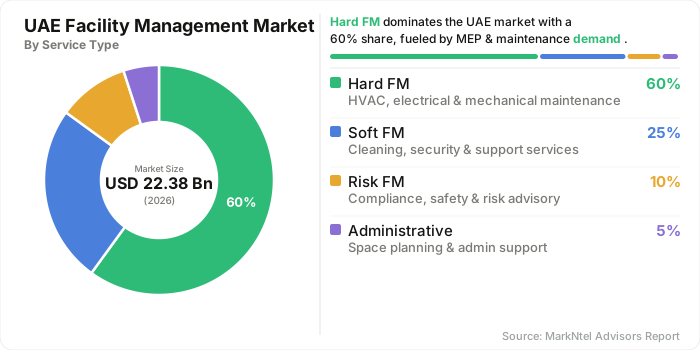
- By service type, hard facility management dominated the market with approximately 60% share in 2026, driven by energy-intensive building systems.
- By operating model, outsourced facility management accounted for approximately 75% of the market share in 2026.
- The industry is moderately consolidated, with the top five players collectively account for approximately 10% market share.
UAE Facility Management Market Size and Outlook
The UAE facility management market was valued at USD 20.39 billion in 2025 and is projected to grow from USD 22.38 billion in 2026 to USD 29.36 billion by 2032, registering a CAGR of approximately 4.63% during 2026–2032. This sustained expansion is supported by increasing government expenditure, large-scale urban development, digital modernization of public assets, and stricter workplace safety requirements.
Federal investment is creating a strong foundation for integrated facility management demand. The UAE Federal Budget for 2026 was approved at USD 25.15 billion, representing a 29% increase over 2025 and supporting priorities under the We the UAE 2031 vision. Within this framework, allocations for facilities, infrastructure, and financial investments increased significantly from USD 870 million in 2025 to USD 5.19 billion in 2026, expanding the pipeline of public assets requiring maintenance, technical operations, energy management, security, and integrated FM services.
Digital transformation is simultaneously strengthening demand for administrative facility management. Government affairs received USD 8.39 billion in 2026, compared with USD 6.15 billion in 2025, supporting the digitization of public services and AI integration across federal entities. As government facilities become increasingly technology-enabled, demand is rising for outsourced space management, reception, workplace coordination, and digitally integrated building operations.
Regulatory requirements are further embedding risk management within FM contracts. Federal Decree-Law No. 33 of 2021 requires employers to maintain safe workplaces and implement occupational health and safety measures, strengthening demand for compliance audits, fire safety, emergency planning, and workplace risk monitoring. Long-term demand is also reinforced by the Dubai 2040 Urban Master Plan, which targets a 134% increase in land allocated to hotels and tourism, expansion of commercial areas to 168 square kilometres, and a 25% increase in land dedicated to education and healthcare facilities, creating a substantial pipeline of assets requiring lifecycle facility management services.
UAE Facility Management Market Key Indicators
- UAE government initiatives such as Net Zero 2050, smart city development, and federal infrastructure modernization are reshaping urban operations. These programs focus on sustainability, digital monitoring, and efficiency improvements across public assets. Accelerates adoption of IoT-based FM systems, outsourced facility services, and performance-based maintenance contracts across government buildings.
- UAE continues to strengthen its position as a global trade and logistics hub, with non-oil foreign trade exceeding USD 272.4 billion in 2025, reflecting strong expansion in ports, warehouses, and free zones. This growth is increasing the number of operational industrial and commercial facilities requiring continuous maintenance, energy optimization, and security services. Higher warehouse density and logistics infrastructure directly increase demand for Hard FM and integrated maintenance services.
- The financial and insurance sector is one of the fastest-growing contributors to UAE GDP, with Dubai’s financial activities growing strongly in 2025, supported by expanding DIFC operations and multinational corporate relocations. This is increasing demand for premium-grade office spaces and managed commercial buildings. Growth in corporate offices raises demand for soft FM (cleaning, security) and administrative FM services.
- Dubai’s healthcare sector recorded strong growth in 2025, with health and social work activities expanding over 15% year-on-year, supported by new hospitals, clinics, and medical cities. This expansion is aligned with government healthcare modernization programs. Healthcare facilities require highly specialized FM services including sterilization, HVAC precision control, and compliance-driven maintenance.
- Dubai’s real estate sector continued strong expansion in 2025, with sector growth exceeding 6–8% year-on-year and rising transaction volumes across residential and commercial properties. This reflects sustained investor demand and population inflows. Every new property delivery increases long-term FM contracts for lifecycle maintenance, energy management, and tenant services.
- The ICT sector in Dubai grew steadily in 2025, contributing around 4–5% of GDP, driven by digital transformation, AI adoption, and smart city programs. Government initiatives are accelerating digital infrastructure across public and private buildings. Drives adoption of smart FM platforms, IoT-based monitoring, and AI-powered predictive maintenance systems.
UAE Facility Management Market Scope
| Category | Segments |
|---|---|
| By Type | Hard, Soft, Risk, Administrative |
| By Operating Model | In-house, Outsourced |
| By Service Delivery | Integrated, Bundled, Single Service |
| By Enterprise Size | Large, Mid-Size, Small |
| By End User | Commercial, Residential, Government, Retail, Education, Healthcare, Hospitality |
UAE Facility Management Market Growth Drivers
Expansion of Energy-Intensive Desalination and Utility Infrastructure in the UAE
The UAE facility management market is significantly driven by the country’s heavy reliance on desalination and utility infrastructure to ensure long-term water security. Desalination plants form a core component of national infrastructure and require continuous operation, maintenance, and technical oversight due to their energy-intensive nature. This creates sustained demand for specialized facility management services, particularly in asset reliability, preventive maintenance, and operational efficiency management across utility networks.
According to UAE government environment and water security frameworks, desalination remains a key pillar of national water supply systems, contributing substantially to overall utility operations and associated energy consumption. The UAE Water Security Strategy 2036 emphasizes improving efficiency, reducing environmental impact, and enhancing infrastructure resilience across water production and distribution systems. These priorities directly increase the need for advanced facility management capabilities, especially in managing critical infrastructure uptime, optimizing energy use, and ensuring compliance with sustainability targets.
As a result, facility management providers are increasingly engaged in supporting utility operators through integrated maintenance solutions, digital monitoring systems, and performance optimization strategies across desalination and water treatment assets.
Recent Trends
Strong Government Push Toward Energy Efficiency and Net-Zero Buildings Driving FM Transformation
UAE facility management market is increasingly influenced by government-led sustainability mandates and decarbonization targets under the UAE Net Zero by 2050 Strategic Initiative, which is accelerating demand for energy-efficient building operations and advanced facility management solutions. These policies are driving widespread adoption of smart energy monitoring, HVAC optimization, and predictive maintenance systems across commercial and public infrastructure, strengthening the role of facility managers in achieving measurable efficiency outcomes.
According to UAE Ministry of Energy and Infrastructure (2025), regulatory efforts are intensifying to improve building energy performance standards and reduce overall consumption intensity across federal and private assets. Complementing this, Dubai Electricity and Water Authority (DEWA) highlights that commercial buildings account for a significant share of electricity demand in Dubai, reinforcing the need for structured energy management interventions at the facility level.
For instance, the 2026 expansion of DEWA’s Etihad ESCO retrofit program delivered measurable efficiency improvements through large-scale energy performance contracting across government and private buildings. The initiative achieved substantial electricity savings and demonstrated the effectiveness of outsourced energy management solutions in reducing operational consumption while improving asset performance. This reinforces how policy direction combined with practical implementation is accelerating technology adoption in the UAE facility management ecosystem.
UAE Facility Management Market Opportunities and Challenges
Stringent Sustainability Regulations Accelerating Green Facility Management Solutions
The implementation of stringent sustainability regulations in the UAE is creating significant compliance challenges for facility operators managing large and diversified asset portfolios across commercial, residential, and public infrastructure segments. As the country advances its climate commitments and strengthens environmental governance frameworks, building owners are increasingly required to reduce carbon emissions, improve energy efficiency, and adopt sustainable operational practices across the entire building lifecycle. This regulatory environment is particularly demanding for older assets that require retrofitting to meet modern green building and energy performance standards.
At the same time, this challenge is generating strong opportunities for green facility management solutions, including ISO 14001-certified environmental management systems, energy-efficient building operations, waste reduction strategies, and ESG-aligned maintenance frameworks. Facility management providers are increasingly integrating smart technologies such as automated energy monitoring systems, predictive maintenance tools, and low-carbon asset optimization platforms to meet compliance requirements while improving operational efficiency.
The UAE Green Agenda 2030, which focuses on sustainable economic growth and reduced environmental impact across key sectors, is reinforcing this shift by encouraging widespread adoption of sustainable infrastructure practices. As a result, facility management companies that can deliver data-driven, compliance-ready, and environmentally responsible solutions are expected to gain a strong competitive advantage in the UAE market.
Segmentation Insights
Hard Facility Management Dominates the UAE Facility Management Market
Hard Facility Management is the leading segment in the UAE FM market, accounting for around 60% of total revenue, driven by the region’s energy-intensive infrastructure and advanced building systems. Services such as HVAC, district cooling, electrical installations, energy management, and building automation form the core of operational efficiency in large assets. According to DEWA 2025 statistics, commercial buildings account for 48.9% of Dubai’s electricity consumption (around 30,050 GWh), highlighting strong reliance on cooling and power systems, which reinforces sustained demand for Hard FM services across the UAE.
The leadership of this segment is further supported by national sustainability initiatives and energy efficiency mandates. The UAE Ministry of Energy and Infrastructure (2025) has set a target to reduce building energy consumption intensity by up to 40%, accelerating adoption of smart building systems, predictive maintenance, and advanced energy management solutions. The widespread deployment of district cooling networks, smart meters, and automated building management systems across high-rise developments and mega infrastructure projects further strengthens demand. Collectively, high energy intensity, regulatory pressure, and rapid urban infrastructure expansion are expected to sustain the dominance of hard facility management in the UAE market. Based on Service Type, the scope has been divided into:
- Hard
- Soft
- Risk
- Administrative
Outsourced Facility Management Gains Dominance Driven by Operational Efficiency and Scale
The outsourced facility management represents approximately 75% of UAE facility management market, making it the dominant operating model due to the increasing preference for integrated service providers to manage complex, multi-asset infrastructure. Large-scale developments such as commercial towers, hospitality assets, airports, and mixed-use communities require specialized technical expertise, workforce scalability, and integrated service delivery, which are efficiently provided through outsourcing models. According to the UAE Ministry of Energy and Infrastructure (2025), federal building energy and water consumption monitoring systems have been expanded nationwide, strengthening the role of professional facility management providers in performance tracking, maintenance optimization, and compliance management.
The segment is further supported by government-led sustainability initiatives. DEWA’s Etihad ESCO program (2025 reporting cycle) achieved approximately 35.2 GWh in electricity savings, demonstrating the effectiveness of third-party energy service providers in delivering measurable efficiency improvements. In addition, the UAE’s Net Zero 2050 Strategy is accelerating adoption of outsourced FM models to achieve energy optimization, carbon reduction, and lifecycle asset management across public and private sector infrastructure. These factors collectively reinforce outsourcing as the preferred and most scalable facility management model in the UAE. Based on Operating Model, the scope has been divided into:
- In-house
- Outsourced
UAE Facility Management Market Competitive Analysis
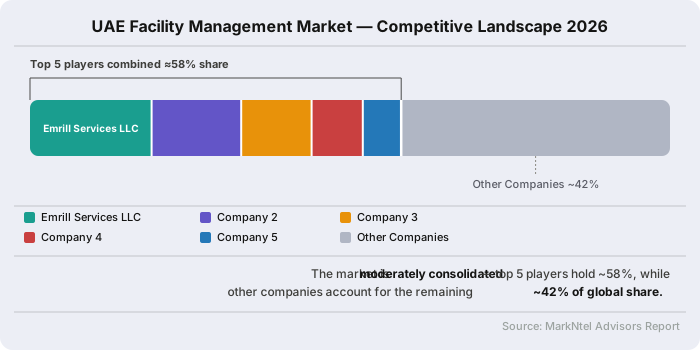
The UAE facility management industry is moderately consolidated, with a mix of integrated FM providers and diversified regional service groups operating across commercial, residential, and infrastructure assets. The top five companies Farnek Services LLC, Emrill Services LLC, Imdaad LLC, EFS Facilities Management Services, and Enova Facility Management Services LLC collectively account for approximately 10% of the market. Competitive positioning is driven by contract scale, technological adoption, sustainability capabilities, and multi-service integration across hard and soft facility management offerings.
Key Companies in the UAE Facility Management Market
- EMRILL Services LLC
- Imdaad L.L.C.
- Farnek Services LLC
- EFS Facilities Management Services
- Khidmah
- Al Shirawi Facilities Management LLC
- Etisalat Facilities Management L.L.C.
- Enova Facility Management Services LLC
- Transguard
- Darwish Interserve
- Others
UAE Facility Management Industry News and Recent Developments
March 2025: Farnek Launches Flexitalent Workforce Outsourcing Platform
In March 2025, Farnek introduced Flexitalent, a technology-driven workforce outsourcing solution designed to provide flexible staffing for facility management operations across the UAE. The platform enables organizations to rapidly deploy trained personnel for technical maintenance, cleaning, hospitality, security, and support services while improving workforce planning and operational efficiency.
Impact Analysis: The solution addresses increasing demand for flexible workforce management as organizations seek scalable FM service models. The digital platform enhances resource utilization and strengthens operational resilience across commercial, hospitality, healthcare, and mixed-use developments.
November 2025: Imdaad Partners with Emirati Environment Friends Society
In November 2025, Imdaad signed a cooperation agreement with the Emirati Environment Friends Society to advance sustainability and environmental stewardship initiatives across the UAE. The partnership focuses on environmental awareness, waste reduction, and sustainability programs that complement Imdaad's integrated facility management and environmental services portfolio.
Impact Analysis: The initiative reinforces the growing importance of sustainability within the UAE facility management sector. The partnership supports increasing client demand for environmentally responsible FM services while aligning with national sustainability and circular economy objectives.
September 2025: Farnek Expands Hybrid Cleaning Unit Deployment Across the UAE
In September 2025, Farnek announced the expansion of its AI-powered Hybrid Cleaning Units, confirming deployment of more than 30 robotic-assisted cleaning systems across client facilities and outlining plans to increase deployment to approximately 100 units by 2026. The expansion supports commercial offices, airports, hospitality properties, and retail developments through intelligent, autonomous cleaning operations.
Impact Analysis: The expansion highlights the accelerating digitalization of facility management services in the UAE. Greater adoption of robotics and AI is enabling FM providers to improve operational efficiency, optimize workforce utilization, and deliver more consistent service quality across large property portfolios.
Frequently Asked Questions
- Market Segmentation
- Introduction
- Product Definition
- Research Process
- Assumptions
- Executive Summary
- UAE Facility Management Services Market, Customer Buying Behavior, 2026
- Factors Influencing Customer’s Decision
- Priority Matrix of Customer’s Need
- Customer and Service Provider Proximity Analysis
- UAE Facility Management Market Winning Strategies, 2026
- Investment Scenario
- Hotspots
- UAE Facility Management Market Porter’s Five Forces Analysis
- UAE Facility Management Market Policies, Regulations, and Product Standards
- UAE Facility Management Market Trends & Developments
- UAE Facility Management Market Dynamics
- Growth Factors
- Challenges
- UAE Facility Management Market Hotspot & Opportunities
- UAE Facility Management Market Outlook, 2022-2032
- Market Size & Outlook
- By Revenues (USD Million)
- Market Segmentation & Outlook
- By Type- Market Size & Forecast 2022-2032, USD Million
- Hard
- Soft
- Risk
- Administrative
- By Operating Model- Market Size & Forecast 2022-2032, USD Million
- In-house
- Outsourced
- By Service Delivery- Market Size & Forecast 2022-2032, USD Million
- Integrated
- Bundled
- Single Service
- By Enterprise Size- Market Size & Forecast 2022-2032, USD Million
- Large
- Mid-Size
- Small
- By End User- Market Size & Forecast 2022-2032, USD Million
- Commercial
- Residential
- Government
- Retail
- Education
- Healthcare
- Hospitality
- Others (Transportation, Utilities & Energy, etc.)
- By Region- Market Size & Forecast 2022-2032, USD Million
- Dubai
- Abu Dhabi & Al Ain
- Sharjah & Northern Emirate
- By Company
- Competition Characteristics
- Market Share & Analysis
- By Type- Market Size & Forecast 2022-2032, USD Million
- Market Size & Outlook
- Dubai Facility Management Market Outlook, 2022-2032
- Market Size & Outlook
- By Revenues (USD Million)
- Market Segmentation & Outlook
- By Operating Model- Market Size & Forecast 2022-2032, USD Million
- By Service Delivery- Market Size & Forecast 2022-2032, USD Million
- By Enterprise Size- Market Size & Forecast 2022-2032, USD Million
- By End User- Market Size & Forecast 2022-2032, USD Million
- By Region- Market Size & Forecast 2022-2032, USD Million
- Market Size & Outlook
- Abu Dhabi & Al Ain Facility Management Market Outlook, 2022-2032
- Market Size & Outlook
- By Revenues (USD Million)
- Market Segmentation & Outlook
- By Operating Model- Market Size & Forecast 2022-2032, USD Million
- By Service Delivery- Market Size & Forecast 2022-2032, USD Million
- By Enterprise Size- Market Size & Forecast 2022-2032, USD Million
- By End User- Market Size & Forecast 2022-2032, USD Million
- By Region- Market Size & Forecast 2022-2032, USD Million
- Market Size & Outlook
- Sharjah & Northern Emirate Facility Management Market Outlook, 2022-2032
- Market Size & Outlook
- By Revenues (USD Million)
- Market Segmentation & Outlook
- By Operating Model- Market Size & Forecast 2022-2032, USD Million
- By Service Delivery- Market Size & Forecast 2022-2032, USD Million
- By Enterprise Size- Market Size & Forecast 2022-2032, USD Million
- By End User- Market Size & Forecast 2022-2032, USD Million
- By Region- Market Size & Forecast 2022-2032, USD Million
- Market Size & Outlook
- UAE Facility Management Market Key Strategic Imperatives for Success & Growth
- Competitive Outlook
- Company Profiles
- EMRILL Services LLC
- Business Description
- Product Portfolio
- Collaborations & Alliances
- Recent Developments
- Financial Details
- Others
- Imdaad L.L.C.
- Business Description
- Product Portfolio
- Collaborations & Alliances
- Recent Developments
- Financial Details
- Others
- Farnek Services LLC
- Business Description
- Product Portfolio
- Collaborations & Alliances
- Recent Developments
- Financial Details
- Others
- Khidmah LLC
- Business Description
- Product Portfolio
- Collaborations & Alliances
- Recent Developments
- Financial Details
- Others
- Al Shirawi Facilities Management LLC
- Business Description
- Product Portfolio
- Collaborations & Alliances
- Recent Developments
- Financial Details
- Others
- EFS Facilities Management Services
- Business Description
- Product Portfolio
- Collaborations & Alliances
- Recent Developments
- Financial Details
- Others
- Enova Facility Management Services LLC
- Business Description
- Product Portfolio
- Collaborations & Alliances
- Recent Developments
- Financial Details
- Transguard
- Business Description
- Product Portfolio
- Collaborations & Alliances
- Recent Developments
- Financial Details
- Darwish Interserve
- Business Description
- Product Portfolio
- Collaborations & Alliances
- Recent Developments
- Financial Details
- Etisalat Facilities Management L.L.C.
- Business Description
- Product Portfolio
- Collaborations & Alliances
- Recent Developments
- Financial Details
- Others
- EMRILL Services LLC
- Company Profiles
- Disclaimer
MarkNtel Advisors follows a robust and iterative research methodology designed to ensure maximum accuracy and minimize deviation in market estimates and forecasts. Our approach combines both bottom-up and top-down techniques to effectively segment and quantify various aspects of the market. A consistent feature across all our research reports is data triangulation, which examines the market from three distinct perspectives to validate findings. Key components of our research process include:
1. Scope & Research Design At the outset, MarkNtel Advisors define the research objectives and formulate pertinent questions. This phase involves determining the type of research—qualitative or quantitative—and designing a methodology that outlines data collection methods, target demographics, and analytical tools. They also establish timelines and budgets to ensure the research aligns with client goals.
2. Sample Selection and Data Collection In this stage, the firm identifies the target audience and determines the appropriate sample size to ensure representativeness. They employ various sampling methods, such as random or stratified sampling, based on the research objectives. Data collection is carried out using tools like surveys, interviews, and observations, ensuring the gathered data is reliable and relevant.
3. Data Analysis and Validation Once data is collected, MarkNtel Advisors undertake a rigorous analysis process. This includes cleaning the data to remove inconsistencies, employing statistical software for quantitative analysis, and thematic analysis for qualitative data. Validation steps are taken to ensure the accuracy and reliability of the findings, minimizing biases and errors.

4. Data Forecast and FinalizationThe final phase involves forecasting future market trends based on the analyzed data. MarkNtel Advisors utilize predictive modeling and time series analysis to anticipate market behaviors. The insights are then compiled into comprehensive reports, featuring visual aids like charts and graphs, and include strategic recommendations to inform client decision-making
We offer flexible licensing options to cater to varying organizational needs. Choose the pricing pack that best suits your requirements:
Buy Now Inquire Before Buying
 Request Customization
 Talk to our Consultant







