

Saudi Arabia Facility Management Market Research Report Forecast: (2026-2032)
By Type (Hard, Soft, Risk, Administrative), By Operating Model (In-house, Outsourced), By Service Delivery (Integrated, Bundled, Single Service), By Enterprise Size (Large, Mid-Siz ... e, Small), By End User (Commercial, Residential, Government, Retail, Education, Healthcare, Hospitality, Others (Transportation, Utilities & Energy, etc.)), and others Read more
- Buildings, Construction, Metals & Mining
- Jul 2026
- Pages 140
- Report Format: PDF, Excel, PPT
Saudi Arabia Facility Management Market
Projected 3.76% CAGR from 2026 to 2032
Study Period
2026-2032
Market Size (2026)
USD 38.21 Billion
Market Size (2032)
USD 47.69 Billion
Base Year
2025
Projected CAGR
3.76%
Leading Segments
By Type: Hard
Saudi Arabia Facility Management Market Key Takeaways
- The Saudi Arabia facility management market size was valued at around USD 37.71 billion in 2025 and is projected to grow from USD 38.21 billion in 2026 to USD 47.69 billion by 2032, exhibiting a CAGR of 3.76% during 2026–2032.
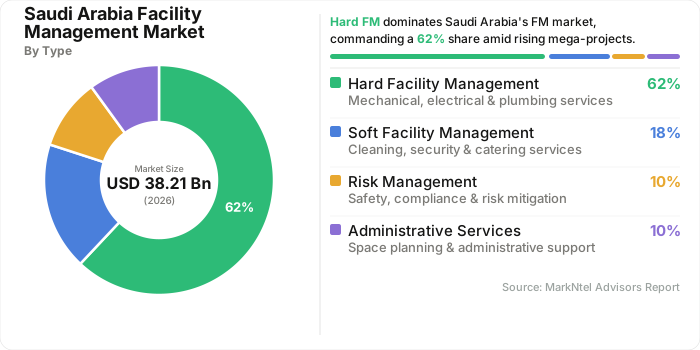
- Hard facility management is anticipated to hold nearly 62% of the market share by type in 2026.
- By operating model, the outsourced segment is projected to account for approximately 71% of the market in 2026.
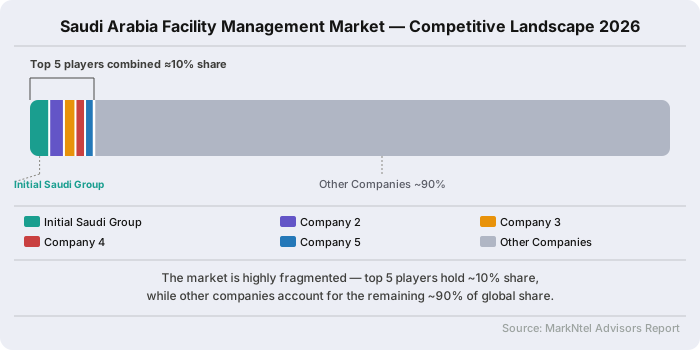
- The market is highly fragmented, with top five players collectively account for approximately 10% market share.
Saudi Arabia Facility Management Market Size and Outlook
The facility management market size in the KSA was valued at USD 37.71 billion in 2025 and is projected to grow from USD 38.21 billion in 2026 to USD 47.69 billion by 2032. Along with this, the market is estimated to grow at a CAGR of around 3.76% during the forecast period, i.e., 2026-32. Market growth is increasingly supported by the Kingdom's sustainability agenda, as environmental performance, energy efficiency, and resource optimization become integral to the operation of buildings and infrastructure under Saudi Vision 2030.
The importance of sustainable facility management is reinforced by the substantial environmental footprint of the global building sector. According to the International Energy Agency, building operations account for approximately 30% of global final energy consumption and 26% of global energy-related emissions, comprising 8% from direct building emissions and 18% from indirect emissions associated with electricity and heat generation. This creates a strong imperative for facility operators to improve building energy performance, optimize HVAC systems, reduce resource consumption, and implement data-driven environmental monitoring.
At the national level, the Saudi Green Initiative is accelerating this transition through targets to reduce annual carbon emissions by 278 million tonnes and protect 30% of the Kingdom's land and sea areas by 2030. These commitments are strengthening demand for energy management, waste reduction, water conservation, sustainable maintenance, and environmental compliance services across commercial, industrial, residential, government, and large-scale development projects.
As environmental, social, and governance priorities gain prominence, organizations are increasingly evaluating facility management providers based on their sustainability capabilities and compliance with internationally recognized frameworks such as ISO 14001 for environmental management systems and ISO 41001 for facility management systems. Consequently, environmental performance is evolving from a supplementary service consideration into an increasingly important procurement criterion, encouraging FM providers to embed resource efficiency, regulatory compliance, and measurable sustainability outcomes into long-term service contracts.
Saudi Arabia Facility Management Market Key Indicators
- Saudi Arabia awarded approximately USD 39.5 billion in construction contracts during 2025, marking the highest annual value on record. The rapid expansion of commercial buildings, residential communities, healthcare facilities, and infrastructure projects increases the long-term requirement for hard and soft facility management services once these assets become operational.
- Saudi Arabia welcomed 123 million domestic and international tourists in 2025, while tourism spending reached approximately USD 81.1 billion. The growing number of hotels, resorts, entertainment venues, and tourism destinations significantly increases demand for integrated facility management, including housekeeping, technical maintenance, landscaping, and security services.
- Saudi Arabia achieved a 65.4% homeownership rate by the end of 2024, reflecting continued expansion of residential developments under Vision 2030. The growing housing stock drives demand for community management, building maintenance, cleaning, security, and other residential facility management services.
- According to the Saudi Ministry of Health Statistical Yearbook 2024 (published in 2025), the Kingdom had 515 hospitals, 80,675 hospital beds, and 2,391 primary healthcare centers. The expansion of healthcare infrastructure creates sustained demand for specialized facility management services such as infection control, HVAC maintenance, medical waste management, and compliance management.
- According to the Vision 2030 Annual Report 2025, 93% of Vision 2030 Key Performance Indicators met or exceeded their annual targets. Continued progress across giga-projects such as NEOM, Qiddiya, Diriyah, and The Red Sea is accelerating demand for integrated, technology-enabled facility management services throughout the operational lifecycle of these developments.
Saudi Arabia Facility Management Market Scope
| Category | Segments |
|---|---|
| By Type | Hard, Soft, Risk, Administrative |
| By Operating Model | In-house, Outsourced |
| By Service Delivery | Integrated, Bundled, Single Service |
| By Enterprise Size | Large, Mid-Size, Small |
| By End User | Commercial, Residential, Government, Retail, Education, Healthcare, Hospitality, Others (Transportation, Utilities & Energy, etc. |
Saudi Arabia Facility Management Market Growth Drivers
Expanding Healthcare Infrastructure Driving Demand for Specialized Facility Management Services
Saudi Arabia's continued expansion of healthcare infrastructure under Vision 2030 is creating substantial opportunities for the facility management market. The Kingdom is strengthening its healthcare ecosystem through new hospitals, medical cities, and primary healthcare centers while increasing private sector participation under the Health Sector Transformation Program. These facilities require specialized facility management services, including HVAC maintenance, medical gas systems management, infection prevention, biomedical waste handling, building automation, and energy management to ensure uninterrupted healthcare delivery and compliance with stringent healthcare regulations.
The scale of healthcare investment continues to support long-term FM demand. According to the Saudi Ministry of Health Statistical Yearbook 2024, released in 2025, Saudi Arabia had 515 hospitals, 80,675 hospital beds, and 2,391 primary healthcare centers across the Kingdom. As healthcare capacity continues to expand to meet the objectives of Vision 2030 and rising patient demand, integrated facility management providers are expected to play an increasingly important role in maintaining critical healthcare infrastructure. The growing complexity of modern healthcare facilities is further accelerating demand for technically advanced and compliance-driven facility management solutions throughout the forecast period.
Recent Trends
Rapid Expansion of Integrated Facility Management Contracts in Saudi Arabia
The KSA facility management market is witnessing a structural transition toward integrated facility management contracts, driven by giga-project execution under Vision 2030. A clear example is the NEOM Trojena project IFM contract awarded to Red Sea International in December 2025, valued at approximately USD 54 million covering end-to-end services including maintenance, utilities, catering, security, and waste management under a unified service model.
This reflects a broader government-backed push to consolidate fragmented service contracts into single-point operational frameworks, improving efficiency and compliance across large-scale assets. The model is increasingly applied across NEOM, Red Sea Global, and other Public Investment Fund (PIF)-backed developments where operational complexity requires centralized governance.
A key driver is the scale of Saudi Arabia’s mega infrastructure pipeline, which includes multi-asset environments such as smart cities, tourism zones, and industrial clusters. These assets demand lifecycle-based management rather than traditional maintenance outsourcing. As a result, IFM is becoming the preferred procurement structure for high-value government and quasi-government projects.
Saudi Arabia Facility Management Market Opportunities and Challenges
Increasing Fire and Safety Compliance Requirements Creating Opportunities for Advanced Fire Safety Management Services
The rapid expansion of Saudi Arabia's commercial buildings, hospitals, airports, industrial facilities, and mixed-use developments has increased the complexity of maintaining fire and life safety compliance. Asset owners must ensure that facilities comply with evolving fire protection regulations while minimizing operational risks and ensuring business continuity. This challenge is creating strong demand for specialized facility management services, including fire safety system maintenance, compliance audits, emergency preparedness, risk assessments, and technical workforce training. As modern infrastructure becomes more sophisticated, integrated fire and life safety management is becoming a critical component of long-term facility operations.
Supporting this opportunity, the National Fire Protection Association (NFPA) signed a Memorandum of Understanding (MoU) with the Saudi Facility Management Association (SFMA) in June 2025 to strengthen fire safety standards across the Kingdom. The partnership focuses on expanding professional training, certification programs, technical knowledge exchange, and the adoption of international fire and life safety best practices for the Saudi facility management industry. This initiative is expected to enhance workforce capabilities and accelerate the adoption of advanced fire safety management solutions across large infrastructure and commercial developments.
Segmentation Insights
Hard Facility Management to Sustain 62% Market Leadership Through Smart Infrastructure and Giga Project Expansion
Hard Facility Management accounted for approximately 62% of the Saudi Arabia facility management market in 2026, making it the largest service segment due to the growing demand for technical operation and maintenance of critical building infrastructure. Hard FM services, including HVAC systems, electrical installations, plumbing, district cooling, building management systems, and fire safety maintenance, are essential for ensuring operational continuity, regulatory compliance, and energy efficiency across commercial buildings, healthcare facilities, airports, industrial assets, and large mixed-use developments. The segment continues to benefit from Saudi Arabia's ongoing infrastructure expansion under Vision 2030, where large-scale developments require long-term lifecycle management rather than construction support alone.
The dominance of the segment is reinforced by the rapid execution of giga-projects across the Kingdom, the Saudi Vision 2030 portfolio includes transformative developments such as NEOM, Diriyah, Qiddiya, ROSHN communities, and The Red Sea destination, all incorporating advanced smart building systems, district cooling networks, and energy-efficient infrastructure. These projects are expected to sustain demand for engineering-intensive Hard FM services throughout the forecast period. Based on Type, the scope has been divided into:
- Hard
- Soft
- Risk
- Administrative
Outsourced Operating Model to Sustain 71% Market Leadership Through Large-Scale Infrastructure Expansion and Rising Operational Complexity
The outsourced operating model accounted for approximately 71% of the Saudi Arabia facility management market in 2026, driven by the increasing preference of public and private organizations to engage specialized facility management providers for integrated operational services. Outsourcing enables asset owners to improve operational efficiency, access technical expertise, reduce lifecycle costs, and ensure compliance with international maintenance and safety standards. As Saudi Arabia expands its portfolio of smart cities, commercial developments, healthcare facilities, and tourism destinations, outsourced FM providers are increasingly managing comprehensive service contracts covering technical maintenance, cleaning, security, landscaping, and workplace support.
The growth of outsourced FM is supported by the Kingdom's ambitious infrastructure investment pipeline. According to the Saudi Press Agency, the newly established Expo 2030 Riyadh Company will develop and operate an exhibition site spanning 6 million square meters, with the event expected to attract more than 40 million visits during its operational period. In addition, numerous Public Investment Fund-backed developments are progressing simultaneously across the Kingdom, creating sustained demand for specialized integrated facility management providers capable of managing complex multi-asset environments. These large-scale operational requirements continue to strengthen the adoption of outsourced facility management services across Saudi Arabia.Based on Operating Model, the scope has been divided into:
- In-house
- Outsourced
Saudi Arabia Facility Management Market Competitive Landscape
The Saudi Arabia facility management market is highly fragmented, with the top five companies Muheel Facilities Management, Initial Saudi Group, Enova, MEEM Edgenta, and EFS Facilities Services Group collectively accounting for an estimated 10% of the organized market. Competition is driven by integrated FM capabilities, technical expertise, digital solutions, and participation in Vision 2030 infrastructure projects.
Key Companies in the Saudi Arabia Facility Management Market
- Initial Saudi Group
- Afras
- Muheel Facilities Management
- MEEM Edgenta
- Al Mahmal Facilities Services Co.
- Enova
- CBRE Group Inc.
- EFS Facilities Services Group
- Farnek Services LLC
- Dussmann Group
- Zahran Facility Management
Saudi Arabia Facility Management Industry News and Recent Developments
June 2025: NFPA–SFMA Strategic MoU to Strengthen Fire Safety Standards in Saudi Facility Management Sector
The National Fire Protection Association (NFPA) entered into a Memorandum of Understanding with the Saudi Facility Management Association (SFMA) in Riyadh to enhance vocational training and elevate fire safety standards across Saudi Arabia’s facility management ecosystem. The collaboration focuses on capacity building for facility managers, standardized safety protocols, and improved compliance with international fire safety frameworks.
Impact Analysis: The agreement strengthens regulatory and operational safety integration within Saudi Arabia’s rapidly expanding facility base. It accelerates professionalization of FM services, particularly in high-risk environments such as hospitals, airports, and giga-project assets, where compliance-driven maintenance is becoming a core operational requirement.
February 2026: SFMA–Nemetschek Partnership to Advance Smart and Sustainable Facility Management
The Saudi Facility Management Association (SFMA) and Nemetschek Arabia signed a strategic memorandum to promote digital transformation in facility management through BIM integration, digital twin technologies, and workforce upskilling programs aligned with smart building operations.
Impact Analysis: The partnership accelerates digital adoption in Saudi Arabia’s FM sector, enabling predictive maintenance, lifecycle asset optimization, and improved building performance analytics. It reinforces the shift toward smart FM ecosystems aligned with Vision 2030, particularly across giga-projects and government infrastructure portfolios.
Frequently Asked Questions
- Market Segmentation
- Introduction
- Product Definition
- Research Process
- Assumptions
- Executive Summary
- Saudi Arabia Facility Management Market Policies, Regulations, and Product Standards
- Saudi Arabia Facility Management Market Trends & Developments
- Saudi Arabia Facility Management Market Dynamics
- Growth Factors
- Challenges
- Saudi Arabia Facility Management Market Hotspot & Opportunities
- Saudi Arabia Facility Management Market Outlook, 2022-2032
- Market Size & Outlook
- By Revenues (USD Million)
- Market Segmentation & Outlook
- By Type- Market Size & Forecast 2022-2032, USD Million
- Hard
- Soft
- Risk
- Administrative
- By Operating Model- Market Size & Forecast 2022-2032, USD Million
- In-house
- Outsourced
- By Service Delivery- Market Size & Forecast 2022-2032, USD Million
- Integrated
- Bundled
- Single Service
- By Enterprise Size- Market Size & Forecast 2022-2032, USD Million
- Large
- Mid-Size
- Small
- By End User- Market Size & Forecast 2022-2032, USD Million
- Commercial
- Residential
- Government
- Retail
- Education
- Healthcare
- Hospitality
- Others (Transportation, Utilities & Energy, etc.)
- By Region- Market Size & Forecast 2022-2032, USD Million
- East
- West
- North
- South
- Central
- By Company
- Competition Characteristics
- Market Share & Analysis
- By Type- Market Size & Forecast 2022-2032, USD Million
- Market Size & Outlook
- Saudi Arabia Hard Facility Management Market Outlook, 2022-2032
- Market Size & Outlook
- By Revenues (USD Million)
- Market Segmentation & Outlook
- By Operating Model- Market Size & Forecast 2022-2032, USD Million
- By Service Delivery- Market Size & Forecast 2022-2032, USD Million
- By Enterprise Size- Market Size & Forecast 2022-2032, USD Million
- By End User- Market Size & Forecast 2022-2032, USD Million
- By Region- Market Size & Forecast 2022-2032, USD Million
- Market Size & Outlook
- Saudi Arabia Soft Facility Management Market Outlook, 2022-2032
- Market Size & Outlook
- By Revenues (USD Million)
- Market Segmentation & Outlook
- By Operating Model- Market Size & Forecast 2022-2032, USD Million
- By Service Delivery- Market Size & Forecast 2022-2032, USD Million
- By Enterprise Size- Market Size & Forecast 2022-2032, USD Million
- By End User- Market Size & Forecast 2022-2032, USD Million
- By Region- Market Size & Forecast 2022-2032, USD Million
- Market Size & Outlook
- Saudi Arabia Risk Facility Management Market Outlook, 2022-2032
- Market Size & Outlook
- By Revenues (USD Million)
- Market Segmentation & Outlook
- By Operating Model- Market Size & Forecast 2022-2032, USD Million
- By Service Delivery- Market Size & Forecast 2022-2032, USD Million
- By Enterprise Size- Market Size & Forecast 2022-2032, USD Million
- By End User- Market Size & Forecast 2022-2032, USD Million
- By Region- Market Size & Forecast 2022-2032, USD Million
- Saudi Arabia Administrative Facility Management Market Outlook, 2022-2032
- Market Size & Outlook
- By Revenues (USD Million)
- Market Segmentation & Outlook
- By Operating Model- Market Size & Forecast 2022-2032, USD Million
- By Service Delivery- Market Size & Forecast 2022-2032, USD Million
- By Enterprise Size- Market Size & Forecast 2022-2032, USD Million
- By End User- Market Size & Forecast 2022-2032, USD Million
- By Region- Market Size & Forecast 2022-2032, USD Million
- Market Size & Outlook
- Saudi Arabia Facility Management Market Key Strategic Imperatives for Success & Growth
- Competitive Outlook
- Company Profiles
- Initial Saudi Group
- Business Description
- Product Portfolio
- Collaborations & Alliances
- Recent Developments
- Financial Details
- Others
- Afras
- Business Description
- Product Portfolio
- Collaborations & Alliances
- Recent Developments
- Financial Details
- Others
- Muheel Facilities Management
- Business Description
- Product Portfolio
- Collaborations & Alliances
- Recent Developments
- Financial Details
- Others
- MEEM Edgenta
- Business Description
- Product Portfolio
- Collaborations & Alliances
- Recent Developments
- Financial Details
- Others
- Al Mahmal Facilities Services Co.
- Business Description
- Product Portfolio
- Collaborations & Alliances
- Recent Developments
- Financial Details
- Others
- Enova
- Business Description
- Product Portfolio
- Collaborations & Alliances
- Recent Developments
- Financial Details
- Others
- CBRE Group Inc.
- Business Description
- Product Portfolio
- Collaborations & Alliances
- Recent Developments
- Financial Details
- Others
- EFS Facilities Services Group
- Business Description
- Product Portfolio
- Collaborations & Alliances
- Recent Developments
- Financial Details
- Others
- Farnek Services LLC
- Business Description
- Product Portfolio
- Collaborations & Alliances
- Recent Developments
- Financial Details
- Others
- Dussmann Group
- Business Description
- Product Portfolio
- Collaborations & Alliances
- Recent Developments
- Financial Details
- Others
- Zahran Facility Management
- Business Description
- Product Portfolio
- Collaborations & Alliances
- Recent Developments
- Financial Details
- Others
- Others
- Initial Saudi Group
- Company Profiles
- Disclaimer
MarkNtel Advisors follows a robust and iterative research methodology designed to ensure maximum accuracy and minimize deviation in market estimates and forecasts. Our approach combines both bottom-up and top-down techniques to effectively segment and quantify various aspects of the market. A consistent feature across all our research reports is data triangulation, which examines the market from three distinct perspectives to validate findings. Key components of our research process include:
1. Scope & Research Design At the outset, MarkNtel Advisors define the research objectives and formulate pertinent questions. This phase involves determining the type of research—qualitative or quantitative—and designing a methodology that outlines data collection methods, target demographics, and analytical tools. They also establish timelines and budgets to ensure the research aligns with client goals.
2. Sample Selection and Data Collection In this stage, the firm identifies the target audience and determines the appropriate sample size to ensure representativeness. They employ various sampling methods, such as random or stratified sampling, based on the research objectives. Data collection is carried out using tools like surveys, interviews, and observations, ensuring the gathered data is reliable and relevant.
3. Data Analysis and Validation Once data is collected, MarkNtel Advisors undertake a rigorous analysis process. This includes cleaning the data to remove inconsistencies, employing statistical software for quantitative analysis, and thematic analysis for qualitative data. Validation steps are taken to ensure the accuracy and reliability of the findings, minimizing biases and errors.

4. Data Forecast and FinalizationThe final phase involves forecasting future market trends based on the analyzed data. MarkNtel Advisors utilize predictive modeling and time series analysis to anticipate market behaviors. The insights are then compiled into comprehensive reports, featuring visual aids like charts and graphs, and include strategic recommendations to inform client decision-making
We offer flexible licensing options to cater to varying organizational needs. Choose the pricing pack that best suits your requirements:
Buy Now Inquire Before Buying
 Request Customization
 Talk to our Consultant







