

US Facility Management Market Research Report Forecast (2026-2032)
By Type (Hard, Soft, Risk, Administrative), By Operating Model (In-house, Outsourced), By Service Delivery (Integrated, Bundled, Single Service), By Enterprise Size (Large, Mid-Siz ... e, Small), By End User (Commercial, Residential, Government, Retail, Education, Healthcare, Hospitality, Others (Transportation, Utilities & Energy, etc.)), and others Read more
- Buildings, Construction, Metals & Mining
- Jul 2026
- Pages 140
- Report Format: PDF, Excel, PPT
US Facility Management Market
Projected 4.66% CAGR from 2026 to 2032
Study Period
2026-2032
Market Size (2026)
USD 356 Billion
Market Size (2032)
USD 468 Billion
Base Year
2025
Projected CAGR
4.66%
Leading Segments
By Service Type: Hard
US Facility Management Market Key Takeaways
- The United States facility management market size was valued at around USD 342 billion in 2025 and is projected to grow from USD 356 billion in 2026 to USD 468 billion by 2032.
- The industry is projected to witness steady growth at a CAGR of around 4.66% during 2026-2032.
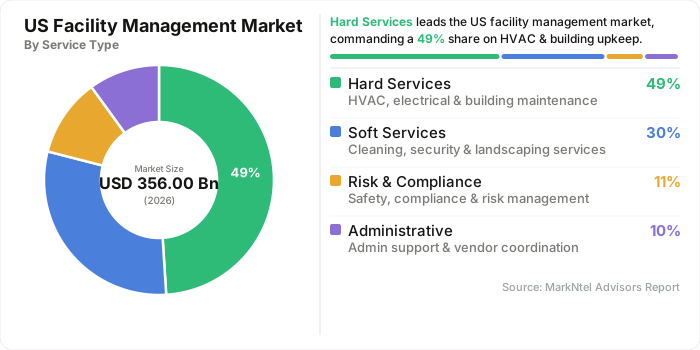
- By service type, hard facility management dominated the market with approximately 49% share in 2026.
- By operating model, outsourced facility management accounted for approximately 68% of the market share in 2026.
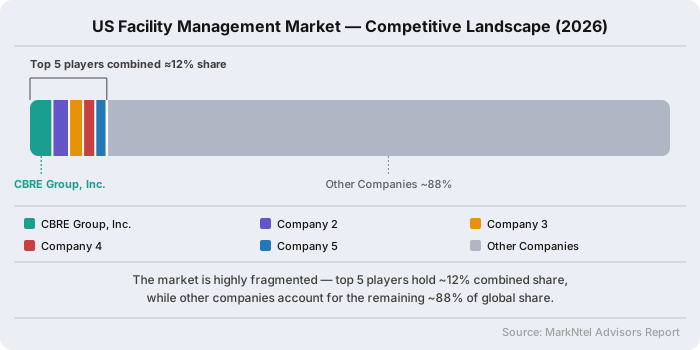
- The industry is moderately fragmented, with top five players collectively account for approximately 12% market share.
US Facility Management Market Size and Outlook
The U.S Facility Management market size was valued at USD 342 billion in 2025 and is projected to grow from USD 356 billion in 2026 to USD 468 billion by 2032. Along with this, the market is estimated to grow at a CAGR of around 4.66% during the forecast period, i.e., 2026-32.
The market is expected to witness sustained growth through 2032, supported by increasing investments in public infrastructure modernization, federal real estate optimization, and the expansion of mission-critical facilities. The growing adoption of integrated workplace management solutions, digital twins, and resilience-focused asset management will continue to transform facility operations across commercial, healthcare, government, education, and industrial sectors. Additionally, the rising construction of advanced manufacturing facilities, semiconductor plants, and renewable energy projects is expected to create long-term demand for specialized facility management services.
A key contributor to future market expansion is the Infrastructure Investment and Jobs Act , which allocates USD 550 billion in new federal investments for transportation, utilities, broadband, airports, ports, and public infrastructure. These assets will require long-term operation, maintenance, compliance management, and lifecycle optimization, creating significant opportunities for integrated facility management providers. Furthermore, according to the U.S. Census Bureau, the value of nonresidential construction put in place exceeded USD 1.3 trillion (annual rate) during 2026, reflecting continued investment in commercial, institutional, healthcare, educational, manufacturing, and public infrastructure facilities.
As organizations increasingly prioritize operational resilience, workplace experience, and asset lifecycle management, facility management providers offering integrated digital platforms, technical expertise, and sustainability-focused services will be well positioned to capitalize on future market opportunities.
US Facility Management Market Key Indicators
- The U.S. Energy Information Administration (EIA) projects commercial electricity consumption to reach 1,547 billion kWh in 2026, increasing the need for energy management, HVAC optimization, and predictive maintenance services, thereby driving demand for advanced facility management solutions.
- U.S. commercial buildings consume approximately 6.8 quadrillion British thermal units (Btu) of energy annually (EIA). The high energy intensity encourages organizations to adopt building automation, energy-efficient infrastructure, and integrated facility management services to reduce operating costs.
- The United States has approximately 5.9 million commercial buildings spanning nearly 97 billion square feet (EIA). The large building stock creates sustained demand for maintenance, security, cleaning, technical services, and lifecycle asset management across diverse end-user industries.
- The U.S. General Services Administration manages more than 363 million rentable square feet of federally owned and leased space. This extensive portfolio supports continuous demand for outsourced facility management, preventive maintenance, and energy-efficient building operations.
- More than 150,000 commercial and multifamily buildings benchmark their energy performance using the EPA's ENERGY STAR Portfolio Manager. The widespread use of benchmarking tools is accelerating investments in smart buildings, digital facility management platforms, and AI-enabled building performance optimization.
US Facility Management Market Scope
| Category | Segments |
|---|---|
| By Type | Hard, Soft, Risk, Administrative |
| By Operating Model | In-house, Outsourced |
| By Service Delivery | Integrated, Bundled, Single Service |
| By Enterprise Size | Large, Mid-Size, Small |
| By End User | Commercial, Residential, Government, Retail, Education, Healthcare, Hospitality, Others (Transportation, Utilities & Energy, etc. |
US Facility Management Market Growth Drivers
Expanding Commercial Building Stock Driving Demand for Facility Management
The growth of the facility management industry in the US is supported by the country’s large commercial building base, which requires ongoing maintenance, energy optimization, and compliance services. The U.S. Energy Information Administration (EIA) reports about 5.9 million commercial buildings with nearly 97 billion square feet of floorspace, creating strong demand for HVAC, electrical, cleaning, security, and building automation services. As portfolios become more complex, organizations are increasingly adopting integrated facility management models to improve efficiency, extend asset life, and reduce operating costs.
The industry shift is reinforced by industry innovation. In January 2026, CBRE partnered with Siemens Smart Infrastructure to integrate AI-powered building analytics into its Global Workplace Solutions platform, enabling predictive maintenance, intelligent automation, and energy optimization across commercial facilities. Such collaborations show how technology is reshaping facility operations and supporting the growing U.S. commercial building stock. As demand rises for smarter, more resilient buildings, facility managers are expected to rely more heavily on digital tools that improve performance, sustainability, and occupant experience.
![US Facility Management Market Size, Share and Trends, Report [2030]](https://www.marknteladvisors.com/public/uploads/infographic/usa-facility-management-market.webp)
Recent Trends
Growing Adoption of Smart Building and AI-Enabled Facility Management
The U.S. facility management industry is increasingly adopting smart building technologies, artificial intelligence, Internet of Things sensors, and predictive maintenance platforms to improve operational efficiency, optimize asset performance, and reduce lifecycle operating costs. AI-enabled building management systems allow facility managers to monitor HVAC, lighting, occupancy, indoor air quality, and critical equipment in real time, enabling predictive maintenance and data-driven decision-making.
According to the U.S. Environmental Protection Agency (EPA), more than 150,000 commercial and multifamily buildings benchmark their energy performance using the ENERGY STAR Portfolio Manager, demonstrating the widespread adoption of digital energy management across the country. The trend is further supported by recent industry innovation. In March 2026, Johnson Controls launched the C•CURE IQ Video Management System and Incident Management platform at ISC West 2026, integrating AI-powered video analytics, access control, and automated incident response into a unified smart building platform. Such developments are accelerating the transition toward intelligent, connected facility management solutions that enhance operational resilience, occupant safety, and building performance.
US Facility Management Market Opportunities and Challenges
Skilled Labor Shortages Creating Opportunities for Intelligent Automation in Facility Management
A major challenge confronting the U.S. facility management market is the shortage of skilled maintenance technicians, electricians, HVAC specialists, and building engineers, making it increasingly difficult for organizations to maintain complex facilities efficiently. According to the U.S. Bureau of Labor Statistics (BLS), employment of general maintenance and repair workers is projected to grow 5% between 2024 and 2034, with approximately 154,000 job openings projected each year, primarily driven by workforce retirements and labor replacement needs. The shortage is increasing maintenance costs, delaying asset servicing, and placing greater pressure on facility operators to maintain service quality.
This challenge is creating significant opportunities for AI-enabled maintenance platforms, digital workforce management, and intelligent building automation that reduce dependence on manual inspections. Supporting this trend, Johnson Controls introduced OpenBlue Companion R2.22 in March 2026, adding enhanced workplace management, visitor scheduling, and digital workspace capabilities that improve workforce productivity and streamline facility operations. Such innovations are enabling organizations to optimize limited labor resources while improving operational efficiency and occupant experience.
Segmentation Insights
Hard Facility Management Emerges as the Leading Segment
The hard facility management accounted for approximately 49% of the U.S. facility management market in 2026, making it the largest segment based on service type. The segment leads because it covers essential technical building functions such as HVAC systems, electrical installations, plumbing, building management systems, energy management, district cooling, and fire safety services. These services are critical for operational continuity, occupant safety, asset reliability, and regulatory compliance across commercial, healthcare, education, government, and industrial facilities. As buildings become more technologically advanced, the need for specialized maintenance, monitoring, and repair services continues to rise, further strengthening the segment’s position in the market.
According to the U.S. Energy Information Administration (EIA), U.S. commercial buildings consumed approximately 6.8 quadrillion British thermal units (Btu) of energy, with space heating accounting for nearly one-third of total consumption. This highlights the importance of efficient maintenance and energy management, particularly for systems that directly influence energy use and operational costs. The growing adoption of smart building technologies, predictive maintenance tools, and energy-efficient infrastructure is also supporting demand for hard facility management services. In addition, organizations are placing greater emphasis on sustainability, carbon reduction, and compliance with building performance standards, all of which require continuous technical oversight. These factors are expected to sustain the segment’s leadership throughout the forecast period. Based on service type, the scope has been divided into:
- Hard
- Soft
- Risk
- Administrative
Organizations Increasingly Prefer Outsourced Operations to Enhance Facility Performance
The outsourced facility management represented approximately 68% of the United States facility management market in 2026, making it the dominant segment based on Operating Model. Organizations increasingly outsource facility management functions to specialized providers to improve efficiency, reduce costs, and access technical expertise across integrated hard and soft services. Outsourcing allows organizations to focus on core business activities while benefiting from professional facility management capabilities, advanced maintenance practices, and scalable service delivery. As operational complexity increases, many enterprises prefer outsourced arrangements because they provide flexibility, performance accountability, and access to specialized labor and technology without the burden of maintaining large in-house teams.
According to the U.S. Energy Information Administration (EIA), the United States has approximately 5.9 million commercial buildings, creating a substantial base of facilities that require ongoing management. This large and diverse building stock supports strong demand for third-party service providers capable of handling maintenance, energy optimization, and compliance requirements across different facility types. In addition, the U.S. Department of Energy’s Federal Energy Management Program (FEMP) encourages federal agencies to improve facility energy performance, further supporting demand for outsourced providers with advanced technical and energy management capabilities. The increasing focus on energy efficiency, preventive maintenance, and performance benchmarking is expected to reinforce the adoption of outsourced facility management across both public and private sector facilities. Based on operating model, the scope has been divided into:
- In-house
- Outsourced
US Facility Management Market Competitive Analysis
The United States facility management market is moderately fragmented, with competition among global integrated facility management providers, commercial real estate service firms, and specialized technical service companies. The top five companies CBRE, JLL, ABM Industries, EMCOR Group, and Sodexo collectively account for approximately 12% of the market. Competitive positioning is driven by integrated service capabilities, nationwide service networks, digital building technologies, strategic outsourcing contracts, and expertise in delivering energy-efficient and AI-enabled facility management solutions.
Key Companies in US Facility Management Market
- CBRE Group Inc.
- Jones Lang LaSalle Incorporated (JLL)
- ABM Industries Incorporated
- EMCOR Group Inc.
- Sodexo
- ISS A/S
- Cushman & Wakefield plc
- Compass Group PLC
- Amentum
- Others
US Facility Management Industry News and Recent Developments
March 2026: Johnson Controls Launches exacqVision 26.0
Johnson Controls introduced exacqVision 26.0, the latest version of its enterprise video management software featuring AI-powered video search, enhanced cybersecurity, improved cloud connectivity, and seamless integration with access control systems. The solution is designed to strengthen security operations across commercial buildings, healthcare facilities, manufacturing sites, and educational campuses.
Impact Analysis: The launch supports the increasing adoption of intelligent security technologies within facility management. AI-enabled surveillance and cloud-based management improve operational visibility, reduce manual monitoring, and strengthen building security while supporting integrated facility management strategies.
March 2026: Johnson Controls Releases OpenBlue Companion R2.22
Johnson Controls released OpenBlue Companion R2.22, introducing multi-day visitor scheduling, enhanced workspace reservations, and improved workplace communication features. The updated mobile application simplifies hybrid workplace management by enabling employees and facility managers to coordinate visitors, reserve workspaces, and optimize office utilization through a unified digital platform.
Impact Analysis: The release reflects increasing enterprise demand for flexible workplace management solutions. The enhanced capabilities support hybrid work strategies by improving space utilization, employee experience, and operational efficiency while enabling facility managers to make data-driven workplace decisions.
Frequently Asked Questions
- Market Segmentation
- Introduction
- Product Definition
- Research Process
- Assumptions
- Executive Summary
- US Facility Management Market Policies, Regulations, and Product Standards
- US Facility Management Market Trends & Developments
- US Facility Management Market Dynamics
- Growth Factors
- Challenges
- US Facility Management Market Hotspot & Opportunities
- US Facility Management Market Outlook, 2022-2032
- Market Size and Outlook
- By Revenues (USD Million)
- Market Segmentation and Outlook
- By Type- Market Size & Forecast 2022-2032, USD Million
- Hard
- Soft
- Risk
- Administrative
- By Operating Model- Market Size & Forecast 2022-2032, USD Million
- In-house
- Outsourced
- By Service Delivery- Market Size & Forecast 2022-2032, USD Million
- Integrated
- Bundled
- Single Service
- By Enterprise Size- Market Size & Forecast 2022-2032, USD Million
- Large
- Mid-Size
- Small
- By End User- Market Size & Forecast 2022-2032, USD Million
- Commercial
- Residential
- Government
- Retail
- Education
- Healthcare
- Hospitality
- Others (Transportation, Utilities & Energy, etc.)
- By Region- Market Size & Forecast 2022-2032, USD Million
- South
- West
- Midwest
- Northeast
- Others
- By Company
- Competition Characteristics
- Market Share & Analysis
- By Type- Market Size & Forecast 2022-2032, USD Million
- Market Size and Outlook
- US Hard Facility Management Market Outlook, 2022-2032
- Market Size and Outlook
- By Revenues (USD Million)
- Market Segmentation and Outlook
- By Operating Model- Market Size & Forecast 2022-2032, USD Million
- By Service Delivery- Market Size & Forecast 2022-2032, USD Million
- By Enterprise Size- Market Size & Forecast 2022-2032, USD Million
- By End User- Market Size & Forecast 2022-2032, USD Million
- By Region- Market Size & Forecast 2022-2032, USD Million
- Market Size and Outlook
- US Soft Facility Management Market Outlook, 2022-2032
- Market Size and Outlook
- By Revenues (USD Million)
- Market Segmentation and Outlook
- By Operating Model- Market Size & Forecast 2022-2032, USD Million
- By Service Delivery- Market Size & Forecast 2022-2032, USD Million
- By Enterprise Size- Market Size & Forecast 2022-2032, USD Million
- By End User- Market Size & Forecast 2022-2032, USD Million
- By Region- Market Size & Forecast 2022-2032, USD Million
- Market Size and Outlook
- US Risk Facility Management Market Outlook, 2022-2032
- Market Size and Outlook
- By Revenues (USD Million)
- Market Segmentation and Outlook
- By Operating Model- Market Size & Forecast 2022-2032, USD Million
- By Service Delivery- Market Size & Forecast 2022-2032, USD Million
- By Enterprise Size- Market Size & Forecast 2022-2032, USD Million
- By End User- Market Size & Forecast 2022-2032, USD Million
- By Region- Market Size & Forecast 2022-2032, USD Million
- Market Size and Outlook
- US Administrative Facility Management Market Outlook, 2022-2032
- Market Size and Outlook
- By Revenues (USD Million)
- Market Segmentation and Outlook
- By Operating Model- Market Size & Forecast 2022-2032, USD Million
- By Service Delivery- Market Size & Forecast 2022-2032, USD Million
- By Enterprise Size- Market Size & Forecast 2022-2032, USD Million
- By End User- Market Size & Forecast 2022-2032, USD Million
- By Region- Market Size & Forecast 2022-2032, USD Million
- Market Size and Outlook
- US Facility Management Market Key Strategic Imperatives for Success & Growth
- Competitive Outlook
- Company Profiles
- CBRE Group Inc.
- Business Description
- Product Portfolio
- Collaborations & Alliances
- Recent Developments
- Financial Details
- Others
- Jones Lang LaSalle Incorporated (JLL)
- Business Description
- Product Portfolio
- Collaborations & Alliances
- Recent Developments
- Financial Details
- Others
- ABM Industries Incorporated
- Business Description
- Product Portfolio
- Collaborations & Alliances
- Recent Developments
- Financial Details
- Others
- EMCOR Group Inc
- Business Description
- Product Portfolio
- Collaborations & Alliances
- Recent Developments
- Financial Details
- Others
- Sodexo
- Business Description
- Product Portfolio
- Collaborations & Alliances
- Recent Developments
- Financial Details
- Others
- Compass Group
- Business Description
- Product Portfolio
- Collaborations & Alliances
- Recent Developments
- Financial Details
- Others
- ISS A/S
- Business Description
- Product Portfolio
- Collaborations & Alliances
- Recent Developments
- Financial Details
- Others
- Cushman & Wakefield
- Business Description
- Product Portfolio
- Collaborations & Alliances
- Recent Developments
- Financial Details
- Others
- Aramark
- Business Description
- Product Portfolio
- Collaborations & Alliances
- Recent Developments
- Financial Details
- Others
- Others
- CBRE Group Inc.
- Company Profiles
- Disclaimer
MarkNtel Advisors follows a robust and iterative research methodology designed to ensure maximum accuracy and minimize deviation in market estimates and forecasts. Our approach combines both bottom-up and top-down techniques to effectively segment and quantify various aspects of the market. A consistent feature across all our research reports is data triangulation, which examines the market from three distinct perspectives to validate findings. Key components of our research process include:
1. Scope & Research Design At the outset, MarkNtel Advisors define the research objectives and formulate pertinent questions. This phase involves determining the type of research—qualitative or quantitative—and designing a methodology that outlines data collection methods, target demographics, and analytical tools. They also establish timelines and budgets to ensure the research aligns with client goals.
2. Sample Selection and Data Collection In this stage, the firm identifies the target audience and determines the appropriate sample size to ensure representativeness. They employ various sampling methods, such as random or stratified sampling, based on the research objectives. Data collection is carried out using tools like surveys, interviews, and observations, ensuring the gathered data is reliable and relevant.
3. Data Analysis and Validation Once data is collected, MarkNtel Advisors undertake a rigorous analysis process. This includes cleaning the data to remove inconsistencies, employing statistical software for quantitative analysis, and thematic analysis for qualitative data. Validation steps are taken to ensure the accuracy and reliability of the findings, minimizing biases and errors.

4. Data Forecast and FinalizationThe final phase involves forecasting future market trends based on the analyzed data. MarkNtel Advisors utilize predictive modeling and time series analysis to anticipate market behaviors. The insights are then compiled into comprehensive reports, featuring visual aids like charts and graphs, and include strategic recommendations to inform client decision-making
We offer flexible licensing options to cater to varying organizational needs. Choose the pricing pack that best suits your requirements:
Buy Now Inquire Before Buying
 Request Customization
 Talk to our Consultant







