Malaysia Facility Management Market Research Report Forecast: (2026-2032)
By Type (Hard, Soft, Risk, Administrative), By Operating Model (In-house, Outsourced), By Service Delivery (Integrated, Bundled, Single Service), By End User (Commercial, Residenti ... al, Government, Retail, Education, Healthcare, Hospitality, Others (Transportation, Utilities & Energy, etc.)), By Enterprise Size (Large, Mid-Size, Small), and others Read more
- Buildings, Construction, Metals & Mining
- Jun 2026
- Pages 140
- Report Format: PDF, Excel, PPT
Malaysia Facility Management Market
Projected 5.11% CAGR from 2026 to 2032
Study Period
2026-2032
Market Size (2026)
USD 13.1 Billion
Market Size (2032)
USD 17.67 Billion
Base Year
2025
Projected CAGR
5.11%
Leading Segments
By Type: Hard
Malaysia Facility Management Market Key Takeaways
- Malaysia Facility Management Market size was valued at USD 12.47 billion in 2025 and is projected to grow from USD 13.1 billion in 2026 to USD 17.67 billion by 2032.
- The market is projected to register a CAGR of 5.11% during 2026-2032.
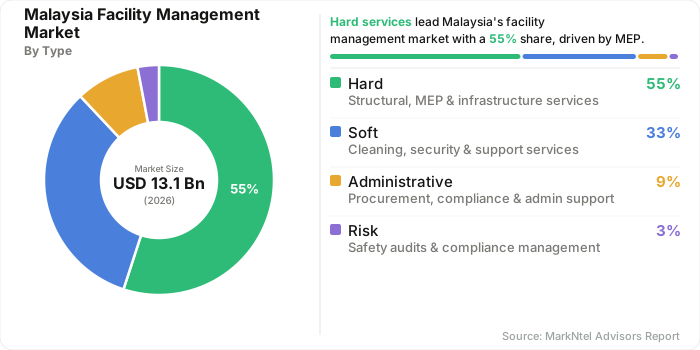
- By type, the hard segment holds a significant share of about 54% in 2026.
- By end user, the Commercial segment seized a significant share of about 35% in 2026.
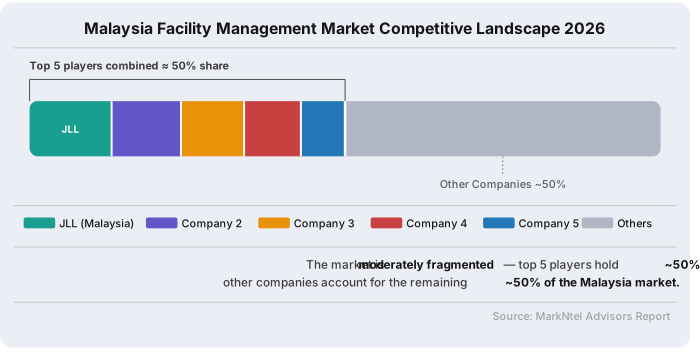
- The industry is moderately fragmented. However, the top five players collectively account for nearly 50% share.
Malaysia Facility Management Market Size and Outlook
The Malaysia Facility Management Market size was valued at was valued at USD 12.47 billion in 2025 and is projected to grow from USD 13.1 billion in 2026 to USD 17.67 billion by 2032. Along with this, the market is estimated to grow at a CAGR of around 5.11% during the forecast period, i.e., 2026-32.
The market is projected to expand steadily over the coming years, supported by rising infrastructure modernization, increasing adoption of smart building solutions, and growing demand for outsourced maintenance services across commercial, institutional, and public assets. Rapid urban development and continuous investment in education, healthcare, commercial real estate, and transport infrastructure are increasing the complexity of building operations, creating sustained demand for integrated facility management and lifecycle asset management services throughout the country.
The education sector is emerging as a strong contributor to long-term facility management demand. A recent example includes the RM49.9 million redevelopment of SMK Kanowit in Sarawak, which introduced new academic blocks, laboratories, and upgraded infrastructure facilities. Such developments expand the operational asset base requiring HVAC maintenance, utilities management, sanitation services, and building lifecycle support. As Malaysia continues modernizing educational infrastructure and public institutions, demand for energy-efficient infrastructure management and preventive maintenance services is expected to rise steadily.
At the same time, Malaysia digital infrastructure transformation is accelerating adoption of AI-driven facility operations and IoT-enabled building management systems. For example, Digital Nasional Berhad (DNB) and Ericsson implemented AI-, machine learning-, and automation-based operations for Malaysia 5G infrastructure, enabling predictive monitoring and automated system management. Similar technologies are increasingly being integrated into commercial buildings and institutional facilities for predictive maintenance, centralized monitoring, and energy optimization, strengthening the transition toward data-driven facility operations.
Workforce transformation is also becoming a critical market development factor. Official labour data showed skills-related underemployment remained above 35% in 2025, highlighting a growing gap between conventional maintenance capabilities and the technical expertise required for modern facility operations. This challenge is encouraging investment in certification-led upskilling programs and digital maintenance training focused on smart infrastructure systems and automated asset management technologies.
Eventually, Malaysia facility management industry is evolving from conventional maintenance services toward technology-enabled, sustainability-focused, and integrated operational models. The combination of infrastructure expansion, smart FM solutions, and workforce modernization is expected to significantly strengthen long-term market demand across both public and private infrastructure ecosystems.
Malaysia Facility Management Market Key Indicators
- Malaysia construction sector recorded USD 8.9 billion work done in Q4 2024, growing 23.1% year-on-year, driven by residential and non-residential building activity. Strong expansion in building construction and special trade activities reflects rising infrastructure intensity, increasing demand for building maintenance, energy systems management, and integrated facility management services across commercial and institutional assets.
- Malaysia recorded USD 80.4 billion in approved investments in 2024, reflecting 14.9% year-on-year growth, with the services sector contributing USD 53.6 billion driven by data centres, global business services, and commercial property developments across key regions. This investment pipeline significantly strengthens facility management demand, as each new operational asset requires pre-commissioning support, lifecycle maintenance, energy optimization, and compliance-driven building operations from the start of commercial use.
- Malaysia healthcare expansion is strengthening facility management demand, supported by the Ministry of Health 2025 initiative to collaborate with 91 private hospitals for outsourced services such as cardiology, radiology, and nephrology. Private hospital capacity, currently around 18,779 beds, is projected to reach 23,000–24,000 beds by 2028, driven by expansions from KPJ Healthcare, IHH Healthcare, and Sunway Healthcare. This growth increases demand for specialist FM services including sterile environment maintenance, HVAC systems for operating theatres, medical waste management, and infection control across advanced clinical facilities.
Malaysia Facility Management Market Scope
| Category | Segments |
|---|---|
| By Type | Hard, Soft, Risk, Administrative |
| By Operating Model | In-house, Outsourced |
| By Service Delivery | Integrated, Bundled, Single Service |
| By End User | Commercial, Residential, Government, Retail, Education, Healthcare, Hospitality, Others (Transportation, Utilities & Energy, etc. |
| By Enterprise Size | Large, Mid-Size, Small |
Malaysia Facility Management Market Growth Drivers
Growing Education Sector to Boost Facility Management
Malaysia education infrastructure expansion is emerging as a structural driver for facility management demand, supported by sustained public capital allocation and large-scale school modernization. In Budget 2024, the Ministry of Education was allocated USD 12.5 billion, with USD 404 million dedicated to school maintenance and upgrading works. The government also reported ongoing upgrades of over 1,000 dilapidated schools nationwide, with a significant share already completed, reflecting continuous infrastructure renewal across public education assets. These developments directly increase the need for structured facility services covering building maintenance, sanitation systems, and energy management across school campuses.
Beyond 2025, Malaysia Strategic Education direction emphasizes modernization of learning environments through digital classrooms, improved infrastructure quality, and energy-efficient campus development. This transition is increasing operational complexity within educational institutions, requiring continuous facility upkeep and lifecycle asset management. As schools and campuses evolve into more technology-integrated environments, demand for outsourced facility management services covering HVAC systems, utilities optimization, cleaning operations, and building maintenance is expected to rise steadily across the public education sector.
Moreover, rising investment in education infrastructure and continuous modernization initiatives are strengthening FM dependency across institutions. This will steadily expand demand for professional facility management services in Malaysia over the coming years.
Malaysia Facility Management Market Trends
Escalating Use of Artificial Intelligence & Internet of Things
Malaysia is accelerating adoption of AI-enabled infrastructure, IoT connectivity, and digital governance systems, strengthening the foundation for smart facility operations across public buildings. In 2024, the government established the National AI Office to coordinate national-level deployment of AI across industries, supporting automation, analytics, and data-driven decision-making. This aligns with major digital infrastructure expansion, including Google USD 2 billion data center investment, which enhances cloud capacity and enables real-time IoT-based monitoring systems. Together, these developments are enabling predictive maintenance, automated energy tracking, and remote facility monitoring in modern infrastructure environments.
In parallel, Malaysia Digital Education Policy and broader smart campus initiatives are increasing reliance on connected building systems, digital classrooms, and AI-assisted administrative operations. Recent policy research highlights growing integration of AI in institutional management systems, particularly in education and public facilities. This shift is expanding deployment of IoT-based facility management systems, including sensor-driven energy optimization, predictive maintenance alerts, and centralized building dashboards, improving operational efficiency across schools, hospitals, and government infrastructure.
Furthermore, the expansion of AI-enabled infrastructure and IoT-driven facility systems is transforming Malaysia FM sector from reactive maintenance to predictive and automated operations. This transition is significantly improving efficiency and will continue accelerating demand for smart facility management solutions across key infrastructure sectors.
Malaysia Facility Management Industry Opportunities and Challenges
Skilled Workforce Shortage Driving Certification-Based Training and FM Skill Development Programs
The facility management sector in Malaysia is constrained by a widening shortage of technically skilled talent required for managing HVAC systems, electrical assets, and digitally enabled building infrastructure. A 2026 labour analysis highlights a gap where demand for engineering professionals significantly exceeds domestic output, with roughly 50,000 engineers required versus about 5,000 graduating annually, reflecting a structural supply deficit. This imbalance is already visible in construction and property operations, where maintenance roles are increasingly difficult to fill, slowing down preventive servicing cycles and reducing efficiency in complex building environments.
At the same time, this shortage is generating a strong transformation opportunity within the FM ecosystem. Organizations are shifting toward structured reskilling models, where general technicians are upgraded into CMMS-enabled and BIM-supported facility operators. Industry hiring trends in 2026 show rising wage premiums for digitally skilled maintenance professionals, reinforcing the value of certification-based career pathways. This is pushing FM providers to invest in internal academies and OEM-led training collaborations, creating a more resilient workforce capable of managing smart buildings and data-driven maintenance systems efficiently.
Segmentation Insights
Hard Services is Leading Segment in Malaysia Facility Management
Hard services dominate the Malaysia facility management market with an estimated 54% share, driven by their essential role in maintaining building functionality and regulatory compliance. These services include HVAC maintenance, electrical systems, fire safety, plumbing, and structural upkeep, which are critical for uninterrupted operations across all facility types. The expansion of smart building maintenance, energy-efficient infrastructure, and complex assets such as hospitals and data centres is significantly increasing reliance on technically skilled service delivery to ensure operational continuity and system reliability.
The growth of predictive maintenance systems and automation-enabled infrastructure is further strengthening demand for hard services, as modern facilities require continuous monitoring and preventive intervention. Rising construction activity across commercial and institutional sectors is expanding the installed asset base, directly increasing lifecycle maintenance requirements. Additionally, strict safety regulations and operational standards across Malaysia reinforce the non-discretionary nature of these services, positioning hard services as the backbone of facility management contracts across public and private infrastructure ecosystems. Based on type, the scope has been segmented into
- Hard
- Soft
- Risk
- Administrative
Commercial leads the End-Use Segment
The commercial segment accounts for approximately 35% share of the Malaysia facility management market, driven by rapid expansion of office buildings, retail complexes, business parks, and mixed-use developments in major urban hubs such as Kuala Lumpur, Johor, and Penang. These assets require continuous facility operations management, including security, cleaning, energy optimization, and maintenance services to ensure tenant satisfaction and asset performance efficiency.
Growing adoption of integrated facility management and sustainability-driven building operations is further strengthening outsourcing demand within commercial properties. The rise of Grade A office spaces and modern retail infrastructure has increased reliance on professional FM providers capable of delivering consistent service quality and operational efficiency. Additionally, competitive leasing environments and higher occupancy expectations are pushing property owners to adopt smart FM solutions, enabling data-driven decision-making and improved lifecycle asset management across commercial real estate portfolios. The key end users mapped in the study involve
- Commercial
- Residential
- Government
- Retail
- Education
- Healthcare
- Hospitality
- Others (Transportation, Utilities & Energy, etc.)
Malaysia Facility Management Industry Competitive Analysis
The Malaysia facility management market is moderately fragmented, with a mix of global integrated facility management providers and local engineering and property management firms operating across hard FM, soft FM, and integrated service contracts. The top five companies, including JLL, CBRE, ISS Facility Services, GFM Services Berhad, and AWC Berhad, collectively account for approximately 50% of the total market share, reflecting a competitive landscape shaped by strong dominance in high-value commercial contracts, government-linked facilities, and infrastructure-driven maintenance services, alongside a long tail of regional and niche service providers.
Key Companies in Facility Management
- JLL
- CBRE
- AWC Berhad
- Sepadu Group
- Harta Maintenance Sdn Bhd
- Zelan AM Services Sdn Bhd
- PMC Facilities & Real Estate
- RPH Global Property Management
- GFM Services Berhad
- MST Facilities Sdn Bhd
- Others
Malaysia Facility Management Industry News and Recent Developments
June 2025: I-Bhd Launches AI and Robotics Infrastructure Initiative for Smart Property Operations
Malaysia-based I-Bhd announced an investment of approximately USD 2.1 to deploy AI and robotics infrastructure across its property portfolio through 2028. The initiative includes robotics-assisted services, predictive maintenance systems, and smart visitor management technologies aimed at improving operational efficiency and accelerating adoption of digital property and facility management solutions.
Impact Analysis: The initiative strengthens Malaysia transition toward smart facility management and automation-enabled building operations. Deployment of AI-driven predictive maintenance and robotics-assisted services is expected to improve operational efficiency, reduce manpower dependency, and optimize lifecycle asset management across commercial properties. The project also reinforces broader market demand for AI-enabled infrastructure, IoT integration, and data-driven facility operations, encouraging FM providers to invest in advanced digital maintenance capabilities.
March 2025: AWC Secures Major Integrated Facility Management Contracts for Critical Infrastructure Assets
AWC Berhad expanded its facility management portfolio through multiple integrated facility management contracts covering government complexes, hospitals, and TM data centres in Malaysia. One major contract involved approximately USD 21.1 million for TM Central 1 facilities and data centres over five years, strengthening AWC’s presence in mission-critical infrastructure management.
Impact Analysis: The contracts reinforce rising demand for integrated facility management and specialized maintenance services across Malaysia’s digital and public infrastructure ecosystem. Expansion into data centres and technology-driven assets highlights growing reliance on predictive maintenance, energy optimization, and uptime-focused operations. These developments strengthen the transition toward smart infrastructure management, while increasing long-term opportunities for FM providers in healthcare, telecom infrastructure, and government facility operations.
Frequently Asked Questions
- Market Segmentation
- Introduction
- Product Definition
- Research Process
- Assumptions
- Executive Summary
- Malaysia Facility Management Market Policies, Regulations, and Product Standards
- Malaysia Facility Management Market Trends & Developments
- Malaysia Facility Management Market Dynamics
- Growth Factors
- Challenges
- Malaysia Facility Management Market Hotspot & Opportunities
- Malaysia Facility Management Market Outlook, 2022-2032F
- Market Size & Outlook
- By Revenues (USD Million)
- Market Share & Outlook
- By Type- Market Size & Forecast 2022-2032, USD Million
- Hard
- Soft
- Risk
- Administrative
- By Operating Model- Market Size & Forecast 2022-2032, USD Million
- In-house
- Outsourced
- By Service Delivery- Market Size & Forecast 2022-2032, USD Million
- Integrated
- Bundled
- Single Service
- By End User- Market Size & Forecast 2022-2032, USD Million
- Commercial
- Residential
- Government
- Retail
- Education
- Healthcare
- Hospitality
- Others (Transportation, Utilities & Energy, etc.)
- By Enterprise Size- Market Size & Forecast 2022-2032, USD Million
- Large
- Mid-Size
- Small
- By Region- Market Size & Forecast 2022-2032, USD Million
- North
- East
- West
- South
- By Company
- Competition Characteristics
- Market Share & Analysis
- By Type- Market Size & Forecast 2022-2032, USD Million
- Market Size & Outlook
- Malaysia Hard Market Outlook, 2022-2032
- Market Size & Outlook
- By Revenues (USD Million)
- Market Share & Outlook
- By Operating Model- Market Size & Forecast 2022-2032, USD Million
- By Service Delivery- Market Size & Forecast 2022-2032, USD Million
- By End User- Market Size & Forecast 2022-2032, USD Million
- By Enterprise Size- Market Size & Forecast 2022-2032, USD Million
- By Region- Market Size & Forecast 2022-2032, USD Million
- Market Size & Outlook
- Malaysia Soft Market Outlook, 2022-2032
- Market Size & Outlook
- By Revenues (USD Million)
- Market Share & Outlook
- By Operating Model- Market Size & Forecast 2022-2032, USD Million
- By Service Delivery- Market Size & Forecast 2022-2032, USD Million
- By End User- Market Size & Forecast 2022-2032, USD Million
- By Enterprise Size- Market Size & Forecast 2022-2032, USD Million
- By Region- Market Size & Forecast 2022-2032, USD Million
- Market Size & Outlook
- Malaysia Risk Market Outlook, 2022-2032
- Market Size & Outlook
- By Revenues (USD Million)
- Market Share & Outlook
- By Operating Model- Market Size & Forecast 2022-2032, USD Million
- By Service Delivery- Market Size & Forecast 2022-2032, USD Million
- By End User- Market Size & Forecast 2022-2032, USD Million
- By Enterprise Size- Market Size & Forecast 2022-2032, USD Million
- By Region- Market Size & Forecast 2022-2032, USD Million
- Market Size & Outlook
- Malaysia Administrative Market Outlook, 2022-2032
- Market Size & Outlook
- By Revenues (USD Million)
- Market Share & Outlook
- By Operating Model- Market Size & Forecast 2022-2032, USD Million
- By Service Delivery- Market Size & Forecast 2022-2032, USD Million
- By End User- Market Size & Forecast 2022-2032, USD Million
- By Enterprise Size- Market Size & Forecast 2022-2032, USD Million
- By Region- Market Size & Forecast 2022-2032, USD Million
- Market Size & Outlook
- Malaysia Facility Management Market Key Strategic Imperatives for Success & Growth
- Competitive Outlook
- Company Profiles
- Administrative
- Business Description
- Product Portfolio
- Collaborations & Alliances
- Recent Developments
- Financial Details
- Others
- JLL
- Business Description
- Product Portfolio
- Collaborations & Alliances
- Recent Developments
- Financial Details
- Others
- CBRE
- Business Description
- Product Portfolio
- Collaborations & Alliances
- Recent Developments
- Financial Details
- Others
- AWC Berhad
- Business Description
- Product Portfolio
- Collaborations & Alliances
- Recent Developments
- Financial Details
- Others
- Sepadu Group
- Business Description
- Product Portfolio
- Collaborations & Alliances
- Recent Developments
- Financial Details
- Others
- Harta Maintenance Sdn Bhd
- Business Description
- Product Portfolio
- Collaborations & Alliances
- Recent Developments
- Financial Details
- Others
- Zelan AM Services Sdn Bhd
- Business Description
- Product Portfolio
- Collaborations & Alliances
- Recent Developments
- Financial Details
- Others
- PMC Facilities & Real Estate
- Business Description
- Product Portfolio
- Collaborations & Alliances
- Recent Developments
- Financial Details
- Others
- RPH Global Property Management
- Business Description
- Product Portfolio
- Collaborations & Alliances
- Recent Developments
- Financial Details
- Others
- GFM Services Berhad
- Business Description
- Product Portfolio
- Collaborations & Alliances
- Recent Developments
- Financial Details
- Others
- Administrative
- Company Profiles
- Disclaimer
MarkNtel Advisors follows a robust and iterative research methodology designed to ensure maximum accuracy and minimize deviation in market estimates and forecasts. Our approach combines both bottom-up and top-down techniques to effectively segment and quantify various aspects of the market. A consistent feature across all our research reports is data triangulation, which examines the market from three distinct perspectives to validate findings. Key components of our research process include:
1. Scope & Research Design At the outset, MarkNtel Advisors define the research objectives and formulate pertinent questions. This phase involves determining the type of research—qualitative or quantitative—and designing a methodology that outlines data collection methods, target demographics, and analytical tools. They also establish timelines and budgets to ensure the research aligns with client goals.
2. Sample Selection and Data Collection In this stage, the firm identifies the target audience and determines the appropriate sample size to ensure representativeness. They employ various sampling methods, such as random or stratified sampling, based on the research objectives. Data collection is carried out using tools like surveys, interviews, and observations, ensuring the gathered data is reliable and relevant.
3. Data Analysis and Validation Once data is collected, MarkNtel Advisors undertake a rigorous analysis process. This includes cleaning the data to remove inconsistencies, employing statistical software for quantitative analysis, and thematic analysis for qualitative data. Validation steps are taken to ensure the accuracy and reliability of the findings, minimizing biases and errors.

4. Data Forecast and FinalizationThe final phase involves forecasting future market trends based on the analyzed data. MarkNtel Advisors utilize predictive modeling and time series analysis to anticipate market behaviors. The insights are then compiled into comprehensive reports, featuring visual aids like charts and graphs, and include strategic recommendations to inform client decision-making
We offer flexible licensing options to cater to varying organizational needs. Choose the pricing pack that best suits your requirements:
Buy Now Inquire Before Buying
 Request Customization
 Talk to our Consultant