

Africa Facility Management Market Research Report Forecast: (2026-2032)
By Type (Hard, Soft, Risk, Administrative), By Operating Model (In-house, Outsourced), By Service Delivery (Integrated, Bundled, Single Service), By Enterprise Size (Large, Mid-Siz ... e, Small), By End User (Commercial, Residential, Government, Retail, Education, Healthcare, Hospitality, Others), and others Read more
- Buildings, Construction, Metals & Mining
- Jul 2026
- Pages 240
- Report Format: PDF, Excel, PPT
Africa Facility Management Market
Projected 13.16% CAGR from 2026 to 2032
Study Period
2026-2032
Market Size (2026)
USD 52.3 Billion
Market Size (2032)
USD 109.8 Billion
Base Year
2025
Projected CAGR
13.16%
Leading Segments
By Type: Hard
Africa Facility Management Market Key Takeaways
- The Africa Facility Management Market size was valued at around USD 48.7 billion in 2025 and is projected to grow from USD 52.3 billion in 2026 to USD 109.8 billion by 2032.
- The industry is projected to witness steady growth at a CAGR of 13.16% during 2026–2032.
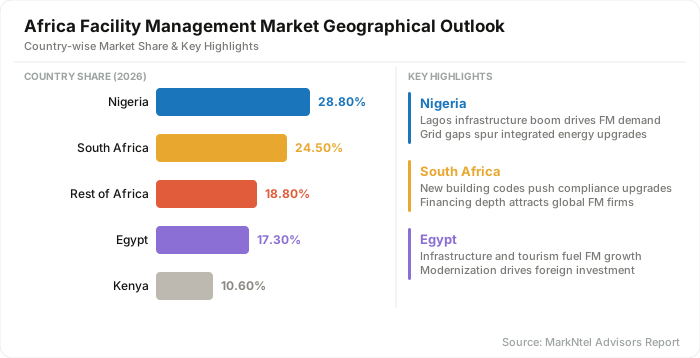
- Nigeria is expected to dominate the industry, accounting for approximately 28.80 % market share in 2026.
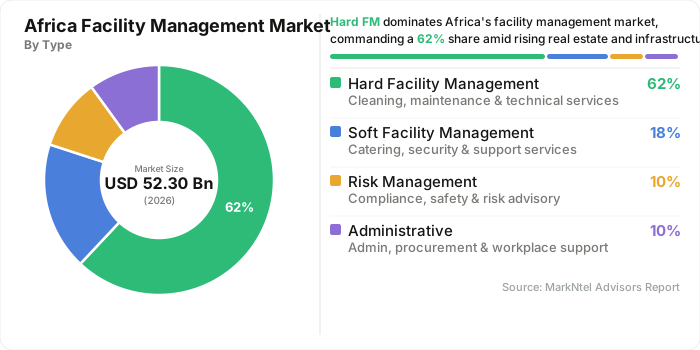
- By type, hard facility management is anticipated to hold nearly 62% of the industry share in 2026.
- By operating model, the outsourced segment is projected to account for approximately 68% of the industry in 2026.
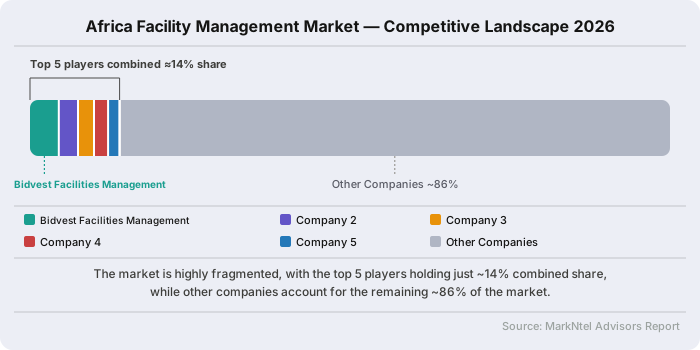
- The industry is highly fragmented, with top five players collectively account for approximately 14 % combined market share.
Africa Facility Management Market Size and Outlook
The facility management industry in Africa is estimated to grow at a CAGR of around 13.16% during the forecast period, i.e., 2026–2032, supported by expanding commercial and institutional real estate, rising outsourcing of building operations, growing industrial and logistics infrastructure, and increasing adoption of technology-enabled maintenance solutions across emerging African economies. Facility management providers continue to gain traction as organizations prioritize operational efficiency, regulatory compliance, and asset lifecycle management over in-house maintenance models.
According to the World Bank's Africa Economic Update, growth in Sub-Saharan Africa is projected to hold at 4.1% in 2026, matching the pace of 2025, while the region's working-age population is expected to expand by more than 620 million people between 2025 and 2050 the fastest and largest demographic shift of any developing region. This sustained economic and demographic expansion is accelerating construction of commercial offices, industrial facilities, and institutional buildings that require continuous, professionally managed maintenance and operations.
Government-led infrastructure and energy access programs are further strengthening long-term market expansion. The World Bank's Mission 300 initiative aims to connect 300 million people across Africa to reliable, affordable, and sustainable electricity by 2030, driving parallel investment in building-level power systems, energy management infrastructure, and technical maintenance capacity across commercial and public facilities. Simultaneously, national governments are advancing regulatory reforms and public-private partnerships to modernize urban infrastructure, further supporting demand for integrated facility management services.
Going forward, expanding urbanization, infrastructure investment, and institutional demand for outsourced building operations are expected to strengthen long-term facility management demand across Africa, supporting growth of the Africa FM industry from USD 52.3 billion in 2026 to USD 109.8 billion by 2032.
Africa Facility Management Market Key Indicators
- Africa continues to face a major electricity access gap, with over 560 million people in Sub-Saharan Africa lacking access to electricity (UN, 2026). This structural deficit is increasing reliance on facility-level power systems such as diesel generators, hybrid energy systems, UPS networks, and building energy management solutions in commercial and institutional infrastructure. Facility managers are increasingly required to ensure uninterrupted power supply for hospitals, airports, data centers, and commercial buildings through energy optimization and backup infrastructure management. This directly expands demand for energy management, HVAC efficiency systems, and technical maintenance services within FM contracts. Strengthens demand for energy-focused hard facility management and resilience-based building operations.
- Africa added over 11.3 GW of renewable energy capacity in 2025 (IRENA), led by solar and distributed energy systems across South Africa, Egypt, and Ethiopia. This expansion is reshaping facility operations, particularly in commercial buildings and industrial zones integrating solar PV, battery storage, and hybrid energy systems. Facility management providers are increasingly responsible for managing distributed energy assets, optimizing load balancing, and ensuring integration with building management systems (BMS).Expands FM scope toward energy optimization, hybrid power management, and sustainability-driven facility operations.
- Africa’s logistics and trade infrastructure is expanding significantly, with ports such as Tanger Med handling over 11 million TEUs in 2025 (Reuters) and Mombasa Port exceeding 2 million TEUs (Kenya Ports Authority, 2025). This growth is driving demand for facility management across warehouses, logistics parks, cold storage facilities, and industrial real estate. These assets require continuous maintenance of mechanical systems, security, energy efficiency, and operational uptime. Drives strong demand for industrial and logistics-focused facility management services.
- Africa’s data center capacity remains under 1% of global capacity, with most infrastructure concentrated in fewer than 10 cities (industry estimates supported by regional infrastructure reporting, 2026). This scarcity is driving rapid development of hyperscale and edge data centers in hubs such as Johannesburg, Nairobi, and Lagos. These facilities require highly specialized FM services, including precision cooling, 24/7 monitoring, and predictive maintenance systems. Expands high-value technical FM demand in mission-critical infrastructure environments.
- African governments are investing heavily in urban transport corridors and smart infrastructure systems under AfDB-supported urban development programs. With urban infrastructure investment needs estimated at USD 320 billion+ (OECD/AfDB analysis), cities are expanding roads, bridges, lighting systems, and public infrastructure networks. These assets require ongoing maintenance, street lighting management, and integrated municipal facility services. Increases demand for municipal and public infrastructure facility management services.
Africa Facility Management Market Scope
| Category | Segments |
|---|---|
| By Type | Hard, Soft, Risk, Administrative |
| By Operating Model | In-house, Outsourced |
| By Service Delivery | Integrated, Bundled, Single Service |
| By Enterprise Size | Large, Mid-Size, Small |
| By End User | Commercial, Residential, Government, Retail, Education, Healthcare, Hospitality, Others |
Africa Facility Management Market Growth Drivers
Rapid Urbanization and Expansion of Built Infrastructure Driving Facility Management Demand
Rapid urbanization across Africa is one of the most significant growth drivers of the facility management market. According to the United Nations – World Urbanization Prospects, Africa’s urban population is expected to rise sharply, reaching more than 1.5 billion by 2050, representing one of the fastest urban growth rates globally. This expansion is driving large-scale development of commercial offices, residential complexes, airports, hospitals, educational institutions, and industrial parks, all of which require continuous facility management services to ensure operational efficiency, safety, and compliance.
The sustained infrastructure pipeline is increasing demand for both hard and soft facility management services, including maintenance of HVAC systems, electrical networks, building automation systems, cleaning, security, and energy management. Additionally, government-led urban development programs and rising private sector investments in real estate are accelerating outsourcing of integrated facility management services to specialized providers. As cities expand and infrastructure becomes more complex, facility management is evolving into a critical operational requirement supporting long-term asset performance and sustainability.
Recent Trends
Digital Public Infrastructure and Smart City Programs Accelerating Digital Facility Management Adoption
Governments across Africa are expanding digital public infrastructure and smart city programs, significantly increasing demand for technology-enabled facility management services. The African Development Bank’s Africa Information Highway (AIH) connects 54 African countries and 16 regional organizations, enabling broader access to real-time infrastructure and urban datasets that support planning and asset monitoring. In parallel, the African Union’s Digital Transformation Strategy for Africa (2020–2030) is driving digitization of public services, including building operations, municipal asset records, and infrastructure governance systems. These frameworks are enabling the adoption of computerized facility management systems and digital maintenance workflows.
The shift is further reinforced by increasing deployment of smart city and intelligent infrastructure initiatives across African economies. For instance, South Africa’s Smart City programs in Johannesburg and Cape Town are integrating IoT-based infrastructure monitoring and digital municipal service platforms, improving building efficiency and urban asset management. Similarly, Kenya’s Konza Technopolis (under development) is designed as a fully digital smart city incorporating smart utilities, automated infrastructure management, and technology-driven facility operations. These initiatives demonstrate how African governments are embedding digital infrastructure into urban planning, directly supporting the evolution of facility management toward predictive, data-driven operations.
Africa Facility Management Market Opportunities and Challenges
Skills Shortage Challenge Paves the Way for Specialized, Outsourced Facility Management Opportunities
A key challenge facing the Africa facility management market is a persistent shortage of skilled technical labor. The International Labour Organization's Lifelong Learning and Skills for the Future: Insights for Africa brief highlights those access gaps and shifting skills demand remain central constraints on building resilient, inclusive labour systems across the continent, directly affecting trades relevant to building operations, such as HVAC, electrical systems, and building automation. This shortage limits the ability of in-house teams to maintain increasingly complex, technology-enabled buildings, raises labor costs, and slows service standardization for providers scaling across multiple African markets.
This constraint, however, is generating a corresponding opportunity. As internal maintenance capabilities fall short, organizations are increasingly compelled to outsource technical operations to specialized facility management providers with access to trained, multi-skilled workforces and structured training pipelines. This dynamic is reinforced by the growing complexity of building requirements: the UN Environment Programme's Global Status Report for Buildings and Construction 2025–2026 reports that global building energy intensity has fallen by 8.5% and green building certifications have nearly tripled, citing Kenya among countries that have introduced updated building energy codes, alongside California, Japan, and Singapore.
Facility management providers that invest in workforce upskilling and energy-efficiency expertise are therefore positioned to capture rising demand for compliance-driven, technically specialized outsourced FM contracts. The labor-skills gap is accelerating outsourcing demand toward FM providers with strong technical training capabilities and green-building expertise.
Segmentation Insights
Hard Facility Management Holding Around 62% Market Share Remain the Largest Service Type Across Africa
Hard Facility Management accounts for an estimated 62% share of the Africa facility management market by type, driven by the rapid expansion of commercial buildings, industrial facilities, healthcare institutions, airports, educational campuses, and public infrastructure requiring continuous technical maintenance. The segment covers essential engineering services, including HVAC systems, electrical installations, plumbing apparatus, building management systems, energy management, fire protection systems, elevators, and road & street lighting.
According to the International Energy Agency's World Energy Outlook 2025, Africa's population is expanding at twice the global average rate, and under current policies, the continent's energy demand is projected to increase by more than 50% by 2040.The report further notes that solar power is expected to supply nearly 40% of new electricity capacity added across the continent over the next decade, with North Africa, Kenya, and Namibia emerging as key clean energy hubs. This accelerating, electricity-intensive growth trajectory is placing sustained pressure on commercial and institutional buildings to adopt reliable backup power, load management, and energy-efficient technical systems. These trends continue to reinforce the dominance of hard facility management across the African market. Based on type, the market has been segmented into:
- Hard
- Soft
- Risk
- Administrative
Outsourced Facility Management Holding Around 68% Market Share Would Remain the Preferred Operating Model Across Africa
Outsourced Facility Management accounts for an estimated 68% share of the Africa facility management market by operating model, driven by the increasing preference of organizations to contract specialized service providers for integrated building operations and maintenance. Large corporations, healthcare institutions, airports, educational campuses, financial organizations, industrial facilities, retail complexes, increasingly outsource facility management to improve operational efficiency, optimize maintenance costs, access technical expertise, and ensure compliance with health, safety, and environmental regulations. The outsourcing model also enables organizations to focus on core business functions while benefiting from standardized service delivery, advanced digital technologies, and long-term asset lifecycle management.
According to the United Nations, Africa's urban population is projected to exceed 1.5 billion by 2050, while the African Development Bank estimates that the continent requires USD 130–170 billion annually in infrastructure investment. The expansion of commercial real estate, industrial parks, healthcare facilities, airports, data centres, and mixed-use developments is significantly increasing demand for professional facility management services. Furthermore, the growing adoption of smart buildings, IoT-enabled asset monitoring, predictive maintenance, workplace management platforms, and ESG-driven operational strategies continues to accelerate outsourced FM contracts, reinforcing the segment's dominant position across the African market. Based on operating model, the market has been segmented into:
- In-house
- Outsourced
Africa Facility Management Market Geographical Analysis
Nigeria held an estimated 28.80% share of the facility management industry in Africa, making it the region's largest market. The country's leadership is supported by rapid urbanization, expanding commercial real estate, and rising investments in office complexes, retail centers, healthcare facilities, educational institutions, airports, and industrial infrastructure. Strong demand from the oil & gas, banking, telecommunications, and manufacturing sectors has accelerated the adoption of outsourced hard and soft facility management services. Growing construction activity in major cities such as Lagos and Abuja continues to generate long-term opportunities for integrated facility management providers.
Nigeria's dominance is further strengthened by increasing investments in transport infrastructure, logistics hubs, mixed-use developments, and smart commercial buildings that require advanced maintenance and operational support. The growing adoption of digital facility management platforms, IoT-enabled building monitoring systems, predictive maintenance, and energy management solutions is improving operational efficiency across large facilities. Furthermore, rising outsourcing by corporate enterprises and public institutions to reduce operating costs, ensure regulatory compliance, and improve asset performance, together with the presence of experienced domestic and international service providers, continues to reinforce Nigeria's leadership in the Africa Facility Management Market.
Africa Facility Management Market Competitive Analysis
The Africa facility management industry is highly fragmented, with leading companies including Bidvest Facilities Management, Tsebo Solutions Group, Servest Africa, G4S Africa, and Broll Property Group collectively accounting for an estimated 14% of the market. Competition is driven by integrated service offerings, regional expansion, digital FM solutions, technical expertise, and long-term outsourcing contracts across diverse end-use sectors.
Key Companies in the Africa Facility Management Market
- Bidvest Facilities Management
- Tsebo Solutions Group
- Servest Africa
- G4S Africa
- Broll Property Group
- Excellerate Services
- JLL
- Cushman & Wakefield
- Apleona GmbH
- EFS Facilities Management
- Alpha Mead Group
- Contrack Facilities Management S.A.E.
- Colliers
- Knight Frank
- Savills plc
Africa Facility Management Industry News and Recent Developments
April 2025: Tsebo Facilities Solutions Kenya Joined the Africa Facility Management Association
Tsebo Facilities Solutions Kenya became a corporate member of the Africa Facility Management Association (Africa FM), strengthening collaboration with regional industry stakeholders. The partnership supports the adoption of international facility management standards, knowledge sharing, professional certification, and continuous skills development throughout the African FM sector.
Impact Analysis: The partnership is expected to accelerate the standardization of facility management practices across Africa while encouraging greater adoption of integrated FM solutions. Enhanced collaboration between leading service providers and professional bodies will improve service quality, workforce competency, and operational consistency across the region.
September 2025: Africa Facility Management Association Launched an Online Directory of FM Professionals
The Africa Facility Management Association introduced an online directory connecting facility management professionals, consultants, researchers, and service providers across the continent. The platform enables organizations to identify qualified FM expertise more efficiently while promoting collaboration and professional networking throughout Africa.
Impact Analysis: The digital platform improves access to qualified facility management professionals, supporting faster recruitment and project delivery. Increased industry connectivity is expected to strengthen professional standards, facilitate knowledge exchange, and support the growing demand for outsourced facility management services across Africa.
November 2025: Africa FM Hosted the 5th Africa FM International Conference in Kigali
The Africa Facility Management Association organized its 5th Africa FM International Conference in Kigali, Rwanda, focusing on smart buildings, sustainability, digital transformation, ESG integration, and asset management. The event brought together facility managers, technology providers, government representatives, and property owners to discuss emerging trends shaping Africa's built environment.
Impact Analysis: The conference promotes the adoption of digital facility management technologies, smart building solutions, and sustainable operational practices. Increased collaboration among industry participants is expected to accelerate innovation, improve asset performance, and enhance operational efficiency across commercial and institutional facilities.
May 2026: IFMA Announced IFMA Global Africa 2026 Conference
The International Facility Management Association (IFMA) announced IFMA Global Africa 2026, scheduled to be held in Accra, Ghana, under the theme "Scaling Up: Technology, Talent and Transformation in Facilities Management for Developing Markets." The event highlights AI-enabled facility management, digital asset management, sustainability, and workforce development to address the evolving needs of Africa's built environment.
Impact Analysis: The conference is expected to accelerate the adoption of AI, IoT-enabled building management systems, and predictive maintenance technologies across Africa. Increased exposure to international best practices will strengthen digital transformation initiatives, improve operational efficiency, and support the modernization of integrated facility management services.
Frequently Asked Questions
- Market Segmentation
- Introduction
- Product Definition
- Research Process
- Assumptions
- Executive Summary
- Africa Facility Management Market Porter’s Five Forces Analysis
- Africa Facility Management Market Policies, Regulations, and Product Standards
- Africa Facility Management Market Trends & Developments
- Africa Facility Management Market Dynamics
- Growth Factors
- Challenges
- Africa Facility Management Market Hotspot & Opportunities
- Africa Facility Management Market Outlook, 2022-2032
- Market Segmentation & Outlook
- By Revenues (USD Million)
- Market Segmentation & Outlook
- By Type- Market Size & Forecast 2022-2032, USD Million
- Hard
- Soft
- Risk
- Administrative
- By Operating Model- Market Size & Forecast 2022-2032, USD Million
- In-house
- Outsourced
- By Service Delivery- Market Size & Forecast 2022-2032, USD Million
- Integrated
- Bundled
- Single Service
- By Enterprise Size- Market Size & Forecast 2022-2032, USD Million
- Large
- Mid-Size
- Small
- By End User- Market Size & Forecast 2022-2032, USD Million
- Commercial
- Residential
- Government
- Retail
- Education
- Healthcare
- Hospitality
- Others
- By Country
- Ethiopia
- South Africa
- Nigeria
- Kenya
- Egypt
- Morocco
- Algeria
- Ghana
- rest of Africa
- By Company
- Competition Characteristics
- Market Share & Analysis
- By Type- Market Size & Forecast 2022-2032, USD Million
- Market Segmentation & Outlook
- Ethiopia Facility Management Market Outlook, 2022-2032F
- Market Segmentation & Outlook
- By Revenues (USD Million)
- Market Segmentation & Outlook
- By Type- Market Size & Forecast 2022-2032, USD Million
- By Operating Model- Market Size & Forecast 2022-2032, USD Million
- By Service Delivery- Market Size & Forecast 2022-2032, USD Million
- By Enterprise Size- Market Size & Forecast 2022-2032, USD Million
- By End User- Market Size & Forecast 2022-2032, USD Million
- Market Segmentation & Outlook
- South Africa Facility Management Market Outlook, 2022-2032F
- Market Segmentation & Outlook
- By Revenues (USD Million)
- Market Segmentation & Outlook
- By Type- Market Size & Forecast 2022-2032, USD Million
- By Operating Model- Market Size & Forecast 2022-2032, USD Million
- By Service Delivery- Market Size & Forecast 2022-2032, USD Million
- By Enterprise Size- Market Size & Forecast 2022-2032, USD Million
- By End User- Market Size & Forecast 2022-2032, USD Million
- Market Segmentation & Outlook
- Nigeria Facility Management Market Outlook, 2022-2032F
- Market Segmentation & Outlook
- By Revenues (USD Million)
- Market Segmentation & Outlook
- By Type- Market Size & Forecast 2022-2032, USD Million
- By Operating Model- Market Size & Forecast 2022-2032, USD Million
- By Service Delivery- Market Size & Forecast 2022-2032, USD Million
- By Enterprise Size- Market Size & Forecast 2022-2032, USD Million
- By End User- Market Size & Forecast 2022-2032, USD Million
- Market Segmentation & Outlook
- Kenya Facility Management Market Outlook, 2022-2032F
- Market Segmentation & Outlook
- By Revenues (USD Million)
- Market Segmentation & Outlook
- By Type- Market Size & Forecast 2022-2032, USD Million
- By Operating Model- Market Size & Forecast 2022-2032, USD Million
- By Service Delivery- Market Size & Forecast 2022-2032, USD Million
- By Enterprise Size- Market Size & Forecast 2022-2032, USD Million
- By End User- Market Size & Forecast 2022-2032, USD Million
- Market Segmentation & Outlook
- Egypt Facility Management Market Outlook, 2022-2032F
- Market Segmentation & Outlook
- By Revenues (USD Million)
- Market Segmentation & Outlook
- By Type- Market Size & Forecast 2022-2032, USD Million
- By Operating Model- Market Size & Forecast 2022-2032, USD Million
- By Service Delivery- Market Size & Forecast 2022-2032, USD Million
- By Enterprise Size- Market Size & Forecast 2022-2032, USD Million
- By End User- Market Size & Forecast 2022-2032, USD Million
- Market Segmentation & Outlook
- Morocco Facility Management Market Outlook, 2022-2032F
- Market Segmentation & Outlook
- By Revenues (USD Million)
- Market Segmentation & Outlook
- By Type- Market Size & Forecast 2022-2032, USD Million
- By Operating Model- Market Size & Forecast 2022-2032, USD Million
- By Service Delivery- Market Size & Forecast 2022-2032, USD Million
- By Enterprise Size- Market Size & Forecast 2022-2032, USD Million
- By End User- Market Size & Forecast 2022-2032, USD Million
- Market Segmentation & Outlook
- Algeria Facility Management Market Outlook, 2022-2032F
- Market Segmentation & Outlook
- By Revenues (USD Million)
- Market Segmentation & Outlook
- By Type- Market Size & Forecast 2022-2032, USD Million
- By Operating Model- Market Size & Forecast 2022-2032, USD Million
- By Service Delivery- Market Size & Forecast 2022-2032, USD Million
- By Enterprise Size- Market Size & Forecast 2022-2032, USD Million
- By End User- Market Size & Forecast 2022-2032, USD Million
- Market Segmentation & Outlook
- Ghana Facility Management Market Outlook, 2022-2032F
- Market Segmentation & Outlook
- By Revenues (USD Million)
- Market Segmentation & Outlook
- By Type- Market Size & Forecast 2022-2032, USD Million
- By Operating Model- Market Size & Forecast 2022-2032, USD Million
- By Service Delivery- Market Size & Forecast 2022-2032, USD Million
- By Enterprise Size- Market Size & Forecast 2022-2032, USD Million
- By End User- Market Size & Forecast 2022-2032, USD Million
- Market Segmentation & Outlook
- Africa Facility Management Market Key Strategic Imperatives for Success & Growth
- Competitive Outlook
- Company Profiles
- Bidvest Facilities Management
- Business Description
- Product Portfolio
- Collaborations & Alliances
- Recent Developments
- Financial Details
- Others
- Tsebo Solutions Group
- Business Description
- Product Portfolio
- Collaborations & Alliances
- Recent Developments
- Financial Details
- Others
- Servest Africa
- Business Description
- Product Portfolio
- Collaborations & Alliances
- Recent Developments
- Financial Details
- Others
- G4S Africa
- Business Description
- Product Portfolio
- Collaborations & Alliances
- Recent Developments
- Financial Details
- Others
- Broll Property Group
- Business Description
- Product Portfolio
- Collaborations & Alliances
- Recent Developments
- Financial Details
- Others
- Excellerate Services
- Business Description
- Product Portfolio
- Collaborations & Alliances
- Recent Developments
- Financial Details
- Others
- JLL
- Business Description
- Product Portfolio
- Collaborations & Alliances
- Recent Developments
- Financial Details
- Others
- Cushman & Wakefield
- Business Description
- Product Portfolio
- Collaborations & Alliances
- Recent Developments
- Financial Details
- Others
- Apleona GmbH
- Business Description
- Product Portfolio
- Collaborations & Alliances
- Recent Developments
- Financial Details
- Others
- EFS Facilities Management
- Business Description
- Product Portfolio
- Collaborations & Alliances
- Recent Developments
- Financial Details
- Others
- Alpha Mead Group
- Business Description
- Product Portfolio
- Collaborations & Alliances
- Recent Developments
- Financial Details
- Others
- Contrack Facilities Management S.A.E.
- Business Description
- Product Portfolio
- Collaborations & Alliances
- Recent Developments
- Financial Details
- Others
- Colliers
- Business Description
- Product Portfolio
- Collaborations & Alliances
- Recent Developments
- Financial Details
- Others
- Knight Frank
- Business Description
- Product Portfolio
- Collaborations & Alliances
- Recent Developments
- Financial Details
- Others
- Others
- Bidvest Facilities Management
- Company Profiles
- Disclaimer
MarkNtel Advisors follows a robust and iterative research methodology designed to ensure maximum accuracy and minimize deviation in market estimates and forecasts. Our approach combines both bottom-up and top-down techniques to effectively segment and quantify various aspects of the market. A consistent feature across all our research reports is data triangulation, which examines the market from three distinct perspectives to validate findings. Key components of our research process include:
1. Scope & Research Design At the outset, MarkNtel Advisors define the research objectives and formulate pertinent questions. This phase involves determining the type of research—qualitative or quantitative—and designing a methodology that outlines data collection methods, target demographics, and analytical tools. They also establish timelines and budgets to ensure the research aligns with client goals.
2. Sample Selection and Data Collection In this stage, the firm identifies the target audience and determines the appropriate sample size to ensure representativeness. They employ various sampling methods, such as random or stratified sampling, based on the research objectives. Data collection is carried out using tools like surveys, interviews, and observations, ensuring the gathered data is reliable and relevant.
3. Data Analysis and Validation Once data is collected, MarkNtel Advisors undertake a rigorous analysis process. This includes cleaning the data to remove inconsistencies, employing statistical software for quantitative analysis, and thematic analysis for qualitative data. Validation steps are taken to ensure the accuracy and reliability of the findings, minimizing biases and errors.

4. Data Forecast and FinalizationThe final phase involves forecasting future market trends based on the analyzed data. MarkNtel Advisors utilize predictive modeling and time series analysis to anticipate market behaviors. The insights are then compiled into comprehensive reports, featuring visual aids like charts and graphs, and include strategic recommendations to inform client decision-making
We offer flexible licensing options to cater to varying organizational needs. Choose the pricing pack that best suits your requirements:
Buy Now Inquire Before Buying
 Request Customization
 Talk to our Consultant







