

GCC Facility Management Market Research Report Forecast: (2026-2032)
By Type (Hard (District Cooling, Building Management, Plumbing Apparatus, Pumps & Sanitary Units, Electrical Installation, Energy Management, Air Conditioning System, Road & Street ... Lighting System, Others (Fire Safety Services, Security Systems Services, etc.)), Soft (Cleaning Services, Catering, Pest Control, Landscaping, Others (Concierge Services, Health & Safety Services, etc.)), Risk (Insurance Management, Security, Disaster Management, Reserve/Sinking Fund, Others (Legal & Liability, Supply Chain Risk, etc.)), Administrative (Mail Management, Front Office Management, Space & Planning Management, Inventory Management, Others (Procurement & Vendor Management, Contract Management, etc.))), By Operating Model (In-house, Outsourced), By Service Delivery (Integrated, Bundled, Single Service), By Enterprise Size (Large, Mid-Size, Small), By End User (Commercial, Residential, Government, Retail, Education, Healthcare, Hospitality, Others (Transportation, Utilities & Energy, etc.)), and others Read more
- Buildings, Construction, Metals & Mining
- Aug 2026
- Pages 240
- Report Format: PDF, Excel, PPT
GCC Facility Management Market
Projected 6.61% CAGR from 2026 to 2032
Study Period
2026-2032
Market Size (2026)
USD 62.6 Billion
Market Size (2032)
USD 91.9 Billion
Base Year
2025
Projected CAGR
6.61%
Leading Segments
By Type: Hard
GCC Facility Management Market Key Takeaways
- The GCC facility management market is valued at USD 55.2 billion in 2025 and is projected to reach USD 62.6 billion in 2026 and USD 91.9 billion by 2032.
- The industry is projected to witness steady growth at a CAGR of61% during 2026-32.
- Saudi Arabia leads geographically with an estimated 45% share in 2026.
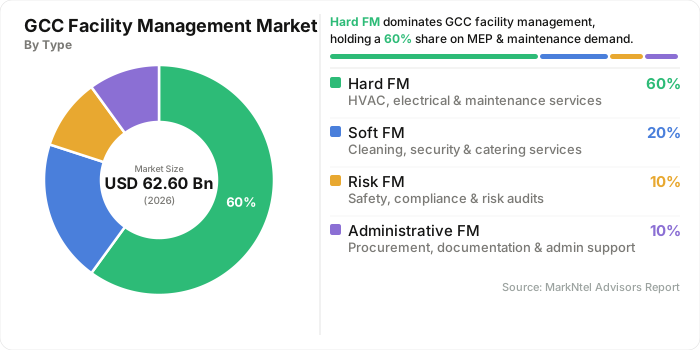
- Hard facility management dominates by type with approximately 60% share in 2026.
- Outsourced facility management accounts for an estimated 70% share in 2026.
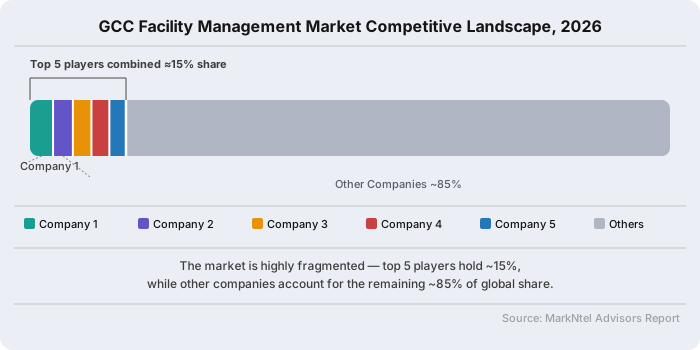
- The industry remains highly fragmented, collectively estimated at approximately 15%, leaving substantial room for regional competitors overall.
GCC Facility Management Market Size and Outlook
The facility management market in the GCC is valued at USD 55.2 billion in 2025 and is projected to reach USD 62.6 billion in 2026 and USD 91.9 billion by 2032, registering a 6.61% CAGR during 2026–2032. Market growth is increasingly supported by government spending on the development, operation, and maintenance of public infrastructure, which creates recurring demand for facility management services beyond the construction phase. For instance, the UAE’s 2025 federal budget allocated USD 476 million to public services, including USD 327 million for infrastructure investments aimed at developing, upgrading, and maintaining government facilities and public services. The continued allocation of public funds toward government infrastructure is expected to increase the requirement for recurring building operations, preventive maintenance, cleaning, security, and asset-support services, thereby supporting the expansion of the GCC FM industry.
GCC Facility Management Market Key Indicators
- GCC construction activity remains a major indicator for the expansion of the facility management addressable asset base. In 2025, the UAE recorded US$328.7 billion in construction contract awards between 2020 and August 2025, while construction accounted for 62% of the UAE's future project pipeline. UAE construction output also reached a record US$107.2 billion in 2024 and is projected to reach US$130.8 billion by 2029. The continued addition of commercial buildings, residential communities, mixed-use developments, and infrastructure assets creates a larger installed base requiring cleaning, technical maintenance, security, energy management, and asset management services, thereby supporting GCC facility management demand.
- The GCC's tourism and hospitality infrastructure is expanding the volume of facilities requiring continuous outsourced and integrated management services. GCC-Stat reported more than 11,200 hotel establishments and approximately 711,500 hotel rooms in 2024, with hotel establishments increasing 1.3% year-on-year. The expansion of hotels, resorts, serviced residences, and tourism destinations increases demand for HVAC maintenance, MEP services, housekeeping, waste management, landscaping, security, and energy-efficiency solutions, directly strengthening the facility management opportunity across the GCC.
- Growth in GCC office infrastructure is creating demand for increasingly sophisticated facility management services. Riyadh's Grade-A office buildings recorded an average 98% occupancy rate in 2025, while total office stock across Riyadh, Jeddah, and the Dammam Metropolitan Area is projected to increase from 9.7 million sq. m. in 2025 to 15 million sq. m. by 2028. Riyadh alone is expected to exceed 10 million sq. m. of office stock by 2027, representing a 60% increase in supply. Such rapid expansion, combined with high occupancy, increases the need for preventive maintenance, workplace management, building automation, energy optimization, security, and other integrated facility services.
- Airport passenger growth is increasing the operational intensity of transportation facilities and consequently the requirement for specialized facility management. Saudi Arabia's airports handled 140.9 million passengers in 2025, representing a 9.6% year-on-year increase, while aircraft movements reached approximately 980,400, up 8.3%. Dubai International Airport separately handled a record 95.2 million passengers in 2025, up 3.1% year-on-year, while annual flight movements reached 454,800. Higher passenger volumes and aircraft movements require more frequent cleaning, HVAC servicing, security, baggage-area maintenance, electrical and mechanical maintenance, and emergency-response services, supporting demand for specialized facility management across GCC airports.
- The rapid expansion of healthcare infrastructure is increasing the number of highly regulated facilities requiring specialized facility management. Across the GCC, the number of hospitals reached approximately 882 by the end of 2024, an increase of 176 hospitals between 2014 and 2024, while total hospital beds reached approximately 127,600. In addition, GCC governments operated around 3,400 health centers and complexes in 2023. The expansion of hospitals and healthcare facilities creates recurring demand for critical-environment maintenance, HVAC and air-quality management, medical waste handling, infection-control support, electrical systems maintenance, cleaning, and other specialized facility services.
- The GCC's data center expansion is creating a high-value segment for technically specialized facility management services. Saudi Arabia's data-center market had approximately 222 MW of IT power capacity in Q1 2025, with an additional 760 MW planned by 2030, implying potential capacity expansion of more than three times the existing base. JLL also reported that 1.4 GW of data-center capacity was under construction in Riyadh, with a further 5.2 GW planned. Data centers require continuous cooling, power-management, backup systems, fire protection, monitoring, and preventive maintenance, making their expansion particularly significant for high-value technical facility management and integrated facilities management contracts.
- Expansion of GCC retail and mixed-use destinations is also increasing the volume of high-footfall facilities requiring continuous operational support. In Saudi Arabia, consumer spending reached USD 376 billion in 2024, increasing 7% year-on-year, while more than 3.4 million sq. m. of new retail space is scheduled for completion by 2028. Cenomi Centers alone recorded 126.8 million mall visitors in FY2025, up 4.4% year-on-year, with portfolio occupancy reaching 94.2%. Higher retail footfall and expanding mall space increase requirements for cleaning, security, HVAC, elevators, parking management, landscaping, waste management, and energy optimization, thereby supporting facility management demand across GCC commercial properties.
GCC Facility Management Scope
| Category | Segments |
|---|---|
| By Type | Hard (District Cooling, Building Management, Plumbing Apparatus, Pumps & Sanitary Units, Electrical Installation, Energy Management, Air Conditioning System, Road & Street Lighting System, Others (Fire Safety Services, Security Systems Services, etc.)), Soft (Cleaning Services, Catering, Pest Control, Landscaping, Others (Concierge Services, Health & Safety Services, etc.)), Risk (Insurance Management, Security, Disaster Management, Reserve/Sinking Fund, Others (Legal & Liability, Supply Chain Risk, etc.)), Administrative (Mail Management, Front Office Management, Space & Planning Management, Inventory Management, Others (Procurement & Vendor Management, Contract Management, etc. |
| By Operating Model | In-house, Outsourced |
| By Service Delivery | Integrated, Bundled, Single Service |
| By Enterprise Size | Large, Mid-Size, Small |
| By End User | Commercial, Residential, Government, Retail, Education, Healthcare, Hospitality, Others (Transportation, Utilities & Energy, etc. |
GCC Facility Management Market Growth Drivers
Rapid Expansion of Non-Oil Economic Activity Strengthening Demand for Facility Management
Economic diversification is increasing the GCC facility management industry addressable customer base by expanding the number of operational industrial, logistics, commercial, tourism, and business assets requiring continuous maintenance and support services. Saudi Arabia’s non-oil economy expanded by 4.9% in 2025, demonstrating sustained activity beyond hydrocarbons. At the same time, the Kingdom recorded 12,946 industrial facilities, creating a substantially larger installed base for electrical, HVAC, mechanical, cleaning, safety, and asset-management services.
The National Industrial Development and Logistics Program reported that industrial and mining investments reached approximately USD 426.7 billion by 2025, supporting continued development of factories and associated infrastructure. This expansion directly benefits FM providers because newly operational facilities require recurring services after construction completion, while industrial assets demand specialized technical maintenance and safety management. Consequently, diversification is shifting FM demand from traditional commercial properties toward a broader portfolio of operational assets, supporting sustained outsourcing and integrated-service requirements across the GCC.
Recent Trends
IoT-Enabled Predictive Maintenance Gains Momentum as GCC FM Shifts Toward Real-Time Asset Monitoring
IoT-enabled predictive maintenance is emerging as a key technology trend in the GCC facility management market, as connected sensors allow FM operators to continuously monitor equipment condition, detect anomalies, and schedule maintenance before failures occur. A 2025 PwC and Saudi Facility Management Association report identifies IoT, AI, and predictive analytics among the technologies transforming FM operations, particularly through real-time monitoring of equipment functionality, occupancy, and energy consumption.
A strong 2025 GCC-specific development was the launch of ENGIE Solutions' Smart O&M platform, which combines AI, IoT, detection and diagnostics, and predictive-maintenance algorithms for facility operations. ENGIE reported that its UAE integrated FM operations helped avoid more than 10,500 tonnes of CO₂ emissions and were targeting 15,000 tonnes in 2025, demonstrating the measurable sustainability potential of digitally managed operations. Separately, Saudi Arabia's Two Holy Mosques Smart Engineering Command and Control Center uses IoT, 5G and LoRaWAN alongside AI and automated early-warning systems for real-time facility monitoring.
GCC Facility Management Market Opportunities and Challenges
Extreme Climate Conditions Increasing Cooling-System Loads, Creating Demand for Specialized HVAC FM Services
Extreme heat across the GCC increases operating pressure on cooling infrastructure, making HVAC reliability and maintenance a recurring requirement for facility operators. Dubai recorded a 5.11% increase in electricity demand during 2025, while DEWA reported that cooling-services revenue increased 4.9%, reflecting continued demand for cooling infrastructure. The pressure is particularly relevant to FM providers responsible for maintaining chillers, air-conditioning systems, pumps, controls, and associated equipment, where sustained utilization increases the importance of preventive servicing and operational readiness.
The same conditions are creating a commercial opportunity for FM companies to expand into specialized cooling-plant maintenance, HVAC optimization, equipment servicing, and district-cooling support. During H1 2025, Empowers district-cooling consumption increased 7.1% year-on-year, while the company signed 86 new contracts covering more than 99,000 refrigeration tons. By the end of 2025, Empower operated 90 district-cooling plants and more than 430 km of distribution networks, creating a substantial installed infrastructure base requiring continuous technical operation and maintenance. These developments expand the addressable market for FM providers with specialized cooling expertise.
Segmentation Insights
Hard Facility Management to Account for an Estimated 60% Share Through Technical Infrastructure and Asset-Care Requirements
Hard facility management is estimated to account for approximately 60% of the GCC facility management industry in 2026, supported by the growing technical complexity of commercial, industrial, government, and infrastructure assets. Demand is concentrated across HVAC, electrical systems, plumbing, MEP, fire protection, chillers, building management, and other critical infrastructure requiring continuous maintenance and operational reliability. A relevant 2025 development was QatarEnergy’s tender for hard FM services at its headquarters, which carried an approximately USD 961,000 bid bond.
The tender covered MEP, HVAC, civil systems, fire protection, chillers, generators, UPS, security systems, and lifts and escalators, illustrating the extensive technical requirements associated with managing large GCC facilities. QatarEnergy also specified maintenance and operational support for multiple critical building systems, reinforcing the importance of specialized engineering capabilities. The continued expansion of energy, infrastructure, commercial, and institutional facilities across the GCC is expected to sustain demand for preventive maintenance, asset reliability, energy efficiency, and lifecycle management services. Based on type, the market is segmented into:
- Hard
- Soft
- Risk
- Administrative
Outsourced Facility Management to Represent an Estimated 70% Share as Asset Owners Prioritize Specialized Service Providers
Outsourced facility management is estimated to account for approximately 70% of the GCC facility management market in 2026, supported by the increasing preference of asset owners for specialist operators with established technical expertise, trained workforces, and scalable service capabilities. Outsourcing enables large property owners and institutions to transfer day-to-day facility operations to dedicated providers while maintaining contractual control over service quality and performance.
The trend was reinforced in December 2025, when Saudi Arabia’s Public Investment Fund announced an agreement for JLL to acquire a significant stake in FMTECH, with PIF retaining majority ownership. FMTECH, established in 2023, provides integrated FM services to PIF portfolio companies and public and private-sector clients in Saudi Arabia. The agreement also involves integrating JLL’s digital FM platforms and operating systems, highlighting the growing role of technology-enabled service delivery within outsourced contracts. The development demonstrates how strategic partnerships are strengthening specialist FM capabilities while supporting more standardized, transparent, and data-driven facility operations. Based on the Operating model, the market is further bifurcated into:
- Outsourced
- In–house
Saudi Arabia Leads GCC Facility Management Market with 45% Share
Saudi Arabia is expected to remain the largest geographical market in the GCC facility management sector. Its dominance is supported by large-scale infrastructure, real estate, tourism, and urban development under Vision 2030. Construction and real estate activities contributed 13.8% of Saudi Arabia’s GDP through Q2 2025, demonstrating the substantial built-asset base requiring ongoing maintenance and operational services.
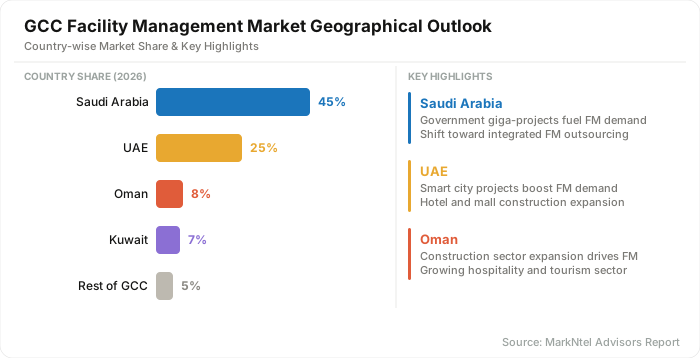
The Kingdom’s real-estate project pipeline for 2025–2030 is estimated at USD 554 billion, creating significant demand for technical maintenance, cleaning, security, energy management, and integrated FM services. Additionally, more than USD 933 billion of giga-projects were valued in 2024, further expanding the addressable facilities base.
GCC Facility Management Market Competitive Analysis
The GCC facility management market is highly fragmented, with the top five companies EFS Facilities Services Group, Emrill Services LLC, Farnek Services LLC, Imdaad L.L.C., and Khidmah LLC collectively estimated to account for approximately 15% of the market
Key Companies in the GCC Facility Management Market
- EFS Facilities Services Group
- Emrill Services LLC
- Farnek Services LLC
- Imdaad L.L.C.
- Enova Integrated Facilities Management
- Khidmah LLC
- Musanadah Facilities Management Company
- Al Shirawi Facilities Management LLC
- Al-Futtaim Engineering & Technologies
- Transguard Group LLC
- Cofely Besix Facility Management
- MAB Facilities Management LLC
- e& Facilities Management (eFM)
- ENGIE Solutions Middle East
- Serveu Facilities Management
GCC Facility Management Industry News and Recent Developments
May 2026: HITEK AI Expands Saudi FM Proposition with ESG and Sustainability Solutions
HITEK AI expanded its Saudi Arabian service portfolio in 2026 by introducing sustainability and ESG consultancy capabilities alongside its digital optimization tools. The offering incorporates solutions for carbon reduction, ESG strategy, waste and resource optimization, and ESG reporting. HITEK AI combines consultancy with digital tools designed to generate measurable sustainability outcomes for organizations operating in Saudi Arabia.
Impact Analysis: This development is significant for GCC FM because sustainability is becoming increasingly integrated with building operations rather than treated as a separate consulting function. FM providers can increasingly combine maintenance, energy optimization, resource management, carbon monitoring, and ESG reporting within a single service proposition.
June 2026: Seder Group and ProFun Launch Integrated Operations Platform for Saudi Destinations
Saudi-based Seder Group and ProFun established SPOC, a new operating company designed to support Saudi Arabia's expanding entertainment, tourism, cultural, and sports destinations. The platform integrates operational planning, pre-opening readiness, workforce management, facilities management, technical services, security, compliance, technology integration, and venue operations. Seder contributes more than four decades of Saudi operations and FM experience and a workforce exceeding 28,000 employees.
Impact Analysis: The launch broadens the addressable FM market beyond traditional property portfolios into visitor attractions and large-scale destinations. It also reflects growing demand for lifecycle-based FM, where operators become involved from project preparation through long-term facility operations.
Frequently Asked Questions
- Market Segmentation
- Introduction
- Product Definition
- Research Process
- Assumptions
- Executive Summary
- GCC Facility Management Market Policies, Regulations, and Product Standards
- GCC Facility Management Market Trends & Developments
- GCC Facility Management Market Dynamics
- Growth Factors
- Challenges
- GCC Facility Management Market Hotspot & Opportunities
- GCC Facility Management Market Outlook, 2022-2032
- Market Size & Outlook
- By Revenues (USD Million)
- Market Segmentation & Outlook
- By Type- Market Size & Forecast 2022-2032, USD Million
- Hard
- District Cooling
- Building Management
- Plumbing Apparatus, Pumps & Sanitary Units
- Electrical Installation
- Energy Management
- Air Conditioning System
- Road & Street Lighting System
- Others (Fire Safety Services, Security Systems Services, etc.)
- Soft
- Cleaning Services
- Catering
- Pest Control
- Landscaping
- Others (Concierge Services, Health & Safety Services, etc.)
- Risk
- Insurance Management
- Security
- Disaster Management
- Reserve/Sinking Fund
- Others (Legal & Liability, Supply Chain Risk, etc.)
- Administrative
- Mail Management
- Front Office Management
- Space & Planning Management
- Inventory Management
- Others (Procurement & Vendor Management, Contract Management, etc.)
- Hard
- By Operating Model- Market Size & Forecast 2022-2032, USD Million
- In-house
- Outsourced
- By Service Delivery- Market Size & Forecast 2022-2032, USD Million
- Integrated
- Bundled
- Single Service
- By Enterprise Size- Market Size & Forecast 2022-2032, USD Million
- Large
- Mid-Size
- Small
- By End User- Market Size & Forecast 2022-2032, USD Million
- Commercial
- Residential
- Government
- Retail
- Education
- Healthcare
- Hospitality
- Others (Transportation, Utilities & Energy, etc.)
- By Country
- Saudi Arabia
- The UAE
- Qatar
- Oman
- Kuwait
- Bahrain
- By Company
- Competition Characteristics
- Market Share & Analysis
- By Type- Market Size & Forecast 2022-2032, USD Million
- Market Size & Outlook
- Saudi Arabia Facility Management Market Outlook, 2022-2032
- Market Size & Outlook
- By Revenues (USD Million)
- Market Segmentation & Outlook
- By Type- Market Size & Forecast 2022-2032, USD Million
- By Operating Model- Market Size & Forecast 2022-2032, USD Million
- By Service Delivery- Market Size & Forecast 2022-2032, USD Million
- By Enterprise Size- Market Size & Forecast 2022-2032, USD Million
- By End User- Market Size & Forecast 2022-2032, USD Million
- Market Size & Outlook
- The UAE Facility Management Market Outlook, 2022-2032
- Market Size & Outlook
- By Revenues (USD Million)
- Market Segmentation & Outlook
- By Type- Market Size & Forecast 2022-2032, USD Million
- By Operating Model- Market Size & Forecast 2022-2032, USD Million
- By Service Delivery- Market Size & Forecast 2022-2032, USD Million
- By Enterprise Size- Market Size & Forecast 2022-2032, USD Million
- By End User- Market Size & Forecast 2022-2032, USD Million
- Market Size & Outlook
- Qatar Facility Management Market Outlook, 2022-2032
- Market Size & Outlook
- By Revenues (USD Million)
- Market Segmentation & Outlook
- By Type- Market Size & Forecast 2022-2032, USD Million
- By Operating Model- Market Size & Forecast 2022-2032, USD Million
- By Service Delivery- Market Size & Forecast 2022-2032, USD Million
- By Enterprise Size- Market Size & Forecast 2022-2032, USD Million
- By End User- Market Size & Forecast 2022-2032, USD Million
- Market Size & Outlook
- Oman Facility Management Market Outlook, 2022-2032
- Market Size & Outlook
- By Revenues (USD Million)
- Market Segmentation & Outlook
- By Type- Market Size & Forecast 2022-2032, USD Million
- By Operating Model- Market Size & Forecast 2022-2032, USD Million
- By Service Delivery- Market Size & Forecast 2022-2032, USD Million
- By Enterprise Size- Market Size & Forecast 2022-2032, USD Million
- By End User- Market Size & Forecast 2022-2032, USD Million
- Market Size & Outlook
- Kuwait Facility Management Market Outlook, 2022-2032
- Market Size & Outlook
- By Revenues (USD Million)
- Market Segmentation & Outlook
- By Type- Market Size & Forecast 2022-2032, USD Million
- By Operating Model- Market Size & Forecast 2022-2032, USD Million
- By Service Delivery- Market Size & Forecast 2022-2032, USD Million
- By Enterprise Size- Market Size & Forecast 2022-2032, USD Million
- By End User- Market Size & Forecast 2022-2032, USD Million
- Market Size & Outlook
- Bahrain Facility Management Market Outlook, 2022-2032
- Market Size & Outlook
- By Revenues (USD Million)
- Market Segmentation & Outlook
- By Type- Market Size & Forecast 2022-2032, USD Million
- By Operating Model- Market Size & Forecast 2022-2032, USD Million
- By Service Delivery- Market Size & Forecast 2022-2032, USD Million
- By Enterprise Size- Market Size & Forecast 2022-2032, USD Million
- By End User- Market Size & Forecast 2022-2032, USD Million
- Market Size & Outlook
- GCC Facility Management Market Key Strategic Imperatives for Success & Growth
- Competitive Outlook
- Company Profiles
- EFS Facilities Services Group
- Business Description
- Product Portfolio
- Collaborations & Alliances
- Recent Developments
- Financial Details
- Others
- Emrill Services LLC
- Business Description
- Product Portfolio
- Collaborations & Alliances
- Recent Developments
- Financial Details
- Others
- Farnek Services LLC
- Business Description
- Product Portfolio
- Collaborations & Alliances
- Recent Developments
- Financial Details
- Others
- Imdaad L.L.C.
- Business Description
- Product Portfolio
- Collaborations & Alliances
- Recent Developments
- Financial Details
- Others
- Enova Integrated Facilities Management
- Business Description
- Product Portfolio
- Collaborations & Alliances
- Recent Developments
- Financial Details
- Others
- Khidmah LLC
- Business Description
- Product Portfolio
- Collaborations & Alliances
- Recent Developments
- Financial Details
- Others
- Musanadah Facilities Management Company
- Business Description
- Product Portfolio
- Collaborations & Alliances
- Recent Developments
- Financial Details
- Others
- Al Shirawi Facilities Management LLC
- Business Description
- Product Portfolio
- Collaborations & Alliances
- Recent Developments
- Financial Details
- Others
- Al-Futtaim Engineering & Technologies
- Business Description
- Product Portfolio
- Collaborations & Alliances
- Recent Developments
- Financial Details
- Others
- Transguard Group LLC
- Business Description
- Product Portfolio
- Collaborations & Alliances
- Recent Developments
- Financial Details
- Others
- Cofely Besix Facility Management
- Business Description
- Product Portfolio
- Collaborations & Alliances
- Recent Developments
- Financial Details
- Others
- MAB Facilities Management LLC
- Business Description
- Product Portfolio
- Collaborations & Alliances
- Recent Developments
- Financial Details
- Others
- e& Facilities Management (eFM)
- Business Description
- Product Portfolio
- Collaborations & Alliances
- Recent Developments
- Financial Details
- Others
- ENGIE Solutions Middle East
- Business Description
- Product Portfolio
- Collaborations & Alliances
- Recent Developments
- Financial Details
- Others
- Serveu Facilities Management
- Business Description
- Product Portfolio
- Collaborations & Alliances
- Recent Developments
- Financial Details
- Others
- Others
- EFS Facilities Services Group
- Company Profiles
- Disclaimer
MarkNtel Advisors follows a robust and iterative research methodology designed to ensure maximum accuracy and minimize deviation in market estimates and forecasts. Our approach combines both bottom-up and top-down techniques to effectively segment and quantify various aspects of the market. A consistent feature across all our research reports is data triangulation, which examines the market from three distinct perspectives to validate findings. Key components of our research process include:
1. Scope & Research Design At the outset, MarkNtel Advisors define the research objectives and formulate pertinent questions. This phase involves determining the type of research—qualitative or quantitative—and designing a methodology that outlines data collection methods, target demographics, and analytical tools. They also establish timelines and budgets to ensure the research aligns with client goals.
2. Sample Selection and Data Collection In this stage, the firm identifies the target audience and determines the appropriate sample size to ensure representativeness. They employ various sampling methods, such as random or stratified sampling, based on the research objectives. Data collection is carried out using tools like surveys, interviews, and observations, ensuring the gathered data is reliable and relevant.
3. Data Analysis and Validation Once data is collected, MarkNtel Advisors undertake a rigorous analysis process. This includes cleaning the data to remove inconsistencies, employing statistical software for quantitative analysis, and thematic analysis for qualitative data. Validation steps are taken to ensure the accuracy and reliability of the findings, minimizing biases and errors.

4. Data Forecast and FinalizationThe final phase involves forecasting future market trends based on the analyzed data. MarkNtel Advisors utilize predictive modeling and time series analysis to anticipate market behaviors. The insights are then compiled into comprehensive reports, featuring visual aids like charts and graphs, and include strategic recommendations to inform client decision-making
We offer flexible licensing options to cater to varying organizational needs. Choose the pricing pack that best suits your requirements:
Buy Now Inquire Before Buying
 Request Customization
 Talk to our Consultant







