

Latin America Edible Oil Market Research Report: Forecast (2026-2032)
Latin America Edible Oil Market - By Type (Industrial Oil, Linseed Oil, Castor Oil, Vegetable Oils, Canola Oil, Soybean Oil, Olive Oil, Sunflower Oil, Peanut Oil, Others), Animal-D ... erived Oils, Fish Oil, Others, Palm Oils, Palm Oil, Coconut Oil, Palm Kernel Oil), By Application (Food, Cooking and Frying, Baking, Salad Dressing and Marinades, Falvor Enhancement and Finishing Touches, Sauce and Condiments, Food Preservation), Non-Food Application (Industrial, Biodiesel, Fatty acids and alcohols, Lubricants, Solvents, Others, Animal Feed), By Extraction Method (Mechanical Extraction, Solvent Extraction, Enzymatic Extraction, Ultrasound Extraction, Aqueous Extraction), By Grade (Virgin, Extra Virgin, Cold Pressed, Organic, Refined, Others), By Packaging Type (Pouches, Jars, Cans, Bottles, Bulk containers), By Pack Size (Less than 1 Liters, 1 Liters - 5 liters, 5 Liters - 10 Liters, Above 10 Liters), By Distribution Channel (Supermarkets & Hypermarkets, Direct/Institutional Sales, Convenience Stores, Online, Others), and others Read more
- Food & Beverages
- Dec 2025
- Pages 168
- Report Format: PDF, Excel, PPT
Latin America Edible Oil Market
Projected 4.30% CAGR from 2026 to 2032
Study Period
2026-2032
Market Size (2025)
USD 18.14 Billion
Market Size (2032)
USD 24.36 Billion
Base Year
2025
Projected CAGR
4.30%
Leading Segments
By Type: Soybean Oil
Latin America Edible Oil Market Report Key Takeaways:
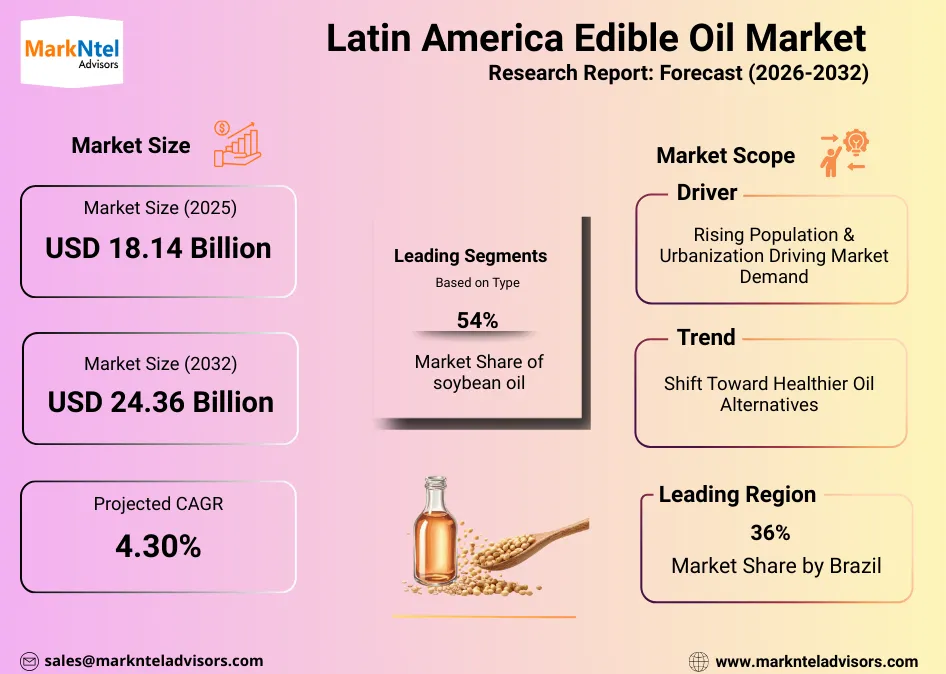
- The Latin America Edible Oil Market size is valued at around USD 18.14 billion in 2025 and is projected to reach USD 24.36 billion by 2032. The estimated CAGR from 2026 to 2032 is around 4.30%, indicating strong growth.
- By type, the soybean oil is the most preferred oil type, holding around 54% market share in 2025.
- By distribution channel, the Supermarkets & Hypermarkets represented 40% of the Latin America Edible Oil Market size in 2025.
- By country, Brazil leads the Latin America Edible Oil Market with a dominant 42% market share in 2025.
- The leading edible oil companies in Latin America are Cargill Incorporated, Bunge Limited, Archer Daniels Midland Company, Unilever Group, Alicorp, Associated British Foods Plc, Ragasa, Coamo Cooperativa Agroindustrial Ltda, Algar Agro, and others.
Market Insights & Analysis: Latin America Edible Oil Market (2026- 2032):
The Latin America Edible Oil Market size is valued at around USD 18.14 billion in 2025 and is projected to reach USD 24.36 billion by 2032. Along with this, the market is estimated to grow at a CAGR of around 4.30% during the forecast period, i.e., 2026-32.
The Latin America Edible Oil Market is experiencing rapid growth, driven primarily by rising population and accelerating urbanization, which are increasing demand for processed foods, foodservice consumption, and household cooking oils, alongside a clear shift toward healthier oils such as sunflower, canola, olive, avocado, and cold-pressed variants, supported by public-health policies, dietary guidelines, and growing consumer preference for unsaturated and premium oil alternatives.
Countries such as Brazil, with a population of about 213 million in 2025 and an urbanization rate of nearly 84%, concentrate consumption in major metropolitan hubs like São Paulo and Rio de Janeiro. These dense urban centers accelerate product demand cycles and enhance retail and foodservice distribution efficiency for edible oils.
On the supply front, capacity expansion is improving regional self-sufficiency. Bolivia’s state-owned soybean processing plant in San Julián is expected to produce around 60,000 tonnes of refined edible oil annually, enabling it to cover a large share of the country’s domestic demand. The facility aims to reduce reliance on imports, stabilize cooking oil prices, and strengthen national food security. Operated by the state, the project supports value addition within Bolivia’s agricultural sector and ensures the steady availability of soybean oil for households. Meanwhile, Argentina, Chile, and Uruguay are witnessing continued launches of extra virgin olive oil variants and premium packaging formats in 2025, reflecting sustained growth in higher-value oil consumption across domestic and export markets.
Looking ahead, large-scale institutional funding will further strengthen the sector. For instance, the CAF – Development Bank of Latin America and the Caribbean’s USD 8.5 billion commitment through 2030 to modernize agriculture will enhance oilseed productivity and processing infrastructure. Complementing this, investments such as Guatemala’s USD 20 million cold-chain and logistics expansion will improve food distribution efficiency, indirectly supporting edible oil supply networks.
Overall, rising urban demand, expanding domestic refining capacity, premium oil adoption, and sustained agri-infrastructure investments are collectively strengthening supply resilience and consumption growth, positioning the Latin America edible oil market for steady, long-term expansion.
Latin America Edible Oil Market Recent Developments:
-
June 2025: At Naturaltech 2025, Copra showcased innovative coconut-based products, including Coconut Butter Spray and Coconut Shoyu with 40% less sodium, alongside high-fiber coconut flour for low-carb diets. The brand also highlighted its Extra Virgin Coconut Oil for both culinary and certified cosmetic use, emphasizing natural, vegan formulations and broad applications in food and beauty.
- May 2025: Bunge broadened its Soya consumer oil range beyond soybean oil by adding sunflower, canola, and corn oil variants and introducing smaller pack sizes. These launches respond to rising consumer awareness around unsaturated fats and cholesterol management, while positioning the brand within the “better-for-you” everyday cooking segment.
Latin America Edible Oil Market Scope:
| Category | Segments |
|---|---|
| By Type | Industrial Oil, Linseed Oil, Castor Oil, Vegetable Oils, Canola Oil, Soybean Oil, Olive Oil, Sunflower Oil, Peanut Oil, Others), Animal-Derived Oils, Fish Oil, Others, Palm Oils, Palm Oil, Coconut Oil, Palm Kernel Oil), |
| By Application | Food, Cooking and Frying, Baking, Salad Dressing and Marinades, Falvor Enhancement and Finishing Touches, Sauce and Condiments, Food Preservation), Non-Food Application (Industrial, Biodiesel, Fatty acids and alcohols, Lubricants, Solvents, Others, Animal Feed), |
| By Extraction Method | Mechanical Extraction, Solvent Extraction, Enzymatic Extraction, Ultrasound Extraction, Aqueous Extraction), |
| By Grade | Virgin, Extra Virgin, Cold Pressed, Organic, Refined, Others), |
| By Packaging Type | Pouches, Jars, Cans, Bottles, Bulk containers), |
| By Pack Size | Less than 1 Liters, 1 Liters - 5 liters, 5 Liters - 10 Liters, Above 10 Liters), |
| By Distribution Channel | Supermarkets & Hypermarkets, Direct/Institutional Sales, Convenience Stores, Online, Others), and others |
Latin America Edible Oil Market Drivers:
Rising Population & Urbanization Driving Market Demand
Rapid population growth and accelerating urbanization across Latin America are acting as a core structural driver of the edible oil market. By 2025, Latin America and the Caribbean’s population is projected to be approximately 667.9 million, with an urbanization rate of about 85.5%, translating to nearly 571 million urban residents, significantly higher than the global average. This concentration of population in cities directly amplifies demand for edible oils.
Urban lifestyles are closely linked with higher consumption of processed, packaged, and foodservice meals, all of which rely heavily on edible oils such as soybean and sunflower oil for cooking, frying, and food preparation. Compared with rural households, urban consumers typically exhibit higher purchasing power and more frequent dining-out behavior, increasing per-capita edible oil usage through restaurants, quick-service chains, and ready-to-cook foods.
Beyond 2025, government-led investments in urban infrastructure, including food distribution networks, cold-chain logistics, wholesale markets, and modern retail expansion, are expected to further improve edible oil availability and penetration across rapidly growing cities. These developments will strengthen supply efficiency and support sustained consumption growth.
Expanding population size combined with deepening urbanization is reshaping dietary patterns and food consumption habits in Latin America, directly increasing edible oil usage and positioning this driver as a long-term catalyst for market growth.
Latin America Edible Oil Market Trends:
Shift Toward Healthier Oil Alternatives
A growing preference for healthier edible oils such as sunflower, canola, olive, avocado, and cold-pressed variants is a defining trend in the Latin American edible oil industry. This shift is being driven by rapid urbanization, rising health awareness, and stronger public-health policies promoting improved dietary fat intake.
The World Health Organization’s 2024 milestone report confirms that 53 countries had implemented best-practice policies to eliminate industrial trans fats by 2023, accelerating reformulation toward oils rich in unsaturated fats and away from partially hydrogenated products.
National dietary frameworks are reinforcing the shift toward healthier edible oils in Latin America. Brazil’s official Food Guide promotes natural or minimally processed foods and moderation in oil use, encouraging households to prefer higher-quality oils over mass-market alternatives. Supporting this, the FAO’s 2024 Statistical Yearbook notes rising consumption and trade of higher-value oils such as olive and avocado.
On the supply side, USDA Foreign Agricultural Service data shows Mexico’s avocado production is forecast to reach 2.75 million metric tons in 2025, improving raw material availability for avocado oil. Consumption trends further validate this shift, as olive oil use in Colombia nearly doubled from about 4 million litres in 2019 to 7.6 million liters in 2024.
Policy-led fat reformulation, official dietary guidance, rising production of specialty oil crops, and clear consumption growth are collectively shifting Latin America toward healthier edible oils, expanding premium segments, and reshaping long-term market growth.
Latin America Edible Oil Market Challenges:
Volatility in Raw Material Prices Impeding Market Growth
Volatility in oilseed and vegetable-oil feedstock prices remains a major challenge for the Latin America edible oil market, creating uncertainty across procurement, processing, and pricing. For instance, between 2023 and 2025, global vegetable oil prices were highly volatile. The FAO reported a sharp decline in vegetable oil price indices in 2023, followed by a rebound in 2025, with palm, soybean, and sunflower oil prices reaching multi-year highs.
Regional supply shocks have intensified price volatility. In Argentina, adverse weather during MY2024/25 led the USDA Buenos Aires office to revise soybean production down to about 49 million metric tons, reducing crushing activity and limiting soybean oil export availability.
These fluctuations translate into significant cost pressure for refiners. USDA Economic Research Service forecasts indicate soybean farm prices fluctuating between USD 10.00 and USD 10.50 per bushel during 2024–25, affecting input costs, crushing margins, and refined oil pricing across the region.
Persistent raw-material price volatility raises production costs, compresses margins, and leads to unstable retail prices, ultimately constraining affordability and slowing sustained growth in the Latin America edible oil market.
Latin America Edible Oil Market (2026-32) Segmentation Analysis:
The Latin America Edible Oil Market Report and Forecast 2026-2032 offers a detailed analysis of the market based on the following segments:
Based on Type
- Industrial Oil
- Linseed Oil
- Castor Oil
- Vegetable Oils
- Canola Oil
- Soybean Oil
- Olive Oil
- Sunflower Oil
- Peanut Oil
- Others
- Animal-Derived Oils
- Fish Oil
- Others
- Palm Oils
- Palm Oil
- Coconut Oil
- Palm Kernel Oil
The soybean oil segment holds the largest share in the Latin America Edible Oil Market, around 54%, driven by the region’s strong soybean production base, cost competitiveness, and widespread applicability across household, foodservice, and industrial uses.
Latin America, particularly Brazil and Argentina, is among the world’s largest soybean producers, ensuring abundant raw material availability and stable large-scale crushing capacity. This local supply advantage keeps soybean oil prices relatively affordable compared with olive, sunflower, or canola oils, making it the preferred choice for daily cooking among mass consumers.
Soybean oil’s neutral taste, high smoke point, and versatility further support its dominance, as it is extensively used in frying, baking, processed foods, and foodservice operations. Additionally, it is a key input for industrial food manufacturing, including snacks, sauces, and ready-to-eat products, reinforcing high-volume demand.
While healthier and specialty oils are gaining traction, their higher prices limit penetration. As a result, soybean oil continues to dominate consumption, particularly in price-sensitive markets, anchoring its leadership position within the region’s edible oil mix.
Based on Distribution Channel
- Supermarkets & Hypermarkets
- Direct/Institutional Sales
- Convenience Stores
- Online
- Others
The supermarkets and hypermarkets category leads the Latin America Edible Oil Industry, accounting for 40% of market share, and continues to lead due to their extensive reach, product variety, and strong consumer trust.
These outlets serve as primary grocery destinations for urban households, offering a wide assortment of edible oils ranging from mass-market soybean and palm oils to premium options such as olive, canola, and sunflower oils. Their scale allows for competitive pricing, bulk promotions, and private-label offerings, which appeal to price-sensitive as well as health-conscious consumers.
Supermarkets also benefit from well-developed supply chains, cold storage, and efficient inventory management, ensuring consistent availability and freshness. Additionally, in-store promotions, discounts, and product visibility significantly influence purchasing decisions, especially for frequently used staples like cooking oil.
As urbanization continues and organized retail expands across Latin America, supermarkets and hypermarkets remain the dominant channel driving volume sales and brand penetration in the edible oil market.
Latin America Edible Oil Market (2026-32): Regional Projection
The Latin America Edible Oil Market is dominated by Brazil, with a substantial market share of around 36%. This country's market dominance is supported by its large population base, strong agricultural capacity, and well-developed processing infrastructure. As the region’s largest economy and one of the world’s top producers of soybeans, Brazil benefits from abundant domestic availability of oilseeds, ensuring a stable raw material supply for edible oil production.
The country hosts a mature refining ecosystem with both multinational and domestic players operating large-scale crushing and refining facilities, enabling cost efficiency and volume scalability.
High urbanization levels and a diversified food-processing sector further strengthen demand, as edible oils are extensively used across household cooking, packaged foods, and foodservice channels.
Additionally, Brazil’s robust retail network, dominated by supermarkets and hypermarkets, facilitates widespread product distribution and faster adoption of both conventional and healthier oil variants.
Government-backed agricultural programs and continued investments in logistics and storage infrastructure also enhance supply-chain resilience, reinforcing Brazil’s leadership position within the regional edible oil market.
Gain a Competitive Edge with Our Latin America Edible Oil Market Report
- Latin America Edible Oil Market Report by MarkNtel Advisors provides a detailed & thorough analysis of market size & share, growth rate, competitive landscape, and key players. This comprehensive analysis helps businesses gain a holistic understanding of the market dynamics & make informed decisions.
- This report also highlights current market trends & future projections, allowing businesses to identify emerging opportunities & potential challenges. By understanding market forecasts, companies can align their strategies & stay ahead of the competition.
- Latin America Edible Oil Market Report aids in assessing & mitigating risks associated with entering or operating in the market. By understanding market dynamics, regulatory frameworks, and potential challenges, businesses can develop strategies to minimize risks & optimize their operations.
*Reports Delivery Format - Market research studies from MarkNtel Advisors are offered in PDF, Excel and PowerPoint formats. Within 24 hours of the payment being successfully received, the report will be sent to your email address.
Frequently Asked Questions
- Market Segmentation
- Introduction
- Market Definition
- Research Process
- Assumptions
- Executive Summary
- Latin America Edible Oil Market Trends & Development
- Latin America Edible Oil Market Dynamics
- Growth Drivers
- Challenges
- Latin America Edible Oil Market Regulations, Policies & Standards
- Latin America Edible Oil Market Import & Export Analysis
- Latin America Edible Oil Market Supply Chain Analysis
- Latin America Edible Oil Market Hotspots & Opportunities
- Latin America Edible Oil Market Outlook, 2022-2032F
- Market Size & Analysis
- By Revenues (USD Million)
- By Quantity Sold (Million Tons)
- Market Share & Analysis
- By Type - Market Size & Forecast 2022-2032, USD Million & Million Tons
- Industrial Oil
- Linseed Oil
- Castor Oil
- Vegetable Oils
- Canola Oil
- Soybean Oil
- Olive Oil
- Sunflower Oil
- Peanut Oil
- Others
- Animal-Derived Oils
- Fish Oil
- Others
- Palm Oils
- Palm Oil
- Coconut Oil
- Palm Kernel Oil
- Industrial Oil
- By Application - Market Size & Forecast 2022-2032, USD Million & Million Tons
- Food
- Cooking and Frying
- Baking
- Salad Dressing and Marinades
- Falvor Enhancement and Finishing Touches
- Sauce and Condiments
- Food Preservation
- Non-Food Application
- Industrial
- Biodiesel
- Fatty acids and alcohols
- Lubricants
- Solvents
- Others
- Animal Feed
- Food
- By Extraction Method- Market Size & Forecast 2022-2032, USD Million & Million Tons
- Mechanical Extraction
- Solvent Extraction
- Enzymatic Extraction
- Ultrasound Extraction
- Aqueous Extraction
- By Grade - Market Size & Forecast 2022-2032, USD Million & Million Tons
- Virgin
- Extra Virgin
- Cold Pressed
- Organic
- Refined
- Others
- By Packaging Type - Market Size & Forecast 2022-2032, USD Million & Million Tons
- Pouches
- Jars
- Cans
- Bottles
- Bulk containers
- By Pack Size - Market Size & Forecast 2022-2032, USD Million & Million Tons
- Less than 1 Liters
- 1 Liters - 5 liters
- 5 Liters - 10 Liters
- Above 10 Liters
- By Distribution Channel- Market Size & Forecast 2022-2032, USD Million & Million Tons
- Supermarkets & Hypermarkets
- Direct/Institutional Sales
- Convenience Stores
- Online
- Others
- By Country
- Brazil
- Argentina
- Mexico
- Chile
- Peru
- Colombia
- Ecuador
- Others
- By Company
- Competition Characteristics
- Market Share of Leading Companies
- By Type - Market Size & Forecast 2022-2032, USD Million & Million Tons
- Market Size & Analysis
- Brazil Edible Oil Market Outlook, 2022-2032F
- Market Size & Analysis
- By Revenues (USD Million)
- By Units Sold (USD Million)
- Market Share & Analysis
- By Type - Market Size & Forecast 2022-2032, USD Million & Million Tons
- By Application - Market Size & Forecast 2022-2032, USD Million & Million Tons
- By Extraction Method- Market Size & Forecast 2022-2032, USD Million & Million Tons
- By Grade - Market Size & Forecast 2022-2032, USD Million & Million Tons
- By Packaging Type - Market Size & Forecast 2022-2032, USD Million & Million Tons
- By Pack Size - Market Size & Forecast 2022-2032, USD Million & Million Tons
- By Distribution Channel- Market Size & Forecast 2022-2032, USD Million & Million Tons
- Market Size & Analysis
- Argentina Edible Oil Market Outlook, 2022-2032F
- Market Size & Analysis
- By Revenues (USD Million)
- By Units Sold (USD Million)
- Market Share & Analysis
- By Type - Market Size & Forecast 2022-2032, USD Million & Million Tons
- By Application - Market Size & Forecast 2022-2032, USD Million & Million Tons
- By Extraction Method- Market Size & Forecast 2022-2032, USD Million & Million Tons
- By Grade - Market Size & Forecast 2022-2032, USD Million & Million Tons
- By Packaging Type - Market Size & Forecast 2022-2032, USD Million & Million Tons
- By Pack Size - Market Size & Forecast 2022-2032, USD Million & Million Tons
- By Distribution Channel- Market Size & Forecast 2022-2032, USD Million & Million Tons
- Market Size & Analysis
- Mexico Edible Oil Market Outlook, 2022-2032F
- Market Size & Analysis
- By Revenues (USD Million)
- By Units Sold (USD Million)
- Market Share & Analysis
- By Type - Market Size & Forecast 2022-2032, USD Million & Million Tons
- By Application - Market Size & Forecast 2022-2032, USD Million & Million Tons
- By Extraction Method- Market Size & Forecast 2022-2032, USD Million & Million Tons
- By Grade - Market Size & Forecast 2022-2032, USD Million & Million Tons
- By Packaging Type - Market Size & Forecast 2022-2032, USD Million & Million Tons
- By Pack Size - Market Size & Forecast 2022-2032, USD Million & Million Tons
- By Distribution Channel- Market Size & Forecast 2022-2032, USD Million & Million Tons
- Market Size & Analysis
- Chile Edible Oil Market Outlook, 2022-2032F
- Market Size & Analysis
- By Revenues (USD Million)
- By Units Sold (USD Million)
- Market Share & Analysis
- By Type - Market Size & Forecast 2022-2032, USD Million & Million Tons
- By Application - Market Size & Forecast 2022-2032, USD Million & Million Tons
- By Extraction Method- Market Size & Forecast 2022-2032, USD Million & Million Tons
- By Grade - Market Size & Forecast 2022-2032, USD Million & Million Tons
- By Packaging Type - Market Size & Forecast 2022-2032, USD Million & Million Tons
- By Pack Size - Market Size & Forecast 2022-2032, USD Million & Million Tons
- By Distribution Channel- Market Size & Forecast 2022-2032, USD Million & Million Tons
- Market Size & Analysis
- Peru Edible Oil Market Outlook, 2022-2032F
- Market Size & Analysis
- By Revenues (USD Million)
- By Units Sold (USD Million)
- Market Share & Analysis
- By Type - Market Size & Forecast 2022-2032, USD Million & Million Tons
- By Application - Market Size & Forecast 2022-2032, USD Million & Million Tons
- By Extraction Method- Market Size & Forecast 2022-2032, USD Million & Million Tons
- By Grade - Market Size & Forecast 2022-2032, USD Million & Million Tons
- By Packaging Type - Market Size & Forecast 2022-2032, USD Million & Million Tons
- By Pack Size - Market Size & Forecast 2022-2032, USD Million & Million Tons
- By Distribution Channel- Market Size & Forecast 2022-2032, USD Million & Million Tons
- Market Size & Analysis
- Colombia Edible Oil Market Outlook, 2022-2032F
- Market Size & Analysis
- By Revenues (USD Million)
- By Units Sold (USD Million)
- Market Share & Analysis
- By Type - Market Size & Forecast 2022-2032, USD Million & Million Tons
- By Application - Market Size & Forecast 2022-2032, USD Million & Million Tons
- By Extraction Method- Market Size & Forecast 2022-2032, USD Million & Million Tons
- By Grade - Market Size & Forecast 2022-2032, USD Million & Million Tons
- By Packaging Type - Market Size & Forecast 2022-2032, USD Million & Million Tons
- By Pack Size - Market Size & Forecast 2022-2032, USD Million & Million Tons
- By Distribution Channel- Market Size & Forecast 2022-2032, USD Million & Million Tons
- Market Size & Analysis
- Ecuador Edible Oil Market Outlook, 2022-2032F
- Market Size & Analysis
- By Revenues (USD Million)
- By Units Sold (USD Million)
- Market Share & Analysis
- By Type - Market Size & Forecast 2022-2032, USD Million & Million Tons
- By Application - Market Size & Forecast 2022-2032, USD Million & Million Tons
- By Extraction Method- Market Size & Forecast 2022-2032, USD Million & Million Tons
- By Grade - Market Size & Forecast 2022-2032, USD Million & Million Tons
- By Packaging Type - Market Size & Forecast 2022-2032, USD Million & Million Tons
- By Pack Size - Market Size & Forecast 2022-2032, USD Million & Million Tons
- By Distribution Channel- Market Size & Forecast 2022-2032, USD Million & Million Tons
- Market Size & Analysis
- Latin America Edible Oil Market Key Strategic Imperatives for Growth & Success
- Competition Outlook
- Company Profiles
- Cargill Incorporated
- Business Description
- Product Portfolio
- Strategic Alliances or Partnerships
- Recent Developments
- Financial Details
- Others
- Bunge Limited
- Business Description
- Product Portfolio
- Strategic Alliances or Partnerships
- Recent Developments
- Financial Details
- Others
- Archer Daniels Midland Company
- Business Description
- Product Portfolio
- Strategic Alliances or Partnerships
- Recent Developments
- Financial Details
- Others
- Unilever Group
- Business Description
- Product Portfolio
- Strategic Alliances or Partnerships
- Recent Developments
- Financial Details
- Others
- Alicorp
- Business Description
- Product Portfolio
- Strategic Alliances or Partnerships
- Recent Developments
- Financial Details
- Others
- Associated British Foods Plc
- Business Description
- Product Portfolio
- Strategic Alliances or Partnerships
- Recent Developments
- Financial Details
- Others
- Ragasa
- Business Description
- Product Portfolio
- Strategic Alliances or Partnerships
- Recent Developments
- Financial Details
- Others
- Coamo Cooperativa Agroindustrial Ltda
- Business Description
- Product Portfolio
- Strategic Alliances or Partnerships
- Recent Developments
- Financial Details
- Others
- Algar Agro
- Business Description
- Product Portfolio
- Strategic Alliances or Partnerships
- Recent Developments
- Financial Details
- Others
- Others
- Cargill Incorporated
- Company Profiles
- Disclaimer
MarkNtel Advisors follows a robust and iterative research methodology designed to ensure maximum accuracy and minimize deviation in market estimates and forecasts. Our approach combines both bottom-up and top-down techniques to effectively segment and quantify various aspects of the market. A consistent feature across all our research reports is data triangulation, which examines the market from three distinct perspectives to validate findings. Key components of our research process include:
1. Scope & Research Design At the outset, MarkNtel Advisors define the research objectives and formulate pertinent questions. This phase involves determining the type of research—qualitative or quantitative—and designing a methodology that outlines data collection methods, target demographics, and analytical tools. They also establish timelines and budgets to ensure the research aligns with client goals.
2. Sample Selection and Data Collection In this stage, the firm identifies the target audience and determines the appropriate sample size to ensure representativeness. They employ various sampling methods, such as random or stratified sampling, based on the research objectives. Data collection is carried out using tools like surveys, interviews, and observations, ensuring the gathered data is reliable and relevant.
3. Data Analysis and Validation Once data is collected, MarkNtel Advisors undertake a rigorous analysis process. This includes cleaning the data to remove inconsistencies, employing statistical software for quantitative analysis, and thematic analysis for qualitative data. Validation steps are taken to ensure the accuracy and reliability of the findings, minimizing biases and errors.

4. Data Forecast and FinalizationThe final phase involves forecasting future market trends based on the analyzed data. MarkNtel Advisors utilize predictive modeling and time series analysis to anticipate market behaviors. The insights are then compiled into comprehensive reports, featuring visual aids like charts and graphs, and include strategic recommendations to inform client decision-making
We offer flexible licensing options to cater to varying organizational needs. Choose the pricing pack that best suits your requirements:
Buy Now Inquire Before Buying
 Request Customization
 Talk to our Consultant







