

Bahrain Electric Vehicle Market Research Report: Forecast (2026-2032)
By Vehicle Type (Passenger Cars, Commercial Vehicles, Two Wheelers, Three Wheelers), By Propulsion Type (Battery Electric Vehicle (BEV), Hybrid Electric Vehicle (HEV), Plug-in hybr ... id electric vehicles, Fuel-cell electric vehicles), By Charging Type (AC Charging, DC Fast Charging, Wireless Charging), By Range (Less than 200 km, 200–400 km, Above 400 km), By End User (Personal Use, Commercial/Fleet Operators, Public Transportation), By Battery Type (Lithium-Ion Battery, Lithium Iron Phosphate (LFP), Nickel Manganese Cobalt (NMC), Solid-State Battery, Nickel Metal Hydride (NiMH)), and others Read more
- Automotive
- Jul 2026
- Pages 139
- Report Format: PDF, Excel, PPT
Bahrain Electric Vehicle Market
Projected 30.70% CAGR from 2026 to 2032
Study Period
2026-2032
Market Size (2026)
USD 7.82 Million
Market Size (2032)
USD 38.99 Million
Base Year
2025
Projected CAGR
30.70%
Leading Segments
By Vehicle Type: Passenger cars
Bahrain Electric Vehicle Market Key Takeaways
- The Bahrain electric vehicle market size was valued at USD 5.98 million in 2025 and is projected to grow from USD 7.82 million in 2026 to USD 38.99 million by 2032, expanding at a 7% during 2026–2032.
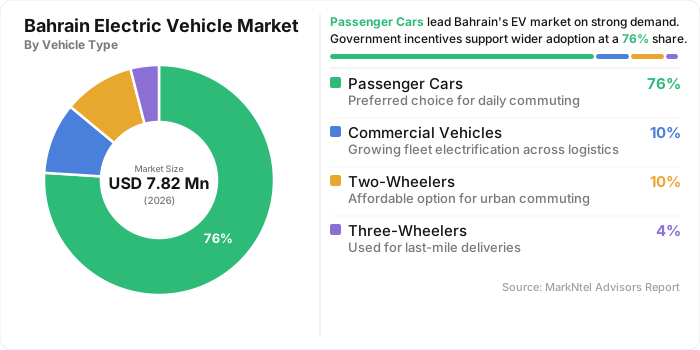
- Passenger cars are expected to dominate the market with approximately 76% share in 2026.
- By propulsion type, battery electric vehicles (BEVs) are anticipated to account for around 71% of the market in 2026.
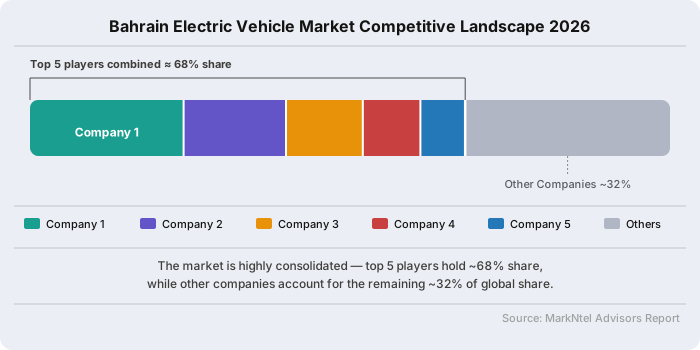
- The market remains moderately consolidated, with the top five companies collectively accounting for approximately 68% of total market share.
Bahrain Electric Vehicle Market Size and Outlook
The electric vehicle market size in Bahrain was valued at USD 5.98 million in 2025 and is projected to grow from USD 7.82 million in 2026 to USD 38.99 million by 2032. Along with this, the market is estimated to grow at a CAGR of around 30.70 % during the forecast period, i.e., 2026-32.
The outlook for the Bahrain electric vehicle market through 2032 will largely depend on the pace of the Kingdom's electricity sector decarbonization, rather than solely on the expansion of charging infrastructure or vehicle availability. Bahrain's Supreme Council for Environment has doubled the country's renewable energy target under its updated National Renewable Energy Action Plan, raising the 2035 goal from 10% to 20% of the energy mix a shift that will materially change the emissions profile of every kilowatt-hour used to charge an EV battery in the Kingdom.
This recalibration, paired with parallel commitments to double Bahrain's tree cover from 1.8 million and quadruple mangrove coverage from 400,000, signals that electrification of transport is being planned as one strand within a broader, government-coordinated decarbonization program rather than a standalone automotive trend.
For market participants, this has practical implications. As grid electricity becomes cleaner, the lifecycle carbon case for EV ownership strengthens independent of vehicle-level innovation, which should support continued premium and mid-market model launches from brands such as Tesla and BYD without relying solely on consumer environmental sentiment. At the same time, public transport electrification and residential charging expansion remain the key swing factors that will determine whether Bahrain's EV penetration accelerates faster than the regional GCC average or continues to trail larger markets such as the UAE and Saudi Arabia.
Through 2032, the market's trajectory will likely depend less on vehicle supply, which is already diversifying rapidly, and more on how consistently national energy and transport policy is executed on the ground.
Bahrain Electric Vehicle Market Key Indicators
- Bahrain's passenger vehicle fleet exceeded 760,000 registered vehicles in 2024, reflecting one of the highest vehicle ownership rates in the GCC. A larger vehicle parc creates a substantial replacement market for electric vehicles as consumers gradually shift from internal combustion engine (ICE) vehicles to battery electric and plug-in hybrid models, supporting long-term EV demand.
- Road transport accounts for nearly one-quarter of Bahrain's total energy consumption, making vehicle electrification a strategic priority for reducing oil consumption and transport-related emissions. As transport remains one of the country's largest energy-consuming sectors, policies encouraging EV adoption are expected to accelerate over the forecast period.
- Bahrain has set a target of achieving Net Zero emissions by 2060, with transport electrification identified as a key decarbonization pathway. This long-term national commitment is encouraging investments in EV charging infrastructure, regulatory support, and cleaner mobility solutions, positively influencing electric vehicle adoption.
- Solar energy capacity in Bahrain is targeted to reach approximately 710 MW by 2035 under the National Energy Strategy. Expansion of renewable electricity generation strengthens the environmental value proposition of EVs by enabling cleaner charging while supporting sustainable transport objectives.
- Public EV charging infrastructure has expanded steadily, with multiple new charging locations commissioned during 2025, including installations by public utilities and commercial operators. Increasing charger availability reduces range anxiety and improves accessibility, making EV ownership more practical and supporting market growth.
- Global electric car sales surpassed 17 million units in 2024, representing more than 20% of worldwide new passenger car sales. The rapid increase in global EV production expands the availability of electric models from international manufacturers, particularly Chinese and European brands that are increasingly entering GCC markets such as Bahrain.
- Public charging stations worldwide have doubled over the past two years, while the number of ultra-fast chargers (≥150 kW) increased by around 50% in 2024. Continuous advancements in charging infrastructure and charging speeds are improving consumer confidence and accelerating EV adoption across emerging markets, including Bahrain.
Bahrain Electric Vehicle Market Scope
| Category | Segments |
|---|---|
| By Vehicle Type | Passenger Cars, Commercial Vehicles, Two Wheelers, Three Wheelers |
| By Propulsion Type | Battery Electric Vehicle (BEV), Hybrid Electric Vehicle (HEV), Plug-in hybrid electric vehicles, Fuel-cell electric vehicles |
| By Charging Type | AC Charging, DC Fast Charging, Wireless Charging |
| By Range | Less than 200 km, 200–400 km, Above 400 km |
| By End User | Personal Use, Commercial/Fleet Operators, Public Transportation |
| By Battery Type | Lithium-Ion Battery, Lithium Iron Phosphate (LFP), Nickel Manganese Cobalt (NMC), Solid-State Battery, Nickel Metal Hydride (NiMH |
Bahrain Electric Vehicle Market Growth Drivers
Government-Led Decarbonization and Clean Energy Policies Driving Long-Term Electric Vehicle Adoption in Bahrain
Government initiatives promoting decarbonization and clean energy transition are expected to be the most influential long-term growth driver for the Bahrain electric vehicle industry. Bahrain has committed to achieving net-zero emissions by 2060, prompting greater emphasis on sustainable transportation and electrification. As policies increasingly encourage low-carbon mobility and renewable energy integration, investments in EV infrastructure, charging networks, and clean electricity are expected to accelerate. These initiatives create a favorable regulatory environment for automakers, charging operators, and fleet owners, supporting higher electric vehicle penetration across both private and commercial vehicle segments over the forecast period.
Supporting this strategy, Bahrain launched its National Energy Strategy in 2025, targeting a significant increase in renewable energy deployment and improvements in energy efficiency to support the country's decarbonization roadmap. The strategy establishes a stronger foundation for transport electrification by promoting cleaner electricity generation and long-term investment in sustainable infrastructure. As electricity production becomes greener, the environmental benefits of EV ownership increase, making electric mobility more attractive to consumers and businesses while strengthening the long-term outlook for Bahrain's electric vehicle market.
Recent Trends
Ultra-Fast Charging Infrastructure Expansion Accelerating Electric Vehicle Adoption in Bahrain
The rapid deployment of ultra-fast public charging infrastructure has become one of the most significant trends in the Bahrain electric vehicle industry. As EV ownership grows, the government is prioritizing faster, more accessible charging solutions to improve user convenience and reduce charging times. A robust fast-charging network is expected to strengthen consumer confidence, encourage long-distance EV travel, and attract additional electric vehicle manufacturers to the Kingdom. This trend also supports Bahrain's broader carbon neutrality and sustainable transport objectives by making electric mobility more practical for both private and commercial users.
The trend was reinforced in October 2025, when Bahrain's Ministry of Electricity and Water Affairs inaugurated five ultra-fast EV charging stations located in Diyar Al Muharraq, The Avenues, Adliya, Liwan, and Durrat Al Bahrain. The stations are capable of charging EV batteries to 80% in less than 15 minutes, while the accompanying mobile application enables users to locate chargers, check real-time availability, and make digital payments. These developments significantly enhance Bahrain's charging ecosystem and improve the overall EV ownership experience.
Bahrain Electric Vehicle Market Opportunities and Challenges
Fossil-Fuel-Reliant Public Transport Fleet Paves the Way for Commercial Fleet Electrification in Bahrain's EV Market
Bahrain's public transport and taxi network, regulated by the Ministry of Transportation and Telecommunications (MTT), remains almost entirely dependent on conventional fuel vehicles. According to the Ministry, the Kingdom operates 1,460 licensed taxi vehicles, while Bahrain Public Transport Company runs more than 20 bus routes carrying around 30,000 daily riders, none of it currently electrified. This scale of conventional public and shared mobility represents a considerable, largely untapped source of transport emissions, limiting the overall environmental gains achievable through electric vehicle adoption confined mainly to private passenger cars.
MTT's strategic plan to expand bus network coverage to 77% and modernize public transport infrastructure, including upgraded bus shelters, layby stops, and depots, provides a ready foundation for phased fleet electrification. As the Kingdom pursues its 2060 net-zero target, integrating electric buses and taxis into this expanding network could convert public transport from an emissions liability into a flagship decarbonization channel, unlocking commercial-scale demand for electric vehicles and charging infrastructure across Bahrain's transport sector, strengthening the Kingdom's broader electric vehicle market and its regional sustainability positioning.
Segmentation Insights
Passenger Cars Accounting for Approximately 76% Market Share Supported by Expanding Premium EV Portfolio and Dealer Investments
Passenger Cars are estimated to account for approximately 76% of the Bahrain electric vehicle industry in 2026, reflecting growing consumer preference for premium electric mobility and improved model availability through authorized dealerships. Bahrain's high passenger vehicle ownership, strong purchasing power, and increasing demand for technologically advanced vehicles continue to support this segment. International automakers are prioritizing Bahrain for premium EV introductions, while local distributors are expanding showroom networks and customer support services to strengthen market penetration. These factors position passenger cars as the primary contributor to EV sales across the Kingdom.
Supporting this trend, Tesla officially entered Bahrain through its first Experience Centre at Bahrain World Trade Center in 2025, allowing customers to explore, test drive, and purchase Tesla vehicles locally while receiving dedicated after-sales support. The expansion significantly improves accessibility to premium battery-electric vehicles and reflects manufacturers' growing confidence in Bahrain's EV market. Enhanced retail presence and customer engagement are expected to accelerate passenger EV adoption and strengthen the segment's long-term market leadership. Based on the vehicle type, the market is further bifurcated into:
- Passenger cars
- Commercial vehicles
- Two-wheelers
- Three-Wheelers
Battery Electric Vehicles (BEVs) Holding Approximately 71% Market Share Driven by New Model Introductions and Corporate Fleet Electrification
The battery electric vehicles are estimated to capture approximately 71% of the Bahrain electric vehicle industry in 2026, supported by increasing demand for zero-emission mobility and the growing availability of advanced electric vehicle models. Consumers are increasingly choosing BEVs due to lower operating costs, improved battery technology, and expanding manufacturer portfolios. Corporate organizations are also evaluating battery-electric vehicles as part of their sustainability strategies, creating additional demand beyond individual consumers and strengthening the long-term outlook for the segment.
As an example, Volvo Cars introduced the all-electric EX30 across GCC markets during 2025, including Bahrain through its regional dealer network. The compact premium SUV targets urban buyers with improved energy efficiency, advanced safety technologies, and competitive driving range, expanding consumer choice within Bahrain's BEV market. The launch highlights manufacturers' continued investment in introducing next-generation battery-electric vehicles tailored to regional customer preferences and is expected to support sustained BEV adoption. based on the propulsion type, the market is further bifurcated into:
- Battery Electric Vehicle (BEV)
- Hybrid Electric Vehicle (HEV)
- Plug-in hybrid electric vehicles
- Fuel-cell electric vehicles
Bahrain Electric Vehicle Industry Competitive Landscape
The Bahrain electric vehicle market is moderately consolidated, supported by a mix of global EV manufacturers competing through authorized distributors and expanding dealership networks. The top five companies, namely Tesla, BYD Company Ltd., Hyundai Motor Company, BMW AG, and Mercedes-Benz Group AG, collectively account for approximately 68% of the market.
Key Companies in the Bahrain Electric Vehicle Market
- Tesla
- BYD Company Ltd.
- Hyundai Motor Company
- BMW AG
- Mercedes-Benz Group AG
- Nissan Motor Corporation
- Toyota Motor Corporation
- Kia Corporation
- Volvo Car Corporation
- Porsche AG (Porsche Middle East & Africa)
- Others
Bahrain Electric Vehicle Industry News and Recent Developments
October 2025: BYD Bahrain Launches the BYD SHARK 6 Plug-in Hybrid Pickup
BYD Bahrain, through its authorized distributor Fakhro Motors, launched the BYD SHARK 6 in Bahrain. The model combines a plug-in hybrid powertrain with off-road capability and targets both commercial and lifestyle customers. The launch expanded BYD's electrified vehicle portfolio in Bahrain and reinforced the company's strategy to increase new energy vehicle adoption across the Kingdom.
Impact Analysis: The introduction of the SHARK 6 broadens EV and plug-in hybrid choices in Bahrain beyond passenger sedans and SUVs. It is expected to accelerate electrification in the pickup segment, attracting fleet operators and consumers seeking lower fuel consumption and reduced emissions.
2026: BYD Bahrain Introduces the BYD SEALION 7 Electric SUV
During 2026, BYD Bahrain expanded its local product lineup by introducing the SEALION 7, a battery-electric SUV built on the company's latest e-Platform. The vehicle features an extended driving range, Blade Battery technology, and advanced driver assistance systems, strengthening BYD's premium EV offering in Bahrain.
Impact Analysis: The launch increases competition in Bahrain's mid-size electric SUV segment and provides consumers with a broader selection of long-range EVs. It also strengthens BYD's market position against premium international manufacturers.
2026: BYD Bahrain Adds the BYD SEAL 7 DM-i Plug-in Hybrid
In 2026, BYD Bahrain expanded its electrified portfolio with the SEAL 7 DM-i, a plug-in hybrid sedan combining electric driving capability with extended range through its dual-mode hybrid technology. The model is targeted at customers transitioning from conventional ICE vehicles to electrified mobility.
Impact Analysis: The launch supports gradual EV adoption by addressing range concerns while lowering fuel consumption and emissions. It also expands the availability of electrified vehicles across different customer segments in Bahrain.
Frequently Asked Questions
- Market Segmentation
- Introduction
- Product Definition
- Research Process
- Assumptions
- Executive Summary
- Bahrain Electric Vehicle Production (Thousand Units) Trend 2022-2032
- Bahrain Electric Vehicle Production (Thousand Units) Trend by Type of Vehicle 2022-2032
- Passenger Cars
- Commercial Vehicles
- Two-wheelers
- Three-Wheelers
- Company-Wise Production Plants and Statistics
- Installed Production Capacity
- Actual Production
- Planned Production Target
- Bahrain Electric Vehicle Production (Thousand Units) Trend by Type of Vehicle 2022-2032
- Bahrain Electric Vehicle Market Supply Chain Analysis 2022-2032
- Bahrain Electric Vehicle Market Import &Export Analysis 2022-2032
- Bahrain Electric Vehicle Market Policies, Regulations, and Product Standards
- Bahrain Electric Vehicle Market Trends & Developments
- Bahrain Electric Vehicle Market Dynamics
- Growth Factors
- Challenges
- Bahrain Electric Vehicle Market Hotspot & Opportunities
- Bahrain Electric Vehicle Market Outlook, 2022-2032
- Market Size & Outlook
- By Revenues (USD Million)
- By Units Sold (Thousand Units)
- Market Segmentation & Outlook
- By Vehicle Type- Market Size & Forecast 2022-2032, USD Million & Thousand Units
- Passenger Cars
- Sedan
- Hatchback
- SUV
- Commercial Vehicles
- Light Commercial Vehicles
- Electric Light Trucks
- Electric Minivans
- Medium & Heavy Commercial Vehicles
- Electric Trucks & Bus
- Two Wheelers
- Scooters
- Motorcycles
- Moped
- Three Wheelers
- Passenger Carrier
- Load Carrier
- Passenger Cars
- By Propulsion Type- Market Size & Forecast 2022-2032, USD Million
- Battery Electric Vehicle (BEV)
- Hybrid Electric Vehicle (HEV)
- Plug-in hybrid electric vehicles
- Fuel-cell electric vehicles
- By Charging Type- Market Size & Forecast 2022-2032, USD Million
- AC Charging
- DC Fast Charging
- Wireless Charging
- By Range- Market Size & Forecast 2022-2032, USD Million
- Less than 200 km
- 200–400 km
- Above 400 km
- By End User- Market Size & Forecast 2022-2032, USD Million
- Personal Use
- Commercial/Fleet Operators
- Public Transportation
- By Battery Type- Market Size & Forecast 2022-2032, USD Million
- Lithium-Ion Battery
- Lithium Iron Phosphate (LFP)
- Nickel Manganese Cobalt (NMC)
- Solid-State Battery
- Nickel Metal Hydride (NiMH)
- By Region- Market Size & Forecast 2022-2032, USD Million
- North
- Central
- South
- By Company
- Competition Characteristics
- Market Share & Analysis
- By Vehicle Type- Market Size & Forecast 2022-2032, USD Million & Thousand Units
- Market Size & Outlook
- Bahrain Electric Passenger Cars Market Outlook, 2022-2032
- Market Size & Outlook
- By Revenues (USD Million)
- By Units Sold (Thousand Units)
- Market Segmentation & Outlook
- By Propulsion Type- Market Size & Forecast 2022-2032, USD Million
- By Charging Type- Market Size & Forecast 2022-2032, USD Million
- By Range- Market Size & Forecast 2022-2032, USD Million
- By End User- Market Size & Forecast 2022-2032, USD Million
- By Battery Type- Market Size & Forecast 2022-2032, USD Million
- By Region- Market Size & Forecast 2022-2032, USD Million
- Market Size & Outlook
- Bahrain Electric Commercial Vehicles Market Outlook, 2022-2032
- Market Size & Outlook
- By Revenues (USD Million)
- By Units Sold (Thousand Units)
- Market Segmentation & Outlook
- By Propulsion Type- Market Size & Forecast 2022-2032, USD Million
- By Charging Type- Market Size & Forecast 2022-2032, USD Million
- By Range- Market Size & Forecast 2022-2032, USD Million
- By End User- Market Size & Forecast 2022-2032, USD Million
- By Battery Type- Market Size & Forecast 2022-2032, USD Million
- By Region- Market Size & Forecast 2022-2032, USD Million
- Market Size & Outlook
- Bahrain Electric Two Wheelers Market Outlook, 2022-2032
- Market Size & Outlook
- By Revenues (USD Million)
- By Units Sold (Thousand Units)
- Market Segmentation & Outlook
- By Propulsion Type- Market Size & Forecast 2022-2032, USD Million
- By Charging Type- Market Size & Forecast 2022-2032, USD Million
- By Range- Market Size & Forecast 2022-2032, USD Million
- By End User- Market Size & Forecast 2022-2032, USD Million
- By Battery Type- Market Size & Forecast 2022-2032, USD Million
- By Region- Market Size & Forecast 2022-2032, USD Million
- Market Size & Outlook
- Bahrain Electric Three Wheelers Market Outlook, 2022-2032
- Market Size & Outlook
- By Revenues (USD Million)
- By Units Sold (Thousand Units)
- Market Segmentation & Outlook
- By Propulsion Type- Market Size & Forecast 2022-2032, USD Million
- By Charging Type- Market Size & Forecast 2022-2032, USD Million
- By Range- Market Size & Forecast 2022-2032, USD Million
- By End User- Market Size & Forecast 2022-2032, USD Million
- By Battery Type- Market Size & Forecast 2022-2032, USD Million
- By Region- Market Size & Forecast 2022-2032, USD Million
- Market Size & Outlook
- Bahrain Electric Vehicle Market Key Strategic Imperatives for Success & Growth
- Competitive Outlook
- Company Profiles
- Tesla
- Business Description
- Product Portfolio
- Collaborations & Alliances
- Recent Developments
- Financial Details
- Others
- BYD Company Ltd.
- Business Description
- Product Portfolio
- Collaborations & Alliances
- Recent Developments
- Financial Details
- Others
- Hyundai Motor Company
- Business Description
- Product Portfolio
- Collaborations & Alliances
- Recent Developments
- Financial Details
- Others
- BMW AG
- Business Description
- Product Portfolio
- Collaborations & Alliances
- Recent Developments
- Financial Details
- Others
- Mercedes-Benz Group AG
- Business Description
- Product Portfolio
- Collaborations & Alliances
- Recent Developments
- Financial Details
- Others
- Nissan Motor Corporation
- Business Description
- Product Portfolio
- Collaborations & Alliances
- Recent Developments
- Financial Details
- Others
- Toyota Motor Corporation
- Business Description
- Product Portfolio
- Collaborations & Alliances
- Recent Developments
- Financial Details
- Others
- Kia Corporation
- Business Description
- Product Portfolio
- Collaborations & Alliances
- Recent Developments
- Financial Details
- Others
- Volvo Car Corporation
- Business Description
- Product Portfolio
- Collaborations & Alliances
- Recent Developments
- Financial Details
- Others
- Porsche AG (Porsche Middle East & Africa)
- Business Description
- Product Portfolio
- Collaborations & Alliances
- Recent Developments
- Financial Details
- Others
- Others
- Tesla
- Company Profiles
- Disclaimer
MarkNtel Advisors follows a robust and iterative research methodology designed to ensure maximum accuracy and minimize deviation in market estimates and forecasts. Our approach combines both bottom-up and top-down techniques to effectively segment and quantify various aspects of the market. A consistent feature across all our research reports is data triangulation, which examines the market from three distinct perspectives to validate findings. Key components of our research process include:
1. Scope & Research Design At the outset, MarkNtel Advisors define the research objectives and formulate pertinent questions. This phase involves determining the type of research—qualitative or quantitative—and designing a methodology that outlines data collection methods, target demographics, and analytical tools. They also establish timelines and budgets to ensure the research aligns with client goals.
2. Sample Selection and Data Collection In this stage, the firm identifies the target audience and determines the appropriate sample size to ensure representativeness. They employ various sampling methods, such as random or stratified sampling, based on the research objectives. Data collection is carried out using tools like surveys, interviews, and observations, ensuring the gathered data is reliable and relevant.
3. Data Analysis and Validation Once data is collected, MarkNtel Advisors undertake a rigorous analysis process. This includes cleaning the data to remove inconsistencies, employing statistical software for quantitative analysis, and thematic analysis for qualitative data. Validation steps are taken to ensure the accuracy and reliability of the findings, minimizing biases and errors.

4. Data Forecast and FinalizationThe final phase involves forecasting future market trends based on the analyzed data. MarkNtel Advisors utilize predictive modeling and time series analysis to anticipate market behaviors. The insights are then compiled into comprehensive reports, featuring visual aids like charts and graphs, and include strategic recommendations to inform client decision-making
We offer flexible licensing options to cater to varying organizational needs. Choose the pricing pack that best suits your requirements:
Buy Now Inquire Before Buying
 Request Customization
 Talk to our Consultant







