

India Truck & Bus Air Conditioner Market Research Report: Forecast (2026-2032)
By Vehicle Type (Bus, Truck), By Product Type (Roof-Mounted AC, Back Wall AC), By Demand Type (OEM, Aftermarket), By Cooling Capacity (Up to 10 kW, 10.1–20 kW, 20.1–35 kW, Above 35 ... kW), and others Read more
- Automotive
- Jul 2026
- Pages 140
- Report Format: PDF, Excel, PPT
India Truck & Bus Air Conditioner Market
Projected 18% CAGR from 2026 to 2032
Study Period
2026-2032
Market Size (2026)
USD 231 Million
Market Size (2032)
USD 627 Million
Base Year
2025
Projected CAGR
18%
Leading Segments
By Vehicle Type: Bus
India Truck & Bus Air Conditioner Market Key Takeaways
- The India Truck & Bus Air Conditioner Market was valued at USD 219 million in 2025 and is projected to grow to USD 231 million in 2026, further reaching USD 627 million by 2032.
- The market is projected to witness steady growth at a CAGR of approximately 18 % during 2026–2032.
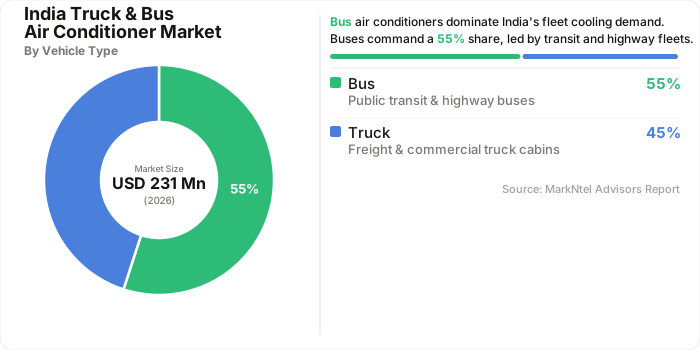
- By vehicle type, the bus segment holds the largest share with 55% of the market in 2026.
- The OEM segment has witnessed strong growth and holds a 68% market share in the market.
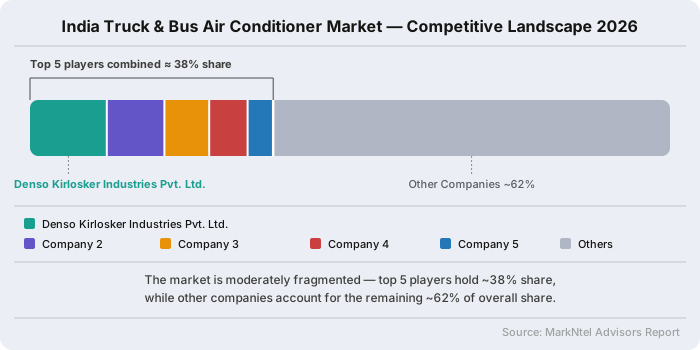
- The market remains moderately fragmented, with the top 5 players accounting for around 38 % market share in 2026.
India Truck & Bus Air Conditioner Market Size & Outlook
The truck & bus air conditioner market in India is projected to expand from approximately USD 219 million in 2025 to USD 231 million in 2026, reaching nearly USD 627 million by 2032, and is anticipated to expand at a CAGR of approximately 18% during 2026–2032.
Supported by steady growth in commercial vehicle production, rising demand for passenger comfort, and increasing integration of bus HVAC systems and truck cabin cooling systems across OEM platforms. The market is also benefiting from the broader transition toward comfort-oriented and energy-efficient commercial vehicle HVAC systems in both freight and passenger mobility applications.
Moreover, the adoption of ACs for buses and trucks are strongly influenced by infrastructure-led mobility expansion, higher vehicle utilization, and improving intercity connectivity across India. Expansion of road networks and logistics corridors is enabling longer operational routes, which is increasing reliance on advanced transport climate control solutions to ensure driver comfort and operational efficiency. At the same time, fleet operators are increasingly prioritizing air-conditioned vehicles as a competitive differentiator, particularly in premium intercity and organized transport segments.
According to the Ministry of Road Transport and Highways (MoRTH), India’s national highway network has reached over 146,000 km in 2024, significantly enhancing freight and passenger movement efficiency across states. This infrastructure expansion is directly supporting higher penetration of HVAC-equipped commercial vehicles.
In parallel, tourism is emerging as a significant long-term demand driver for the India truck and bus air conditioner industry. According to the Ministry of Tourism, India recorded approximately 2.5 billion domestic tourist visits in 2024. This momentum is expected to continue, with the World Travel & Tourism Council (WTTC) projecting the travel and tourism sector's contribution to India's economy to increase from USD 256 billion in 2024 to approximately USD 523 billion by 2034, reflecting sustained expansion in tourism activity.
As leisure and intercity travel continue to grow over the forecast period, demand for air-conditioned buses, particularly premium coaches, tourist buses, and long-distance intercity fleets, is expected to increase significantly, supporting sustained growth in the bus air conditioning market through 2032.
India Truck & Bus Air Conditioner Key Indicators
- According to SIAM, domestic sales of Medium and Heavy Commercial Vehicles (M&HCVs) remained at approximately 3.74 lakh units in FY 2024–25. The large installed base of medium and heavy trucks continues to support OEM demand for cabin air-conditioning systems, particularly as regulatory requirements make HVAC integration a standard feature across higher gross vehicle weight categories.
- According to the Ministry of Heavy Industries (MHI), 5,135 electric buses were supplied as of February 2025 against 6,862 sanctioned buses. The increasing deployment of electric buses is accelerating demand for advanced thermal management technologies, as HVAC systems play a critical role in passenger comfort, battery efficiency, vehicle range optimization, and overall operational performance.
- According to the Automotive Component Manufacturers Association of India (ACMA), the Indian auto component industry reached USD 80.2 billion in FY 2024–25, registering 9.6% year-on-year growth. The expansion of domestic automotive manufacturing capabilities is strengthening the local supply chain for HVAC assemblies, heat exchangers, compressors, blowers, and electronic control systems, supporting greater localization and technological advancement within India's truck and bus air conditioner market.
India Truck & Bus Air Conditioner Market Scope
| Category | Segments |
|---|---|
| By Vehicle Type | Bus, Truck |
| By Product Type | Roof-Mounted AC, Back Wall AC |
| By Demand Type | OEM, Aftermarket |
| By Cooling Capacity | Up to 10 kW, 10.1–20 kW, 20.1–35 kW, Above 35 kW |
India Truck & Bus Air Conditioner Market Drivers
Electrification-Led Transformation Reshaping Demand for Truck & Bus Air Conditioner
Rising electrification of India’s commercial fleet is emerging as a core growth driver for the commercial vehicle HVAC market, particularly in the electric bus HVAC systems segment. According to the Ministry of Heavy Industries (MHI), India has already supplied 5,135 electric buses under FAME-II as of February 2025, while the PM e-Bus Sewa scheme (launched in 2024) targets deployment of more than 38,000 electric buses with an outlay of USD 412 million. This large-scale transition is fundamentally reshaping thermal management requirements, as electric buses require highly energy-optimized cooling systems to balance passenger comfort with battery efficiency and driving range. As a result, OEMs are increasingly integrating advanced HVAC architectures into vehicle platforms rather than treating them as auxiliary systems.
On the commercial trucking side, regulatory and operational shifts are reinforcing demand for truck cabin cooling systems across both ICE and emerging electric platforms. MoRTH’s mandate requiring mandatory air-conditioning for category trucks manufactured from October 2025 onward, aligned with performance standards, is converting HVAC from a comfort feature into a compliance requirement for new vehicles. This regulatory push, combined with the growing focus on driver comfort, operational efficiency, and long-haul productivity, is accelerating the adoption of integrated transport climate control solutions across India’s trucking ecosystem.
Recent Trends
Accelerating Shift Toward Low-GWP Refrigerants and Next-Generation Thermal System Architecture
A key trend in the India truck & bus air conditioner market is the transition toward low-GWP refrigerants and advanced thermal system design, driven by sustainability requirements and next-generation vehicle efficiency needs. OEMs are increasingly moving away from conventional HFC-based systems toward alternatives like R-744 (CO₂), which support lower environmental impact and improved energy performance. This shift is also strengthening demand for more efficient commercial vehicle HVAC systems, integrating optimized compressors and thermal management technologies for better performance in buses and long-haul trucks.
Moreover, India’s ratification of the Kigali Amendment is accelerating this transformation by mandating a phased reduction of hydrofluorocarbons (HFCs) from 2028 onwards across cooling applications. This regulatory roadmap is expected to drive strong adoption of low-GWP cooling technologies, including CO₂-based HVAC systems in commercial vehicles. As a result, manufacturers are increasingly developing next-generation bus air conditioning systems and truck cabin cooling systems aligned with future environmental compliance and improved thermal efficiency requirements.
India Truck & Bus Air Conditioner Market Opportunities and Challenges
SME Cost Sensitivity Limiting HVAC Adoption, Creating Opportunity for Value-Engineered Solutions in Fleet Segment
A key challenge in the India truck & bus air conditioner market is the low adoption of HVAC systems among SMEs due to high upfront costs and strong price sensitivity in fleet purchasing decisions. India’s retail inflation, remaining in the 4%–6% range during 2024–2025 (RBI CPI tracking), continues to constrain operating budgets for small fleet operators. Many SMEs in semi-urban logistics prioritize affordability and payload efficiency over air-conditioning, limiting penetration of truck cabin cooling systems and bus HVAC systems in the cost-sensitive commercial vehicle segment.
The cost sensitivity among SMEs is creating strong opportunities for low-cost and modular commercial vehicle HVAC systems and retrofit solutions that reduce total ownership cost while maintaining essential cooling performance. OEMs are increasingly targeting entry-level fleets with scalable truck cabin cooling systems designed for easier installation and lower operating energy use. Supporting this shift, Valeo in 2024 expanded its CO₂-based (R744) HVAC and heat-pump portfolio for commercial vehicles, enabling more energy-efficient and cost-optimized bus HVAC systems, improving adoption feasibility in price-sensitive SME fleet segments.
India Truck & Bus Air Conditioner Market Segmentation
Bus Segment Dominance Driven by Rising Intercity Mobility and Premium Air-Conditioned Fleet Adoption
The Bus segment holds a 55% market share in the India truck & bus air conditioner market, driven by the strong dominance of AC-based intercity and long-distance travel. According to redBus BusTrack reports, AC buses account for nearly 71–72% of total seats sold in India’s intercity bus market in 2025–2026, highlighting a clear structural preference for air-conditioned mobility in commercial passenger transport. This trend is further reinforced by rapid passenger growth, with the sector recording 147.19 million intercity passengers in H2 FY2026, supported by a 24% year-on-year increase in demand, where AC and sleeper categories remain the primary growth drivers.
The expansion of digital mobility platforms is further strengthening AC bus penetration. Operators such as Zingbus report large-scale deployment of AC-enabled fleets, including Volvo and Bharat Benz platforms across 800+ cities, reflecting a standardized shift toward comfort-oriented fleet design. Rising heat stress conditions, increasing long-distance travel demand, and improved affordability parity between AC and non-AC services are accelerating the adoption of bus HVAC systems across private operators and state transport undertakings. As a result, OEMs are increasingly integrating transport climate control solutions at the manufacturing stage, reinforcing the bus segment’s dominance in the commercial vehicle HVAC ecosystem. Based on Vehicle Type, the market is segmented into:
- Bus
- Truck
Factory-Fit Comfort Revolution Driving OEM Dominance in Commercial Vehicle HVAC Integration
The OEM segment has witnessed strong growth and holds a 68% market share in the India truck & bus air conditioner industry, driven by rising adoption of premium commercial vehicles and increasing demand for factory-fitted comfort systems. According to SIAM, India recorded 9,56,671 commercial vehicle sales in FY 2024–25, reflecting sustained expansion in both truck and bus production, with a noticeable shift toward higher-comfort and feature-rich vehicle configurations. This is further supported by increasing deployment of premium buses and heavy-duty trucks in logistics, mining, and infrastructure-linked applications, where OEM-installed truck cabin cooling systems are becoming a standard specification rather than an optional feature.
In parallel, the recovery and expansion of India’s tourism and mobility sector is strengthening demand for air-conditioned buses and luxury coaches. According to the Ministry of Tourism, India recorded 1.73 billion domestic tourist visits in 2024, highlighting strong growth in intercity and leisure travel. This surge is driving fleet operators and tour companies to increasingly adopt factory-fitted bus HVAC systems to enhance passenger comfort and service differentiation. As a result, OEM integration continues to dominate the commercial vehicle HVAC market, supported by rising demand for premium travel experiences and large-scale fleet modernization across India. Based on Demand Type, the industry is segmented into:
- OEM
- Aftermarket
India Truck & Bus Air Conditioner Market Competitive Analysis
The India Truck & Bus Air Conditioner Market is moderately fragmented, with the key players collectively accounting for 38% market share, driven by strong OEM partnerships, high entry barriers in thermal system engineering, and long-term supply contracts with commercial vehicle manufacturers. Market leadership is dominated by established HVAC specialists with strong manufacturing bases in India, deep OEM integration capabilities, and growing focus on electric bus HVAC systems and truck cabin cooling systems aligned with regulatory and electrification trends.
Top Manufacturers in the India Truck & Bus Air Conditioner Industry
- DENSO Kirloskar Industries Pvt. Ltd.
- Subros Limited
- Sidwal Refrigeration Industries Pvt. Ltd.
- Trans ACNR Solutions Pvt. Ltd. (JTAC)
- Valeo
- Eberspächer Gruppe GmbH & Co. KG
- SONGZ Automobile Air Conditioning Co., Ltd.
- TKT HVAC Co., Ltd.
- Thermo King India Pvt. Ltd.
- Sphere Thermal Systems Pvt. Ltd.
- Others
India Truck & Bus Air Conditioner Industry News and Recent Developments
January 2026 Subros Limited Secures Major EV Compressor Order from OEM
Subros Limited secured a USD 150 million electric compressor contract from Maruti Suzuki for hybrid and electrified vehicle platforms, strengthening its position in next-generation automotive thermal systems. The company is also expanding its focus toward electric compressors and integrated HVAC modules, supported by long-standing technical collaborations with global partners such as DENSO. This development comes alongside rising OEM demand driven by regulatory momentum, including the 2025 mandate for truck cabin air-conditioning in N2/N3 vehicles, accelerating integration of truck cabin cooling systems across India’s commercial vehicle fleet.
Impact Analysis: This order significantly strengthens Subros’ visibility in the commercial vehicle HVAC market, shifting its revenue base toward high-value electrified systems. It enhances penetration in OEM-led platforms, especially in trucks and buses, while improving adoption of advanced bus HVAC systems and EV-compatible transport climate control solutions across India.
October 2025 DENSO India Expands Focus on Electrified Thermal Management Systems
DENSO India continued strengthening its electrification strategy by advancing development of high-efficiency compressors, HVAC modules, and thermal management systems tailored for hybrid and electric vehicle platforms. The company is aligning its India operations with OEM electrification programs, where demand for energy-efficient bus HVAC systems is increasing due to rapid adoption of electric buses and stricter efficiency expectations in commercial mobility.
Impact Analysis: This development reinforces DENSO’s positioning in premium commercial vehicle HVAC systems, particularly in OEM-integrated bus platforms. It is expected to support wider deployment of advanced truck cabin cooling systems, while accelerating adoption of low-energy transport climate control solutions across electrified commercial fleets.
Frequently Asked Questions
- Market Segmentation
- Introduction
- Product Definition
- Research Process
- Assumptions
- Executive Summary
- India Truck & Bus Air Conditioner Market Policies, Regulations, and Product Standards
- India Truck & Bus Air Conditioner Market Trends & Developments
- India Truck & Bus Air Conditioner Market Dynamics
- Growth Factors
- Challenges
- India Truck & Bus Air Conditioner Market Hotspot & Opportunities
- India Truck & Bus Air Conditioner Market Outlook, 2022-2032
- Market Size & Outlook
- By Revenues (USD Million)
- Market Share & Outlook
- By Vehicle Type- Market Size & Forecast 2022-2032, USD Million
- Bus
- Truck
- By Product Type- Market Size & Forecast 2022-2032, USD Million
- Roof-Mounted AC
- Back Wall AC
- By Demand Type- Market Size & Forecast 2022-2032, USD Million
- OEM
- Aftermarket
- By Cooling Capacity- Market Size & Forecast 2022-2032, USD Million
- Up to 10 kW
- 10.1–20 kW
- 20.1–35 kW
- Above 35 kW
- By Region- Market Size & Forecast 2022-2032, USD Million
- North India
- South India
- West India
- East India
- By Company
- Competition Characteristics
- Market Share & Analysis
- By Vehicle Type- Market Size & Forecast 2022-2032, USD Million
- Market Size & Outlook
- India Bus Air Conditioner Market Outlook, 2022-2032
- Market Size & Outlook
- By Revenues (USD Million)
- Market Share & Outlook
- By Product Type- Market Size & Forecast 2022-2032, USD Million
- By Demand Type- Market Size & Forecast 2022-2032, USD Million
- By Cooling Capacity- Market Size & Forecast 2022-2032, USD Million
- By Region- Market Size & Forecast 2022-2032, USD Million
- Market Size & Outlook
- India Truck Air Conditioner Market Outlook, 2022-2032
- Market Size & Outlook
- By Revenues (USD Million)
- Market Share & Outlook
- By Product Type- Market Size & Forecast 2022-2032, USD Million
- By Demand Type- Market Size & Forecast 2022-2032, USD Million
- By Cooling Capacity- Market Size & Forecast 2022-2032, USD Million
- By Region- Market Size & Forecast 2022-2032, USD Million
- Market Size & Outlook
- India Truck & Bus Air Conditioner Market Key Strategic Imperatives for Success & Growth
- Competitive Outlook
- Company Profiles
- DENSO Kirloskar Industries Pvt. Ltd.
- Business Description
- Product Portfolio
- Collaborations & Alliances
- Recent Developments
- Financial Details
- Others
- Subros Limited
- Business Description
- Product Portfolio
- Collaborations & Alliances
- Recent Developments
- Financial Details
- Others
- Sidwal Refrigeration Industries Pvt. Ltd.
- Business Description
- Product Portfolio
- Collaborations & Alliances
- Recent Developments
- Financial Details
- Others
- Valeo
- Business Description
- Product Portfolio
- Collaborations & Alliances
- Recent Developments
- Financial Details
- Others
- Eberspächer Gruppe GmbH & Co. KG
- Business Description
- Product Portfolio
- Collaborations & Alliances
- Recent Developments
- Financial Details
- Others
- SONGZ Automobile Air Conditioning Co., Ltd.
- Business Description
- Product Portfolio
- Collaborations & Alliances
- Recent Developments
- Financial Details
- Others
- TKT HVAC Co., Ltd.
- Business Description
- Product Portfolio
- Collaborations & Alliances
- Recent Developments
- Financial Details
- Others
- Thermo King India Pvt. Ltd.
- Business Description
- Product Portfolio
- Collaborations & Alliances
- Recent Developments
- Financial Details
- Others
- Sphere Thermal Systems Pvt. Ltd
- Business Description
- Product Portfolio
- Collaborations & Alliances
- Recent Developments
- Financial Details
- Others
- Others
- Business Description
- Product Portfolio
- Collaborations & Alliances
- Recent Developments
- Financial Details
- Others
- DENSO Kirloskar Industries Pvt. Ltd.
- Company Profiles
- Disclaimer
MarkNtel Advisors follows a robust and iterative research methodology designed to ensure maximum accuracy and minimize deviation in market estimates and forecasts. Our approach combines both bottom-up and top-down techniques to effectively segment and quantify various aspects of the market. A consistent feature across all our research reports is data triangulation, which examines the market from three distinct perspectives to validate findings. Key components of our research process include:
1. Scope & Research Design At the outset, MarkNtel Advisors define the research objectives and formulate pertinent questions. This phase involves determining the type of research—qualitative or quantitative—and designing a methodology that outlines data collection methods, target demographics, and analytical tools. They also establish timelines and budgets to ensure the research aligns with client goals.
2. Sample Selection and Data Collection In this stage, the firm identifies the target audience and determines the appropriate sample size to ensure representativeness. They employ various sampling methods, such as random or stratified sampling, based on the research objectives. Data collection is carried out using tools like surveys, interviews, and observations, ensuring the gathered data is reliable and relevant.
3. Data Analysis and Validation Once data is collected, MarkNtel Advisors undertake a rigorous analysis process. This includes cleaning the data to remove inconsistencies, employing statistical software for quantitative analysis, and thematic analysis for qualitative data. Validation steps are taken to ensure the accuracy and reliability of the findings, minimizing biases and errors.

4. Data Forecast and FinalizationThe final phase involves forecasting future market trends based on the analyzed data. MarkNtel Advisors utilize predictive modeling and time series analysis to anticipate market behaviors. The insights are then compiled into comprehensive reports, featuring visual aids like charts and graphs, and include strategic recommendations to inform client decision-making
We offer flexible licensing options to cater to varying organizational needs. Choose the pricing pack that best suits your requirements:
Buy Now Inquire Before Buying
 Request Customization
 Talk to our Consultant







