

By Product (Beer, Spirits, Wine, Ready-to-Drink (RTD) Alcoholic Beverages, Cider, Others), By Alcohol Content (Low Alcohol, Medium Alcohol, High Alcohol), By Packaging (Glass Bottl......es, Metal Cans, PET Bottles, Others), By Distribution Channel (On-Trade, Off-Trade), and others Read more
- Food & Beverages
- Jul 2026
- 144
- PDF, Excel, PPT
US Alcoholic Drinks Market Key Takeaways
- The US Alcoholic Drinks market size was valued at USD 316 billion in 2025 and is projected to grow from USD 329 billion in 2026 to USD 441 billion by 2032, exhibiting a CAGR of 5.11% during 2026-2032.
- By product type, Beer holds a significant share of about 43% in 2026.
- By distribution channel, off-trade seized a significant share of about 63% in 2026.
- The industry is moderately fragmented. However, the top five players collectively account for nearly 65% share.
US Alcoholic Drinks Market Size and Outlook
The US alcoholic drinks market size was valued at USD 316 billion in 2025 and is projected to grow from USD 329 billion in 2026 to USD 441 billion by 2032. Along with this, the market is estimated to grow at a CAGR of around 5.11% during the forecast period, i.e., 2026-32.
The market remains one of the world’s largest and most mature beverage industries, but it is currently undergoing a structural transition rather than simple expansion. In recent years, total retail sales of beer, wine, and liquor stores reached about USD 72.29 billion in 2024, reflecting steady but slowing consumer demand across categories. While the industry continues to generate strong value, consumption volumes are gradually stabilizing, with overall the alcohol intake showing signs of mild contraction due to health awareness and economic pressures.
A key trend shaping the outlook is changing category leadership. Spirits have overtaken beer in value share, accounting for around 42% of the market in 2025, compared to beer’s 41.8%, marking a long-term shift toward premium distilled products and cocktails. Within spirits, tequila and ready-to-drink (RTD) cocktails are expanding rapidly, with RTD spirits growth exceeding 16% in value in 2024, driven by convenience and lifestyle appeal.
However, the market is also facing a clear moderation trend. National surveys show alcohol consumption among adults falling to 54% in 2025, the lowest level recorded in decades, as consumers increasingly associate drinking with health risks and lifestyle balance. This has led to declining wine volumes and softer beer demand, especially in mainstream segments, while premium and low-alcohol alternatives gain traction.
At the same time, innovation is reshaping growth momentum. E-commerce alcohol sales have expanded significantly, reaching over USD 23 billion in 2024, highlighting a shift toward digital purchasing channels. Additionally, non-alcoholic and low-alcohol beverages are growing as major substitutes, particularly among younger consumers.
Overall, the U.S. alcoholic drinks industry outlook is defined by premiumization, moderation, and product diversification, with stable revenue growth but evolving consumption patterns that are reshaping traditional beer–wine–spirits dynamics.
US Alcoholic Drinks Market Key Indicators
- The U.S. Bureau of Economic Analysis reported that DPI increased by USD 57.4 billion (0.3%) in September 2024, while personal consumption expenditures rose by USD 105.8 billion (0.5%). Rising income levels support premiumization, encouraging consumers to spend more on imported beer, premium tequila, whiskey, and wine. Higher purchasing power directly benefits the value growth of the alcoholic beverages market.
- According to the Distilled Spirits Council of the United States (DISCUS), U.S. spirits exports reached a record USD 2.4 billion in 2024, increasing 10% year-over-year. The European Union accounted for approximately USD 1.2 billion of exports, highlighting strong global demand for American spirits. Import volumes are equally important as they support demand for tequila, imported beer, and premium wine in the U.S. market.
- According to the U.S. Department of Agriculture (USDA), U.S. corn production reached approximately 378.3 million metric tons in MY 2024/25, while barley production totaled about 3.1 million metric tons and wheat production reached 53.9 million metric tons, ensuring a stable supply of raw materials for brewers and distillers.
- Additionally, California, the nation's leading wine-producing state, crushed 2.884 million tons of wine grapes in 2024, generating a crop value of approximately USD 2.99 billion. Strong agricultural production helps stabilize input availability and supports domestic alcohol manufacturing. However, fluctuations in crop yields, weather conditions, and commodity prices can directly affect production costs, profitability, and final beverage prices across the alcoholic drinks industry.
US Alcoholic Drinks Market Scope
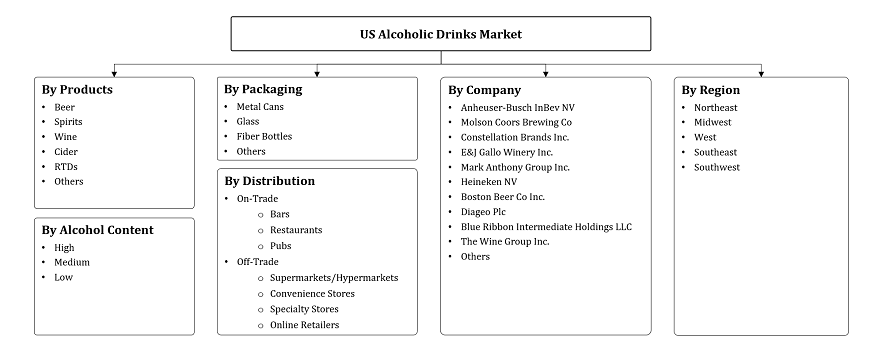
| Category | Segments |
|---|---|
| By Product | Beer, Spirits, Wine, Ready-to-Drink (RTD) Alcoholic Beverages, Cider, Others |
| By Alcohol Content | Low Alcohol, Medium Alcohol, High Alcohol |
| By Packaging | Glass Bottles, Metal Cans, PET Bottles, Others |
| By Distribution Channel | On-Trade, Off-Trade |
US Alcoholic Drinks Market Growth Drivers
Rising Consumer Preference for Premium Alcoholic Beverages Drives Market Value Growth
Premiumization has emerged as a major driver of the U.S. alcoholic beverages industry as consumers increasingly favor high-quality spirits, imported beers, and premium wines over value-priced alternatives. This shift is boosting industry revenues despite relatively stable overall alcohol consumption. According to the Distilled Spirits Council of the United States, spirits maintained the largest share of the U.S. beverage alcohol market in 2024 at 42.2%, while supplier sales reached USD 37.2 billion, highlighting consumers’ continued willingness to spend on higher-value alcoholic beverages. Premium categories such as tequila and mezcal generated USD 6.7 billion in sales in 2024, reflecting sustained demand for premium and super-premium offerings.
Major alcohol producers are actively restructuring portfolios around premium products. In 2025, Constellation Brands continued divesting lower-priced wine brands while focusing on premium labels and imported beers. The company also announced plans to invest approximately USD 2 billion through fiscal 2028 to expand brewing capacity and support anticipated growth in higher-end beer segments. Furthermore, premium American whiskey producers such as Brown-Forman continue expanding innovation around super-premium expressions and flavored whiskey portfolios to capture evolving consumer preferences.
Premiumization is increasing average consumer spending per purchase and improving profitability across beer, wine, and spirits categories. Continued investments in premium product portfolios, production capacity, and brand innovation are expected to accelerate market value growth and strengthen the long-term expansion of the U.S. alcoholic beverages industry.
- Market Segmentation
- Introduction
- Product Definition
- Research Process
- Assumptions
- Executive Summary
- US Alcoholic Drinks Market Policies, Regulations, and Product Standards
- US Alcoholic Drinks Value Chain Analysis
- US Alcoholic Drinks Market Production Trend 2022-2032
- US Alcoholic Drinks Market Production Trend by Type of Product
- Beer
- Spirits
- Wine
- Ready-to-Drink (RTD) Alcoholic Beverages
- Cider
- Others
- Company-Wise Production Plants and Statistics
- Installed Production Capacity
- Actual Production
- Planned Production Target
- US Alcoholic Drinks Market Production Trend by Type of Product
- US Alcoholic Drinks Market Pricing Analysis 2022-2032
- US Alcoholic Drinks Market Pricing Trend (USD/Liters) 2022-2032
- US Alcoholic Drinks Market Pricing Trend (USD/Liters) By Product Type 2022-2032
- Beer
- Spirits
- Wine
- Ready-to-Drink (RTD) Alcoholic Beverages
- Cider
- Others
- US Alcoholic Drinks Market Trends & Developments
- US Alcoholic Drinks Market Dynamics
- Growth Factors
- Challenges
- US Alcoholic Drinks Market Hotspot & Opportunities
- US Alcoholic Drinks Market Outlook, 2022-2032F
- Market Size & Outlook
- By Revenues (USD Million)
- By Quantity Sold (Thousand Liters)
- Market Segmentation & Outlook
- By Product- Market Size & Forecast 2022-2032, USD Million & Thousand Liters
- Beer
- Spirits
- Wine
- Ready-to-Drink (RTD) Alcoholic Beverages
- Cider
- Others
- By Alcohol Content- Market Size & Forecast 2022-2032, USD Million & Thousand Liters
- Low Alcohol
- Medium Alcohol
- High Alcohol
- By Packaging- Market Size & Forecast 2022-2032, USD Million & Thousand Liters
- Glass Bottles
- Metal Cans
- PET Bottles
- Others
- By Distribution Channel- Market Size & Forecast 2022-2032, USD Million & Thousand Liters
- On-Trade
- Bars
- Restaurants
- Pubs
- Hotels
- Nightclubs
- Casinos
- Entertainment Venues
- Off-Trade
- Supermarkets & Hypermarkets
- Convenience Stores
- Specialty Liquor Stores
- Warehouse Clubs
- Drug Stores
- Online Retailers
- Direct-to-Consumer (DTC)
- On-Trade
- By Region- Market Size & Forecast 2022-2032, USD Million & Thousand Liters
- Northeast
- Midwest
- South
- West
- By Company
- Competition Characteristics
- Market Share & Analysis
- By Product- Market Size & Forecast 2022-2032, USD Million & Thousand Liters
- Market Size & Outlook
- US Beer Market Outlook, 2022-2032
- Market Size & Outlook
- By Revenues (USD Million)
- By Quantity Sold (Thousand Liters)
- Market Segmentation & Outlook
- By Type- Market Size & Forecast 2022-2032, USD Million & Thousand Liters
- Lager
- Ale
- Stout & Porter
- Wheat Beer
- Craft Beer
- Non-Alcoholic Beer
- Others
- By Alcohol Content- Market Size & Forecast 2022-2032, USD Million & Thousand Liters
- By Packaging- Market Size & Forecast 2022-2032, USD Million & Thousand Liters
- By Distribution Channel- Market Size & Forecast 2022-2032, USD Million & Thousand Liters
- By Region- Market Size & Forecast 2022-2032, USD Million & Thousand Liters
- By Type- Market Size & Forecast 2022-2032, USD Million & Thousand Liters
- Market Size & Outlook
- US Spirits Market Outlook, 2022-2032
- Market Size & Outlook
- By Revenues (USD Million)
- By Quantity Sold (Thousand Liters)
- Market Segmentation & Outlook
- By Type- Market Size & Forecast 2022-2032, USD Million & Thousand Liters
- Whiskey
- Vodka
- Tequila & Mezcal
- Rum
- Gin
- Brandy & Cognac
- Liqueurs & Cordials
- Others
- By Alcohol Content- Market Size & Forecast 2022-2032, USD Million & Thousand Liters
- By Packaging- Market Size & Forecast 2022-2032, USD Million & Thousand Liters
- By Distribution Channel- Market Size & Forecast 2022-2032, USD Million & Thousand Liters
- By Region- Market Size & Forecast 2022-2032, USD Million & Thousand Liters
- By Type- Market Size & Forecast 2022-2032, USD Million & Thousand Liters
- Market Size & Outlook
- US Wine Market Outlook, 2022-2032
- Market Size & Outlook
- By Revenues (USD Million)
- By Quantity Sold (Thousand Liters)
- Market Segmentation & Outlook
- By Type- Market Size & Forecast 2022-2032, USD Million & Thousand Liters
- Red Wine
- White Wine
- Rosé Wine
- Sparkling Wine
- Fortified Wine
- Dessert Wine
- By Alcohol Content- Market Size & Forecast 2022-2032, USD Million & Thousand Liters
- By Packaging- Market Size & Forecast 2022-2032, USD Million & Thousand Liters
- By Distribution Channel- Market Size & Forecast 2022-2032, USD Million & Thousand Liters
- By Region- Market Size & Forecast 2022-2032, USD Million & Thousand Liters
- By Type- Market Size & Forecast 2022-2032, USD Million & Thousand Liters
- Market Size & Outlook
- US Ready-to-Drink (RTD) Alcoholic Beverages Market Outlook, 2022-2032
- Market Size & Outlook
- By Revenues (USD Million)
- By Quantity Sold (Thousand Liters)
- Market Segmentation & Outlook
- By Type- Market Size & Forecast 2022-2032, USD Million & Thousand Liters
- Spirits-Based RTDs
- Malt-Based RTDs
- Wine-Based RTDs
- Hard Seltzers
- Canned Cocktails
- Others
- By Alcohol Content- Market Size & Forecast 2022-2032, USD Million & Thousand Liters
- By Packaging- Market Size & Forecast 2022-2032, USD Million & Thousand Liters
- By Distribution Channel- Market Size & Forecast 2022-2032, USD Million & Thousand Liters
- By Region- Market Size & Forecast 2022-2032, USD Million & Thousand Liters
- By Type- Market Size & Forecast 2022-2032, USD Million & Thousand Liters
- Market Size & Outlook
- US Cider Market Outlook, 2022-2032
- Market Size & Outlook
- By Revenues (USD Million)
- By Quantity Sold (Thousand Liters)
- Market Segmentation & Outlook
- By Type- Market Size & Forecast 2022-2032, USD Million & Thousand Liters
- Apple Cider
- Pear Cider (Perry)
- Flavored Cider
- Others
- By Alcohol Content- Market Size & Forecast 2022-2032, USD Million & Thousand Liters
- By Packaging- Market Size & Forecast 2022-2032, USD Million & Thousand Liters
- By Distribution Channel- Market Size & Forecast 2022-2032, USD Million & Thousand Liters
- By Region- Market Size & Forecast 2022-2032, USD Million & Thousand Liters
- By Type- Market Size & Forecast 2022-2032, USD Million & Thousand Liters
- Market Size & Outlook
- US Alcoholic Drinks Market Key Strategic Imperatives for Success & Growth
- Competitive Outlook
- Company Profiles
- Anheuser-Busch InBev NV
- Business Description
- Product Portfolio
- Collaborations & Alliances
- Recent Developments
- Financial Details
- Others
- Molson Coors Beverage Company
- Business Description
- Product Portfolio
- Collaborations & Alliances
- Recent Developments
- Financial Details
- Others
- Constellation Brands Inc.
- Business Description
- Product Portfolio
- Collaborations & Alliances
- Recent Developments
- Financial Details
- Others
- E. & J. Gallo Winery
- Business Description
- Product Portfolio
- Collaborations & Alliances
- Recent Developments
- Financial Details
- Others
- Mark Anthony Group Inc.
- Business Description
- Product Portfolio
- Collaborations & Alliances
- Recent Developments
- Financial Details
- Others
- Diageo plc
- Business Description
- Product Portfolio
- Collaborations & Alliances
- Recent Developments
- Financial Details
- Others
- Blue Ribbon Intermediate Holdings LLC
- Business Description
- Product Portfolio
- Collaborations & Alliances
- Recent Developments
- Financial Details
- Others
- Wine Group LLC
- Business Description
- Product Portfolio
- Collaborations & Alliances
- Recent Developments
- Financial Details
- Others
- Heineken N.V.
- Business Description
- Product Portfolio
- Collaborations & Alliances
- Recent Developments
- Financial Details
- Others
- Boston Beer Company, Inc.
- Business Description
- Product Portfolio
- Collaborations & Alliances
- Recent Developments
- Financial Details
- Others
- Others
- Anheuser-Busch InBev NV
- Company Profiles
- Disclaimer
MarkNtel Advisors follows a robust and iterative research methodology designed to ensure maximum accuracy and minimize deviation in market estimates and forecasts. Our approach combines both bottom-up and top-down techniques to effectively segment and quantify various aspects of the market. A consistent feature across all our research reports is data triangulation, which examines the market from three distinct perspectives to validate findings. Key components of our research process include:
1. Scope & Research Design At the outset, MarkNtel Advisors define the research objectives and formulate pertinent questions. This phase involves determining the type of research—qualitative or quantitative—and designing a methodology that outlines data collection methods, target demographics, and analytical tools. They also establish timelines and budgets to ensure the research aligns with client goals.
2. Sample Selection and Data Collection In this stage, the firm identifies the target audience and determines the appropriate sample size to ensure representativeness. They employ various sampling methods, such as random or stratified sampling, based on the research objectives. Data collection is carried out using tools like surveys, interviews, and observations, ensuring the gathered data is reliable and relevant.
3. Data Analysis and Validation Once data is collected, MarkNtel Advisors undertake a rigorous analysis process. This includes cleaning the data to remove inconsistencies, employing statistical software for quantitative analysis, and thematic analysis for qualitative data. Validation steps are taken to ensure the accuracy and reliability of the findings, minimizing biases and errors.

4. Data Forecast and FinalizationThe final phase involves forecasting future market trends based on the analyzed data. MarkNtel Advisors utilize predictive modeling and time series analysis to anticipate market behaviors. The insights are then compiled into comprehensive reports, featuring visual aids like charts and graphs, and include strategic recommendations to inform client decision-making
FILL THE FORM TO GET THE FREE SAMPLE PAGES
We offer flexible licensing options to cater to varying organizational needs. Choose the pricing pack that best suits your requirements:
Buy Now Inquire Before Buying
 Talk to our Consultant
 Request Customization