

South Korea E-Commerce Logistics Market Research Report: Forecast (2026-2032)
South Korea E-Commerce Logistics Market - By Service Type (Transportation, Warehousing & Inventory Management, Value-Added Services), By Distribution Channel (Fulfillment Centers a ... nd Warehouses, Last-Mile Delivery Networks, Third-Party Logistics Providers, Parcel Lockers, Pickup Points, and Click-and-Collect Systems), By Business Model (Business-to-Business (B2B), Business-to-Consumer (B2C), Consumer-to-Consumer (C2C)), By End User (E-Retailers and Marketplaces, SMEs and Online Brands, Cross-Border Sellers),, and others Read more
- Food & Beverages
- Feb 2026
- Pages 135
- Report Format: PDF, Excel, PPT
South Korea E-Commerce Logistics Market
Projected 12.90% CAGR from 2026 to 2032
Study Period
2026-2032
Market Size (2025)
USD 9.4 Billion
Market Size (2032)
USD 21.9 Billion
Base Year
2025
Projected CAGR
12.90%
Leading Segments
By Service Type: Transportation
South Korea E-Commerce Logistics Market Report Key Takeaways:
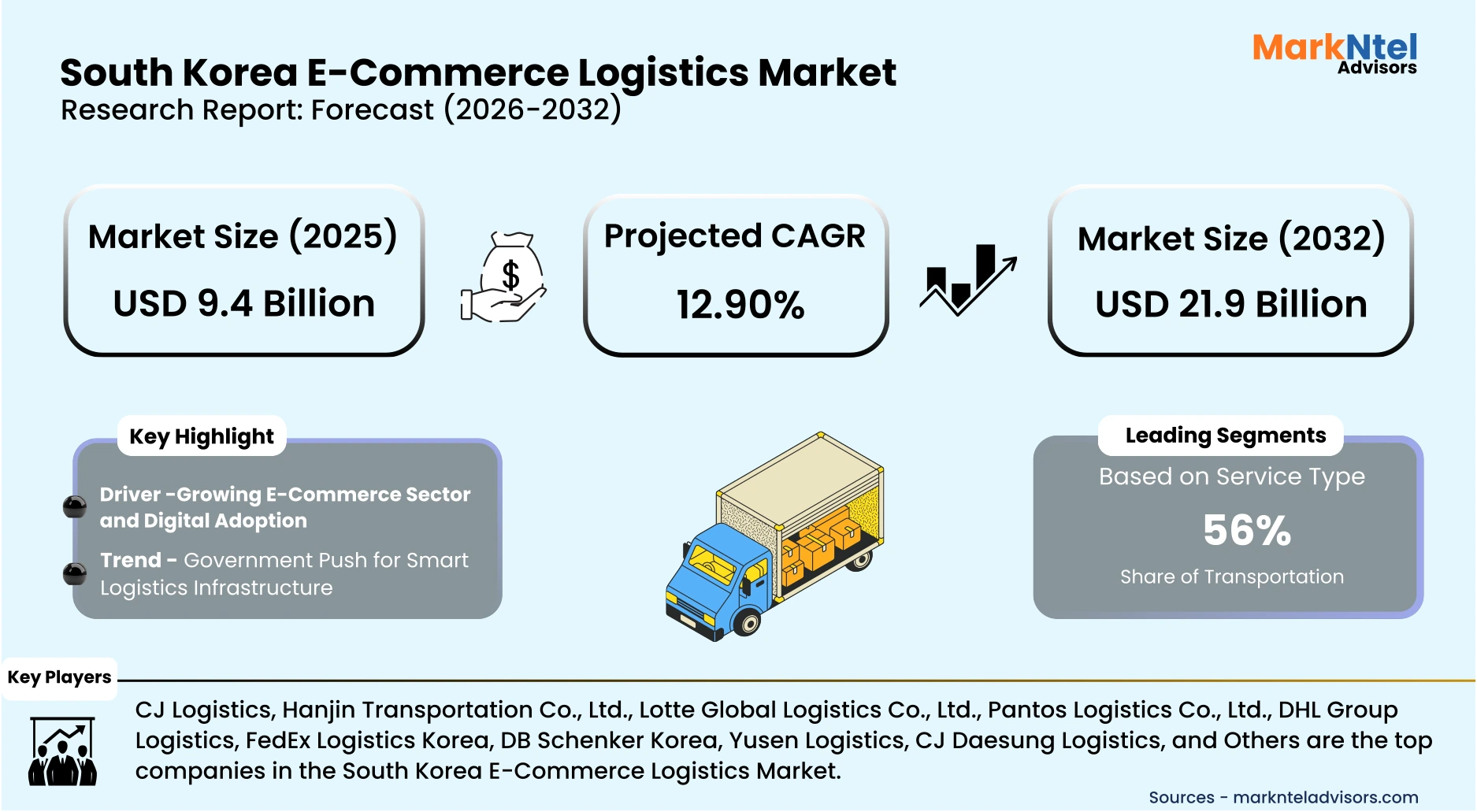
- Market size was valued at around USD9.4 billion in 2025 and is projected to reach USD21.9 billion by 2032. The estimated CAGR from 2026 to 2032 is around 12.90%, indicating strong growth.
- The central region, led by Seoul, holds the largest market share of about 54% in the South Korea E-Commerce Logistics Market in 2025.
- By Service Type, the Transportation segment represented a significant share of about 56% in the South Korea E-Commerce Logistics Market in 2025.
- By Distribution Channel, the Last-Mile Delivery Networks segment presented a significant share of about 32% in the South Korea E-Commerce Logistics Market in 2025.
- Leading E-Commerce Logistics Companies in the South Korea Market are CJ Logistics, Hanjin Transportation Co., Ltd., Lotte Global Logistics Co., Ltd., Pantos Logistics Co., Ltd., DHL Group Logistics, FedEx Logistics Korea, DB Schenker Korea, Yusen Logistics, CJ Daesung Logistics, and Others.
Market Insights & Analysis: South Korea E-Commerce Logistics Market (2026-32):
The South Korea E-Commerce Logistics Market size was valued at around USD9.4 billion in 2025 and is projected to reach USD21.9 billion by 2032. Along with this, the market is estimated to grow at a CAGR of around 12.90% during the forecast period, i.e., 2026-32.
South Korea’s E-Commerce Logistics Industry is expanding rapidly, powered by high internet penetration, fast delivery expectations, and strong government support for digital infrastructure. The nation’s online retail ecosystem is one of the most advanced globally. For instance, according to Statistics Korea, South Korea’s total e-commerce transaction value reached billions of dollars in recent years, reflecting a robust increase driven by rising consumer demand and efficient logistics networks.
Additionally, leading companies such as Coupang, CJ Logistics, and Lotte Global Logistics are at the forefront of transforming logistics operations. For reference, Coupang’s Rocket Delivery now reaches more than 70% of South Korea’s population, enabling same-day or next-day delivery through an extensive network of automated fulfillment centers. Similarly, CJ Logistics continues to invest in smart warehouses equipped with AI-driven robotics and automation to reduce processing times and optimize routes, particularly across Seoul and Gyeonggi Province.
Also, cross-border e-commerce contributes significantly to logistics demand, in which South Koreans spend billions of dollars annually on overseas online purchases, prompting government agencies to tighten customs oversight and enhance trade logistics efficiency. Overall, continuous investment in warehouse automation, digital tracking systems, and eco-friendly packaging is reshaping operations to meet sustainability goals. Therefore, South Korea is poised to remain a regional benchmark for fast, reliable, and sustainable e-commerce logistics, with its well-developed infrastructure and tech-led innovation.
South Korea E-Commerce Logistics Market Recent Developments:
- October 2025: FedEx Logistics Korea expanded its intra-Asia air network, adding new routes connecting South Korea, Vietnam, Taiwan, and China. This development enhances regional connectivity, reduces delivery times, and strengthens FedEx's capacity to handle the growing cross-border e-commerce shipments across key Asian markets.
- May 2025: LX Pantos acquired a large distribution center in Cheongna, Incheon, spanning about 142,852 m2, marking a major step in expanding its e-commerce logistics operations. The facility focuses on supporting K-culture direct-purchase exports, enabling faster processing of global online orders for Korean beauty, fashion, and entertainment products, and strengthening South Korea's digital export ecosystem.
South Korea E-Commerce Logistics Market Scope:
| Category | Segments |
|---|---|
| By Service Type | Transportation, Warehousing & Inventory Management, Value-Added Services |
| By Distribution Channel | Fulfillment Centers and Warehouses, Last-Mile Delivery Networks, Third-Party Logistics Providers, Parcel Lockers, Pickup Points, and Click-and-Collect Systems |
| By Business Model | Business-to-Business (B2B), Business-to-Consumer (B2C), Consumer-to-Consumer (C2C) |
| By End User | E-Retailers and Marketplaces, SMEs and Online Brands, Cross-Border Sellers |
South Korea E-Commerce Logistics Market Driver:
Growing E-Commerce Sector and Digital Adoption
South Korea’s e-commerce sector serves as a pivotal driver of logistics market expansion, underpinned by advanced digital infrastructure and highly connected consumers. According to Statistics Korea, the nation’s e-commerce transaction value reached approximately USD165-172 billion in 2023, reflecting sustained and robust growth in online retail activity. With internet penetration nearing 98% and smartphone usage around 95%, digital engagement has become deeply embedded in consumer behavior.
Moreover, leading platforms such as Coupang, 11Street, and Gmarket continue to enhance delivery efficiency and service diversity, while secure digital payment systems, including Naver Pay, KakaoPay, and Coupang Pay, have simplified transactions and strengthened consumer confidence. This broad digital adoption has created a dynamic ecosystem that supports seamless purchasing, faster order fulfillment, and higher delivery volumes. Consequently, the expansion of e-commerce and digital adoption is driving sustained growth, modernization, and competitiveness across South Korea’s logistics and fulfillment networks.
Surge in Cross-Border Trade Driving Market Demand
South Korea’s growing cross-border e-commerce activity is a key driver of logistics market expansion. According to the Korea Customs Service, overseas online purchases reached approximately USD1.6 billion in 2024, reflecting strong consumer demand for goods from the U.S., Japan, and China. This surge has prompted the government to enhance digital customs clearance systems and strengthen border efficiency to handle rising parcel volumes. The Incheon International Airport and Port have been central to this development, with recent investments expanding bonded warehouses and automated cargo-handling zones to support faster cross-border delivery. These initiatives not only streamline international trade flows but also reinforce South Korea’s role as a regional logistics and e-commerce hub connecting Northeast Asia to global online markets.
South Korea E-Commerce Logistics Market Trend:
Government Push for Smart Logistics Infrastructure
The South Korean government, through the Ministry of Land, Infrastructure, and Transport (MOLIT), is strongly promoting the development of Smart Logistics Innovation Zones to modernize and digitize the logistics industry. These initiatives focus on transforming warehousing, transportation, and last-mile delivery through the use of automated systems, smart technologies, and eco-friendly solutions. For instance, in January 2022, MOLIT designated a smart logistics center system and an unloading robot technology as new excellent logistics technologies. The robot can unload 11 boxes in 30 minutes from a 1,500-ton truck, over four times faster than traditional methods, significantly improving efficiency.
Additionally, the government’s National Logistics Basic Plan (2021–2030) also emphasizes building high-tech, smart technology–based logistics systems to enhance digital connectivity and sustainability. These policies are actively transforming this market and encouraging logistics companies to invest in automation, smart warehousing, and cleaner transport solutions, making South Korea a leader in next-generation logistics infrastructure.
Expansion of Green and Sustainable Logistics
South Korea is placing strong emphasis on eco-friendly logistics as part of its commitment to reach carbon neutrality by 2050. The Ministry of Environment & the Ministry of Land, Infrastructure and Transport (MOLIT) have rolled out policies supporting electric vehicles (EVs) and green logistics facilities. For instance, in the 2024 fiscal year, the government allocated USD1.25 billion for EV subsidies, covering passenger cars, trucks, and buses under its low-emission vehicle program.
Moreover, the national carbon-neutrality roadmap targets to increase the stock of eco-friendly vehicles, including electric and hydrogen models, as part of transforming Korea’s transport and logistics ecosystem. In the logistics sector, this translates into investment in electric delivery vans, solar-powered warehouses, and energy-efficient cold-chain hubs. Such infrastructure upgrades reduce emissions, lower operational costs, and strengthen supply-chain resilience. As companies adopt these solutions, South Korea’s logistics market is moving toward a greener, smarter foundation that supports e-commerce growth while aligning with national sustainability goals.
South Korea E-Commerce Logistics Market Challenge:
Labor Shortages and Rising Warehousing Costs
South Korea’s e-commerce logistics industry is under pressure as demand for faster deliveries continues to rise. According to the Korea Occupational Safety and Health Agency (KOSHA), parcel deliveries exceeded 3.8 billion in 2023, leading to fatigue and overwork among delivery personnel. Despite government efforts to improve working hours and safety measures, the shortage of skilled delivery workers remains a key concern for logistics companies.
At the same time, rising warehousing and land costs are adding to the burden. As the Ministry of Land, Infrastructure and Transport (MOLIT) reported that logistics land prices increased by more than 12% between 2022 and 2024, particularly in Seoul and Gyeonggi Province. As urban warehouse space becomes more expensive and limited, logistics firms are being forced to build facilities farther from major cities, which raises transportation costs and affects last-mile delivery efficiency.
South Korea E-Commerce Logistics Market (2026-32) Segmentation Analysis:
The South Korea E-Commerce Logistics Market study of MarkNtel Advisors evaluates & highlights the major trends and influencing factors in each segment. It includes predictions for the period 2026–32 at the South Korea level. Based on the analysis, the market has been further classified as;
Based on Service Type
- Transportation
- Warehousing & Inventory Management
- Value-Added Services
In the South Korean E-Commerce Logistics Market, the transportation segment is the leading service type by accounting for a market share of about 56%. This dominance comes from the country’s strong need for fast and reliable parcel movement between warehouses, fulfillment centers, and customers. With the rise of same-day and next-day delivery services, logistics companies such as CJ Logistics, Hanjin Transportation, and Lotte Global Logistics have heavily invested in nationwide trucking fleets and advanced routing systems.
The use of AI-based route planning and real-time tracking ensures timely deliveries even during peak shopping periods. South Korea’s modern road and air networks also support efficient transportation of goods across urban and rural areas. As a result, transportation remains the backbone of e-commerce logistics operations, ensuring seamless product movement from sellers to consumers.
Based on the Distribution Channel
- Fulfillment Centers and Warehouses
- Last-Mile Delivery Networks
- Third-Party Logistics Providers
- Parcel Lockers, Pickup Points, and Click-and-Collect Systems
The last-mile delivery networks are the leading segment in South Korea’s e-commerce logistics industry and hold about 32% market share. The country’s high internet usage and dense urban population have created strong demand for ultra-fast doorstep delivery. Companies like Coupang, with its Rocket Delivery service, and CJ Logistics have set new standards by offering same-day or next-day delivery to most customers.
To support this, firms are expanding micro-fulfillment centers, automated sorting hubs, and eco-friendly delivery fleets in major cities such as Seoul, Busan, and Incheon. The growing popularity of mobile commerce and 24-hour online shopping further boosts the importance of efficient last-mile operations. This segment continues to lead as it directly impacts customer satisfaction and brand loyalty in South Korea’s fast-paced e-commerce environment.
South Korea E-Commerce Logistics (2026-32): Regional Projection
The central region of South Korea, which includes Seoul, Gyeonggi Province, and Incheon, serves as the core of the nation’s e-commerce logistics network with a market share of about 54%. This region benefits from its dense population, advanced infrastructure, and proximity to major ports and airports. According to the Ministry of Land, Infrastructure and Transport (MOLIT), the Seoul Metropolitan Area accounts for over 25.7 million m² of logistics floor space across nearly 490 large-scale centers, making it the largest logistics hub in the country.
Additionally, Incheon International Airport, with a cargo handling capacity of around 5 million tonnes annually, and the nearby Incheon Port together support most cross-border e-commerce shipments. Gyeonggi Province, surrounding Seoul, hosts major fulfillment and distribution centers operated by Coupang, CJ Logistics, and Lotte Global Logistics, ensuring rapid last-mile delivery to more than half of South Korea’s population. This concentration of logistics infrastructure, consumer demand, and transport access firmly establishes the central region as the backbone of this market.
Gain a Competitive Edge with Our South Korea E-Commerce Logistics Market Report
- South Korea E-Commerce Logistics Market Report by MarkNtel Advisors provides a detailed & thorough analysis of market size & share, growth rate, competitive landscape, and key players. This comprehensive analysis helps businesses gain a holistic understanding of the market dynamics & make informed decisions.
- This report also highlights current market trends & future projections, allowing businesses to identify emerging opportunities & potential challenges. By understanding market forecasts, companies can align their strategies & stay ahead of the competition.
- South Korea E-Commerce Logistics Market Report aids in assessing & mitigating risks associated with entering or operating in the market. By understanding market dynamics, regulatory frameworks, and potential challenges, businesses can develop strategies to minimize risks & optimize their operations.
*Reports Delivery Format - Market research studies from MarkNtel Advisors are offered in PDF, Excel and PowerPoint formats. Within 24 hours of the payment being successfully received, the report will be sent to your email address.
Frequently Asked Questions
- Market Segmentation
- Introduction
- Product Definition
- Research Process
- Assumptions
- Executive Summary
- South Korea E-Commerce Logistics Market Regulations, Policies & Standards
- South Korea E-Commerce Logistics Market Trends & Developments
- South Korea E-Commerce Logistics Market Strategic Insights
- South Korea E-Commerce Logistics Market Dynamics
- Growth Drivers
- Challenges
- South Korea E-Commerce Logistics Market Hotspots & Opportunities
- South Korea E-Commerce Logistics Market Outlook, 2022- 2032F
- Market Size & Analysis
- Market Revenues (USD Million)
- Market Share & Analysis
- By Service Type
- Transportation- Market Size & Forecast 2022-2032, USD Million
- Warehousing & Inventory Management- Market Size & Forecast 2022-2032, USD Million
- Value-Added Services- Market Size & Forecast 2022-2032, USD Million
- By Distribution Channel
- Fulfillment Centers and Warehouses- Market Size & Forecast 2022-2032, USD Million
- Last-Mile Delivery Networks- Market Size & Forecast 2022-2032, USD Million
- Third-Party Logistics Providers - Market Size & Forecast 2022-2032, USD Million
- Parcel Lockers, Pickup Points, and Click-and-Collect Systems- Market Size & Forecast 2022-2032, USD Million
- By Business Model
- Business-to-Business (B2B)- Market Size & Forecast 2022-2032, USD Million
- Business-to-Consumer (B2C)- Market Size & Forecast 2022-2032, USD Million
- Consumer-to-Consumer (C2C)- Market Size & Forecast 2022-2032, USD Million
- By End User
- E-Retailers and Marketplaces- Market Size & Forecast 2022-2032, USD Million
- SMEs and Online Brands- Market Size & Forecast 2022-2032, USD Million
- Cross-Border Sellers- Market Size & Forecast 2022-2032, USD Million
- By Region
- North
- South
- East
- West
- Central
- By Competitors
- Competition Characteristics
- Market Share & Analysis
- By Service Type
- Market Size & Analysis
- South Korea Transportation E-Commerce Logistics Market Outlook, 2022- 2032F
- Market Size & Analysis
- Market Revenues (USD Million)
- Market Share & Analysis
- By Distribution Channel- Market Size & Forecast 2022-2032, USD Million
- By End User- Market Size & Forecast 2022-2032, USD Million
- By Business Model- Market Size & Forecast 2022-2032, USD Million
- Market Size & Analysis
- South Korea Warehousing & Inventory Management E-Commerce Logistics Market Outlook, 2022- 2032F
- Market Size & Analysis
- Market Revenues (USD Million)
- Market Share & Analysis
- By Distribution Channel- Market Size & Forecast 2022-2032, USD Million
- By End User- Market Size & Forecast 2022-2032, USD Million
- By Business Model- Market Size & Forecast 2022-2032, USD Million
- Market Size & Analysis
- South Korea Value-Added Services E-Commerce Logistics Market Outlook, 2022- 2032F
- Market Size & Analysis
- Market Revenues (USD Million)
- Market Share & Analysis
- By Distribution Channel- Market Size & Forecast 2022-2032, USD Million
- By End User- Market Size & Forecast 2022-2032, USD Million
- By Business Model- Market Size & Forecast 2022-2032, USD Million
- Market Size & Analysis
- South Korea E-Commerce Logistics Market Key Strategic Imperatives for Growth & Success
- Competitive Outlook
- Company Profiles
- CJ Logistics
- Business Description
- Product Portfolio
- Strategic Alliances or Partnerships
- Recent Developments
- Financial Details
- Others
- Hanjin Transportation Co., Ltd.
- Business Description
- Product Portfolio
- Strategic Alliances or Partnerships
- Recent Developments
- Financial Details
- Others
- Lotte Global Logistics Co., Ltd.
- Business Description
- Product Portfolio
- Strategic Alliances or Partnerships
- Recent Developments
- Financial Details
- Others
- Pantos Logistics Co., Ltd.
- Business Description
- Product Portfolio
- Strategic Alliances or Partnerships
- Recent Developments
- Financial Details
- Others
- DHL Group Logistics
- Business Description
- Product Portfolio
- Strategic Alliances or Partnerships
- Recent Developments
- Financial Details
- Others
- FedEx Logistics Korea
- Business Description
- Product Portfolio
- Strategic Alliances or Partnerships
- Recent Developments
- Financial Details
- Others
- DB Schenker Korea
- Business Description
- Product Portfolio
- Strategic Alliances or Partnerships
- Recent Developments
- Financial Details
- Others
- Yusen Logistics
- Business Description
- Product Portfolio
- Strategic Alliances or Partnerships
- Recent Developments
- Financial Details
- Others
- CJ Daesung Logistics
- Business Description
- Product Portfolio
- Strategic Alliances or Partnerships
- Recent Developments
- Financial Details
- Others
- Others
- CJ Logistics
- Company Profiles
- Disclaimer
MarkNtel Advisors follows a robust and iterative research methodology designed to ensure maximum accuracy and minimize deviation in market estimates and forecasts. Our approach combines both bottom-up and top-down techniques to effectively segment and quantify various aspects of the market. A consistent feature across all our research reports is data triangulation, which examines the market from three distinct perspectives to validate findings. Key components of our research process include:
1. Scope & Research Design At the outset, MarkNtel Advisors define the research objectives and formulate pertinent questions. This phase involves determining the type of research—qualitative or quantitative—and designing a methodology that outlines data collection methods, target demographics, and analytical tools. They also establish timelines and budgets to ensure the research aligns with client goals.
2. Sample Selection and Data Collection In this stage, the firm identifies the target audience and determines the appropriate sample size to ensure representativeness. They employ various sampling methods, such as random or stratified sampling, based on the research objectives. Data collection is carried out using tools like surveys, interviews, and observations, ensuring the gathered data is reliable and relevant.
3. Data Analysis and Validation Once data is collected, MarkNtel Advisors undertake a rigorous analysis process. This includes cleaning the data to remove inconsistencies, employing statistical software for quantitative analysis, and thematic analysis for qualitative data. Validation steps are taken to ensure the accuracy and reliability of the findings, minimizing biases and errors.

4. Data Forecast and FinalizationThe final phase involves forecasting future market trends based on the analyzed data. MarkNtel Advisors utilize predictive modeling and time series analysis to anticipate market behaviors. The insights are then compiled into comprehensive reports, featuring visual aids like charts and graphs, and include strategic recommendations to inform client decision-making
We offer flexible licensing options to cater to varying organizational needs. Choose the pricing pack that best suits your requirements:
Buy Now Inquire Before Buying
 Request Customization
 Talk to our Consultant







