

By Temperature grade (Low-Temperature Coal Tar Pitch, Medium-Temperature Coal Tar Pitch, High-Temperature Coal Tar Pitch), By Grade (Aluminum Grade, Graphite Grade, Special/Mesopha......se Grade, Others), By Application (Aluminum Smelting, Graphite Electrodes, Refractories, Roofing & Waterproofing, Carbon Fiber & Advanced Carbon Materials, Battery Anode Materials, Carbon Black, Others), and others Read more
- Buildings, Construction, Metals & Mining
- Sep 2026
- 280
- PDF, Excel, PPT
Asia-Pacific Coal Tar Pitch Market Key Takeaways
- The Asia-Pacific coal tar pitch market is projected to grow from USD 1.67 billion in 2025 to USD 1.98 billion in 2026, and to USD 3.22 billion by 2032, expanding at an 8.44% CAGR.
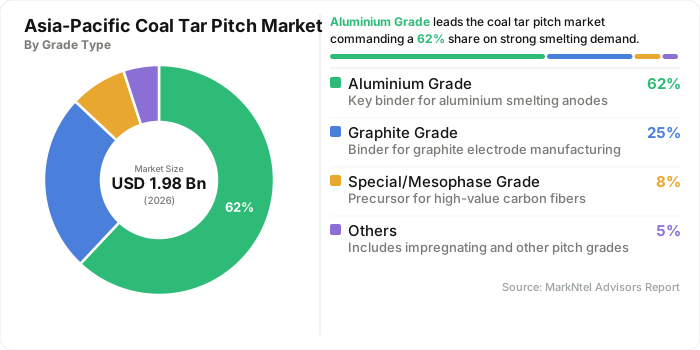
- By grade, the aluminum-grade pitch leads with a 62% share.
- By temperature grade, medium-temperature pitch commands a 60% share.
- China leads with a 35% share, driven by its massive alumina and primary aluminum production base.
- The market is moderately consolidated, with the top five players accounting for approximately 55% of the market.
Asia-Pacific Coal Tar Pitch Market Size and Outlook
The Asia-Pacific coal tar pitch market is expected to expand from USD 1.67 billion in 2025 to USD 1.98 billion in 2026, and is projected to grow to USD 3.22 billion by 2032, registering a CAGR of 8.44% during 2026–2032.
The outlook is supported by the region’s large steel, coke, graphite-electrode, refractory, and aluminum industries, which represent the principal downstream applications and supply linkages for coal tar pitch. China produced 960.8 million tonnes of crude steel in 2025, while India produced 164.9 million tonnes, Japan 80.7 million tonnes and South Korea 62.2 million tonnes, according to the World Steel Association. China and India therefore provide a substantial base for coke, graphite-electrode and refractory consumption, while India’s steel output increased 10.4% in 2025, creating additional industrial demand.
Coke production and coking-coal demand remain important because coal tar, the feedstock for coal tar pitch, is recovered during coke-making. India’s coking-coal imports increased from 57.58 million tonnes in 2024–25 to 66.33 million tonnes in FY2025–26, reflecting continued requirements from its expanding steel industry and supporting coke-making activity. EAF expansion provides another demand channel through graphite electrodes, where pitch is used as a binder. In 2025, EAFs accounted for 57.7% of India's steel production, compared with 10.6% in China, increasing the importance of electrode-based carbon-material consumption.
Aluminum production and industrial CAPEX further broaden demand. China produced 45.02 million tonnes of primary aluminum in 2025, up 2.4% year-on-year, sustaining requirements for pitch-based carbon anodes. In India, NALCO is pursuing a 0.5-MTPA smelter expansion at Angul, while Hindalco is expanding Aditya and evaluating additional Mahan capacity. Indonesia is preparing a 600-KTPA Mempawah aluminum facility, targeting 900 KTPA total capacity by 2029.
Construction, infrastructure investment, mining activity, energy consumption, and urbanization support the market indirectly by increasing steel, aluminum, and manufactured-material requirements. Meanwhile, coal, coking-coal, petroleum-pitch and energy prices, trade flows and steel prices influence production economics and pitch pricing. Environmental regulations and decarbonization investment are also reshaping demand: Australia has introduced a USD 2-billion Green Aluminium Production Credit, encouraging modernization and lower-emission aluminum production. Overall, China provides the largest consumption base, while India, Indonesia and Australia represent important capacity-expansion and modernization opportunities.
Asia-Pacific Coal Tar Pitch Market Key Indicators
- China produced 45.02 million tonnes of electrolytic aluminum in 2025, up 2.4% YoY, while India produced 4.2 million tonnes in FY2024-25. Higher aluminum output directly increases prebaked carbon-anode requirements and coal tar pitch consumption. Over five years, steady Chinese production and expanding Indian output should support pitch demand, particularly across China and South Asia.
- India produced 164.9 million tonnes of crude steel in 2025, up 10.4% YoY, while Asia & Oceania produced 1,324.5 million tonnes. Growing EAF steelmaking increases graphite-electrode requirements, creating additional electrode-grade coal tar pitch demand. Over five years, continued steel capacity expansion should diversify pitch consumption, with India and broader Asia-Pacific benefiting most.
- Global electric-car purchases exceeded 20 million units in 2025, up 20%, while China exceeded 13 million units, around 60% of global sales. Rising EV production supports synthetic graphite anode manufacturing, where coal tar pitch can serve as a carbon coating and precursor. Over five years, battery applications should become an increasingly important demand channel, led by China, Japan, and South Korea.
- India's Ministry of Mines targets a six-fold increase in aluminum production by 2047 and 150 MTPA bauxite capacity. Planned aluminum expansion will require additional smelting capacity, increasing carbon-anode production and associated coal tar pitch consumption. Over five years, capacity additions should strengthen the forward pitch-demand pipeline, making India and South Asia increasingly important markets for regional suppliers.
- India produced 24.7 million tonnes of bauxite in FY2024-25, up 2.9% from 24.0 million tonnes previously. Greater bauxite availability supports alumina production and ultimately primary aluminum output, strengthening the upstream base for carbon-anode requirements. Over five years, continued raw-material growth should support stable pitch consumption, particularly across India and the wider South Asian aluminum supply chain.
Asia-Pacific Coal Tar Pitch Market Scope
| Category | Segments |
|---|---|
| By Temperature grade | Low-Temperature Coal Tar Pitch, Medium-Temperature Coal Tar Pitch, High-Temperature Coal Tar Pitch |
| By Grade | Aluminum Grade, Graphite Grade, Special/Mesophase Grade, Others |
| By Application | Aluminum Smelting, Graphite Electrodes, Refractories, Roofing & Waterproofing, Carbon Fiber & Advanced Carbon Materials, Battery Anode Materials, Carbon Black, Others |
Asia-Pacific Coal Tar Pitch Market Growth Drivers
Growth in Graphite Electrode Manufacturing and EAF Steelmaking
Coal tar pitch is a critical impregnating agent in graphite electrode manufacturing, since impregnation increases electrode density and mechanical strength, properties directly required for the high current loads carried during electric arc furnace (EAF) steelmaking. Tata Steel commissioned India's first scrap-based EAF facility at Hi-Tech Valley, Ludhiana, in March 2026, built at an investment of approximately USD 3.37 billion with an annual capacity of 0.75 million tonnes, creating a new domestic anchor for electrode and pitch consumption.
The scale of this shift is larger in China, where the China Iron and Steel Association reported that the EAF route accounted for only 10.5% of national crude steel output in 2024, still short of the government's 15% target for 2025, leaving a substantial capacity gap that domestic steelmakers must close through new EAF installations over the remainder of the decade.
Coal tar pitch producers with impregnation-grade product lines calibrated to UHP (ultra-high-power) electrode specifications are best positioned to capture demand as EAF capacity additions in India and China proceed to close this policy-mandated shortfall.
Recent Trends
Emergence of Battery-Grade Coal Tar Pitch for Lithium-Ion Anodes
The rapid expansion of lithium-ion battery manufacturing in Asia-Pacific is creating a new, higher-value application for coal tar pitch beyond its traditional use in aluminum anodes, graphite electrodes, and refractories. The opportunity is particularly significant in China, where more than 92% of global anode-material production is concentrated, making the country the region’s principal processing hub for graphite-based battery anodes.
The scale of the battery manufacturing base is already translating into substantial requirements for anode materials. China shipped 1,888.6 GWh of lithium-ion batteries in 2025, up 55.5% year-on-year and accounting for 82.8% of global shipments. This growth was supported by both electric vehicles and energy-storage batteries, meaning the requirement for anode materials—and consequently specialized carbon precursors and coating materials such as coal tar pitch—is expanding alongside cell production.
In China, pitch-based carbon materials can support anode production for electric passenger vehicles, commercial EVs, and battery energy storage systems (BESS). This is particularly relevant as energy storage becomes a faster-growing battery application. The opportunity is also beginning to extend to India, where domestic cell manufacturing is being established. India's ACC PLI program has a USD 1.91 billion outlay for 50 GWh of domestic advanced-cell manufacturing capacity, with 40 GWh already awarded to four companies as of February 2026. Although India's battery ecosystem is still at an earlier stage than China's, increasing domestic cell production creates a future requirement for locally available anode and carbon-material inputs.
Therefore, the trend is strategically important for coal tar pitch producers because APAC battery expansion is creating demand for more specialized, higher-performance pitch grades, while simultaneously broadening the addressable end-use base from aluminum and steel toward EV batteries and BESS. China represents the immediate demand center, while India's emerging cell-manufacturing capacity provides a developing secondary opportunity.
Asia-Pacific Coal Tar Pitch Market Opportunities and Challenges
China’s Coking Capacity Phase-Down Creating Feedstock Consolidation Opportunities for Integrated Coal Tar Pitch Producers
China’s tightening environmental regulations are expected to reshape the regional coal tar pitch feedstock landscape. In January 2025, China introduced new emission standards for the coking industry, replacing the previous 2012 standards and targeting reductions of 50% in particulate matter emissions and 40% in sulfur dioxide emissions. The stricter requirements are expected to accelerate the retirement, upgrading, or consolidation of older and less-efficient coking facilities.
This development is significant for the Asia-Pacific coal tar pitch industry because coal tar is generated as a by-product of coke production and serves as the primary feedstock for coal tar pitch distillation. A reviewed assessment projects that China’s coke demand could decline by 44.2% between 2025 and 2035, implying a potential reduction in the availability of coal-tar feedstock as inefficient coking capacity is phased out. This could particularly affect non-integrated pitch producers that rely on third-party coke producers for coal tar, increasing their exposure to feedstock availability and cost fluctuations.
At the same time, this supply-side restructuring creates an opportunity for producers with secured coal-tar supplies and established distillation capacity. In India, Himadri Speciality Chemical is expanding its coal tar distillation capacity from 500,000 tonnes per annum to 600,000 tonnes per annum, strengthening its ability to process additional feedstock. The company also made its first export shipment of liquid coal tar pitch to the Middle East in November 2025, demonstrating the potential for APAC producers to diversify their customer base as feedstock availability becomes increasingly strategic.
The key opportunity for the market is therefore shifting from simply increasing pitch production to securing the underlying coal-tar feedstock. As China's coking industry consolidates, integrated producers and companies with long-term feedstock arrangements can gain a stronger supply position, while expanded distillation capacity enables them to serve both domestic APAC demand and emerging export markets.
Segmentation Insights
Aluminum-Grade Pitch Captures 62% as Smelter Modernization Sustains Demand
Supported by sustained investment, modernization, and operating continuity across the region’s major primary aluminium smelting bases. In Malaysia, Press Metal Aluminium Holdings operates approximately 1.08 million tonnes per year of smelting capacity across its Bintulu and Mukah facilities, with high utilization supported by the availability of low-cost hydropower in Sarawak. This sustained smelter operation provides a recurring requirement for pitch used in anode production.
In China, the replacement of 580,000 tonnes per year of aluminum smelting capacity by Wanji Holding Group, with construction beginning in 2026 and production targeted for 2027, is shifting demand toward higher-performance aluminum-grade pitch as newer 600-kiloampere electrolytic cells require tighter anode-binder specifications.
Meanwhile, in Australia, Rio Tinto’s USD 790 million commitment through 2038 to maintain operations at the Toma go smelter reduces the risk of capacity closure and supports long-term pitch consumption. Collectively, these developments demonstrate that demand for aluminum-grade pitch is being supported not only by the scale of regional aluminum production but also by smelter modernization, capacity replacement, high utilization, and extended operating lifecycles. As Asian smelters increasingly adopt higher-amperage and more energy-efficient technologies, demand is also moving toward consistently performing, higher-specification pitch, reinforcing aluminum grade as the dominant segment through the forecast period. By grade is further segmented into the following sub-categories:
- Aluminum Grade
- Graphite Grade
- Special/Mesophase Grade
- Others
Medium-Temperature Pitch Commands a 60% Share, Anchored by APAC’s Expanding Carbon-Material Ecosystem
Primarily due to its balanced softening point, viscosity, binding strength, and carbon yield, making it suitable for aluminum anodes, graphite electrodes, and refractory applications. Its leadership is being reinforced as regional industries expand capacity to improve product value, reduce emissions, and meet rising demand for advanced carbon materials.
In Taiwan, CSCC is expanding its Ping nan plant to shift toward higher-value advanced carbon materials and graphite blocks, enabling greater value capture while increasing consumption of pitch as a binder in these products. In Japan, JFE Holdings’ JPY 329.4 billion (~USD 2.2 billion) investment in a 2-million-tonne EAF is aimed at reducing steelmaking emissions by 2.6 million tonnes annually while maintaining large-scale output; greater EAF production increases reliance on graphite electrodes and, consequently, pitch used in electrode manufacturing.
Meanwhile, Rain Industries’ 50,000-tonne-per-year first-phase facility in India, with another 200,000 tonnes planned, is bringing pitch production closer to expanding aluminum, graphite, and battery-material demand, improving supply reliability and reducing logistics dependence. These investments expand pitch-consuming industries while improving localized supply, supporting continued demand for medium-temperature grades across APAC. By temperature grade, the market is further segmented into the following sub-categories:
- Low-Temperature Coal Tar Pitch
- Medium-Temperature Coal Tar Pitch
- High-Temperature Coal Tar Pitch
Asia-Pacific Coal Tar Pitch Market Geographical Analysis
China Commands a 35% Share as Aluminum Dominance and Integrated Feedstock Capacity Reinforce the Market
Supported by its position as the region’s largest primary aluminum producer and the resulting requirement for coal-tar-pitch-based binder material used in prebaked carbon anodes. The country produced approximately 88.3 million tonnes of alumina in 2025, representing more than 60% of global output, creating a large downstream aluminum-smelting base that requires prebaked carbon anodes and, consequently, anode-grade coal tar pitch as a binder. With major smelting capacity concentrated in Shandong, Henan, Shanxi, and Inner Mongolia, the scale and continuous operation of these facilities provide a stable consumption base for pitch.
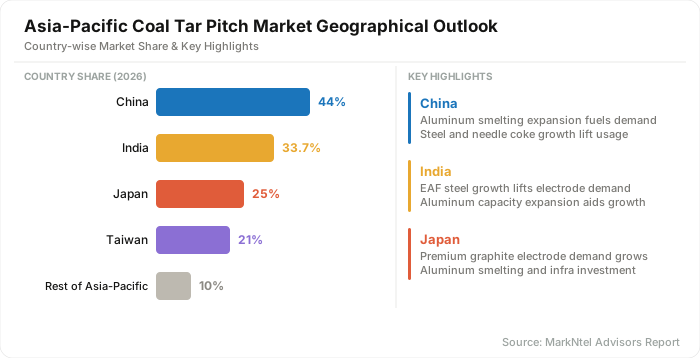
At the upstream level, Liupanshui, Guizhou, is expanding coking capacity to around 15 million tonnes per year, approximately five times its previous production scale, potentially increasing the availability of coal-tar feedstock for domestic pitch processing. This strengthens the local supply chain from coking to coal-tar distillation and pitch production, reducing reliance on externally sourced feedstock and improving supply security for anode manufacturers.
However, with China’s aluminum industry already operating close to its capacity ceiling, substantial incremental pitch demand will increasingly depend on capacity transfers, replacement of older smelters, and approval of new capacity under the 2025–2027 aluminum-sector action plan. Thus, China’s scale across both upstream feedstock generation and downstream aluminum production continues to reinforce its leading position in APAC coal tar pitch demand.
Asia-Pacific Coal Tar Pitch Market Competitive Landscape
The Asia-Pacific coal tar pitch market is moderately consolidated. The top five players—Himadri Speciality Chemical Limited, Epsilon Carbon, JFE Chemical Corporation, Nippon Steel Chemical & Material Co., Ltd., and Mitsubishi Chemical Group Corporation—collectively account for approximately 55% of the Asia-Pacific market share.
Major Players in the Asia-Pacific Coal Tar Pitch Market
- Himadri Speciality Chemical Limited
- Epsilon Carbon
- JFE Chemical Corporation
- Nippon Steel Chemical & Material Co., Ltd.
- Mitsubishi Chemical Group Corporation
- China Steel Chemical Corporation
- Jining Carbon Group Co., Ltd.
- Shanxi Coking Co., Ltd.
- Shandong Weijiao Holding Group Co., Ltd.
- Baowu Carbon Material Technology Co., Ltd.
- POSCO MC Materials
- Shree Shyam Chemicals
Asia-Pacific Coal Tar Pitch Market News and Recent Developments
2025: Alba and Epsilon Carbon Sign MoU for Long-Term Liquid Coal Tar Pitch Supply
Aluminium Bahrain (Alba) and Epsilon Carbon signed a non-binding MoU to explore a long-term liquid coal tar pitch supply arrangement, supporting Epsilon Carbon’s planned USD 20 million coal tar pitch melting facility in Bahrain. The project complements Epsilon’s planned expansion of coal tar distillation capacity to 750,000 tonnes by 2027.
Impact analysis: The collaboration strengthens Alba’s raw-material supply diversification while providing Epsilon with direct access to the Gulf’s large aluminum-smelting base, supporting regionalization of pitch supply and reducing dependence on distant Asian sources.
2025: Himadri Speciality Chemical Commissions New Mangalore Export Terminal
Himadri Speciality Chemical commissioned a new liquid coal tar pitch export terminal at New Mangalore Port and completed its first 3,600-tonne shipment to the Middle East. The facility establishes a second coastal export corridor alongside its Haldia terminal, improving logistics flexibility and access to international aluminum customers.
Impact analysis: The investment enables Himadri to reduce dependence on a single export gateway, shorten shipping routes to Middle Eastern markets, and strengthen supply reliability. This infrastructure expansion also enhances the company’s competitiveness in overseas pitch markets.
- Market Segmentation
- Introduction
- Product Definition
- Research Process
- Assumptions
- Executive Summary
- Asia-Pacific Coal Tar Pitch Market Policies, Regulations, and Product Standards
- Asia-Pacific Coal Tar Pitch Market Trends & Developments
- Asia-Pacific Coal Tar Pitch Market Dynamics
- Growth Factors
- Challenges
- Asia-Pacific Coal Tar Pitch Market Hotspot & Opportunities
- Asia-Pacific Coal Tar Pitch Market Outlook, 2022-2032
- Market Size & Outlook
- By Revenues (USD Million)
- By Quantity Sold (Tons)
- Market Share & Analysis
- By Temperature grade - Market Size & Forecast 2022-2032, USD Million & Tons
- Low-Temperature Coal Tar Pitch
- Medium-Temperature Coal Tar Pitch
- High-Temperature Coal Tar Pitch
- By Grade- Market Size & Forecast 2022-2032, USD Million & Tons
- Aluminum Grade
- Graphite Grade
- Special/Mesophase Grade
- Others
- By Application- Market Size & Forecast 2022-2032, USD Million & Tons
- Aluminum Smelting
- Graphite Electrodes
- Refractories
- Roofing & Waterproofing
- Carbon Fiber & Advanced Carbon Materials
- Battery Anode Materials
- Carbon Black
- Others
- By Region
- China
- Japan
- India
- South Korea
- Australia
- Indonesia
- Thailand
- Vietnam
- New Zealand
- Rest of Asia-Pacific
- By Company
- Competition Characteristics
- Market Share & Analysis
- By Temperature grade - Market Size & Forecast 2022-2032, USD Million & Tons
- Market Size & Outlook
- China Coal Tar Pitch Market Outlook, 2022-2032
- Market Size & Outlook
- By Revenues (USD Million)
- By Quantity Sold (Tons)
- Market Segmentation and Outlook
- By type- Market Size & Forecast 2022-2032, USD Million
- By Grade type- Market Size & Forecast 2022-2032, USD Million
- By application- Market Size & Forecast 2022-2032, USD Million
- Market Size & Outlook
- Japan Coal Tar Pitch Market Outlook, 2022-2032
- Market Size & Outlook
- By Revenues (USD Million)
- By Quantity Sold (Tons)
- Market Segmentation and Outlook
- By type- Market Size & Forecast 2022-2032, USD Million
- By Grade type- Market Size & Forecast 2022-2032, USD Million
- By application- Market Size & Forecast 2022-2032, USD Million
- Market Size & Outlook
- India Coal Tar Pitch Market Outlook, 2022-2032
- Market Size & Outlook
- By Revenues (USD Million)
- By Quantity Sold (Tons)
- Market Segmentation and Outlook
- By type- Market Size & Forecast 2022-2032, USD Million
- By Grade type- Market Size & Forecast 2022-2032, USD Million
- By application- Market Size & Forecast 2022-2032, USD Million
- Market Size & Outlook
- South Korea Coal Tar Pitch Market Outlook, 2022-2032
- Market Size & Outlook
- By Revenues (USD Million)
- By Quantity Sold (Tons)
- Market Segmentation and Outlook
- By type- Market Size & Forecast 2022-2032, USD Million
- By Grade type- Market Size & Forecast 2022-2032, USD Million
- By application- Market Size & Forecast 2022-2032, USD Million
- Market Size & Outlook
- Australia Coal Tar Pitch Market Outlook, 2022-2032
- Market Size & Outlook
- By Revenues (USD Million)
- By Quantity Sold (Tons)
- Market Segmentation and Outlook
- By type- Market Size & Forecast 2022-2032, USD Million
- By Grade type- Market Size & Forecast 2022-2032, USD Million
- By application- Market Size & Forecast 2022-2032, USD Million
- Market Size & Outlook
- Indonesia Coal Tar Pitch Market Outlook, 2022-2032
- Market Size & Outlook
- By Revenues (USD Million)
- By Quantity Sold (Tons)
- Market Segmentation and Outlook
- By type- Market Size & Forecast 2022-2032, USD Million
- By Grade type- Market Size & Forecast 2022-2032, USD Million
- By application- Market Size & Forecast 2022-2032, USD Million
- Market Size & Outlook
- Thailand Coal Tar Pitch Market Outlook, 2022-2032
- Market Size & Outlook
- By Revenues (USD Million)
- By Quantity Sold (Tons)
- Market Segmentation and Outlook
- By type- Market Size & Forecast 2022-2032, USD Million
- By Grade type- Market Size & Forecast 2022-2032, USD Million
- By application- Market Size & Forecast 2022-2032, USD Million
- Market Size & Outlook
- Vietnam Coal Tar Pitch Market Outlook, 2022-2032
- Market Size & Outlook
- By Revenues (USD Million)
- By Quantity Sold (Tons)
- Market Segmentation and Outlook
- By type- Market Size & Forecast 2022-2032, USD Million
- By Grade type- Market Size & Forecast 2022-2032, USD Million
- By application- Market Size & Forecast 2022-2032, USD Million
- Market Size & Outlook
- New Zealand Coal Tar Pitch Market Outlook, 2022-2032
- Market Size & Outlook
- By Revenues (USD Million)
- By Quantity Sold (Tons)
- Market Segmentation and Outlook
- By type- Market Size & Forecast 2022-2032, USD Million
- By Grade type- Market Size & Forecast 2022-2032, USD Million
- By application- Market Size & Forecast 2022-2032, USD Million
- Market Size & Outlook
- Asia-Pacific Coal Tar Pitch Market Key Strategic Imperatives for Success & Growth
- Competitive Outlook
- Company Profiles
- Himadri Speciality Chemical Limited
- Business Description
- Product Portfolio
- Collaborations & Alliances
- Recent Developments
- Financial Details
- Others
- Epsilon Carbon
- Business Description
- Product Portfolio
- Collaborations & Alliances
- Recent Developments
- Financial Details
- Others
- JFE Chemical Corporation
- Business Description
- Product Portfolio
- Collaborations & Alliances
- Recent Developments
- Financial Details
- Others
- Nippon Steel Chemical & Material Co., Ltd.
- Business Description
- Product Portfolio
- Collaborations & Alliances
- Recent Developments
- Financial Details
- Others
- Mitsubishi Chemical Group Corporation
- Business Description
- Product Portfolio
- Collaborations & Alliances
- Recent Developments
- Financial Details
- Others
- China Steel Chemical Corporation
- Business Description
- Product Portfolio
- Collaborations & Alliances
- Recent Developments
- Financial Details
- Others
- Jining Carbon Group Co., Ltd.
- Business Description
- Product Portfolio
- Collaborations & Alliances
- Recent Developments
- Financial Details
- Others
- Shanxi Coking Co., Ltd.
- Business Description
- Product Portfolio
- Collaborations & Alliances
- Recent Developments
- Financial Details
- Others
- Shandong Weijiao Holding Group Co., Ltd.
- Business Description
- Product Portfolio
- Collaborations & Alliances
- Recent Developments
- Financial Details
- Others
- Baowu Carbon Material Technology Co., Ltd.
- Business Description
- Product Portfolio
- Collaborations & Alliances
- Recent Developments
- Financial Details
- Others
- POSCO MC Materials
- Business Description
- Product Portfolio
- Collaborations & Alliances
- Recent Developments
- Financial Details
- Others
- Shree Shyam Chemicals
- Business Description
- Product Portfolio
- Collaborations & Alliances
- Recent Developments
- Financial Details
- Others
- Himadri Speciality Chemical Limited
- Company Profiles
- Disclaimer

MarkNtel Advisors follows a robust and iterative research methodology designed to ensure maximum accuracy and minimize deviation in market estimates and forecasts. Our approach combines both bottom-up and top-down techniques to effectively segment and quantify various aspects of the market. A consistent feature across all our research reports is data triangulation, which examines the market from three distinct perspectives to validate findings. Key components of our research process include:
1. Scope & Research Design At the outset, MarkNtel Advisors define the research objectives and formulate pertinent questions. This phase involves determining the type of research—qualitative or quantitative—and designing a methodology that outlines data collection methods, target demographics, and analytical tools. They also establish timelines and budgets to ensure the research aligns with client goals.
2. Sample Selection and Data Collection In this stage, the firm identifies the target audience and determines the appropriate sample size to ensure representativeness. They employ various sampling methods, such as random or stratified sampling, based on the research objectives. Data collection is carried out using tools like surveys, interviews, and observations, ensuring the gathered data is reliable and relevant.
3. Data Analysis and Validation Once data is collected, MarkNtel Advisors undertake a rigorous analysis process. This includes cleaning the data to remove inconsistencies, employing statistical software for quantitative analysis, and thematic analysis for qualitative data. Validation steps are taken to ensure the accuracy and reliability of the findings, minimizing biases and errors.

4. Data Forecast and FinalizationThe final phase involves forecasting future market trends based on the analyzed data. MarkNtel Advisors utilize predictive modeling and time series analysis to anticipate market behaviors. The insights are then compiled into comprehensive reports, featuring visual aids like charts and graphs, and include strategic recommendations to inform client decision-making
FILL THE FORM TO GET THE FREE SAMPLE PAGES
We offer flexible licensing options to cater to varying organizational needs. Choose the pricing pack that best suits your requirements:
Buy Now Inquire Before Buying
 Talk to our Consultant
 Request Customization