

By Service (Infrastructure as a Service (IaaS), Platform as a Service (PaaS), Software as a Service (SaaS)), By Workload (Application Development & Testing, Data Storage & Backup, Resource Management,... ... Resource Management, Orchestration Services, Analytics & Reporting, Others), By Deployment (Public, Private, Hybrid), By Enterprise Size (Small & Medium Enterprises, Large Enterprises), By End Use (BFSI, IT & Telecom, Retail & Consumer Goods, Manufacturing, Energy & Utilities, Healthcare, Media & Entertainment, Government & Public Sector, Transportation & Logistics, Others), and others Read more
- ICT & Electronics
- Aug 2026
- 140
- PDF, Excel, PPT
Turkey Cloud Computing Market Key Takeaways
- The Turkey cloud computing market size was valued at USD 3.32 billion in 2025 and is projected to grow from USD 3.64 billion in 2026 to USD 5.98 billion by 2032.
- The industry is projected to reflect sustained growth at a steady CAGR of 8.63% during 2026–2032.
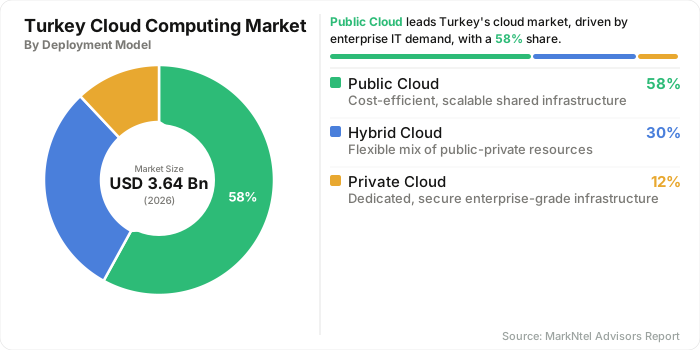
- By deployment model, public cloud holds a significant share of about 58% in 2026.
- By service model, software as a service seized a significant share of about 48% in 2026.
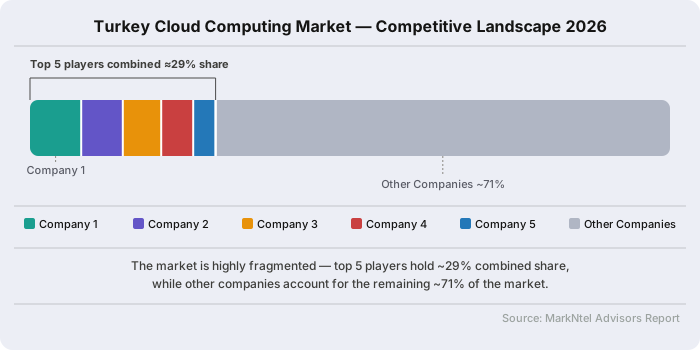
- The industry is highly fragmented. However, the top five players collectively account for nearly 29% of the market share.
Turkey Cloud Computing Market Size and Outlook
The Turkey cloud computing market size was valued at USD 3.32 billion in 2025 and is projected to grow from USD 3.64 billion in 2026 to USD 5.98 billion by 2032. Along with this, the market is estimated to grow at a CAGR of around 8.63% during the forecast period, i.e., 2026–32.
Turkey's cloud computing market is expanding rapidly as enterprises accelerate cloud migration to support AI adoption, digital business operations, and data-intensive applications across banking, manufacturing, retail, healthcare, and the public sector. Government support for digital infrastructure and AI investment is strengthening market growth. In 2025, Turkcell and Google Cloud announced plans to establish Türkiye's first hyperscale Google Cloud region through a multi-year investment, while the government also reaffirmed its ambition to mobilize USD 10 billion in data center and AI investments by 2030.
These developments are expected to enhance cloud infrastructure, strengthen data sovereignty, and create long-term growth opportunities for the Turkey cloud computing market.
Turkey Cloud Computing Market Key Indicators
- Cloud computing has become a standard technology among Turkey's largest organizations, with 54.3% of enterprises employing 250 or more people purchasing paid cloud services in 2025. Higher adoption among large enterprises reflects greater digital maturity, larger IT budgets, and increasing reliance on cloud platforms for ERP, analytics, AI, and cybersecurity applications. Since large enterprises account for a substantial share of enterprise IT spending, this segment continues to drive the country's cloud services market.
- Government support for AI and data center infrastructure is becoming a major growth catalyst. In June 2026, Türkiye announced USD 3 billion in public funding intended to catalyze approximately USD 10 billion in private-sector investment in data centers and AI technologies. The government also plans to increase national data center capacity and establish AI growth zones. These investments should increase demand for cloud computing, high-performance computing, storage, networking, and AI-as-a-service infrastructure.
- Türkiye's software market is expected to reach approximately USD 11.5 billion in 2025, representing nearly 19% year-over-year growth. Cloud-based software adoption is identified as an important contributor to productivity improvements among Turkish businesses. Rapid expansion of SaaS, enterprise applications, AI software and cybersecurity solutions increases the amount of computing, storage and networking infrastructure consumed through cloud platforms, supporting broader cloud-market development.
- Turkey has a substantial connectivity base supporting cloud adoption. Approximately 96.2% of households have broadband access, while 89.5% access the internet through mobile broadband. Türkiye also has approximately 96.4 million mobile broadband subscriptions. This connectivity provides the foundation for cloud-based applications, digital services, SaaS platforms, remote work, streaming, IoT and other data-intensive applications. The forthcoming 5G rollout should further strengthen this infrastructure-driven demand.
- Türkiye's expanding technology ecosystem is another supporting factor. The government reported 114 technoparks, more than 13,000 technology startups and over 1,700 R&D/design centers in 2026. It also plans to train 100,000 AI application professionals and provide AI literacy training to 5 million citizens over two years. A growing technology and AI workforce can accelerate enterprise adoption of cloud-native applications, AI services, analytics and high-performance computing
Turkey Cloud Computing Market Scope
| Category | Segments |
|---|---|
| By Service | Infrastructure as a Service (IaaS), Platform as a Service (PaaS), Software as a Service (SaaS |
| By Workload | Application Development & Testing, Data Storage & Backup, Resource Management, Orchestration Services, Analytics & Reporting, Others |
| By Deployment | Public, Private, Hybrid |
| By Enterprise Size | Small & Medium Enterprises, Large Enterprises |
| By End Use | BFSI, IT & Telecom, Retail & Consumer Goods, Manufacturing, Energy & Utilities, Healthcare, Media & Entertainment, Government & Public Sector, Transportation & Logistics, Others |
Turkey Cloud Computing Market Growth Drivers
Enterprise Cloud Adoption in Turkey Rises from 16.4% in 2023 to 20.4% in 2025, Accelerating Digital Transformation-Driven Market Growth
Enterprise digital transformation has become the strongest demand-side driver of the Turkey cloud computing market, as organizations increasingly migrate critical workloads from on-premise infrastructure to cloud platforms to improve operational agility, scalability, cybersecurity, and cost efficiency. According to the Turkish Statistical Institute (TURKSTAT), the proportion of enterprises purchasing paid cloud computing services increased from 16.4% in 2023 to 20.4% in 2025, representing nearly 24% growth in enterprise cloud adoption over two years.
Adoption is particularly strong among large organizations, where 54.3% of enterprises with 250 or more employees use paid cloud services, compared with 31.8% of medium-sized enterprises, demonstrating that cloud computing is becoming a core component of enterprise IT modernization rather than an emerging technology. Simultaneously, enterprise adoption of digital business applications continues to rise, with 76.5% of large enterprises using ERP software, 42.0% using CRM systems, and 35.1% deploying Business Intelligence platforms in 2025, creating sustained demand for scalable cloud infrastructure capable of supporting integrated business operations.
Growing enterprise demand is also encouraging long-term investment by global cloud providers. In November 2025, Google Cloud and Turkcell announced plans to establish a new Google Cloud Region in Türkiye, backed by a multi-year investment of up to USD 3 billion through 2035, providing domestic access to AI, analytics, cybersecurity, and data services while strengthening local cloud capacity. The project is expected to accelerate migration among regulated industries including banking, manufacturing, healthcare, and the public sector by improving data residency, reducing latency, and expanding enterprise-grade cloud services.
As digital transformation continues to reshape business operations, rising enterprise cloud adoption will remain the primary engine supporting long-term growth of the Turkey cloud computing market.
Recent Trends
Growing Adoption of Sovereign and Locally Hosted Cloud Infrastructure
Sovereign cloud and data localization are gaining importance in Turkey’s cloud computing market as organizations increasingly prioritize domestic data storage, cybersecurity, regulatory compliance, and reduced dependence on foreign infrastructure. This trend is particularly significant for government institutions and organizations handling critical information. Turkey’s data-localization framework also places specific requirements on strategic government workloads and financial-sector information systems, strengthening the need for locally controlled cloud infrastructure.
A recent example is Türksat’s Gölbaşı Data Center, announced in February 2025. The 28,500-square-meter facility is planned to increase Türksat’s existing data-center capacity by more than eight times across its phases. The Turkish Ministry of Transport and Infrastructure stated that the center will provide domestic software-based data and cloud services for institutions holding critical information, including services supporting the e-Government Gateway. The facility is targeted for commissioning in 2027.
This development is complemented by Türksat Cloud, which provides compute, storage, network, Kubernetes, backup and disaster-recovery services from data centers located in Turkey. The platform emphasizes national security standards and 100% KVKK compliance, directly addressing organizations' data-residency and security requirements.
Together, these developments demonstrate Turkey’s movement toward domestically hosted and sovereign cloud infrastructure, creating additional demand for local cloud platforms, data centers and secure cloud services.
Turkey Cloud Computing Market Opportunities and Challenges
Regulatory Compliance Barriers Accelerating Secure Cloud Adoption in Turkey
Turkey’s cloud computing adoption is constrained by regulatory requirements related to data protection, cross-border data transfers, and sector-specific compliance obligations. The Personal Data Protection Law (KVKK No. 6698) requires organizations to implement adequate safeguards when transferring personal data abroad, creating additional evaluation and governance requirements for enterprises using international cloud platforms.
In highly regulated industries such as banking, organizations must also comply with the Banking Regulation and Supervision Agency (BRSA) Regulation on Banks’ Information Systems and Electronic Banking Services, which includes requirements related to information security, risk management, auditability, and third-party IT service providers. These compliance obligations increase migration complexity and may delay cloud adoption for businesses handling sensitive workloads.
Regulatory complexity is creating opportunities for cloud providers to develop solutions aligned with Turkey’s governance requirements. In 2025, Google Cloud strengthened support for Turkish financial institutions by providing BRSA compliance guidance and control mappings for its cloud services, helping banks evaluate cloud workloads against local regulatory expectations. Such compliance frameworks, including security controls, governance tools, and audit support, are reducing migration barriers for regulated enterprises and encouraging wider adoption of hybrid and public cloud solutions in Turkey’s banking and financial services sector.
Segmentation Insights
Public Cloud Dominates with Nearly 58% Share, Driven by Scalable Infrastructure Adoption and Enterprise Digital Transformation
Public cloud holds nearly 58% of the Turkey cloud computing market due to its cost efficiency, scalability, and ability to support large-scale digital transformation across industries. The segment leads as enterprises increasingly prefer cloud-based infrastructure instead of investing in expensive on-premise data centers. A strong example is Turkcell, which has developed extensive cloud and data center capabilities through Turkcell Cloud, providing businesses with scalable virtual data centers, storage, and infrastructure services.
The company operates multiple data centers in Turkey and enables enterprises to reduce infrastructure costs while improving operational flexibility. Similarly, the rapid expansion of digital banking services by institutions such as Türkiye İş Bankası, which offers extensive mobile and internet banking platforms, reflects the growing requirement for scalable and reliable cloud infrastructure to manage high-volume digital transactions. Additionally, increasing adoption of AI, analytics, and SaaS applications among Turkish businesses is further strengthening public cloud demand, making it the leading deployment model in the country. Based on deployment model, the scope has been segmented into
- Public Cloud
- Private Cloud
- Hybrid Cloud
SaaS Captures Nearly 48% Share, Supported by Rising Adoption of Cloud-Based Enterprise Applications in Turkey
Software as a Service (SaaS) leads the market, accounting for approximately 48% share in 2026. The segment dominates due to increasing demand for cloud-based business applications, flexible subscription models, and reduced IT infrastructure requirements among Turkish enterprises. SaaS allows organizations to access enterprise software without purchasing and maintaining costly hardware, making it highly attractive for SMEs and large companies undergoing digital transformation. A strong example is Logo Yazılım, which provides cloud-based ERP and business management solutions that help Turkish companies manage accounting, finance, inventory, and operational processes through SaaS platforms. Logo Yazılım Official Website
Additionally, the adoption of cloud productivity solutions such as Microsoft 365 by enterprises supports SaaS growth by enabling remote collaboration, document management, and secure digital workflows. Microsoft 365 Official Website Furthermore, Turkey’s expanding fintech, e-commerce, and SME ecosystem is increasing demand for scalable software solutions, as SaaS platforms provide continuous updates, faster deployment, and lower maintenance costs compared with traditional software models. These factors have established SaaS as the leading service model. By service model, the market is categorized into
- Infrastructure as a Service (IaaS)
- Platform as a Service (PaaS)
- Software as a Service (SaaS)
Turkey Cloud Computing Market Competitive Analysis
The Turkey cloud computing market is highly fragmented, with the top five companies collectively accounting for approximately 29% of the market by value in 2026. Key participants include Turkcell İletişim Hizmetleri A.Ş., Microsoft Corporation, Amazon Web Services, Inc., Google LLC, and Huawei Technologies Co., Ltd.
Major Companies in Turkey Cloud Computing Industry
- Turkcell İletişim Hizmetleri A.Ş.
- Microsoft Corporation
- Amazon Web Services, Inc.
- Google LLC
- Huawei Technologies Co., Ltd.
- International Business Machines Corporation (IBM)
- Oracle Corporation
- Netaş Telekomünikasyon A.Ş.
- Vodafone Telekomünikasyon A.Ş.
- Intertech Bilgi İşlem ve Pazarlama Ticaret A.Ş.
- Others
Turkey Cloud Computing Industry News and Recent Developments
2026: AWS Launches Istanbul Local Zone to Strengthen Cloud Infrastructure in Türkiye
Amazon Web Services (AWS) launched its Istanbul Local Zone in May 2026, bringing AWS compute, storage, networking, and database capabilities closer to Turkish enterprises. The launch enables lower-latency cloud access, supports local data processing requirements, and helps organizations migrate AI, analytics, and enterprise workloads more efficiently. The new infrastructure also supports services including Amazon EC2, Amazon S3, Amazon EKS, and AWS Direct Connect.
Impact Analysis: The launch of AWS Istanbul Local Zone is expected to accelerate cloud adoption in Türkiye by improving application speed, reducing latency, and enabling localized data processing. It will support industries such as finance, e-commerce, and manufacturing in deploying AI, analytics, and mission-critical workloads more efficiently. The development strengthens AWS’s local presence and encourages enterprises to transition toward cloud-native and hybrid cloud environments.
2026: Turkcell Expands Cloud and Data Center Investments Under Google Cloud Partnership
Turkcell continued expanding its cloud infrastructure capabilities in 2026 following its strategic partnership with Google Cloud. The company is developing Türkiye’s first hyperscale Google Cloud region with a combined investment commitment of approximately USD 3 billion, including Google Cloud’s planned USD 2 billion investment and Turkcell’s USD 1 billion contribution toward digital infrastructure. The initiative aims to enhance AI, cybersecurity, and enterprise cloud adoption in Türkiye
Impact Analysis: Turkcell’s cloud infrastructure expansion is expected to strengthen Türkiye’s digital ecosystem by increasing domestic cloud capacity and improving access to advanced AI, cybersecurity, and data management services. The USD 3 billion investment initiative will support enterprise migration, particularly in regulated sectors requiring data localization. The development will also enhance Türkiye’s position as a regional cloud infrastructure hub and accelerate long-term digital transformation across industries.
- Market Segmentation
- Introduction
- Product Definition
- Research Process
- Assumptions
- Executive Summary
- Turkey Cloud Computing Market Policies, Regulations, and Product Standards
- Turkey Cloud Computing Market Trends & Developments
- Turkey Cloud Computing Market Dynamics
- Growth Factors
- Challenges
- Turkey Cloud Computing Market Hotspot & Opportunities
- Turkey Cloud Computing Market Outlook, 2022-2032F
- Market Size & Outlook
- By Revenues (USD Million)
- Market Segmentation & Outlook
- By Service- Market Size & Forecast 2022-2032, USD Million
- Infrastructure as a Service (IaaS)
- Platform as a Service (PaaS)
- Software as a Service (SaaS)
- By Workload- Market Size & Forecast 2022-2032, USD Million
- Application Development & Testing
- Data Storage & Backup
- Resource Management
- Orchestration Services
- Analytics & Reporting
- Others
- By Deployment- Market Size & Forecast 2022-2032, USD Million
- Public
- Private
- Hybrid
- By Enterprise Size- Market Size & Forecast 2022-2032, USD Million
- Small & Medium Enterprises
- Large Enterprises
- By End Use- Market Size & Forecast 2022-2032, USD Million
- BFSI
- IT & Telecom
- Retail & Consumer Goods
- Manufacturing
- Energy & Utilities
- Healthcare
- Media & Entertainment
- Government & Public Sector
- Transportation & Logistics
- Others
- By Region- Market Size & Forecast 2022-2032, USD Million
- Marmara
- Aegean
- Mediterranean
- Central Anatolia
- Eastern Anatolia
- Southeastern Anatolia
- By Company
- Competition Characteristics
- Market Share & Analysis
- By Service- Market Size & Forecast 2022-2032, USD Million
- Market Size & Outlook
- Turkey Public Cloud Computing Market Outlook, 2022-2032
- Market Size & Outlook
- By Revenues (USD Million)
- Market Segmentation & Outlook
- By Workload- Market Size & Forecast 2022-2032, USD Million
- By Deployment- Market Size & Forecast 2022-2032, USD Million
- By Enterprise Size- Market Size & Forecast 2022-2032, USD Million
- By End Use- Market Size & Forecast 2022-2032, USD Million
- By Region- Market Size & Forecast 2022-2032, USD Million
- Market Size & Outlook
- Turkey Private Cloud Computing Market Outlook, 2022-2032
- Market Size & Outlook
- By Revenues (USD Million)
- Market Segmentation & Outlook
- By Workload- Market Size & Forecast 2022-2032, USD Million
- By Deployment- Market Size & Forecast 2022-2032, USD Million
- By Enterprise Size- Market Size & Forecast 2022-2032, USD Million
- By End Use- Market Size & Forecast 2022-2032, USD Million
- By Region- Market Size & Forecast 2022-2032, USD Million
- Market Size & Outlook
- Turkey Hybrid Cloud Computing Market Outlook, 2022-2032
- Market Size & Outlook
- By Revenues (USD Million)
- Market Segmentation & Outlook
- By Workload- Market Size & Forecast 2022-2032, USD Million
- By Deployment- Market Size & Forecast 2022-2032, USD Million
- By Enterprise Size- Market Size & Forecast 2022-2032, USD Million
- By End Use- Market Size & Forecast 2022-2032, USD Million
- By Region- Market Size & Forecast 2022-2032, USD Million
- Market Size & Outlook
- Turkey Cloud Computing Market Key Strategic Imperatives for Success & Growth
- Competitive Outlook
- Company Profiles
- Turkcell İletişim Hizmetleri A.Ş.
- Business Description
- Product Portfolio
- Collaborations & Alliances
- Recent Developments
- Financial Details
- Others
- Microsoft Corporation
- Business Description
- Product Portfolio
- Collaborations & Alliances
- Recent Developments
- Financial Details
- Others
- Amazon Web Services, Inc.
- Business Description
- Product Portfolio
- Collaborations & Alliances
- Recent Developments
- Financial Details
- Others
- Google LLC
- Business Description
- Product Portfolio
- Collaborations & Alliances
- Recent Developments
- Financial Details
- Others
- Huawei Technologies Co., Ltd.
- Business Description
- Product Portfolio
- Collaborations & Alliances
- Recent Developments
- Financial Details
- Others
- International Business Machines Corporation (IBM)
- Business Description
- Product Portfolio
- Collaborations & Alliances
- Recent Developments
- Financial Details
- Others
- Oracle Corporation
- Business Description
- Product Portfolio
- Collaborations & Alliances
- Recent Developments
- Financial Details
- Others
- Netaş Telekomünikasyon A.Ş.
- Business Description
- Product Portfolio
- Collaborations & Alliances
- Recent Developments
- Financial Details
- Others
- Vodafone Telekomünikasyon A.Ş.
- Business Description
- Product Portfolio
- Collaborations & Alliances
- Recent Developments
- Financial Details
- Others
- Intertech Bilgi İşlem ve Pazarlama Ticaret A.Ş.
- Business Description
- Product Portfolio
- Collaborations & Alliances
- Recent Developments
- Financial Details
- Others
- Turkcell İletişim Hizmetleri A.Ş.
- Company Profiles
- Disclaimer

MarkNtel Advisors follows a robust and iterative research methodology designed to ensure maximum accuracy and minimize deviation in market estimates and forecasts. Our approach combines both bottom-up and top-down techniques to effectively segment and quantify various aspects of the market. A consistent feature across all our research reports is data triangulation, which examines the market from three distinct perspectives to validate findings. Key components of our research process include:
1. Scope & Research Design At the outset, MarkNtel Advisors define the research objectives and formulate pertinent questions. This phase involves determining the type of research—qualitative or quantitative—and designing a methodology that outlines data collection methods, target demographics, and analytical tools. They also establish timelines and budgets to ensure the research aligns with client goals.
2. Sample Selection and Data Collection In this stage, the firm identifies the target audience and determines the appropriate sample size to ensure representativeness. They employ various sampling methods, such as random or stratified sampling, based on the research objectives. Data collection is carried out using tools like surveys, interviews, and observations, ensuring the gathered data is reliable and relevant.
3. Data Analysis and Validation Once data is collected, MarkNtel Advisors undertake a rigorous analysis process. This includes cleaning the data to remove inconsistencies, employing statistical software for quantitative analysis, and thematic analysis for qualitative data. Validation steps are taken to ensure the accuracy and reliability of the findings, minimizing biases and errors.

4. Data Forecast and FinalizationThe final phase involves forecasting future market trends based on the analyzed data. MarkNtel Advisors utilize predictive modeling and time series analysis to anticipate market behaviors. The insights are then compiled into comprehensive reports, featuring visual aids like charts and graphs, and include strategic recommendations to inform client decision-making
We’d love to understand what matters most to you.