

India Data Center Infrastructure Market Research Report: Forecast (2026-2032)
By Infrastructure Type (IT Infrastructure (AI/HPC Accelerators, Storage systems, Networking equipment), Power Infrastructure (Uninterruptible power supply, Power distribution units ... , Switchgear, transformers, and Substations, Backup generators), Cooling Infrastructure (Air cooling systems, Immersion Cooling, Direct-to-Chip (D2C)), Physical Infrastructure (High-Density Racks and Cabinets, Hot/Cold Containment Systems, Structured Cabling and pathways), Intelligent Management and Control (Data Center Infrastructure Management (DCIM), AI-Driven Power, Liquid, and Environmental Monitoring)), By Data Center Type (Enterprise Data Center, Colocation Data Center, Hyperscale Data Center, Edge Data Center), By Tier Standard (Tier I & II, Tier III, Tier IV), By Facility Size (Micro (Below 1 MW), Small to Mid-Enterprise (1 to 5 MW), Retail Colocation/ Large Enterprise (6 to 20 MW), Wholesale Colocation/ Regional Cloud (21 to 50 MW), Mega Hyperscale (Above 50 MW)), By End User Industry (IT and Telecommunications, BFSI, Government and Public Sector, Healthcare and Life Sciences, Retail and E-commerce, Manufacturing and Industrial, Others), and others Read more
- ICT & Electronics
- Jul 2026
- Pages 140
- Report Format: PDF, Excel, PPT
India Data Center Infrastructure Market
Projected 10.3% CAGR from 2026 to 2032
Study Period
2026-2032
Market Size (2026)
USD 33.49 Billion
Market Size (2032)
USD 60.25 Billion
Base Year
2025
Projected CAGR
10.3%
Leading Segments
Based Infrastructure Layer: IT Infrastructure
India Data Center Infrastructure Market Key Takeaways
- India data center infrastructure market size was valued at USD 28.52 billion in 2025 and is projected to grow from USD 33.49 billion in 2026 to USD 60.25 billion by 2032.
- The market is projected to register a CAGR of 10.3% during 2026–2032.
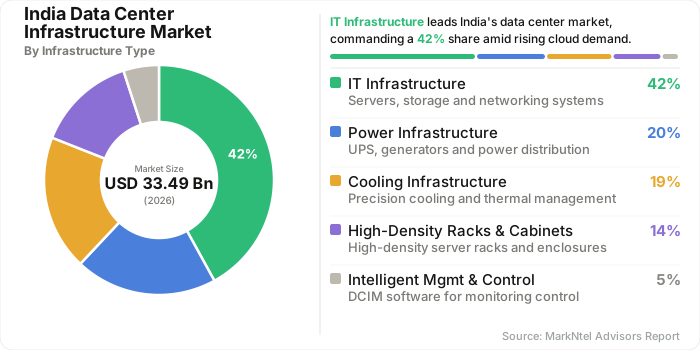
- IT infrastructure represents the most dominant segment with around 42% of total infrastructure spending.
- By end users, IT and telecommunications accounted for 31% of the market size in 2026.
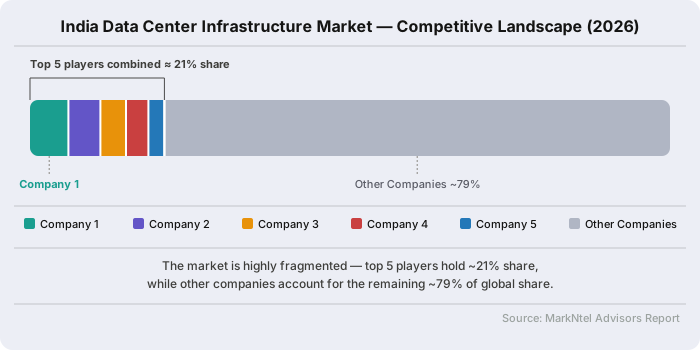
- The industry is moderately fragmented, with the top five players collectively accounting for approximately 21% of the market share in 2026.
India Data Center Infrastructure Market Size and Outlook
The India data center infrastructure market was valued at USD 28.52 billion in 2025 and is estimated at USD 33.49 billion in 2026. The market is projected to reach USD 60.25 billion by 2032, registering a CAGR of around 10.3% during the forecast period, 2026–2032.
The market is expected to witness a structural shift as growth increasingly moves beyond capacity additions toward the development of a more integrated domestic infrastructure ecosystem. Jabil's partnership with Adani Enterprises, in 2026, to establish an AI and data center infrastructure manufacturing platform is expected to strengthen local production of electrical systems, racks, power equipment, and AI infrastructure hardware, supporting supply chain resilience while reducing import dependence. Together with India's operational IT load capacity projected to exceed 4.5 GW by 2030, these developments are expected to accelerate infrastructure investments across new hyperscale and enterprise facilities.
Government initiatives are expected to reinforce long-term infrastructure investments. Under the IndiaAI Mission, backed by an allocation exceeding USD 1.09 billion, more than 34,000 GPUs have been onboarded through empanelled providers, with deployments targeted to approach 100,000 GPUs by the end of 2026. Complementing these initiatives, Uttar Pradesh's Data Center Policy 2026 aims to attract investments exceeding USD 21 billion while enabling more than 2 GW of AI-ready capacity, creating sustained demand for electrical infrastructure, cooling systems, backup power, and associated construction activities.
As AI deployments continue to scale, infrastructure specifications are expected to evolve toward higher-density and more resilient designs. Growing adoption of liquid cooling, enhanced thermal management, advanced fire protection systems, and upgraded electrical infrastructure for GPU-intensive workloads is anticipated to increase infrastructure spending per megawatt across future developments. Supported by the Union Budget FY2026-27, infrastructure status for facilities above 5 MW, and state-level incentives, these developments are expected to sustain long-term investments across India's data center infrastructure industry throughout the forecast period.
India Data Center Infrastructure Market Key Indicators
- India's digital economy contributes approximately 13% of national GDP in 2025 and is expanding at nearly twice the pace of the overall economy, reinforcing long-term demand for digital infrastructure, cloud services, and data processing capacity.
- India's technology industry revenue is projected to reach USD 315 billion in FY26, growing 6.1% year on year, reflecting sustained expansion in enterprise digitalisation, cloud adoption, and technology services that continue to strengthen demand for data center infrastructure.
- India recorded 1,092.79 million internet subscribers and 1,065.88 million broadband connections during January to March 2026, with broadband subscriptions increasing 5.81% quarter on quarter, supporting continued growth in digital traffic and data center workloads.
- India's AI-related technology revenue is estimated at USD 10-12 billion in FY26, indicating a transition from pilot projects to enterprise-scale deployments that are increasing demand for high-performance computing and AI data center infrastructure.
- Microsoft announced USD 17.5 billion to expand its cloud and AI infrastructure in India between 2026 and 2029, reflecting growing hyperscale capacity requirements driven by enterprise cloud and AI adoption rather than short-term infrastructure additions.
India Data Center Infrastructure Market Scope
| Category | Segments |
|---|---|
| By Infrastructure Type | IT Infrastructure (AI/HPC Accelerators, Storage systems, Networking equipment), Power Infrastructure (Uninterruptible power supply, Power distribution units, Switchgear, transformers, and Substations, Backup generators), Cooling Infrastructure (Air cooling systems, Immersion Cooling, Direct-to-Chip (D2C)), Physical Infrastructure (High-Density Racks and Cabinets, Hot/Cold Containment Systems, Structured Cabling and pathways), Intelligent Management and Control (Data Center Infrastructure Management (DCIM), AI-Driven Power, Liquid, and Environmental Monitoring |
| By Data Center Type | Enterprise Data Center, Colocation Data Center, Hyperscale Data Center, Edge Data Center |
| By Tier Standard | Tier I & II, Tier III, Tier IV |
| By Facility Size | Micro (Below 1 MW), Small to Mid-Enterprise (1 to 5 MW), Retail Colocation/ Large Enterprise (6 to 20 MW), Wholesale Colocation/ Regional Cloud (21 to 50 MW), Mega Hyperscale (Above 50 MW |
| By End User Industry | IT and Telecommunications, BFSI, Government and Public Sector, Healthcare and Life Sciences, Retail and E-commerce, Manufacturing and Industrial, Others |
India Data Center Infrastructure Market Growth Drivers
Hyperscaler and AI Infrastructure Investments Accelerating Infrastructure Procurement
Large-scale investments by hyperscale cloud providers, colocation operators, and AI technology companies are accelerating data center construction pipelines across India, creating sustained demand for infrastructure systems. As projects progress from planning to commissioning, developers procure mission-critical IT, electrical, mechanical, cooling, networking, physical security, and infrastructure management solutions, creating long-term opportunities for equipment manufacturers, engineering firms, systems integrators, and infrastructure vendors across the project lifecycle.
Major investment announcements during 2025 and 2026 continue to reinforce this procurement pipeline. Microsoft announced investments of approximately USD 17.5 billion in India's cloud and AI infrastructure between 2026 and 2029, while Google unveiled a USD 15 billion AI Hub in Visakhapatnam. Domestic initiatives, including Reliance's partnership with NVIDIA and Digital Connexion's expansion plans, are further strengthening project execution. Reflecting this momentum, Diamond Power Infrastructure secured a USD 45.2 million order for Hyderabad data center projects, demonstrating that infrastructure investments are increasingly translating into the procurement of electrical systems and power distribution equipment.
Government support is further accelerating the India data center infrastructure market by improving project financing, reducing capital costs, and shortening development timelines. Infrastructure status enables easier access to long-term institutional funding, while FY2026–27 fiscal incentives encourage new investments, faster capacity expansion, and quicker deployment of hyperscale and colocation data center facilities across the country.
Recent Trends
AI-Ready High-Density Infrastructure Architecture Becoming the Standard for New Deployments
The data center infrastructure industry in India is witnessing a transition towards AI-ready infrastructure architectures designed to support increasingly compute-intensive workloads. Rather than adapting conventional facilities, developers are engineering new deployments around high-density rack environments, modular electrical distribution, scalable power systems, and advanced thermal management from the design stage. During 2026, operators increasingly upgraded cooling, fire protection, and electrical infrastructure to support high-density GPU clusters, reinforcing AI readiness as the baseline design standard for new hyperscale and enterprise facilities.
Technology adoption across 2025 and 2026 is accelerating this evolution. NVIDIA's collaborations with Reliance, Tata Communications, Yotta Data Services, and other ecosystem partners are driving wider adoption of standardized AI reference architectures built around HGX systems, DGX SuperPOD designs, Blackwell-ready rack architectures, InfiniBand networking fabrics, and BlueField DPUs. Commercial deployments such as Tata Communications' Vayu AI Cloud and Yotta's AI infrastructure continue to influence procurement of high-performance servers, AI networking, integrated infrastructure platforms, and high-density power systems for accelerated computing.
These reference architectures are simultaneously redefining supporting infrastructure specifications across new data center deployments. Developers are increasingly specifying Blackwell-ready liquid cooling systems, coolant distribution units (CDUs), higher-capacity busway power distribution, intelligent DCIM platforms, digital twin capabilities, and high-density rack configurations to support next-generation GPU clusters. Beyond NVIDIA reference architectures, adoption of high-performance Ethernet fabrics, advanced server platforms, and integrated infrastructure management solutions is further diversifying procurement requirements, making specialised electromechanical infrastructure the benchmark for future AI-ready data center deployments across India.
India Data center Infrastructure Market Challenges and Opportunities
Water Constraints Reshaping Cooling Infrastructure While Expanding Opportunities for Advanced Thermal Management
Rapid deployment of AI-ready data centers is increasing demand for high-capacity cooling infrastructure across India. As facilities support increasingly dense compute environments, cooling systems require greater thermal efficiency while operating within water-stressed regions such as Mumbai, Hyderabad, Chennai, and Bengaluru. This is making the selection and engineering of mechanical infrastructure more complex, particularly for cooling systems, heat rejection equipment, water treatment solutions, and thermal management technologies.
Water conservation requirements are further influencing infrastructure design and equipment selection. Alongside state initiatives promoting wastewater recycling and Zero Liquid Discharge, the Ministry of Jal Shakti introduced groundwater extraction guidelines for data centers during 2026, encouraging more sustainable water management practices. Consequently, developers are increasingly required to integrate water-efficient cooling systems, treatment equipment, and monitoring solutions while balancing thermal performance, infrastructure efficiency, regulatory compliance, and long-term operational resilience.
These evolving requirements are creating significant opportunities for suppliers of advanced cooling infrastructure. Developers are increasingly specifying direct liquid cooling, immersion cooling, closed-loop cooling systems, coolant distribution units (CDUs), rear-door heat exchangers, and high-efficiency heat rejection equipment to support AI-ready facilities while improving water and energy efficiency. This transition is expanding demand for specialised mechanical infrastructure, intelligent cooling controls, and integrated thermal management solutions across new hyperscale, enterprise, and colocation developments.
Technology providers are responding by expanding local AI cooling capabilities to support this shift. During 2026, Schneider Electric commissioned its Motivair liquid cooling manufacturing facility in Bengaluru to strengthen domestic availability of high-density cooling solutions for AI infrastructure. Alongside continued portfolio expansion by Vertiv, Johnson Controls, STULZ, and CoolIT Systems, growing adoption of AI-driven thermal optimisation, intelligent monitoring, and integrated cooling platforms is expected to create sustained opportunities for India data center infrastructure industry vendors as advanced thermal management becomes an increasingly critical component of future data center investments.
Segmentation Insights
IT Infrastructure Dominates Through Rising Compute and AI Hardware Investments
IT Infrastructure dominates the India data center infrastructure market with around 42% share of total infrastructure spending in 2026. The segment maintains its leading position because servers, AI/HPC accelerators, storage systems, and networking equipment form the core of every data center deployment. Growing investments in hyperscale campuses, enterprise cloud infrastructure, and AI-ready facilities are significantly increasing demand for high-performance computing hardware. Continuous expansion of digital services across industries further supports sustained procurement of IT infrastructure components.
Increasing deployment of GPU clusters, high-speed networking fabrics, and enterprise storage platforms is further reinforcing the segment's leadership. Operators are upgrading compute infrastructure to accommodate AI training, inference workloads, cloud applications, and high-volume data processing requirements. Frequent hardware refresh cycles and rising rack densities are also contributing to higher investments in IT equipment compared with other infrastructure layers. These factors are expected to maintain the segment's dominance throughout the forecast period. Based on the infrastructure layer, the market is further bifurcated into:
- IT Infrastructure
- Power Infrastructure
- Cooling Infrastructure
- High-Density Racks and Cabinets
- Intelligent Management and Control
IT and Telecommunications Lead Through Large-Scale Capacity Expansion
IT and Telecommunications account for nearly 31% of the Market in 2026, making them the dominant end-user segment. Their leadership is driven by continuous investments in hyperscale campuses, cloud regions, and AI infrastructure that require substantial deployment of servers, networking equipment, storage systems, cooling technologies, and power infrastructure. Rising enterprise cloud adoption and expanding digital services continue to accelerate infrastructure investments by leading cloud operators.
The rapid rollout of AI-enabled cloud services, sovereign cloud offerings, and high-performance computing capabilities is further strengthening infrastructure demand from hyperscale operators. These companies continue expanding data center capacity to support enterprise digital transformation, generative AI applications, and increasing data consumption across industries. Their long-term infrastructure investment strategies, supported by strong capital expenditure and sustained customer demand, are expected to preserve their market leadership during the forecast period. Based on end-user industry, the market is further bifurcated into:
- IT and Telecommunications
- BFSI
- Government and Public Sector
- Healthcare and Life Sciences
- Retail and E-commerce
- Manufacturing and Others
India Data Center Infrastructure Market Competitive Analysis
The India data center infrastructure market is moderately fragmented, with domestic operators, global data center providers, telecom companies, and digital infrastructure developers competing across colocation, hyperscale, enterprise, and AI-ready infrastructure segments. Major participants include Schneider Electric SE, Vertiv Holdings Co., ABB Ltd., Eaton Corporation plc, and Legrand SA. The top five players collectively account for approximately 21% of the market.
Key Companies in the India Data Center Infrastructure Market
- Schneider Electric SE
- Vertiv Holdings Co
- ABB Ltd.
- Eaton Corporation plc
- Legrand SA
- Cummins Inc.
- Delta Electronics, Inc.
- Siemens AG
- Johnson Controls International plc
- STULZ GmbH
India Data Center Infrastructure Industry News and Recent Developments
2026: Meta and Reliance Industries Partner for 168 MW Built-to-Suit AI Data Center
Meta Platforms entered into a landmark agreement with Reliance Industries Limited on 10 June 2026 to lease an AI-enabled data center in Jamnagar, Gujarat. Representing Meta's first built-to-suit facility in India, Reliance will provide end-to-end services across the asset lifecycle to deliver an initial capacity of 168 MW within two years. To meet high-density compute demands sustainably, the facility will run entirely on renewable energy and utilize desalinated seawater for its cooling systems.
Impact Analysis: The agreement validates the structural shift toward high-density, AI-ready infrastructure engineered from the design phase. By utilizing desalinated seawater, the project establishes a sustainable blueprint for mechanical and thermal management infrastructure, overcoming critical resource and water constraints across regional data center deployments in India.
2025: TCS and TPG Partner to Accelerate AI-Ready Data Center Infrastructure Development
Tata Consultancy Services announced on 20 November 2025 that TPG Rise Climate would invest up to USD 1.03 billion for a minority stake in HyperVault, TCS's AI data center subsidiary, as part of a combined commitment of up to USD 2.1 billion. The partnership will support the development of gigawatt-scale, liquid-cooled AI data center infrastructure across India, strengthening the country's readiness for next-generation AI workloads and high-performance computing applications.
Impact Analysis: The partnership reinforces the growing shift towards AI-optimised data center infrastructure in India. It is expected to accelerate the deployment of high-density computing facilities, encourage greater private investment in AI infrastructure, and strengthen India's position as a regional hub for advanced cloud and AI computing services.
Frequently Asked Questions
- Market Segmentation
- Introduction
- Product Definition
- Research Process
- Assumptions
- Executive Summary
- India Data Center Infrastructure Market Policies, Regulations, and Product Standards
- India Data Center Infrastructure Market Trends & Developments
- India Data Center Infrastructure Market Dynamics
- Growth Factors
- Challenges
- India Data Center Infrastructure Market Hotspot & Opportunities
- India Data Center Infrastructure Market Outlook, 2022-2032
- Market Size & Outlook
- By Revenues (USD Million)
- Market Segmentation & Outlook
- By Infrastructure Type- Market Size & Forecast 2022-2032, USD Million
- IT Infrastructure
- AI/HPC Accelerators
- Storage systems
- Networking equipment
- Power Infrastructure
- Uninterruptible power supply
- Power distribution units
- Switchgear, transformers, and Substations
- Backup generators
- Cooling Infrastructure
- Air cooling systems
- Immersion Cooling
- Direct-to-Chip (D2C)
- Physical Infrastructure
- High-Density Racks and Cabinets
- Hot/Cold Containment Systems
- Structured Cabling and pathways
- Intelligent Management and Control
- Data Center Infrastructure Management (DCIM)
- AI-Driven Power, Liquid, and Environmental Monitoring
- IT Infrastructure
- By Data Center Type- Market Size & Forecast 2022-2032, USD Million
- Enterprise Data Center
- Colocation Data Center
- Hyperscale Data Center
- Edge Data Center
- By Tier Standard- Market Size & Forecast 2022-2032, USD Million
- Tier I & II
- Tier III
- Tier IV
- By Facility Size- Market Size & Forecast 2022-2032, USD Million
- Micro (Below 1 MW)
- Small to Mid-Enterprise (1 to 5 MW)
- Retail Colocation/ Large Enterprise (6 to 20 MW)
- Wholesale Colocation/ Regional Cloud (21 to 50 MW)
- Mega Hyperscale (Above 50 MW)
- By End User Industry- Market Size & Forecast 2022-2032, USD Million
- IT and Telecommunications
- BFSI
- Government and Public Sector
- Healthcare and Life Sciences
- Retail and E-commerce
- Manufacturing and Industrial
- Others
- By Region- Market Size & Forecast 2022-2032, USD Million
- Bengaluru
- Chennai
- Hyderabad
- Mumbai
- NCR (Noida)
- Pune
- Others (Kochi, Vizag, Jaipur, Lucknow)
- By Company
- Competition Characteristics
- Market Share & Analysis
- By Infrastructure Type- Market Size & Forecast 2022-2032, USD Million
- Market Size & Outlook
- India Enterprise Data Center Infrastructure Market Outlook, 2022-2032
- Market Size & Outlook
- By Revenues (USD Million)
- Market Segmentation & Outlook
- By Infrastructure Type- Market Size & Forecast 2022-2032, USD Million
- By Data Center Type- Market Size & Forecast 2022-2032, USD Million
- By Tier Standard- Market Size & Forecast 2022-2032, USD Million
- By Facility Size- Market Size & Forecast 2022-2032, USD Million
- By Rack Density- Market Size & Forecast 2022-2032, USD Million
- By Power Source- Market Size & Forecast 2022-2032, USD Million
- By End User Industry- Market Size & Forecast 2022-2032, USD Million
- By hotspots- Market Size & Forecast 2022-2032, USD Million
- Market Size & Outlook
- India Colocation Data Center Infrastructure Market Outlook, 2022-2032
- Market Size & Outlook
- By Revenues (USD Million)
- Market Segmentation & Outlook
- By Infrastructure Type- Market Size & Forecast 2022-2032, USD Million
- By Data Center Type- Market Size & Forecast 2022-2032, USD Million
- By Tier Standard- Market Size & Forecast 2022-2032, USD Million
- By Facility Size- Market Size & Forecast 2022-2032, USD Million
- By Rack Density- Market Size & Forecast 2022-2032, USD Million
- By Power Source- Market Size & Forecast 2022-2032, USD Million
- By End User Industry- Market Size & Forecast 2022-2032, USD Million
- By hotspots- Market Size & Forecast 2022-2032, USD Million
- Market Size & Outlook
- India Edge Data Center Infrastructure Market Outlook, 2022-2032
- Market Size & Outlook
- By Revenues (USD Million)
- Market Segmentation & Outlook
- By Infrastructure Type- Market Size & Forecast 2022-2032, USD Million
- Data Center Type- Market Size & Forecast 2022-2032, USD Million
- By Tier Standard- Market Size & Forecast 2022-2032, USD Million
- By Facility Size- Market Size & Forecast 2022-2032, USD Million
- By Rack Density- Market Size & Forecast 2022-2032, USD Million
- By Power Source- Market Size & Forecast 2022-2032, USD Million
- By End User Industry- Market Size & Forecast 2022-2032, USD Million
- By hotspots- Market Size & Forecast 2022-2032, USD Million
- Market Size & Outlook
- India Hyperscale Data Center Infrastructure Market Outlook, 2022-2032
- Market Size & Outlook
- By Revenues (USD Million)
- Market Segmentation & Outlook
- By Infrastructure Type- Market Size & Forecast 2022-2032, USD Million
- Data Center Type- Market Size & Forecast 2022-2032, USD Million
- By Tier Standard- Market Size & Forecast 2022-2032, USD Million
- By Facility Size- Market Size & Forecast 2022-2032, USD Million
- By Rack Density- Market Size & Forecast 2022-2032, USD Million
- By Power Source- Market Size & Forecast 2022-2032, USD Million
- By End User Industry- Market Size & Forecast 2022-2032, USD Million
- By hotspots- Market Size & Forecast 2022-2032, USD Million
- Market Size & Outlook
- India Data Center Infrastructure Market Key Strategic Imperatives for Success & Growth
- Competitive Outlook
- Company Profiles
- Schneider Electric SE
- Business Description
- Product Portfolio
- Collaborations & Alliances
- Recent Developments
- Financial Details
- Others
- Vertiv Holdings Co.
- Business Description
- Product Portfolio
- Collaborations & Alliances
- Recent Developments
- Financial Details
- Others
- ABB Ltd.
- Business Description
- Product Portfolio
- Collaborations & Alliances
- Recent Developments
- Financial Details
- Others
- Eaton Corporation plc
- Business Description
- Product Portfolio
- Collaborations & Alliances
- Recent Developments
- Financial Details
- Others
- Legrand SA
- Business Description
- Product Portfolio
- Collaborations & Alliances
- Recent Developments
- Financial Details
- Others
- Cummins Inc.
- Business Description
- Product Portfolio
- Collaborations & Alliances
- Recent Developments
- Financial Details
- Others
- Delta Electronics, Inc.
- Business Description
- Product Portfolio
- Collaborations & Alliances
- Recent Developments
- Financial Details
- Others
- Siemens AG
- Business Description
- Product Portfolio
- Collaborations & Alliances
- Recent Developments
- Financial Details
- Others
- Johnson Controls International plc
- Business Description
- Product Portfolio
- Collaborations & Alliances
- Recent Developments
- Financial Details
- Others
- STULZ GmbH
- Business Description
- Product Portfolio
- Collaborations & Alliances
- Recent Developments
- Financial Details
- Others
- Schneider Electric SE
- Company Profiles
- Disclaimer
MarkNtel Advisors follows a robust and iterative research methodology designed to ensure maximum accuracy and minimize deviation in market estimates and forecasts. Our approach combines both bottom-up and top-down techniques to effectively segment and quantify various aspects of the market. A consistent feature across all our research reports is data triangulation, which examines the market from three distinct perspectives to validate findings. Key components of our research process include:
1. Scope & Research Design At the outset, MarkNtel Advisors define the research objectives and formulate pertinent questions. This phase involves determining the type of research—qualitative or quantitative—and designing a methodology that outlines data collection methods, target demographics, and analytical tools. They also establish timelines and budgets to ensure the research aligns with client goals.
2. Sample Selection and Data Collection In this stage, the firm identifies the target audience and determines the appropriate sample size to ensure representativeness. They employ various sampling methods, such as random or stratified sampling, based on the research objectives. Data collection is carried out using tools like surveys, interviews, and observations, ensuring the gathered data is reliable and relevant.
3. Data Analysis and Validation Once data is collected, MarkNtel Advisors undertake a rigorous analysis process. This includes cleaning the data to remove inconsistencies, employing statistical software for quantitative analysis, and thematic analysis for qualitative data. Validation steps are taken to ensure the accuracy and reliability of the findings, minimizing biases and errors.

4. Data Forecast and FinalizationThe final phase involves forecasting future market trends based on the analyzed data. MarkNtel Advisors utilize predictive modeling and time series analysis to anticipate market behaviors. The insights are then compiled into comprehensive reports, featuring visual aids like charts and graphs, and include strategic recommendations to inform client decision-making
We offer flexible licensing options to cater to varying organizational needs. Choose the pricing pack that best suits your requirements:
Buy Now Inquire Before Buying
 Request Customization
 Talk to our Consultant







