

By Type (Blended Cement, Ordinary Portland Cement (OPC), Others), By End User (Residential, Infrastructure, Commercial, Industrial), and others ... Read more
- Buildings, Construction, Metals & Mining
- Aug 2026
- 245
- PDF, Excel, PPT
Middle East Cement Market Key Takeaways
- The Middle East cement market is projected to rise from USD 12.49 billion in 2025 to USD 14.49 billion in 2026 and USD 19.29 billion by 2032.
- The industry is projected to witness steady growth at a 4.88% CAGR during 2026–2032.
- Ordinary Portland cement (OPC) led the market by type, accounting for approximately 58% of total market share in 2026.
- Infrastructure led the market by end user, accounting for approximately 39% of total market share in 2026.
- Saudi Arabia led the market geographically, accounting for approximately 42% of total market share in 2026.
- The market remained moderately consolidated, with the top five companies collectively accounting for approximately 66% of market share in 2026.
Middle East Cement Market Size and Outlook
The Middle East cement market is projected to rise from USD 12.49 billion in 2025 to USD 14.49 billion in 2026 and USD 19.29 billion by 2032, registering a 4.88% CAGR during 2026–2032. Expansion is supported by continued infrastructure development, urban expansion, industrial diversification, transportation upgrades, and new tourism and logistics facilities across GCC economies. Qatar’s government, for instance, planned 3,303 public tenders across 21 economic sectors for 2025, indicating a broad pipeline of government-led activity beyond individual construction projects. Qatar is also continuing road, drainage, rail, and public-transport infrastructure programs, while the UAE’s 2025 federal budget allocated USD 0.70 billion to infrastructure and economic sectors. These region-wide investments are expected to sustain cement consumption through the forecast period.
Middle East Cement Market Key Indicators
- According to AECOM, the MENA region recorded approximately USD 157 billion in project awards during Q1–Q3 2025, with building construction accounting for USD 30.33 billion and representing around 19% of total awards. The continued award of large-scale building projects across residential, commercial, and mixed-use developments increases demand for concrete foundations, structural elements, roads, and other cement-intensive applications, thereby supporting the growth of the Middle East cement market.
- GCC commercial and residential contract awards, including mixed-use developments, exceeded USD 72.5 billion in 2025, making it the second-highest annual total since 2016. The UAE alone accounted for more than USD 50 billion, or approximately 70%, of these awards, while Saudi Arabia represented around 26%. The sustained development of residential towers, retail centers, offices, and mixed-use communities directly increases requirements for ready-mix concrete and cement, positively influencing regional cement consumption.
- UAE construction output reached a record USD 107.2 billion in 2024 and is projected to reach approximately USD 130.8 billion by 2029, representing an increase of about 22%. Construction also accounted for 62% of the UAE's future project pipeline, ahead of transport at 12%, power at 7%, and water at 5%. The expansion of the construction pipeline creates sustained requirements for cement-intensive structural and civil works, making UAE construction output a significant indicator for Middle East cement demand.
- The UAE has a project pipeline exceeding USD 800 billion across infrastructure, energy, utilities, transport, and mixed-use developments, while the construction market is projected to expand by 3–5% annually through 2028. Such large-scale infrastructure development requires substantial volumes of concrete for foundations, bridges, tunnels, roads, utilities, and commercial structures, directly supporting cement consumption in one of the Middle East's major construction markets.
- Contracts awarded by Saudi Arabia's giga-projects reached approximately USD 196 billion in 2025, representing a 20% increase compared with the previous year. These developments span real estate, infrastructure, and tourism and include large-scale urban districts, transportation systems, hospitality assets, and supporting infrastructure. The execution of these projects requires extensive concrete and cement for foundations, buildings, roads, bridges, utilities, and other civil works, strengthening cement demand in Saudi Arabia and the wider Middle East.
- Saudi Arabia launched more than 108,000 housing units through its off-plan sales program in 2025 and issued sales licenses for more than 97,000 additional units. The expansion of residential supply under Vision 2030 increases requirements for residential buildings, foundations, infrastructure, and associated utilities, all of which are cement-intensive applications. Continued housing development therefore provides a measurable downstream indicator supporting the growth of the Middle East cement industry.
- The Middle East hotel construction pipeline reached a record 710 projects and 176,402 rooms in Q4 2025, increasing 15% in projects and 13% in rooms year-over-year. Of these, 332 projects representing 84,172 rooms were under construction, while another 176 projects with 54,060 rooms were scheduled to begin construction within the following 12 months. Hotel development associated with tourism diversification and mega-projects requires large quantities of cement for hotel structures, resorts, foundations, parking facilities, and supporting infrastructure, thereby creating additional demand for cement.
- The Hafeet Rail project connecting the UAE with Oman secured USD 1.5 billion in project financing, while the UAE's national rail system targets freight capacity of 60 million tonnes annually by 2030. Rail development requires cement-intensive construction of bridges, tunnels, stations, foundations, viaducts, and associated civil infrastructure. Continued investment in cross-border and national railway networks therefore provides a measurable infrastructure indicator for cement demand across the Middle East.
Middle East Cement Import–Export Analysis: 24.5 Million Tons Exported by Türkiye and 10 Million Tons by Egypt in 2025
The Middle East cement market remains structurally export-oriented, supported by large production capacities in Türkiye, Egypt, Saudi Arabia, and the UAE, while import demand is concentrated in markets with construction-led supply gaps. In 2025, Türkiye exported USD 1.40 billion of HS 2523 cement and clinker, up from USD 1.20 billion in 2024, with export volume increasing from 21.0 million tons to 24.5 million tons. Egypt remained another major regional supplier, recording USD 837.3 million in exports and approximately 10 million tons of shipments in 2025. Saudi Arabia also strengthened its export position, with export value rising from USD 271.2 million in 2024 to USD 314.4 million in 2025, while volume increased from 6.6 million to 7.9 million tons. Collectively, Türkiye, Egypt, and Saudi Arabia accounted for nearly USD 2.55 billion of global cement and clinker exports in 2025.
On the import side, Israel imported approximately USD 408 million of cement and clinker in 2025, indicating sustained dependence on external supply. Intra-regional trade is also evident in specialty products: Saudi Arabia imported 75.1 million kg of white Portland cement worth USD 6.65 million in 2024, with the UAE supplying USD 4.01 million and Egypt USD 2.52 million.
Overall, strong export capacity and short-haul maritime connectivity position Middle Eastern producers as important suppliers to Africa, Europe, and neighboring markets, while infrastructure and construction activity continue to sustain selective import demand.
Middle East Cement Market Scope
| Category | Segments |
|---|---|
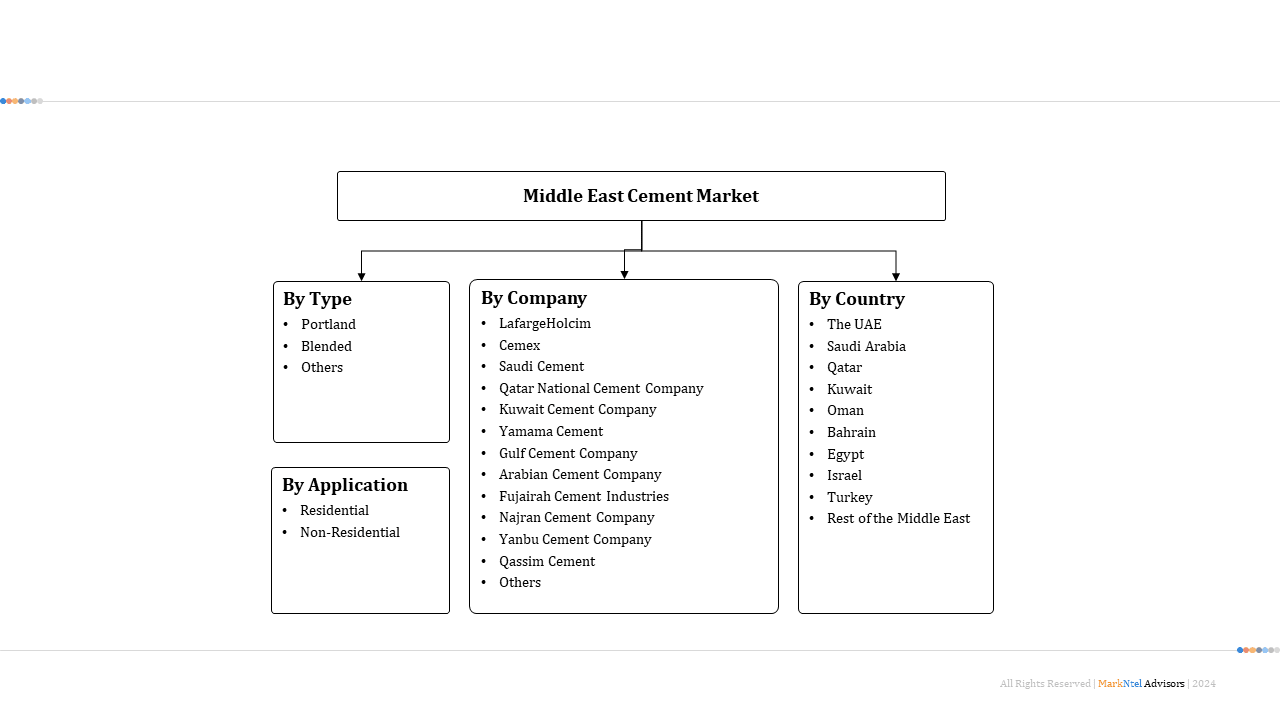
| By Type | Blended Cement, Ordinary Portland Cement (OPC), Others |
| By End User | Residential, Infrastructure, Commercial, Industrial |
Middle East Cement Market Growth Drivers
Government-Led Mega Infrastructure Projects Fuel Cement Demand Across the Middle East
Government investments in large-scale infrastructure and urban development projects are serving as the primary growth driver for the Middle East cement market. Countries across the region, particularly Saudi Arabia and the UAE, are significantly expanding investments in smart cities, transportation networks, industrial zones, tourism destinations, airports, ports, and affordable housing to diversify their economies beyond hydrocarbons. These developments are driving sustained demand for cement across residential, commercial, and infrastructure applications. Additionally, long-term national development programs such as Saudi Vision 2030, UAE We the UAE 2031, and other regional economic diversification strategies continue to create a strong pipeline of construction projects, supporting stable cement consumption over the forecast period.
A notable example is Saudi Arabia's NEOM, where the Board of Directors approved the Bayn project in June 2026, introducing a mixed-use urban community spanning approximately 1.7 million square metres and designed to accommodate more than 30,000 residents. The project will include residential neighborhoods, commercial districts, educational institutions, healthcare facilities, mosques, and extensive public spaces. Along with ongoing developments such as The Line, Oxagon, Trojena, and the Red Sea Project, these large-scale investments are expected to generate substantial demand for cement and other construction materials, reinforcing Saudi Arabia's position as the largest contributor to the Middle East cement market.
- Market Segmentation
- Introduction
- Product Definition
- Research Process
- Assumptions
- Executive Summary
- Middle East Cement Production (Thousand Ton) Trend 2022-2032
- Middle East Cement Production (Thousand Ton) Trend by Type of cement
- Blended Cement
- Portland Slag Cement (PSC)
- Portland Pozzolana Cement (PPC)
- Portland Composite Cement (PCC)
- Ordinary Portland Cement (OPC)
- Others
- Company Wise Production Plants and Statistics
- Installed Production Capacity
- Actual Production
- Planned Production Target
- Middle East Cement Production (Thousand Ton) Trend by Type of cement
- Middle East Cement Pricing Analysis 2022-2032
- Middle East Cement Pricing Trend (USD/Tons) 2022-2032
- Middle East Cement Pricing Trend (USD/Tons) By Country 2022-2032
- The UAE
- Saudi Arabia
- Qatar
- Kuwait
- Oman
- Bahrain
- Egypt
- Israel
- Turkey
- Rest of the Middle East
- Middle East Cement Pricing Trend (USD/Tons) By Cement 2022-2032
- Blended Cement
- Portland Slag Cement (PSC)
- Portland Pozzolana Cement (PPC)
- Portland Composite Cement (PCC)
- Ordinary Portland Cement (OPC)
- Others
- Middle East Cement Market Supply Chain Analysis
- Middle East Cement Market Import & Export Analysis
- Middle East Cement Market Policies, Regulations, and Product Standards
- Middle East Cement Market Trends & Developments
- Middle East Cement Market Dynamics
- Growth Factors
- Challenges
- Middle East Cement Market Hotspot & Opportunities
- Middle East Cement Market Outlook, 2022-2032
- Market Size & Outlook
- By Revenues (USD Million)
- By Quantity Sold (Thousand Tons)
- Market Segmentation & Outlook
- By Type- Market Size & Forecast 2022-2032, USD Million & Thousand Tons
- Blended Cement
- Portland Slag Cement (PSC)
- Portland Pozzolana Cement (PPC)
- Portland Composite Cement (PCC)
- Ordinary Portland Cement (OPC)
- Others
- Blended Cement
- By End User- Market Size & Forecast 2022-2032, USD Million & Thousand Tons
- Residential
- Infrastructure
- Commercial
- Industrial
- By Country
- The UAE
- Saudi Arabia
- Qatar
- Kuwait
- Oman
- Bahrain
- Egypt
- Israel
- Turkey
- Rest of the Middle East
- By Company
- Competition Characteristics
- Market Share & Analysis
- By Type- Market Size & Forecast 2022-2032, USD Million & Thousand Tons
- Market Size & Outlook
- The UAE Cement Market Outlook, 2022-2032
- Market Size & Outlook
- By Revenues (USD Million)
- By Quantity Sold (Thousand Tons)
- Market Segmentation & Outlook
- By Type- Market Size & Forecast 2022-2032, USD Million & Thousand Tons
- By End User- Market Size & Forecast 2022-2032, USD Million & Thousand Tons
- Market Size & Outlook
- Saudi Arabia Cement Market Outlook, 2022-2032
- Market Size & Outlook
- By Revenues (USD Million)
- By Quantity Sold (Thousand Tons)
- Market Segmentation & Outlook
- By Type- Market Size & Forecast 2022-2032, USD Million & Thousand Tons
- By End User- Market Size & Forecast 2022-2032, USD Million & Thousand Tons
- Market Size & Outlook
- Qatar Cement Market Outlook, 2022-2032
- Market Size & Outlook
- By Revenues (USD Million)
- By Quantity Sold (Thousand Tons)
- Market Segmentation & Outlook
- By Type- Market Size & Forecast 2022-2032, USD Million & Thousand Tons
- By End User- Market Size & Forecast 2022-2032, USD Million & Thousand Tons
- Market Size & Outlook
- Kuwait Cement Market Outlook, 2022-2032
- Market Size & Outlook
- By Revenues (USD Million)
- By Quantity Sold (Thousand Tons)
- Market Segmentation & Outlook
- By Type- Market Size & Forecast 2022-2032, USD Million & Thousand Tons
- By End User- Market Size & Forecast 2022-2032, USD Million & Thousand Tons
- Market Size & Outlook
- Oman Cement Market Outlook, 2022-2032
- Market Size & Outlook
- By Revenues (USD Million)
- By Quantity Sold (Thousand Tons)
- Market Segmentation & Outlook
- By Type- Market Size & Forecast 2022-2032, USD Million & Thousand Tons
- By End User- Market Size & Forecast 2022-2032, USD Million & Thousand Tons
- Market Size & Outlook
- Bahrain Cement Market Outlook, 2022-2032
- Market Size & Outlook
- By Revenues (USD Million)
- By Quantity Sold (Thousand Tons)
- Market Segmentation & Outlook
- By Type- Market Size & Forecast 2022-2032, USD Million & Thousand Tons
- By End User- Market Size & Forecast 2022-2032, USD Million & Thousand Tons
- Market Size & Outlook
- Egypt Cement Market Outlook, 2022-2032
- Market Size & Outlook
- By Revenues (USD Million)
- By Quantity Sold (Thousand Tons)
- Market Segmentation & Outlook
- By Type- Market Size & Forecast 2022-2032, USD Million & Thousand Tons
- By End User- Market Size & Forecast 2022-2032, USD Million & Thousand Tons
- Market Size & Outlook
- Israel Cement Market Outlook, 2022-2032
- Market Size & Outlook
- By Revenues (USD Million)
- By Quantity Sold (Thousand Tons)
- Market Segmentation & Outlook
- By Type- Market Size & Forecast 2022-2032, USD Million & Thousand Tons
- By End User- Market Size & Forecast 2022-2032, USD Million & Thousand Tons
- Market Size & Outlook
- Turkey Cement Market Outlook, 2022-2032
- Market Size & Outlook
- By Revenues (USD Million)
- By Quantity Sold (Thousand Tons)
- Market Segmentation & Outlook
- By Type- Market Size & Forecast 2022-2032, USD Million & Thousand Tons
- By End User- Market Size & Forecast 2022-2032, USD Million & Thousand Tons
- Market Size & Outlook
- Middle East Cement Market Key Strategic Imperatives for Success & Growth
- Competitive Outlook
- Company Profiles
- Yamama Cement
- Business Description
- Product Portfolio
- Collaborations & Alliances
- Recent Developments
- Financial Details
- Others
- Saudi Cement
- Business Description
- Product Portfolio
- Collaborations & Alliances
- Recent Developments
- Financial Details
- Others
- Qassim Cement
- Business Description
- Product Portfolio
- Collaborations & Alliances
- Recent Developments
- Financial Details
- Others
- Southern Province Cement
- Business Description
- Product Portfolio
- Collaborations & Alliances
- Recent Developments
- Financial Details
- Others
- Yanbu Cement
- Business Description
- Product Portfolio
- Collaborations & Alliances
- Recent Developments
- Financial Details
- Others
- Arabian Cement
- Business Description
- Product Portfolio
- Collaborations & Alliances
- Recent Developments
- Financial Details
- Others
- Eastern Province Cement
- Business Description
- Product Portfolio
- Collaborations & Alliances
- Recent Developments
- Financial Details
- Others
- Riyadh Cement
- Business Description
- Product Portfolio
- Collaborations & Alliances
- Recent Developments
- Financial Details
- Others
- Najran Cement
- Business Description
- Product Portfolio
- Collaborations & Alliances
- Recent Developments
- Financial Details
- Others
- City Cement
- Business Description
- Product Portfolio
- Collaborations & Alliances
- Recent Developments
- Financial Details
- Others
- Qatar National Cement
- Business Description
- Product Portfolio
- Collaborations & Alliances
- Recent Developments
- Financial Details
- Others
- Holcim
- Business Description
- Product Portfolio
- Collaborations & Alliances
- Recent Developments
- Financial Details
- Others
- CEMEX
- Business Description
- Product Portfolio
- Collaborations & Alliances
- Recent Developments
- Financial Details
- Others
- Raysut Cement
- Business Description
- Product Portfolio
- Collaborations & Alliances
- Recent Developments
- Financial Details
- Others
- Gulf Cement
- Business Description
- Product Portfolio
- Collaborations & Alliances
- Recent Developments
- Financial Details
- Others
- Others
- Yamama Cement
- Company Profiles
- Disclaimer
MarkNtel Advisors follows a robust and iterative research methodology designed to ensure maximum accuracy and minimize deviation in market estimates and forecasts. Our approach combines both bottom-up and top-down techniques to effectively segment and quantify various aspects of the market. A consistent feature across all our research reports is data triangulation, which examines the market from three distinct perspectives to validate findings. Key components of our research process include:
1. Scope & Research Design At the outset, MarkNtel Advisors define the research objectives and formulate pertinent questions. This phase involves determining the type of research—qualitative or quantitative—and designing a methodology that outlines data collection methods, target demographics, and analytical tools. They also establish timelines and budgets to ensure the research aligns with client goals.
2. Sample Selection and Data Collection In this stage, the firm identifies the target audience and determines the appropriate sample size to ensure representativeness. They employ various sampling methods, such as random or stratified sampling, based on the research objectives. Data collection is carried out using tools like surveys, interviews, and observations, ensuring the gathered data is reliable and relevant.
3. Data Analysis and Validation Once data is collected, MarkNtel Advisors undertake a rigorous analysis process. This includes cleaning the data to remove inconsistencies, employing statistical software for quantitative analysis, and thematic analysis for qualitative data. Validation steps are taken to ensure the accuracy and reliability of the findings, minimizing biases and errors.

4. Data Forecast and FinalizationThe final phase involves forecasting future market trends based on the analyzed data. MarkNtel Advisors utilize predictive modeling and time series analysis to anticipate market behaviors. The insights are then compiled into comprehensive reports, featuring visual aids like charts and graphs, and include strategic recommendations to inform client decision-making
We’d love to understand what matters most to you.